
Andrews
Description
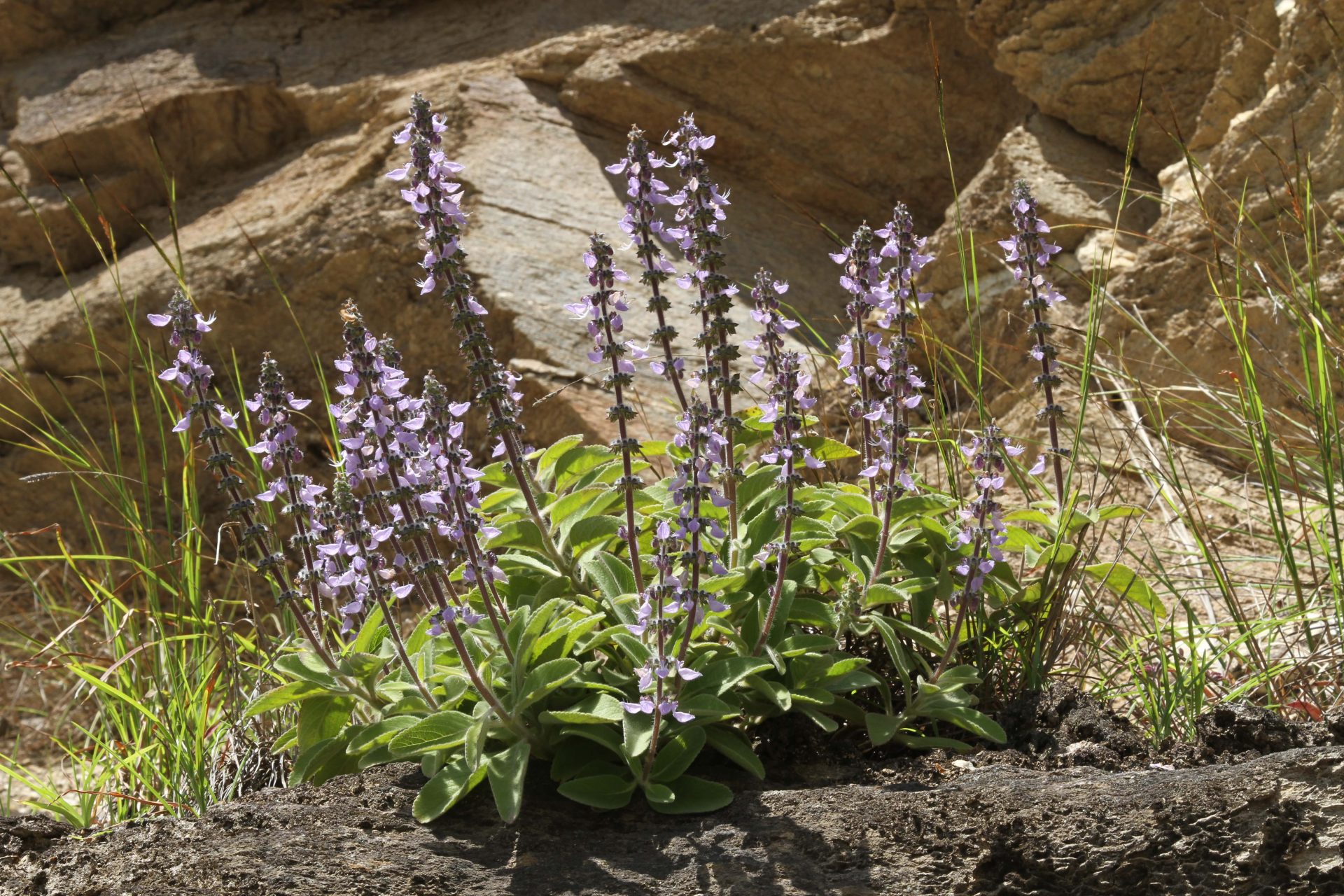
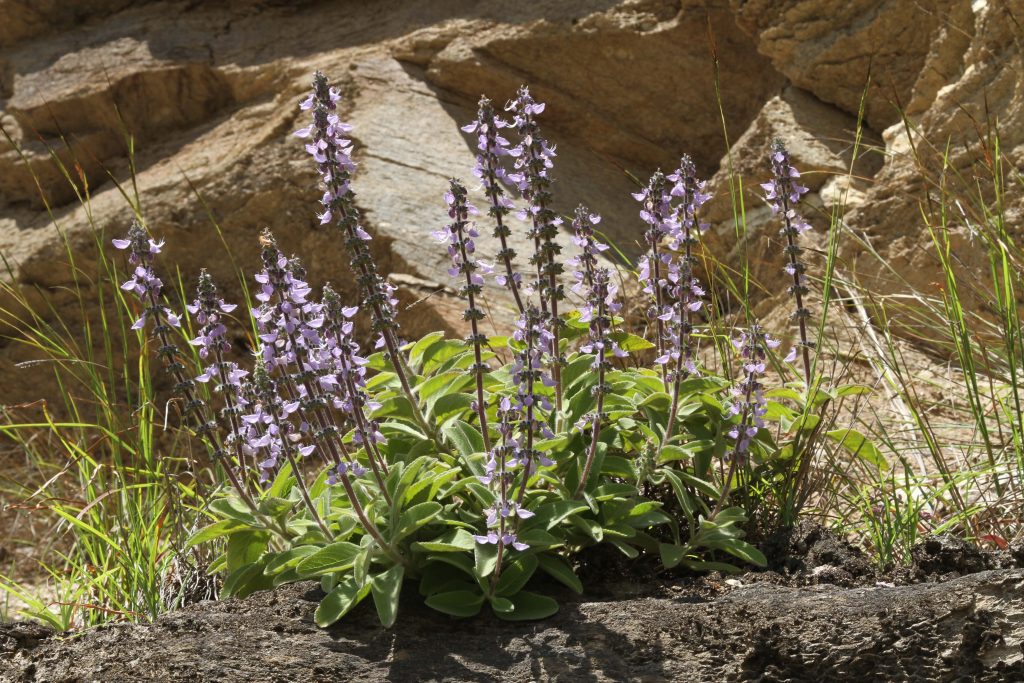
Plectranthus barbatus Andrews is an aromatic perennial herb or subshrub with a broad palaeotropical distribution, recorded from tropical and southern Africa (Ethiopia, Kenya, Tanzania, South Africa) and the Arabian Peninsula through to the Indian subcontinent, Nepal, Bhutan and Sri Lanka, where it is both native and widely cultivated and naturalised. In the Himalaya it grows on warm, dry, rocky banks, terrace margins, scrub and open hill slopes, often near villages. The photographed plant from Wangdi (Wangdue Phodrang) in Bhutan at 2600 m, flowering in September at the close of the monsoon, illustrates its tolerance of sunny, well-drained sites in the lower-temperate zone. GBIF treats the listed name as a synonym, with Plectranthus barbatus the accepted name.
The plant forms an erect, branching, softly woody-based herb with quadrangular, finely pubescent stems. The opposite leaves are broadly ovate, crenate-margined, somewhat fleshy and strongly aromatic, narrowing to a winged petiole and densely glandular and hairy. The flowers are borne in whorls along elongate, terminal racemose inflorescences; the bilabiate corolla is blue to violet-blue, with a short upper lip and a deflexed, boat-shaped lower lip enclosing the four didynamous stamens. As in other Lamiaceae the fruit comprises four smooth nutlets seated in the persistent calyx.
Long cultivated for medicine and as a hedge plant, P. barbatus (often called Coleus forskohlii in pharmacological literature) is the principal source of the diterpenoid forskolin, which has driven extensive cultivation across India and Africa. Its taxonomy is complicated by this synonymy and by horticultural movement blurring native and introduced ranges. The species is not of conservation concern, being weedy, easily propagated and widely naturalised.
Author: Andrews · Sources: POWO (Kew), GBIF, Flora of Bhutan, Flora of Tropical East Africa (Lamiaceae), Plectranthus and Allied Genera (Lukhoba, Simmonds & Paton)