
(D.C.) Rehder & E.H. Wilson
Description
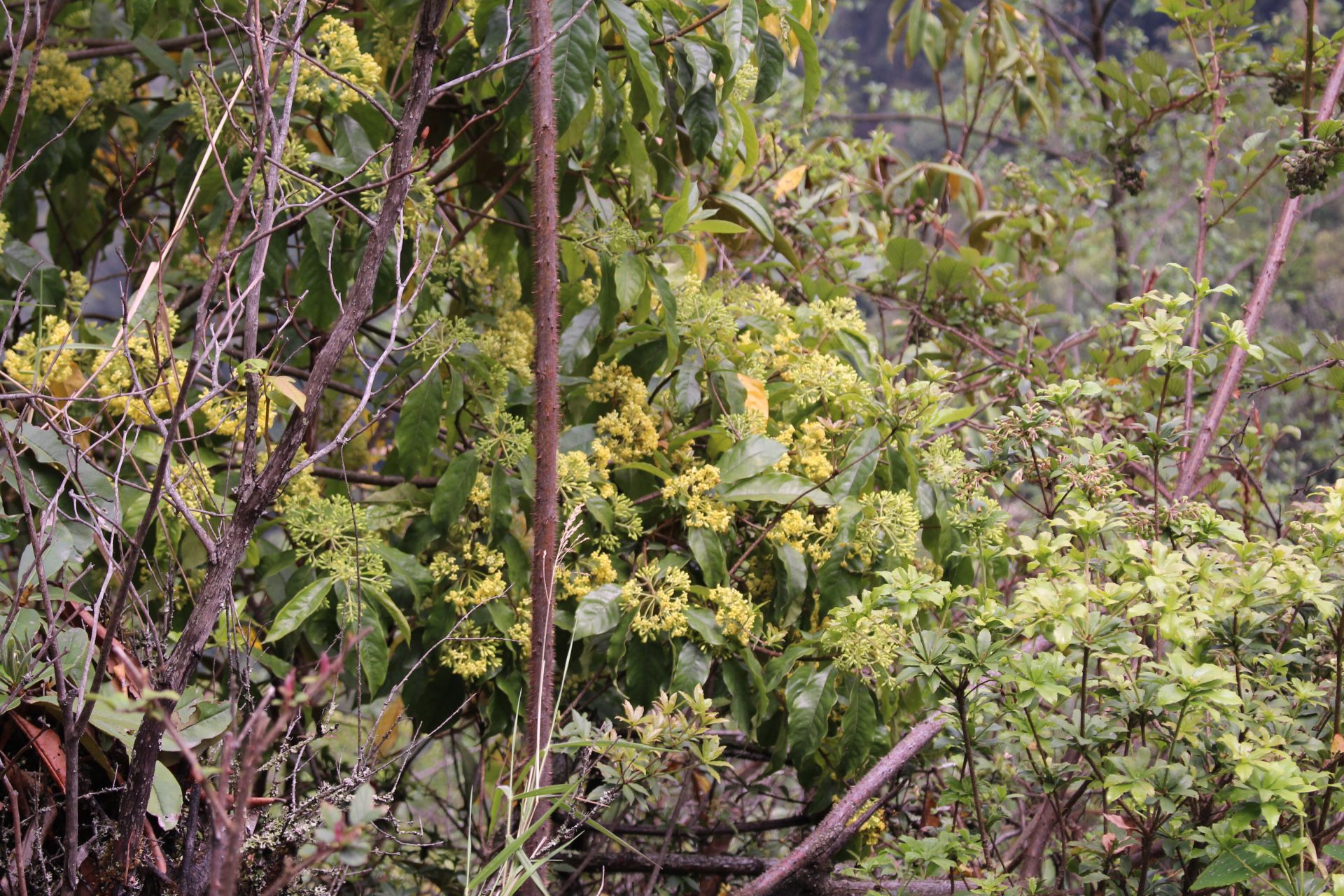
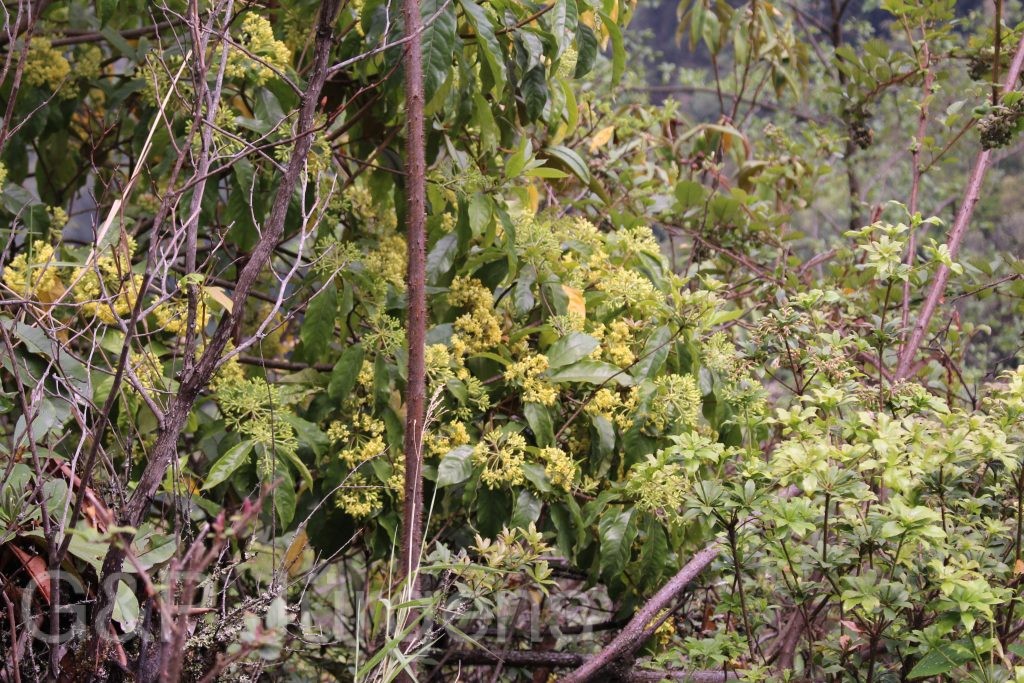
Pittosporum napaulense is an evergreen tree of the Himalaya and adjacent uplands, distributed from northern India and Nepal through Bhutan into southwestern China and Myanmar, with records also from Thailand; GBIF documents over two hundred occurrences across this range. It is a plant of subtropical to warm-temperate broadleaved forest, forest margins and ravine slopes, generally found between about 800 and 2000 m. The tree photographed at Samdrup in southern Bhutan at 850 m, in flower in May, exemplifies this preference for the warm, humid lower foothill forests of the eastern Himalaya, where it grows as an understorey to canopy tree and produces its fragrant flowers in late spring before the onset of the heaviest monsoon rains.
The plant is a small to medium-sized tree with smooth grey bark and glabrous twigs. The leaves are alternate but often crowded toward the branch tips in a pseudo-whorled arrangement, elliptic to oblong-lanceolate, leathery, entire and glossy, with the margins sometimes faintly wavy. The flowers are borne in terminal corymbose panicles and are creamy white to pale yellow and sweetly fragrant; each flower is five-merous, with free petals whose lower portions cohere into a tube and spreading upper lobes, five stamens, and a superior ovary. The fruit is a globose to ovoid woody capsule that splits into valves to expose numerous small seeds embedded in a sticky, resinous orange-red pulp, the viscid coating that gives the genus its name (Pittosporum, "pitch-seed") and aids dispersal by birds.
Pittosporum is a largely Old World genus of trees and shrubs centred on the tropics and subtropics of Asia, Australasia and the Pacific, and P. napaulense is the principal Himalayan representative. The family name is rendered "Pittosporaceaea" in the source; the accepted spelling is Pittosporaceae. The resinous, sticky-seeded capsules are a hallmark of the family, and the bark and leaves of this and related species have featured in local traditional medicine. As a widespread and ecologically adaptable forest tree spanning several countries and a broad elevational band, P. napaulense is not considered threatened, though its lower-elevation forest habitat is subject to ongoing pressure from agriculture and settlement in the densely populated eastern Himalayan foothills.
Author: (D.C.) Rehder & E.H. Wilson · Sources: POWO (Kew), GBIF, Flora of China Vol. 9, Flora of Bhutan Vol. 1 Part 2, Flora of Nepal, A Monograph of the Asian species of Pittosporum (Wenbin Zhang and Hua Peng)