Tag:

Myanmar

Flowers of the Myanmar Himalaya — 604 species recorded from northern Myanmar (Burma) and the eastern Himalayan borderlands, a biodiversity hotspot linking the Himalaya to the mountains of Yunnan and Southeast Asia. The region’s forests and alpine slopes hold a rich flora of rhododendrons, orchids, balsams and gentians. Every page gives a botanical description, distribution, habitat and flowering time with the original photograph.

(D.Don) Hutch.

Bhutan2012 477
Bhutan Pele-La 3300m, June

Description

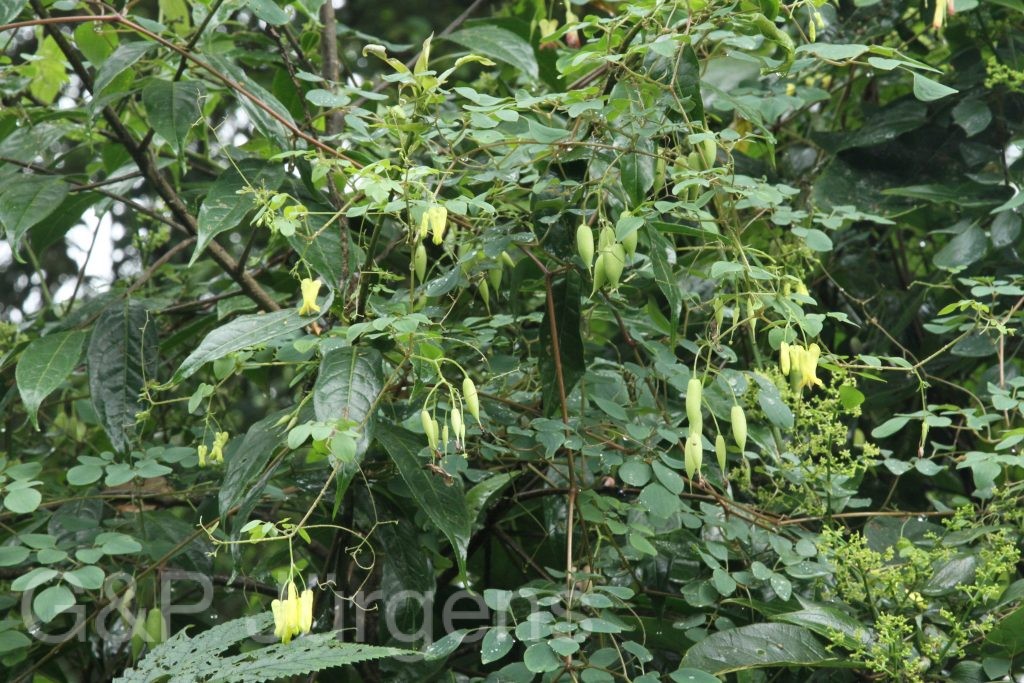
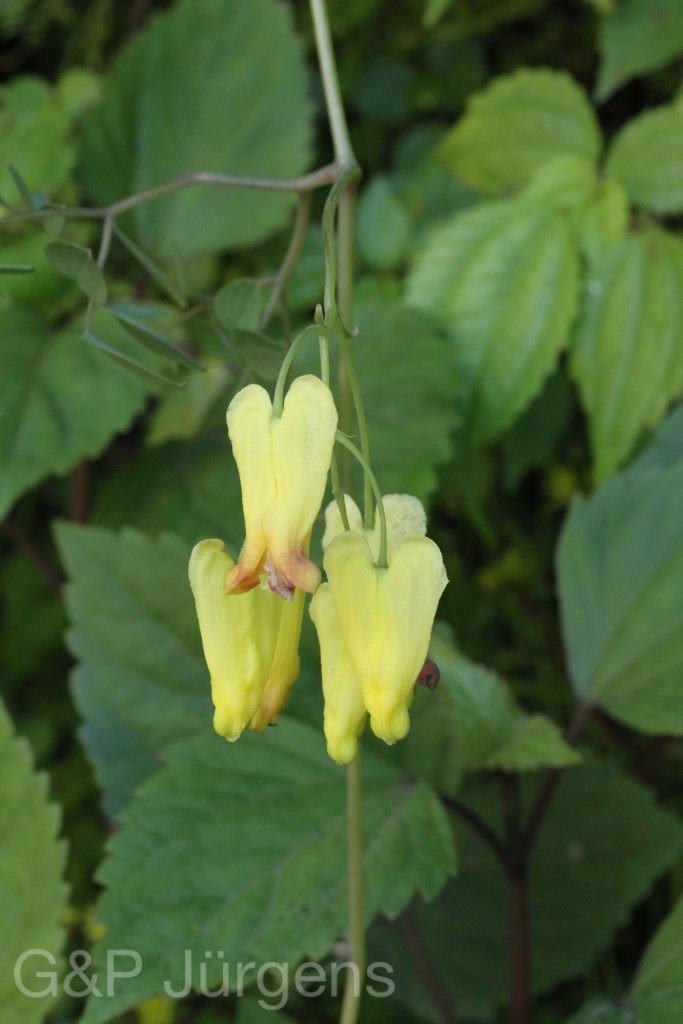
Dactylicapnos scandens is a climbing fumitory of the Himalaya and adjacent China and Indochina, native across China, India, Nepal, Bhutan, Myanmar, Vietnam, Thailand and Sri Lanka; its more than 300 GBIF records include numerous cultivated and naturalised occurrences in Europe, North America and New Zealand, reflecting its popularity as an ornamental climber. It grows in moist temperate forest, thickets and shrubby clearings, scrambling over other vegetation, mostly between about 1500 and 3300 m. The plant shown from Pele-La in Bhutan at 3300 m, flowering in June, sits at the upper edge of this range in cool broadleaved and conifer forest.

It is a herbaceous to suffrutescent perennial climber with slender, much-branched stems clinging by means of branched, tendril-like leaflet tips. The leaves are alternate, two- to three-pinnately compound and glaucous, the ultimate segments small and ovate, the terminal portions modified into coiling tendrils. The flowers hang in pendulous racemes and are zygomorphic with two bilaterally symmetrical, spurred or saccate outer petals enclosing two inner petals, the whole corolla bright golden-yellow. The fruit is an elongate, several-seeded capsule that dehisces to release shining black seeds, each bearing an elaiosome.

Dactylicapnos was separated from Dicentra and Corydalis on the basis of its climbing habit, tendrillate leaves and capsular fruit. D. scandens, based on D. Don's Fumaria scandens and transferred by Hutchinson, is widespread and not threatened, and its toxic isoquinoline alkaloids have attracted pharmacological interest in traditional medicine.

Author: (D.Don) Hutch. · Sources: POWO (Kew), GBIF, Flora of Bhutan, Flora of China, Lidén & Fukuhara revision of Dactylicapnos
(D.Don) Hutch.

Bhutan2012 1316
Bhutan2012 1315
Bhutan2012 678
Bhutan2012 477

Description

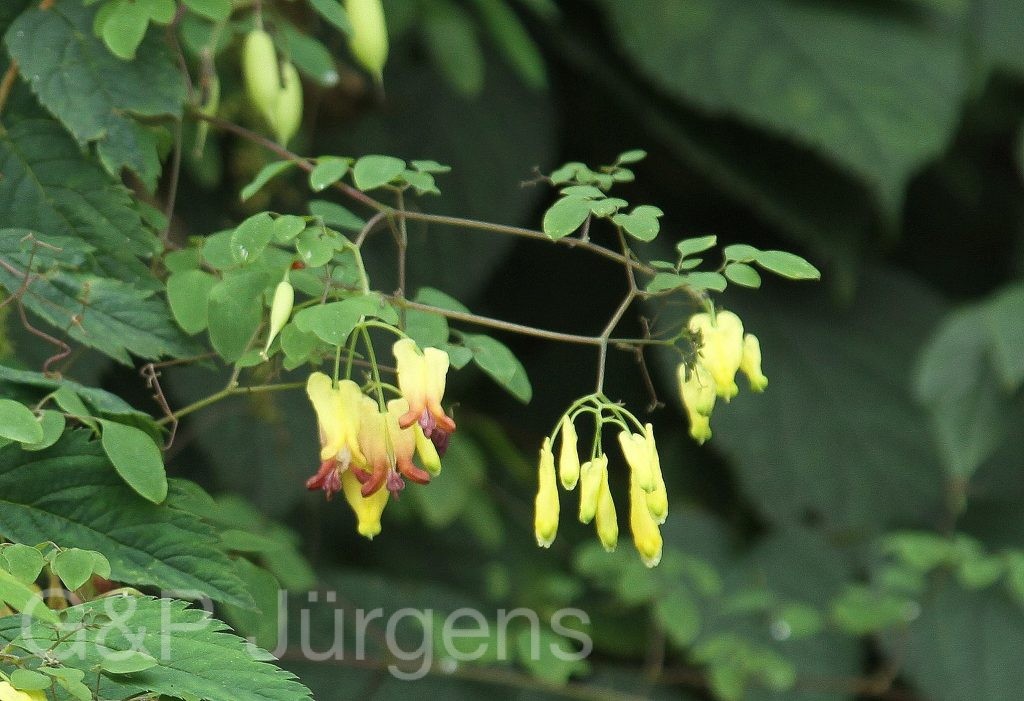
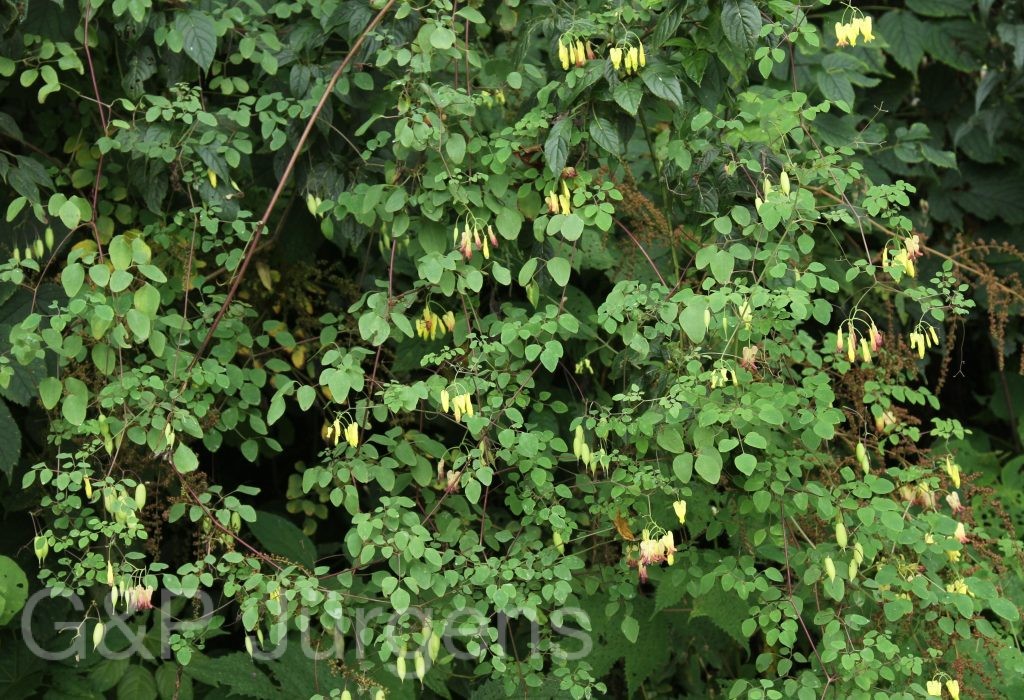
Dactylicapnos scandens (D.Don) Hutch. is a scrambling herbaceous climber of the eastern Himalaya and adjacent montane Asia, ranging across Nepal, India, Bhutan, southern China and Myanmar, with extensions into Thailand and Vietnam; the GBIF dataset records some 301 occurrences, the majority along the Sino-Himalayan arc, while scattered points from Europe, North America and New Zealand reflect cultivated or naturalised material. It favours moist temperate and subtropical forest margins, thickets, ravines and disturbed slopes, typically between about 1500 and 3000 m, threading through supporting vegetation by means of tendrillar leaf appendages.

The plant is a glabrous, glaucous perennial with slender, much-branched, climbing stems arising from a slender rootstock. The leaves are alternate, several times pinnately or ternately divided into small ovate to lanceolate leaflets, the terminal segments of the rachis modified into branched tendrils that secure the climbing habit. The pendent inflorescences are racemose, bearing nodding, bright yellow, distinctly heart-shaped flowers; the outer pair of petals is saccate to spurred at the base and connivent at the apex, enclosing the inner petals in the characteristic fumarioid manner. The fruit is a slender, elongate, dehiscent capsule containing several shining black seeds.

Formerly placed in Dicentra and Corydalis, the genus Dactylicapnos is now firmly assigned to the Papaveraceae subfamily Fumarioideae, distinguished by its climbing tendrillate habit and zygomorphic dimerous flowers. The species is widespread and locally common, of no immediate conservation concern, and is valued horticulturally as an ornamental climber for cool temperate gardens.

Author: (D.Don) Hutch. · Sources: POWO (Kew), GBIF, Flora of China, Flora of Bhutan, Flora of Nepal, Lidén & Zetterlund monograph of Dactylicapnos and Fumarioideae

Daphne sureil

by GP Jürgens

W.W.Sm. & Cave

Bhutan2012 638
Bhutan Tserang, 1600m September
Bhutan2015 218
Bhutan Zhemgang 1000m, October
Bh2008 515 P790
Bhutan Chongsakha, 1800m April

Description

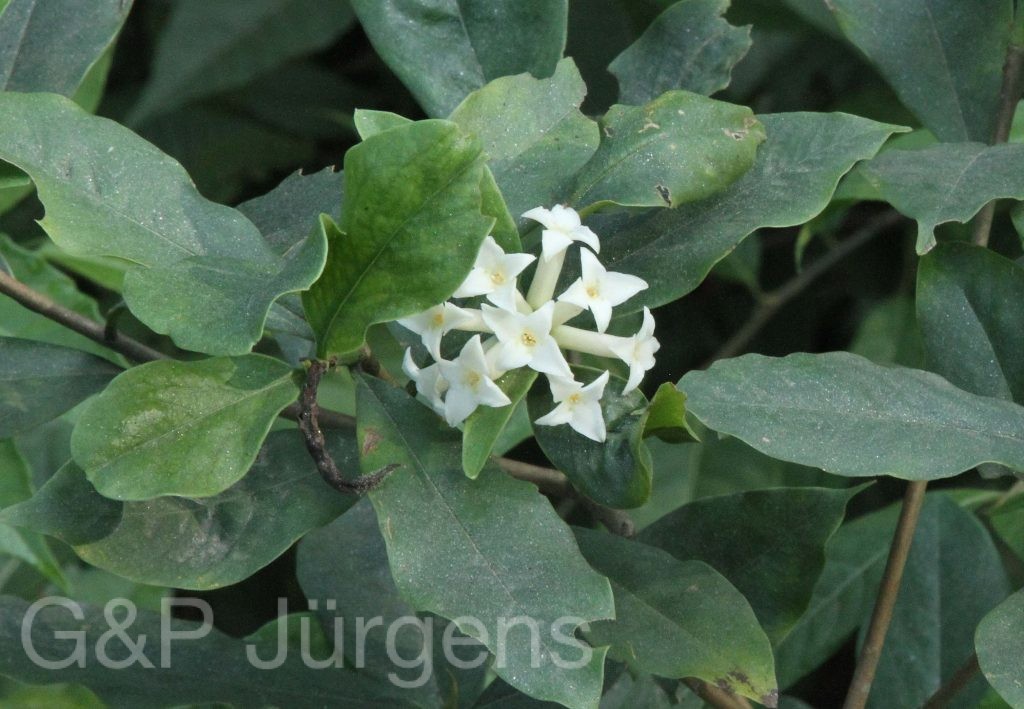
Daphne sureil is a shrub of the eastern Himalaya and adjacent Southeast Asia, recorded from India, Thailand, Nepal, Bhutan, Myanmar, Bangladesh and Vietnam, with about 124 documented occurrences. It is a plant of warm-temperate and subtropical broad-leaved forest, growing in the understorey and along forest margins, ravines and stream banks on moist, well-drained slopes. In Bhutan it occupies the lower to middle montane belt across a broad elevational span, as shown by collections from Tserang at about 1600 m in September, Zhemgang at 1000 m in October and Chongsakha at 1800 m in April, the spring date corresponding to its flowering period.

The species is an evergreen shrub with slender, glabrous branches bearing alternate, shortly petiolate leaves that are elliptic to oblanceolate, entire, acuminate or acute at the apex and tapering at the base, leathery and glossy above with a paler lower surface. The flowers are borne in small terminal clusters and lack petals, the floral display formed instead by a tubular, fragrant white to creamy perianth of four spreading lobes, the tube silky-pubescent without and enclosing eight stamens in two whorls. The fruit is a fleshy ovoid drupe, ripening red, containing a single seed.

Daphne sureil was described by W. W. Smith and Cave from the eastern Himalaya and belongs to the predominantly evergreen Asian assemblage of the genus. As in other Daphne species, the bark contains tough phloem fibres and the tissues bear the diterpenoid daphnane compounds responsible for their acridity and toxicity. The bird-dispersed drupes and strongly scented, presumably moth-pollinated flowers reflect typical thymelaeaceous biology. The species is locally frequent in suitable forest but, being tied to lower-montane broad-leaved woodland, is potentially vulnerable to habitat clearance at its lower elevational limits.

Author: W.W.Sm. & Cave · Sources: POWO (Kew), GBIF, Flora of Bhutan Vol. 1, Flora of China Vol. 13, Flora of Nepal, Halda monograph The Genus Daphne

K.Rosenth.

Bhutan2012 636
Bhutan Tserang 1660m, June

Description

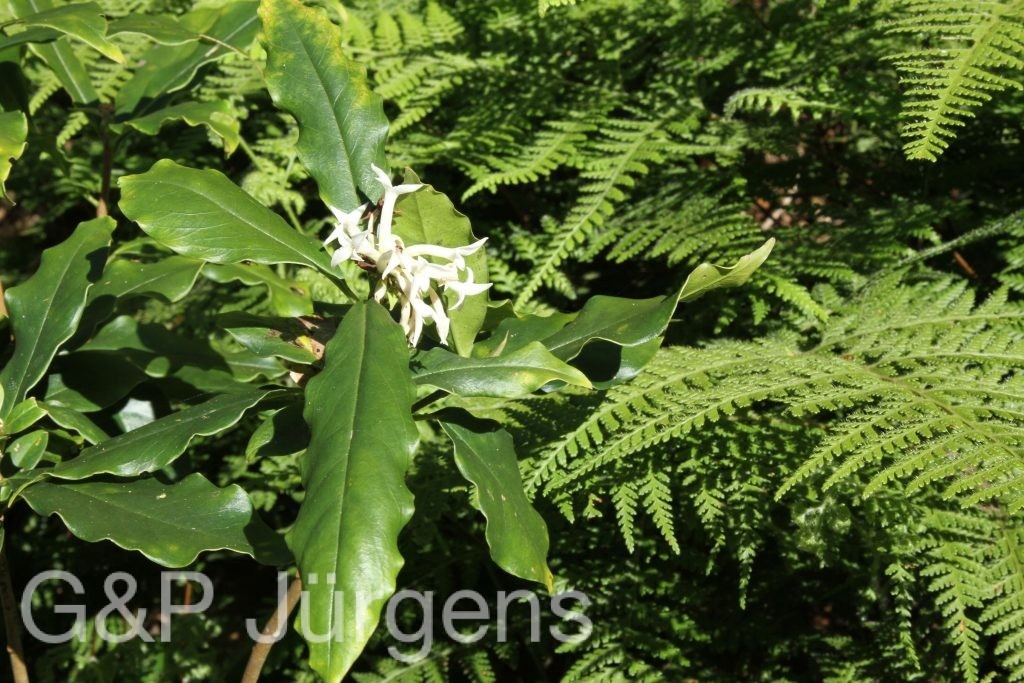
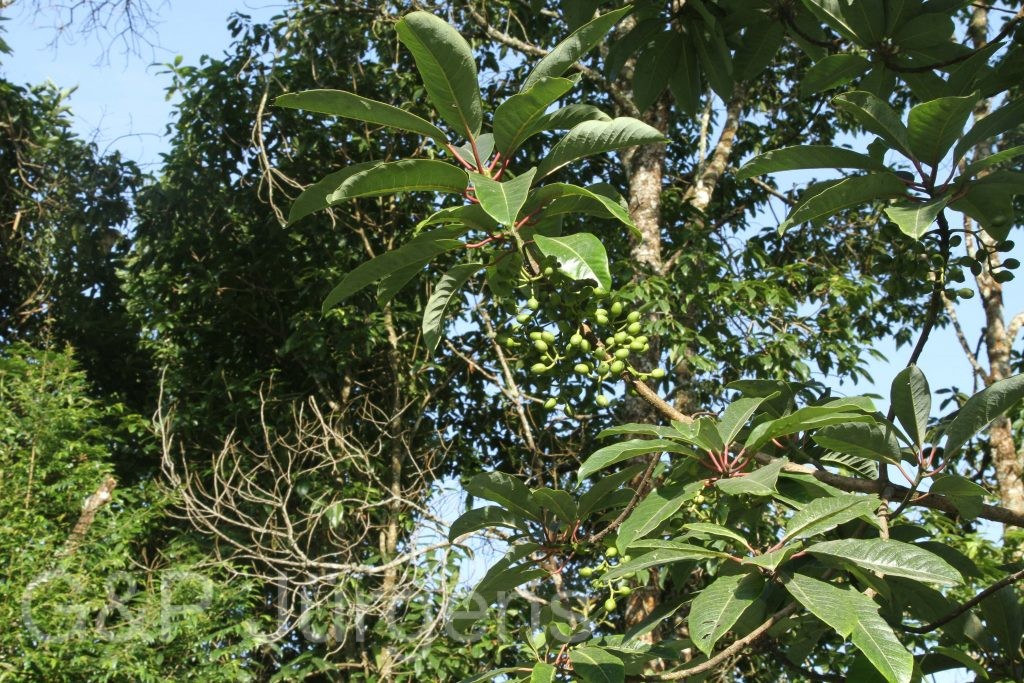
Daphniphyllum chartaceum is an evergreen tree or large shrub of the eastern Himalaya and Indo-Burmese uplands, recorded by GBIF, with around 140 occurrences, from China, Nepal, India, Bhutan, Vietnam and Myanmar. It is a component of moist, broad-leaved evergreen and warm-temperate forest, growing on humid slopes, in ravines and along forest margins, typically between about 1500 and 2500 m. The photographed plant from Tserang in Bhutan, at roughly 1660 m and recorded in June, is representative of its mid-elevation, subtropical-to-warm-temperate forest habitat, where it occupies the understorey to mid-canopy of dense, evergreen Himalayan woodland under a humid, monsoon-influenced climate.

The species is a dioecious tree with smooth bark and stout twigs bearing leaves crowded toward the branch tips. The leaves are simple, alternate but often appearing pseudo-whorled, elliptic to oblong-lanceolate, leathery to chartaceous (papery, as the epithet indicates), entire-margined, with the lower surface usually glaucous and conspicuously papillose, and frequently reddish petioles. Being dioecious, male and female flowers are borne on separate trees in axillary racemes; the flowers are small and apetalous, the males with numerous stamens and the females with a unilocular to bilocular ovary, lacking showy perianth. The fruit is a small, ellipsoid, one-seeded drupe, bluish-black and often glaucous at maturity, borne in short axillary clusters.

Daphniphyllum is the sole genus of Daphniphyllaceae, an isolated family of eastern and southern Asia of considerable phylogenetic interest, placed near Saxifragales and noted for its distinctive Daphniphyllum alkaloids. D. chartaceum is distinguished within the genus by its papery, glaucous-papillose leaves and has been associated with the variable D. himalense complex, with which it shares its montane Himalayan range. The fleshy drupes are dispersed by birds, and the dioecious breeding system enforces outcrossing. The species is reasonably widespread across the eastern Himalaya and Indo-Burma and is not regarded as threatened, though, like many evergreen forest trees of the region, local populations are sensitive to deforestation and land-use change.

Author: K.Rosenth. · Sources: POWO (Kew), GBIF, Flora of China Vol. 11, Flora of Bhutan Vol. 1, Flora of Nepal, Flora of Pakistan, Huang's monograph of Daphniphyllum

Hook.f. & Thomson

Sikkim 2006 329 ergebnis
India West-Bengal, Chaana 1700m, May

Description

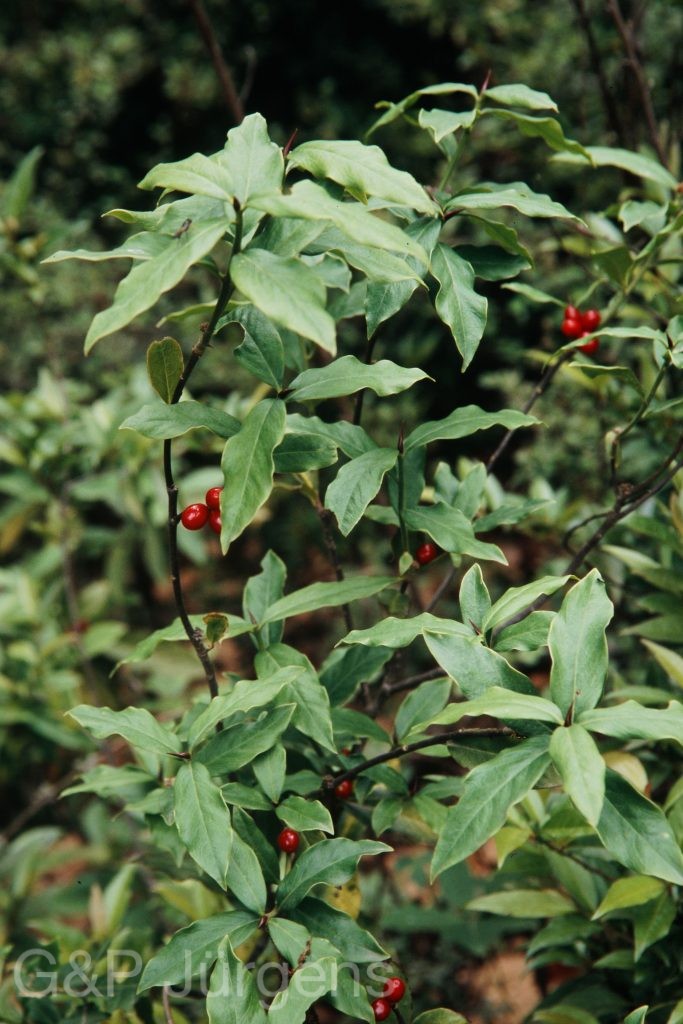
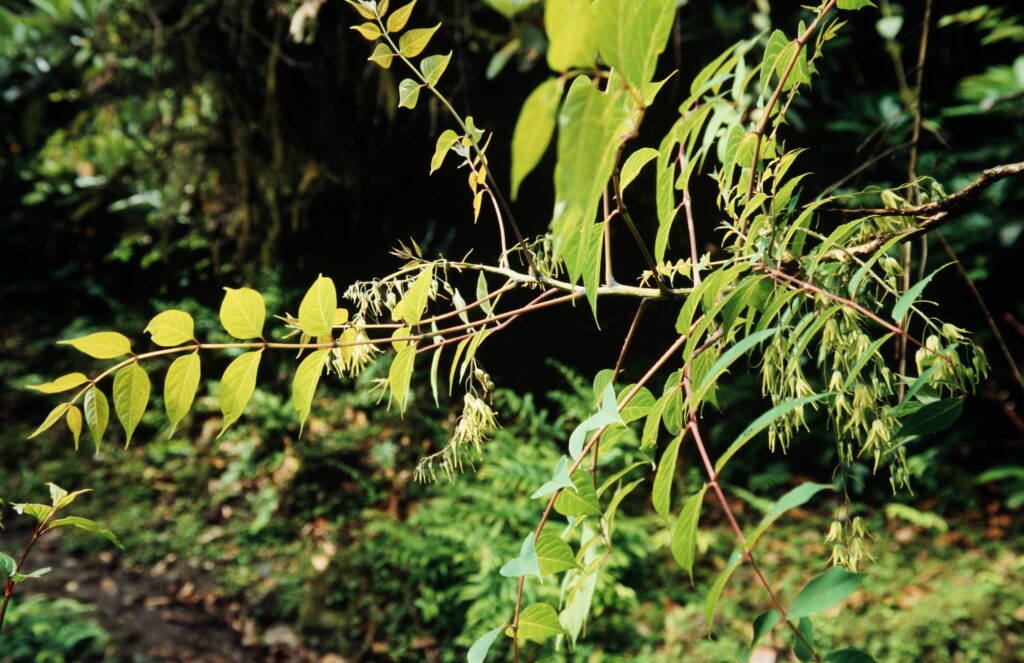
Decaisnea insignis is a deciduous shrub of the Himalaya and southwest China, native to China, India, Bhutan, Nepal and Myanmar, and now widely grown as an ornamental, accounting for numerous records in Europe, North America and elsewhere. It occupies moist temperate forest, forest margins, ravines and shrubby slopes, typically between about 1500 and 3500 m. The photographed plant from Chaana in West Bengal, India, at roughly 1700 m and flowering in May, is characteristic of cool, humid mid-montane forest where it favours sheltered, well-watered situations with rich, humus-laden soils.

The plant is an erect, sparsely branched shrub with stout, pithy stems. The leaves are large, alternate, imparipinnate, with numerous ovate to ovate-lanceolate, entire, acuminate, glaucous-backed leaflets. The flowers are borne in pendulous terminal panicles and are functionally unisexual, with six narrow, greenish-yellow, petaloid sepals and no true petals. The most distinctive feature is the fruit: pendent, cylindrical, sausage-shaped follicles that ripen a striking metallic blue, the fleshy interior containing a translucent, sweetish pulp embedding numerous flattened black seeds, giving rise to the common name dead man's fingers.

The genus commemorates the French botanist Joseph Decaisne, and insignis alludes to its remarkable blue fruit. Some authors treat the blue-fruited Himalayan plants as D. insignis distinct from the yellow-fruited Chinese D. fargesii, though the two are frequently united. The Lardizabalaceae is a small, mainly East Asian family of climbers and shrubs; D. insignis is anomalous as an erect, non-twining member. The conspicuous fleshy fruits suggest vertebrate dispersal, and the species is widely cultivated and not threatened.

Author: Hook.f. & Thomson · Sources: POWO (Kew), GBIF, Flora of China Vol. 7, Flora of Bhutan Vol. 1, Flora of Nepal, A Revision of the Lardizabalaceae

Wall. ex Lindl.

Nepal 2009 114 ergebnis
Nepal Helambu Indrawati-Valley 1500, May

Description

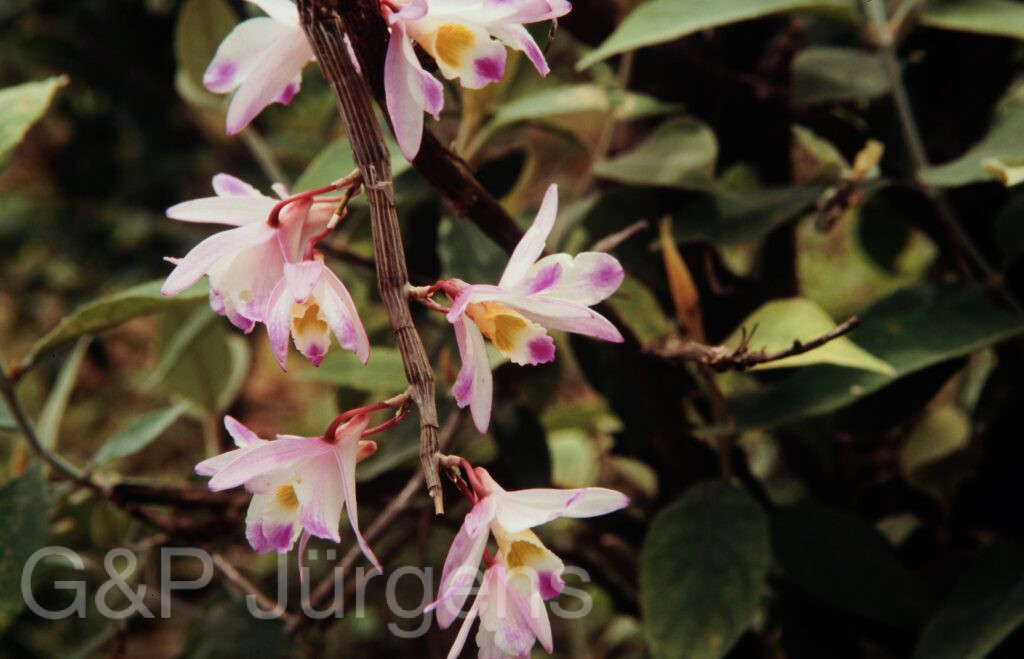
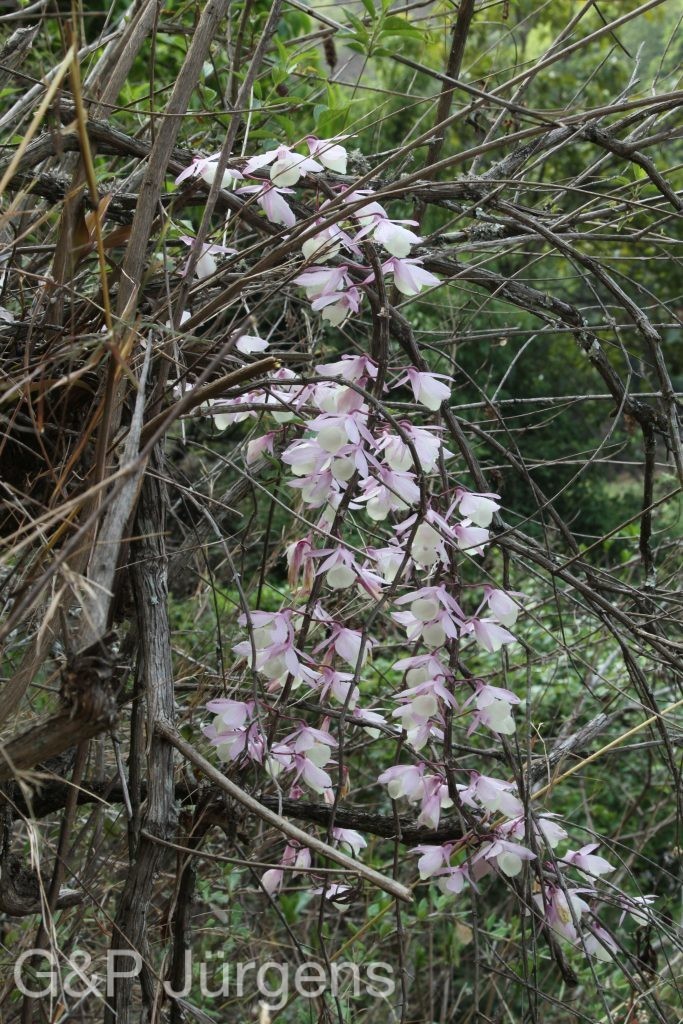
Dendrobium amoenum Wall. ex Lindl. is an epiphytic orchid distributed across the central and eastern Himalaya and adjacent ranges, with records (GBIF: c. 147 occurrences) from India, Nepal, Bhutan and Myanmar, extending into the Malesian region (Indonesia). It is a characteristic element of humid temperate and subtropical broad-leaved forests, growing on mossy trunks and branches at roughly 1,000–2,000 m. The photographed material from Nepal's Helambu region in the Indrawati Valley, at about 1,500 m and flowering in May, falls squarely within its preferred mid-montane belt, where seasonal monsoon humidity and cloud-forest conditions favour epiphytic growth.

The species forms slender, pendulous, terete stems up to 30–60 cm long, often becoming leafless before flowering and bearing thin internodes. The leaves are distichous, lanceolate and deciduous, leaving conspicuous nodal sheaths. Flowers are borne singly or in small clusters from the nodes of older canes, are fragrant, and measure roughly 3–4 cm across. The sepals and petals are white, frequently tinged or tipped with pale rose-purple, while the rounded, pubescent lip is white with a yellow to greenish central disc and a fine purple apical margin. The column is short, bearing four pollinia within an operculate anther cap.

Dendrobium amoenum belongs to the large, taxonomically complex genus Dendrobium (section Dendrobium), members of which display the characteristic deciduous habit and nodal flowering. Like many Himalayan epiphytic orchids it is sensitive to deforestation and to collection pressure, and the genus is listed under CITES Appendix II. The input family "Orchideaceae" is an orthographic variant of the accepted Orchidaceae.

Author: Wall. ex Lindl. · Sources: POWO (Kew), Flora of Bhutan Vol. 3, Flora of Nepal, GBIF, Pearce & Cribb: The Orchids of Bhutan (2002)

Lindl.

Bhutan2012 1365
Bhutan Sandrup 1400m, October
Bhutan2012 1366
Bhutan Sandrup 1400m, October

Description

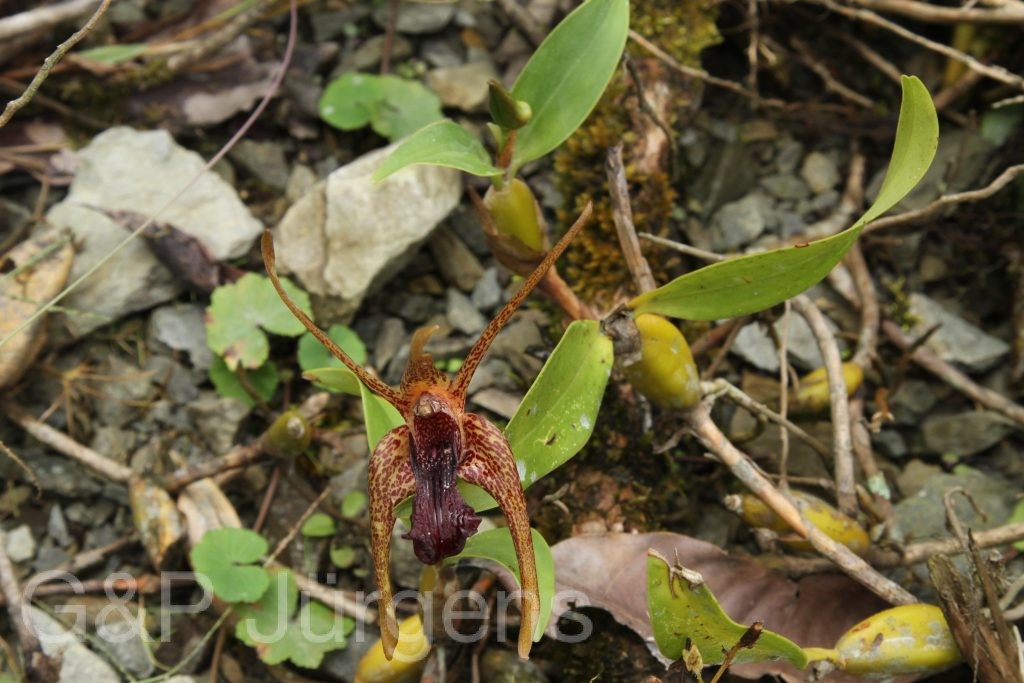
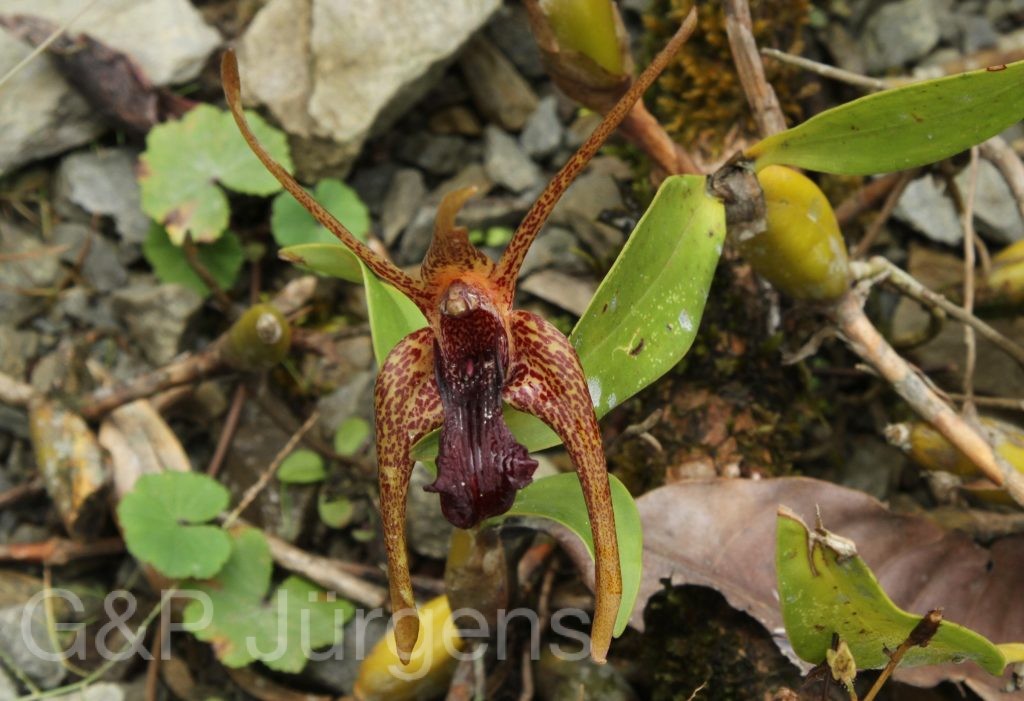
Dendrobium amplum (often treated under the segregate genus Epigeneium as E. amplum) is an epiphytic orchid distributed across the eastern Himalaya and adjacent Southeast Asia. GBIF documents 230 occurrences from China, India, Nepal, Bhutan, Myanmar, Bangladesh, Vietnam and Thailand, with herbarium and cultivated records also in Europe and North America. It inhabits mossy trunks and large branches in humid subtropical broadleaved forest, generally between roughly 1000 and 2000 m. The plant shown was recorded at Sandrup in Bhutan at 1400 m in October, a warm-temperate forest belt where seasonal monsoon moisture sustains a rich epiphytic flora.

The species has a creeping rhizome from which arise well-spaced, ovoid to fusiform pseudobulbs, each conspicuously four-angled and topped by two (rarely three) ovate-elliptic, coriaceous leaves. The inflorescence emerges from the apex of the pseudobulb and carries one to a few comparatively large, showy flowers. The spreading sepals and petals are pale green to yellowish, variously suffused or veined with brown and purple, while the three-lobed labellum bears a recurved, acute or apiculate midlobe and is marked with reddish-purple lines over a callused disc. The mentum is short and the column foot prominent.

Described by John Lindley, the species belongs to a group of broad-bulbed Dendrobium species frequently placed in Epigeneium, a genus whose limits remain debated; POWO accepts the Dendrobium placement. The autumn-flowering habit and large flowers make it attractive to collectors. While ranging widely and not formally listed as threatened, it depends on intact mature forest and is sensitive to habitat loss and over-collection.

Author: Lindl. · Sources: POWO (Kew), GBIF, Flora of Bhutan, Flora of China, Orchids of Bhutan, Dendrobium and its Relatives (Lavarack et al.)

C.E.C. Fisch.

Sikkim2011 17
Sikkim Lachen 2460m, June
Bhutan2014 703
Bhutan Wangdi Phodrang 2280m, May
BhutanPG2011 56 ergebnis
Bhutan Jakar, 20m June
Bhutan2014 702
Bhutan Jakar, 2600m June
Nepal 1994 8 ergebnis
Ost-Nepal Tumlingtar 340m April

Description

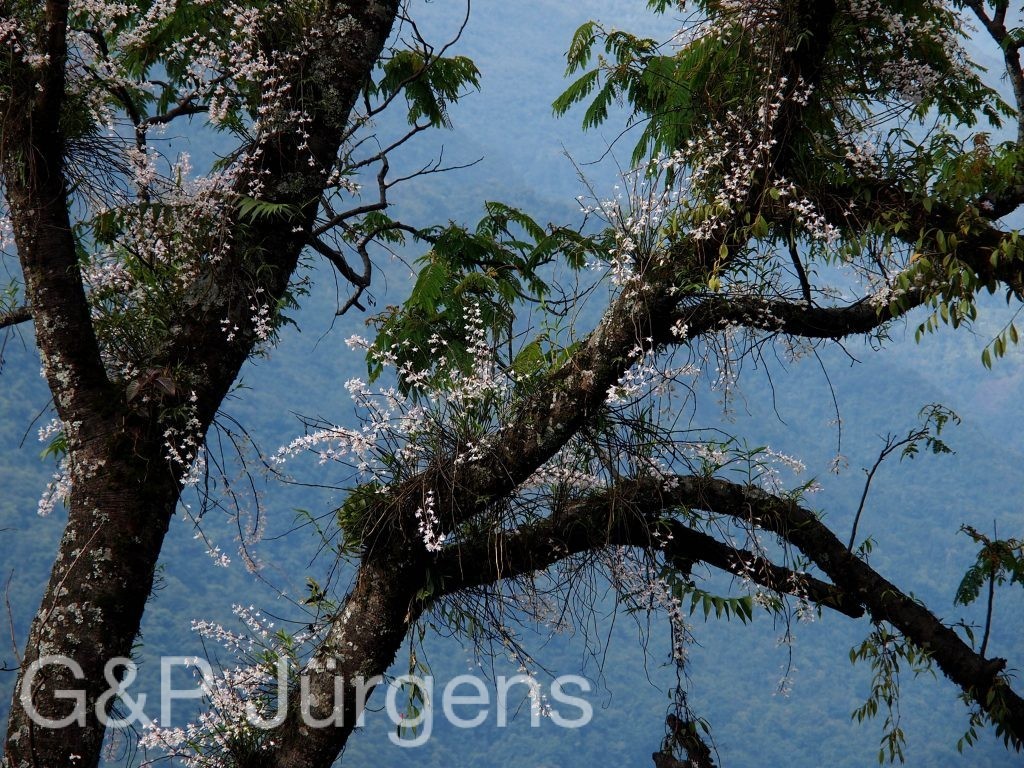
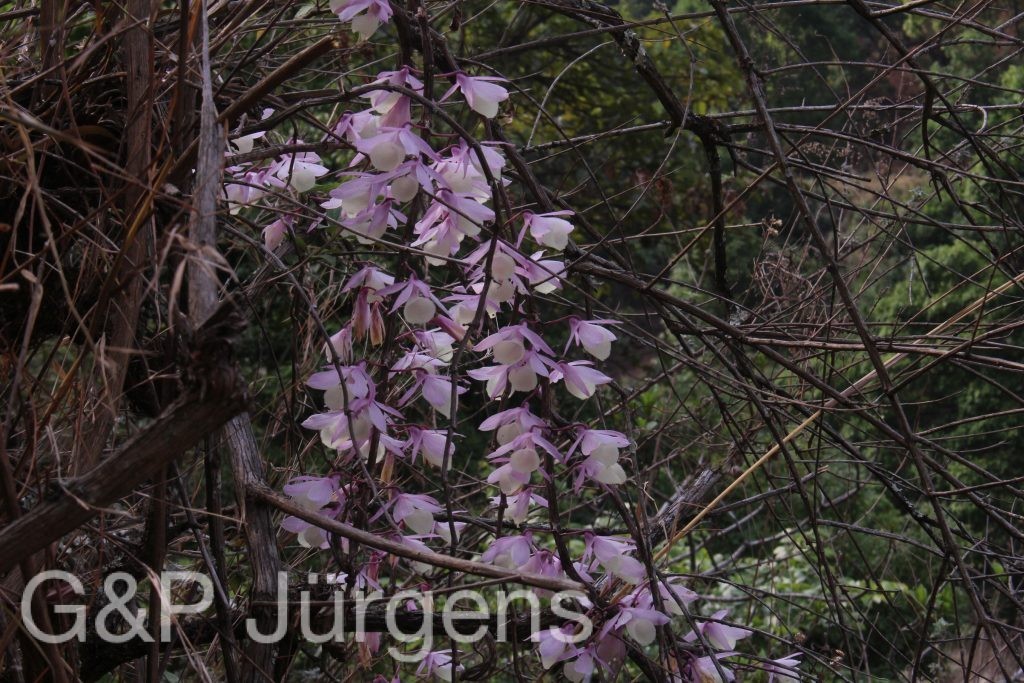
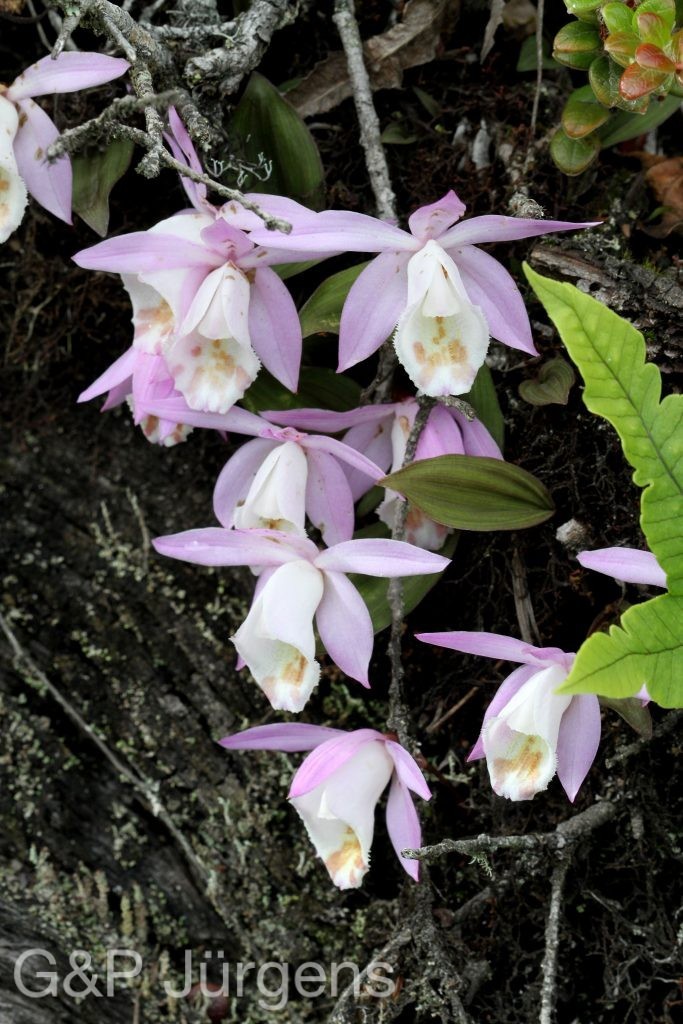
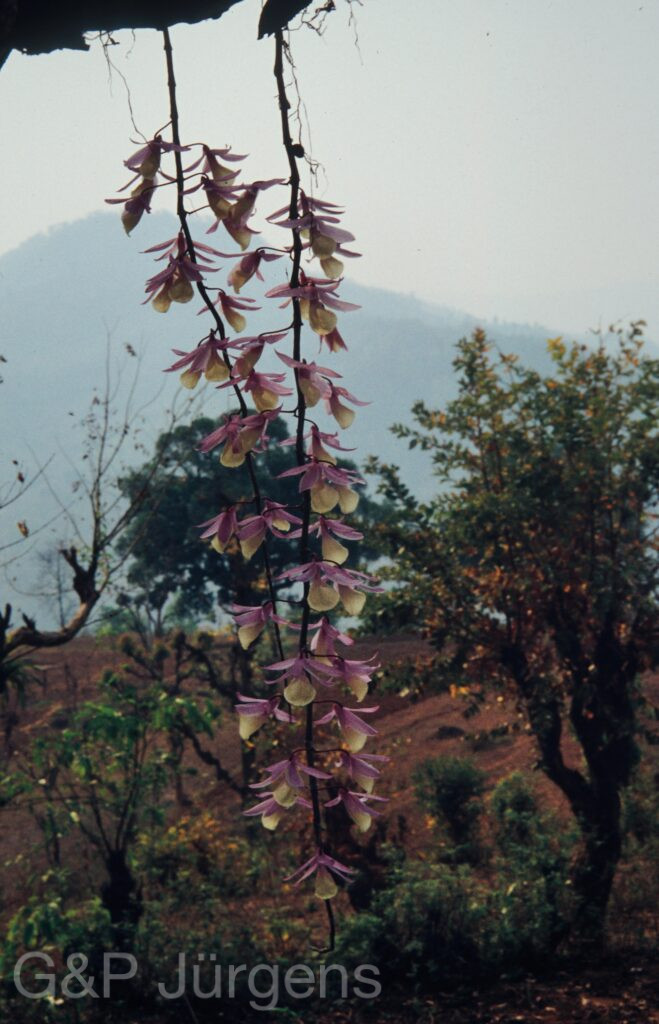
Dendrobium aphyllum is a widespread epiphytic orchid of tropical and subtropical Asia, ranging from India and Nepal through southern China and across mainland Southeast Asia, with GBIF documenting occurrences from India, China, Thailand, Bhutan, Nepal, Vietnam, Myanmar and Laos among many territories. It grows as an epiphyte, and sometimes a lithophyte, on tree trunks and rocks in warm, humid lowland and lower montane forest, enduring a distinct dry season during which the canes shed their leaves. It occupies low to middle elevations; the records span Tumlingtar in eastern Nepal at about 340 m to Sikkim's Lachen and Bhutanese sites up to roughly 2600 m, with the photographed material flowering from April through June across this broad altitudinal range.

The plant produces long, slender, pendulous cane-like stems that branch and trail from the host, leafy when young and largely leaf-shedding before flowering. The leaves are thin, lanceolate and deciduous. The flowers emerge in twos and threes from the nodes of the bare, hanging canes, fragrant and delicately coloured, with pale rose-pink to lilac sepals and petals. The labellum is broadly funnel-shaped to subobicular, cream to pale yellow and finely downy within, often marked with darker veining and rolled around the column to form a trumpet, the lower margin sometimes faintly fringed. The fruit is a pendent capsule.

D. aphyllum is placed in Dendrobium section Dendrobium and is characterised by its leafless flowering canes, as reflected in the epithet; it has accumulated synonymy and is sometimes confused with related pendent species such as D. primulinum and D. anosmum. Long cultivated as an ornamental and used in some traditional medicines, it remains common over much of its vast range, though localised populations are depleted by wild collection and lowland forest clearance.

Author: C.E.C. Fisch. · Sources: POWO (Kew), GBIF, Flora of China, The Orchids of Bhutan (Pearce & Cribb), Dendrobium and its Allies (Lavarack et al.)

Lindl. ex. Wall.

Nepal 97 359 P703
Nepal Arun-Valley 1650m
Nepal 97 358 P701
Nepal Arun-Valley 1650m

Description

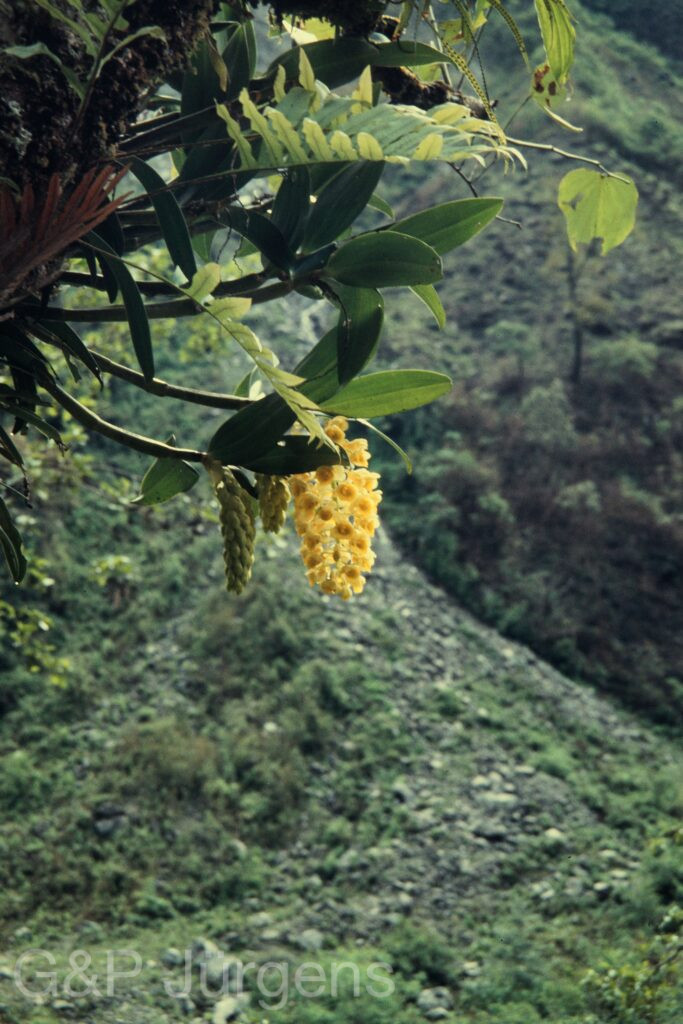
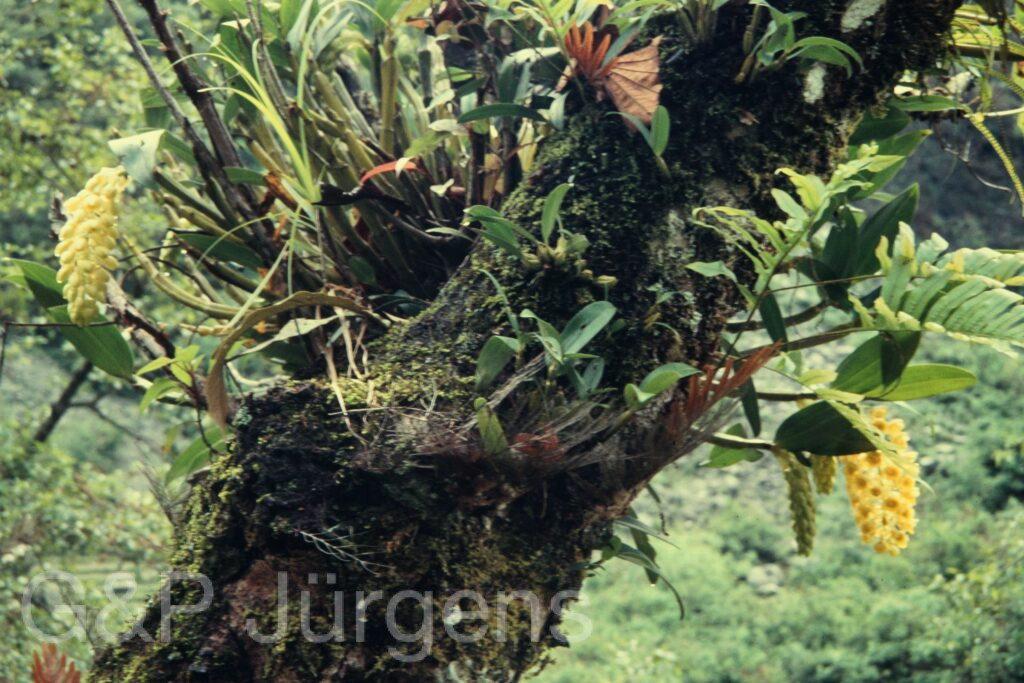
Dendrobium densiflorum is a robust epiphytic orchid of the subtropical and warm-temperate forests of the eastern Himalaya and Indochina, recorded natively from China, India, Nepal, Bhutan, Vietnam, Laos and Myanmar, with 247 GBIF occurrences (several extralimital records reflecting cultivation). It grows as an epiphyte, and occasionally a lithophyte, on mossy trees and shaded rock faces in humid broadleaved forest, generally between about 1000 and 1800 m. The illustrated plant comes from the Arun Valley of eastern Nepal at around 1650 m, a deep monsoon-fed gorge where rich epiphyte communities clothe the evergreen forest.

The species forms stout, clustered, club-shaped to fusiform pseudobulbous canes that are four-angled and longitudinally furrowed, bearing several leathery, oblong-elliptic leaves toward the apex. The inflorescence is its glory: a dense, pendulous, cylindrical raceme arising near the cane apex and carrying many closely set flowers. Each flower has bright golden-yellow, spreading sepals and broader petals, and a conspicuous, broadly orbicular, downy lip of deep egg-yolk orange-yellow, fringed at the margin. The fruit is a ribbed capsule.

The species belongs to Dendrobium section Densiflora, distinguished by these massed, pendent, golden 'pineapple' inflorescences. Spectacular in flower, it has long been prized in horticulture, and over-collection from the wild together with forest clearance has reduced many accessible populations; as with all Dendrobium it is regulated under CITES Appendix II. Its biogeography typifies the Sino-Himalayan epiphytic orchid flora that reaches its western limit in the wet middle-hill forests of Nepal.

Author: Lindl. ex. Wall. · Sources: POWO (Kew), GBIF, Flora of China, Orchids of Nepal, Dendrobium and its Allies (Lavarack, Harris & Stocker)

Griff.

Nepal 95 303 P547 ergebnis
Nepal Bharang 1850m October

Description

Dendrobium eriiflorum is an epiphytic orchid of the eastern Himalaya and Indo-Burmese region, distributed through Nepal, northern India, Bhutan, Bangladesh and Myanmar into Thailand, peninsular Malaysia and Indonesia; GBIF records about 112 occurrences across this range. It is a plant of the subtropical to lower temperate broadleaved forest, growing as an epiphyte on tree trunks and mossy branches in humid, shaded montane woodland, as documented at Bharang in Nepal at 1850 m. In this elevational band it benefits from high atmospheric moisture and a pronounced monsoon, and is recorded in flower in October toward the close of the wet season.

It is a small, tufted epiphyte with clustered, slender, erect to pendent stems (pseudobulb-like canes) sheathed by the membranous bases of the leaves. The leaves are thin, narrowly lanceolate, distichous and deciduous, leaving the older canes leafless. The inflorescences are short, few-flowered racemes arising laterally near the stem apex; the flowers are small, pale greenish-white to cream and densely covered externally with fine hairs, the hairy perianth recalling the genus Eria and giving rise to the epithet "eriiflorum". The lip is three-lobed with a recurved apex, and the column bears a short foot forming a mentum, with the pollinia waxy in the manner typical of Dendrobium.

The species was described by William Griffith, an early explorer of the Himalayan and Burmese flora. Within the large, taxonomically complex genus Dendrobium it falls among the small-flowered Himalayan species; the distinctive pubescent flowers are an unusual diagnostic feature among its relatives. Pollination in such Dendrobium is generally by small bees attracted to the lip. As an epiphyte dependent on intact, humid forest canopy, it is sensitive to deforestation and to the horticultural collection that affects many Himalayan orchids; like all Dendrobium it is listed on CITES Appendix II, regulating international trade.

Author: Griff. · Sources: POWO (Kew), GBIF, Flora of Bhutan, Orchids of Nepal, Seidenfaden's monographic studies of Dendrobium