Tag:

Nepal

Flowers of Nepal — 1313 wild plant species documented from the Nepalese Himalaya, from subtropical foothills to high alpine meadows above 4,000 m. Nepal’s dramatic elevation gradient makes it one of the richest botanical regions on Earth, home to rhododendrons, primulas, gentians and the famed blue poppies (Meconopsis). Every entry gives a botanical description, native distribution, habitat and flowering season, alongside the original field photograph and the location where it was taken.

Lour.

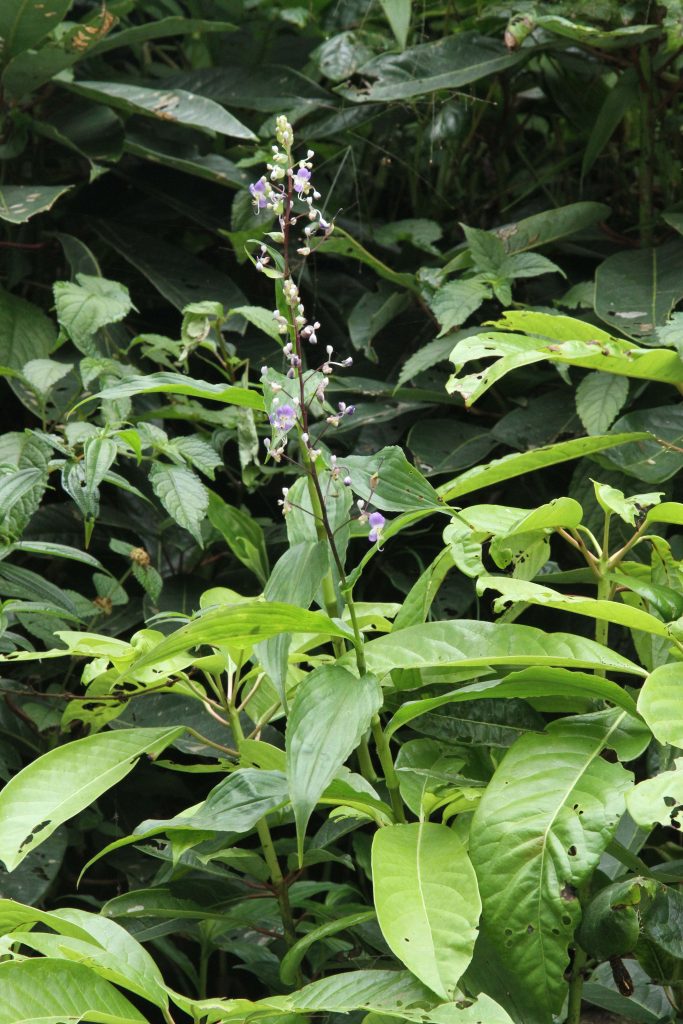
Bhutan2012 662
Bhutan Chele-La 3400m, September

Description

Floscopa scandens is a perennial spiderwort with a very broad Indo-Malesian to Australasian range, documented by GBIF (2373 occurrences) from China, India, Indochina, the Malay Archipelago, the Philippines, New Guinea, Sri Lanka, Bangladesh, Nepal and Australia. It is a plant of wet, shaded ground, growing along streams, ditches, marshes, paddy margins and damp forest floors, predominantly at low and middle elevations though ascending higher locally. The cited record from Chele-La in Bhutan at 3400 m in September lies at the upper end of its range, where it persists in moist hollows and seepage zones flowering into the late monsoon.

The species is a soft, somewhat straggling to decumbent or scrambling herb with elongate, often reddish stems rooting at the lower nodes. The leaves are alternate, sessile or shortly petiolate, lanceolate to elliptic, with closed sheathing bases that are usually ciliate at the mouth. The inflorescence is a dense, much-branched terminal thyrse or panicle of small flowers subtended by membranous bracts and bracteoles; each flower has three free sepals, three free blue to pinkish or whitish petals, and typically six stamens, the filaments often bearded. The fruit is a small, two-locular, laterally compressed capsule containing few seeds.

Floscopa is distinguished within Commelinaceae from the closely related Commelina and Tradescantia by its many-flowered, paniculate inflorescence not enclosed in a folded spathe, and by its compressed bilocular capsule. The genus favours permanently moist, often disturbed wetland habitats and is pollinated by small insects. Widespread and ecologically plastic, F. scandens is common throughout its range and faces no conservation threat.

Author: Lour. · Sources: POWO (Kew), GBIF, Flora of China Vol. 24, Flora of Bhutan Vol. 3, Flora of Nepal, Faden Commelinaceae systematic studies
J.Gay

Bh09 291 P480
Bhutan Pele-La, 3200m June

Description

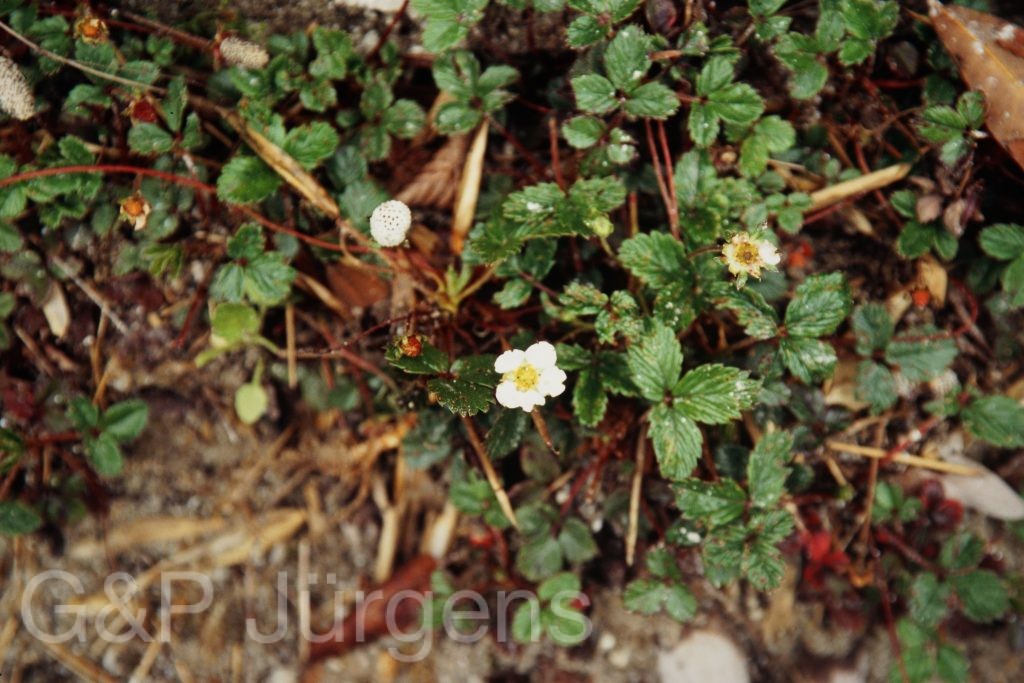
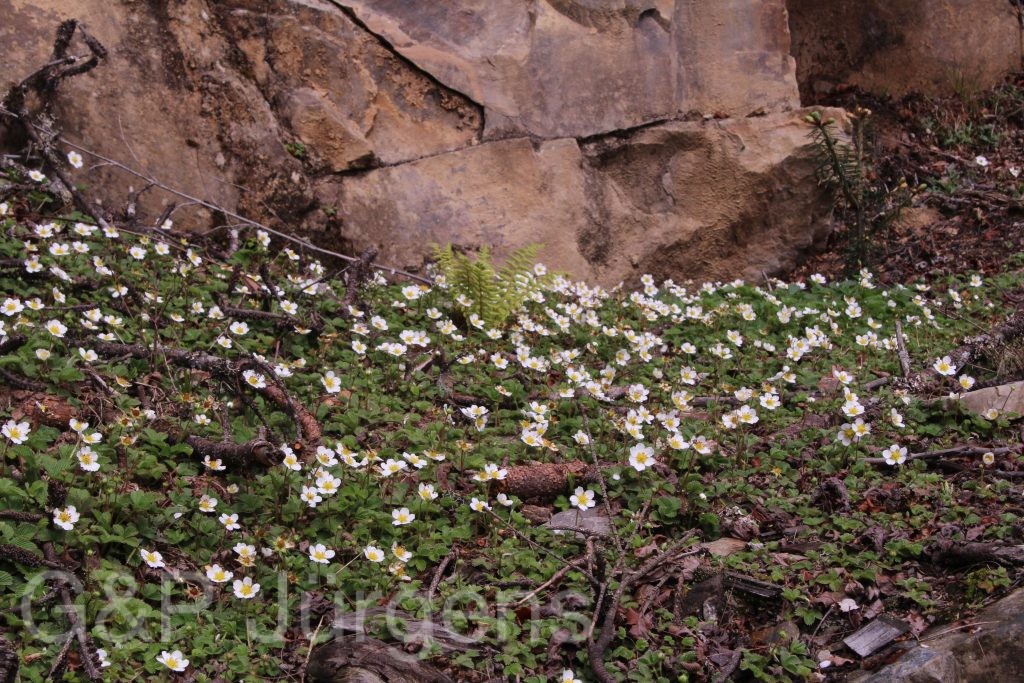
Fragaria daltoniana, the Sikkim strawberry, is a Himalayan wild strawberry native to Nepal, India, Bhutan, southern Tibet (China) and northern Myanmar; the additional GBIF country codes (USA, Norway, France, Sweden, Armenia) reflect cultivated material and herbarium holdings rather than wild range, the dataset listing some 181 records. It grows in moist montane forest margins, clearings, mossy banks, grassy slopes and along streamsides, generally between about 2500 and 4000 m. The plant photographed at the Pele-La in Bhutan at around 3200 m in June represents its typical temperate-forest belt habitat.

It is a slender, stoloniferous perennial herb forming open mats by rooting runners. The trifoliolate leaves are long-petiolate, the leaflets thin, obovate and coarsely serrate, sparsely hairy. Solitary or few white flowers are borne on slender pedicels, each with five spreading petals, numerous stamens and an epicalyx alternating with the sepals. The fleshy receptacle ripens into the diagnostic fruit: an elongate, narrowly ovoid to oblong scarlet 'strawberry' bearing numerous achenes superficially on its surface, larger and more cylindrical than in most relatives but reputedly insipid.

Fragaria daltoniana is one of the few strawberries of the Sino-Himalayan region and is notable to horticulturists and breeders as a wild diploid genetic resource within the genus. Its long, narrow red receptacle distinguishes it from the rounder fruits of F. nubicola and F. vesca, with which it can co-occur. The species is not considered threatened, being locally common across a wide range, though it depends on cool, humid forest-edge microhabitats vulnerable to deforestation and to climatic drying at the lower limits of its altitudinal band.

Author: J.Gay · Sources: POWO (Kew), GBIF, Flora of Bhutan, Flora of China, Annotated Checklist of the Flowering Plants of Nepal, Staudt Taxonomic Studies in the Genus Fragaria

Fragaria nubicola

by GP Jürgens

Lindl. ex Lacaita

Bhutan2014 571
Bhutan Phobjika 3000m, May

Description

Fragaria nubicola, the Himalayan wild strawberry, is widely distributed along the Himalaya and into the mountains of Central Asia, recorded from Nepal, India, Pakistan, China, Bhutan and Afghanistan, with naturalised and cultivated records accounting for the European and North American points among its 545 GBIF occurrences. It inhabits open temperate forest, forest margins, grassy clearings, banks and damp meadow turf, typically between 1500 and 4000 m. The plant photographed in the Phobjika valley of central Bhutan at about 3000 m in May exemplifies the moist, partly shaded montane grassland where it flowers and fruits through the warm season.

The species is a low stoloniferous perennial herb spreading by long, slender, rooting runners from a short woody rootstock. The leaves are basal and trifoliolate, with broadly obovate, coarsely serrate leaflets that are bright green and thinly hairy above and paler and silky-pubescent beneath, borne on long villous petioles. The flowers are solitary or few in a lax cyme on hairy scapes; each has five white obovate petals, an epicalyx alternating with the sepals, and numerous yellow stamens around a domed receptacle. The fleshy red accessory fruit (the edible strawberry) bears the true fruits as small achenes sunk in shallow pits on its surface.

Fragaria nubicola belongs to the diploid lineage of the genus and is considered one of the wild progenitor groups relevant to strawberry evolution and breeding, making it of interest for crop genetic resources. Its trifoliolate leaves and stoloniferous spread are typical of the genus, while the silky lower leaf surface and montane ecology distinguish it from lowland relatives. Reproduction is both clonal, by stolons, and sexual, with fruit dispersed by birds and mammals. The species is common and not threatened, though wild germplasm conservation is valued for its potential in cultivated Fragaria improvement.

Author: Lindl. ex Lacaita · Sources: POWO (Kew), GBIF, Flora of China, Flora of Bhutan, Staudt Monograph of the Genus Fragaria

D.Don

Sikkim2011 68
Sikkim Tanghu 3900m, June
Sikkim2011 69
Sikkim Tanghu 3900m, June
Sikkim2004 414 G713
Sikkim/India Yumthang 3700m May
Sikkim2004 415 P712
Sikkim/India Yumthang 3700m May

Description

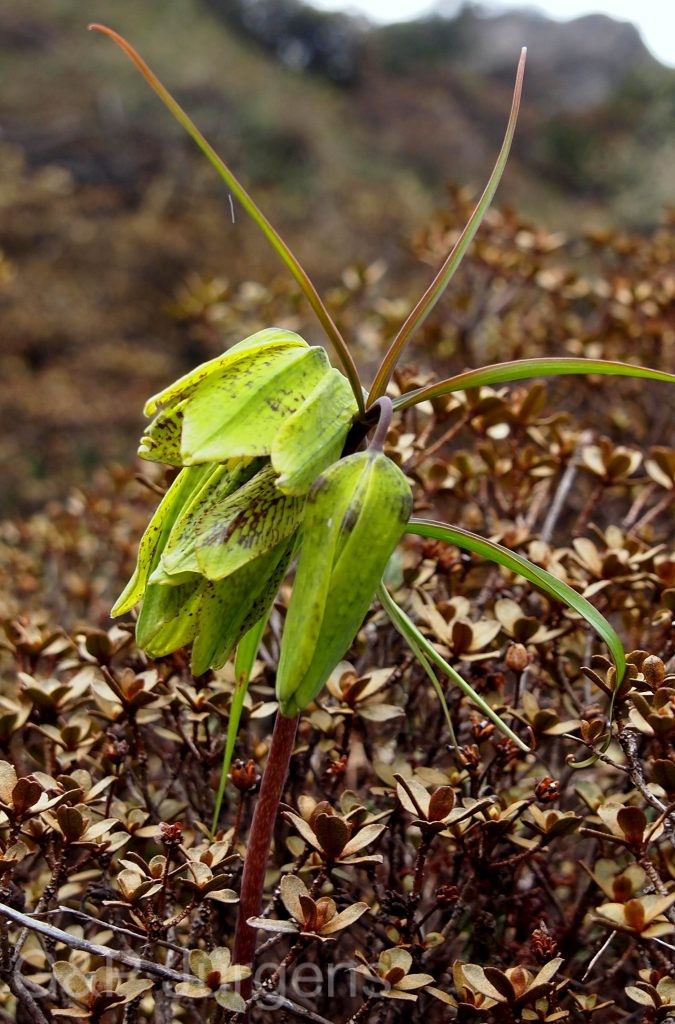
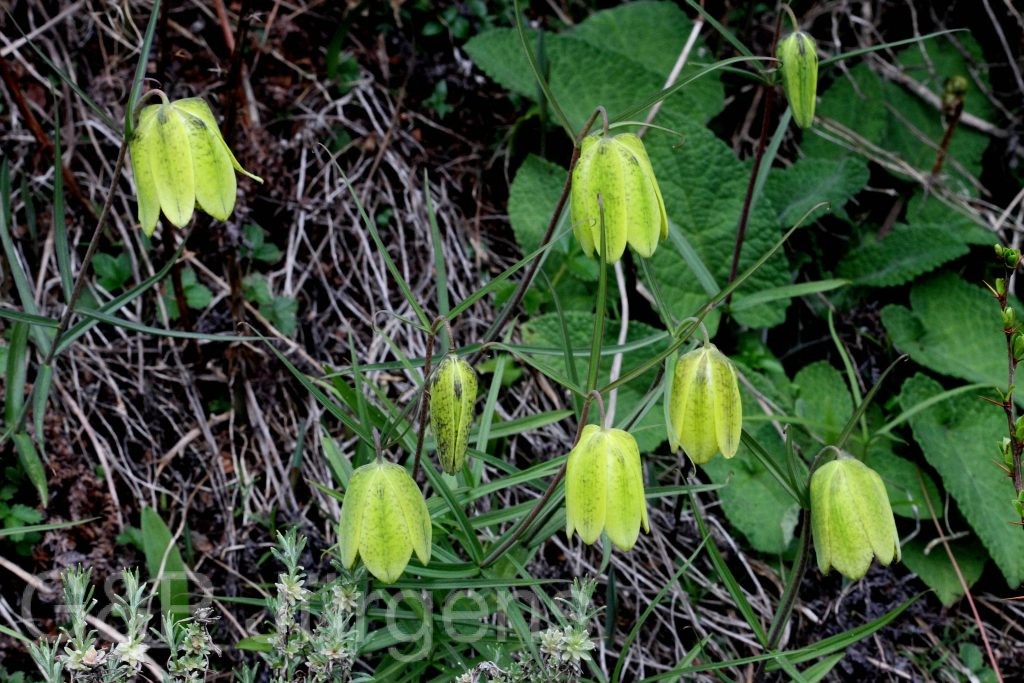
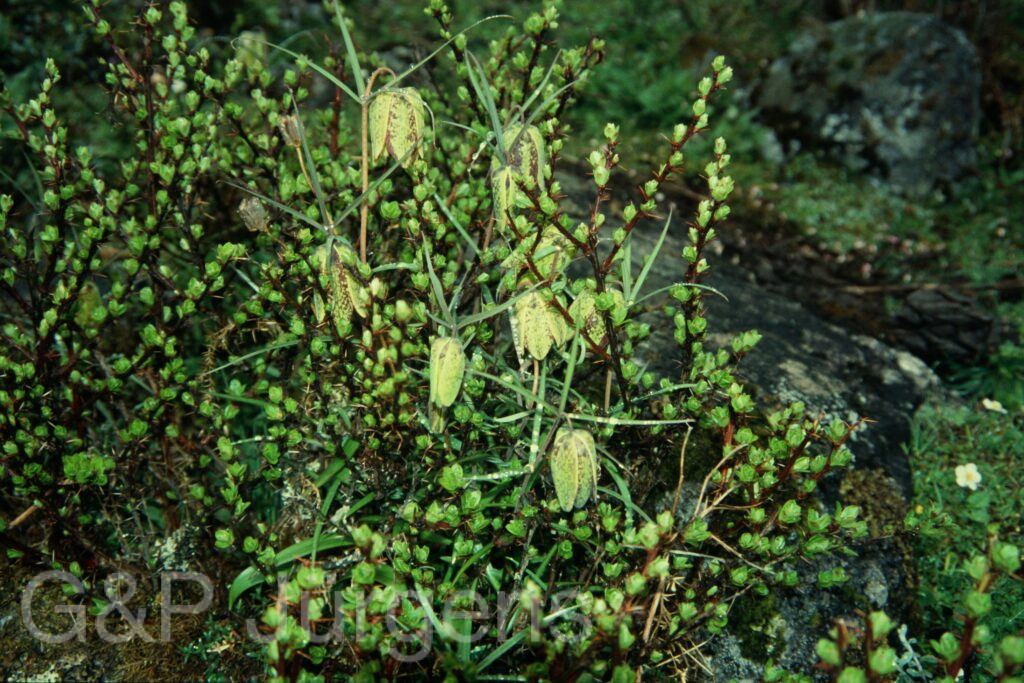
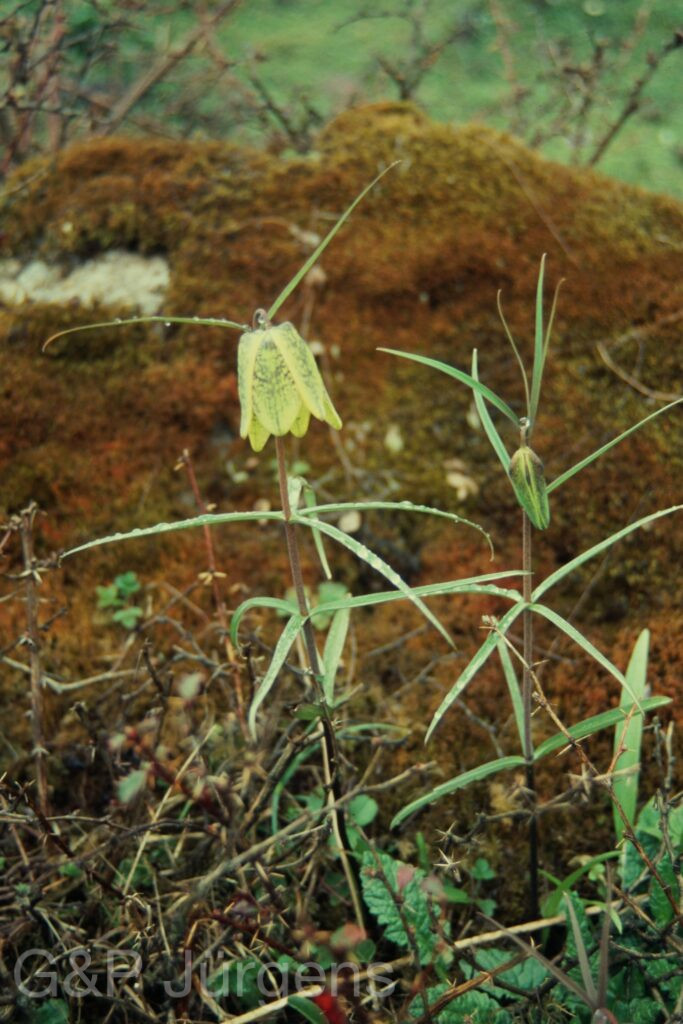
Fritillaria cirrhosa is a bulbous alpine lily of the Himalaya and the Hengduan mountains, native to China, India, Nepal, Pakistan, Bhutan and Myanmar, the very large total of c. 962 records reflecting its wide range and economic importance. It inhabits alpine meadows, scrub, rocky slopes, screes and grassy clearings, mostly between roughly 3200 and 4600 m. The illustrated plants were photographed at Tanghu in Sikkim at 3900 m in June and at Yumthang on the Sikkim/India border at 3700 m in May, sites characteristic of the species, which flowers shortly after snowmelt on cool, moist, well-drained high-montane ground.

It is a perennial herb arising from a small bulb of a few fleshy scales. The slender erect stem bears scattered to whorled, linear to lanceolate leaves, the uppermost of which are prolonged into slender, curling, tendril-like tips, the cirrhose feature from which the epithet derives. The flowers are usually solitary and nodding, broadly campanulate, with six tepals that are yellowish-green to purplish and conspicuously tessellated (chequered) with darker purple-brown; a nectary gland sits near the base of each tepal. The six stamens surround a superior trilocular ovary with a three-lobed style. The fruit is an erect, six-angled or narrowly winged loculicidal capsule.

Fritillaria (Liliaceae) is a Holarctic genus delimited by section on bulb structure, leaf arrangement and style form, and F. cirrhosa is a polymorphic species of the subgenus Fritillaria. Its dried bulb is the source of the renowned traditional Chinese medicine "chuan bei mu," used as an antitussive, and this heavy commercial harvesting is the principal conservation concern: although still widespread, the species is subject to intense wild collection, and the chuan bei mu trade has prompted cultivation efforts and regulatory attention across its range.

Author: D.Don · Sources: POWO (Kew), GBIF, Flora of China, Flowers of the Himalaya (Polunin & Stainton), Rix monograph of Fritillaria

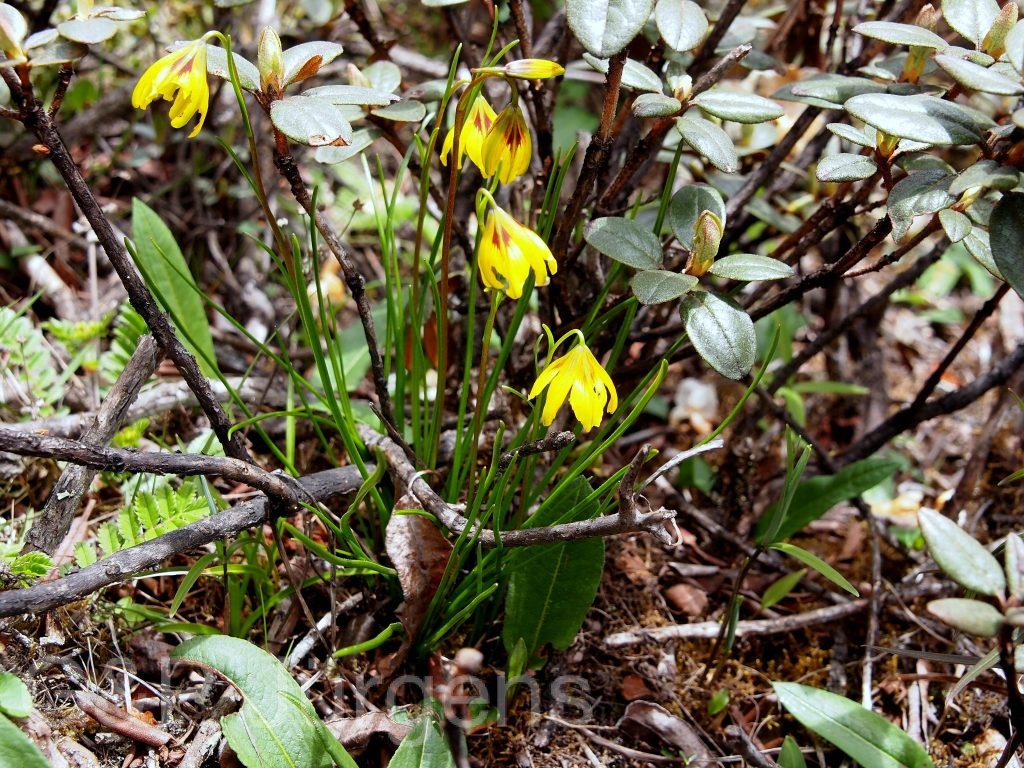
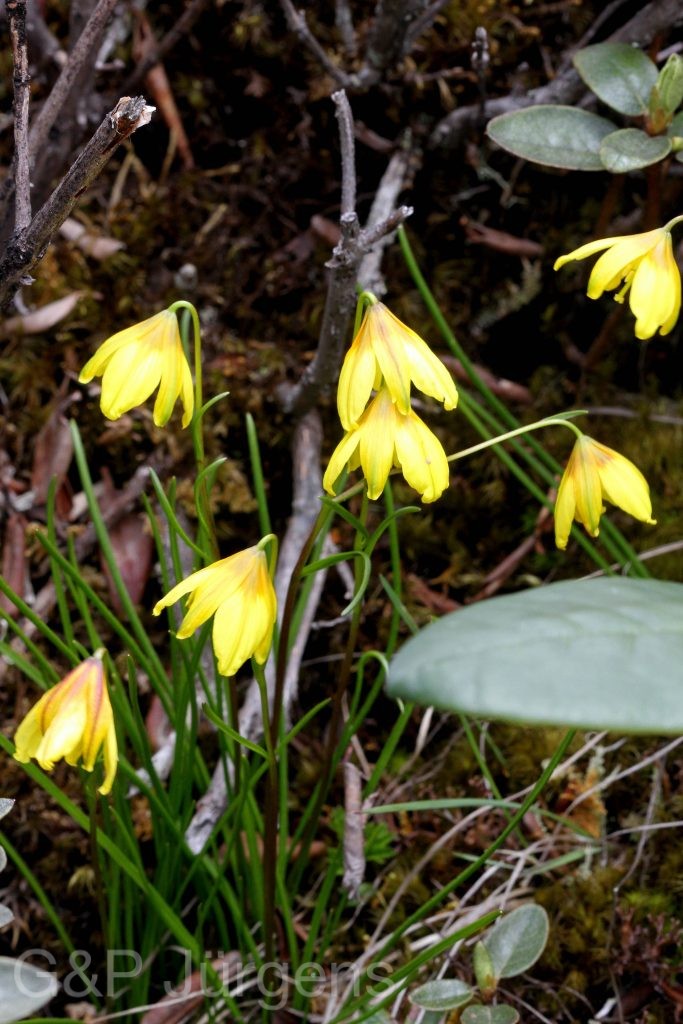
Gagea flavonutans

by GP Jürgens

(H.Hara) Zarrei & Wilkin

Sikkim2011 100
Sikkim Chopta-valley 4200m, June
Sikkim2011 120
Sikkim Chopta-valley 4200m, June

Description

Gagea flavonutans is a small alpine bulbous geophyte of the eastern Himalaya, recorded from Nepal, India, China, Bhutan and Myanmar, with about 104 georeferenced occurrences clustered along the high inner ranges. It grows in open alpine turf, on grassy and stony slopes, screes and moist ground at the edge of melting snow, chiefly between roughly 3800 and 4500 m. The plant was photographed in the Sikkim Chopta Valley at 4200 m in June, an elevation and season characteristic of the genus, whose members flush and flower rapidly in the brief interval following snowmelt before the soil dries.

It is a slender, hairless perennial arising from one or few ovoid tunicate bulbs. There are typically two narrowly linear basal leaves, channelled and grass-like, considerably exceeding the short scape. The inflorescence is few-flowered, the flowers nodding as the epithet flavonutans implies. The perianth comprises six free, narrowly elliptic to oblong tepals, yellow within and often greenish or purplish-tinged on the outer surface; the six stamens have slender filaments and small anthers, and the superior tricarpellate ovary bears a single style. The fruit is a small loculicidal capsule containing numerous seeds.

Gagea (Liliaceae) is a large, taxonomically difficult Old World genus in which species are delimited by bulb structure, leaf number and section, and floral orientation; G. flavonutans, originally described by Hara, was transferred to Gagea in the molecular reassessment by Zarrei and Wilkin that absorbed the segregate Lloydia into a broadened Gagea. Its nodding yellow flowers and high-Himalayan range distinguish it within this complex. As a short-statured snowbed geophyte it is sensitive to changes in snow cover and grazing, though it remains locally frequent and is not currently regarded as threatened.

Author: (H.Hara) Zarrei & Wilkin · Sources: POWO (Kew), GBIF, Flora of China, Annotated Checklist of the Flowering Plants of Nepal, Zarrei & Wilkin phylogenetic revision of Gagea

Gagea lutea

by GP Jürgens

Ker Gawl.

Nepal 97 140 G265
Nepal Mewa-Khola 3100m April
Nepal 97 141 P266
Nepal Mewa-Khola 3100m April

Description

Gagea lutea is a widely distributed Eurasian geophyte, abundant across temperate Europe and northern Asia, with a very large GBIF dataset of over 97000 records from Sweden, Germany, France, Britain, Poland, Russia, Norway, the Netherlands and many other countries, extending eastward to Japan. It grows in deciduous woodland, riverine forest, hedgerows, damp meadows and shaded slopes, typically on moist, base-rich soils. As a spring ephemeral it flowers early and dies back by summer. The photographed plant from the Mewa-Khola valley in eastern Nepal at 3100 m, flowering in April, marks the southeastern Himalayan edge of its range, where it persists in cool, humid montane forest.

It is a small bulbous perennial with a single ovoid bulb. The defining feature is the solitary, broadly linear to linear-lanceolate basal leaf, which is flat, hooded at the apex, somewhat keeled and usually exceeds the inflorescence. Two unequal leaf-like bracts subtend the umbel-like cyme of few flowers. Each flower has six free, narrowly oblong tepals that are bright yellow within and green-striped outside, blunt to subacute at the apex. There are six stamens with yellow anthers and a superior three-locular ovary bearing a single style. The fruit is a loculicidal, obovoid to subglobose capsule producing flattened, subglobose seeds.

Gagea lutea is the type species of its genus and belongs to the tribe Tulipeae of the Liliaceae. It is the well-known Yellow Star-of-Bethlehem, often forming clonal patches; many populations are non-flowering and reproduce vegetatively by bulbils, complicating field census. Pollination is by early-flying bees and flies, and the elaiosome-bearing seeds are partly ant-dispersed (myrmecochory). Though locally declining through woodland loss, it remains common over its vast range and is of least concern.

Author: Ker Gawl. · Sources: POWO (Kew), GBIF, Flora of China Vol. 24, Flora of Nepal, Flora of Pakistan, Levichev Studies in the Genus Gagea (monograph)

(Maxim.) S.C.Chen, P.J.Cribb & S.W.Gale

Nepal 99 34 ergebnis
West-Nepal Chere 3000m June

Description

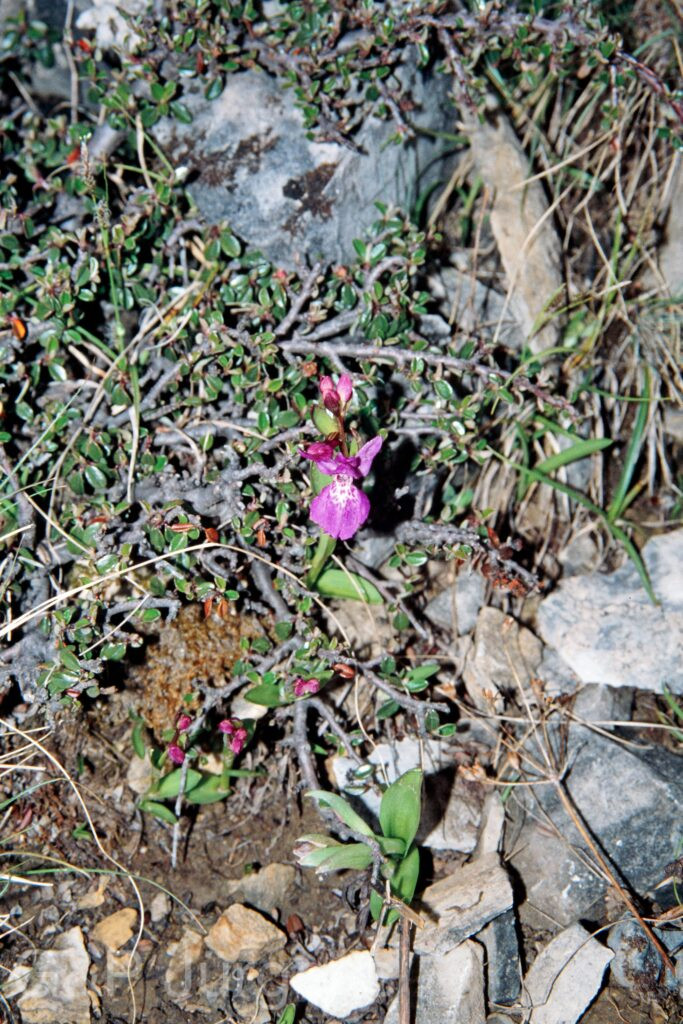
Galearis roborovskii is a terrestrial orchid distributed across the high mountains of Central and East Asia, with georeferenced records documented from China, Nepal, Bhutan, India, Myanmar, Japan and Russia, comprising about 154 occurrences in GBIF. It is a plant of cool, moist alpine and subalpine habitats, favouring open meadows, grassy slopes, streambanks and forest margins where snowmelt maintains soil moisture through the growing season. The species generally occurs between roughly 2500 and 4000 m, and the population photographed at Chere in West Nepal at about 3000 m in June, at the onset of the monsoon flowering season, falls within this montane belt.

It is a small, glabrous, tuberous geophyte arising from ovoid to oblong fleshy tuberoids. The slender, erect stem bears one or two basal leaves that are oblong-elliptic to lanceolate, sheathing at the base and often fleshy. The inflorescence is a short, few-flowered terminal raceme subtended by leaf-like bracts. The flowers are purple to rose-pink, with the dorsal sepal and petals converging to form a loose hood (galea) over the column; the lateral sepals spread or are reflexed, and the trilobed labellum is deflexed and produced basally into a slender, cylindric to clavate spur. The fruit is a small erect dehiscent capsule releasing abundant dust-like seeds.

The genus Galearis was resurrected and recircumscribed on molecular grounds, and this species was transferred from Orchis by S.C.Chen, P.J.Cribb and S.W.Gale; it sits within subtribe Orchidinae. Like most temperate terrestrial orchids it depends on mycorrhizal fungi for germination and establishment, rendering it sensitive to grazing, trampling and habitat disturbance. Though presently widespread and not formally assessed as threatened across its broad Himalayan to Sino-Russian range, localised populations warrant monitoring against alpine land-use pressures.

Author: (Maxim.) S.C.Chen, P.J.Cribb & S.W.Gale · Sources: POWO (Kew), GBIF, Flora of China, Flora of Bhutan, Flora of Nepal, Pearce & Cribb The Orchids of Bhutan

(Lindl.) P.F.Hunt

Sikkim2011 207
Sikkim Lachung 3100m, June
Nepal 99 809 ergebnis
West-Nepal Baga-La-Phedi 4300m, July

Description

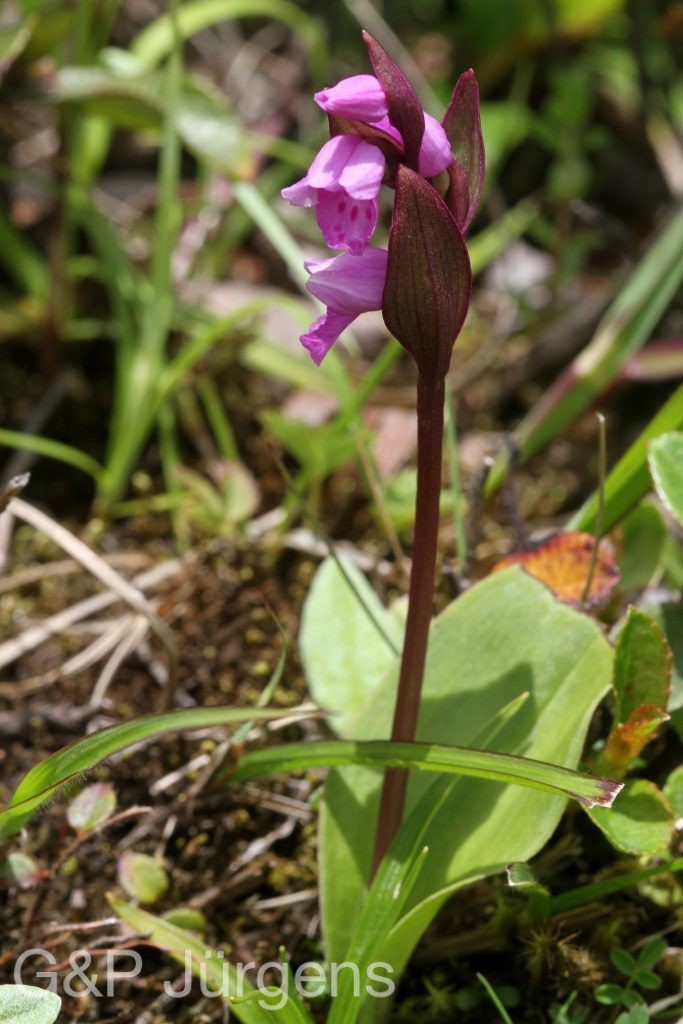
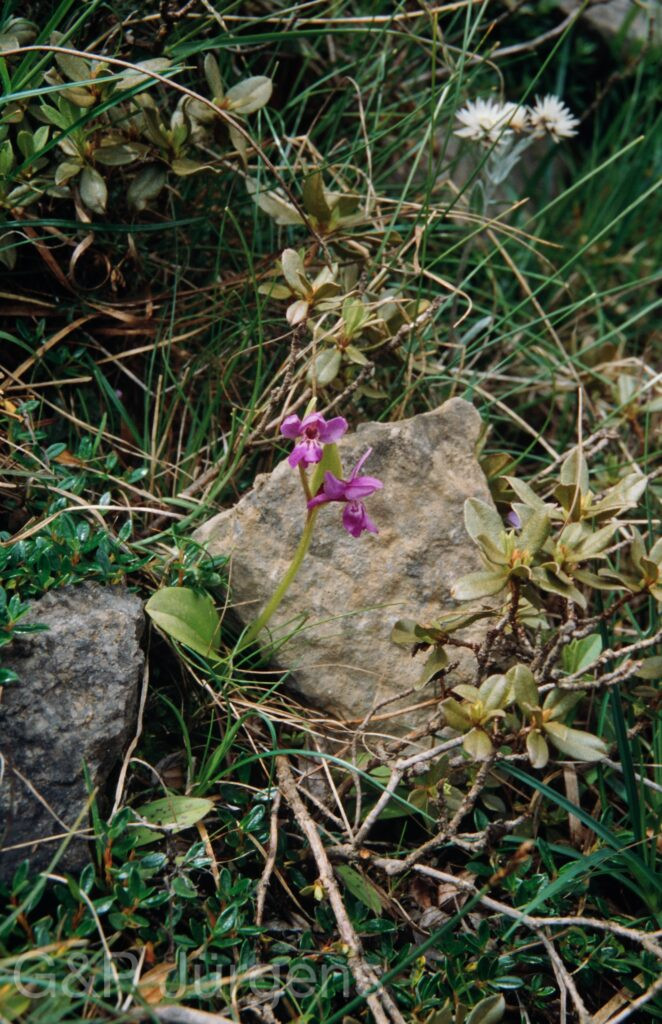
Galearis spathulata is a small terrestrial orchid of the high Himalaya and the mountains of western China, recorded from China, India, Nepal, Bhutan and Myanmar, with over 500 occurrences in GBIF. It is a plant of moist alpine and subalpine meadows, open Rhododendron and juniper scrub, grassy slopes and rocky turf, generally between about 3,000 and 4,500 m. The illustrated gatherings span this range, from Lachung in Sikkim at around 3,100 m in June to Baga-La-Phedi in West Nepal at about 4,300 m in July, where the species flowers through the early summer monsoon.

It is a dwarf, glabrous perennial herb arising from slender, fleshy root-tubers and bearing usually one or two basal, spathulate to oblong leaves that taper to a sheathing base. The short, erect stem terminates in a few-flowered raceme of small purplish-pink flowers, each subtended by a bract. The dorsal sepal and petals converge to form a hood over the column, the lateral sepals spreading; the labellum is entire to obscurely lobed, directed forward and produced at the base into a short, cylindrical to saccate spur. The fruit is an erect, ribbed capsule releasing dust-like seeds.

Galearis is a small holarctic-temperate to Sino-Himalayan genus segregated from Orchis, and G. spathulata is distinguished by its spathulate basal leaves and short-spurred, hooded flowers. Pollination is by insects, with seedling establishment dependent on mycorrhizal association, as in all orchids. Widespread and locally common across the alpine Himalaya, the species is not regarded as threatened, although, being an orchid, it falls under the general CITES Appendix II listing for the family.

Author: (Lindl.) P.F.Hunt · Sources: POWO (Kew), GBIF, Flora of China, Flora of Bhutan, Annotated Checklist of the Flowering Plants of Nepal, Pridgeon et al. Genera Orchidacearum

(Buch.-Ham. ex Sm.) D.Don

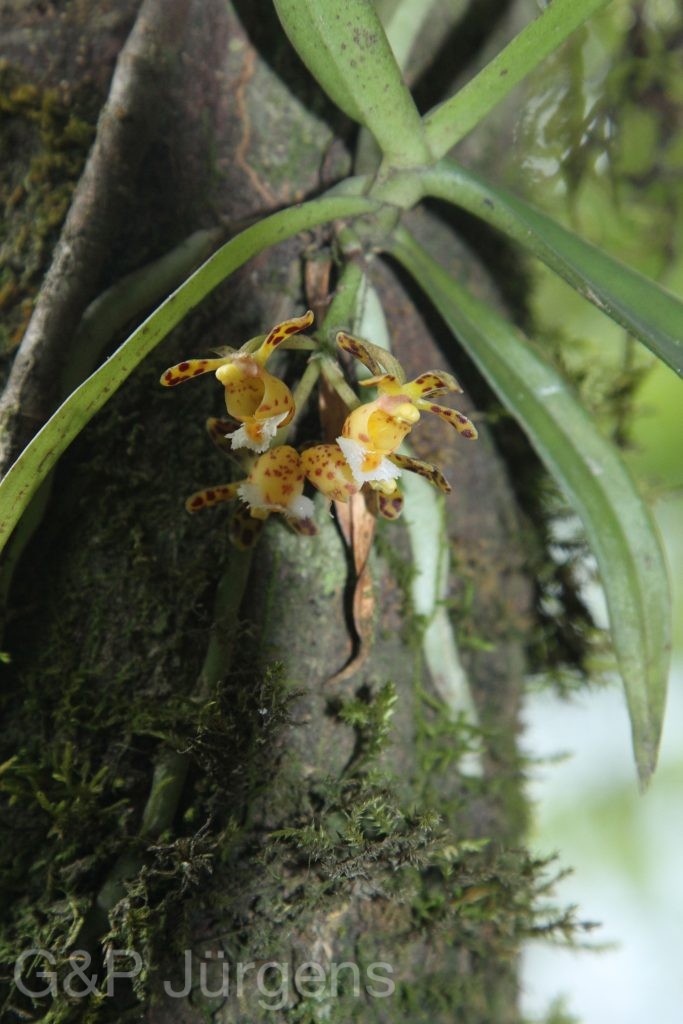
Bhutan2014 463
Bhutan Trongtsa 2030m, May
Bhutan2014 464
Bhutan Trongtsa 2030m, May

Description

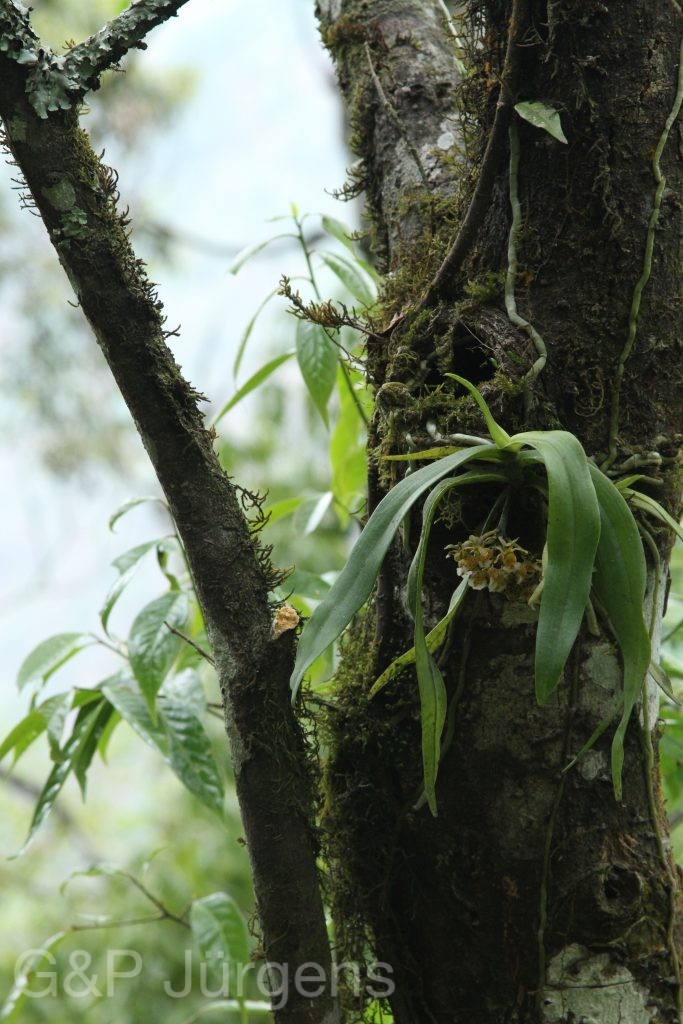
Gastrochilus calceolaris is a widespread epiphytic orchid of the eastern Himalaya and tropical-subtropical Asia, recorded by GBIF from China, India, Nepal, Bhutan, Myanmar and onwards through Vietnam, Thailand, Malaysia, the Philippines and Indonesia, with 356 georeferenced occurrences. It grows on the trunks and branches of broadleaved evergreen trees in humid montane and lower temperate forest, typically between about 1000 and 2300 m. The plant illustrated was photographed near Trongtsa (Trongsa) in central Bhutan at 2030 m in May, a setting of mossy oak and rhododendron forest where atmospheric moisture favours vandaceous epiphytes.

The species is a monopodial epiphyte with a short, stout stem clad in the persistent sheathing bases of distichous, ligulate to oblong leaves that are coriaceous and unequally bilobed at the apex. Numerous flexuous aerial roots anchor the plant. The short, pendent racemes bear several to many subumbellate flowers; the sepals and petals are yellowish green blotched with reddish brown. The labellum is three-lobed with a conspicuous saccate, helmet- or slipper-shaped hypochile (the source of the epithet calceolaris) and a fringed, transversely oblong epichile bearing a hairy central callus. The column is short and the pollinia are waxy.

First described as Aerides calceolaris by Buchanan-Hamilton ex Smith and transferred to Gastrochilus by D. Don, the species is the type-bearing representative of a genus of some five dozen Asian epiphytes segregated from Saccolabium. Though locally frequent across a vast range and not assessed as globally threatened, populations are vulnerable to forest clearance and to collection for the ornamental orchid trade.

Author: (Buch.-Ham. ex Sm.) D.Don · Sources: POWO (Kew), GBIF, Flora of Bhutan, Flora of China, The Genus Gastrochilus (Z.H. Tsi monograph), Orchids of Bhutan

Wall.

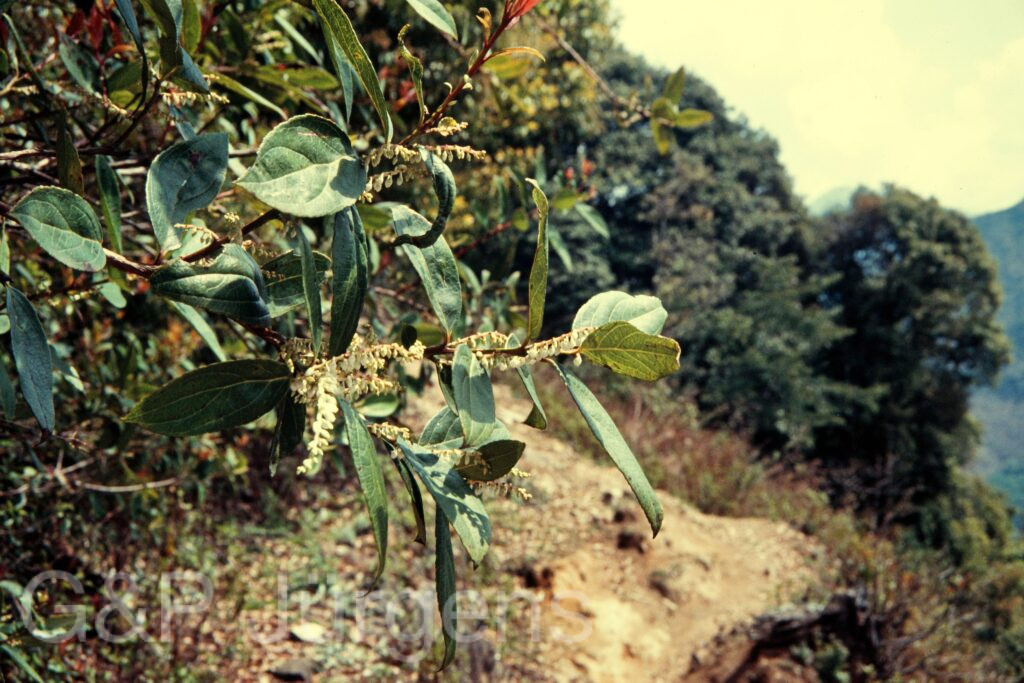
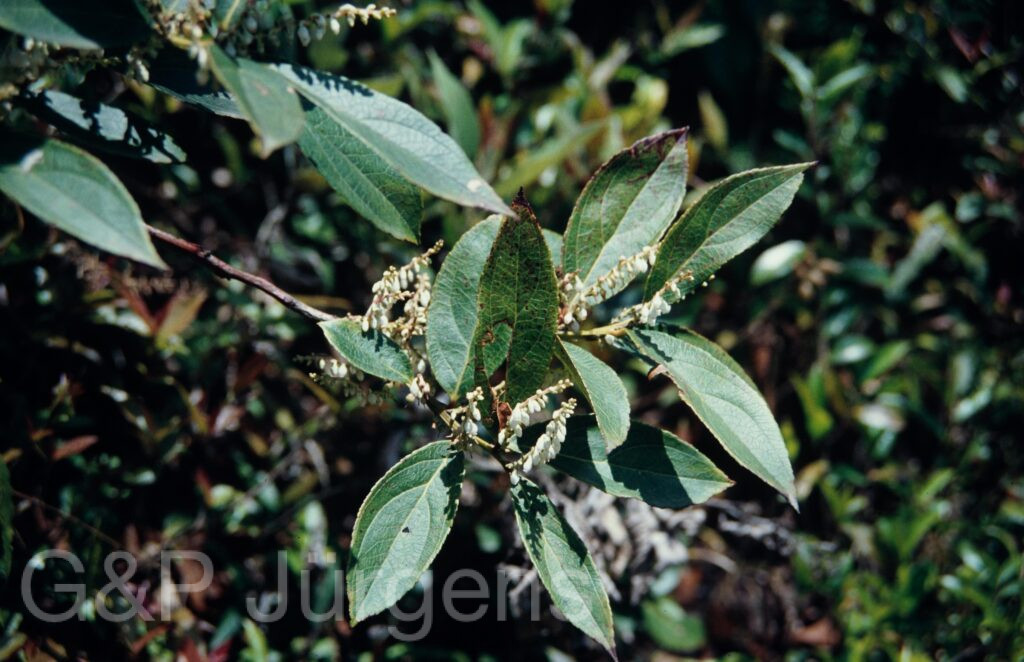
Nepal 97 89 P149
Nepal Tankhu 2200m, April
Nepal 1994 186 ergebnis
Ost-Nepal Jaljale Himal
2350 m, April

Description

Gaultheria fragrantissima Wall. is a wide-ranging evergreen shrub of the eastern Himalaya and montane tropical Asia, documented from Nepal, India, Bhutan, China, Myanmar, Sri Lanka, Thailand, Vietnam, Indonesia and Malaysia, with a substantial body of records (GBIF reports some 1,853 occurrences, the higher latitudes among them reflecting cultivation or introduction). It occupies forest margins, open hillsides, secondary scrub and clearings in oak, rhododendron and broad-leaved evergreen forest, typically at 1,500-2,800 m. The photographed material comes from central and eastern Nepal, at Tankhu (2,200 m) and the Jaljale Himal (2,350 m), both in April, where it flowers on sunny, well-drained slopes.

It forms a much-branched shrub 1-3 m tall, the young twigs reddish, bristly or shortly setose. The leaves are alternate, coriaceous, elliptic to lanceolate, 5-12 cm long, with a serrulate-glandular margin, acuminate apex and conspicuously reticulate venation, aromatic when crushed. Inflorescences are axillary or terminal racemes bearing numerous small, urceolate (urn-shaped) white to pinkish corollas about 4-6 mm long, the calyx persistent and accrescent. The fruit is a depressed-globose capsule enclosed by the swollen, fleshy, bluish-purple calyx, forming a berry-like false fruit, dispersed by birds.

A member of the large genus Gaultheria (Ericaceae, subfam. Vaccinioideae), the species yields a methyl-salicylate-rich essential oil ("Indian wintergreen oil") distilled from its foliage and harvested commercially across Nepal and India. This use, with its capacity to colonise disturbed and burnt ground, makes it locally abundant and of no conservation concern. Its broad ecological amplitude and bird-dispersed fleshy fruits underlie its extensive Indo-Malesian distribution.

Author: Wall. · Sources: POWO (Kew), GBIF, Flora of Nepal, Flora of China, Flora of Bhutan, Airy Shaw revision of Asiatic Gaultheria, Middleton monograph of Gaultheria