Tag:

Nepal

Flowers of Nepal — 1313 wild plant species documented from the Nepalese Himalaya, from subtropical foothills to high alpine meadows above 4,000 m. Nepal’s dramatic elevation gradient makes it one of the richest botanical regions on Earth, home to rhododendrons, primulas, gentians and the famed blue poppies (Meconopsis). Every entry gives a botanical description, native distribution, habitat and flowering season, alongside the original field photograph and the location where it was taken.

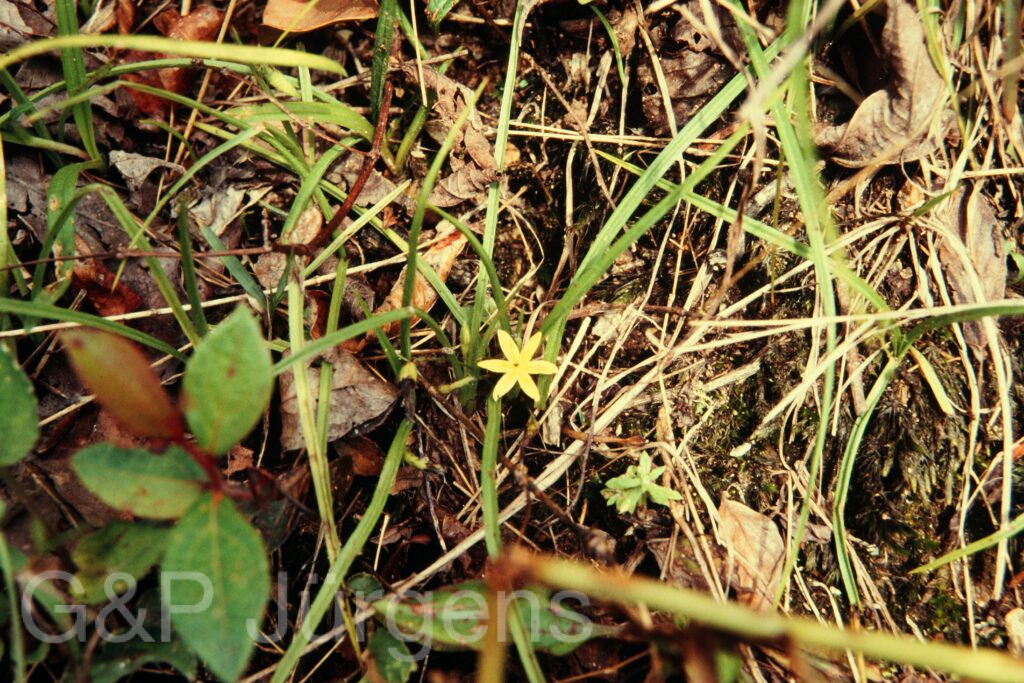
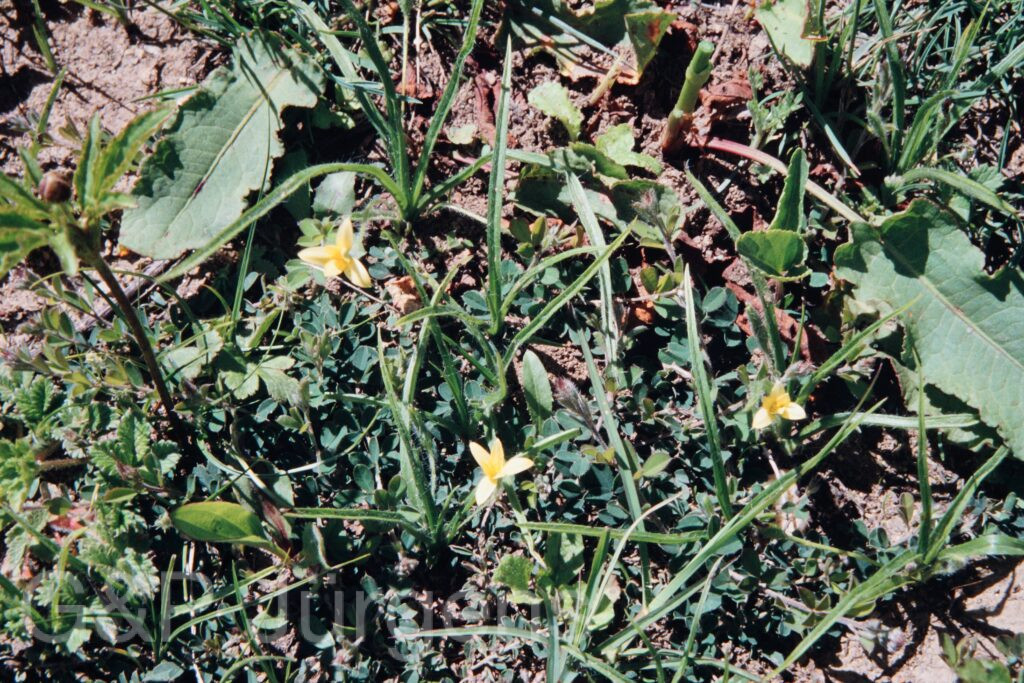
Hypoxis aurea

by GP Jürgens

Lour.

Nepal 97 491 P962
Nepal Num 1650m May
Nepal 99 198 ergebnis
West-Nepal Lara-Lake 2900m, June

Description

Hypoxis aurea Lour. is a small cormous geophyte of the Hypoxidaceae with a wide Asian and Pacific distribution, recorded from India, Nepal, Bhutan, Sri Lanka and China through Taiwan, Japan and Korea, across Southeast Asia (Myanmar, Thailand, Vietnam, Laos, Cambodia, Indonesia, the Philippines) to New Guinea, with around 1,240 georeferenced occurrences. It grows in open, well-lit grassy habitats: hill grassland, open pine and oak woodland, pasture, terrace banks and disturbed slopes, often in seasonally moist soils. The photographed plants from Num at about 1,650 m and from the Lara-Lake area of West Nepal at about 2,900 m, flowering in May and June, show its broad altitudinal span from subtropical foothills to the lower-temperate zone in the Himalaya.

It is a perennial herb arising from a small ovoid to tuberous corm. The leaves are all basal, several, narrowly linear and grass-like, often keeled and clothed (especially toward the base) in long soft hairs. The flowers are borne singly or few together on slender scapes shorter than or about equalling the leaves; each has six spreading yellow tepals, golden within and frequently greenish and hairy on the outer surface, with six stamens and an inferior, hairy ovary. The fruit is a small capsule opening to release numerous tiny black, often muricate seeds.

Hypoxis is a chiefly tropical and warm-temperate genus of grassland geophytes, and its members are well adapted to fire and seasonal drought through the perennating corm, which resprouts after burning or dry-season dormancy. The yellow, pollen-rich, nectarless flowers attract pollen-gathering insects. Widely distributed and frequently associated with grazed and disturbed grassland, H. aurea is common across its range and not considered threatened.

Author: Lour. · Sources: POWO (Kew), Flora of China Vol. 24, Flora of Bhutan Vol. 3, GBIF, Nordal: Hypoxidaceae (in Kubitzki, 1998)
(Hook.f. & Thomson) Al-Shehbaz & O’Kane

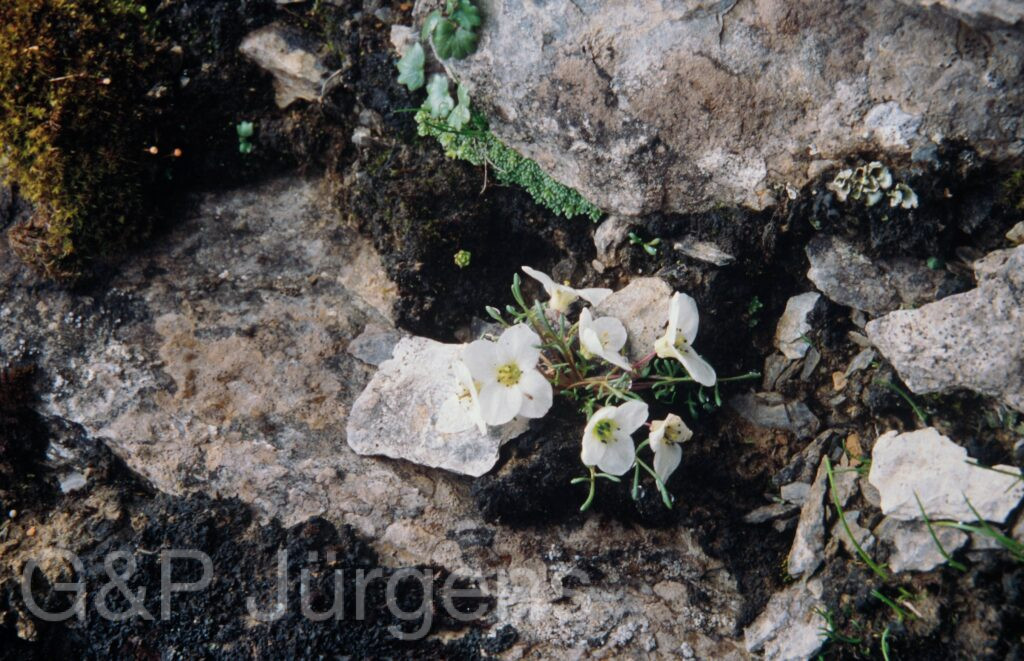
Nepal 99 819 ergebnis
West-Nepal Baga-La-Phedi 4300m, July

Description

Ianhedgea minutiflora is a diminutive, high-alpine crucifer with a broadly Irano-Turanian to western Himalayan distribution, recorded from Afghanistan, Pakistan, northern India, Tajikistan and Iran, and extending eastward into western Nepal. It is a plant of open, stony and gravelly ground, scree slopes, glacial moraines and dry alpine meadows at high elevations, typically between about 3,500 and 4,800 m. The collection from Baga-La-Phedi in West Nepal at 4,300 m in July reflects its occurrence in the cold, well-drained, sparsely vegetated terrain of the upper alpine zone, where the short summer growing season governs its rapid flowering.

The plant is a small annual or short-lived herb with slender, simple to branched stems arising from a thin taproot. The leaves are entire to slightly toothed, oblanceolate to spathulate and mostly basal. The inflorescence is a lax, ebracteate raceme bearing minute, inconspicuous flowers with four whitish petals scarcely exceeding the sepals, giving the species its epithet. The fruit is a small, linear, terete to slightly compressed silique that is sessile or shortly stipitate, dehiscing to release tiny seeds arranged in a single row per locule.

The genus Ianhedgea was segregated by Al-Shehbaz and O'Kane and named in honour of the cruciferologist Ian Charleson Hedge; the species was formerly placed in Sisymbrium and related genera, its basionym attributed to Hooker f. and Thomson. The transfer reflects molecular and morphological reassessment of the tribe Sisymbrieae. As an inconspicuous, widespread high-mountain annual, it faces no recognised conservation threat but is poorly documented owing to its small size and remote habitat.

Author: (Hook.f. & Thomson) Al-Shehbaz & O'Kane · Sources: POWO (Kew), Flora of Pakistan, Annotated Checklist of the Flowering Plants of Nepal, GBIF, Al-Shehbaz: Cruciferae systematics

Wall.

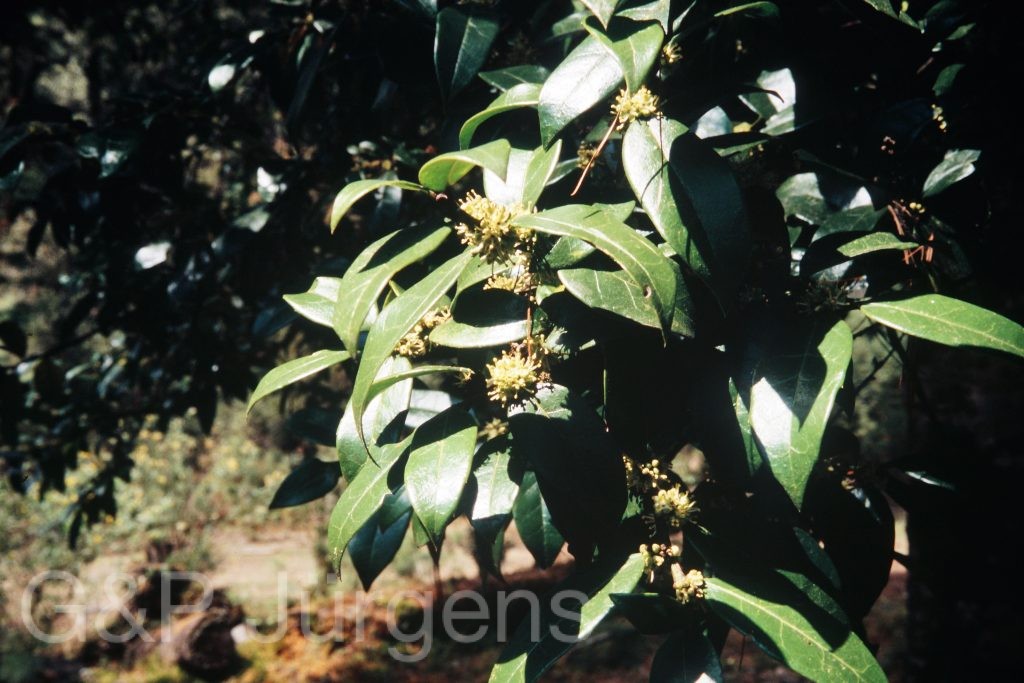
Bh2008 420 P656
Bhutan Phobjika, 3100m April

Description

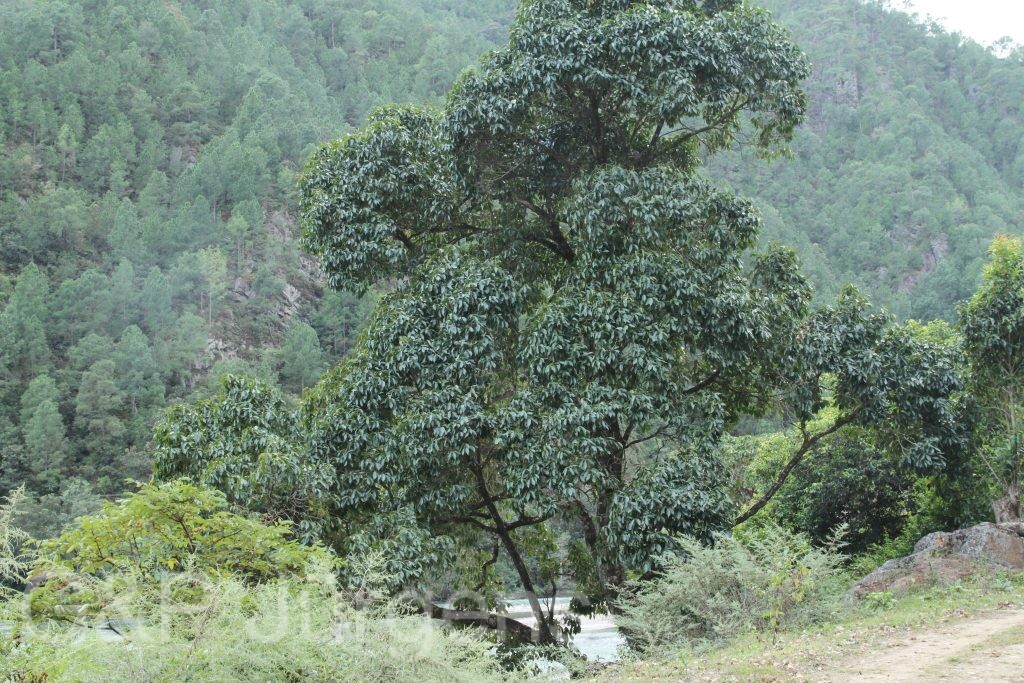
Ilex dipyrena, the Himalayan holly, is an evergreen tree or large shrub distributed along the Himalaya from Pakistan and northern India through Nepal, Sikkim and Bhutan into southern China (Yunnan, Xizang) and Myanmar. It is a characteristic constituent of cool temperate broad-leaved and mixed conifer forest, growing on shaded slopes, ridges and forest margins. It occurs mainly between about 1,800 and 3,300 m; the plant recorded in the Phobjikha valley of Bhutan at 3,100 m in April lies in the upper part of this band, within the moist temperate forest belt where it forms part of the evergreen understorey.

The plant is a small to medium-sized tree with greyish bark and glabrous twigs. The leaves are alternate, leathery and glossy dark green, elliptic to oblong-lanceolate, with a spinose-dentate margin bearing rigid marginal teeth on vigorous shoots, the teeth often reduced on older growth. The plant is dioecious, with small greenish-white, four-merous flowers clustered in the leaf axils. The fruit is a globose drupe ripening dull red, containing typically two pyrenes, a feature reflected in the epithet dipyrena, distinguishing it from the four- to five-seeded common holly.

Ilex is a large, near-cosmopolitan genus and the sole member of its family. Ilex dipyrena, described by Wallich, is the principal native holly of the Himalaya and a long-cultivated ornamental and parent of garden hybrids. Its evergreen, drupe-bearing habit provides food for birds, which disperse the seeds, and it contributes to the structure of temperate Himalayan forest. The species is widespread and common, and is not considered to be of conservation concern.

Author: Wall. · Sources: POWO (Kew), Flora of China Vol. 11, Flora of Bhutan Vol. 2, GBIF, Loizeau et al.: Ilex phylogeny

(Loes.) S.Y. Hu

Bhutan2015 536
Bhutan Mo-Chu 1300m, October
Bhutan2015 540
Bhutan Mo-Chu 1300m, October

Description

Ilex excelsa var. hypotricha is a holly of the eastern Himalaya and adjacent China, distributed through Bhutan, Nepal, NE India, Bangladesh and SW China as recorded by GBIF (CN, IN, NP, BD) on the basis of about 39 occurrences. The photographed tree was found in western Bhutan along the Mo-Chu at about 1,300 m in October. It is a component of subtropical and warm-temperate broadleaf forest, growing on humid hill slopes, along streams and forest margins, generally between about 1,000 and 2,200 m, where it occurs as an understorey to mid-canopy evergreen tree in mixed laurophyllous woodland.

It is an evergreen tree or large shrub with smooth grey bark and glabrous to finely puberulent young shoots. The leaves are alternate, leathery, elliptic to oblong-lanceolate, with an entire to remotely crenulate margin and an acuminate apex; this variety is distinguished by a thin pubescence on the lower surface, particularly along the midrib, the feature signalled by the epithet hypotricha. As in all Ilex the plants are dioecious, the small four-merous white to greenish flowers borne in axillary fascicles or short cymes, the staminate and pistillate flowers on separate trees. The fruit is a small globose red drupe containing several hard pyrenes (stones), characteristically ornamented as is diagnostic in the genus.

The genus Ilex is large and taxonomically intricate, with infraspecific variation in leaf indumentum often used to delimit varieties such as this one; the bony pyrene sculpturing remains an important systematic character. As a forest tree of moderately wide range, this taxon is not regarded as threatened, though its dependence on intact mid-elevation broadleaf forest links its fortunes to the conservation of eastern Himalayan woodland.

Author: (Loes.) S.Y. Hu · Sources: POWO (Kew), Flora of China Vol. 11, Flora of Bhutan Vol. 2, GBIF, Loesener: Monographia Aquifoliacearum

Hook.f. & Thomson

Bhutan2012 329
Bhutan Dochu-La 3200m, September
Bhutan2012 330
Bhutan Dochu-La 3200m, September

Description

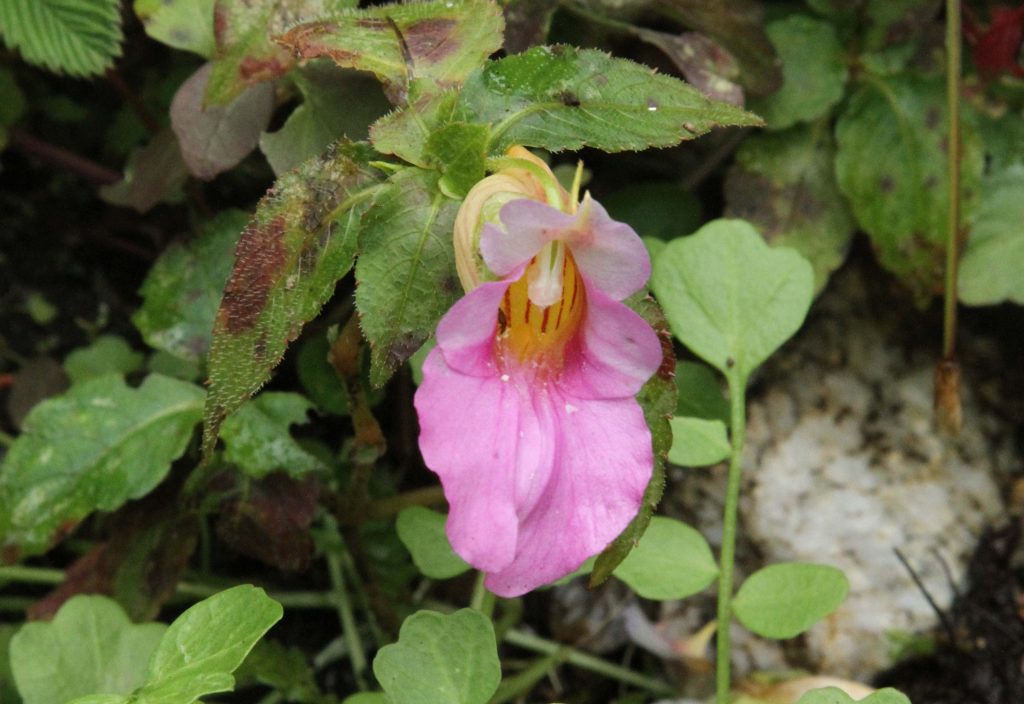
Impatiens arguta is a Sino-Himalayan balsam distributed from the central and eastern Himalaya through Myanmar into south-western China; GBIF records around 934 occurrences across China, India, Myanmar, Bhutan and Nepal. It is a plant of cool, humid temperate forest, growing on shaded moist banks, stream sides, forest margins and clearings, often in the broadleaved and mixed conifer belt. The image from Dochu-La in Bhutan at about 3200 m in September shows it flowering at a misty high pass late in the monsoon season, when temperate balsams reach their flowering peak in the abundant moisture and dappled shade of these slopes.

It is an erect, succulent perennial herb with stout, translucent, glabrous stems swollen at the nodes. The leaves are alternate or subopposite, ovate to lanceolate, with a sharply toothed (arguta, sharp-toothed) margin, an acuminate apex and a petiole sometimes bearing small glands. Flowers are borne singly or few together in the leaf axils on slender pedicels, zygomorphic and showy, typically purple to violet or pinkish; the lower sepal is boat-shaped and prolonged into a slender incurved spur, and the lateral united petals are two-lobed. The fruit is a fleshy, club-shaped capsule that dehisces explosively, scattering the seeds by elastic recoil of the valves.

The genus Impatiens is exceptionally species-rich and rapidly diversifying in the Himalaya, where many narrowly endemic taxa replace one another along altitudinal and longitudinal gradients. The explosive ballistic seed dispersal and nectar-spurred, insect-pollinated flowers of I. arguta are characteristic of the family. The species is widespread and not of conservation concern, but as a moisture-demanding forest herb it depends on the intact humid temperate woodlands of the eastern Himalaya.

Author: Hook.f. & Thomson · Sources: POWO (Kew), GBIF, Flora of Bhutan, Flora of China (Balsaminaceae), Grey-Wilson monograph of Impatiens

Hook.f.

Nepal 95 205 P344 ergebnis
Nepal Cluning-Khola 2900m October

Description

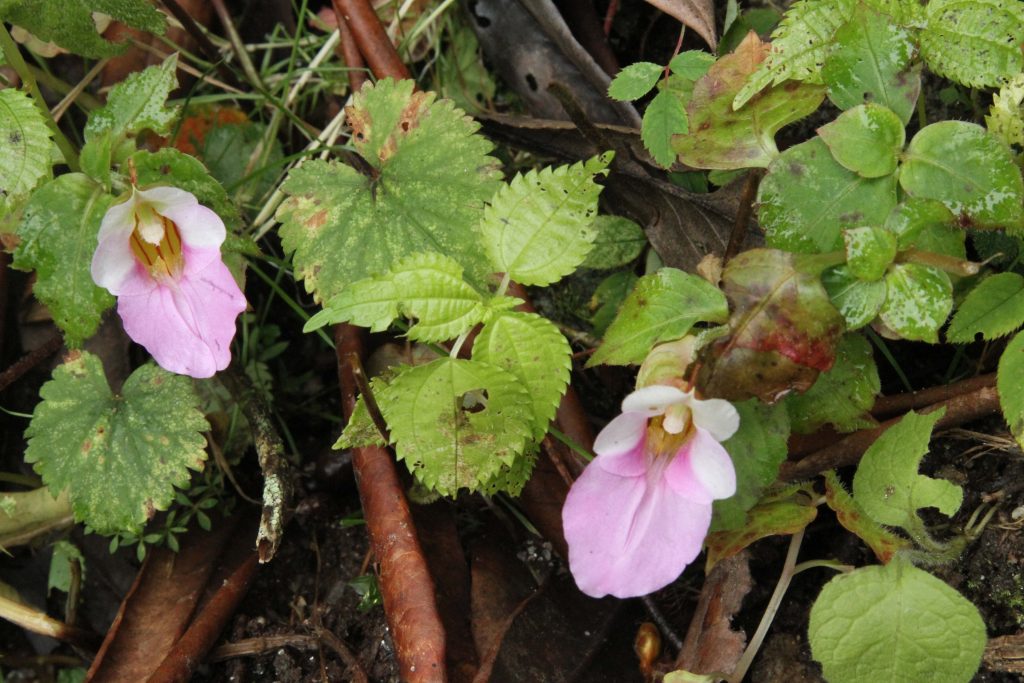
Impatiens cymbifera Hook.f. is a Sino-Himalayan balsam distributed across Nepal, China, India, Bhutan and Myanmar (NP, CN, IN, BT, MM), with GBIF recording about 103 occurrences. It is a plant of cool, humid montane forest, favouring shaded streamsides, seepage slopes, moist rock faces and path margins. The material photographed at the Cluning-Khola in Nepal at 2900 m in October reflects its autumn flowering in the temperate forest belt, where late-monsoon moisture sustains its succulent growth and prolongs anthesis into the post-monsoon season.

It is an erect, succulent annual with translucent, often reddish, watery stems swollen at the nodes and rooting below. The leaves are alternate, ovate to elliptic with a serrate margin bearing small stipitate glands at the base, and an acuminate apex. The flowers are borne singly or few in the leaf axils on slender pedicels, the corolla zygomorphic; the lower sepal is conspicuously enlarged into a boat-shaped (cymbiform, hence the epithet) saccate body abruptly contracted into an incurved spur, while the lateral united petals form two-lobed wings. The capsule is the characteristic clavate, explosively dehiscent fruit of the genus, scattering seeds by elastic recoil of the valves.

Within the large and intricate genus Impatiens, a centre of diversity in the Sino-Himalayan region, I. cymbifera belongs to the forest-dwelling annuals with strongly saccate lower sepals. Its flowers are pollinated by long-tongued insects, and explosive ballistic seed dispersal aids colonisation of moist disturbed ground. As a moisture-demanding annual it is tied to intact montane forest hydrology, and such balsams indicate undisturbed humid forest.

Author: Hook.f. · Sources: POWO (Kew), GBIF, Flora of Nepal, Flora of China Vol. 12, Flora of Bhutan Vol. 2, Grey-Wilson monograph and Sino-Himalayan Impatiens studies

DC.

Bh09 286 P469
Bhutan Tongtsa 2100m, June

Description

Impatiens discolor is an annual herb of the eastern Himalaya and adjoining ranges, documented by GBIF from Nepal, India, Bhutan, China, Thailand and Papua New Guinea across roughly 78 occurrences, several records being indeterminate as to country. It favours shaded, humid montane forest, growing along stream banks, in moist gullies and on seepage-fed roadside banks within evergreen and mixed broad-leaved woodland, typically at middle elevations. The photographed plant from Tongsa (Trongsa) in central Bhutan at about 2100 m, flowering in June with the onset of the monsoon, is typical of the warm, wet conditions that the genus exploits during the rainy season.

The plant has a succulent, translucent, often reddish stem that is erect or ascending and watery in texture, with swollen nodes. The leaves are alternate, ovate to elliptic, with a serrate or crenate-serrate margin and an acuminate apex, frequently glaucous or paler beneath, giving the discolorous appearance referenced by the epithet. The zygomorphic flowers are borne singly or in few-flowered axillary clusters; the lower sepal forms a saccate spur, and the showy yellow corolla (sometimes spotted) is built from a standard and two lateral united petals. The fruit is a fleshy, club-shaped capsule that dehisces explosively, the valves coiling abruptly to fling the seeds well away from the parent.

Balsaminaceae are notoriously taxonomically difficult, with Impatiens hyper-diverse and richly speciose in the Sino-Himalaya, where rapid radiation has produced many narrowly distributed, ecologically specialised taxa. Explosive seed dispersal and dependence on insect pollinators, together with a strictly annual life cycle, tie the species closely to seasonal monsoon moisture. While not formally assessed as threatened, the group's fine-scale habitat specificity makes individual populations sensitive to forest disturbance and altered rainfall regimes.

Author: DC. · Sources: POWO (Kew), GBIF, Flora of China, Flora of Bhutan, Annotated Checklist of the Flowering Plants of Nepal, Grey-Wilson "Impatiens of Africa" and Sino-Himalayan Impatiens monographic studies

Hook.f.

Bhutan2015 90
Bhutan Wangdi 1400m, October

Description

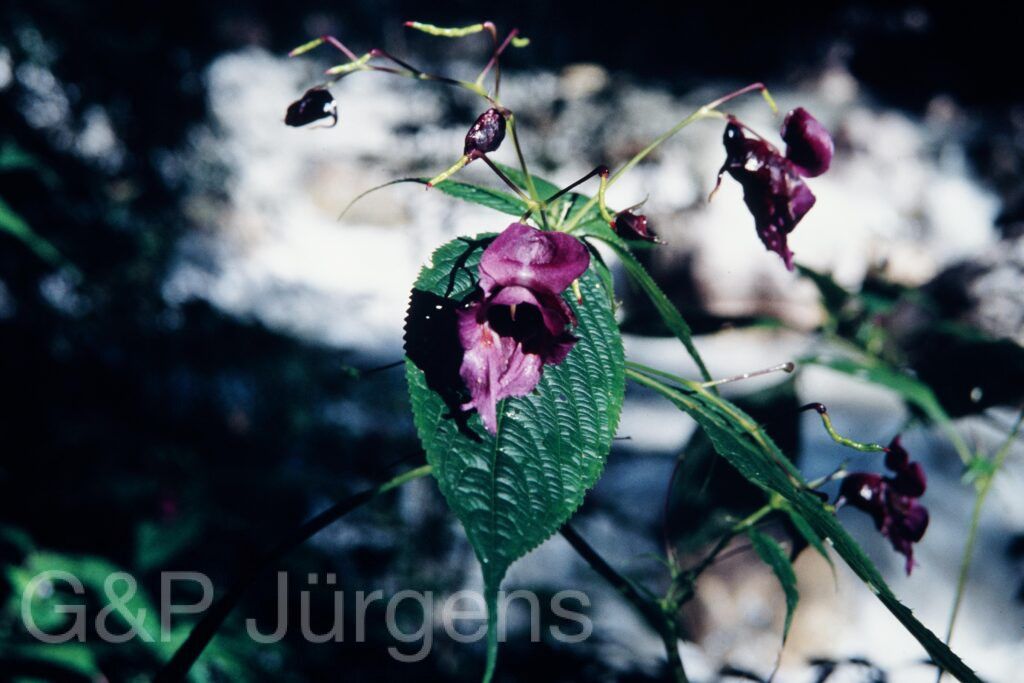
Impatiens drepanophora is a wide-ranging balsam of the eastern Himalaya and Indo-Burmese region, documented from Myanmar, China, India, Nepal, Bangladesh, Bhutan, Laos and Thailand, with around 126 recorded occurrences across this broad arc. It is a plant of warm-temperate to subtropical montane habitats, growing on moist shaded banks, along forest streams, in damp ravines and on disturbed roadside ground where seepage and high humidity prevail. The photographed plant from Wangdi in western Bhutan, at about 1400 m and flowering in October, reflects its mid-elevation preference and its characteristically late, post-monsoon flowering season.

It is a succulent annual with stout, translucent, often reddish-tinged stems that root at the lower nodes and branch freely. The leaves are alternate, ovate to elliptic-lanceolate with a long-acuminate apex and a crenate-serrate margin, the basal teeth or petiole base sometimes bearing stalked glands. The flowers are showy and zygomorphic, borne in axillary clusters, with a slender, conspicuously curved or sickle-shaped spur from which the epithet derives, the lower sepal forming the spurred sac; the lateral united petals and dorsal standard give the characteristic balsam form, the colouring pink to purplish. The fruit is the typical fleshy, explosively dehiscent capsule that scatters seeds when touched at maturity.

The genus Impatiens reaches exceptional richness in the eastern Himalaya, where wet forested slopes and a long monsoon foster numerous species distinguished largely by spur curvature, flower colour and leaf glands. The diagnostic falcate spur of I. drepanophora exemplifies the floral architecture that mediates pollination by long-tongued insects probing for spur-borne nectar. Being relatively widespread and tolerant of disturbed moist habitats, it is not of conservation concern, and like other balsams it can locally form abundant seasonal stands along watercourses and forest margins.

Author: Hook.f. · Sources: POWO (Kew), GBIF, Flora of Bhutan, Flora of China, Flora of British India, Grey-Wilson's Asian Impatiens revisions

Hook.f.

Bhutan2012 696
Bhutan Galephu 850m, September

Description

Impatiens exilis is an eastern Himalayan balsam restricted to a relatively narrow range, with confirmed occurrences in India, Nepal and Bhutan and only some 66 documented collections, marking it as a comparatively localised species. It favours warm, humid lower- to mid-montane settings, growing on shaded, moist banks, along forest streams and in disturbed wayside ground where seepage maintains moisture through the late monsoon. The photographed plant from Galephu in southern Bhutan, at around 850 m and flowering in September, reflects its preference for the foothill belt, considerably lower than many alpine congeners, and its tendency to bloom late in the rainy season.

In keeping with its epithet, it is a slender, delicate annual with translucent, watery, branching stems that root at the lower nodes. The leaves are alternate, thin in texture, ovate to elliptic-lanceolate with a serrate to crenate-serrate margin and a tapering apex, borne on slim petioles. The flowers are small and zygomorphic, solitary or few in the leaf axils, with the lateral sepals reduced and the lower sepal modified into a saccate spur typical of the genus; the corolla comprises an upper standard and paired lateral united petals, the colouring pale. The fruit is the explosively dehiscent fleshy capsule characteristic of Impatiens, propelling the seeds when ripe and disturbed.

Balsaminaceae, and especially Impatiens, form one of the great centres of diversity and endemism in the Himalaya, where rapid speciation has produced numerous narrow-range taxa distinguished by fine differences in spur shape, flower size and leaf form. The explosive ballistic seed dispersal aids short-distance colonisation of disturbed moist ground. As a small, restricted-range species, I. exilis warrants attention to habitat continuity along streams and forest edges, since such delicate annuals are vulnerable to drainage alteration and clearance, although no formal conservation assessment is currently in place.

Author: Hook.f. · Sources: POWO (Kew), GBIF, Flora of Bhutan, Flora of British India, Grey-Wilson's monographic Impatiens studies

Hook.f.

Sikkim2003 66 P89
Sikkim Choka 2900m, August

Description

Impatiens falcifer is an eastern Himalayan balsam with a restricted distribution spanning Nepal, Sikkim, Bhutan, and adjacent parts of southern China (Xizang). GBIF records list 67 occurrences, indicating a comparatively uncommon species. It is found in moist, sheltered habitats within temperate and subalpine forests, including shaded stream banks, mossy rock faces, and forest margins, at elevations of 2,200–3,500 m. The species frequently grows among ferns and other shade-tolerant herbaceous perennials in areas of high humidity.
Impatiens falcifer is an erect, succulent annual herb, 30–60 cm tall, with glabrous, translucent stems that are often reddish-tinged at the nodes. Leaves are alternate, elliptic to ovate-lanceolate, 5–12 cm long, with serrate margins bearing small glandular teeth; the petioles are slender, 1–3 cm long. Flowers are borne in few-flowered axillary racemes. The flowers are yellow, often with reddish spots in the throat, 2–3 cm long, with a deeply saccate lower sepal that narrows into a conspicuously curved or falcate spur — the defining character from which the epithet derives. The lateral united petals are bilobed, the upper lobe ovate, the lower lobe distinctly falcate. The fruit is a fusiform capsule that dehisces explosively when ripe, a characteristic of the genus.
Described by Joseph Dalton Hooker from Sikkim collections, Impatiens falcifer belongs to the large and taxonomically challenging eastern Himalayan radiation of the genus. The photographed specimen from Choka in Sikkim at 2,900 m represents a typical mid-elevation occurrence in cloud-forest habitat. The species can be distinguished from superficially similar yellow-flowered congeners such as I. urticifolia by the strongly curved spur and falcate petal lobes. Its narrow geographical range and dependence on intact moist forest habitats suggest potential vulnerability to deforestation and land-use change.

Author: Hook.f. · Sources: POWO (Kew), GBIF, Flora of British India Vol. 1 (Hooker 1875), Grey-Wilson: Impatiens of Africa (1980), Akiyama et al. (1993)