Tag:

Summer

Harry Sm.

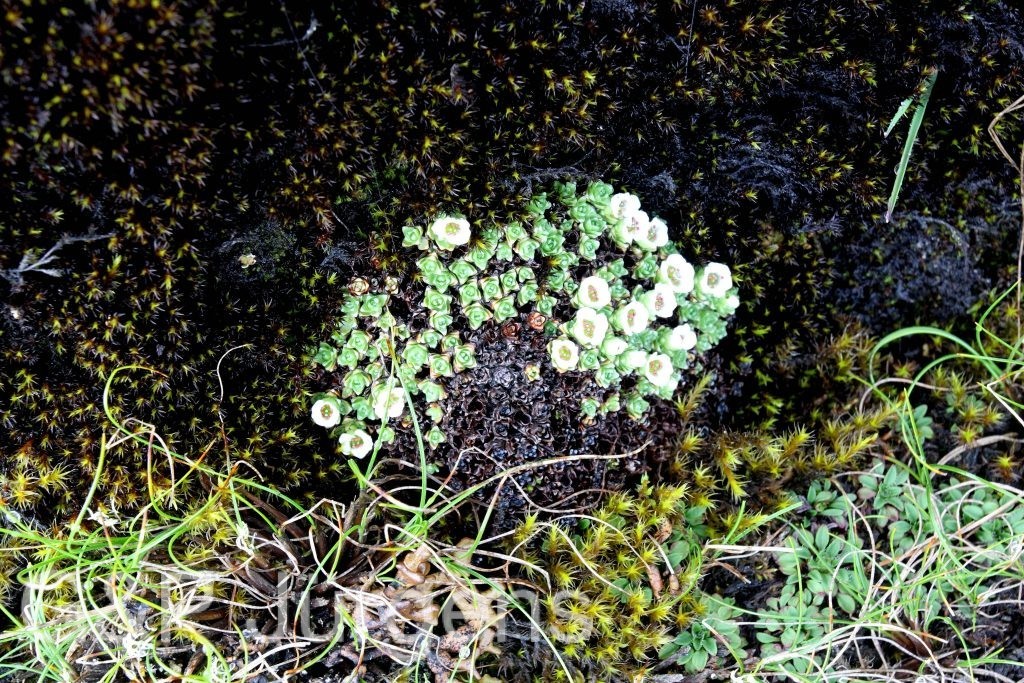
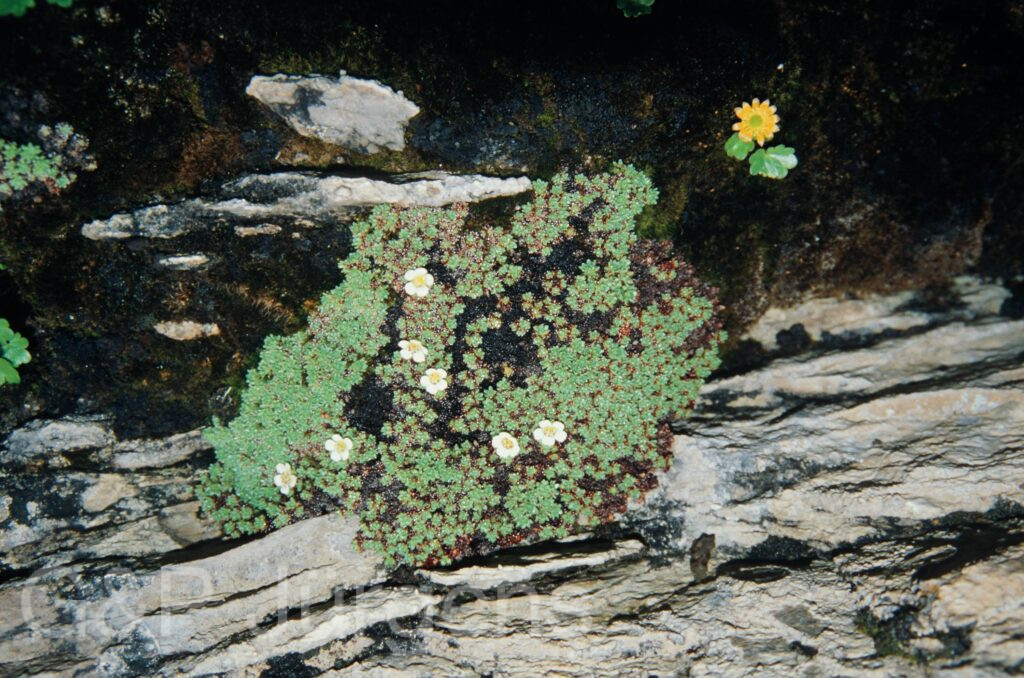
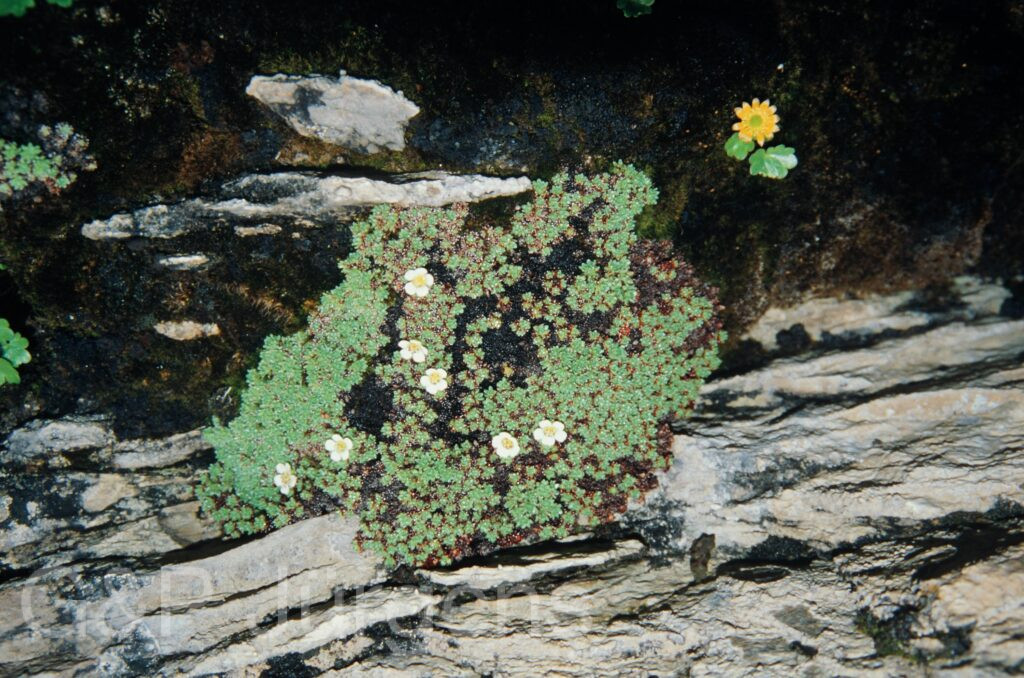
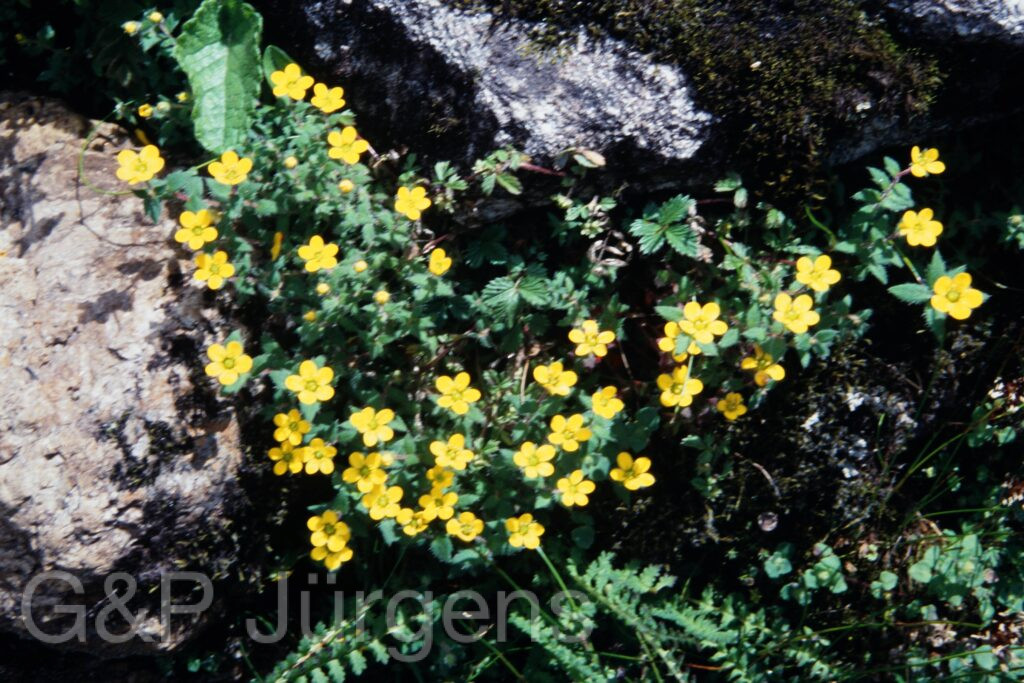
Sikkim2003 201 G281 ergebnis
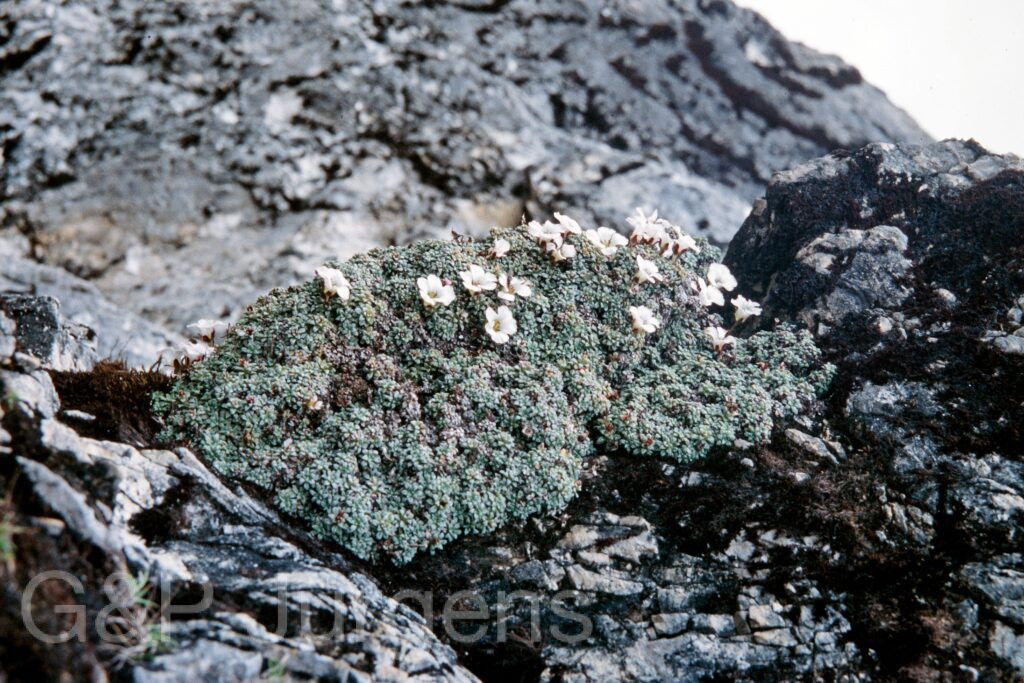
Sikkim Dzongri 3900m, August

Description

Saxifraga engleriana is a high-alpine perennial of the eastern Himalaya and adjacent southwestern China, recorded from China, Nepal, Bhutan, India and Myanmar; its roughly 51 GBIF occurrences are concentrated in the alpine zone of the Sino-Himalayan ranges. It is a plant of cool, humid altitudes, as exemplified by the collection above Dzongri in Sikkim at about 3900 m in August, when flowering coincides with the late-monsoon growing season. It grows in moist alpine turf, on rock ledges and in cliff crevices kept damp by snowmelt and cloud condensation, within the cushion-plant and dwarf-herb communities of the subnival belt.

The plant forms low, tufted to loosely matted growth from a branched caudex, the slender stems bearing small, somewhat fleshy leaves that may carry lime-secreting chalk glands at their margins, a trait of the encrusted silver saxifrages. The glandular-hairy flowering stems carry few-flowered cymes of small flowers with five free, usually white to pale petals, five sepals, ten stamens and a bicarpellate, semi-inferior ovary. The fruit is a two-beaked capsule splitting between persistent styles to release numerous minute seeds.

Saxifraga is a large, predominantly arctic-alpine genus whose Himalayan species are partitioned among sections distinguished by leaf encrustation and indumentum; S. engleriana belongs among the lime-encrusted alpines centred on the high mountains of central Asia. As a narrowly distributed orophyte of a cold, fragmenting habitat, it is potentially sensitive to climate-driven upslope contraction of the alpine zone, though its remoteness affords protection from direct disturbance.

Author: Harry Sm. · Sources: POWO (Kew), GBIF, Flora of China Vol. 8, Flora of Bhutan Vol. 1, Flora of Nepal, Saxifrages of the World (Webb & Gornall)
Harry Sm.

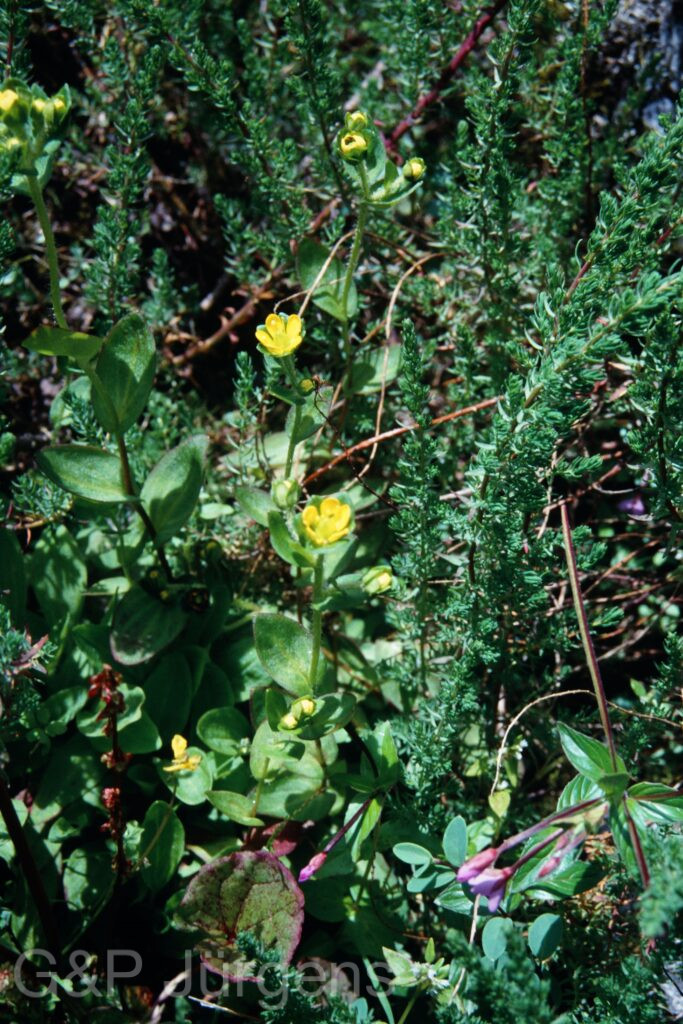
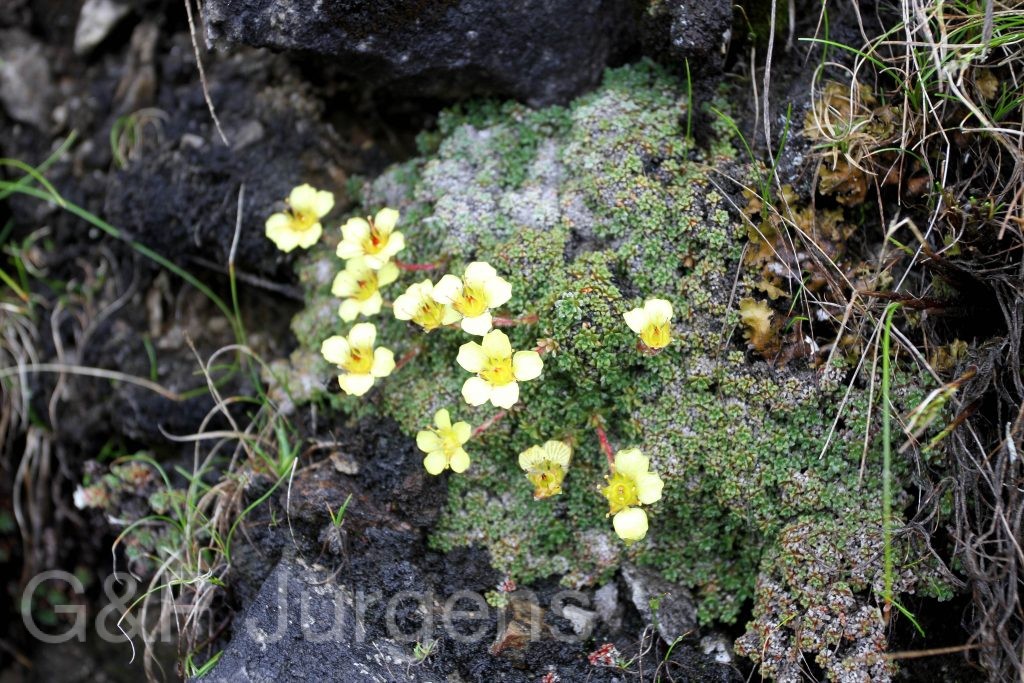
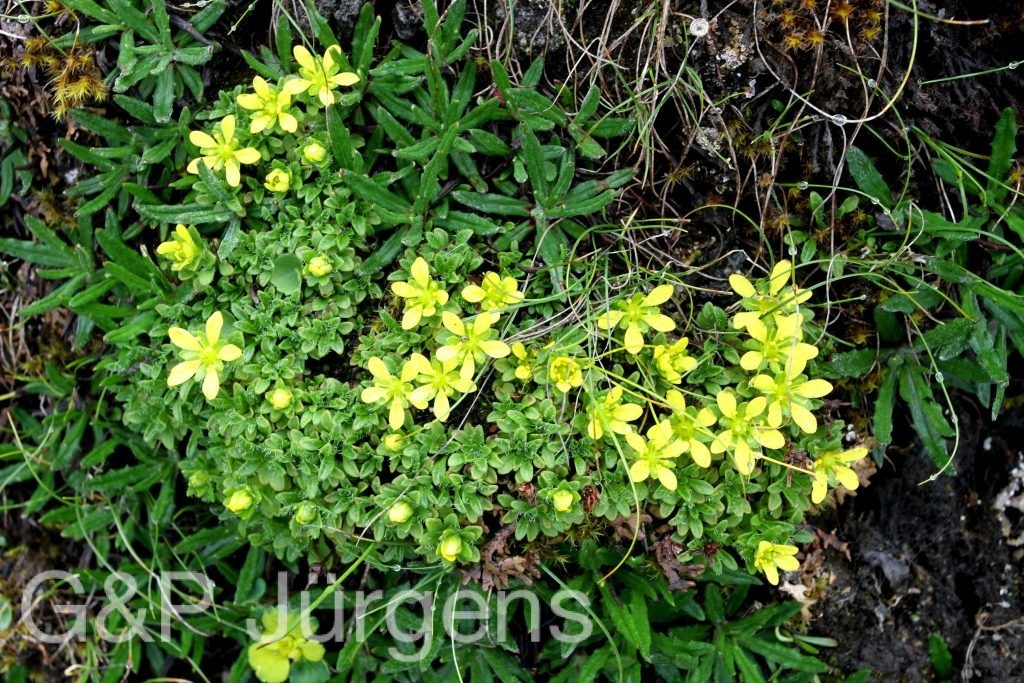
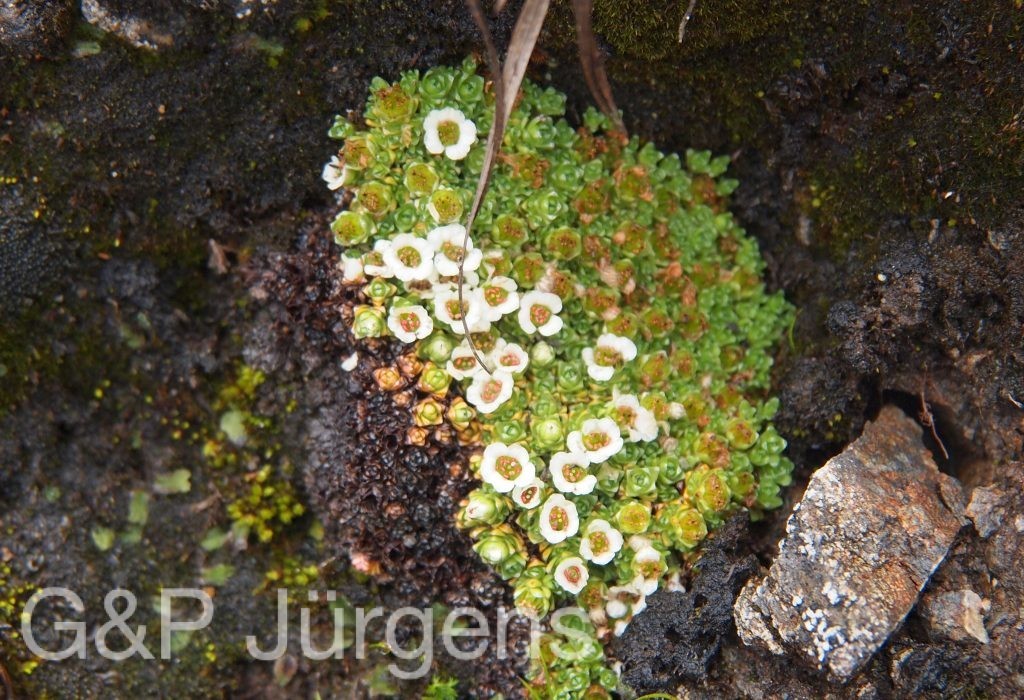
BhutanPG2011 465
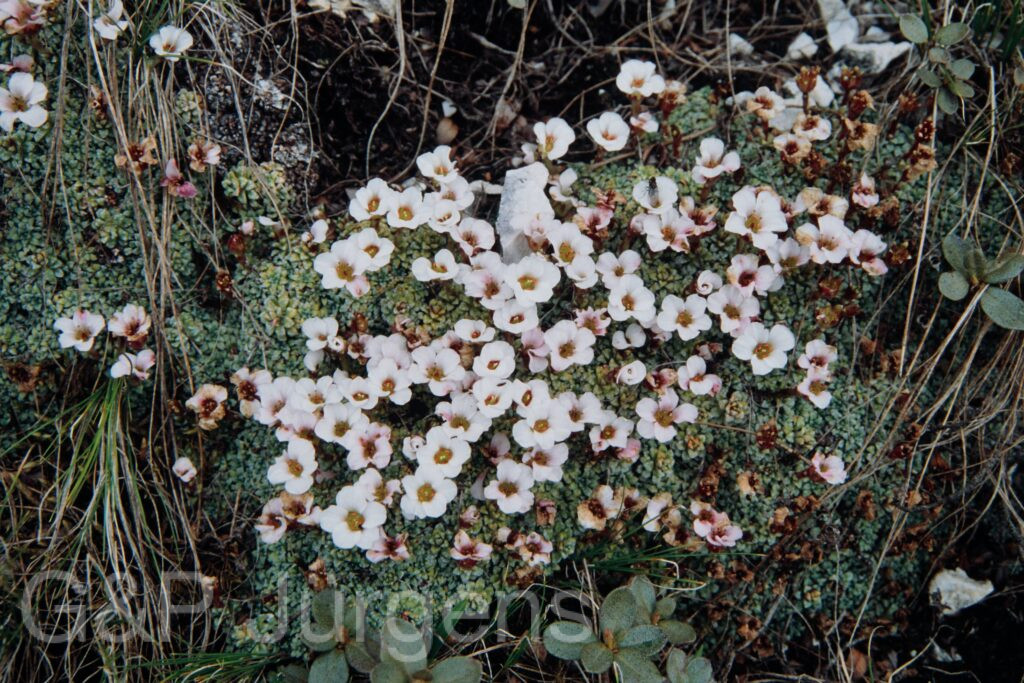
Bhutan Jule-Tso, 4300m June

Description

Saxifraga erinacea is a high-alpine cushion saxifrage of the eastern Himalaya, with a narrow distribution recorded by GBIF only from China (south-eastern Tibet) and Bhutan (12 occurrences), pointing to a restricted Sino-Himalayan range. It inhabits open alpine turf, fine scree, rock crevices and moist gravelly slopes well above the treeline, typically between about 4000 and 4800 m. The photographed plant from Jule-Tso in Bhutan at 4300 m, flowering in June, exemplifies its preference for the cold, exposed, snow-influenced alpine zone where it forms low mats among rocks moistened by snowmelt.

The species is a small, tufted to loosely cushion-forming perennial herb, the name erinacea (hedgehog-like) alluding to its bristly, congested habit. The leaves are small, narrowly oblong to linear, often rigid, marginally ciliate or setose and crowded into dense rosettes or low mats. Flowering stems are short, glandular-hairy, bearing one to few flowers held just above the foliage. Each flower is small and pentamerous, with five spreading petals (typically yellow to pale yellow) exceeding the calyx, ten stamens, and a bicarpellate ovary that is more or less superior. The fruit is a two-beaked capsule splitting between the divergent styles to shed numerous minute seeds.

Described by Harry Smith, a leading specialist on Asian Saxifraga, the species belongs within the large and morphologically diverse genus Saxifraga, most likely allied to the yellow-flowered alpine sections of the Sino-Himalaya. Its dense cushion architecture is a classic adaptation to cold, wind-exposed, desiccating high-mountain habitats, conserving heat and moisture. Given its apparently localised range and specialised alpine niche, the species is potentially sensitive to climate warming and upslope habitat compression, though it remains formally unassessed.

Author: Harry Sm. · Sources: POWO (Kew), GBIF, Flora of China, Flora of Bhutan, Saxifrages: The Complete Cultivars and Species (McGregor)

J. Anthony

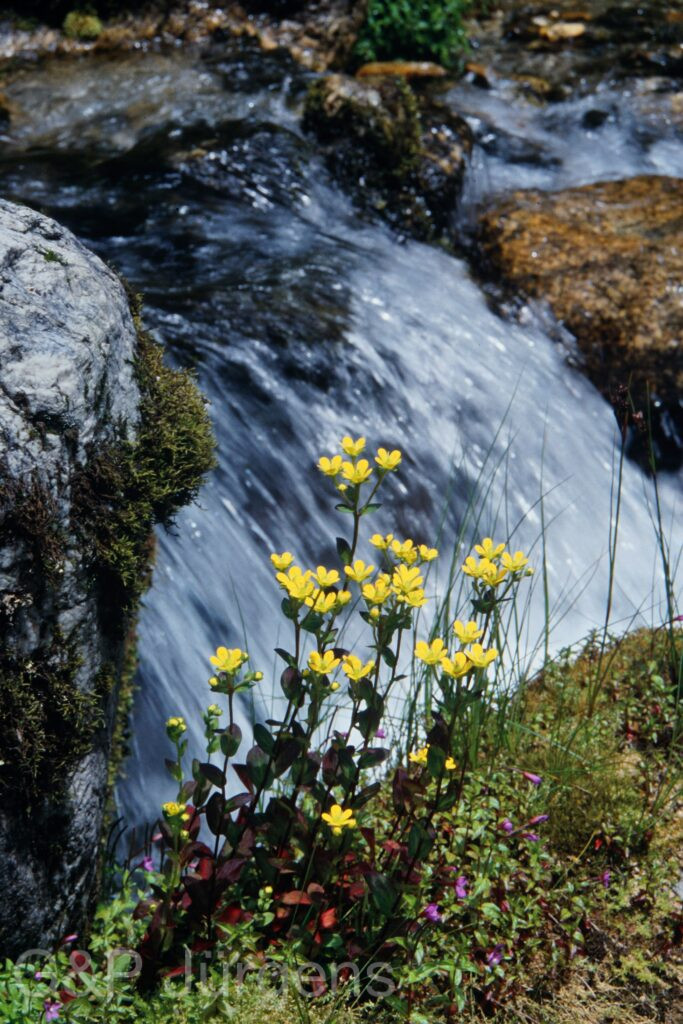
BhutanPG2011 295
Bhutan Jule-Tso, 4000m June
BhutanPG2011 467
Bhutan Jule-Tso, 4000m June

Description

Saxifraga georgei J. Anthony is a high-alpine saxifrage of the eastern Himalaya, recorded from Nepal, Bhutan, India and southern China, with around 50 GBIF occurrences reflecting its localised, high-elevation range; an isolated German record represents cultivated material. It grows on rocky alpine slopes, screes, moraines, cliff ledges and crevices, typically above about 3800 m. The photographed plant from Jule-Tso in Bhutan at approximately 4000 m, flowering in June, is characteristic of its niche in cold, exposed, rocky subnival terrain where it forms low cushions or tufts among stones.

The species is a small, mat- or cushion-forming perennial herb with a branched, somewhat woody base bearing dense rosettes of small, obovate to spathulate, often glandular-margined leaves. The flowering stems are short and few-flowered, glandular-hairy, carrying flowers with a cupular hypanthium, five free sepals and five yellow petals frequently marked with orange or reddish spots. The two carpels are partly fused below, ripening into a small bicarpellate capsule that opens to shed numerous minute seeds.

Saxifraga georgei is placed in Saxifraga section Ciliatae (subsection allied to the Sino-Himalayan cushion saxifrages, Saxifragaceae), a major radiation centred on the high mountains of western China and the Himalaya. Its cushion habit and glandular indumentum are adaptations to cold, desiccating high-altitude conditions. A narrow-range alpine specialist, it is uncommon and, while not formally assessed, is potentially vulnerable to climate-driven habitat contraction.

Author: J. Anthony · Sources: POWO (Kew), GBIF, Flora of Bhutan, Flora of China, Flora of Nepal, Gornall and Pan monographic studies of Saxifraga

Harry Sm.

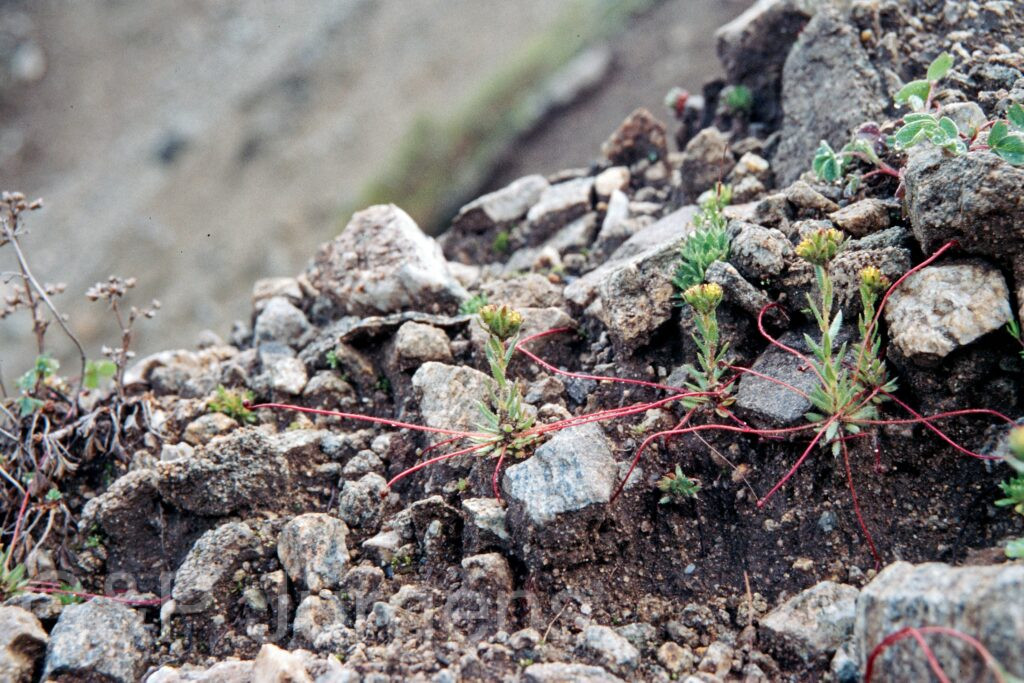
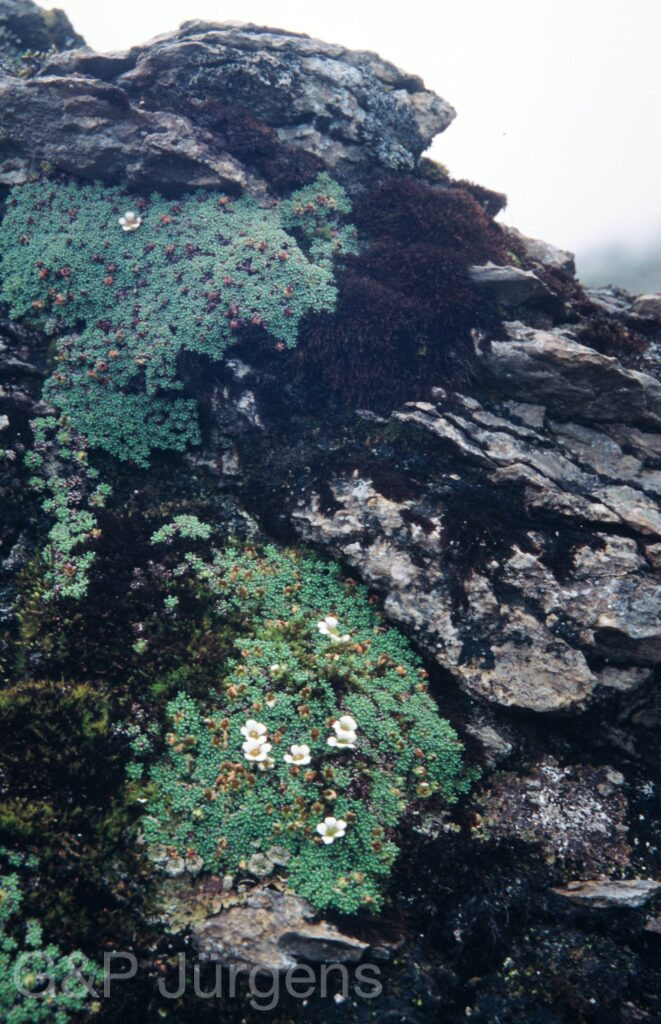
Nepal 99 620 ergebnis
West-Nepal Kagmara-La 4350m, July

Description

Saxifraga montanella Harry Sm. is a diminutive alpine perennial of the saxifrage family endemic to the high Himalaya and adjacent China, with GBIF recording 54 occurrences from China (CN), Bhutan (BT), Nepal (NP) and India (IN). It is a plant of stony alpine turf, rock crevices, moraines and damp gravelly slopes at high elevation, and was photographed in West Nepal on the Kagmara-La at 4350 m in July, in the open alpine zone during the brief high-mountain flowering season. The source URL references Saxifraga elliptica, reflecting the close affinity and historical confusion among related Himalayan saxifrages.

The plant is a small tufted or loosely matted herb with short, slender, often reddish stems. The leaves are mostly basal, forming a small rosette, oblong to spathulate or elliptic, entire and somewhat fleshy, with a few reduced cauline leaves. The flowers are small and usually solitary or few in a lax cyme, with five free sepals, five narrow yellow petals that are often spotted, ten stamens and a bicarpellate ovary that is half-inferior to nearly superior. The fruit is a capsule of two divergent, beaked follicles dehiscing to release numerous minute seeds.

Saxifraga is an enormous, taxonomically complex genus centred on the alpine and arctic Northern Hemisphere, and S. montanella belongs to the yellow-flowered Himalayan assemblage allied to section Ciliatae, which has radiated extensively in the Sino-Himalayan high mountains. Like other cushion and rosette saxifrages it is adapted to short growing seasons, intense radiation and freezing nights. Its narrow range and specialised alpine habitat make it potentially sensitive to climate warming, though it is not currently assessed for conservation status.

Author: Harry Sm. · Sources: POWO (Kew), GBIF, Flora of China, Flora of Nepal, Saxifraga monograph (Gornall; Pan revision of Himalayan Saxifraga sect. Ciliatae)

(Ser.) Wall. & Sternb.

Sikkim2003 218 P303
Sikkim Dzongri 3900m, August
Sikkim2003 219 G304
Sikkim Dzongri 3900m, August

Description

Saxifraga moorcroftiana is a Himalayan saxifrage distributed through Nepal, India, Bhutan, Pakistan and China, with about 281 georeferenced records confirming a wide presence across the high ranges. It is a plant of open, rocky alpine and subalpine ground — stony slopes, cliff ledges, moraine and gravelly meadows — in the zone above and around treeline. The illustrated material from Dzongri in Sikkim, at about 3900 m and flowering in August, reflects the late-summer flowering typical of the species in the moist eastern Himalayan alpine belt, where it grows among rocks kept moist by snow-melt.

The plant is a perennial herb forming tufts or low cushions from a branched rootstock, with rosettes of small, more or less fleshy, oblong to spathulate leaves that may be glandular-hairy and sometimes lime-encrusted along the margins. The flowering stems are erect, often reddish and glandular, bearing a few-flowered cyme or panicle. The flowers are small, with five free sepals, five spreading petals that are pale yellow to greenish-yellow, frequently spotted or flushed with red or orange, and ten stamens. The gynoecium consists of two largely fused carpels, ripening into a bilobed capsule that opens between the beaks to shed numerous minute seeds.

Saxifraga is a large, predominantly arctic-alpine genus, richly developed in the Sino-Himalayan mountains where numerous species occupy specialised rock and screen habitats. The combination is attributed to Wallich and Sternberg, the latter author of an early monograph of the genus. As a widespread component of Himalayan alpine vegetation, S. moorcroftiana is not regarded as threatened, though, like other high-mountain saxifrages, its narrow ecological requirements render local populations sensitive to grazing and to the upward shift of climatic zones.

Author: (Ser.) Wall. & Sternb. · Sources: POWO (Kew), GBIF, Flora of Pakistan, Flora of China (Saxifragaceae), Webb & Gornall: Saxifrages of Europe and monographic treatments of Saxifraga

H.Hara

Nepal 99 543 ergebnis
West-Nepal Churta-Khola 4200m, June

Description

Saxifraga neopropagulifera is a high-alpine cushion- or mat-forming perennial of the central Himalaya, known from Nepal and Bhutan, with GBIF recording 9 occurrences. It grows on damp rock ledges, moss-cushions, gravelly slopes and the margins of late-melting snow patches in the upper alpine zone. The illustrated plant was gathered in the Churta Khola of West Nepal at about 4200 m, flowering in June, where cold, well-drained substrates and a brief growing season prevail.

The species is a low, tufted herb forming compact rosettes of small, often spathulate to oblong leaves. As its epithet implies, it characteristically produces vegetative propagules (bulbils or gemmae) in the leaf axils or at the rosette base, a mode of clonal reproduction well suited to environments where seed set is unreliable. The flowering stems are short and few-flowered, bearing small white to pale flowers with five free petals, ten stamens, and a superior to half-inferior ovary maturing into a two-beaked capsule.

The taxon is accepted in current treatments. It belongs to a group of bulbil-bearing Himalayan saxifrages allied to Saxifraga propagulifera, whose names have been repeatedly revised; H. Hara erected the present species to accommodate Himalayan material. The reliance on asexual propagules is a recurrent adaptive theme among Sino-Himalayan alpine Saxifraga, underpinning persistence on unstable scree. As a narrowly distributed orophyte it is of biogeographic interest and potential conservation concern.

Author: H.Hara · Sources: POWO (Kew), GBIF, Flora of Nepal, Flora of Bhutan, Hara's Enumeration of the Flowering Plants of Nepal

Harry Sm.

Nepal 99 144 ergebnis
West-Nepal South of Rara-Lake 3800m, June
Nepal 99 145 ergebnis
West-Nepal South of Rara-Lake 3800m, June

Description

Saxifraga poluniniana is a cushion-forming alpine perennial of the western and central Himalaya, known from Nepal and India, with GBIF recording 30 occurrences. It occupies rock crevices, cliff faces, stable scree and moss-bound boulders in the upper subalpine to alpine zone. The photographed plant comes from south of Rara Lake in West Nepal at about 3800 m, flowering in June, a region of granitic outcrops and high-rainfall slopes where compact saxifrages thrive on shaded, moist rock.

The species forms dense, low cushions of small, crowded rosettes. The leaves are narrowly spathulate to linear-oblong, often hardened and lime-encrusted in the manner of section Porphyrion relatives, packed tightly to conserve moisture and resist wind exposure. The flowering shoots are short and usually carry a single, relatively large flower with five spreading petals, white to pale pink, ten stamens and a half-inferior ovary; the fruit is a small two-beaked capsule.

The taxon is accepted and was described by Harry Smith, a leading twentieth-century monographer of Sino-Himalayan Saxifraga, the epithet honouring the botanist Oleg Polunin, a noted collector in Nepal. As a narrow-range orophyte restricted to specialised rock habitats it is of considerable biogeographic interest; cushion saxifrages of this kind are valued in alpine horticulture and serve as indicators of intact high-altitude rock-ledge communities. Its limited known range warrants attention to its long-term conservation.

Author: Harry Sm. · Sources: POWO (Kew), GBIF, Flora of Nepal, Harry Smith's revisions of Asiatic Saxifraga, Polunin & Stainton's Flowers of the Himalaya

Harry Sm.

Nepal 99 592 ergebnis
West-Nepal, Grabung-Khola, July
Nepal 99 593 ergebnis
West-Nepal, Grabung-Khola, July

Nepal 99 824 ergebnis
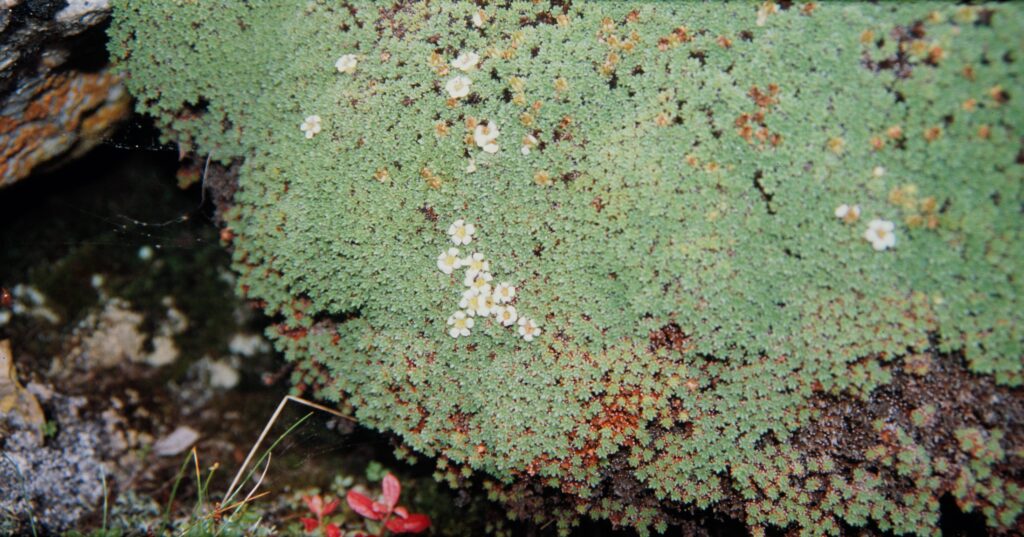
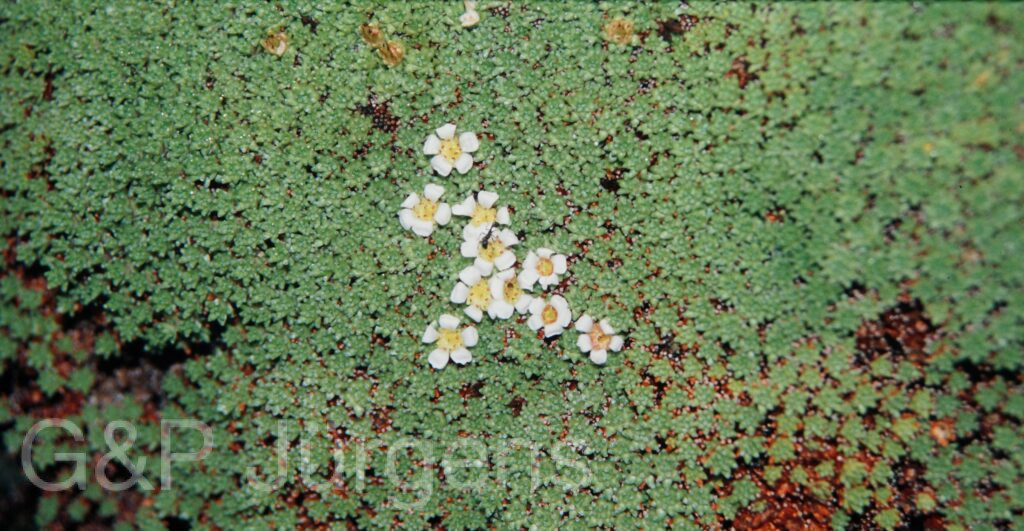
West-Nepal Baga-La-Phedi 4200m, July

Description

Saxifraga pulvinaria is a high-alpine cushion saxifrage of the Himalaya and adjacent Central Asia, recorded from Pakistan, India, Nepal, Bhutan and southern Tibet (China), extending into Tajikistan, Myanmar and the Russian mountains; GBIF holds about 287 occurrences. It is a plant of the upper alpine and subnival zone, colonising stony slopes, moraine, rock crevices and exposed fellfield, as documented in West Nepal at the Grabung-Khola and at Baga-La-Phedi at 4200 m. At these elevations the cushion habit is an adaptation to wind, frost, desiccation and intense radiation, and flowering is restricted to the brief summer window (July) following snowmelt.

It is a perennial forming a dense, compact, hemispherical cushion (the epithet "pulvinaria" denoting this pulvinate growth form) composed of crowded, columnar leaf rosettes. The leaves are minute, sessile, narrowly oblong to spathulate, often somewhat fleshy, imbricate and persistent, frequently bearing chalk-secreting hydathode lime pits along the margin characteristic of the encrusted saxifrages. The flowers are solitary and nearly sessile, set just above the cushion surface; they are small and 5-merous, with white to pinkish or pale yellow petals, ten stamens and a half-inferior to nearly superior ovary of two carpels. The fruit is a small two-beaked capsule releasing numerous minute seeds.

Described by the saxifrage specialist Harry Smith, the species belongs to Saxifraga sect. Porphyrion, the large group of cushion- and crust-forming alpine saxifrages centred on the high mountains of Asia and Europe. The compact cushion architecture buffers internal temperature and humidity and traps wind-blown debris, an ecological strategy shared with many subnival plants. The flowers are pollinated by the few flies and bees active at such heights. Widespread though confined to extreme habitats, the species is not regarded as threatened, but its cold, high-elevation niche makes it a sensitive indicator of alpine climate change.

Author: Harry Sm. · Sources: POWO (Kew), GBIF, Flora of Pakistan, Flora of China, Webb & Gornall's monograph of the Saxifrages

Harry Sm.

BhutanPG2011 349
Bhutan Jule-Tso, 4400m June

Description

Saxifraga sherriffii is a narrowly endemic alpine cushion plant known only from Bhutan (BT), where it is represented by a mere handful of records, around six documented occurrences. It is confined to the high alpine and subnival zone, growing on exposed rock ledges, in crevices of cliffs and on stony, well-drained slopes near the limit of vascular plant life. The type material and the plant shown here come from Jule-Tso in Bhutan at 4400 m, flowering in June; the species commemorates the collector George Sherriff, who with Frank Ludlow explored the Bhutanese and southeastern Tibetan mountains, and its extreme rarity reflects both its restricted range and the inaccessibility of its habitat.

The plant forms a small, dense, tufted to cushion-like perennial of woody-based rosettes. The leaves are small, crowded, spathulate to oblong and somewhat fleshy or leathery, frequently bearing chalk-secreting hydathode pits along the margin in the manner of the encrusted saxifrages, and clothed with glandular hairs. The flowering stems are short and glandular-pubescent, carrying few flowers. Each flower has five spreading petals, white to pale yellow and sometimes spotted, set above a half-inferior ovary, with ten stamens; the calyx lobes are reflexed in fruit. The fruit is a two-beaked capsule dehiscing between the divergent styles to release numerous minute seeds.

Saxifraga is a large, predominantly arctic-alpine genus in which the Himalayan high mountains hold many localised endemics. S. sherriffii belongs to the cushion-forming, lime-encrusting assemblage adapted to cold, wind-exposed, nutrient-poor rock habitats, where the compact growth form conserves heat and moisture. Given its tiny known range, very small number of populations and specialised high-alpine niche, this Bhutanese endemic is of considerable conservation interest and potentially vulnerable to climate-driven contraction of suitable habitat.

Author: Harry Sm. · Sources: POWO (Kew), GBIF, Flora of Bhutan, Saxifragaceae of the Himalaya, Saxifraga (Webb & Gornall monograph)

Harry Sm.

Nepal 99 823 ergebnis
Nepal Baga-La 4000m, July
Nepal 99 824 ergebnis
Nepal Baga-La 4000m, July

Description

Saxifraga staintonii is a rare, narrowly endemic saxifrage known only from central Nepal. It inhabits moist rock crevices, scree slopes, and alpine turf in the upper subalpine to lower alpine zone, at elevations of approximately 3,800–4,500 m. The species has been recorded from very few localities, with only three documented occurrences in GBIF, indicating an extremely restricted distribution. The photograph from the Baga-La at 4,000 m in July represents one of the few field records of this elusive species in its typical high-altitude habitat.
The plant forms compact cushions or loose tufts. Basal leaves are rosulate, spatulate to obovate, 5–12 mm long, with entire to crenulate margins, often glandular-hairy on the upper surface and margins. Flowering stems are erect, 3–8 cm tall, bearing 1–3 flowers in a lax cyme. Flowers are pentamerous with obovate white to pale yellow petals, 4–6 mm long, often with faint orange or red spots near the base. Stamens 10, with clavate filaments. The ovary is semi-inferior, maturing into a capsule with numerous minute seeds.
Saxifraga staintonii was described by Harry Smith and named in honour of J.D.A. Stainton, the eminent British botanist who contributed extensively to the floristic exploration of Nepal. The species belongs to the highly diverse Himalayan radiation of Saxifraga and its precise sectional placement remains under investigation. Given its extremely limited known range and few documented populations, it may warrant conservation attention, though its remote alpine habitat provides a degree of natural protection from direct anthropogenic disturbance. Further survey work in central Nepal is needed to clarify its full distribution.

Author: Harry Sm. · Sources: POWO (Kew), GBIF, Flora of Nepal (ongoing), Grierson & Long: Flora of Bhutan Vol. 1