Tag:

Summer

(E.Peter)

BhutanPG2011 130
Bhutan Kupang 3550m, June

Description

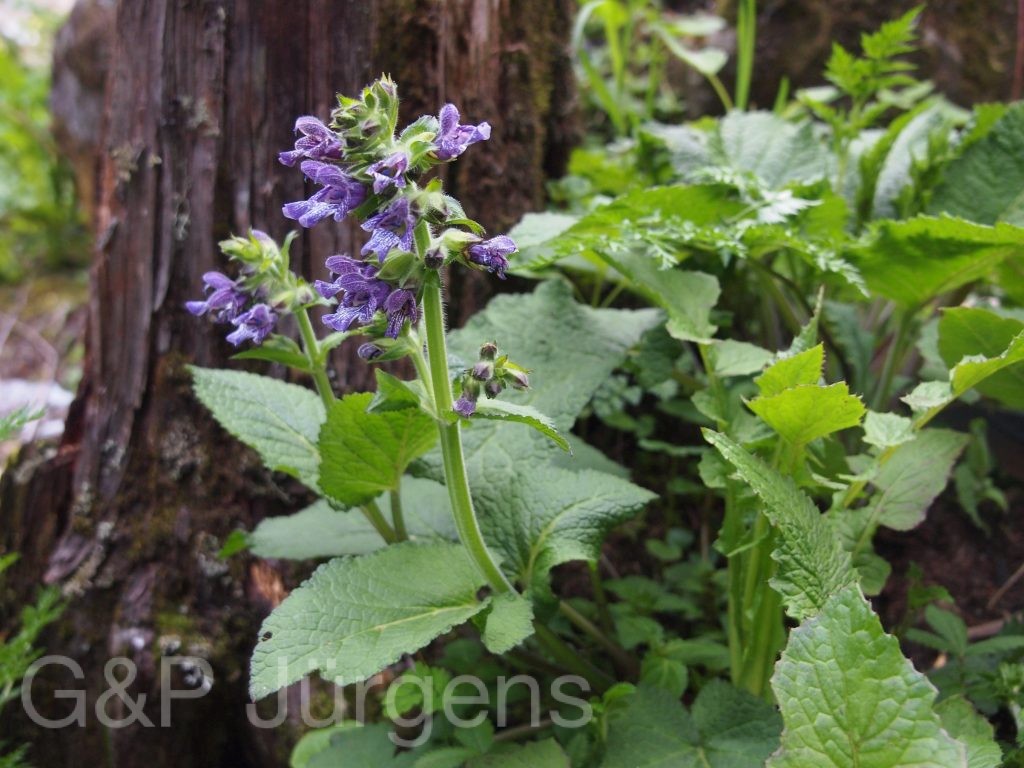
Salvia wardii is a Sino-Himalayan sage distributed across the eastern Himalaya and adjacent China, recorded from southern China (the Tibetan borderlands), Bhutan, Nepal and India, with an outlying record from Sri Lanka and only around 73 GBIF occurrences, a comparatively narrowly known species. It is a plant of subalpine and alpine habitats, growing on open grassy slopes, scrub margins, rocky banks and meadow clearings in the upper temperate to subalpine zone. The image documents the species at Kupang in Bhutan at about 3550 m in June, where it flowers among summer meadow vegetation alongside other perennial herbs of the high pastures.

It is an erect perennial herb arising from a woody rootstock, with quadrangular, pubescent stems. The leaves are mostly basal and lower-cauline, ovate to oblong, cordate to truncate at the base, crenate-serrate, rugose and softly hairy, on long petioles. The inflorescence is a lax terminal raceme of widely spaced verticillasters, each with few flowers. The calyx is bilabiate and glandular-pubescent; the corolla is showy, deep violet to purple-blue, with an exserted upper lip and a broad spreading lower lip, and the connective of the two fertile stamens is elongated and lever-like, characteristic of Salvia. The fruit comprises four smooth nutlets.

Named for the plant collector Frank Kingdon-Ward, Salvia wardii belongs to the Asian section of Salvia centred on the Sino-Himalayan mountains, a centre of diversity for the genus. The staminal lever mechanism promotes outcrossing by long-tongued bees and bumblebees foraging in the brief alpine summer. Its restricted range and small number of records suggest it warrants monitoring, though no formal threat assessment has been made.

Author: (E.Peter) · Sources: POWO (Kew), GBIF, Flora of China, Flora of Bhutan, Salvia: Flora Sinica account, World Checklist of Lamiaceae
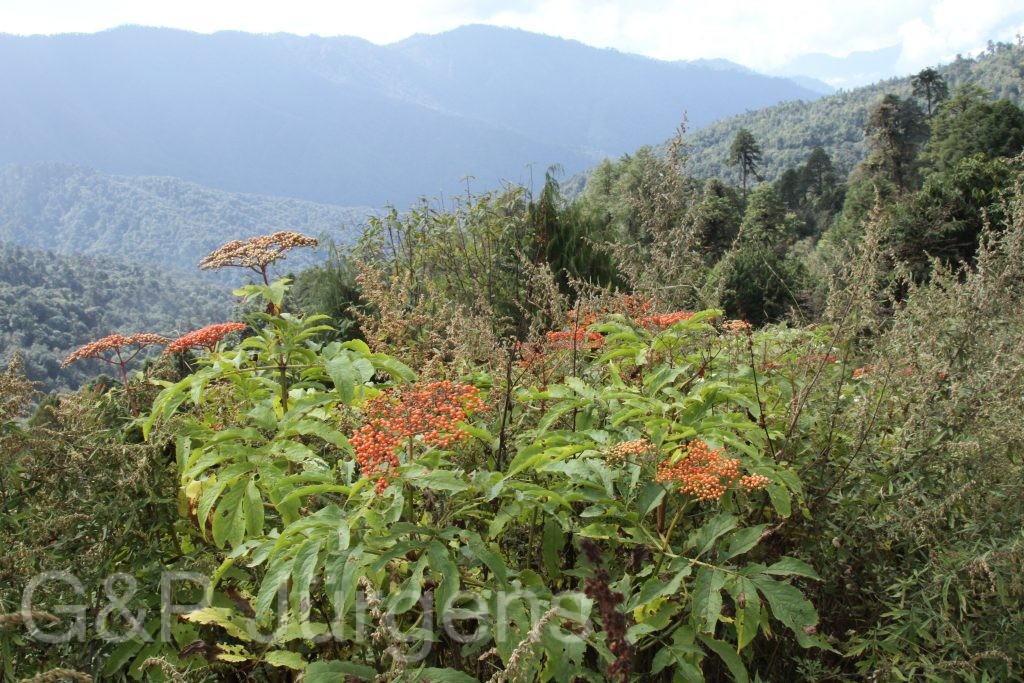
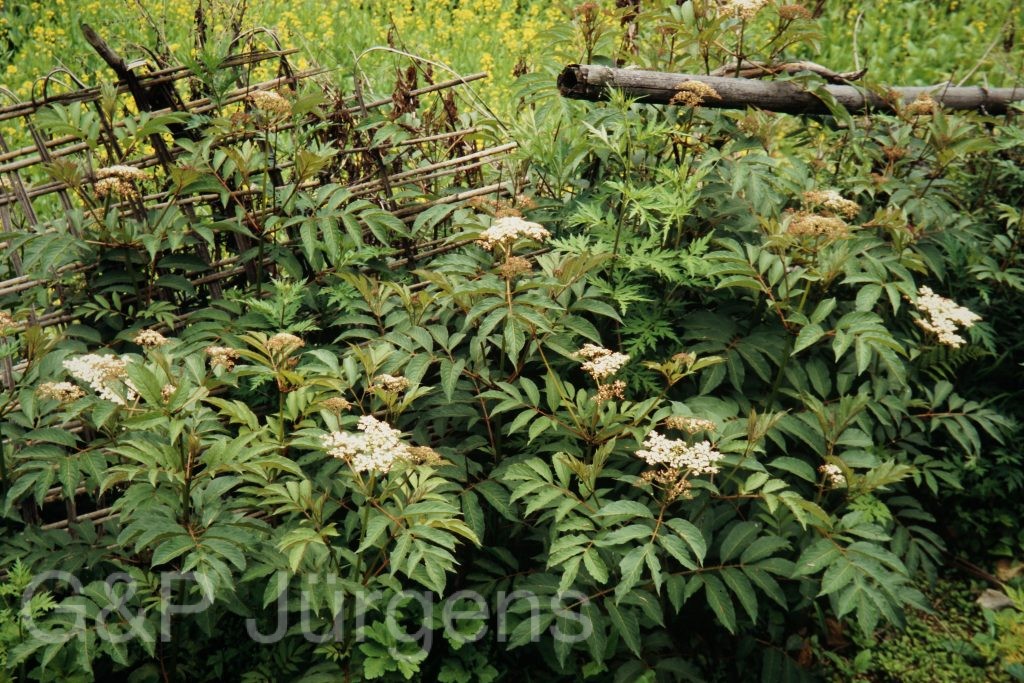
Sambucus adnata

by GP Jürgens

Wall. ex DC.

Bhutan2015 322
Bhutan Trongsa 2100m, October
Bh09 202 P341
Bhutan Thimphu, 2500m June

Description

Sambucus adnata is a herbaceous elder distributed across the Himalaya and western to central China, occurring in Nepal, Bhutan, northern India and widely in China, with its very numerous GBIF records (over 1700) concentrated in this region; records from Germany, the United States, Austria, Japan and elsewhere reflect cultivation and herbarium accessions. It grows in moist forest clearings, on shrubby slopes, along stream banks, roadsides and at forest margins, generally between about 1600 and 3600 m. The photographed plants from Trongsa (2100 m, October) and Thimphu (2500 m, June) in Bhutan illustrate its range through the cool, humid mid-montane belt of the eastern Himalaya.

Unlike its woody relatives, S. adnata is a tall, robust perennial herb dying back to a thick, fleshy, creeping rhizome. The stout, erect, ridged stems bear large, opposite, imparipinnate leaves with several pairs of lanceolate, serrate leaflets, the lowest leaflets often adnate to the rachis or with adnate stipule-like outgrowths, a feature reflected in the epithet. The inflorescence is a large, flat-topped to convex compound cyme of numerous small flowers with a rotate, whitish to pinkish corolla and conspicuous reddish anthers or nectaries. The fruit is a small, globose, red drupe containing a few seed-like stones.

Sambucus, formerly placed in the Caprifoliaceae, is now referred with the genus Adoxa and Viburnum to the Adoxaceae on molecular and morphological grounds. S. adnata is distinctive among elders for its fully herbaceous, rhizomatous habit. It is widespread, common and weedy in disturbed montane habitats, and is of no conservation concern; the plant has a record of local medicinal use for bruises and swellings.

Author: Wall. ex DC. · Sources: POWO (Kew), GBIF, Flora of China, Flora of Bhutan, Annotated Checklist of the Flowering Plants of Nepal, Sambucus (Adoxaceae) monograph

(Hook.f.) Hand.-Mazz.

Sikkim2011 119
Sikkim Chopta-valley 4100m, June
Sikkim2011 118
Sikkim Chopta-valley 4100m, June

Description

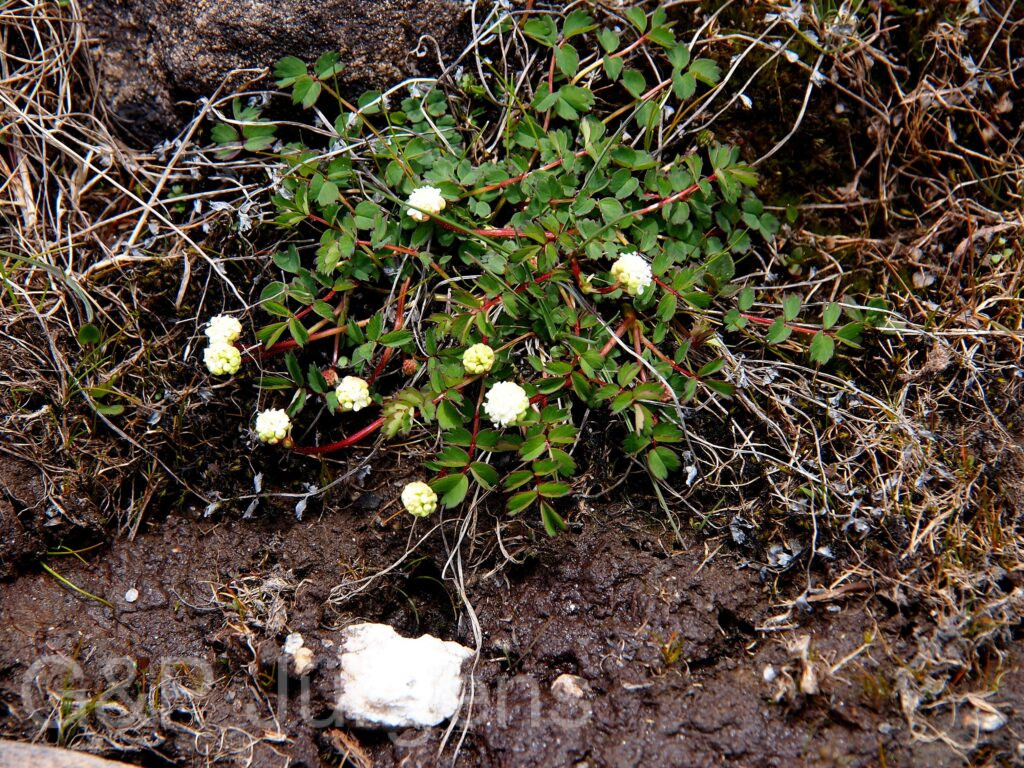
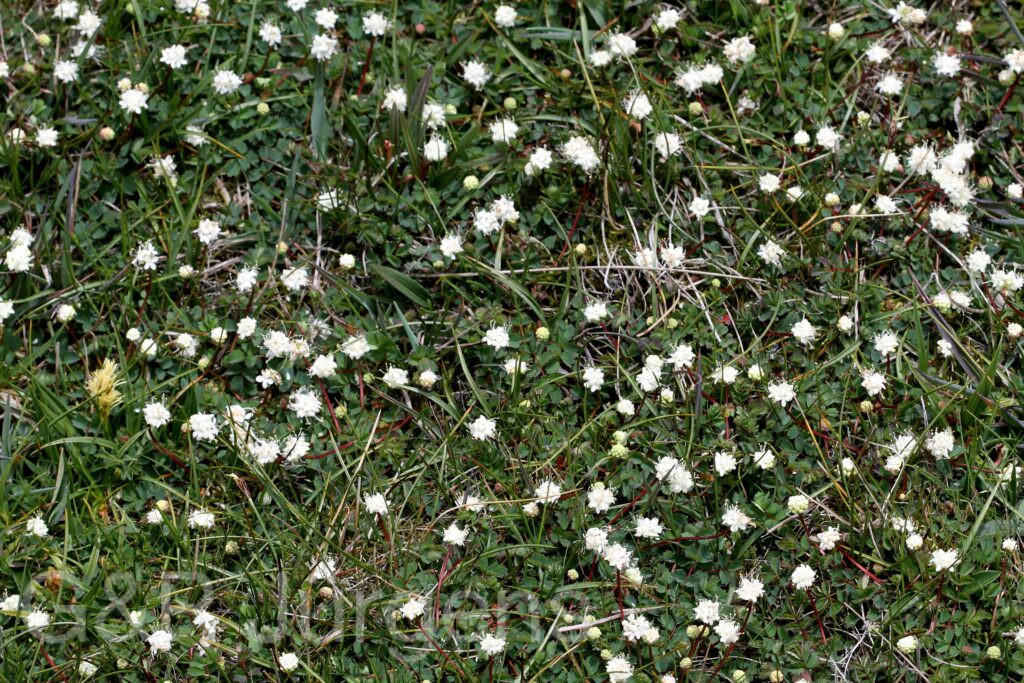
Sanguisorba filiformis (Hook.f.) Hand.-Mazz. is a slender, alpine perennial herb of the Rosaceae, distributed across the eastern and central Himalaya and the mountains of southwestern and central China. Its documented range encompasses China, Bhutan, India and the Korean Peninsula, with GBIF recording 471 georeferenced occurrences. The species is a characteristic component of moist alpine meadows, streamsides, seepage slopes and open turf at elevations of roughly 3,500–4,800 m. The photographed material from the Chopta valley in Sikkim at 4,100 m in June represents typical high-altitude habitat, where the plant flowers as the snow-melt season advances.

The plant develops a short, woody rhizome bearing a basal rosette of pinnately compound leaves; the leaflets are small, ovate to oblong, crenate-serrate at the margins, glabrous and somewhat glaucous beneath. From this rosette arise wiry, filiform, often nodding flowering stems that give the species its epithet. The inflorescence is a small, loose, capitate to shortly oblong head of few flowers; unlike most Sanguisorba the perianth is comparatively reduced, with whitish to pale pink segments, four stamens, and exserted filaments. The fruit is a small dry achene enclosed within the persistent hypanthium.

Formerly placed in the segregate genus Poterium and the subgenus Sanguisorbella, the taxon is sometimes treated under Sanguisorba filiformis as the accepted name, reflecting its distinctive reduced floral architecture. Its restriction to high-altitude wetland and meadow habitats makes it a useful indicator of intact alpine hydrology, and like many Himalayan turf species it may be sensitive to grazing pressure and climate-driven shifts in snowpack.

Author: (Hook.f.) Hand.-Mazz. · Sources: POWO (Kew), GBIF, Flora of China Vol. 9, Flora of Bhutan Vol. 2, Nordborg: Sanguisorba — a monographic study (1966)

D.Don

Sikkim2003 363 P512
Sikkim Lachen Tista Tal 3450m August
Sikkim2003 364 P511
Sikkim Lachen Tista Tal 3450m August
Nepal 95 100 P178 ergebnis
Nepal Barphak 2450m October
Nepal 95 135 P228 ergebnis
Nepal Barphak 2450m October

Description

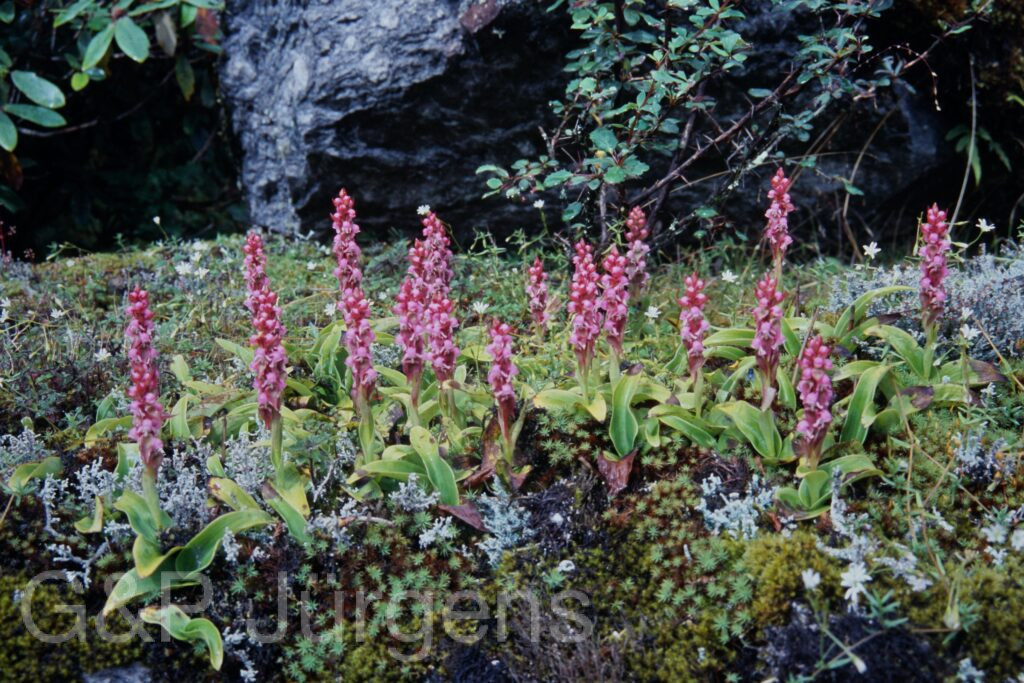
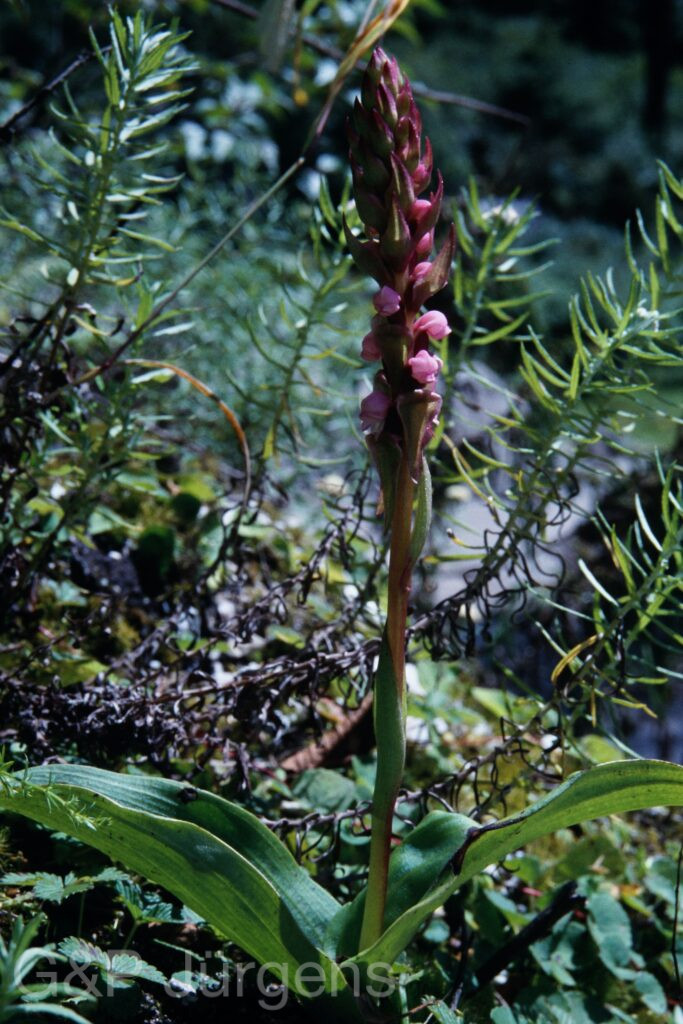
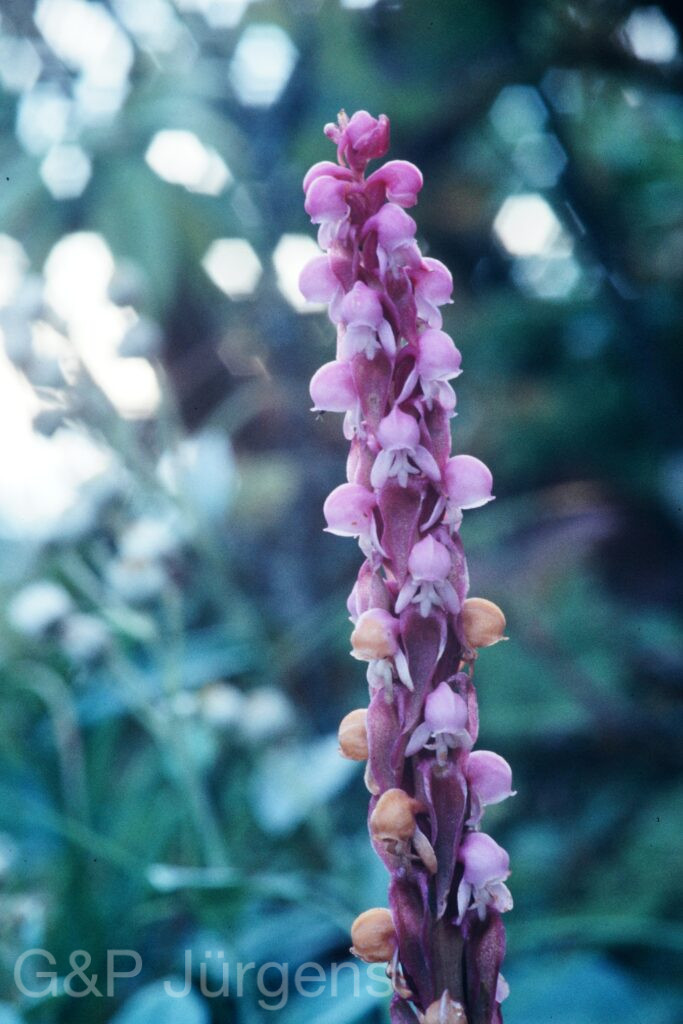
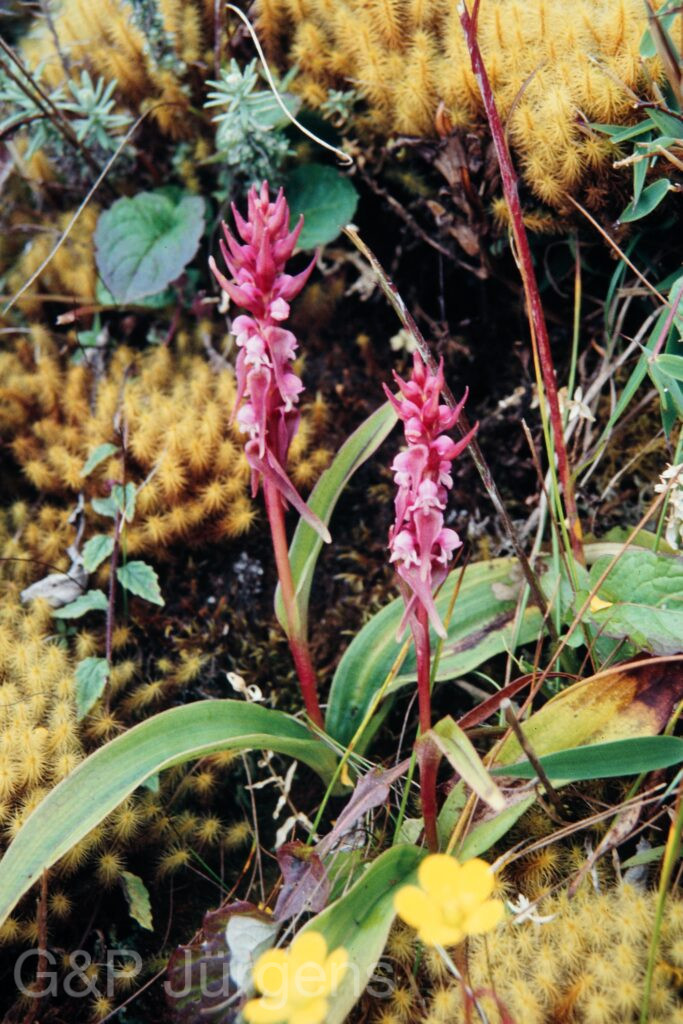
Satyrium nepalense D.Don is a terrestrial orchid of remarkably wide distribution, ranging across the Himalaya and southern Asia from Pakistan, India, Nepal, Bhutan, Sri Lanka and southern China to Myanmar, and extending through tropical and southern Africa; GBIF records nearly 1921 occurrences, reflecting its broad ecological tolerance. It grows in open grassy slopes, meadows, scrub and forest clearings from the submontane belt to high alpine pastures, broadly between about 1500 and 3700 m. The cited material from Lachen in Sikkim at 3450 m in August and Barphak in central Nepal at 2450 m in October illustrates its long flowering season across a wide altitudinal range.

The species is a terrestric herb arising from paired ovoid, tomentose tubers, with an erect leafy stem bearing a few ovate to lanceolate sheathing leaves. The inflorescence is a dense cylindrical raceme of many small, pink to rose-purple, fragrant flowers; each flower is non-resupinate, with the lip uppermost and produced into two slender, parallel spurs at its base, a diagnostic feature of the genus. The fruit is a small dehiscent capsule releasing abundant dust-like seeds.

Satyrium (Orchidaceae, subtribe Satyriinae) is a chiefly African genus with an outlying Asian representation, of which S. nepalense is the most widespread; its twin-spurred, non-resupinate flowers and moth pollination are characteristic. Valued in traditional medicine for its tubers, the species is locally collected, and although still common it warrants monitoring where harvesting pressure is intense.

Author: D.Don · Sources: POWO (Kew), GBIF, Flora of Bhutan, Flora of China, Orchids of Sikkim Himalaya, Pridgeon et al. Genera Orchidacearum

(Wall. ex Schott) Cusimano & Hett.

Nepal 99 241 ergebnis
West-Nepal Tallekh 3000m, June
Nepal 2009 97 ergebnis
Nepal Helambu Samathang 2410, May

Description

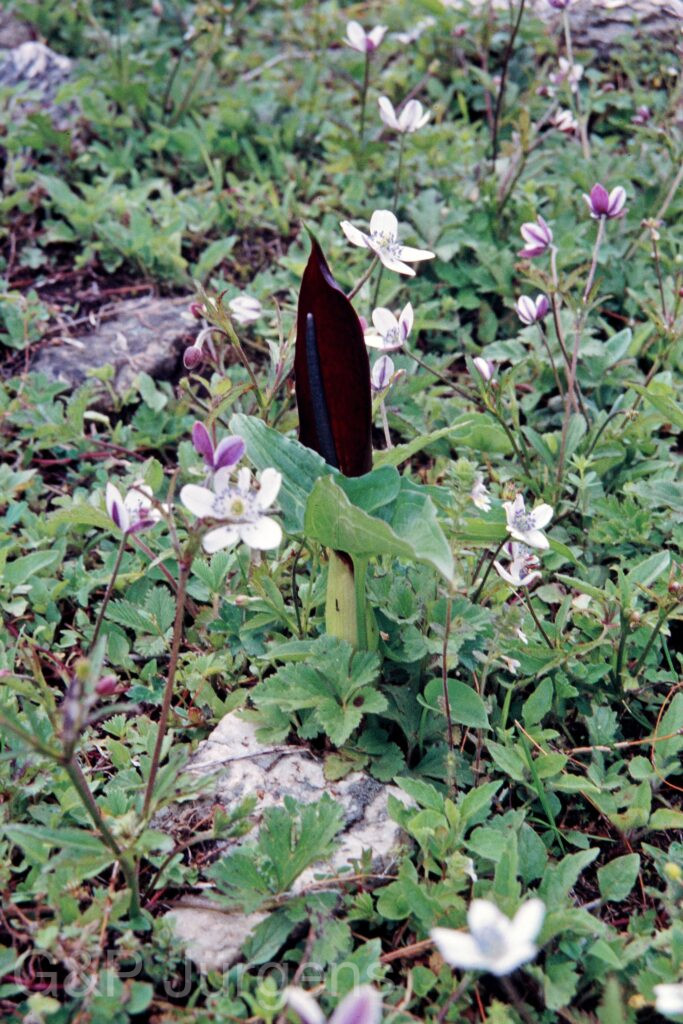
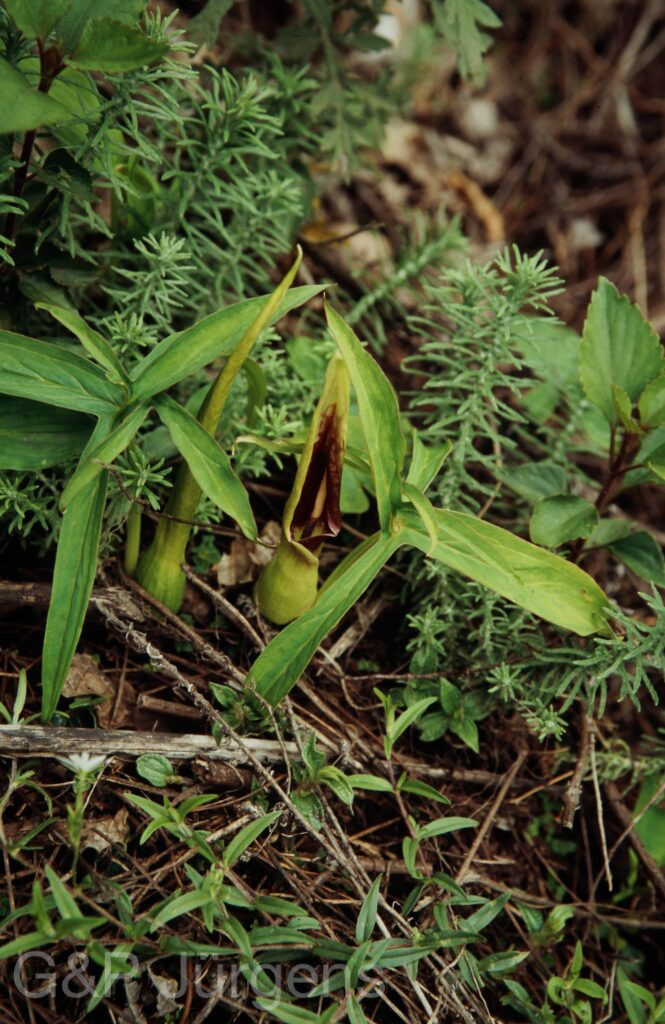
Sauromatum diversifolium is a tuberous aroid of the Himalaya and adjacent uplands, distributed through India, China, Nepal, Bhutan, Myanmar and Thailand, with around 146 recorded occurrences. It grows in moist temperate forest, on shaded banks, in open grassy slopes and among rocks where seasonal soil moisture is reliable, emerging with the onset of the warm season and dying back to its tuber during the dry winter. In Nepal it occupies the middle to upper montane zone, as shown by collections from Tallekh in the west at about 3000 m in June and from Samathang in the Helambu region at 2410 m in May, the latter dates coinciding with its early-season flowering.

The plant arises from a subglobose, depressed tuber and typically produces a single long-petiolate leaf whose blade is deeply pedately divided into several lanceolate to elliptic segments, the lobes acuminate and the petiole often mottled. The inflorescence is a typical aroid spadix subtended by a spathe, the spathe tube convolute and the limb expanded, lanceolate and often dull purple or marked within. The spadix bears a sterile terminal appendix above separated zones of female and male flowers, and emits a faint odour at anthesis to attract small dipteran and beetle pollinators. The fruiting head is a cluster of small berries.

The species was transferred to Sauromatum by Cusimano and Hettich on molecular and morphological evidence that united the former Typhonium diversifolium with the saururoid lineage. The genus is protogynous and largely sapromyophilous, with thermogenic spadices that volatilise scent to lure pollinators into the floral chamber. Widespread and locally frequent in suitable montane habitat, S. diversifolium is not regarded as threatened, though like many tuberous aroids it is sensitive to grazing pressure and the loss of forest-edge microhabitats.

Author: (Wall. ex Schott) Cusimano & Hett. · Sources: POWO (Kew), GBIF, Flora of China Vol. 23, Flora of Bhutan Vol. 3, Flora of Nepal, Cusimano et al. molecular phylogeny of Areae (Araceae)

Franch.

Sikkim2003 293 P407
Sikkim Samiti-Lake 4400m, August
Nepal 99 626 ergebnis
West-Nepal Kagmara-La 4900m, July

Description

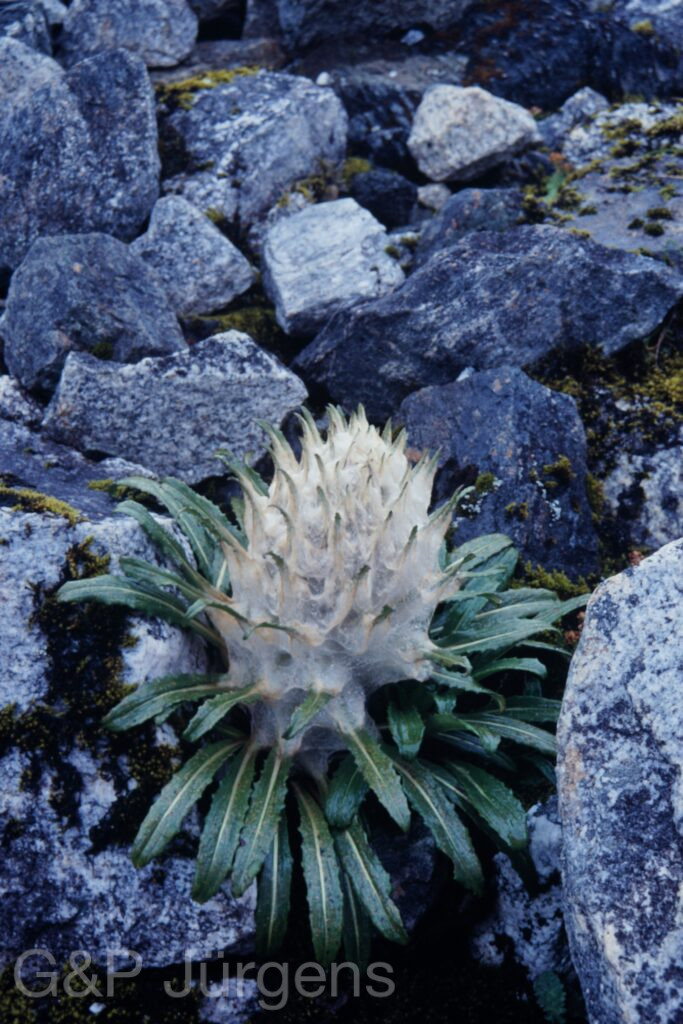
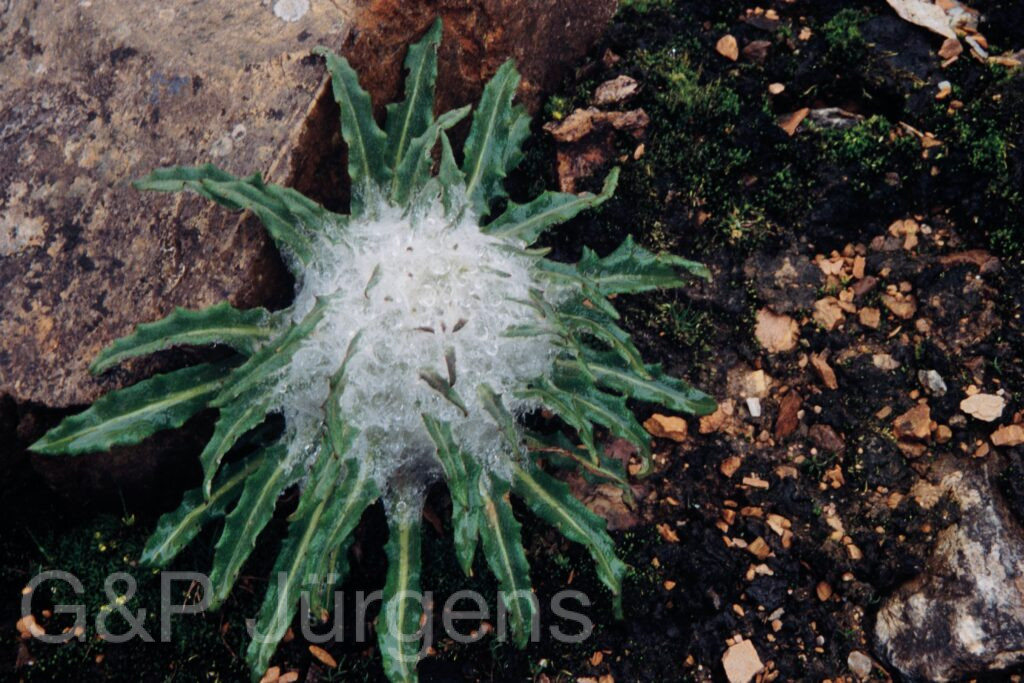
Saussurea gossypiphora, the snowball or cotton-headed saussurea, is a remarkable high-alpine herb of the Himalaya and adjacent Tibetan China, recorded only from China and Nepal in GBIF with a mere 26 occurrences, reflecting both its extreme habitat and its restricted, fragmented distribution. It is among the highest-growing flowering plants, inhabiting open scree, moraine, gravelly alpine slopes and the margins of glacial debris in the upper alpine and subnival zone. The images document it in Sikkim near Samiti Lake at about 4400 m in August and in West Nepal on the Kagmara-La at around 4900 m in July, among the most extreme elevations at which it grows.

It is a stout, dwarf perennial herb forming a dense rosette, in which the upper leaves and the capitula are enveloped in a thick mass of long white woolly hairs forming a globose, cotton-wool-like dome. Beneath this insulating covering the leaves are oblanceolate, deeply toothed and arachnoid-hairy. The numerous small discoid capitula are clustered at the apex within the wool, each with purplish tubular florets and a multiseriate involucre. The fruit is a glabrous achene crowned by a feathery, plumose pappus aiding wind dispersal once the protective wool opens.

The dense lanate indumentum is a celebrated adaptation to the subnival environment, trapping heat, buffering night frost and ultraviolet radiation, and sheltering pollinating insects, paralleling the "glasshouse" and "woolly" growth forms found in other high-elevation Saussurea and Rheum. As a slow-growing, habitat-specialised plant of limited range it is potentially vulnerable to climate warming and collection pressure, though it has not been formally assessed.

Author: Franch. · Sources: POWO (Kew), GBIF, Flora of China, Flora of Nepal, Annotated Checklist of the Flowering Plants of Nepal, Lipschitz Monograph of the Genus Saussurea

(DC.) Edgew.

Sikkim2003 453 G623
Sikkim Chopta Valley 3800m August
Sikkim2003 451 P628
Sikkim Chopta Valley 3800m August

Description

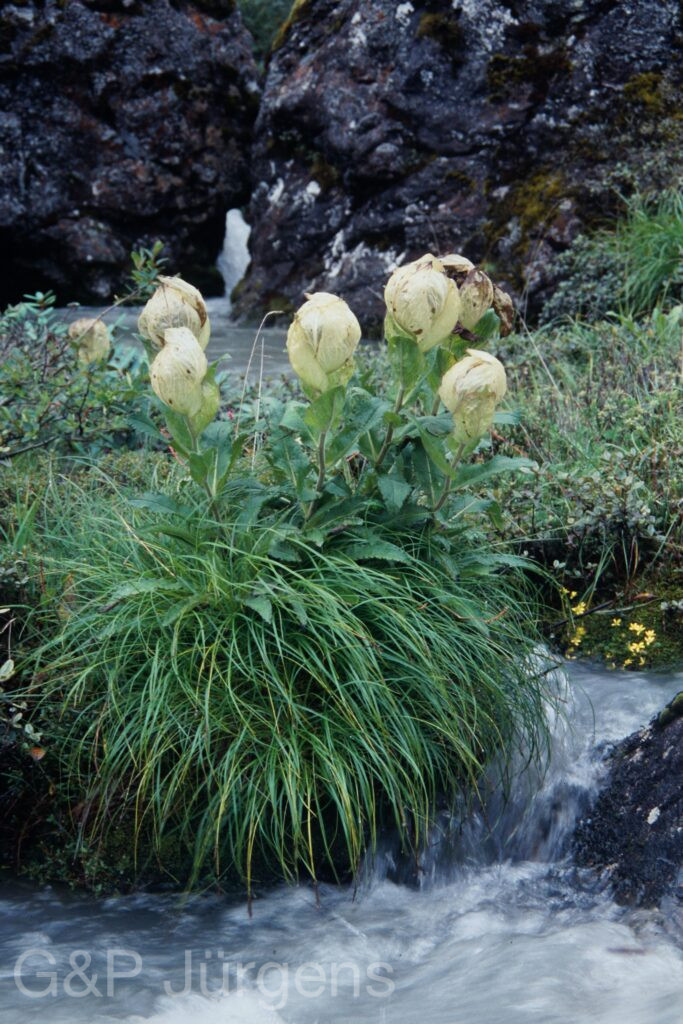
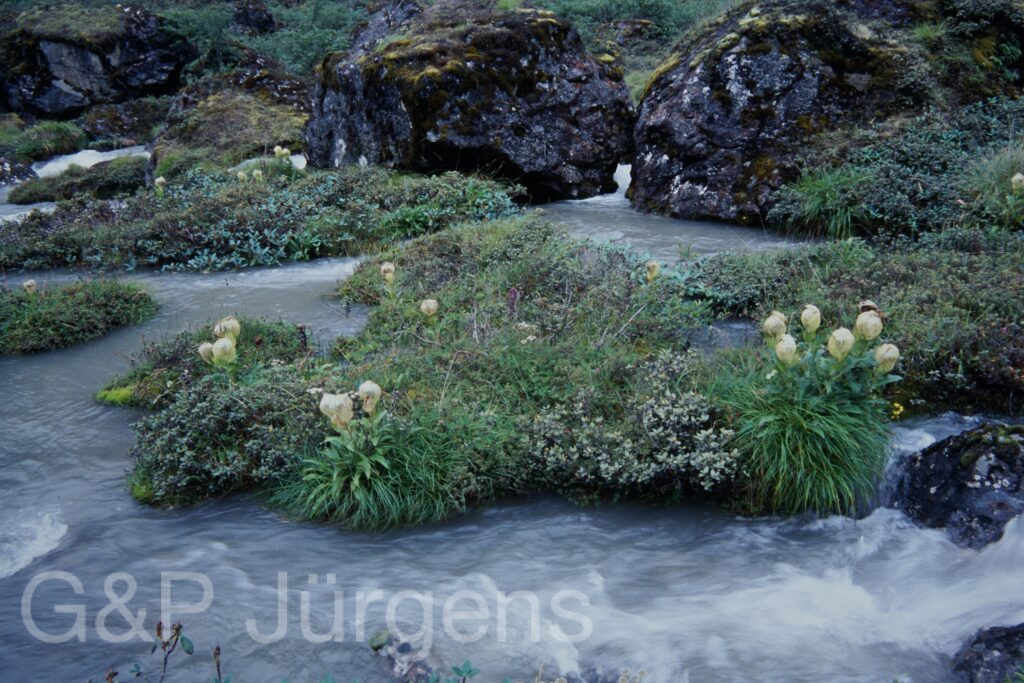
Saussurea obvallata is a high-alpine herb of the Sino-Himalayan region, distributed across the mountains of China, India, Bhutan, Nepal, Myanmar and Pakistan, with some 350 georeferenced records documenting a broadly continuous arc along the Greater Himalaya. It is a plant of open alpine meadows, moraines, scree slopes and rocky pastures, typically between about 3500 and 4800 m. The photographed material from the Chopta Valley in Sikkim at 3800 m, flowering in August, is characteristic of its preferred late-monsoon habitat on moist, well-drained alpine turf where snow lies long into early summer.

The species is a stout perennial arising from a thick taproot, with an erect, simple, leafy stem. The lower leaves are oblanceolate and dentate, narrowing to a winged petiole, while the upper leaves grade into membranous, pale, semi-translucent bracts that arch inward to enclose the inflorescence. These greenish-straw involucral bracts form the conspicuous globose to urn-shaped "lantern" that almost entirely hides the cluster of dark purple capitula within. The florets are tubular and purple-black, and the achenes bear a feathery, plumose pappus that aids wind dispersal.

The enclosing bract chamber is widely interpreted as an adaptation that buffers temperature, protects pollinating insects from cold and wind, and shelters developing florets at extreme elevation, a striking example of greenhouse-like alpine convergence shared with Rheum nobile. Long known in Himalayan tradition as the sacred "Brahma Kamal," the plant is heavily collected for ornament and medicine, and populations near pilgrimage routes face local pressure of regional conservation concern.

Author: (DC.) Edgew. · Sources: POWO (Kew), GBIF, Flora of China, Flora of Bhutan, Annotated Checklist of the Flowering Plants of Nepal, Lipschitz monograph of Saussurea

Hook.f.

Sikkim2003 307 P433
Sikkim Saniti-Lake 4250m August

Description

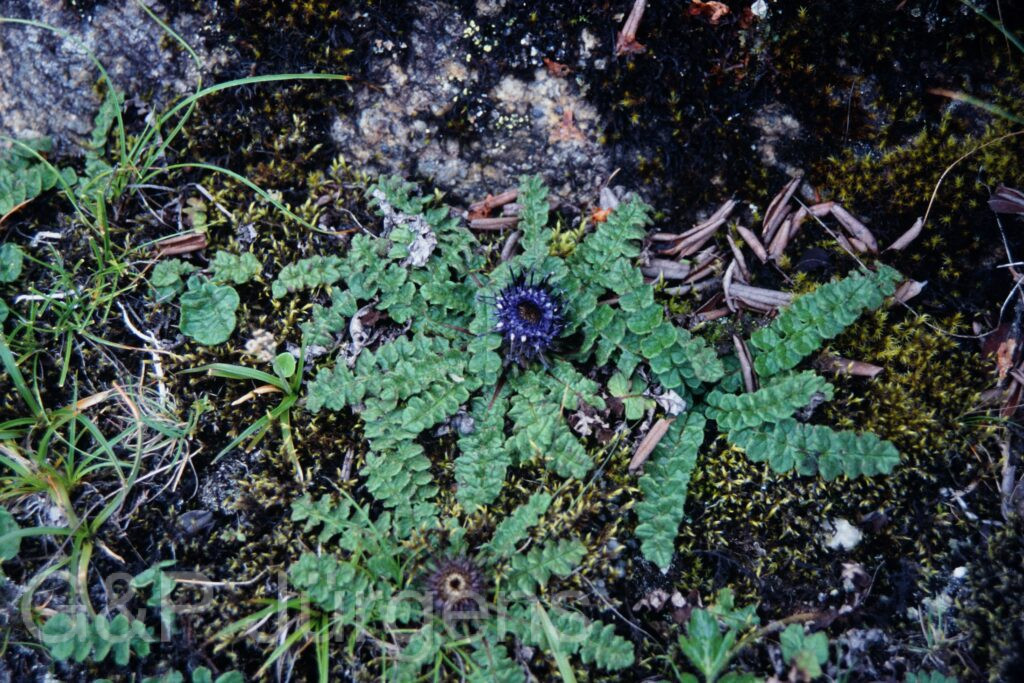
Saussurea polystichoides is a high-alpine perennial herb of the eastern and central Himalaya, recorded from Nepal, northern India, Bhutan and adjacent south-western China, with a small documented base of about 43 occurrences consistent with its restricted, high-elevation habitat. It grows on open alpine turf, screes, moraines and rocky slopes, typically between roughly 4000 and 4800 m. The specimen shown was photographed near Saniti Lake in Sikkim at about 4250 m in August, when these short-season alpines flower during the brief post-monsoon window above the treeline.

The plant is a low, cushion-forming or tufted herb arising from a stout caudex clothed in old leaf bases, the name polystichoides alluding to the fern-like, many-ranked rosette of finely divided leaves. The leaves are pinnately lobed to pinnatisect, narrow and densely arranged, often white-woolly to give protection against cold and intense radiation. The capitula are sessile or shortly stalked and aggregated within the leaf rosette; each head bears tubular, purple to violet disc florets enclosed by imbricate, often lanate phyllaries. The fruit is a glabrous cypsela crowned by a feathery, plumose pappus.

Saussurea (Asteraceae, tribe Cardueae) is a large Asian genus particularly diversified in the high Himalaya and Tibetan Plateau, where many species have evolved dense indumentum or translucent bracts as adaptations to extreme alpine conditions. S. polystichoides belongs to the group of cushion- or rosette-forming saw-worts of the highest screes. Pollinated by alpine insects and wind-dispersed via its plumose pappus, it is a narrow-range, habitat-specialist endemic of conservation interest given its limited area and sensitivity to climatic warming.

Author: Hook.f. · Sources: POWO (Kew), GBIF, Flora of China, Flora of Bhutan, Annotated Checklist of the Flowering Plants of Nepal, Lipschitz monograph of Saussurea

C.B.Clarke

Nepal 99 480 ergebnis
West-Nepal Churta-Khola 3600m, June

Description

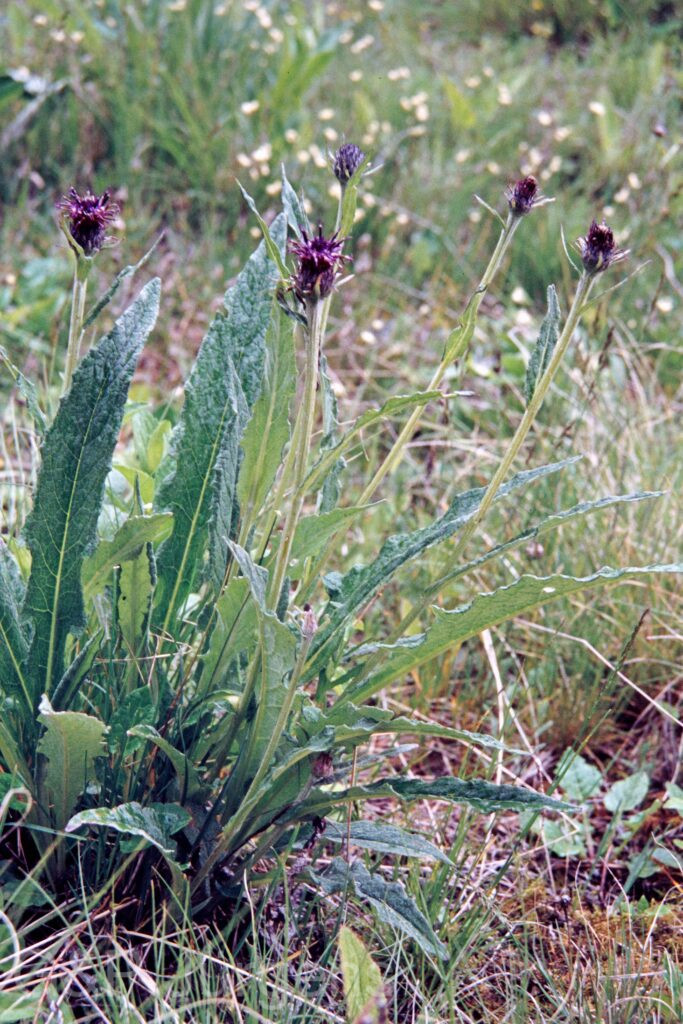
Saussurea roylei is an alpine composite of the western and central Himalaya, distributed through India, Nepal, Pakistan and adjacent China (IN, NP, PK, CN), with about 223 recorded occurrences. It grows in open alpine meadows, on grassy and stony slopes, screes and rocky ground in the subalpine to alpine zone, broadly between about 3000 and 4500 m. The plant shown here was photographed at Churta Khola in West Nepal at 3600 m in June, an elevation and early-summer flowering season typical of the species, where it occupies the herb-rich turf and gravelly margins of high pastures shortly after snowmelt.

The plant is a low perennial herb arising from a stout rootstock, with a simple or sparingly branched, often leafy stem. The leaves are elliptic to lanceolate, the basal ones narrowed to a winged petiole, the margins entire to toothed and the lower surface frequently thinly woolly. The flower heads (capitula) are clustered in a dense terminal corymb, each head an involucre of imbricate, often purplish-tipped bracts enclosing numerous small, tubular, purple to violet disc florets; ray florets are absent, as throughout the genus. The fruit is a glabrous cypsela (achene) crowned by a pappus of feathery inner and shorter, scabrid outer bristles aiding wind dispersal.

Saussurea (tribe Cardueae, the thistle alliance of the Asteraceae) is a large and taxonomically intricate genus that reaches spectacular diversity in the high Sino-Himalaya, including the woolly and bracteate 'snow lotus' alpines. S. roylei belongs to the assemblage of meadow-dwelling, non-cottony species and is pollinated by bumblebees and other alpine insects drawn to the discoid heads. Widespread across the western Himalaya and locally common in alpine grassland, it is not of conservation concern, although high-altitude Saussurea species generally face pressure from grazing and harvesting.

Author: C.B.Clarke · Sources: POWO (Kew), GBIF, Flora of Nepal, Flora of China, Saussurea: A Monograph (Lipschitz)

Maxim.

Sikkim2003 511 G712
Sikkim Yume Samdong 4600m August

Description

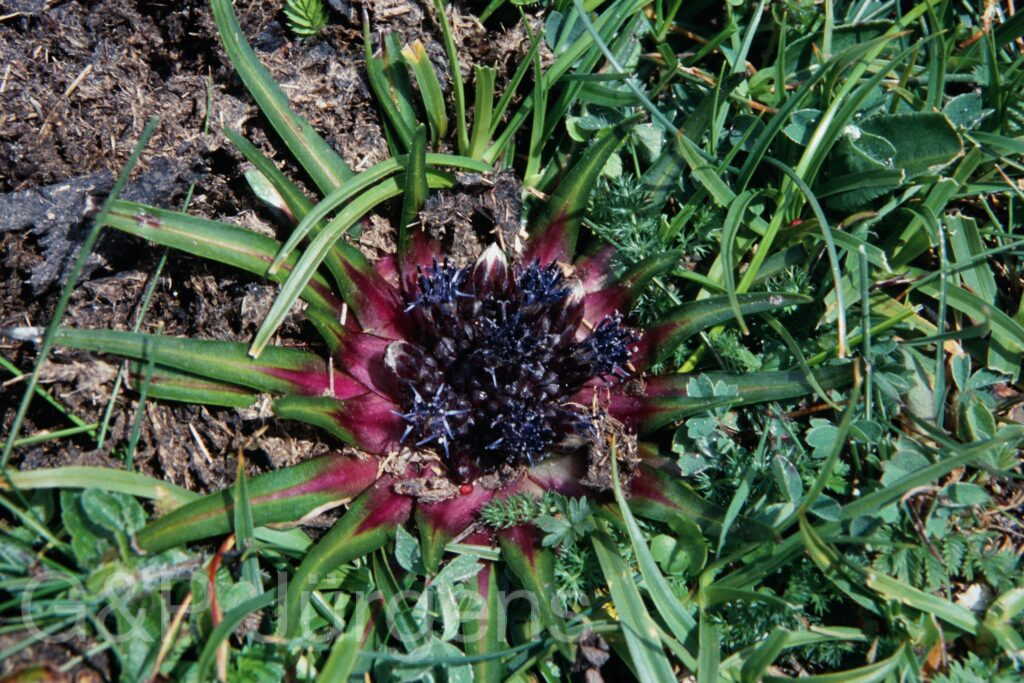
Saussurea stella is a high-alpine herb distributed across the eastern Himalaya and the Tibetan Plateau, recorded from China (Xizang, Yunnan, Sichuan, Qinghai, Gansu), Bhutan and India, with some 821 georeferenced occurrences documented in GBIF. It occupies open alpine meadows, marshy turf, gravelly flushes and the margins of glacial streams, typically between 3000 and 5400 m. The plant photographed at Yume Samdong in northern Sikkim at about 4600 m in August is characteristic of the wet, peaty seepage slopes the species favours during the monsoon, where it forms part of a low cushion-and-rosette sward exposed to intense radiation, nightly frost and a brief growing season.

The species is a stemless, near-acaulescent perennial forming a flat, star-shaped rosette pressed against the substrate from a stout taproot. The numerous lanceolate to linear leaves are glabrous, entire and often suffused with purplish-red, radiating symmetrically and giving the plant its epithet stella. The capitula are sessile and densely clustered at the rosette centre, each involucre with imbricate, purple-tinged phyllaries enclosing tubular purple florets; the corollas are deeply lobed and the anthers tailed at the base. Fruit is a glabrous cylindrical achene with a double pappus of short outer and longer plumose inner bristles.

A member of the large genus Saussurea (subtribe Saussureinae, tribe Cardueae), S. stella belongs to the rosette-forming, ground-hugging guild that recurs in Tibetan alpine floras as an adaptation to cold, windy, high-irradiance environments, the flattened habit and dark pigmentation enhancing heat capture and protecting against ultraviolet stress. Pollination is by alpine flies and bees, and the plumose pappus enables wind dispersal. Though not formally assessed as threatened and locally abundant, it is sensitive to grazing and the warming-driven contraction of alpine seepage habitats.

Author: Maxim. · Sources: POWO (Kew), GBIF, Flora of China, Flora of Bhutan, Lipschitz Monograph of Saussurea