Tag:

Summer


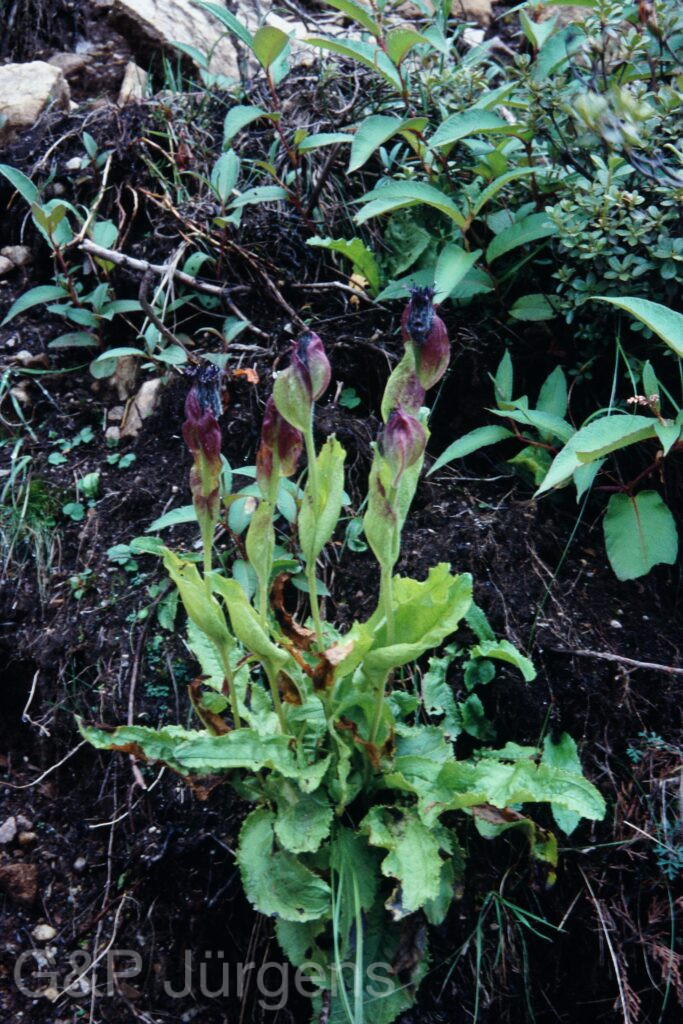
(Lindl. ex Royle) Wall. ex DC.
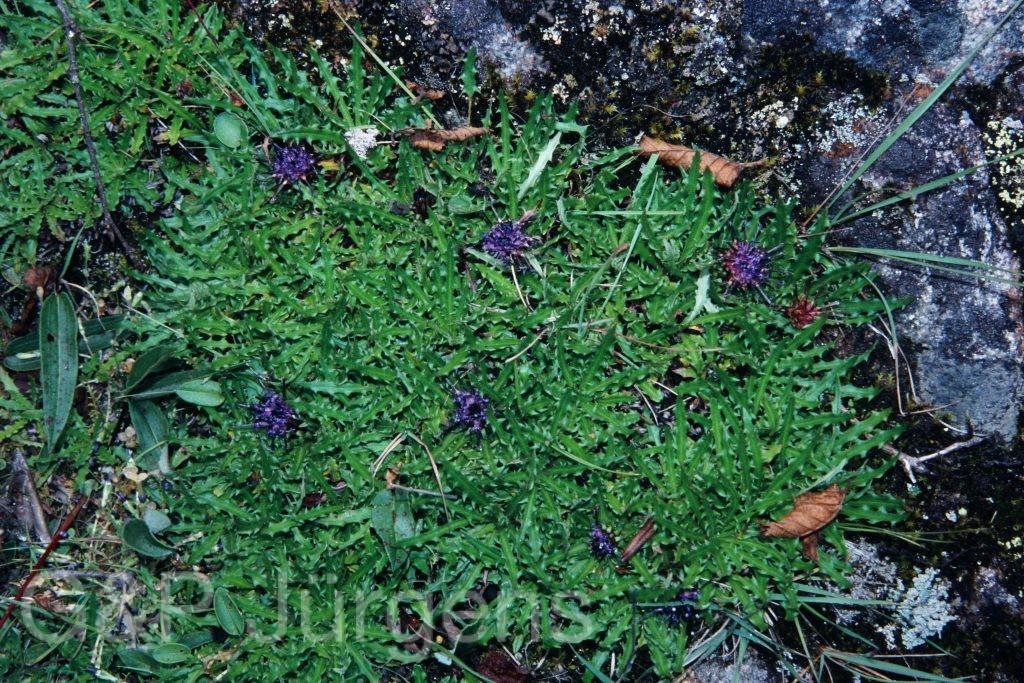
Sikkim2003 431 G598
Sikkim below Dzongri 3800m, August
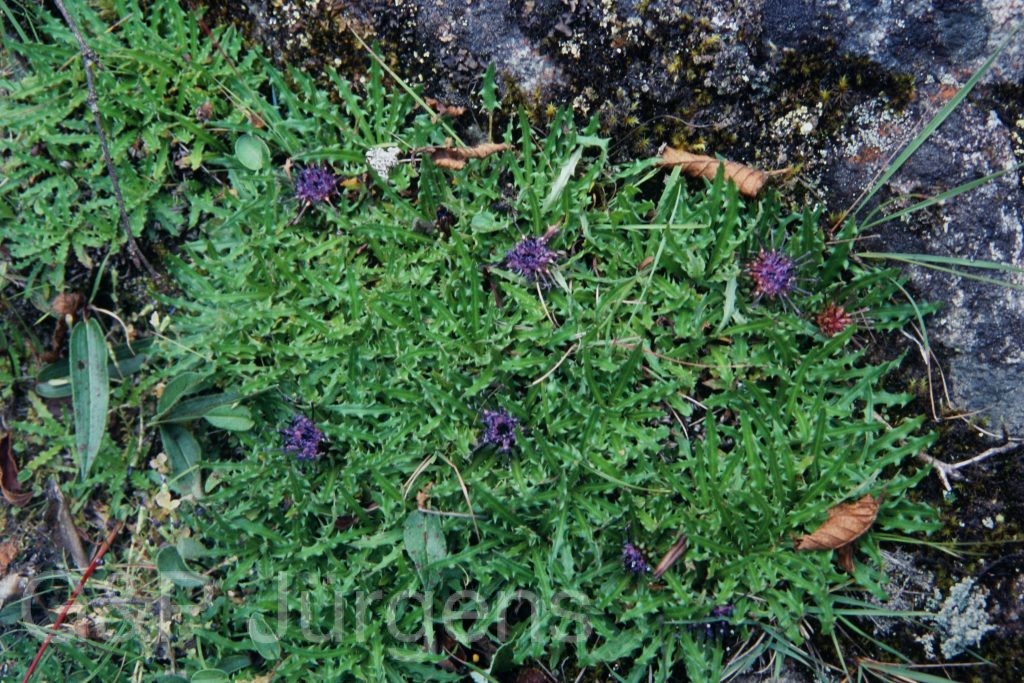
Sikkim2003 101 G138
Sikkim below Dzongri 3800m, August

Description

Saussurea taraxacifolia is a high-elevation composite of the Himalaya and adjacent ranges, distributed through Pakistan, India, Nepal, Bhutan and southern China, with roughly 209 GBIF records. It is a plant of the alpine zone, growing on open stony slopes, screes, gravelly flats and rocky alpine turf, generally well above the treeline. The Sikkim population photographed below Dzongri at 3800 m in August documents the species in its characteristic high-mountain habitat, flowering during the brief monsoon-fed alpine summer when these rosette perennials complete their reproductive cycle.

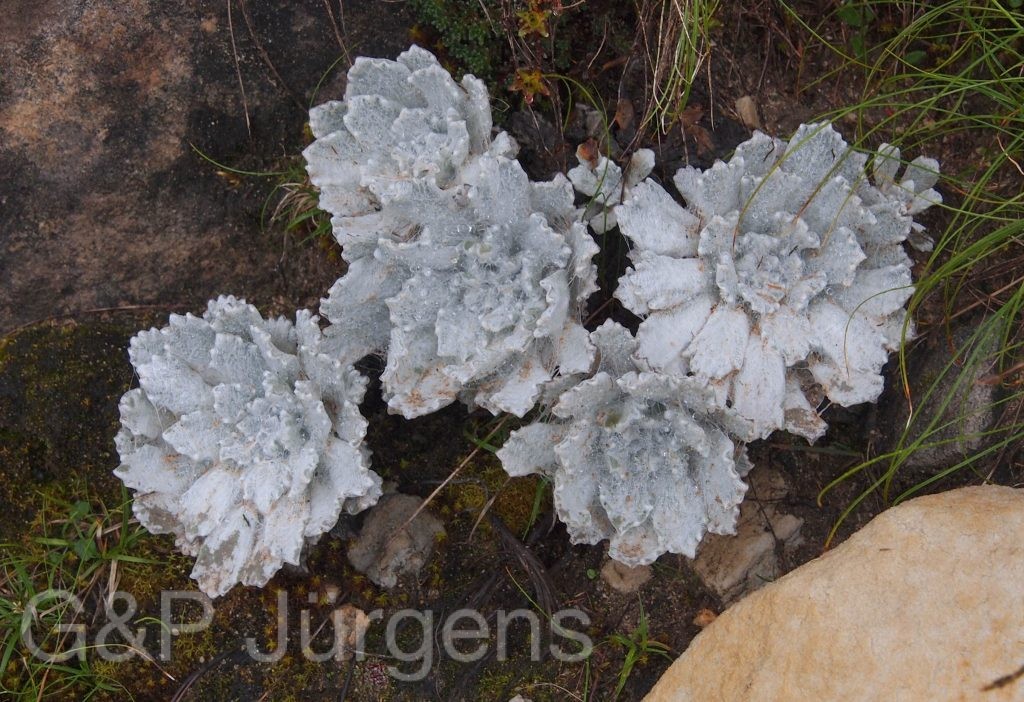
The plant is a low, often acaulescent or short-stemmed perennial herb arising from a stout rootstock, typically with a basal rosette of leaves. As the epithet indicates, the leaves are taraxacum-like (dandelion-like): oblanceolate in outline and runcinate-pinnatifid, with backward-pointing lobes, often somewhat woolly. The capitula are discoid, solitary or aggregated into a dense terminal cluster, each enclosed by an involucre of imbricate phyllaries and containing tubular purple to purplish florets; ray florets are absent, as throughout the genus. The fruit is a cypsela crowned by a pappus of plumose inner bristles and shorter, often barbellate outer bristles, an arrangement diagnostic of Saussurea and adapted to wind dispersal.

Saussurea is a large Sino-Himalayan and central Asian genus that has radiated extensively in the high mountains, with many narrowly endemic alpine specialists. S. taraxacifolia, with its dandelion-like rosette leaves, belongs to the low cushion- and rosette-forming alpine element rather than the woolly "snowball" snow-lotus group. Its dependence on open high-elevation habitats makes it a characteristic member of the Himalayan alpine flora; it is moderately widespread and not formally assessed as threatened, though high-mountain endemics of this kind are increasingly vulnerable to warming and habitat contraction.

Sources: POWO (Kew), GBIF, Flora of China, Flora of Bhutan, Annotated Checklist of the Flowering Plants of Nepal, Lipschitz's monograph of Saussurea
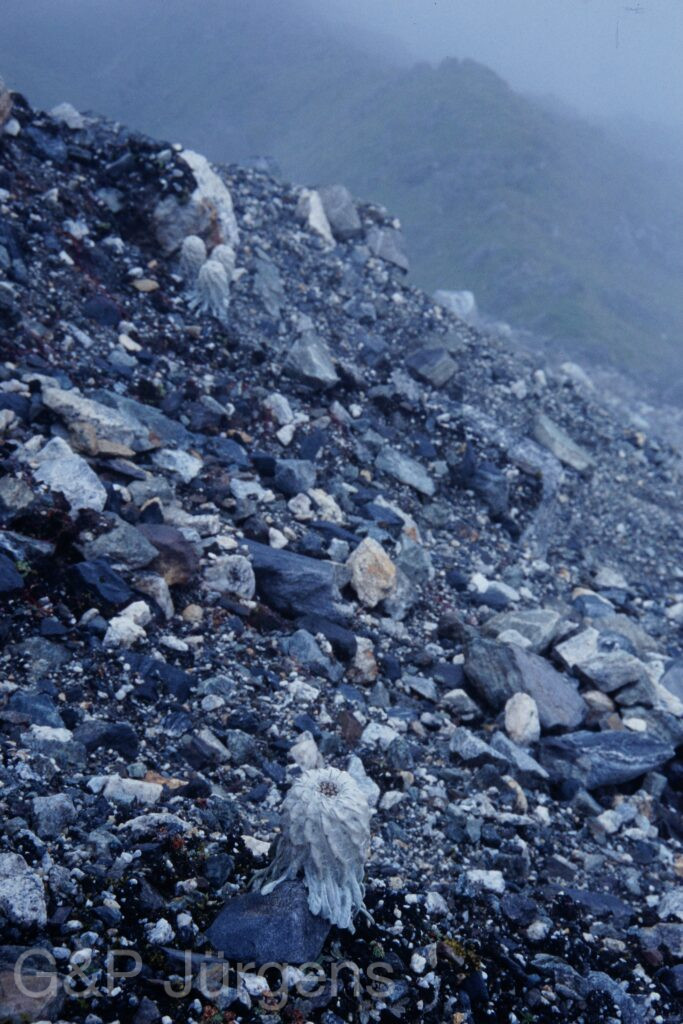
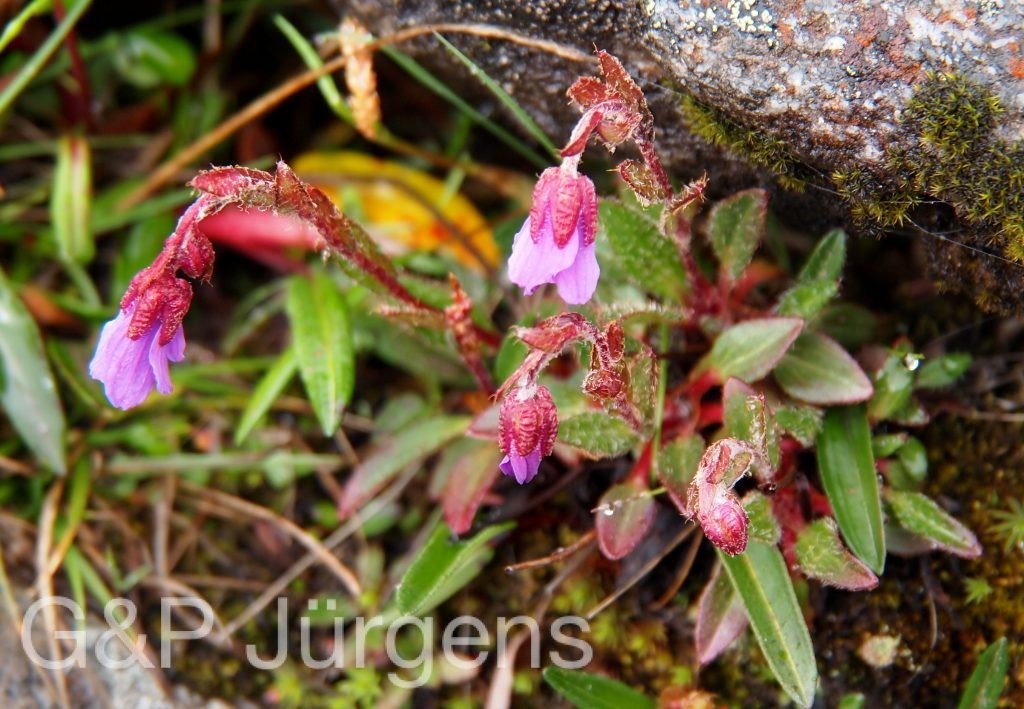
Sch.Bip. ex Hook.f.

BhutanPG2011 363
Bhutan Jule-Tso 4250m, June
Sikkim2003 296 P415
Sikkim above Saniti-Lake 4400m August
Sikkim2003 294 P408
Sikkim above Saniti-Lake 4400m August

Description

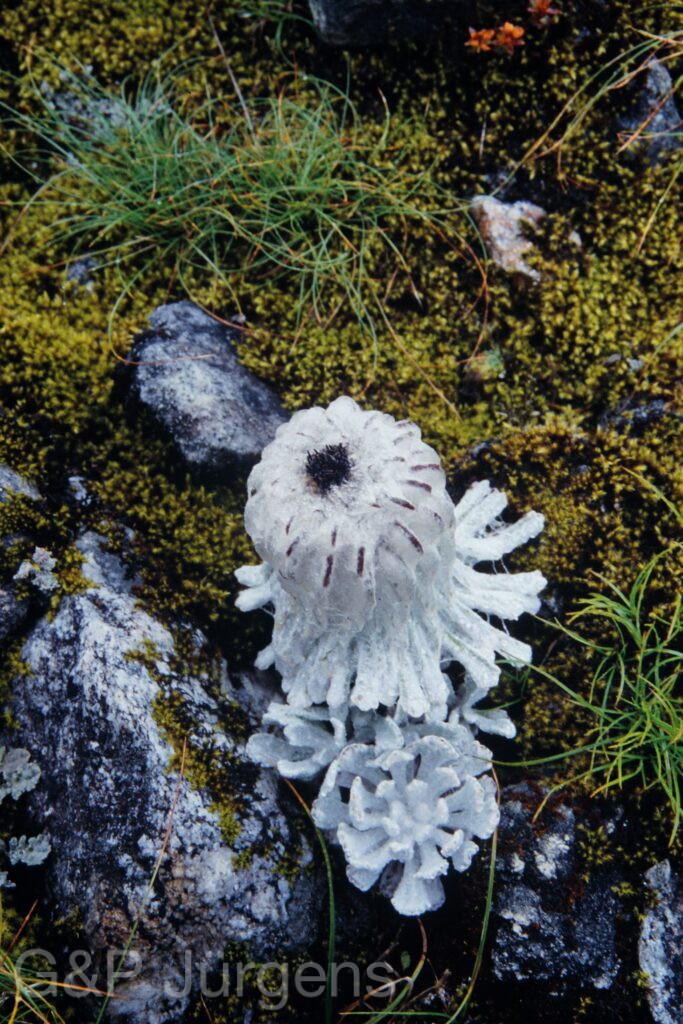
Saussurea tridactyla Sch.Bip. ex Hook.f. is a high-alpine composite of the eastern Himalaya, recorded by GBIF from Nepal, China, India and Bhutan across some 234 occurrences. It belongs to the celebrated group of woolly snowball saussureas of the uppermost mountain zone, growing on open screes, moraine, rocky alpine turf and stony slopes near the snowline, generally between about 4000 and 5000 m. The plants documented at Jule-Tso in Bhutan around 4250 m in June and above Saniti-Lake in Sikkim at about 4400 m in August illustrate its occurrence at the extreme upper limit of vascular plant life, in a harsh environment of strong insolation, wind and cold.

The species forms a low, compact perennial in which the stem and crowded upper leaves and capitula are enveloped in dense, long, white or greyish woolly hairs, producing the characteristic cottony cushion that insulates the developing flowers from cold and ultraviolet radiation. The basal and lower leaves are narrow and toothed to lobed, and the heads are aggregated into a congested terminal cluster. Each capitulum is discoid, with purplish tubular florets enclosed by woolly-margined involucral bracts; the achenes are topped by a pappus of feathery and shorter outer bristles aiding wind dispersal.

Saussurea (tribe Cardueae) is a large Asian genus, and the woolly high-alpine species such as S. tridactyla represent a striking convergent adaptation to extreme altitude, the dense indumentum functioning as a glasshouse-like protection for the inflorescence. With a restricted high-elevation range, the species is naturally localised; such alpine snowball saussureas are increasingly of conservation concern owing to harvesting of related species for medicine and to climate-driven contraction of their cold habitats, making them important sentinels of Himalayan alpine change.

Author: Sch.Bip. ex Hook.f. · Sources: POWO (Kew), GBIF, Flora of Bhutan, Flora of China, Lipschitz monograph of the genus Saussurea

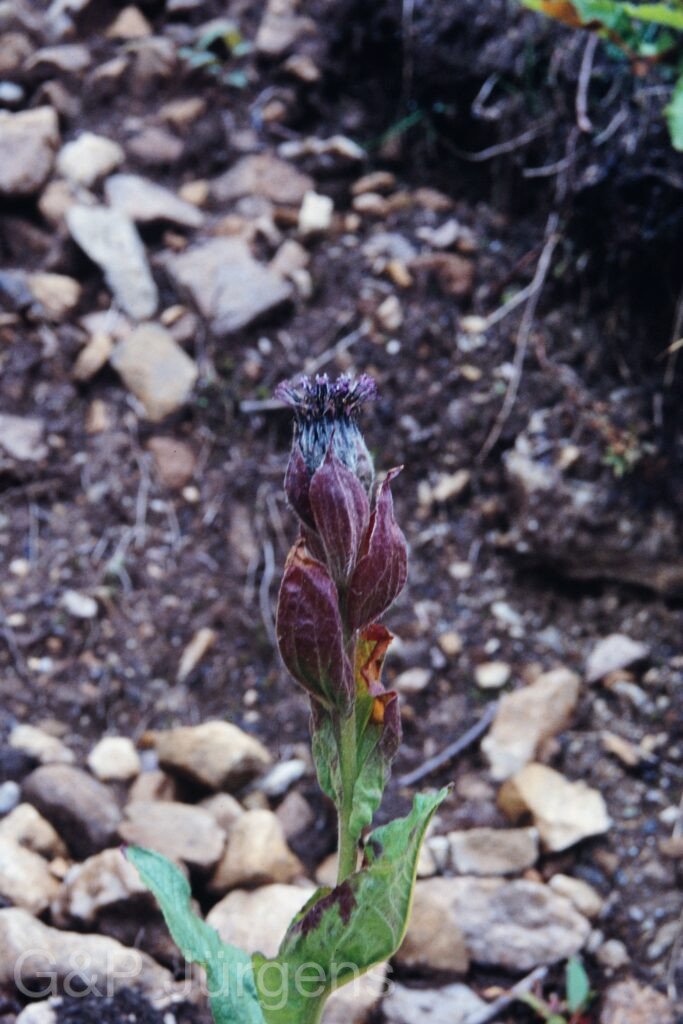
(DC.) Wall. ex Sch.Bip.

Sikkim2003 435 P605
Sikkim Chopta Valley 4000m August
Sikkim2003 436 P606
Sikkim Chopta Valley 4000m August

Description

Saussurea uniflora is a high-alpine thistle-relative of the eastern Himalaya, recorded in GBIF from Nepal, India, China, Bhutan and Japan across 156 occurrences. It is a plant of the upper alpine zone, occupying moist meadows, rocky slopes, screes and seepage flushes generally between 3800 and 4800 m. The photographed individual was found in Sikkim's Chopta Valley at about 4000 m in August, when the brief post-monsoon flowering peak coincides with maximum snow-melt moisture in these exposed habitats.

It is a low, tufted perennial herb arising from a stout, often woody caudex topping a thick taproot, the stem very short or almost absent so that the plant appears acaulescent. The leaves are crowded in a basal rosette, oblanceolate to elliptic, narrowed to a winged petiole, with entire or denticulate margins and a thin floccose-arachnoid indumentum. As the epithet uniflora implies, the plant typically bears a single (or few) large terminal capitulum, the involucre of imbricate, often purple-tinged phyllaries enclosing numerous purple, tubular disc florets; there are no ray florets. The fruit is a glabrous cypsela crowned by a double pappus of outer short bristles and inner plumose hairs.

Saussurea (Asteraceae, tribe Cardueae) is a vast genus centred on the mountains of Asia, many species being cushion- or rosette-forming cold-zone specialists. The reduced stem and condensed solitary head are adaptations to the short alpine growing season and high insolation, with pollination chiefly by bumblebees and flies. Although not formally evaluated for conservation, its restricted high-elevation niche makes it potentially sensitive to upward shifts in vegetation belts driven by warming.

Author: (DC.) Wall. ex Sch.Bip. · Sources: POWO (Kew), GBIF, Flora of China, Flora of Bhutan, Lipschitz Monograph of the Genus Saussurea

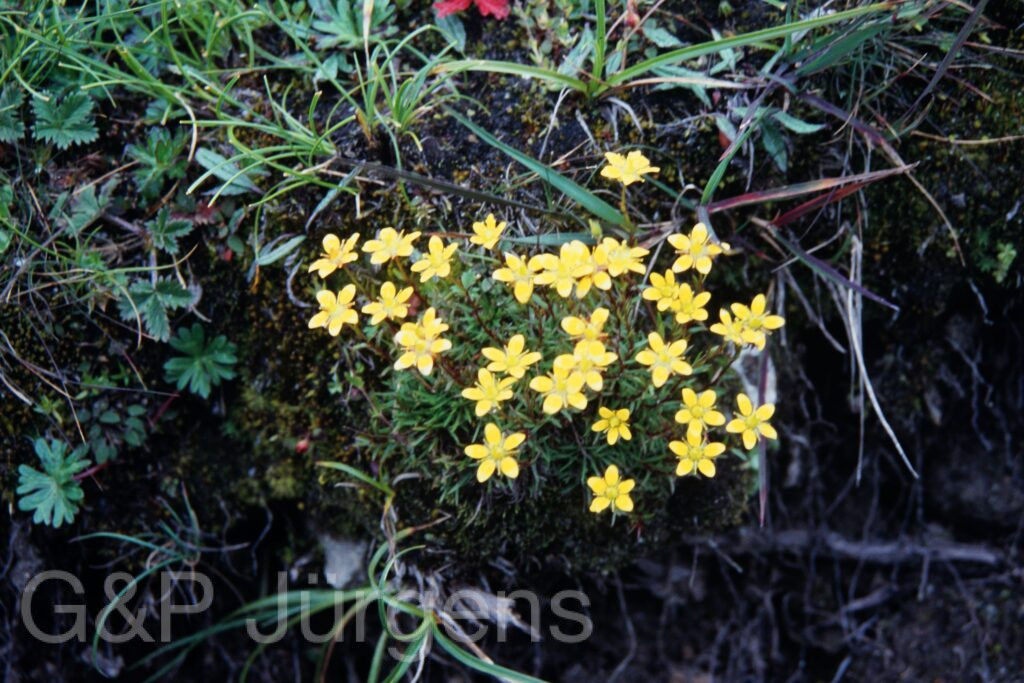
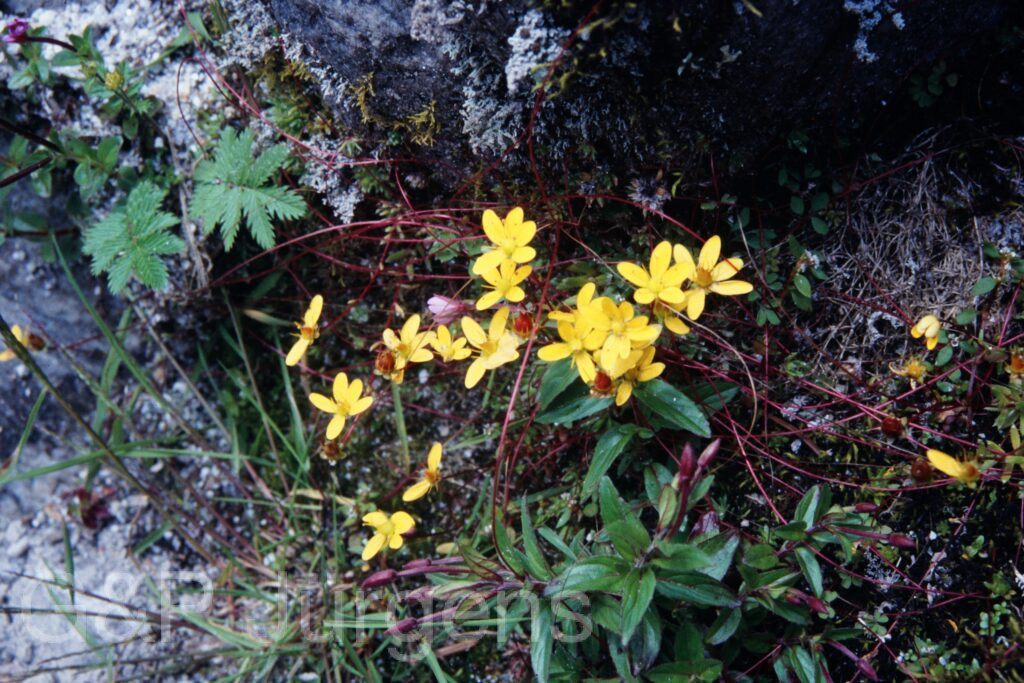
Hook. f. & Thomson

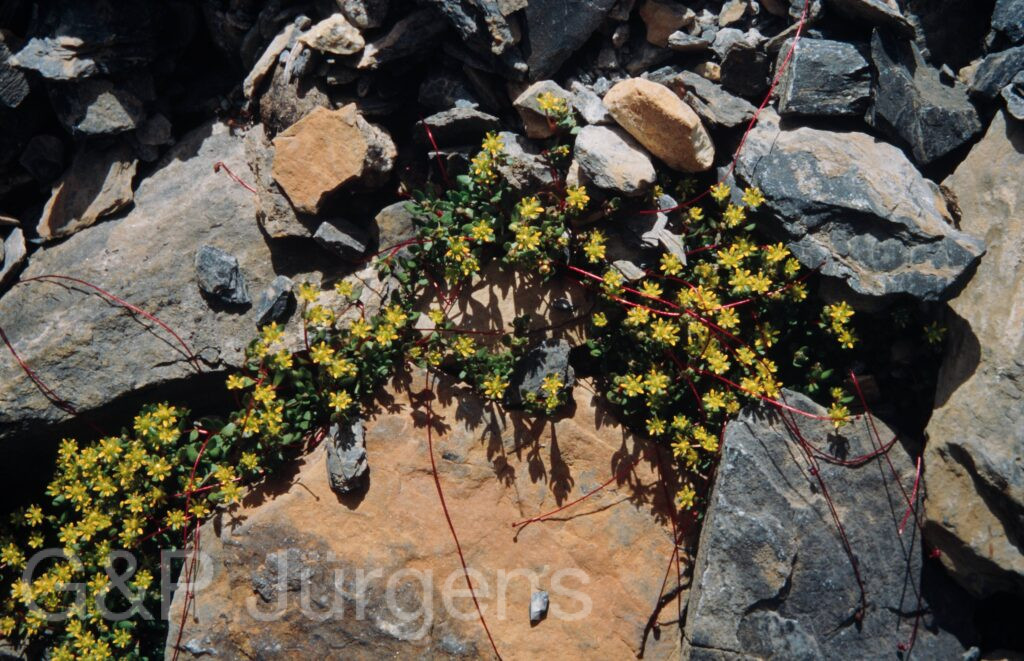
Sikkim2003 282 P388
Sikkim Saint-Lake August

Description

Saxifraga aristulata Hook.f. & Thomson is a cushion-forming alpine saxifrage of the high Himalaya, recorded from China, Nepal, India and Bhutan; the GBIF dataset of 391 occurrences reflects its frequent presence in the alpine zone of the central and eastern ranges. It grows on damp rock ledges, gravelly slopes, moist alpine turf and stream banks at high elevation, broadly between 3500 and 5000 m. The photographed plant from a high lake basin in Sikkim, flowering in August, exemplifies its late-monsoon anthesis in cool, well-drained alpine habitats among rocks and short turf, forming low mats studded with yellow flowers near the snow line.

The species is a small, mat- or cushion-forming perennial herb with slender, prostrate to ascending, leafy stems forming dense low tufts. The leaves are small, alternate to crowded, linear to oblong or narrowly oblanceolate, often ciliate-margined and tipped with a fine bristle or awn — the aristate apex giving the epithet aristulata. The flowers are solitary or few at the stem tips, with five free, spreading, obovate petals that are yellow, sometimes orange- or red-dotted toward the base; the calyx is five-lobed and the ten stamens surround a bicarpellate, partly inferior ovary with two divergent styles. The fruit is a two-beaked capsule splitting between the persistent styles to release numerous small seeds.

Saxifraga aristulata belongs to the large, predominantly yellow-flowered Himalayan section Ciliatae (the Hirculus alliance), centred on the Sino-Himalaya and characterised by cushion or mat habits and ciliate, awn-tipped leaves. The complex is taxonomically intricate, with numerous closely allied high-alpine microspecies. As a widespread, tolerant alpine cushion plant it is of no conservation concern, though as a high-elevation specialist it is potentially sensitive to warming and upslope range contraction; it has occasional appeal among alpine-plant enthusiasts.

Author: Hook. f. & Thomson · Sources: POWO (Kew), GBIF, Flora of China, Flora of Bhutan, Annotated Checklist of the Flowering Plants of Nepal, Pan & Gornall — Saxifraga of the Sino-Himalaya

Sternb.

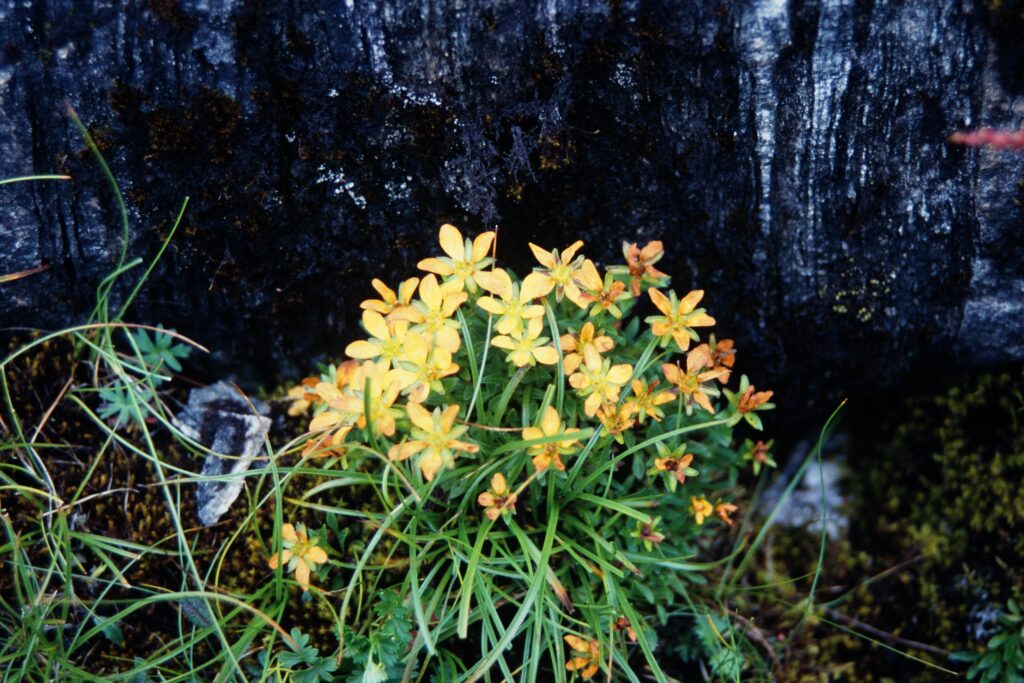
Nepal 99 677 ergebnis
West-Nepal, Kagmara-La 4800m, July
Nepal 99 678 ergebnis
West-Nepal, Kagmara-La 4800m, July

Description

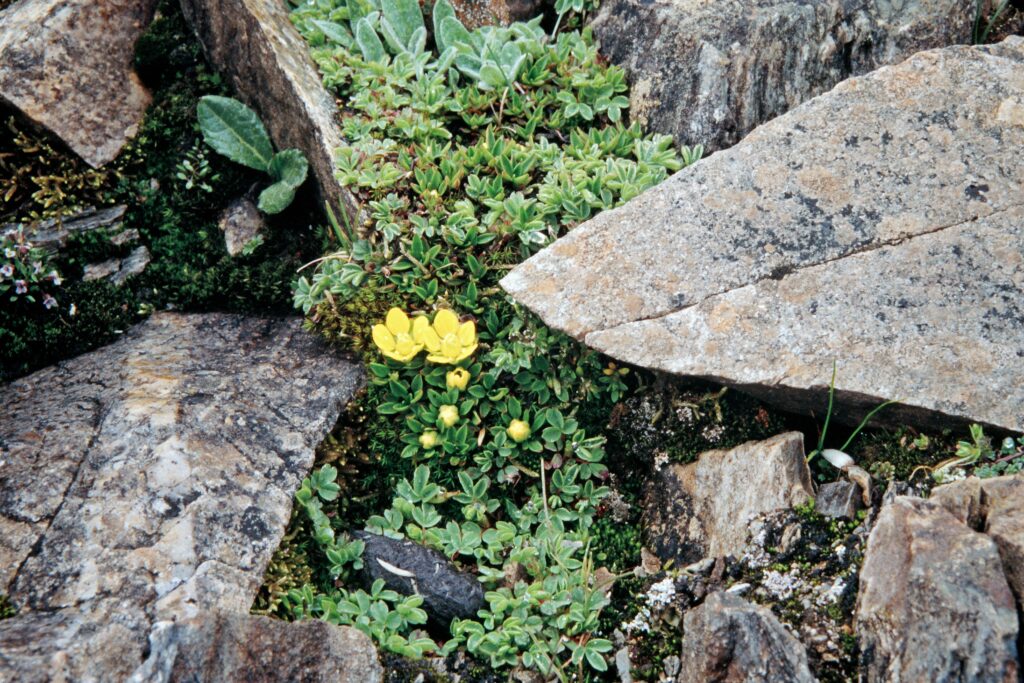
Saxifraga asarifolia is a high-alpine perennial of the Himalaya, recorded from India, Nepal, Bhutan and Pakistan, with GBIF listing about 62 occurrences (the US record reflecting cultivated or herbarium material). It grows on moist, rocky alpine turf, scree margins, moraine and damp ledges in the upper subalpine to alpine belt, generally between 3500 and 5000 m. The illustrated plant was collected in West Nepal at the Kagmara-La at 4800 m in July, near the upper limit of vascular plant life, where it flowers during the brief monsoon-warmed summer amid snowmelt ground.

It is a small, mat- or cushion-forming herb with a slender branching rhizome rooting at the nodes. The leaves are mostly basal, long-petiolate, with reniform to orbicular-cordate, somewhat fleshy blades reminiscent of Asarum, hence the epithet, the margins shallowly crenate or entire and often ciliate. The flowering stems are short and few-flowered, bearing solitary or sparingly cymose flowers. Each flower has five spreading, ovate, yellow to greenish-yellow petals frequently dotted with orange, five sepals, ten stamens, and a superior to half-inferior ovary of two connate carpels. The fruit is a two-beaked capsule dehiscing to release numerous small seeds.

The species belongs within the large and taxonomically intricate genus Saxifraga, associated with the predominantly Asian sections of yellow-flowered alpine saxifrages. Its restriction to high, cold, moist microhabitats makes it a useful indicator of intact alpine ecosystems. While not currently assessed as threatened owing to remote and extensive habitat, populations are vulnerable to climate-driven upward shifts of the alpine zone and to grazing pressure on accessible pastures.

Author: Sternb. · Sources: POWO (Kew), GBIF, Flora of Nepal, Flora of Pakistan, Saxifrages of the World (Webb & Gornall)

C. Marquand

BhutanPG2011 553 1
Bhutan Ludlow-Sherriff-Trail Dem-Tso, 4650m July

Description

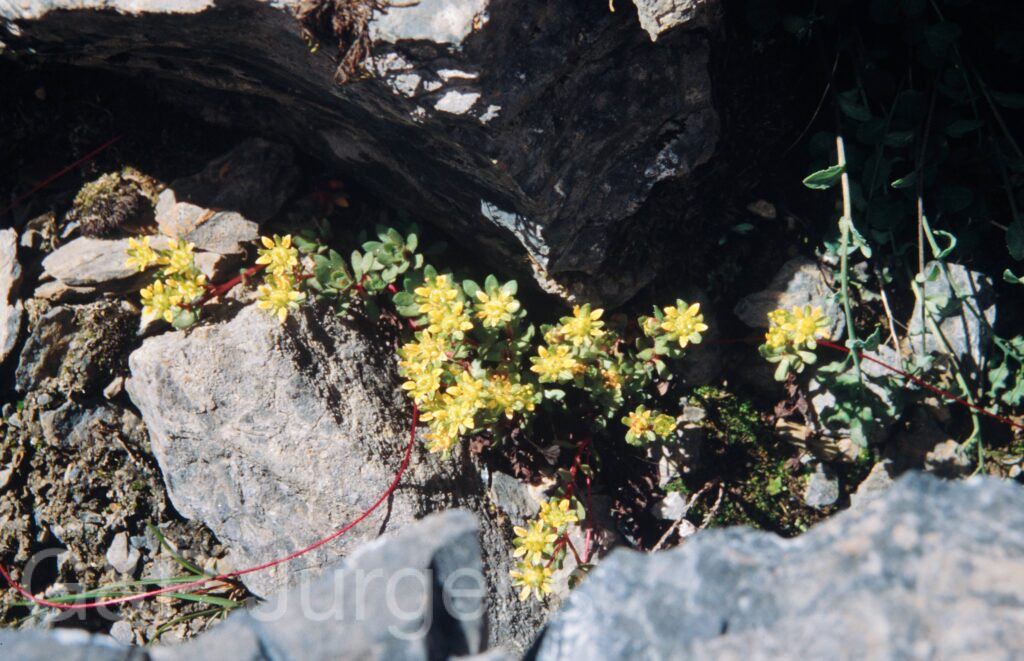
Saxifraga bergenioides is a high-alpine cushion-forming herb of the eastern Himalaya, recorded from China, Bhutan and India, with 102 occurrences in GBIF reflecting its narrow range and restricted habitat. It is a plant of cold, exposed alpine terrain: rock crevices, ledges, moraine and stony turf at very high elevations, typically between 4000 and 4800 m. The collection illustrated, from the Ludlow-Sherriff Trail near Dem-Tso at 4650 m in Bhutan in July, exemplifies its occupancy of the upper alpine zone, where it flowers in midsummer on cold, well-drained rocky substrates near the limit of vascular plant growth.

The plant forms low, compact tufts or cushions arising from a branched, woody-based rootstock. The leaves are mostly basal in dense rosettes, thick and somewhat leathery, obovate to spathulate with entire or obscurely toothed margins, the firm Bergenia-like texture giving rise to the epithet. The flowering stems are short, erect and glandular-hairy, bearing few-flowered cymes; each flower has five spreading sepals and five obovate to oblong petals, white to pale yellow, around two whorls of stamens with a bicarpellate, partly inferior ovary. The fruit is a two-beaked capsule splitting between the divergent styles to release numerous small seeds.

Saxifraga (Saxifragaceae) is a large genus of cold-temperate and arctic-alpine regions, with the Sino-Himalaya a major centre of diversity; S. bergenioides is placed among the leathery-leaved Himalayan saxifrages. Its compact cushion habit is a classic adaptation to wind exposure, cold and physiological drought at extreme altitude. With its limited distribution and specialised high-alpine niche, it is potentially sensitive to climate warming, although its remote habitat currently buffers it from direct human pressures.

Author: C. Marquand · Sources: POWO (Kew), GBIF, Flora of China, Flora of Bhutan, Saxifrages of the World (Monograph of the Genus Saxifraga)

Ser.

Sikkim2003 222 P308
Sikkim Dzongri 3900m 08.2003
Sikkim2003 269 P371
Sikkim Dzongri 4200m August
Sikkim2003 271 P373
Sikkim Dzongri 4200m August

Description

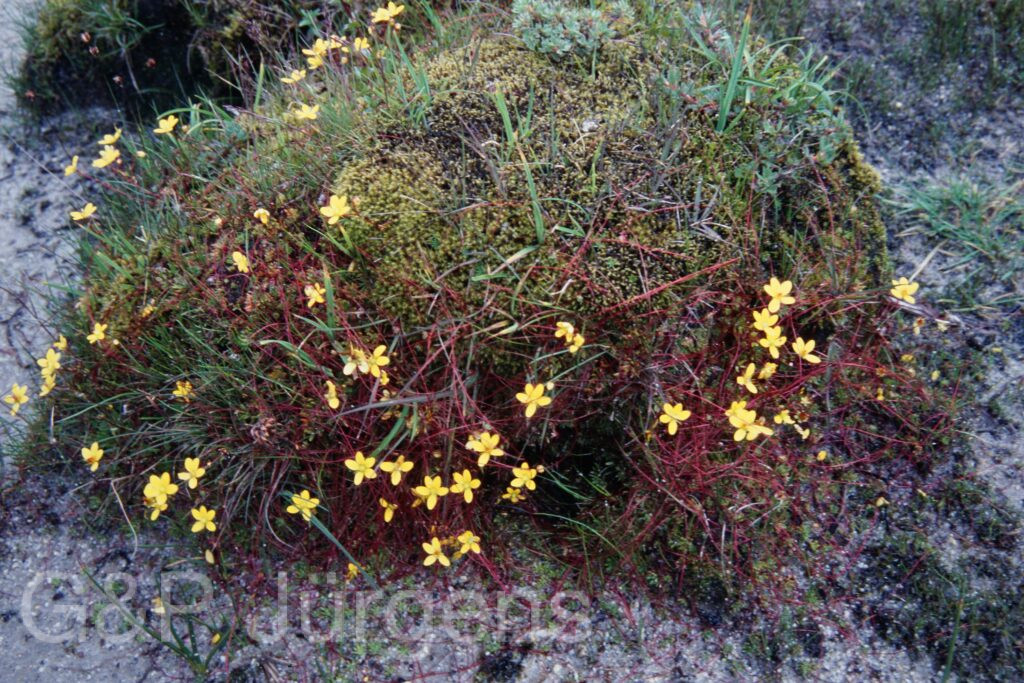
Saxifraga brunonis is a high-alpine cushion-forming herb of the Himalaya and adjacent Tibetan ranges. GBIF records confirm its distribution through Nepal, India, China, Bhutan, Bangladesh, Myanmar and Pakistan, with around 332 occurrences concentrated in the eastern Himalayan high mountains. It is a plant of moist rock ledges, cliff crevices, mossy banks and stable scree at the upper limits of the alpine zone, often where seepage keeps the substrate cool and damp through the growing season. The photographed material from Dzongri in Sikkim at 3900–4200 m, collected in August, is characteristic of its preferred habitat in the summer-monsoon-watered alpine belt, where it flowers at the height of the brief growing season.

It forms low, spreading mats by means of slender, reddish, filiform stolons that root at the nodes to give rise to new rosettes. The leaves are small, oblong to spathulate, entire, fleshy and ciliate-margined, crowded into dense basal rosettes. The flowering stems are short and few-flowered, bearing bright yellow flowers with five free, spreading petals, ten stamens and a half-inferior to nearly superior bicarpellate ovary. The fruit is a two-beaked capsule dehiscing to release numerous minute seeds.

Within the large and taxonomically complex genus Saxifraga, S. brunonis is placed in section Ciliatae, a predominantly Sino-Himalayan group of stoloniferous and rosette-forming alpines. Its runner-mediated clonal spread is an effective strategy for colonising unstable rock surfaces, while seed reproduction allows dispersal to fresh sites. As a strictly high-altitude endemic of the central and eastern Himalaya, the species is potentially sensitive to the upward shift of alpine vegetation belts driven by climate warming.

Author: Ser. · Sources: POWO (Kew), GBIF, Flora of Bhutan, Flora of China (Saxifragaceae), Saxifrages of the World (Webb & Gornall)

W.W.Sm.

Nepal 99 657 ergebnis
Nepal Kagmara-La 4200m, July

Description

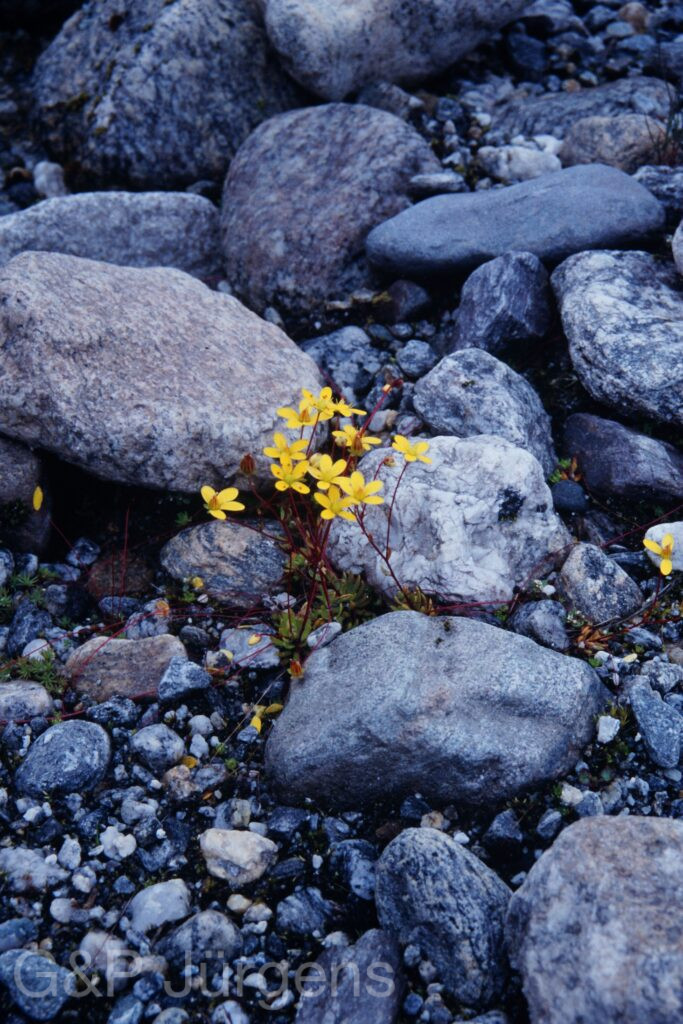
Saxifraga caveana W.W.Sm. is a high-alpine cushion saxifrage endemic to the Sino-Himalayan region, with GBIF records (c. 48 occurrences) from Bhutan, Nepal, China and India. It occupies the upper alpine zone, growing among rocks, on stony slopes, screes and in crevices of moist cliffs, typically between about 4,000 and 5,000 m. The photographed plant from the Kagmara-La in west Nepal at roughly 4,200 m, flowering in July, illustrates its habitat well: a cold, exposed, snow-fed pass environment where the short summer monsoon period coincides with peak flowering.

The species is a small perennial herb forming low tufts or loose cushions from a branched caudex. The leaves are mostly basal, rosulate, small, oblong to spathulate, often somewhat fleshy and ciliate at the margins, and may bear lime-secreting hydathode pores characteristic of many saxifrages. Flowering stems are short, glandular-pubescent, and bear one to few flowers. The flowers are typically pentamerous, with five free sepals and five obovate petals that are pale yellow to whitish, sometimes finely spotted; the ovary is more or less superior with two carpels developing into a capsule that dehisces apically to release numerous minute seeds.

Within the large and intricate genus Saxifraga, S. caveana belongs to the assemblage of Himalayan alpine species whose taxonomy has been clarified mainly through the work on section Ciliatae and related groups. As a narrow-range, high-elevation specialist, it is potentially vulnerable to climate-driven upward shifts of the alpine zone, though its remote habitat affords protection from direct human disturbance.

Author: W.W.Sm. · Sources: POWO (Kew), Flora of China Vol. 8, Flora of Nepal, Flora of Bhutan Vol. 1, GBIF, Pan Jintang & Gornall: Saxifragaceae revisions

W.W. Sm.

Nepal 99 793 ergebnis
West-Nepal Baga-La-Phedi 4500m, July
Nepal 99 792 ergebnis
West-Nepal Baga-La-Phedi 4500m, July

Description

Saxifraga consanguinea W.W.Sm. is a small alpine perennial of the high Himalaya, narrowly distributed and documented by GBIF (163 occurrences) only from China and Nepal. It is a true high-mountain plant of moist alpine turf, rocky slopes, screes and the margins of snowbeds, generally well above the treeline. The cited collection from Baga-La-Phedi in west Nepal at 4500 m in July typifies its habitat in the cold, open alpine zone, where it grows on damp, gravelly ground kept moist by lingering snowmelt during the brief summer flowering season.

The species is a cushion- to tuft-forming herb arising from a slender rootstock, with short stems and crowded, small, sessile leaves that are oblong to linear, entire and often somewhat fleshy, frequently with marginal or apical hydathodes. The flowering stems are short and few-flowered to solitary-flowered; the flowers have five free, yellow petals, a partly inferior, bicarpellate ovary with two short divergent styles, and ten stamens. The fruit is a small bilocular capsule dehiscing between the persistent styles to liberate numerous tiny seeds, the whole plant adapted to the brief, cold growing season of the high alpine.

Saxifraga consanguinea belongs to the predominantly yellow-flowered, alpine sections of this large, taxonomically complex circumboreal and Sino-Himalayan genus, in which species delimitation rests on fine cushion, leaf and floral characters. Its restriction to China and Nepal makes it a genuine high-Himalayan endemic of conservation interest; though no major threats are recorded, its narrow range and dependence on snowmelt-fed alpine habitats render it potentially sensitive to climatic warming and shifting snow regimes.

Author: W.W. Sm. · Sources: POWO (Kew), GBIF, Flora of Nepal, Flora of China, The Saxifragaceae of the Sino-Himalaya, Saxifrages of the World (Webb & Gornall)

Hook. f. & Thomson

Sikkim2003 287 P396 ergebnis
Sikkim Samiti-Lake 2800m, August

Description

Saxifraga cordigera is an alpine perennial endemic to the eastern Himalaya, with GBIF documenting around 89 occurrences spanning Nepal, India, Bhutan and adjacent China. It is a plant of cool, humid high-elevation environments, growing on moist rocky slopes, ledges, banks and the margins of subalpine to alpine meadows where it benefits from constant atmospheric moisture and snowmelt seepage. The plant illustrated near Samiti Lake in Sikkim at about 2800 m in August was recorded during the monsoon flowering period, when these eastern Himalayan slopes are saturated and the saxifrages reach their peak.

It is a tufted to shortly stoloniferous herb forming loose rosettes of leaves that are characteristically cordate to reniform at the base, as the epithet implies, with crenate or dentate margins, somewhat fleshy texture and slender petioles. The flowering stems are erect and glandular-hairy, bearing few-flowered cymose inflorescences. The flowers are pentamerous with five spreading petals that are yellow, frequently spotted or flushed with orange or red, ten stamens, and a bicarpellate, semi-inferior ovary. The fruit is a two-beaked capsule splitting between the persistent styles to release numerous minute seeds.

The species belongs to the large and taxonomically complex genus Saxifraga, here placed in the yellow-flowered alliance traditionally referred to section Hirculus, a predominantly Sino-Himalayan radiation of moisture-loving alpine herbs. Such species are valuable indicators of intact high-altitude wetland and seepage habitats. While not formally evaluated for conservation status and locally frequent within its range, its dependence on cool, perennially moist niches makes it potentially vulnerable to warming and the desiccation of alpine seeps.

Author: Hook. f. & Thomson · Sources: POWO (Kew), GBIF, Flora of China, Flora of Bhutan, Hooker Flora of British India, Webb & Gornall A Manual of Saxifrages