Tag:

Summer

Hook.f. & Thomson

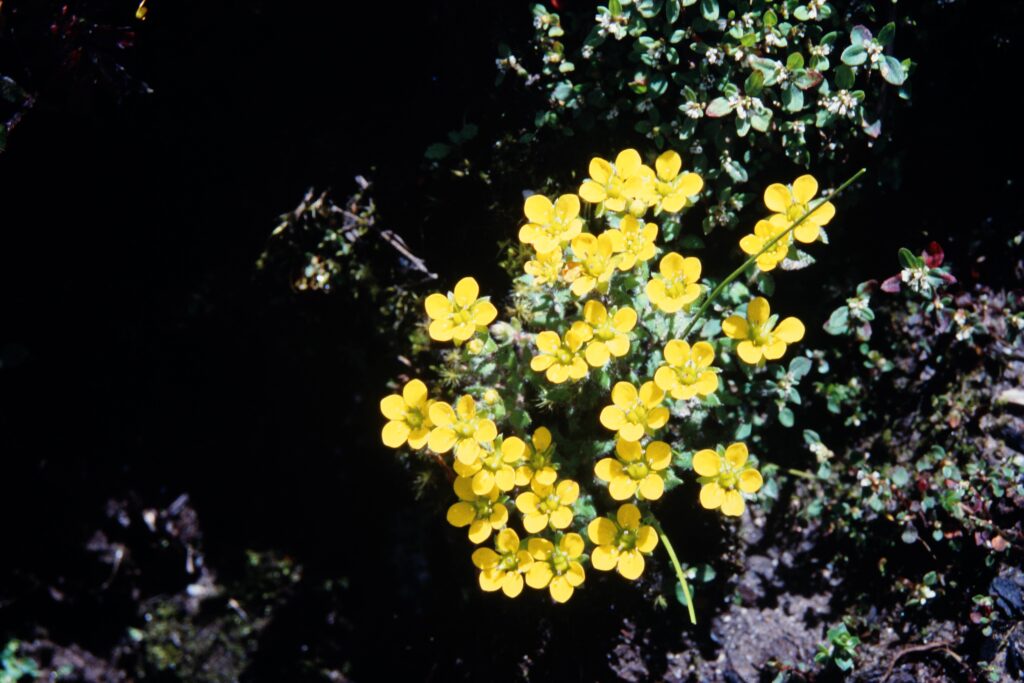
Sikkim2003 102 P139 ergebnis
Sikkim Choka 2900m, August
Sikkim2003 147 P198 ergebnis
Sikkim Choka 2900m, August

Description

Saxifraga stella-aurea is a Sino-Himalayan alpine herb distributed through China, India, Nepal and Bhutan, with scattered ex situ records in Europe. It inhabits moist alpine meadows, seepage slopes, streamsides and rock crevices, typically between about 2700 and 4500 m. The illustrated plant from Choka in Sikkim at roughly 2900 m, flowering in August at the height of the post-monsoon season, reflects its affinity for cool, humid, well-drained sites where snowmelt and persistent moisture sustain the dense, cushion-forming growth characteristic of high-elevation saxifrages.

The species is a small, tufted perennial forming low rosettes or loose mats from a short rhizomatous base. The basal and cauline leaves are spathulate to oblanceolate, entire or obscurely toothed, somewhat fleshy and often ciliate at the margins. The flowering stems are slender and few-leaved, bearing solitary or few yellow flowers. The five petals are obovate to oblong and typically marked with orange or reddish dots, surrounding a hypanthium with ten stamens and a bicarpellate ovary; the fruit is a small capsule dehiscing between the two divergent styles, releasing numerous minute seeds.

The epithet stella-aurea, golden star, refers to the bright stellate yellow corolla. The taxon falls within the large and taxonomically complex section Hirculus, a predominantly Sino-Himalayan alpine group whose species are notoriously difficult to delimit and frequently confused. Like many high-montane Saxifraga, it is an indicator of intact alpine seepage habitats; while not presently threatened given its wide distribution, such communities are sensitive to grazing intensification and climate-driven shifts in snowmelt regimes.

Author: Hook.f. & Thomson · Sources: POWO (Kew), GBIF, Flora of China Vol. 8, Flora of Bhutan Vol. 1, Flora of Nepal, Saxifrages of the World (Webb & Gornall)
Duthie ex Engl. & Irmsch.

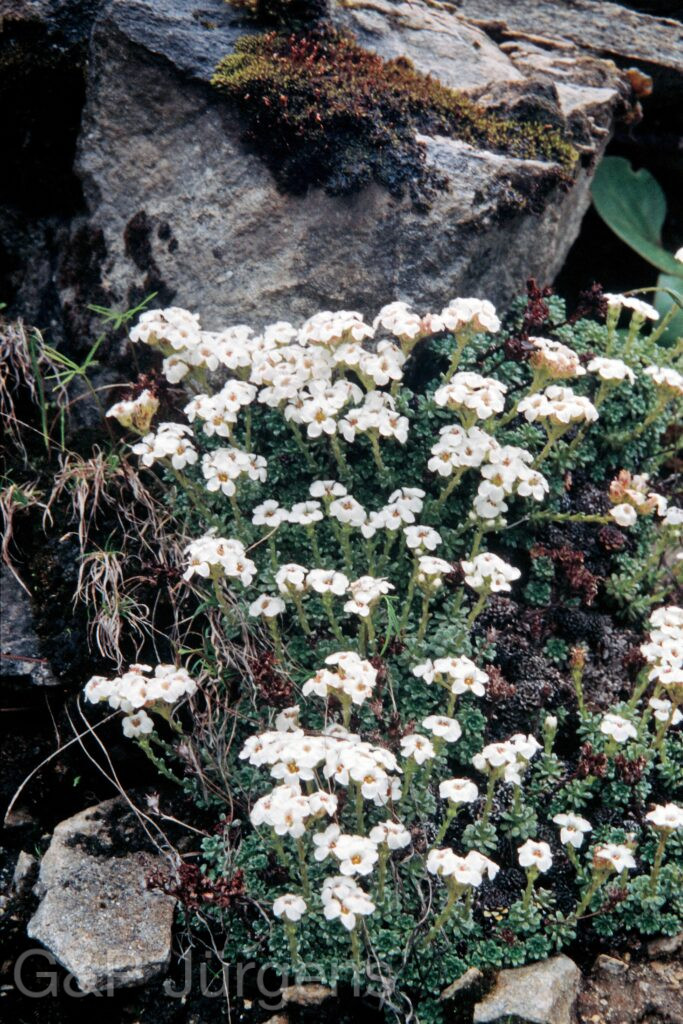
Nepal 99 595 ergebnis
Nepal Kagmara Phedi 4000m, July
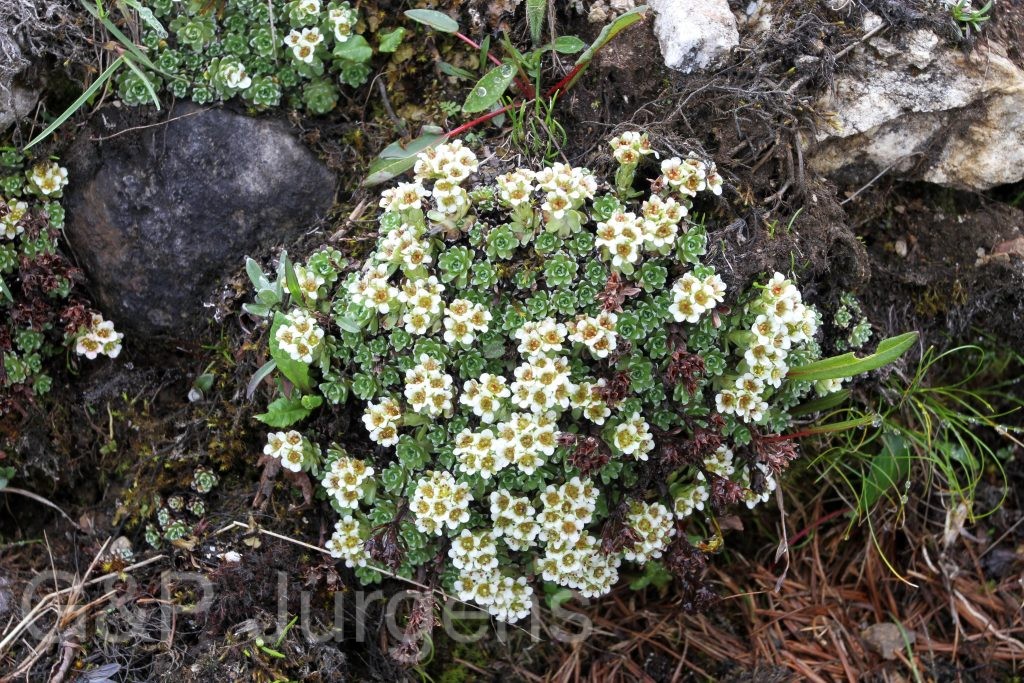
BhutanPG2011 423
Bhutan Warrthang-La 4500m, June

Description

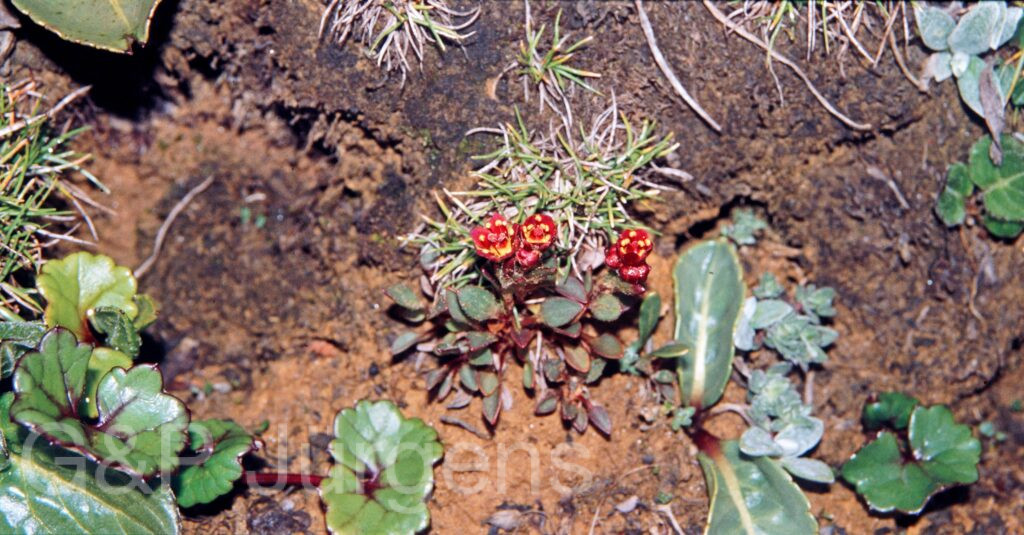
Saxifraga stolitzkae is a high-alpine saxifrage of the Himalaya, recorded from Nepal, India and Bhutan, with around 32 georeferenced occurrences indicating a sparse distribution across the upper ranges. It is a plant of severe high-altitude habitats — open stony slopes, moraine, rock ledges and gravelly ground kept moist by snow-melt — well above treeline. The illustrated material from Kagmara Phedi in Nepal at about 4000 m in July, and from Warrthang-La in Bhutan at around 4500 m in June, places it firmly among the highest-growing Himalayan saxifrages, flowering during the short high-mountain summer as the snow retreats.

The plant is a small perennial herb forming loose tufts or low cushions from a branched rootstock, with crowded rosettes of small, fleshy, oblong to spathulate leaves that are frequently glandular-hairy. The flowering stems are short and often reddish, glandular, bearing one to few flowers. Each flower has five free sepals, five spreading petals — typically yellow, often flecked or flushed with orange or red — and ten stamens. The two largely fused carpels mature into a bilobed capsule that opens between the divergent beaks to release numerous minute seeds, a fruiting structure shared across the genus.

The combination is attributed to Duthie ex Engler and Irmscher, the last two authors of the standard early-twentieth-century monographic treatment of Saxifraga; the species belongs to the assemblage of yellow-flowered, cushion- and rosette-forming Himalayan saxifrages adapted to extreme alpine conditions. Restricted to very high elevations and known from relatively few localities, S. stolitzkae is closely tied to reliable snow-melt moisture and short cool seasons, making it among the species most exposed to the upward shift of climatic zones in the Himalaya, though its remote habitat affords some protection from direct human pressure.

Author: Duthie ex Engl. & Irmsch. · Sources: POWO (Kew), GBIF, Flora of Bhutan, Flora of China (Saxifragaceae), Engler & Irmscher: Das Pflanzenreich, Saxifraga monograph

Engl. & Irmsch.

BhutanPG2011 641
Bhutan Ludlow-Sherriff-Trail Warrtlang-La, 4500m June
Nepal 99 629 ergebnis
West-Nepal Kagmara-La 4900m, July

Description

Saxifraga subsessiliflora is a high-alpine cushion saxifrage distributed across the Himalaya and the mountains of south-western China, with records from Bhutan, Nepal, northern India and China; herbarium material is also held in European collections such as Germany. The roughly 29 georeferenced gatherings place it firmly in the upper alpine to subnival zone. The collections cited in the image caption, from the Ludlow-Sherriff Trail at Warrtlang-La in Bhutan at 4500 m in June and from Kagmara-La in West Nepal at 4900 m in July, are characteristic, the species favouring rock crevices, stony moraine, scree and gritty alpine turf at roughly 4000-5300 m.

It forms low compact tufts or loose mats of densely leafy shoots. The leaves are small, oblong to spathulate, often somewhat fleshy and frequently lime-encrusted through hydathodes at the margins, the older leaves persisting as marcescent remains around the stem base. The flowering stems are short and few-flowered, so that the flowers appear almost sessile among the leaves, as the epithet subsessiliflora indicates. Each flower has five free, ovate, usually pale yellow to cream petals, ten stamens and a semi-inferior ovary of two carpels, the fruit a small bilocular capsule opening between the divergent styles to shed numerous minute seeds.

The species belongs to the large and taxonomically intricate genus Saxifraga, which is exceptionally diversified in the Sino-Himalayan alpine flora, and falls among the encrusted, lime-secreting alpine sections allied to section Porphyrion. Its cushion habit, reduced inflorescence and lime-encrusted leaves are convergent adaptations to cold, wind-exposed, high-radiation subnival environments. Pollination is by generalist alpine flies and small bees during the brief monsoon window. No formal conservation assessment exists, but its narrow high-elevation niche makes it sensitive to alpine warming and habitat loss at the upper limits of plant life.

Author: Engl. & Irmsch. · Sources: POWO (Kew), GBIF, Flora of China, Flora of Bhutan, Saxifrages of the World (Webb & Gornall)
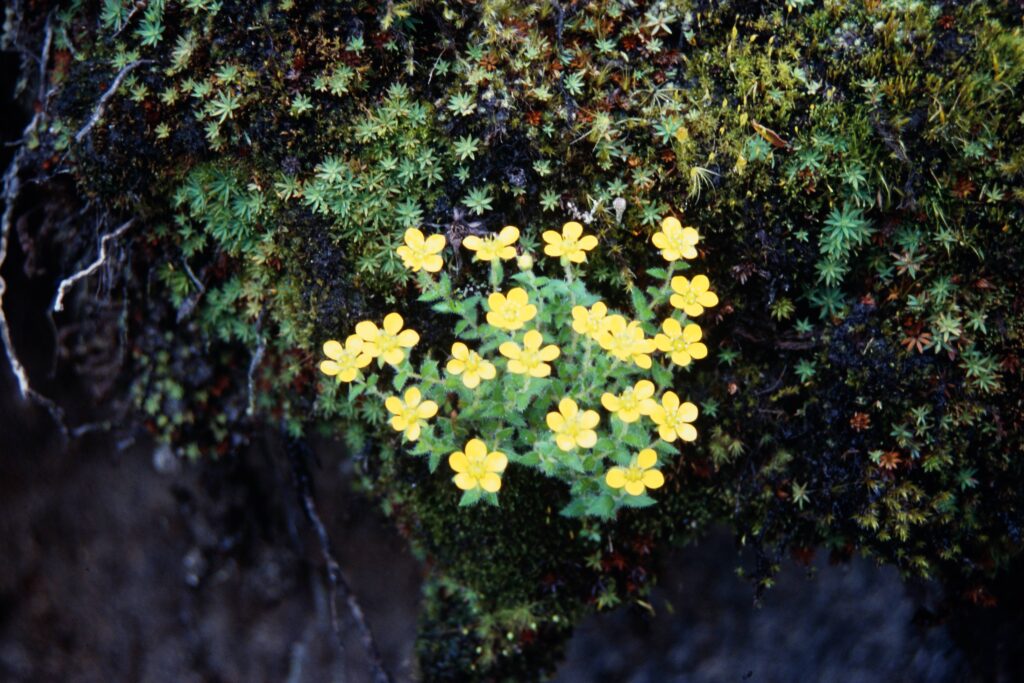
Engl.

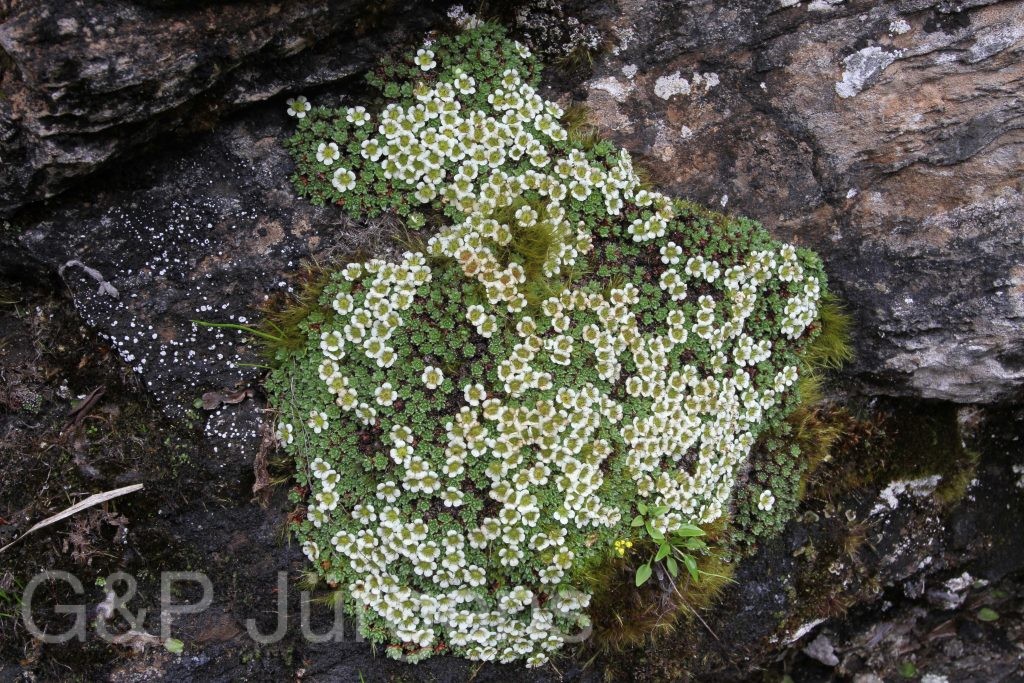
Nepal 99 655 ergebnis
West-Nepal Kagmara-La 5000m, July

Description

Saxifraga tangutica is a high-alpine saxifrage of the Himalaya and Tibetan plateau, distributed across China, Nepal, India and Bhutan, with GBIF documenting 734 occurrences from these four countries (CN, NP, IN, BT). It is a true alpine, growing on open grassy and stony slopes, gravelly flats, rock ledges, moraines and damp turf, typically between about 3500 and 5300 m, ranking among the highest-ascending flowering plants of the region. The photographed plant from the Kagmara-La in West Nepal at 5000 m in July shows it flowering at the height of the brief alpine summer, on a high pass in the Dolpo region where it endures intense radiation, frost and a very short growing season.

It is a small, tufted, perennial herb forming low rosettes or loose mats, the basal leaves oblong to spathulate, often somewhat fleshy and ciliate or glandular-margined. From the rosettes arise slender, glandular-hairy flowering stems bearing a few small cauline leaves and a terminal cymose cluster of several flowers. Each flower has five reflexed green sepals, five yellow petals frequently dotted with orange or reddish glandular spots, ten stamens, and a bicarpellate, partly inferior ovary. The fruit is a two-beaked capsule splitting between the persistent divergent styles to release numerous minute seeds.

The species is referable to Saxifraga section Ciliatae, a large Sino-Himalayan group of yellow-flowered alpine saxifrages centred on the Qinghai-Tibet plateau and the Hengduan ranges, the epithet tangutica alluding to the Tangut (Amdo/northeast Tibet) region. Its compact cushion to rosette habit and glandular indumentum are adaptations to the cold, dry, exposed alpine environment, and the small glandular flowers are visited by flies and other generalist high-altitude insects. Widespread on remote high terrain and not subject to significant pressure, it is of least conservation concern.

Author: Engl. · Sources: POWO (Kew), GBIF, Flora of China Vol. 8, Flora of Bhutan Vol. 1, Flora of Nepal, Saxifrages: A Definitive Guide (Webb & Gornall, and Pan's revision of section Ciliatae)

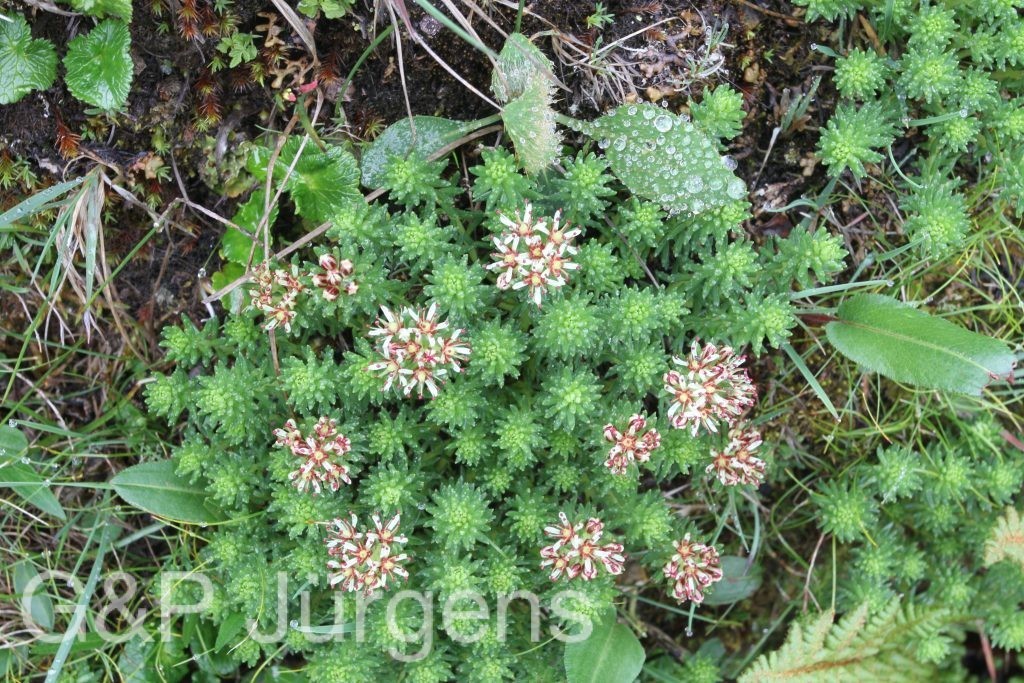
C.E.C. Fisch.

Nepal 99 658 ergebnis
West-Nepal Kagmara-La 5850m, July

Description

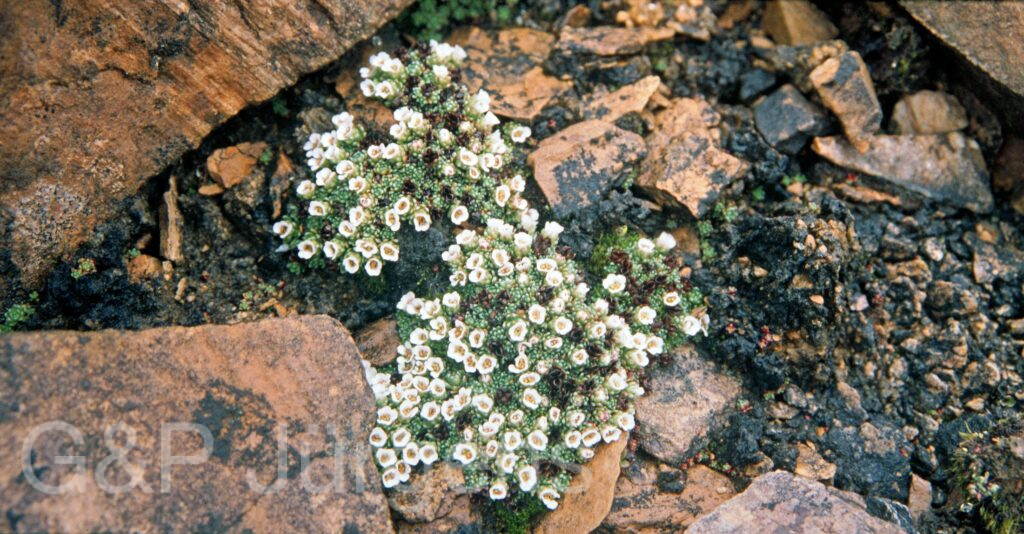
Saxifraga tentaculata is a high-alpine cushion saxifrage of the central and eastern Himalaya, recorded from Nepal, Bhutan and south-western China. GBIF holds only 19 occurrences across these three countries, marking it as a narrowly distributed, infrequently collected species of the loftiest screes and rock crevices. It occupies stony moraine, gravelly slopes, glacial debris and damp rock ledges near the upper limit of vascular plant growth, generally above 4500 m. The plant figured here was found in West Nepal at the Kagmara-La at 5850 m in July, an extreme elevation that places it among the highest-growing flowering plants of the region, blooming briefly during the short summer thaw.

The plant forms low, compact tufts or loose mats from a branching caudex, the slender stems clothed with small, fleshy leaves. The leaves are oblong to spathulate and characteristically fringed with long, gland-tipped, tentacle-like cilia along their margins, a feature giving the species its epithet and distinguishing it from related members of the Hirculus group. The flowering stems are short and glandular-hairy, bearing solitary or few yellow, five-petalled flowers; the petals are obovate, often dotted orange near the base, and exceed the lanceolate sepals. The fruit is a small bilobed capsule containing numerous minute seeds.

Saxifraga tentaculata belongs to section Ciliatae (the Himalayan Hirculus alliance), a large and taxonomically complex group centred on the Sino-Himalaya and Tibetan Plateau that has radiated extensively in alpine and subnival habitats. Its glandular marginal cilia are typical of this section. Given its restricted range and remote, high-elevation habitat, populations are naturally small but largely buffered from human disturbance, though climate-driven upward shifts of the snowline pose a longer-term threat to such subnival specialists.

Author: C.E.C. Fisch. · Sources: POWO (Kew), GBIF, Flora of China, An Annotated Checklist of the Flowering Plants of Nepal, Saxifrages of the World, Monograph of the Genus Saxifraga

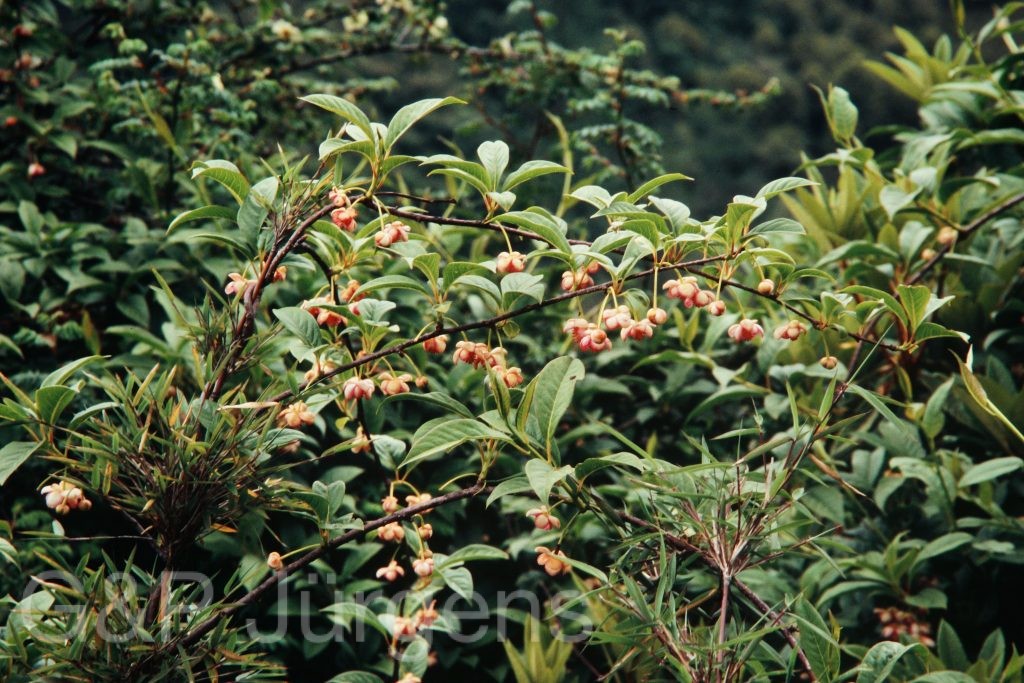
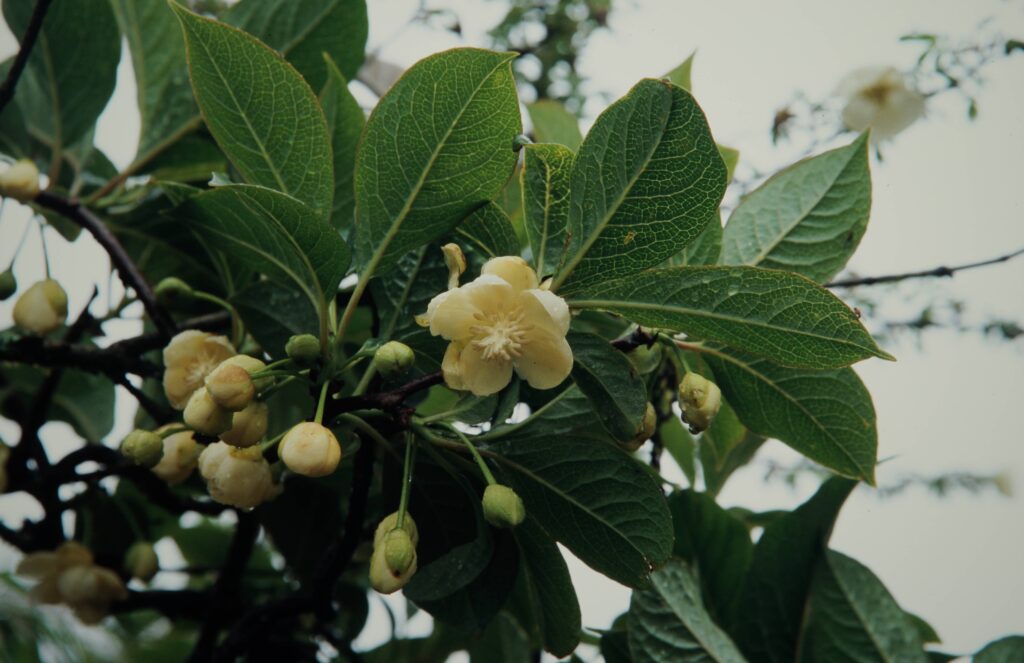
(Wall.) Hook.f. & Thomson

Sikkim2011 189
Sikkim Lachung 2800m, June
Bh09 249 G417
Bhutan Pele-La, 3100m June
Sikkim 2006 7 ergebnis
India West-Bengal Maneybhajang 2000m, May

Description

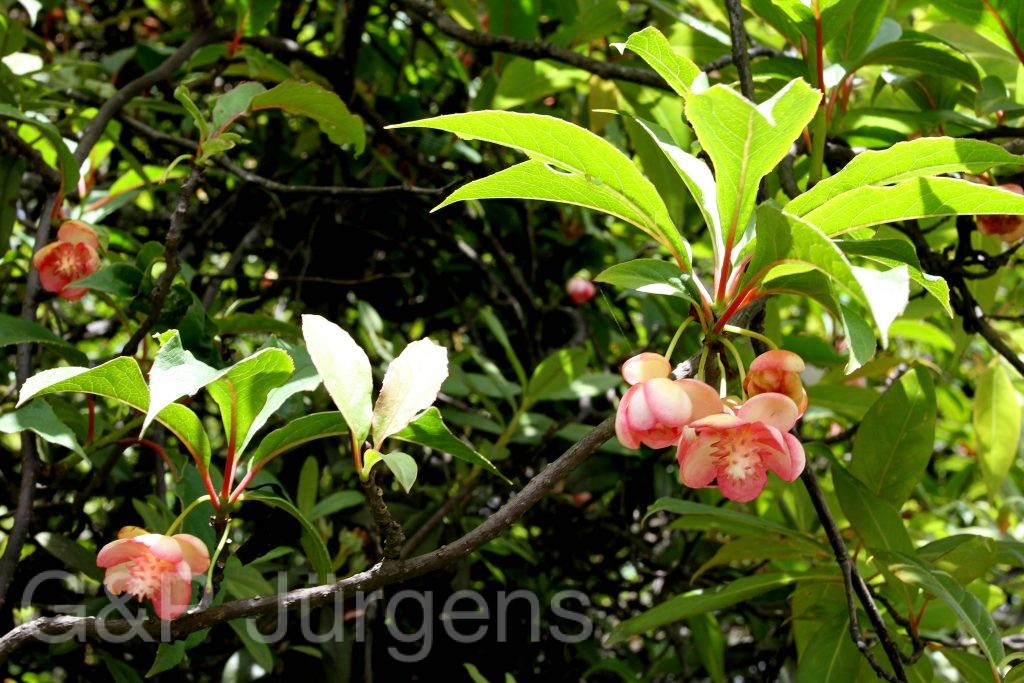
Schisandra grandiflora (Wall.) Hook.f. & Thomson is a deciduous, woody climber of the eastern Himalaya, recorded by GBIF from China, India, Nepal, Bhutan and Myanmar. It is a plant of cool, humid temperate forest, growing in mixed broad-leaved and conifer woodland, along forest margins and ravines, where it scrambles over shrubs and into the canopy, generally between about 2,000 and 3,500 m. The cited collections span Lachung in Sikkim at 2,800 m and Pele-La in Bhutan at 3,100 m in June, and Maneybhajang in West Bengal at 2,000 m in May, illustrating its broad occurrence across the moist temperate forest belt of the eastern Himalayan arc.

The plant is a glabrous, twining liana with slender woody stems and alternate, simple leaves that are elliptic to obovate, with serrulate margins and an acuminate apex, borne on reddish petioles. As in all Schisandraceae the flowers are unisexual, the species being dioecious or monoecious; they are solitary and pendulous on slender pedicels, comparatively large for the genus (hence grandiflora), with several white to creamy or pink-tinged perianth segments not differentiated into sepals and petals. The numerous free carpels of the female flower, borne on an elongating receptacle, ripen into a pendent, spike-like aggregate of red, fleshy berries.

Schisandraceae, together with the related Illiciaceae, occupy a basal position among the angiosperms in the order Austrobaileyales, making the family of major significance in studies of early flowering-plant evolution. Several Schisandra species, notably S. chinensis, are renowned medicinal plants, and the aromatic fruits of S. grandiflora are likewise used locally. Its disjunct Sino-Himalayan distribution reflects the ancient, relictual biogeography characteristic of this lineage.

Author: (Wall.) Hook.f. & Thomson · Sources: POWO (Kew), GBIF, Flora of China Vol. 7, Flora of Bhutan Vol. 1, Saunders: Monograph of Schisandra (Systematic Botany Monographs)

Sedum amabile

by GP Jürgens

H. Ohba

BhutanPG2011 470
Bhutan Ludlow-Sherriff-Trail Warrtlang-La, 4450m June

Description

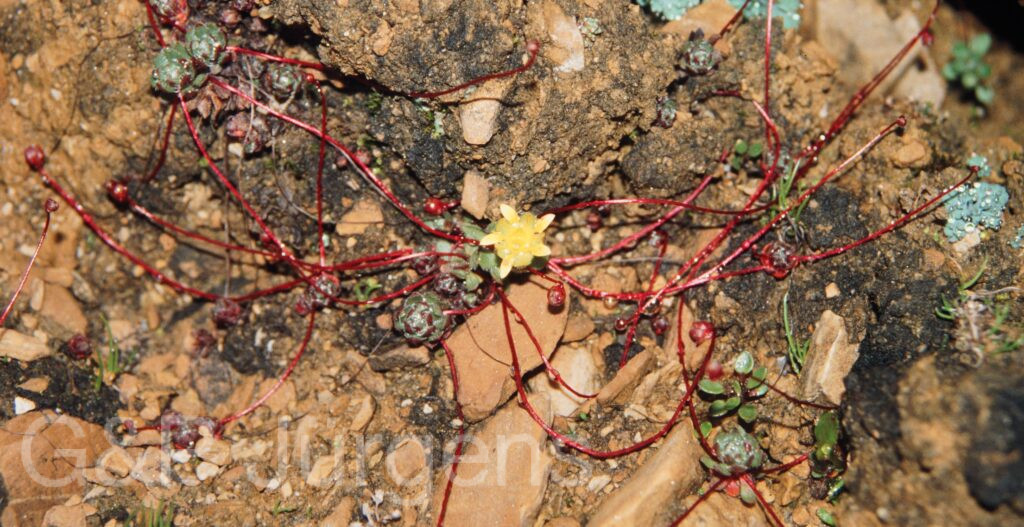
Sedum amabile is a high-alpine succulent of the Eastern Himalaya, recorded principally from Bhutan and the adjacent mountains of Sikkim and southern Tibet (China). GBIF currently holds no georeferenced occurrences and no associated country list for this name, reflecting both its rarity and the unsettled status discussed below. It is a plant of the high alpine zone above about 4000 m, growing among rocks, on stony slopes, moraine and in crevices, as documented along the Ludlow-Sherriff Trail at Warrtlang-La in Bhutan at 4450 m. Like other high-elevation stonecrops it is adapted to a short, cool growing season, flowering in early summer (June) shortly after snowmelt.

It is a small, glabrous, succulent perennial herb forming low tufts from a short rootstock, with fleshy stems bearing crowded, fleshy leaves that are entire, sessile and oblong to obovate. The flowers are borne in a compact, terminal, cymose to corymbose inflorescence; they are typically 5-merous, with free or nearly free petals that in this species are an attractive bright reddish-pink (the epithet "amabile" meaning lovely or pleasing), and twice as many stamens as petals. The carpels are erect and free, maturing into a star-like cluster of small follicles that split along the ventral suture to release numerous minute seeds.

Though catalogued under the genus Sedum, GBIF treats this name as a synonym, with the accepted name given as Sedum amabile; the basionym by H. Ohba and the WordPress link (referencing Rhodiola amabilis) indicate the long-standing taxonomic movement of high-Himalayan succulents between Sedum and the segregate genus Rhodiola, distinguished chiefly by the latter's perennial scaly caudex and frequently dioecious flowers. Such nomenclatural instability is typical of the Sino-Himalayan Crassulaceae. Given its very restricted, high-altitude range and the paucity of records, the species is potentially of conservation concern, although it has not been formally assessed.

Author: H. Ohba · Sources: POWO (Kew), GBIF, Flora of Bhutan, Flora of China, Ohba's monograph of Himalayan Crassulaceae (Sedum and Rhodiola)

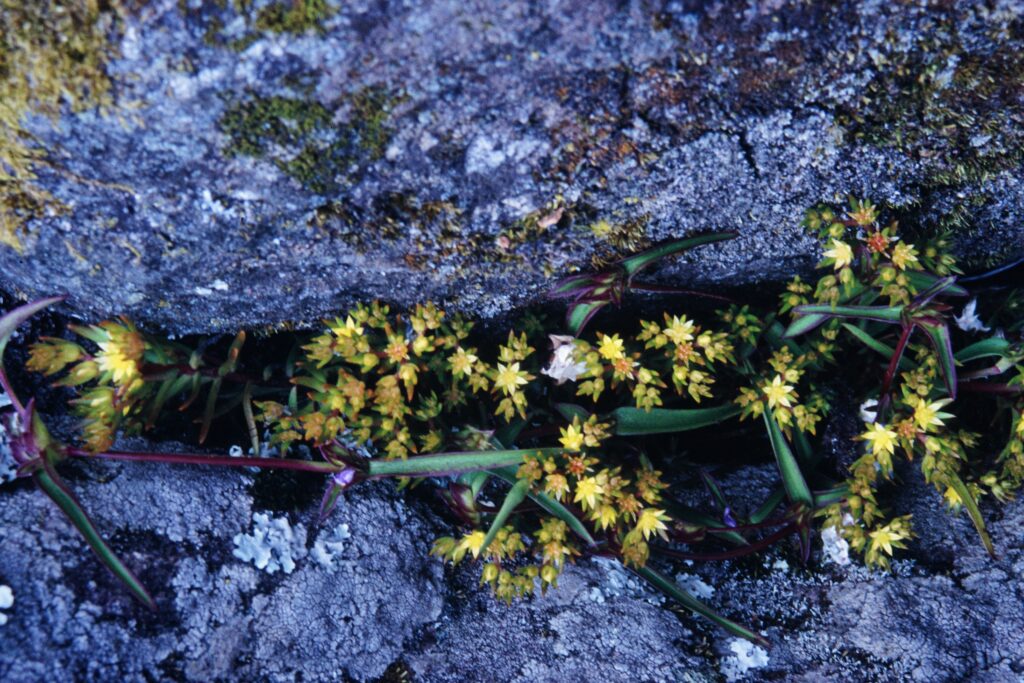
Wall. ex Lindl.

Sikkim2003 385 P543 ergebnis
Sikkim Talim (Zemu-valley) 3280m, August

Description

Sedum multicaule is a widespread Himalayan stonecrop ranging from Pakistan eastwards through India, Nepal, Bhutan and into China and Myanmar, and is well collected with around 618 GBIF records. A succulent of rocky habitats, it colonises moist cliffs, boulders, mossy banks, walls and stony slopes, often growing as a lithophyte in the spray of streams across the temperate to subalpine belt, broadly between about 2000 and 4000 m. The documented gathering from Talim in the Zemu valley of Sikkim at 3280 m in August reflects its preference for damp rock faces during the summer growing season.

It is a perennial, somewhat tufted herb with numerous slender, often reddish stems, as the epithet "multicaule" implies, that are decumbent at the base then ascending. The fleshy leaves are alternate, linear to oblong and terete or semi-terete, frequently spurred at the base and crowded along the stems. The inflorescence is a terminal cyme of several branches bearing many small, sessile, star-shaped flowers; these are typically five-merous with narrow, acute yellow petals, ten stamens and free or shortly united carpels. The fruit comprises spreading, many-seeded follicles.

Sedum in the broad sense belongs to the Crassulaceae and exhibits the CAM photosynthesis and water-storing succulence that suit it to seasonally dry, exposed rock surfaces. The Himalayan members form a taxonomically complex assemblage, several segregated by modern authors into related genera. Of no conservation concern given its abundance and broad altitudinal and geographic range, S. multicaule is a characteristic and resilient element of montane rock-crevice vegetation.

Author: Wall. ex Lindl. · Sources: POWO (Kew), GBIF, Flora of China, Flora of Pakistan, Crassulaceae monograph (Ohba / 't Hart)

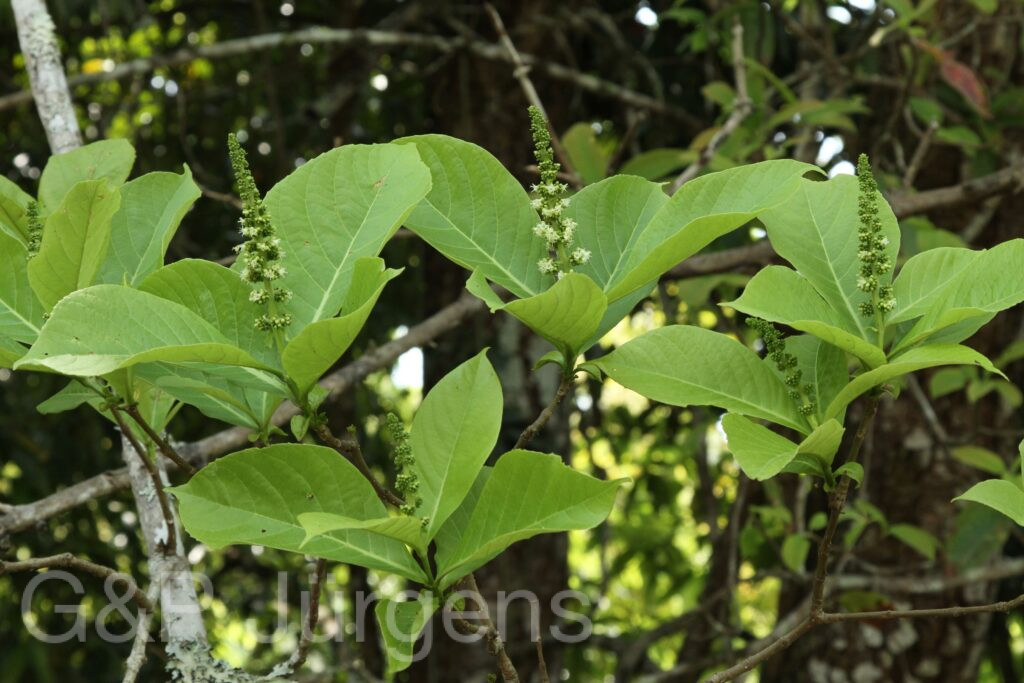
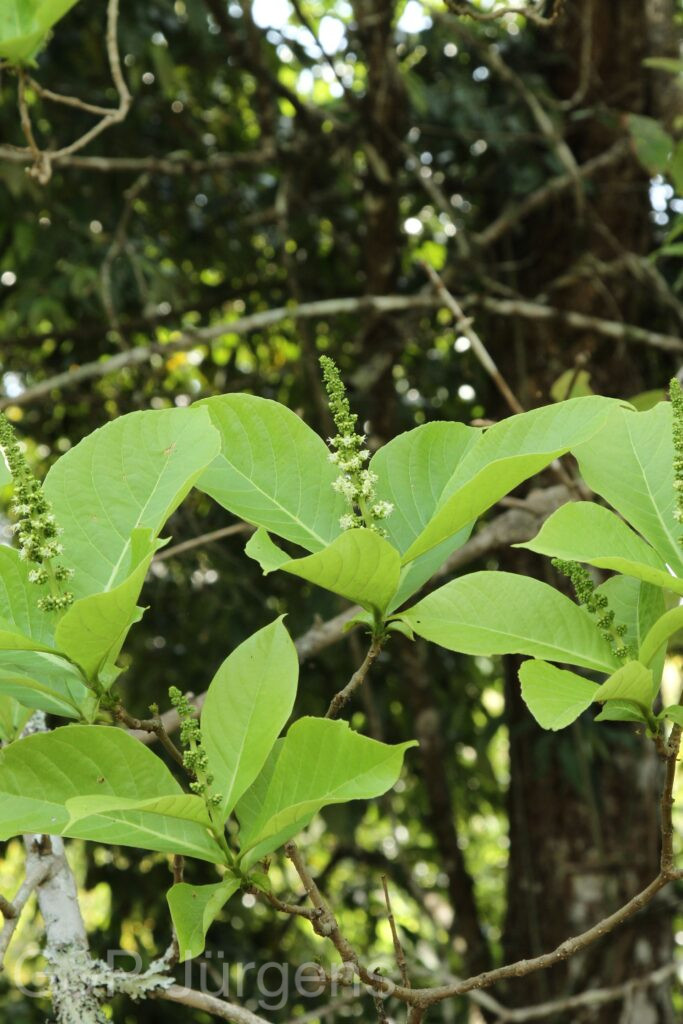
L.f.

Bhutan2014 678
Bhutan Wangdi Phodrang 1100m, June
Bhutan2014 677
Bhutan Wangdi Phodrang 1100m, June

Description

Semecarpus anacardium, the marking-nut tree, is a tree of the South and Southeast Asian tropics extending into the southern Himalayan foothills. GBIF (some 1,524 occurrences) records it natively from India, Nepal, Bhutan, Myanmar, Bangladesh, Sri Lanka, Vietnam, Indonesia, the Philippines and Papua New Guinea, with cultivated or introduced material in the Neotropics and on islands such as Mauritius. It grows in deciduous and semi-evergreen forest, savanna woodland and forest margins, mostly below 1,200 m. The photographed tree is from Wangdue Phodrang in western Bhutan at about 1,100 m, in June, near the upper limit of its subtropical range along the inner Himalayan valleys.

It is a medium-sized deciduous tree with a spreading crown and grey bark exuding an acrid, blackening resin. The leaves are large, simple, obovate to oblong, clustered towards the branch ends, coriaceous and rounded at the apex, with prominent venation. The flowers are small, greenish-white and borne in terminal panicles. The fruit is a drupe seated on a fleshy, orange, swollen hypocarp (the enlarged receptacle); the drupe itself is ovoid and turns black, its pericarp containing the caustic resin.

The black juice is the source of the indelible "marking-nut" dye used traditionally to mark cloth, and the nut is important in Ayurvedic medicine, though the resin is a potent contact irritant rich in urushiol-type phenolics, like others in the Anacardiaceae. The fleshy hypocarp is edible when roasted. The species is common across its range and of no conservation concern, exemplifying the Indo-Malesian tropical element penetrating the lower Himalaya.

Author: L.f. · Sources: POWO (Kew), Flora of Bhutan Vol. 2, Flora of Nepal, GBIF, Ding Hou: Anacardiaceae (Flora Malesiana)

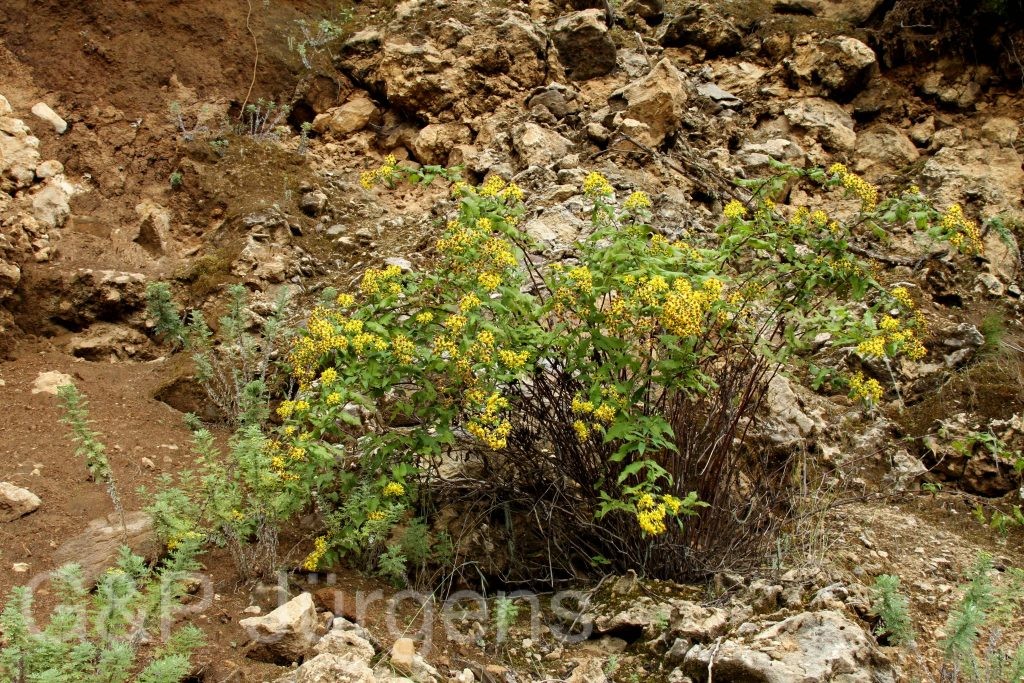
Senecio scandens

by GP Jürgens

Buch.-Ham. ex D.Don

Bhutan2012 109
Bhutan Chogcham 2900m, June

Description

Senecio scandens, the climbing groundsel, is a widely distributed scrambling composite of South, East and Southeast Asia, with 5,659 GBIF occurrences across China, Taiwan, Japan, India, Nepal, Bhutan, Myanmar, Vietnam, Korea, Sri Lanka, Thailand and the Philippines, plus scattered records as an introduction elsewhere. It grows in forest margins, thickets, hedgerows, ravines and disturbed slopes over a very broad altitudinal range from the foothills to over 3000 m. The plant pictured was recorded at Chogcham in Bhutan at 2900 m in June, an upper-temperate setting where this vigorous scrambler clambers over shrubs and forms tangled masses.

It is a perennial herb or subshrub with elongate, climbing or trailing, much-branched stems that can reach several metres. The leaves are alternate, ovate-lanceolate to triangular, often hastate or with a few basal lobes or teeth, acuminate at the apex and shortly petiolate. The numerous yellow capitula are arranged in broad terminal and axillary corymbose panicles; each radiate head has about eight to ten short ray florets around a yellow disc, subtended by a calyculate involucre of narrow phyllaries with conspicuous outer bracteoles. The cypselae are cylindrical and ribbed, bearing a copious white pappus of fine capillary bristles that aids wind dispersal.

Described by Buchanan-Hamilton ex D. Don, the species belongs to the large, cosmopolitan genus Senecio (tribe Senecioneae). Like many of its relatives it contains pyrrolizidine alkaloids and is used in traditional Asian herbal medicine, particularly in Chinese pharmacopoeia. Abundant, fast-growing and tolerant of disturbance, it is in no way threatened and can behave weedily where introduced.

Author: Buch.-Ham. ex D.Don · Sources: POWO (Kew), GBIF, Flora of Bhutan, Flora of China, Senecioneae of the World (Nordenstam), Flowers of the Himalaya (Polunin & Stainton)