Tag:

Yunnan

Flowers of Yunnan — 68 species from the mountains of Yunnan in southwest China, part of the Hengduan and eastern Himalayan biodiversity hotspot renowned worldwide for its rhododendrons, primulas and gentians. This region is one of the great cradles of temperate plant diversity. Each species page provides a botanical description, distribution, habitat and flowering time with the original photograph.

(Prain ex Raym.-Hamet) S.H.Fu
Bhutan2012 88
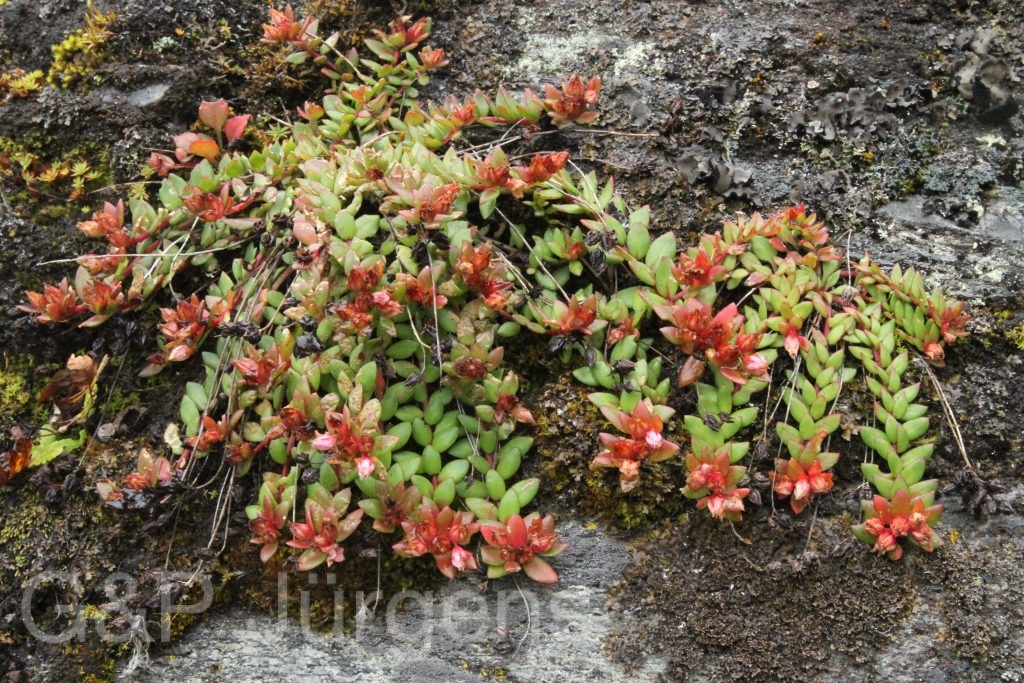
Bhutan Chele La 4150m, September

Description

Rhodiola hobsonii is an alpine succulent perennial of the eastern Himalaya and adjacent southwestern China, recorded from Bhutan, northern India (Sikkim, Arunachal), Nepal and the Chinese provinces of Xizang and Yunnan; GBIF holds about 101 records. It inhabits open stony slopes, gravelly screes, rock crevices and short alpine turf, generally between about 3800 and 5000 m, enduring intense insolation and a brief growing season. The photographed plant was collected at the Chele La pass in western Bhutan at around 4150 m in September, on the well-drained, frost-disturbed substrates it occupies near the upper limit of vascular plant growth.

The plant arises from a stout, woody, persistent caudex crowned by the scaly remains of old leaf bases, from which several short, fleshy, erect or ascending flowering stems develop. The leaves are alternate, sessile, succulent, oblong to obovate, entire or sparingly toothed toward the apex, and rather densely set. The inflorescence is a compact terminal cyme; the species is dioecious, the flowers four- or five-merous and dull purplish-red, the petals narrow. The fruit comprises several erect follicles that split to release minute seeds.

Rhodiola (Crassulaceae) is a large genus of cold alpine and arctic regions, segregated from Sedum by its perennial woody caudex and predominantly dioecious flowers. R. hobsonii belongs to the diverse Sino-Himalayan assemblage of the genus, many members of which are rich in rosavins and salidroside and used in regional traditional medicine. Restricted to high elevations, it is naturally localised but not currently assessed as threatened, though such cushion-zone specialists are vulnerable to warming.

Author: (Prain ex Raym.-Hamet) S.H.Fu · Sources: POWO (Kew), GBIF, Flora of China Vol. 8, Flora of Bhutan Vol. 1, Flora of Nepal, Flora of Pakistan, Ohba monograph of Himalayan Sedoideae and Rhodiola
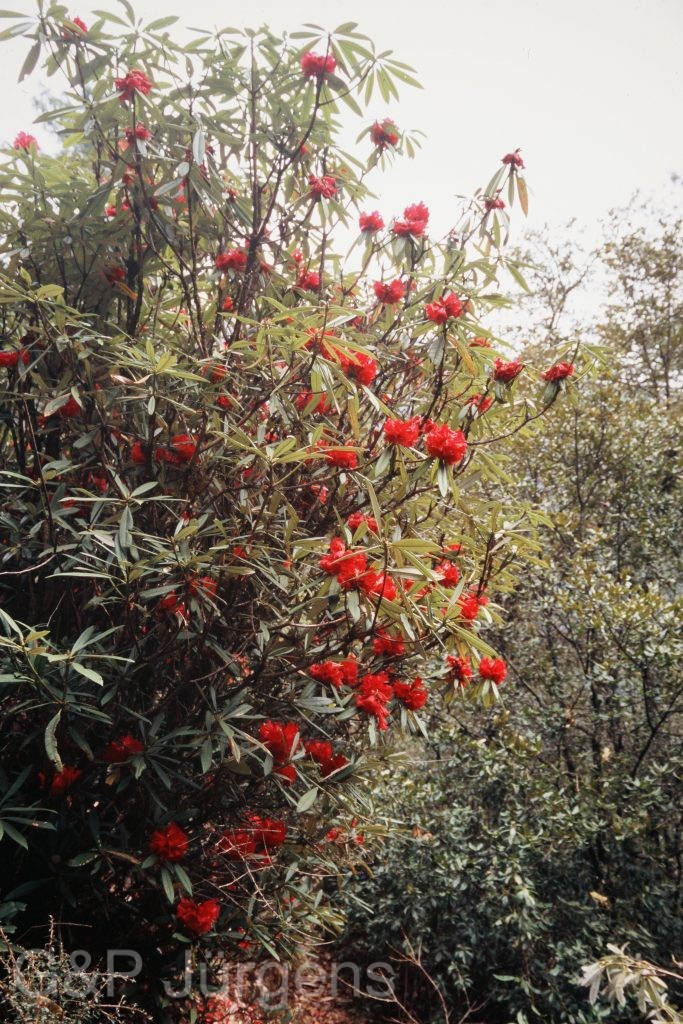
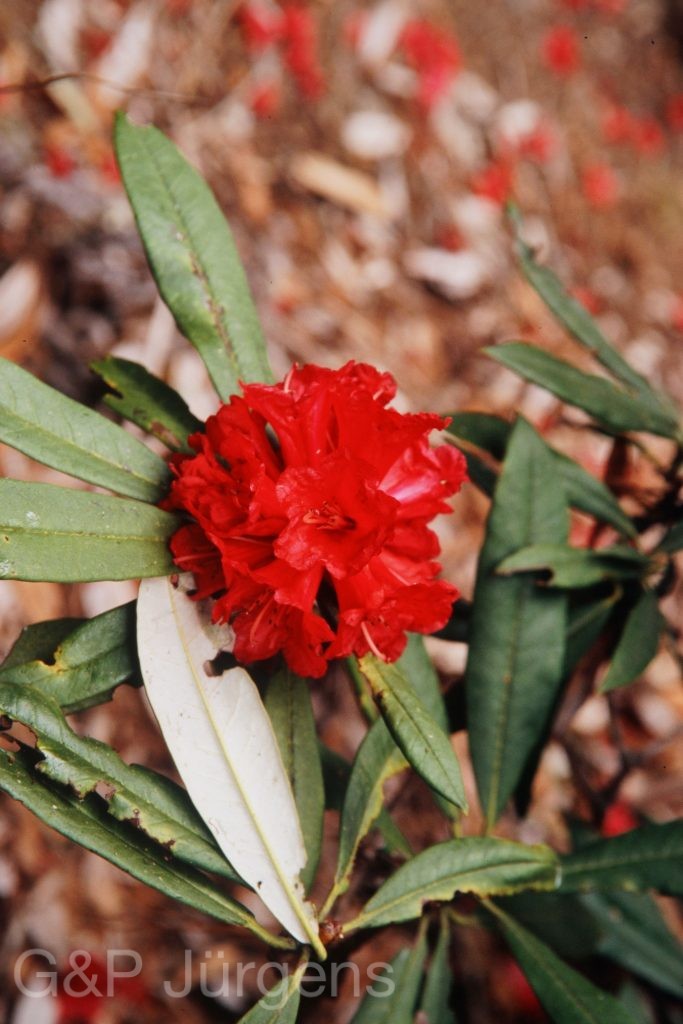
Franch.

Bh2008 21 P38
Bhutan Thimphu-Chu, 2800m
Bh2008 23 P40
Bhutan Thimphu-Chu, 2800m

Description

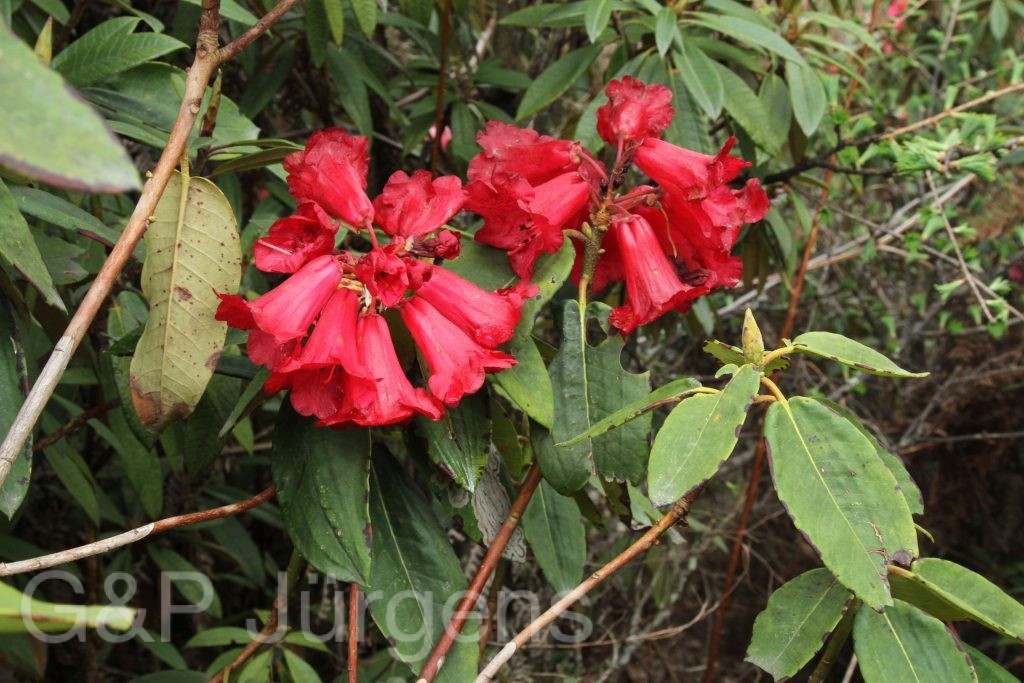
Rhododendron delavayi Franch. is a shrub or small tree of the Sino-Himalayan region, distributed through south-western China (Yunnan, Guizhou, Sichuan, Xizang), Myanmar, Thailand, Vietnam, north-eastern India, Bhutan and Nepal, with horticultural records from the United Kingdom, United States, Canada and Belgium contributing to a GBIF total of around 1,290 occurrences. It grows in evergreen broadleaf forest, pine forest, open thickets and on rocky montane slopes, typically on acidic soils in the warm-temperate to lower montane belt. The illustrated plant comes from the Thimphu-Chu valley in Bhutan at about 2800 m, an elevation characteristic of the species where it forms a conspicuous element of the forest canopy and understorey and flowers in spring.

It is an evergreen shrub to small tree with stout branches and a thick, often flaking bark. The leaves are leathery, oblong-lanceolate to oblanceolate, dark green and glabrous above, the lower surface densely covered with a felted, persistent, fawn to greyish or whitish tomentum (indumentum) that is diagnostic of the species. The flowers are borne in dense, rounded, terminal trusses; each is broadly campanulate with a deep crimson to scarlet corolla of about five lobes, marked at the base with darker nectar pouches, and contains about ten stamens and a glabrous or hairy ovary with a long style. The fruit is a woody, cylindrical, ribbed capsule dehiscing by valves to release numerous minute seeds.

Rhododendron delavayi is the type species of subsection Arborea and is closely related to the Himalayan R. arboreum, with which it intergrades and shares the tree habit and red flowers; it is distinguished by its compact indumentum and floral details. Ecologically it is bird- and insect-pollinated and is a dominant component of warm broadleaf forest, while in cultivation it is valued as a parent of many hybrids. Although widespread, it is locally affected by deforestation and habitat conversion in parts of its range, but overall it remains common and is not regarded as globally threatened.

Author: Franch. · Sources: POWO (Kew), GBIF, Flora of China, Flora of Bhutan, The Genus Rhododendron (Edinburgh, Chamberlain et al.)

Hook. f.

Bhutan2014 315
Bhutan Tumching-La 2600m, May
Bhutan2014 317
Bhutan Tumching-La 2600m, May
Bh2008 159 P260
Bhutan Chendebji, 2600m April
Bh2008 160 P261
Bhutan Chendebji, 2600m April

Description

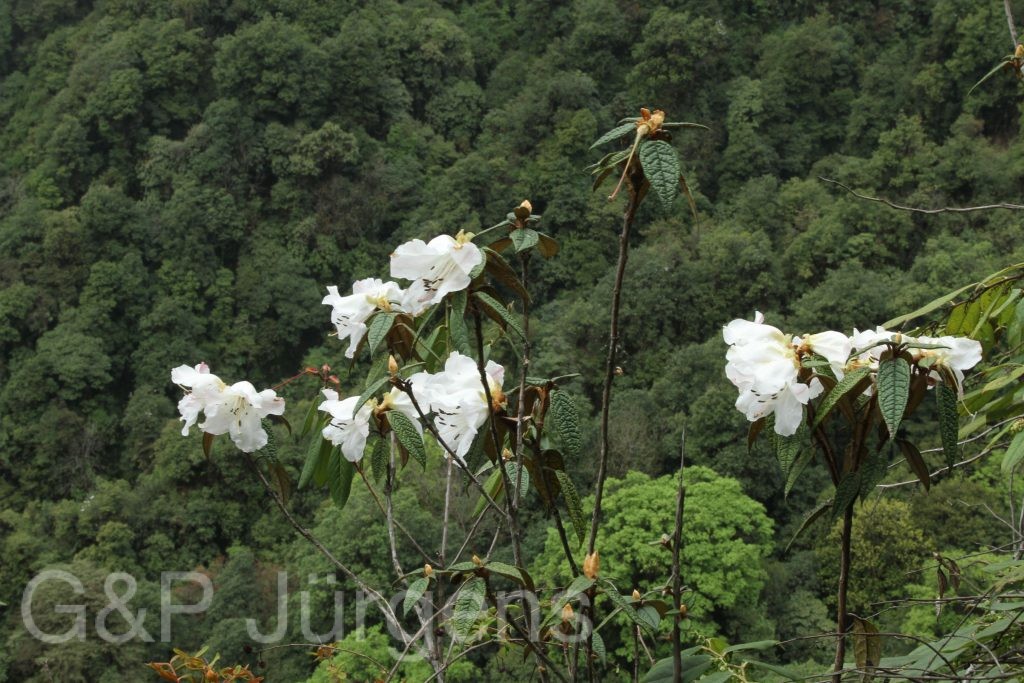
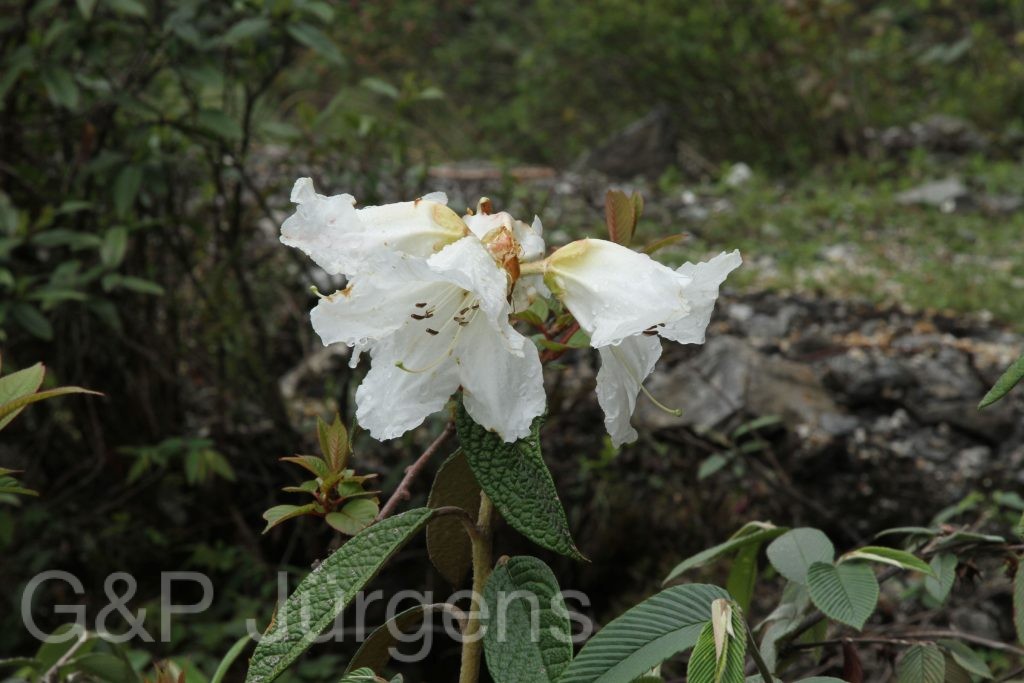
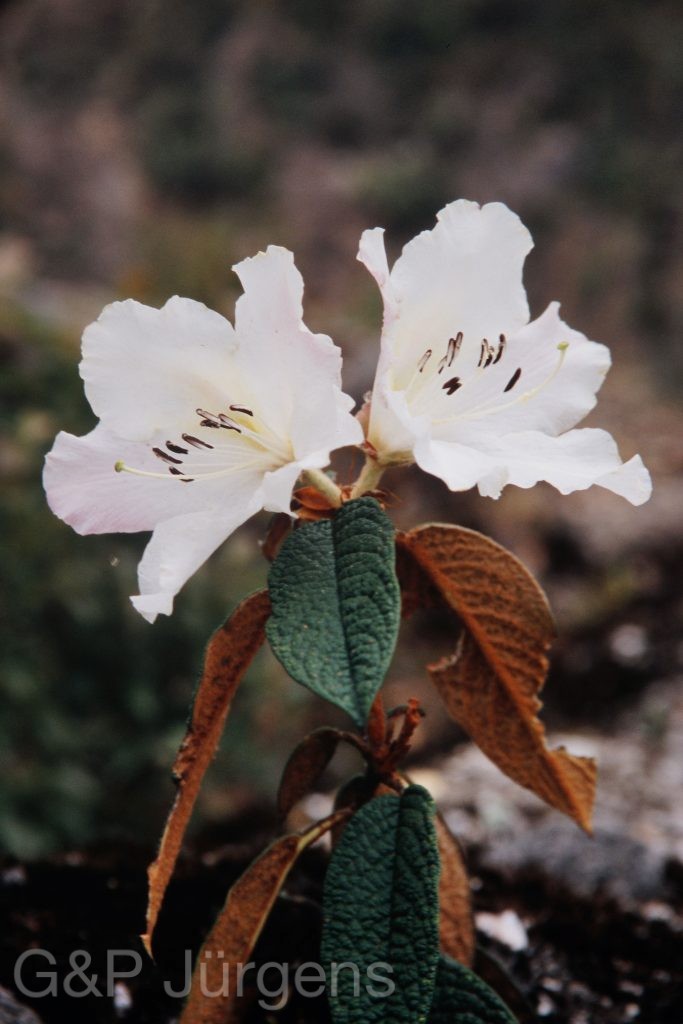
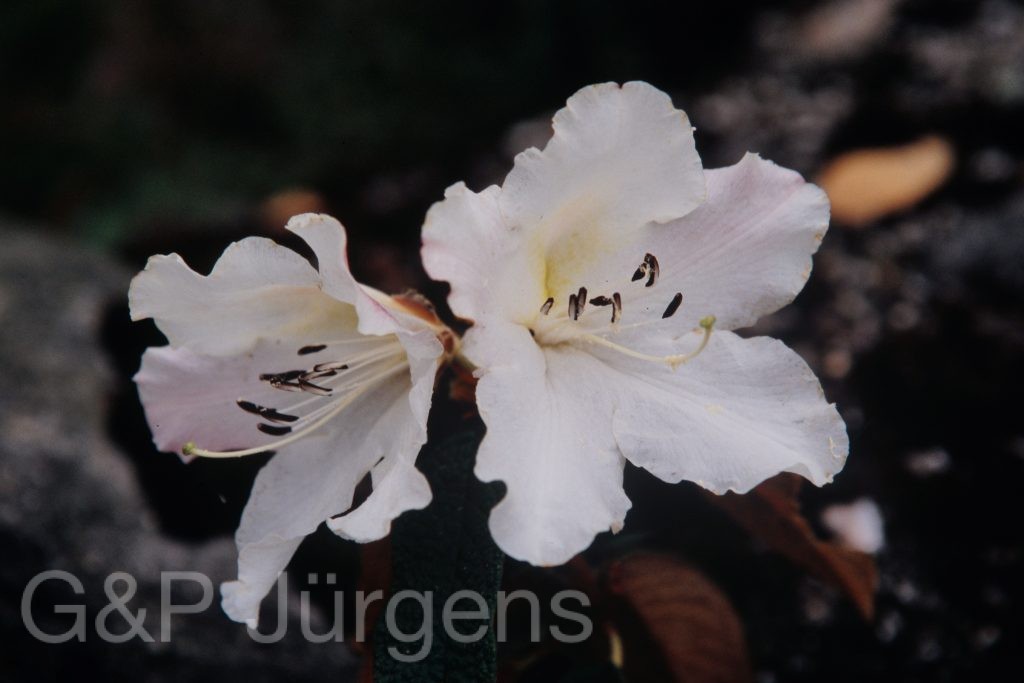
Rhododendron edgeworthii is distributed through the eastern Himalaya and adjacent montane south-west China, with native records spanning Bhutan, north-east India, Myanmar and Yunnan and Xizang (China); the remaining records among 665 georeferenced occurrences (United States, Canada, New Zealand, Britain, Belgium, Korea) reflect its long cultivation as an ornamental. It is characteristically epiphytic or saxicolous, growing on mossy tree trunks, boulders and humus-rich banks in cool, humid temperate forest with oak, Tsuga and other rhododendrons. The species was collected in Bhutan at Tumching-La and Chendebji at around 2600 m, consistent with its typical altitudinal range of roughly 2000-3700 m in the upper temperate zone.

It is a straggling, often epiphytic shrub to about 2-3 m, the young shoots and undersides of the leaves densely clothed in tawny, woolly-tomentose to setose indumentum. The leaves are elliptic to ovate, leathery, bullate-rugose above and conspicuously brown-felted beneath. The flowers, borne in lax trusses of two or three, are large, broadly funnelform-campanular, white usually flushed rose, and strongly fragrant, with the outer surface scaly and the lobes spreading; stamens are typically ten and the ovary densely scaly, ripening into a scaly capsule.

Within the genus the species belongs to subgenus Rhododendron (lepidote rhododendrons), section Rhododendron, subsection Edgeworthia, distinguished by the combination of bullate foliage, dense woolly indumentum and large scented blooms. It hybridises readily in cultivation and has contributed to fragrant hybrid groups. Though locally frequent across a wide range and assessed as of Least Concern, its dependence on undisturbed humid forest makes it sensitive to deforestation and collection pressure.

Author: Hook. f. · Sources: POWO (Kew), GBIF, Flora of Bhutan, Flora of China, The Rhododendron Handbook (Royal Horticultural Society), Cox & Cox The Encyclopedia of Rhododendron Species

Wight

Nepal1992 196 P285 ergebnis
Nepal Suketar 2400m March 
Nepal1992 197 P286 ergebnis
Nepal Suketar 2400m March 

Description

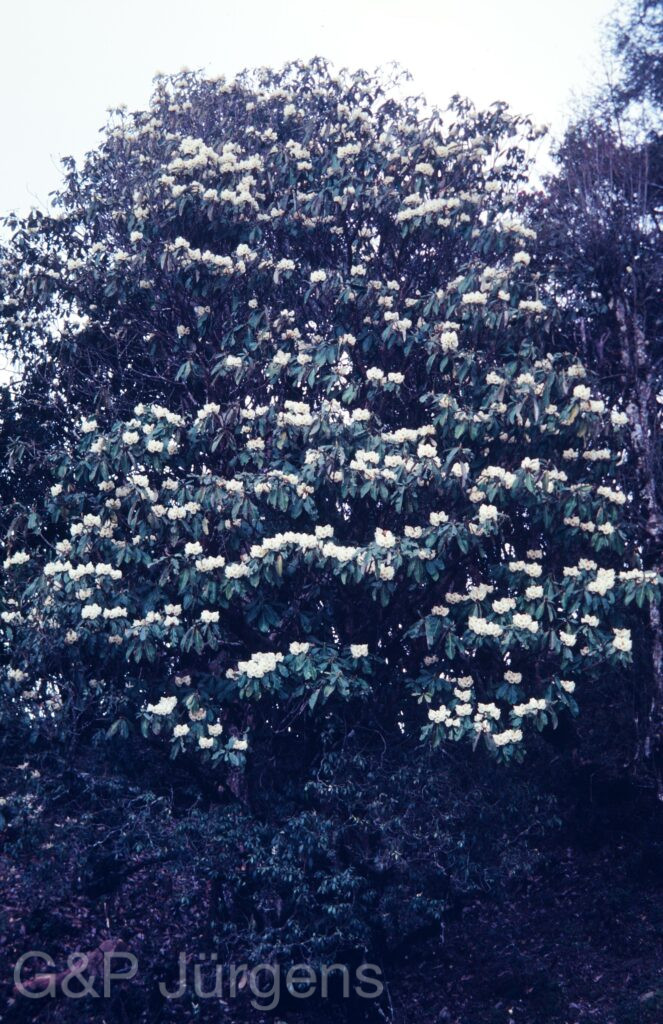
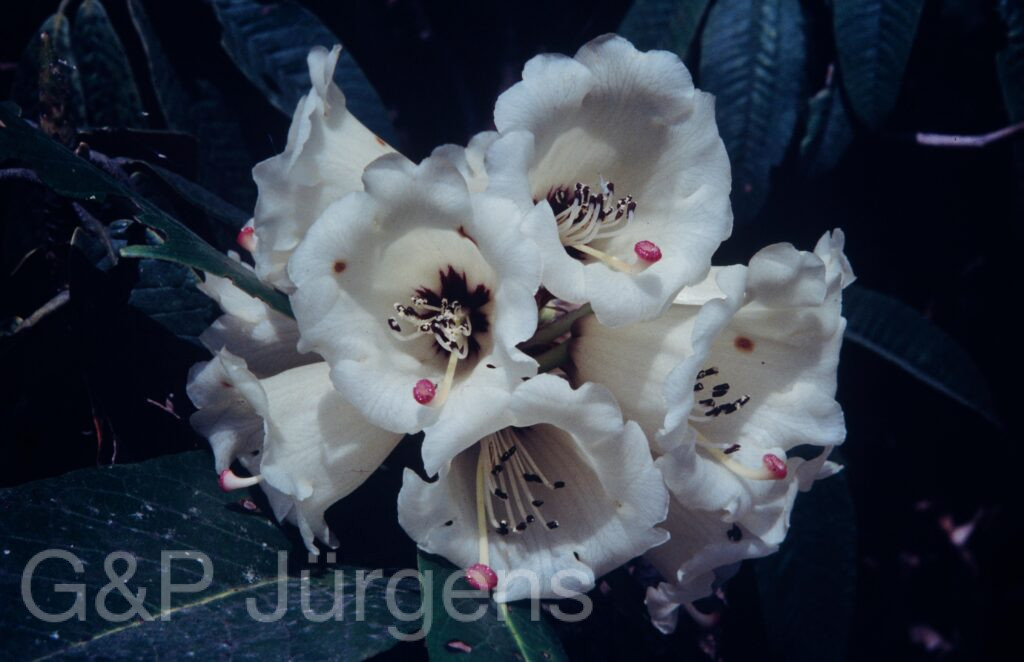
Rhododendron grande is a tree species of the eastern Himalayan temperate forest belt, ranging through Nepal, Sikkim and Darjeeling in India, Bhutan, northern Myanmar and southwestern China (Yunnan, Tibet), with cultivated and naturalised records extending to Great Britain, Belgium, Canada and the United States; the GBIF dataset comprises some 284 georeferenced occurrences. It typically grows between 2000 and 3000 m in cool, humid broad-leaved and conifer forests, ravine margins and on shaded slopes, often forming an understorey component beneath Tsuga and Quercus. The photographed plant from Suketar in eastern Nepal at 2400 m, flowering in March, is characteristic of these mid-montane mist forests where high rainfall and persistent cloud cover prevail.

It is an evergreen shrub or small tree reaching 10–15 m, with stout branchlets and smooth grey-brown bark. The leaves are large, coriaceous, oblong-elliptic to oblanceolate, 15–30 cm long, dark glossy green above and conspicuously silvery to fawn lanate-tomentose beneath with a thin plastered indumentum. The inflorescence is a dense compact truss of 15–25 flowers; the corolla is campanulate, 4–5 cm long, ivory-white to creamy with a basal crimson-purple blotch, eight-lobed, and subtended by a swollen nectary. Stamens are 16, the ovary tomentose, and the fruit a woody curved capsule dehiscing to release numerous minute winged seeds.

Rhododendron grande belongs to subgenus Hymenanthes, subsection Grandia, a group of large-leaved species centred on the Sino-Himalaya and noted for their bicoloured indumentum. As one of the earliest-flowering large rhododendrons it is valued in horticulture and draws nectar-feeding birds and bumblebees. Though not globally threatened, populations face pressure from forest clearance and grazing.

Author: Wight · Sources: POWO (Kew), GBIF, Flora of China Vol. 14, Flora of Bhutan Vol. 2, Flora of Nepal, The Genus Rhododendron (Cox & Cox)

Hook. f.

Bhutan2014 374
Bhutan Tumcheng-La 3900m, May
Bhutan2014 375
Bhutan Tumcheng-La 3900m, May
Bh2008 252 P398
Bhutan Tumching-La, 3400m April
Bh2008 270 P424 scaled
Bhutan Tumching-La, 3700m April
Bh2008 271 P425 1
Bhutan Tumching-La, 3700m April

Description

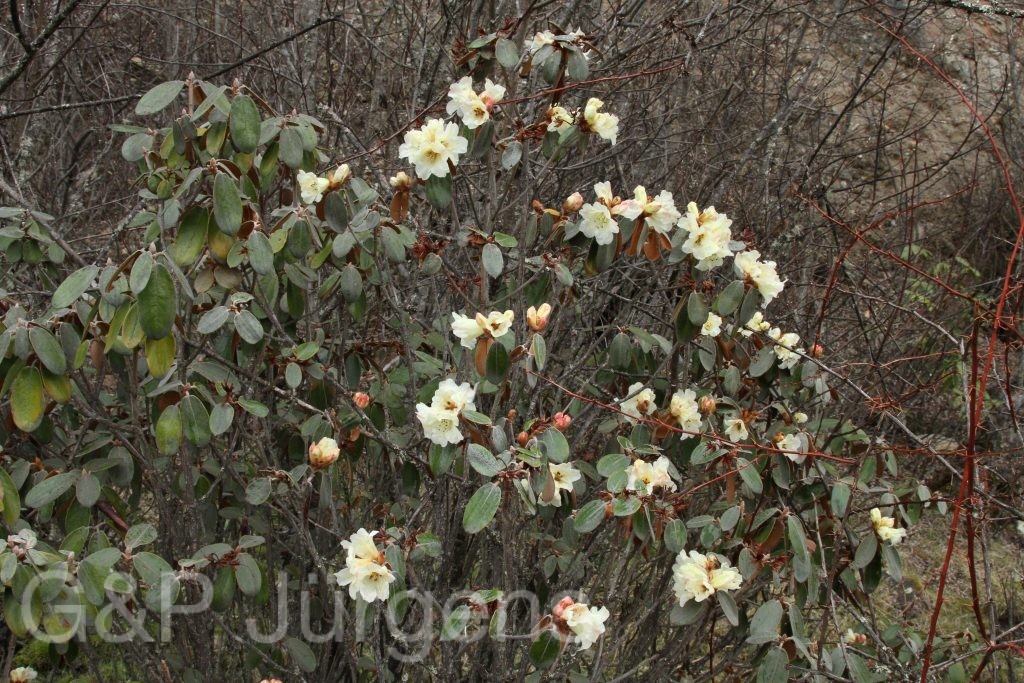
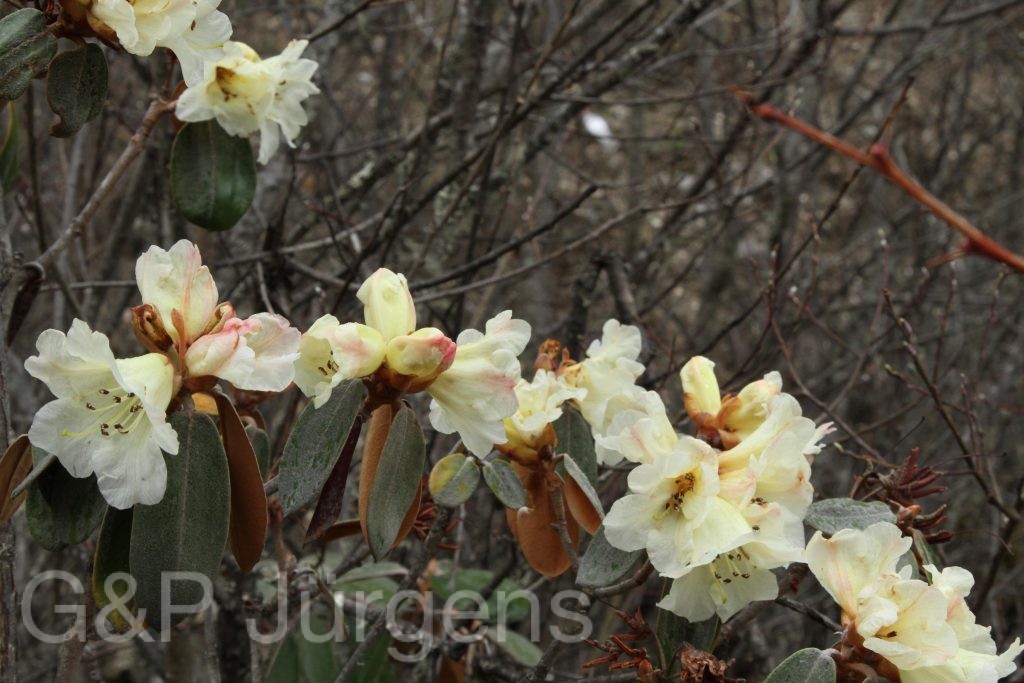
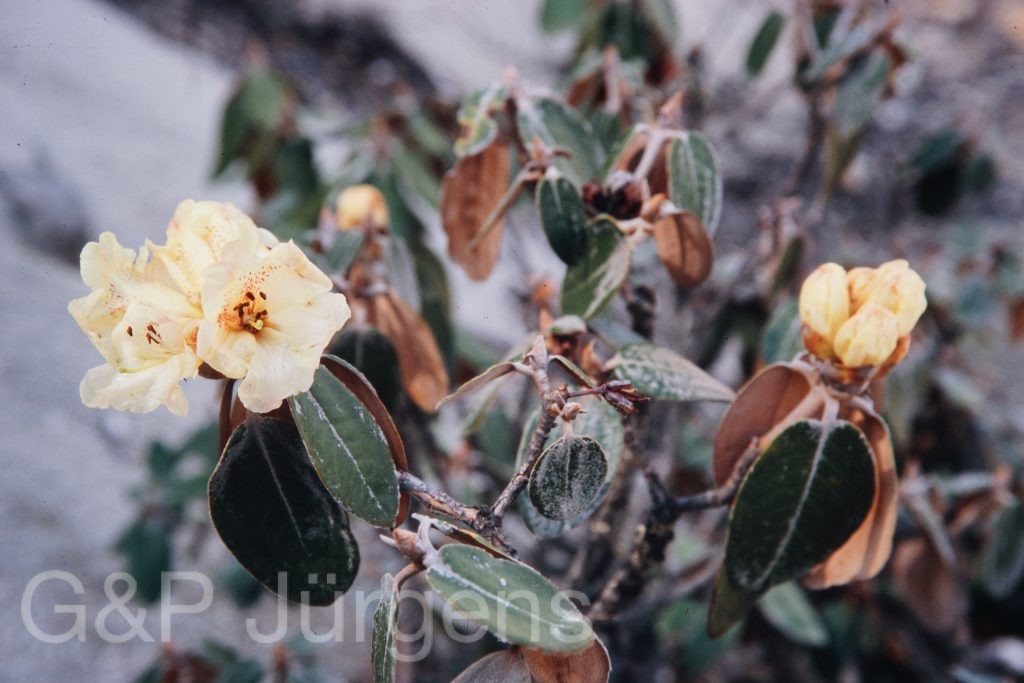
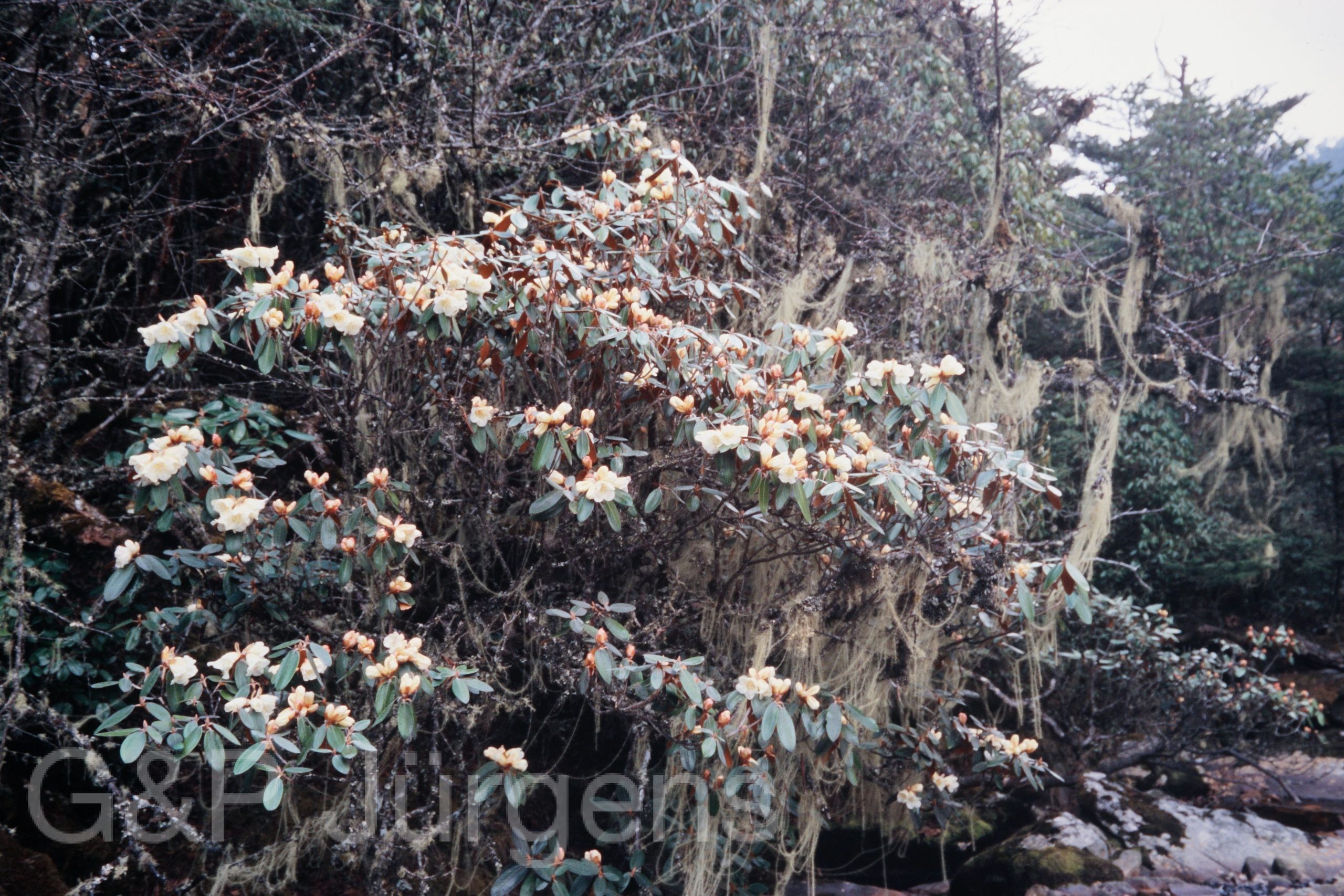
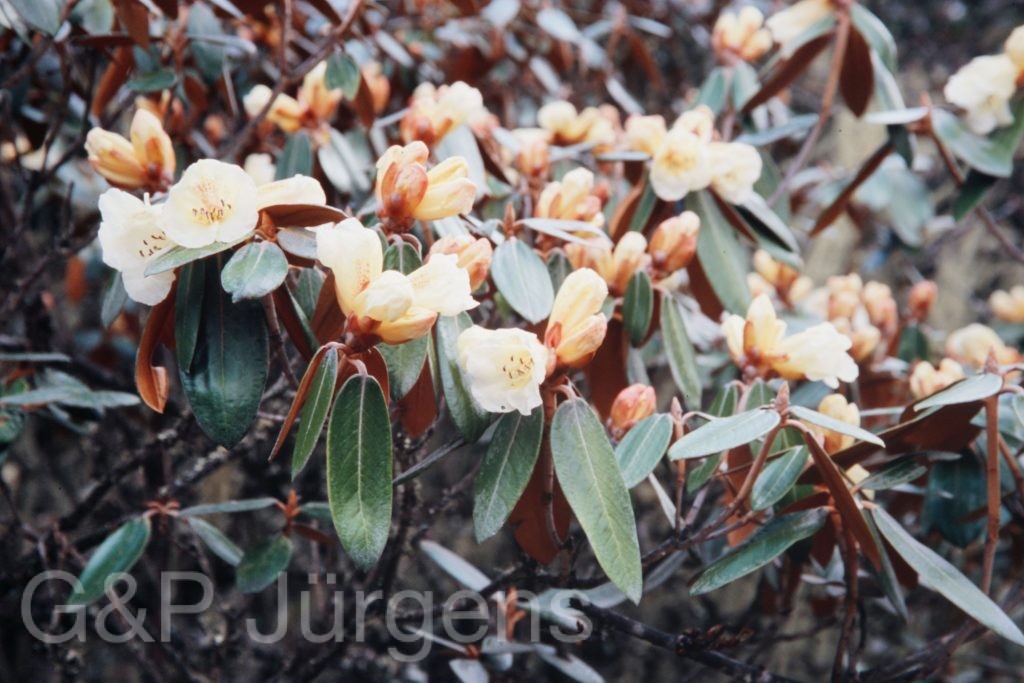
Rhododendron lanatum is an East Himalayan species restricted to the eastern Himalaya, ranging from Sikkim and adjacent northern India through Bhutan to south-eastern Xizang and Yunnan in China, with peripheral records in Nepal; its roughly 180 georeferenced occurrences (IN, BT, CN, NP) reflect a comparatively narrow distribution, supplemented by garden records in Britain and Sweden. It is a component of the subalpine Rhododendron-Abies forest and shrubberies, growing on humus-rich, acidic slopes and rocky moraine between about 3000 and 4300 m. The plants documented on the Bhutanese passes of Tumching-La and Tumcheng-La between 3400 and 3900 m, flowering from April into May, occupy exactly this cool, cloud-soaked subalpine zone.

It is an evergreen shrub or small tree to 3-4 m, conspicuous for the dense rusty to fawn woolly (lanate) indumentum that clothes the young shoots, leaf undersides and bud scales. The leaves are coriaceous, oblong-elliptic, glabrous and dark green above but covered beneath with a thick, two-layered tomentum of branched hairs. The bell-shaped (campanulate) flowers, pale to sulphur-yellow and often flecked with crimson at the base, are 3-4 cm long and grouped in dense terminal trusses of up to a dozen; the corolla bears five lobes, ten stamens and a glabrous ovary. The fruit is a curved, woody, septicidal capsule releasing numerous minute winged seeds.

Rhododendron lanatum belongs to subsection Lanata of subgenus Hymenanthes, a small group defined by their woolly indumentum and yellow campanulate flowers, allied to R. wightii. Its narrow eastern Himalayan range and dependence on intact subalpine forest make it locally vulnerable to grazing, fire and woodland degradation, though it remains frequent within Bhutan's protected highlands.

Author: Hook. f. · Sources: POWO (Kew), GBIF, Flora of Bhutan, Flora of China, Cox's The Larger Rhododendron Species, The Genus Rhododendron (Royal Botanic Garden Edinburgh)

(Tagg & Forrest) W.K. Hu

Bh2008 268 P421
Bhutan Ura 3400m, April
Bhutan2014 540
Bhutan Pele-La 3000m, May

Description

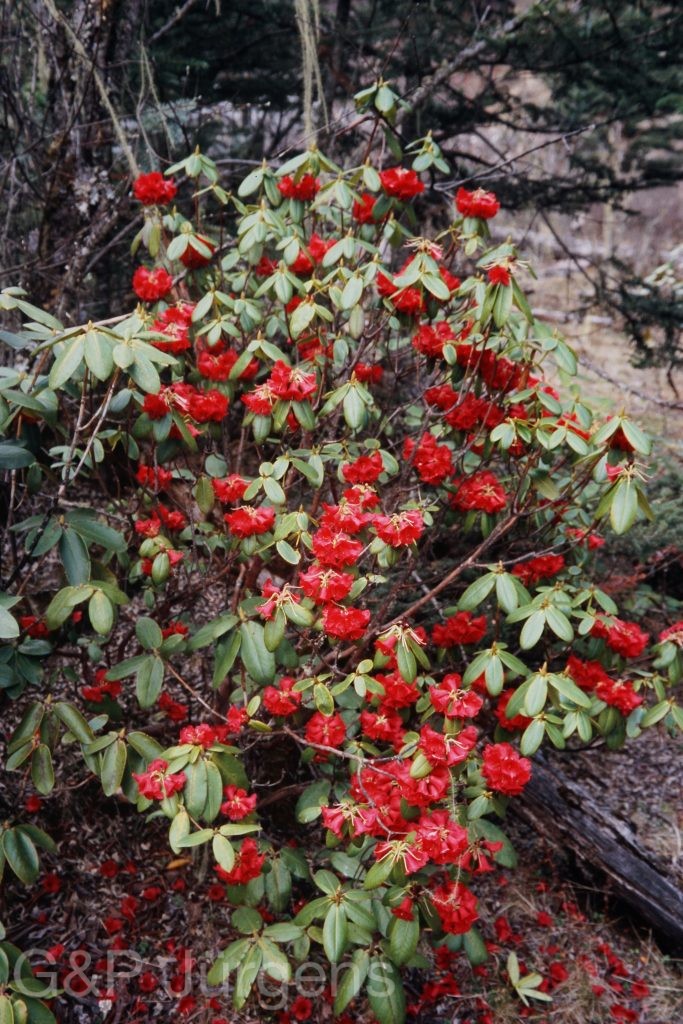
Rhododendron neriiflorum var. appropinquans is an evergreen shrub of the eastern Himalaya, known from a small number of records: GBIF documents only about 9 occurrences, confined to China (Yunnan/Tibet) and Bhutan. It grows in the temperate and subalpine forest belt, on rhododendron-clad slopes, forest margins and rocky banks broadly between 3000 and 3600 m. The photographed plants are from Bhutan at Ura (3400 m, April) and the Pele-La (3000 m, May), flowering in spring as the snow recedes, when the bright corollas appear against cool, humid, peaty mountain soils.

The plant is a much-branched shrub with leathery, evergreen leaves that are elliptic to oblong, dark green and glabrous above and glaucous to whitish-papillose beneath, recalling the foliage of an oleander as the specific epithet neriiflorum implies. The flowers are borne in a compact terminal truss of several blooms; the corolla is tubular-campanulate, fleshy in texture and a vivid crimson to scarlet, with conspicuous dark nectar pouches at the base. Stamens and the long style are exserted, and the calyx is fleshy and often coloured. The fruit is a curved, cylindrical capsule that dehisces septicidally to release numerous minute seeds.

Rhododendron neriiflorum belongs to subgenus Hymenanthes, subsection Neriiflora, a Sino-Himalayan complex of red-flowered species in which infraspecific variants such as var. appropinquans are distinguished by leaf indumentum and floral detail. GBIF treats the name as accepted. Its very restricted documented range and narrow ecological niche make it of biogeographic interest and potentially of conservation concern amid habitat change in eastern Himalayan rhododendron forests.

Author: (Tagg & Forrest) W.K. Hu · Sources: POWO (Kew), GBIF, Flora of Bhutan, Flora of China, Royal Horticultural Society revision of Rhododendron

Hook. f.

BhutanPG2011 549 1
Bhutan Ludlow-Sherriff-Trail Dem-Tso, 4700m July

Description

Rhododendron pumilum is a diminutive alpine shrublet of the eastern Himalaya and adjacent Sino-Himalayan region, recorded from China (Tibet, Yunnan), Nepal, India, Bhutan and Myanmar, with 115 georeferenced occurrences. It inhabits the high alpine zone, growing in damp turf, on mossy rocks, peaty banks and the margins of snow-fed meltwater seeps, typically between about 3500 and 4800 m. The species was photographed on the Ludlow-Sherriff Trail near Dem-Tso, Bhutan, at 4700 m in July, an elevation reflecting its strong association with the uppermost alpine meadows and moist micro-sites close to the limit of vascular plant growth.

It is one of the smallest rhododendrons, a creeping, mat-forming evergreen rarely more than 8 to 15 cm tall, with slender prostrate stems rooting at the nodes and minutely scaly young growth. The tiny leaves are obovate to elliptic, leathery, lepidote beneath with pale scales and often slightly revolute at the margin. The flowers are borne singly or in pairs at the shoot tips on relatively long pedicels and are nodding, broadly campanulate and pink to rose-purple, comparatively large in proportion to the plant; the stamens are typically ten and the style short and stout. The fruit is a small scaly capsule.

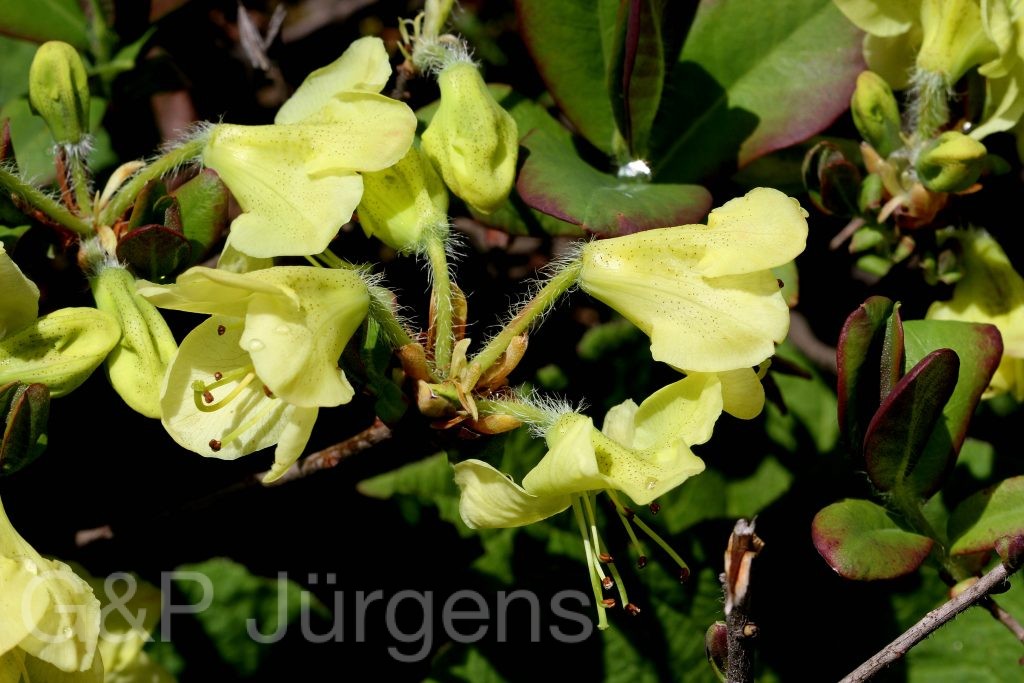
The species is placed in Rhododendron subgenus Rhododendron, section Rhododendron (subsection Uniflora), a group of cushion-forming dwarf lepidote species of the high Sino-Himalaya. Its solitary nodding flowers and creeping habit distinguish it from related dwarfs. Ecologically it is a specialist of cold, moist, well-aerated alpine substrates and an associate of cushion-plant communities. Though not assessed as globally threatened, its restriction to narrow high-elevation habitats makes it vulnerable to climate-driven habitat contraction.

Author: Hook. f. · Sources: POWO (Kew), GBIF, Flora of Bhutan, Flora of China, The Genus Rhododendron (Cullen & Chamberlain monograph)

Franch.

Sikkim2011 211
Sikkim Yumthang 3500m, June
Sikkim2011 213
Sikkim Yumthang 3500m, June
Sikkim2011 218
Sikkim Yumthang 3500m, June

Description

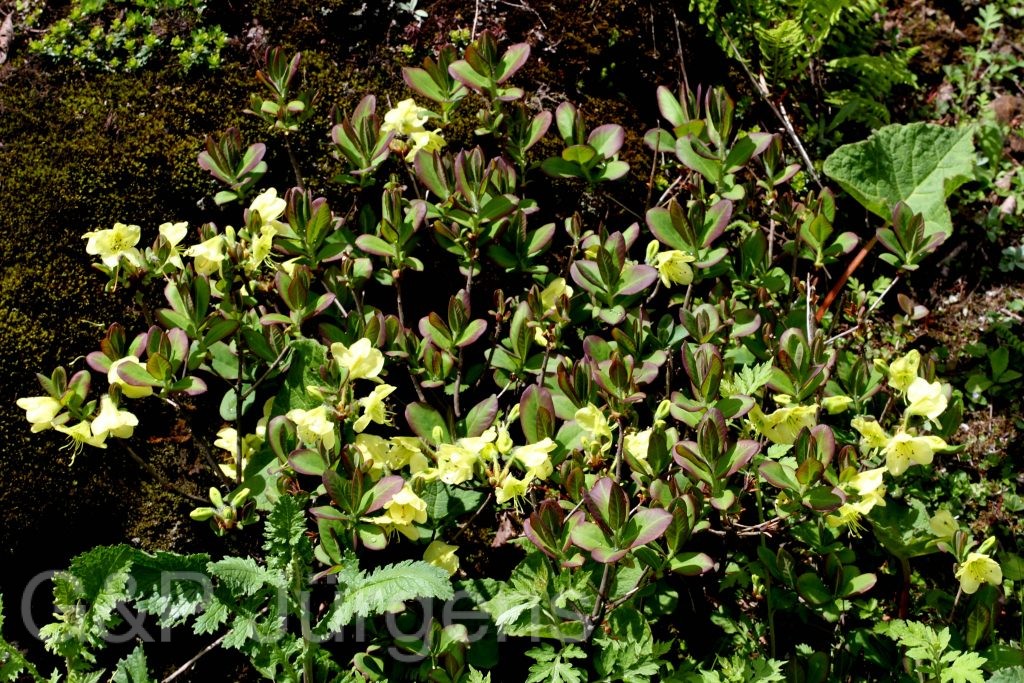
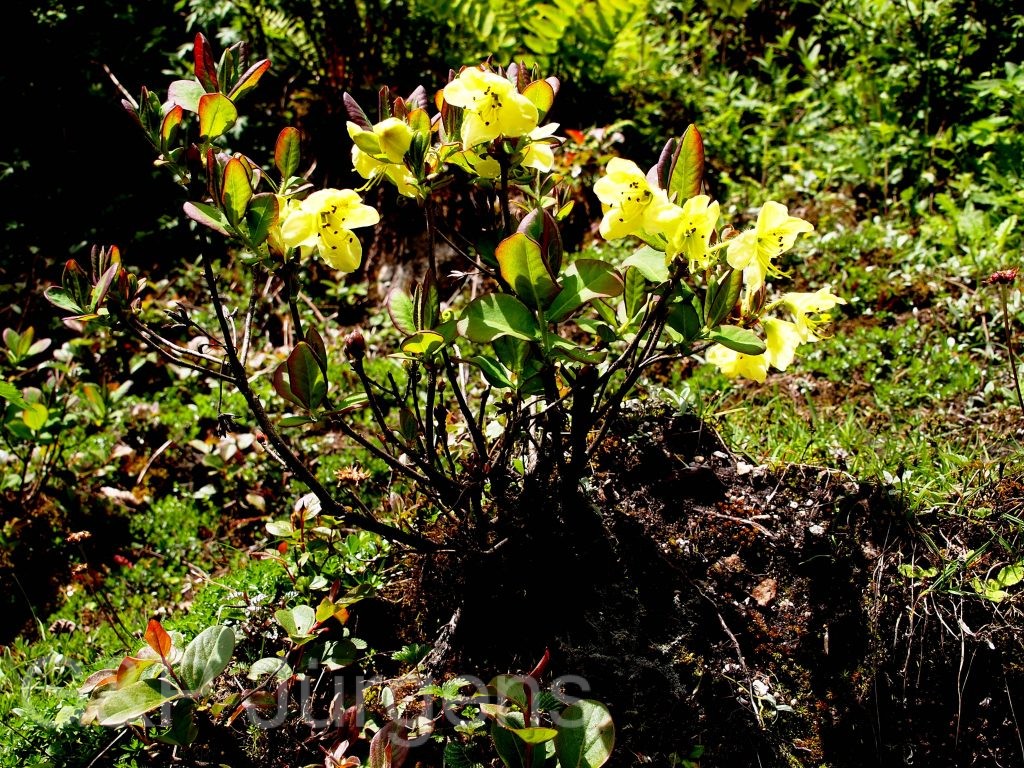
Rhododendron trichocladum is a deciduous, scaly-leaved shrub of the eastern Himalaya and adjacent Sino-Himalayan ranges, distributed across south-western China (notably Yunnan and south-eastern Tibet), northern Myanmar and the Indian Himalaya, with GBIF records (553 occurrences) confirming a centre of abundance in Sikkim, Yunnan and Upper Myanmar. It occupies open hillsides, forest margins, rhododendron thickets and rocky slopes at roughly 2700-4000 m, frequently in cool, humid, moss-rich montane settings. The photographed plant from the Yumthang valley in north Sikkim at about 3500 m in June typifies its preferred sub-alpine zone, where it flowers as the snow recedes alongside dwarf rhododendrons and primulas.

A much-branched shrub usually 0.5-1.5 m tall, with thin, often bristly young shoots bearing scattered scales and setae. The thin, deciduous leaves are obovate to elliptic, bright green, sparsely scaly above and densely lepidote beneath, with ciliate margins and a short petiole. Flowers are borne in small terminal clusters of one to three, opening with or before the leaves; the widely funnel-campanulate corolla is yellow, often greenish-yellow and sometimes faintly spotted, with five lobes and a scaly outer surface. Stamens ten, declinate; the ovary is densely scaly, tapering into a slender style. The fruit is a small, ovoid, scaly capsule dehiscing septicidally to release minute winged seeds.

The species belongs to Rhododendron subsection Trichoclada (subgenus Rhododendron), a small group of deciduous, yellow-flowered, scaly-leaved shrubs characterised by their bristly indumentum. It is a valuable subject for cool temperate woodland gardens and has contributed to horticultural breeding. Though not globally threatened given its broad Sino-Himalayan range, populations are locally dependent on undisturbed sub-alpine scrub, making them sensitive to grazing pressure, fuelwood collection and habitat shifts driven by warming climates.

Author: Franch. · Sources: POWO (Kew), GBIF, Flora of China, Flora of Bhutan, The Genus Rhododendron (Royal Horticultural Society monograph)

Royle

Nepal 99 25 ergebnis
West-Nepal Chere 2850m June

Description

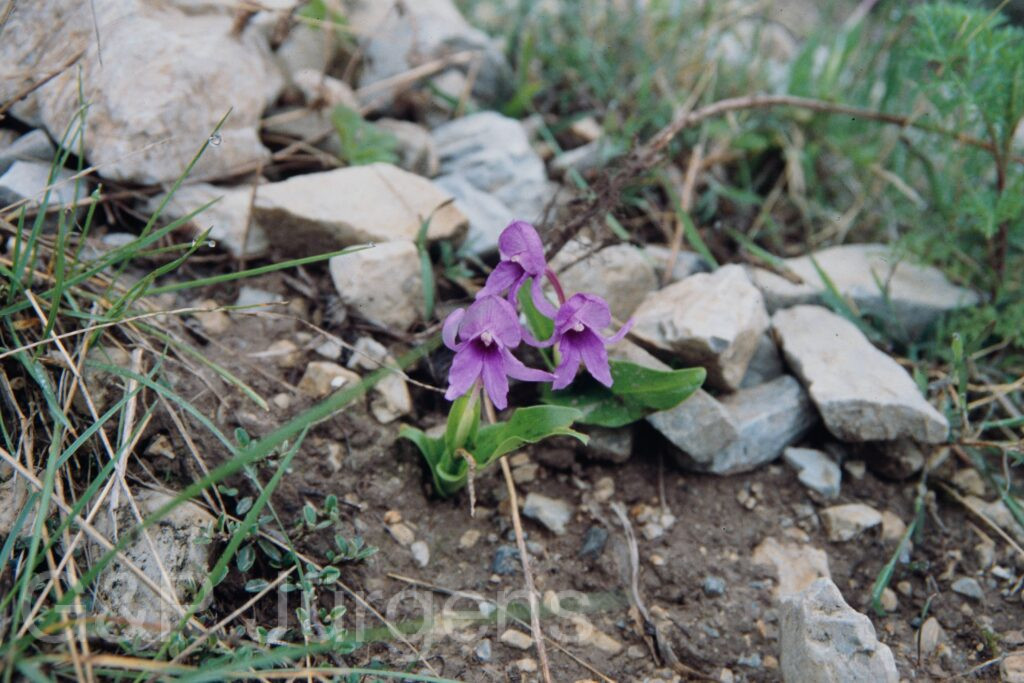
Roscoea alpina is a diminutive, hardy ginger relative widely distributed along the Himalayan arc from Pakistan and Kashmir eastward through India, Nepal and Bhutan into southwestern China (Xizang, Yunnan and Sichuan), with outlying records reaching Myanmar. With well over three hundred occurrences in GBIF and a long horticultural history, it is among the most familiar of the alpine Roscoeas; many of the country records from Europe, North America and Korea reflect cultivated and naturalised material rather than native populations. It grows on open grassy slopes, forest clearings, banks and alpine pastures, generally between about 2400 and 4000 m. The plant photographed at Chere in West Nepal at 2850 m, flowering in June, is characteristic of these summer-moist meadow habitats, where the species emerges with the onset of the monsoon and dies back to a tuberous rootstock as the soil dries.

The plant is a small herbaceous perennial arising from a cluster of fleshy, fascicled root tubers. The short pseudostem is formed by overlapping leaf sheaths and bears a few narrowly lanceolate to linear leaves. Unlike most of its relatives, R. alpina typically produces a single flower at a time, opening successively. The flower is rose-pink to purple, with a long slender perianth tube; the dorsal corolla lobe arches as a hood over the floral parts, the lateral lobes are narrow, and the prominent two-lobed labellum, formed from staminodes, is reflexed and notched, serving as a landing platform for bee pollinators. A single fertile stamen and an inferior ovary complete the flower, the latter maturing into an elongate, several-seeded capsule.

Roscoea is a remarkable temperate offshoot of the otherwise tropical Zingiberaceae, having adapted to seasonal montane climates through its tuberous, deciduous habit and monsoon-synchronised phenology; the genus shows a striking Sino-Himalayan distributional disjunction. R. alpina sits among the small-flowered, solitary-flowered species and is one of the most cold-tolerant, accounting for its popularity in alpine and rock gardens. The family is here spelled "Zingiberacaea" following the source; the accepted form is Zingiberaceae. Though not globally threatened owing to its broad range, local populations are vulnerable to overgrazing and habitat conversion, and the species remains a model for studying the evolution of montane life in a predominantly lowland tropical lineage.

Author: Royle · Sources: POWO (Kew), GBIF, Flora of China Vol. 24, Flora of Bhutan Vol. 3 Part 1, Flora of Nepal, Flora of Pakistan, The Genus Roscoea (Jill Cowley, Kew)

Wall. ex Andersson

Garh 07 395 2 ergebnis
India Garhwal Khiar Kutti 3950m, June

Description

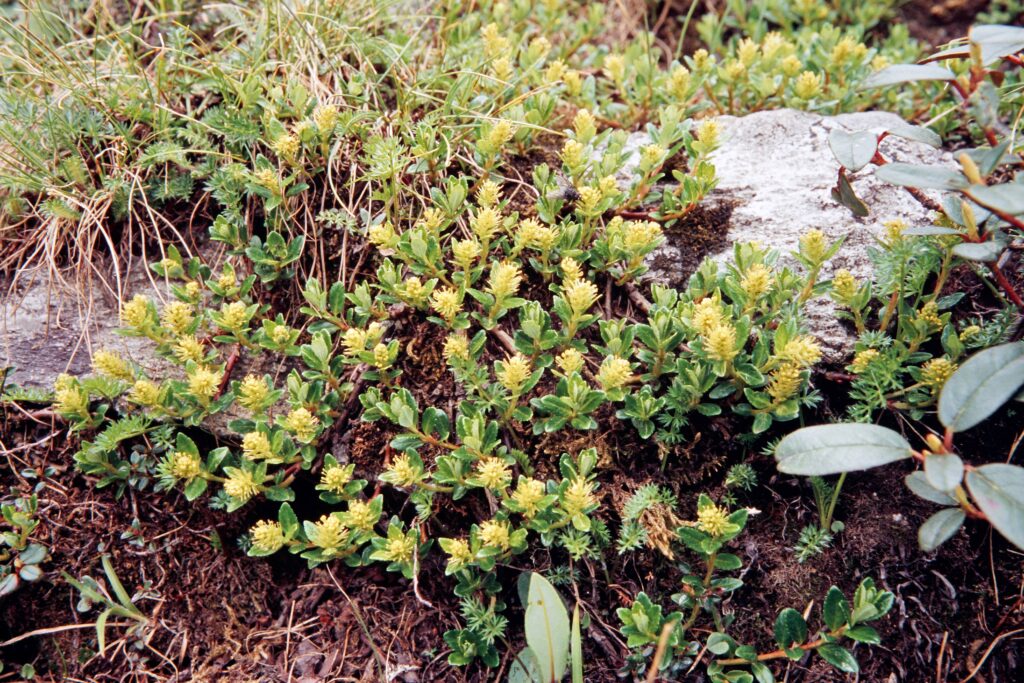
Salix lindleyana is a high-altitude dwarf willow distributed across the Himalayas from Pakistan through northern India, Nepal, and Bhutan to southwest China (Xizang, Yunnan) and northern Myanmar. GBIF records approximately 773 occurrences, concentrated in the alpine zones of the western and central Himalayas. The species is a characteristic element of subnival and alpine habitats at 3,500–5,200 m elevation, growing on moraines, scree slopes, stream margins, and moist alpine meadows. At Khiar Kutti in Garhwal at 3,950 m, it forms prostrate mats on gravelly substrates near glacial meltwater channels, flowering in June as the snowpack recedes and summer warmth permits a brief growing season.
Salix lindleyana is a prostrate, creeping deciduous shrub rarely exceeding 5–15 cm in height. Stems are slender, woody, rooting at the nodes, spreading laterally to form dense mats up to 1 m or more across. Leaves are small, elliptic to obovate, 5–15 mm long, entire or obscurely crenulate, glabrous at maturity, bright green above and slightly glaucous beneath. Catkins are terminal, erect, 1–3 cm long, appearing with or just after the leaves; male catkins bear stamens with purple-tipped filaments and yellow anthers, while female catkins develop into capsules 3–5 mm long containing minute, comose seeds that are dispersed by wind. The entire growth form is adapted to minimise exposure to desiccating alpine winds and to capture warmth from the ground surface.
Salix lindleyana is one of the highest-growing woody plants in the Himalayas and an important pioneer species in alpine and subnival ecosystems. Its prostrate, mat-forming habit stabilises loose substrates on moraines and scree slopes, facilitating soil development and subsequent colonisation by other alpine plants. The species is named after the English botanist John Lindley and was formally described by Andersson based on Wallich's Himalayan collections. It belongs to the section Chamaetia, a group of arctic-alpine dwarf willows, and is closely related to S. serpyllifolia of the European Alps — a biogeographical parallel reflecting Tertiary migration routes between the Alpine and Himalayan orogens.

Author: Wall. ex Andersson · Sources: POWO (Kew), GBIF, Flora of China Vol. 4, Flora of Pakistan Vol. 203, Polunin & Stainton: Flowers of the Himalaya (1984)