Tag:

Yunnan

Flowers of Yunnan — 68 species from the mountains of Yunnan in southwest China, part of the Hengduan and eastern Himalayan biodiversity hotspot renowned worldwide for its rhododendrons, primulas and gentians. This region is one of the great cradles of temperate plant diversity. Each species page provides a botanical description, distribution, habitat and flowering time with the original photograph.

Wall. ex Benth

BhutanPG2011 386
Bhutan Dur-Tso, 3450m June

Description

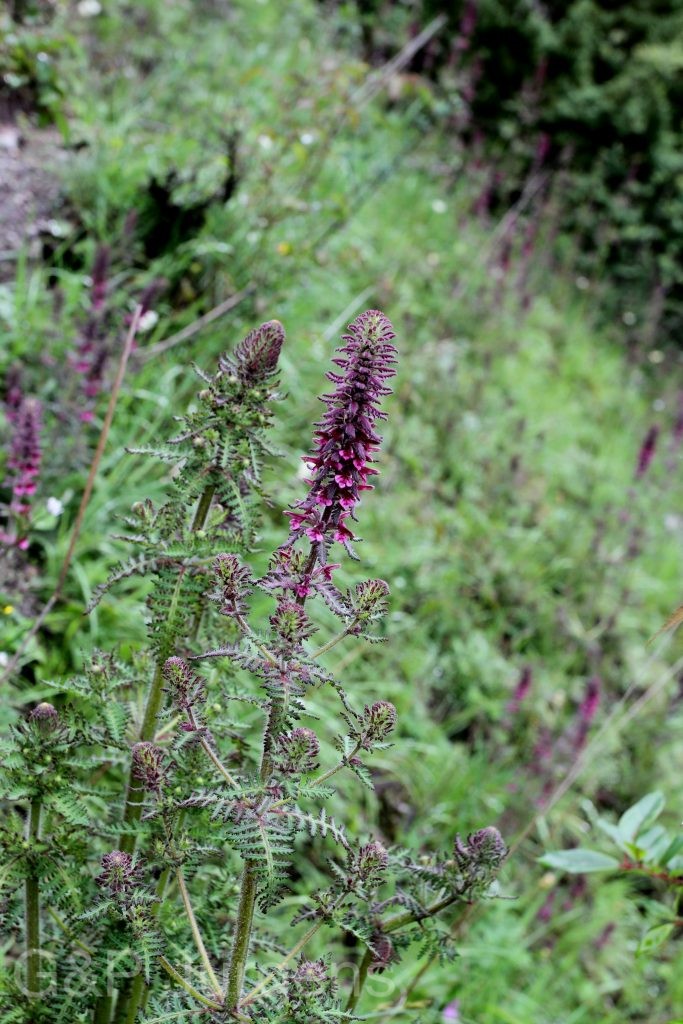
Pedicularis mollis is a widespread Himalayan lousewort ranging through Nepal, China (Xizang, Yunnan), India and Bhutan, and is comparatively well collected, with GBIF holding nearly 392 occurrences. It grows in the subalpine and lower alpine zones, typically between about 3000 and 4200 m, in open coniferous and Rhododendron forest, on grassy slopes, in damp meadows and along the margins of streams and tarns. The photographed plant from Dur-Tso in Bhutan at 3450 m, flowering in June, exemplifies its preference for moist, well-watered montane ground where it associates with sedges and other meadow forbs. Like all louseworts it is a hemiparasite, drawing water and minerals from the roots of neighbouring plants.

It is a robust perennial with erect, softly pubescent stems arising from a stout rootstock. The leaves are oblong-lanceolate in outline and pinnately to pinnatipartite divided, the segments themselves toothed and clothed in soft hairs that give the species its epithet. The inflorescence is a dense, elongating terminal spike subtended by leafy bracts. Each flower has a tubular, toothed calyx and a strongly two-lipped corolla, typically pink to purplish, the hooded upper lip (galea) curved into a beak enclosing the anthers, the lower lip three-lobed and spreading. Pollination is chiefly by long-tongued bumblebees, and the fruit is an oblique capsule with several seeds.

Pedicularis is one of the largest genera of the northern hemisphere, reaching its greatest diversity in the Sino-Himalaya, where dozens of species partition habitat and pollinator. P. mollis is distinguished by its soft pubescence, leaf dissection and galea form. The genus's hemiparasitic habit makes its members important to meadow community structure, while specialised bumblebee pollination links reproductive success to montane pollinator populations now under pressure from land-use and climatic change.

Author: Wall. ex Benth · Sources: POWO (Kew), GBIF, Flora of China, Flora of Bhutan, Pennell 'The Scrophulariaceae of the Western Himalayas', Yamazaki monograph of Pedicularis
(Prain) T.Yamaz.

Sikkim2004 427 G737
Sikkim/India Yumtahng 3500m May

Description

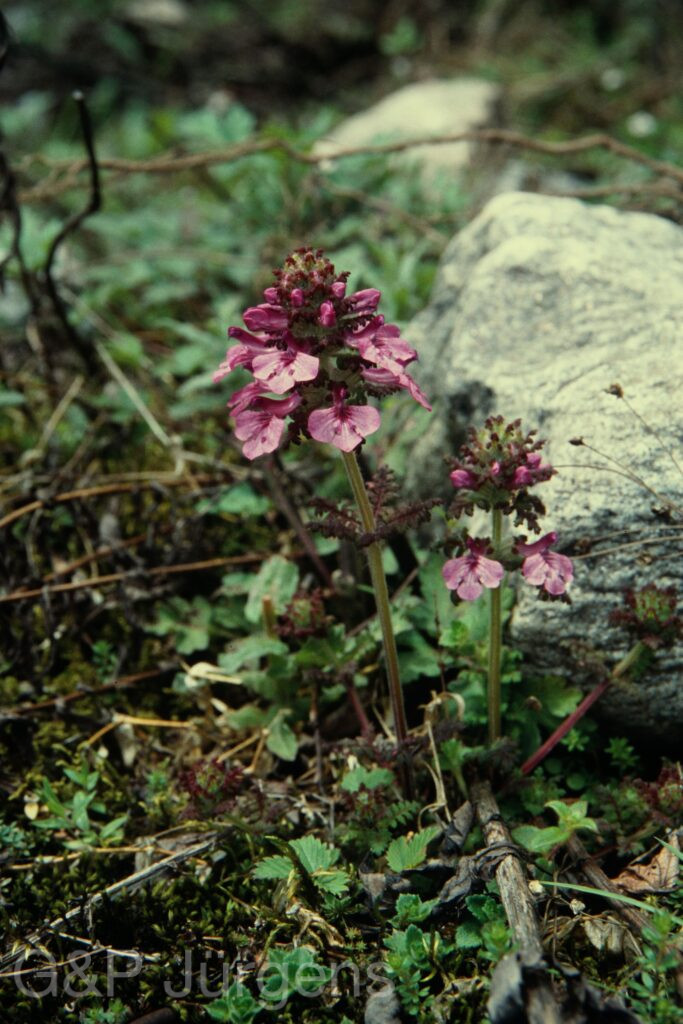
Pedicularis roylei var. speciosa is a hemiparasitic perennial of the eastern Himalaya, distributed across the high-montane and subalpine belt of southern China (Xizang and adjacent Yunnan) and Nepal, with populations extending into Sikkim and the Chumbi region. The variety is documented from a modest number of records (GBIF lists around 12 occurrences from CN and NP), reflecting both its restricted range and the limited collecting in its remote habitats. It occupies open alpine meadows, moist grassy slopes, the margins of Rhododendron and Abies forest, and streamside flushes between roughly 3000 and 4300 m. The photographed plant from the Yumthang valley in northern Sikkim at about 3500 m, flowering in May, is typical of these subalpine pastures where snowmelt sustains a brief but vigorous flush of growth. As a root-hemiparasite, it draws water and minerals from neighbouring grasses and forbs via haustoria while retaining functional green foliage.

The plant forms a low, clumped herb arising from a stout caudex, with erect or ascending stems often clothed in soft hairs. The leaves are mostly basal and pinnatisect, with oblong-lanceolate segments that are themselves toothed or crenate, giving the foliage a fern-like texture. The inflorescence is a dense spike or capitate cluster of conspicuous flowers; var. speciosa is distinguished by its notably large, showy corollas. The bilabiate corolla is rose-pink to purplish, the galea (upper lip) prolonged into a slender, often beak-like apex that twists or curves, while the broad three-lobed lower lip forms a landing platform. The calyx is tubular and toothed, and the four didynamous stamens lie concealed within the galea. The fruit is an obliquely ovoid capsule containing several seeds.

Within the large and taxonomically complex genus Pedicularis, which reaches its global diversity peak in the Sino-Himalayan region, this taxon belongs to a group whose beaked galeas reflect specialised pollination by long-tongued bumblebees. The variety, based on the basionym described by Prain and later treated by T. Yamazaki, is sometimes folded into a broadly circumscribed P. roylei; GBIF accepts it at varietal rank. Its elaborate floral architecture exemplifies the radiation of corolla forms that has accompanied the genus's hemiparasitic lifestyle. Though not currently regarded as threatened, alpine Pedicularis are sensitive to grazing pressure and climate-driven shifts in the snowmelt regime, making long-term monitoring of Himalayan populations desirable.

Author: (Prain) T.Yamaz. · Sources: POWO (Kew), GBIF, Flora of China Vol. 18, Flora of Bhutan Vol. 2 Part 3, Flora of Nepal, A Revision of the Genus Pedicularis (Pennell; Yamazaki, Pedicularis of Eastern Asia)

(Hook.) Sweet

Bhutan2014 342
Bhutan Tumching-La 3000m, May
Bhutan2014 886
Bhutan Chele-La 3300m, May

Description

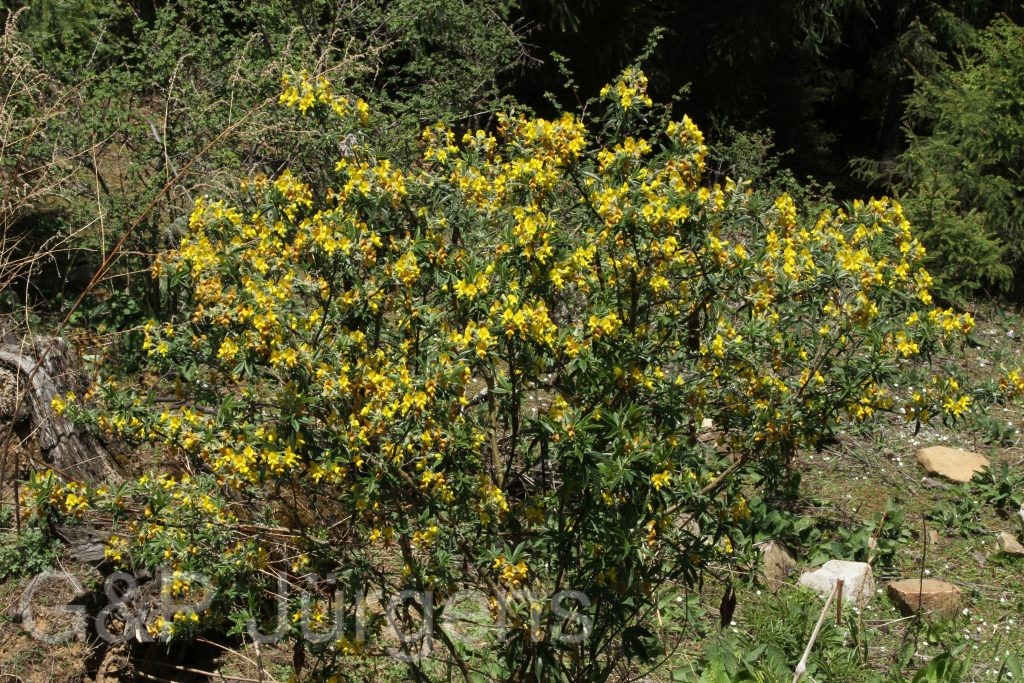
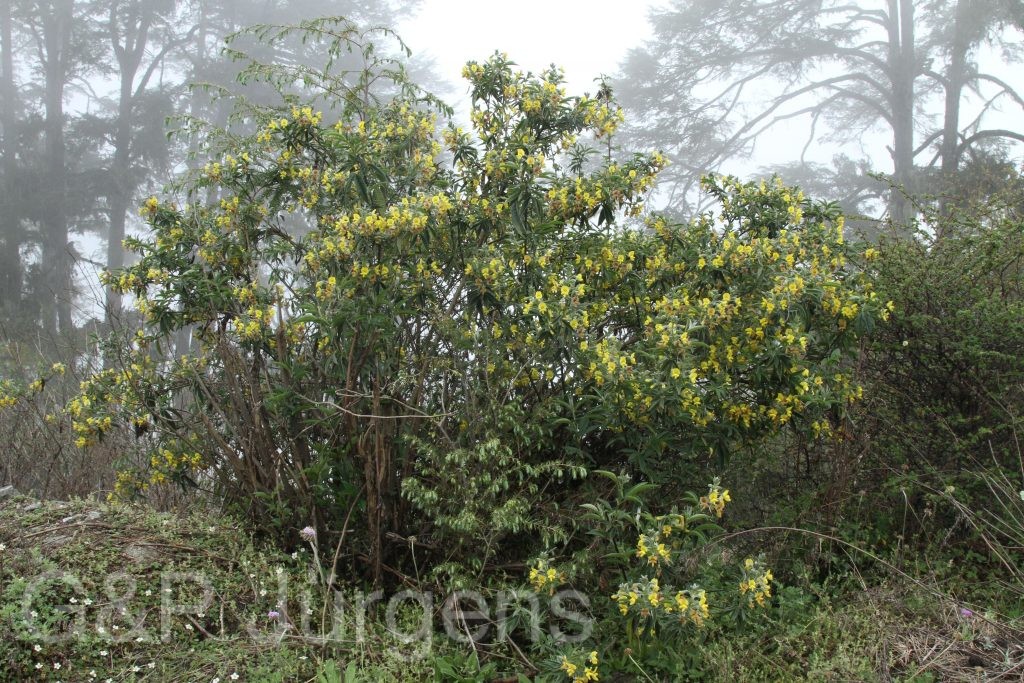
Piptanthus nepalensis is a Sino-Himalayan shrub distributed along the southern flank of the great ranges from Nepal and northern India eastward through Bhutan into south-western China (Yunnan, Sichuan, Xizang), with outlying records in Myanmar; the species is widely cultivated and naturalised in temperate gardens, accounting for the European, North American and Antipodean records (GB, DE, BE, NL, US, CA, NZ) among its more than 1600 georeferenced occurrences. It favours open scrub, forest margins, rocky slopes and stream banks in the upper montane and subalpine belts, typically between about 2500 and 4000 m. The populations on the Bhutanese passes of Tumching-La (3000 m) and Chele-La (3300 m), flowering with the spring thaw in May, are characteristic of its habitat among Rhododendron and conifer scrub.

It is a deciduous to semi-evergreen shrub reaching 1-4 m, with stout greenish branchlets bearing silky-pubescent young growth. The leaves are trifoliolate, long-petiolate and stipulate, the leaflets elliptic to lanceolate, dark green and glabrescent above, glaucous and appressed-silky beneath. The showy golden-yellow papilionaceous flowers, 2.5-3 cm long, are borne in terminal erect racemes; the calyx is bilabiate and silky, and the standard, wings and keel are typical of the tribe Thermopsideae. The fruit is a flattened, elongate, dehiscent legume to 12 cm, glaucous-pubescent and containing several dark reniform seeds.

Piptanthus is a small genus of the broadly defined Thermopsideae allied to Thermopsis and Anagyris, distinguished by its woody habit and trifoliolate leaves. Long-cultivated for its early bloom, P. nepalensis hosts nitrogen-fixing rhizobia that aid colonisation of skeletal soils. It is not considered threatened, being abundant across a broad range, though its toxic quinolizidine alkaloids deter browsing.

Author: (Hook.) Sweet · Sources: POWO (Kew), GBIF, Flora of China, Flora of Bhutan, Flora of Nepal, Turner's revision of Piptanthus (Thermopsideae)

(Hook.f.) Soó

Sikkim2003 96 P133
Sikkim above Chora 3600m 08.2003
Sikkim2003 97 P134
Sikkim above Chora 3600m 08.2003

Description

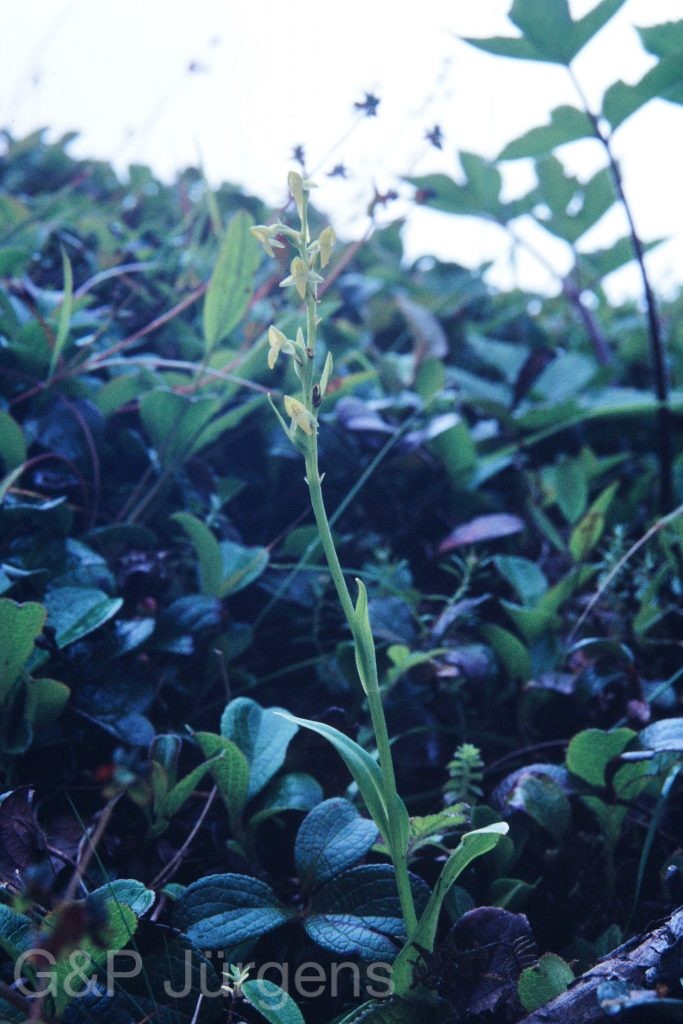
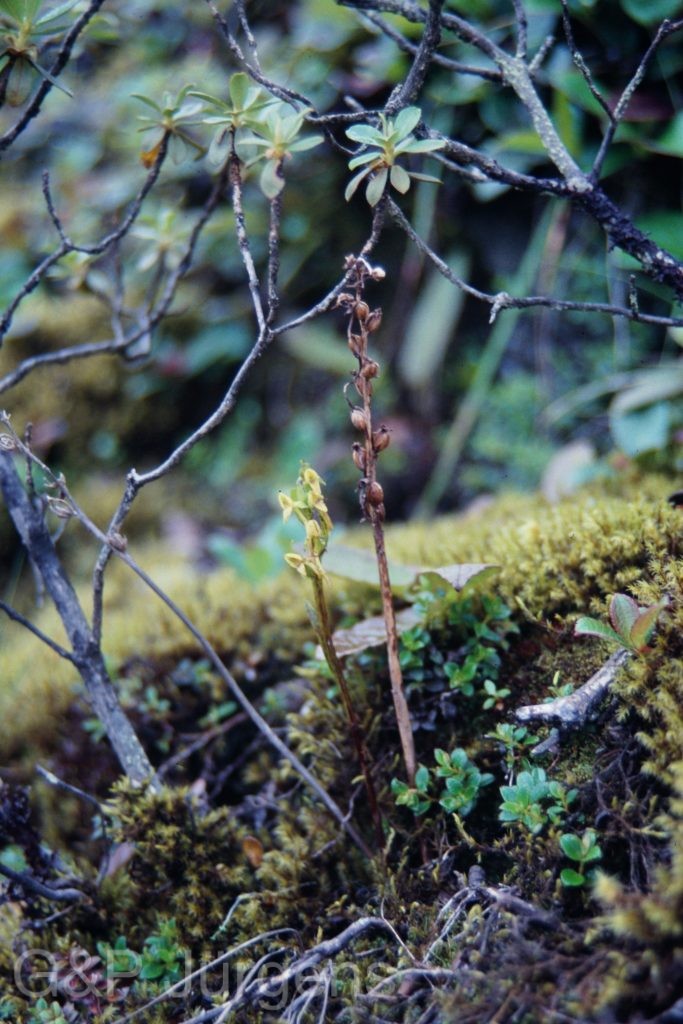
Platanthera leptocaulon is a terrestrial orchid of the eastern Himalaya and adjacent mountains of south-western China, recorded from Sikkim and the rest of northern India, Nepal, Bhutan, Myanmar and Yunnan and Sichuan in China. The roughly 67 georeferenced collections concentrate in the high subalpine to alpine belt, where the species occupies moist open turf, the margins of dwarf-shrub thickets and grassy hollows kept damp by snowmelt. The plant photographed above Chora in Sikkim at 3600 m in August typifies its habitat, flowering during the late-summer monsoon at elevations of roughly 3000-4200 m on humus-rich, well-drained slopes.

It is a slender, glabrous herb arising from ovoid to fusiform root-tubers, the erect stem comparatively thin and wiry (the epithet leptocaulon meaning "slender-stemmed"). The few cauline leaves are oblong-lanceolate to linear, sheathing at the base and grading upwards into bracts. The lax terminal raceme bears small greenish to greenish-white flowers; the dorsal sepal and petals are connivent to form a hood over the column, the lateral sepals spreading, and the entire, narrowly oblong labellum extends backwards into a slender cylindrical spur. The viscidia are naked and the pollinia are attached by slender caudicles, with fruit a small erect dehiscent capsule releasing dust-like seed.

The genus Platanthera is a large Holarctic and Asian assemblage centred on temperate and montane regions, and P. leptocaulon belongs to the species-rich Sino-Himalayan radiation, the basionym having been transferred by Soo from Habenaria. Like most members of the genus it depends on mycorrhizal fungi for germination and probably on long-tongued nocturnal pollinators attracted to the spurred flowers. Though not formally assessed, its broad transboundary range and tolerance of grazed alpine pasture suggest reasonable security, but populations remain vulnerable to overgrazing and the warming-driven upslope contraction of alpine grassland.

Author: (Hook.f.) Soó · Sources: POWO (Kew), GBIF, Flora of China, Flora of Bhutan, The Genus Platanthera (Orchidaceae) monograph

D.Don

Sikkim 2006 261 ergebnis
India West-Bengal, Lingza 1300m, May

Description

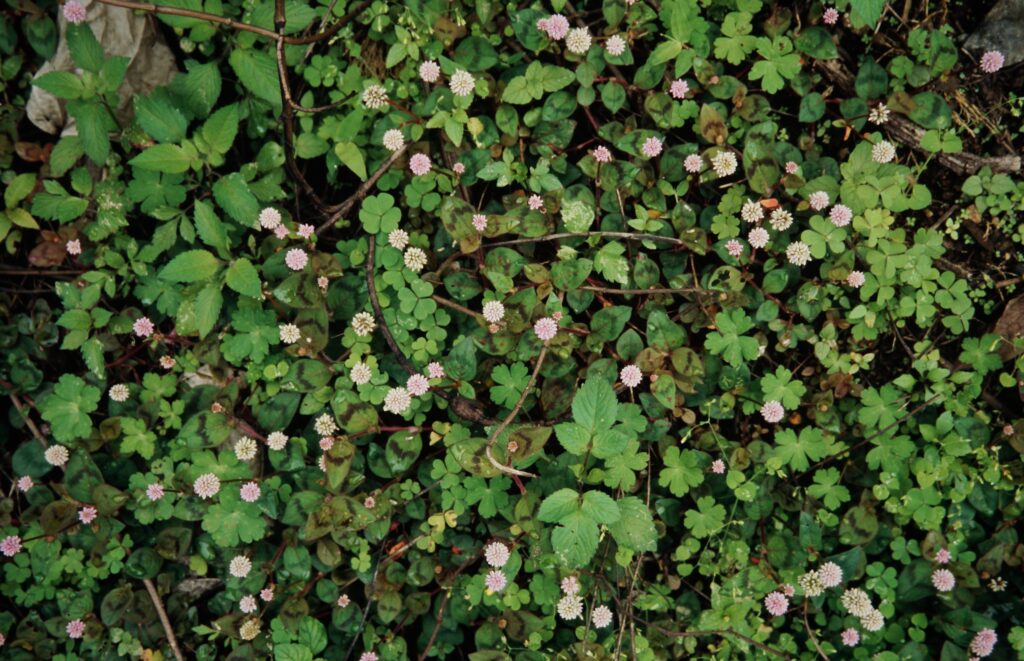
Polygonum microcephalum is a herb of the eastern Himalaya and montane Southeast Asia, widely distributed from Nepal and north-east India through Bhutan and south-western China (Yunnan, Sichuan, Xizang) to northern Myanmar and Vietnam. The very large global occurrence figures returned under the accepted genus Persicaria reflect aggregated records of the broader complex; this taxon is properly treated as Persicaria microcephala (D. Don) H. Gross. It grows in moist, shaded situations — forest understorey, streamsides, ditches and disturbed clearings — chiefly between about 800 and 2,800 m. The plant photographed at Lingza in West Bengal, India, at 1,300 m in May represents its typical low-montane subtropical broadleaf forest habitat.

It is a perennial herb with slender, often reddish, ascending to scrambling stems rooting at the lower nodes, the swollen nodes sheathed by membranous, cylindrical ochreae. The leaves are alternate, ovate to broadly lanceolate, acuminate, frequently marked with a dark chevron and red venation, the surfaces sometimes finely pubescent. The flowers are minute and aggregated into small, dense, head-like or short-spike inflorescences, the perianth of five tepals white to pinkish; stamens commonly eight. The fruit is a trigonous, dark, shining achene enclosed within the persistent perianth.

The segregation of Persicaria from Polygonum sensu lato, supported by molecular phylogenetics, places this species in a large genus characterised by ochreate sheaths and capitate or spiciform inflorescences. The dark-marked, often red-flushed foliage has brought certain forms into cultivation. The species is widespread, ecologically adaptable and of no conservation concern, behaving locally as a colonist of disturbed ground.

Author: D.Don · Sources: POWO (Kew), Flora of China Vol. 5, Flora of Bhutan Vol. 1, GBIF, Hong et al.: Polygonaceae in Flora of China

(C.E.C. Fisch.) T.T. Yu & C.L. Li

Sikkim2003 506 P706 ergebnis
Sikkim Yume Samdong 4400m, August

Description

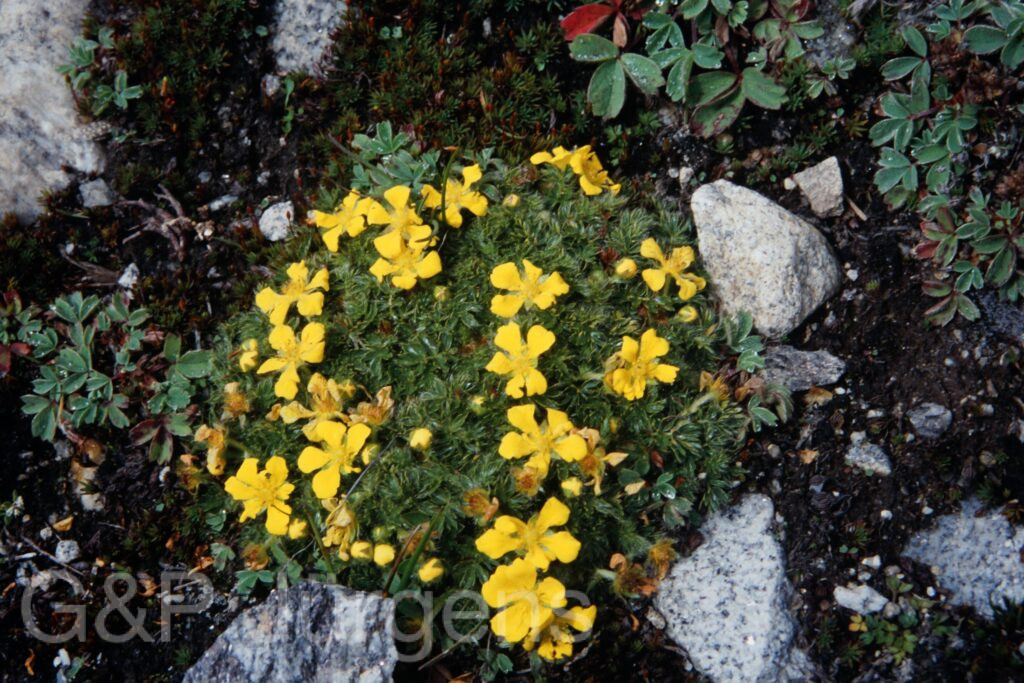
Potentilla articulata var. latipetiolata is a high-altitude perennial herb found in the eastern Himalayas and extending into the Sino-Himalayan region. It has been recorded from northeast India (Sikkim), Bhutan, and China (Xizang, Yunnan). The variety inhabits alpine scree, rocky moraine margins, and gravelly slopes at elevations of 3,800–5,000 m, favouring well-drained, mineral substrates with sparse vegetation cover. It has been collected from the Yume Samdong area in Sikkim at 4,400 m, flowering in August at the height of the eastern Himalayan monsoon.
The plant forms a compact, caespitose rosette from a stout, woody caudex covered with persistent, fibrous leaf-base remnants. The basal leaves are pinnately compound with 5–9 leaflets that are obovate to elliptic, 5–12 mm long, densely sericeous to villous on both surfaces, giving the foliage a silvery appearance. The petioles are broad and somewhat winged, a diagnostic character of var. latipetiolata distinguishing it from the typical variety. The flowering stems are short, 3–10 cm tall, bearing 1–3 flowers. The flowers are 10–15 mm in diameter, with five bright yellow, broadly obovate petals exceeding the sepals. The epicalyx segments are lanceolate, slightly shorter than the sepals. The achenes are smooth, ovoid, approximately 1.5 mm long.
This variety was originally described by C.E.C. Fischer and subsequently recombined by T.T. Yu and C.L. Li. It is distinguished from the typical Potentilla articulata primarily by its broader, more conspicuously winged petioles. With approximately 39 occurrence records in GBIF, it is a relatively uncommon taxon. The high-alpine habitats it occupies are among the most climate-sensitive ecosystems in the Himalayas, and long-term monitoring of such specialised alpine rosette plants is important for understanding biotic responses to warming temperatures and glacial retreat in the region.

Author: (C.E.C. Fisch.) T.T. Yu & C.L. Li · Sources: POWO (Kew), GBIF, Flora of China Vol. 9, Flora of Bhutan Vol. 1, Grierson & Long: Flora of Bhutan Vol. 1 (1987)

G.Watt

Bhutan2014 1057
Bhutan Takthsang 2900m, May
Bhutan2014 1060
Bhutan Takthsang 2900m, May

Description

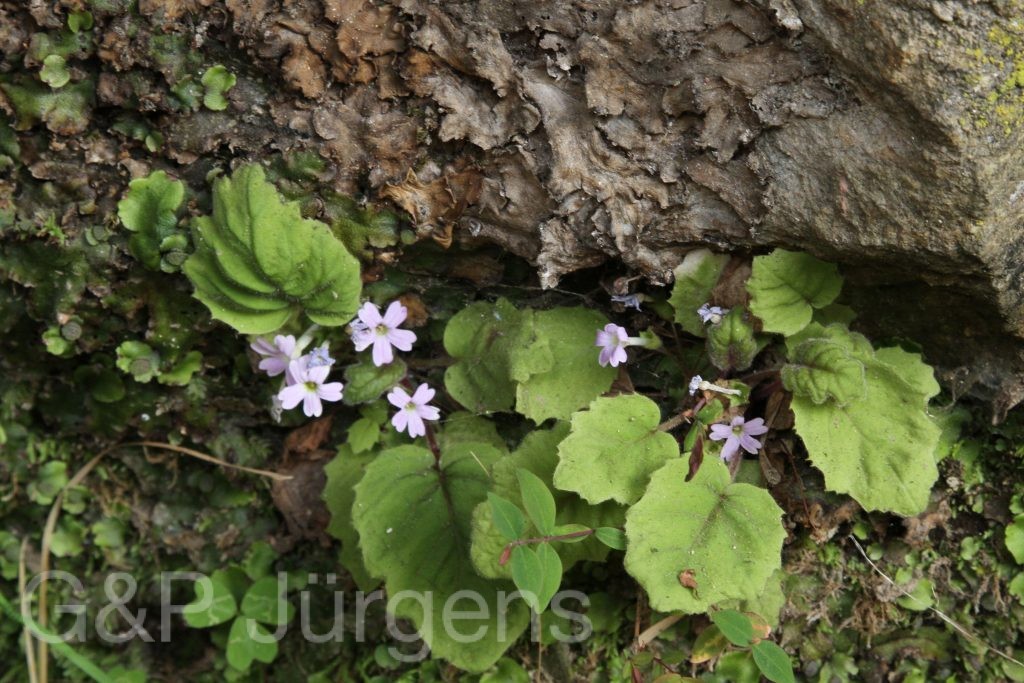
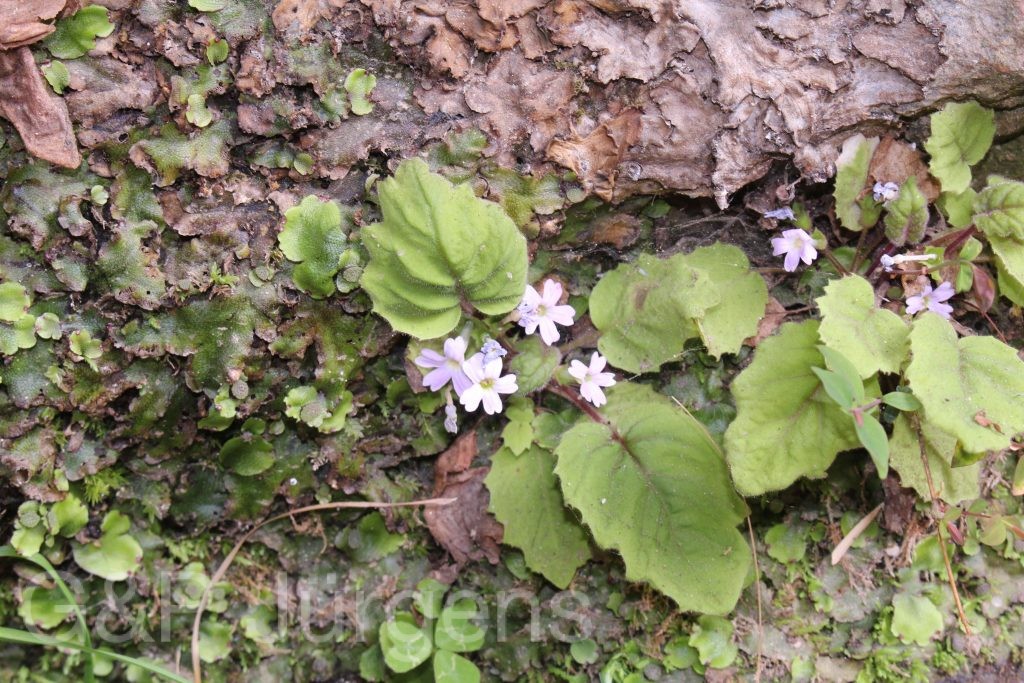
Primula filipes is a slender, delicate primrose of the eastern Himalayas, distributed across Bhutan, Sikkim and adjacent northeast India, eastern Nepal, northern Myanmar and southwest China (Xizang, Yunnan). It is a plant of cool, humid montane forest, favouring mossy banks, shaded streamsides and damp rock ledges within mixed broad-leaved and conifer woodland. The species typically occurs between roughly 2,500 and 3,600 m; the population photographed near the cliffside monastery of Taktshang (Tiger's Nest) in Bhutan at about 2,900 m in May is characteristic of its preferred shaded, moist forest understorey.

The plant is a small perennial herb forming a loose rosette of thin, ovate to oblong-elliptic leaves that are crenate-dentate at the margin and gradually narrowed into a slender, winged petiole, the lamina often farinose beneath. From the rosette arises a filiform, erect scape, frequently efarinose, terminating in a lax umbel of few flowers. The flowers are small, with a campanulate calyx and a pale to deep purple-violet corolla bearing a yellow eye and a notched, spreading limb; the capsule is globose and shorter than or subequal to the persistent calyx.

Primula filipes belongs to section Petiolares, a large and taxonomically intricate Himalayan group characterised by farinose, rosette-forming herbs of moist forest habitats. The species was described by the botanist George Watt from Himalayan material. As a narrowly montane forest endemic dependent on undisturbed humid woodland, it is sensitive to deforestation and trampling at popular pilgrimage sites, though it remains locally frequent within suitable habitat.

Author: G.Watt · Sources: POWO (Kew), Flora of Bhutan Vol. 1, Flora of China Vol. 15, GBIF, Richards: Primula (2003)

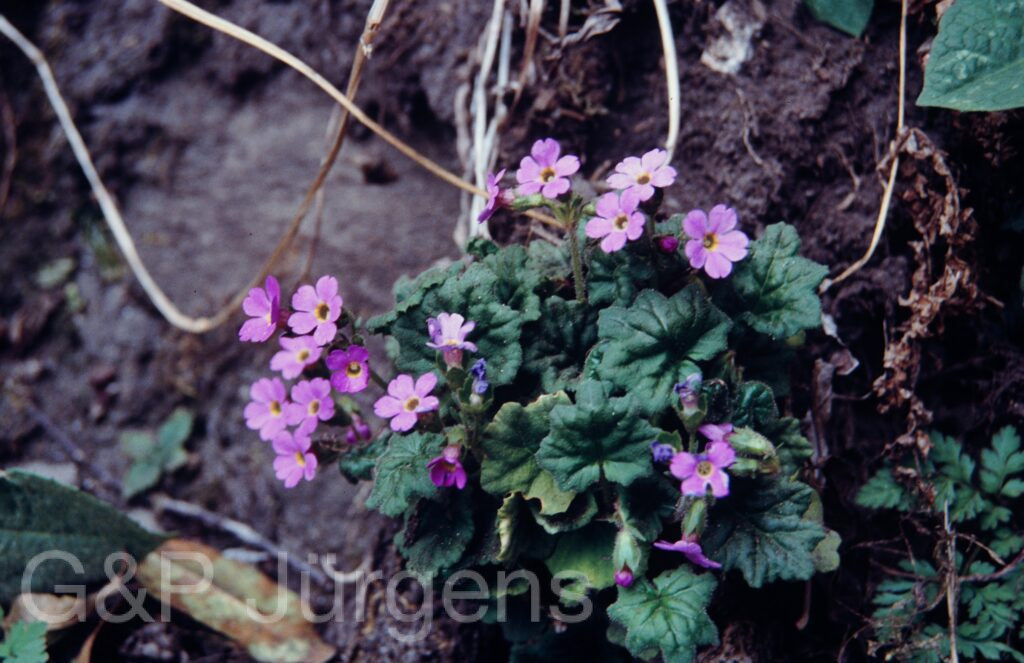
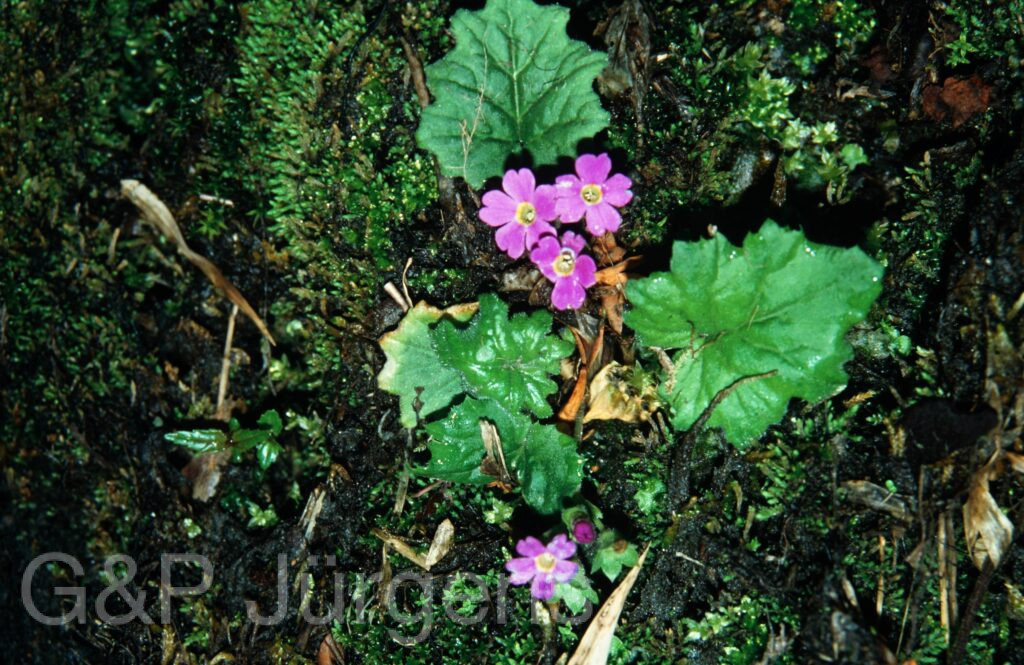
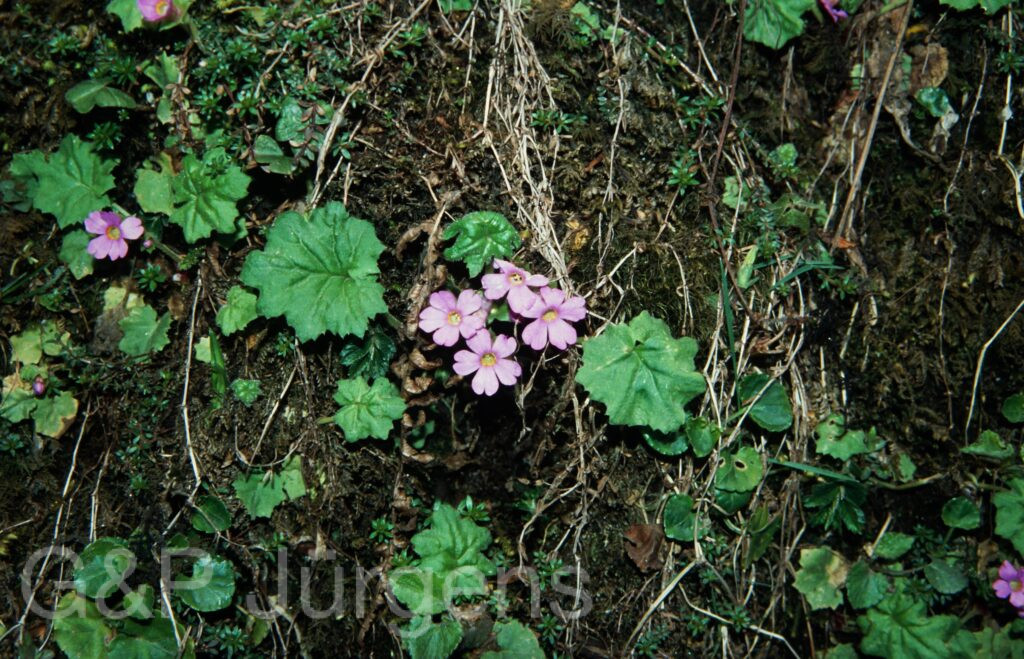
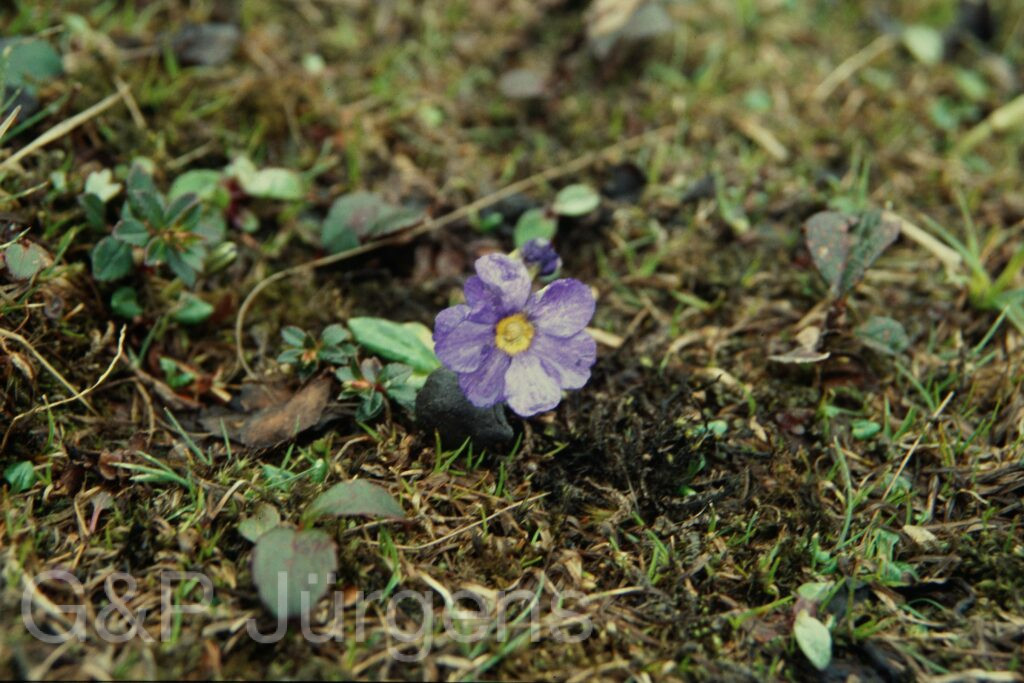
Primula listeri

by GP Jürgens

King ex Hook.f.

Nepal 1994 205 ergebnis
Ost-Nepal Mewa-Khola 2300m April 
Nepal1992 207 P303 ergebnis
Nepal Suketar 2400m March 
Nepal 2001 88 ergebnis ergebnis
East-Nepal Gupka Pokhari 3000m, April
Nepal 2001 123 ergebnis ergebnis
East-Nepal Gupka Pokhari 3000m, April

Description

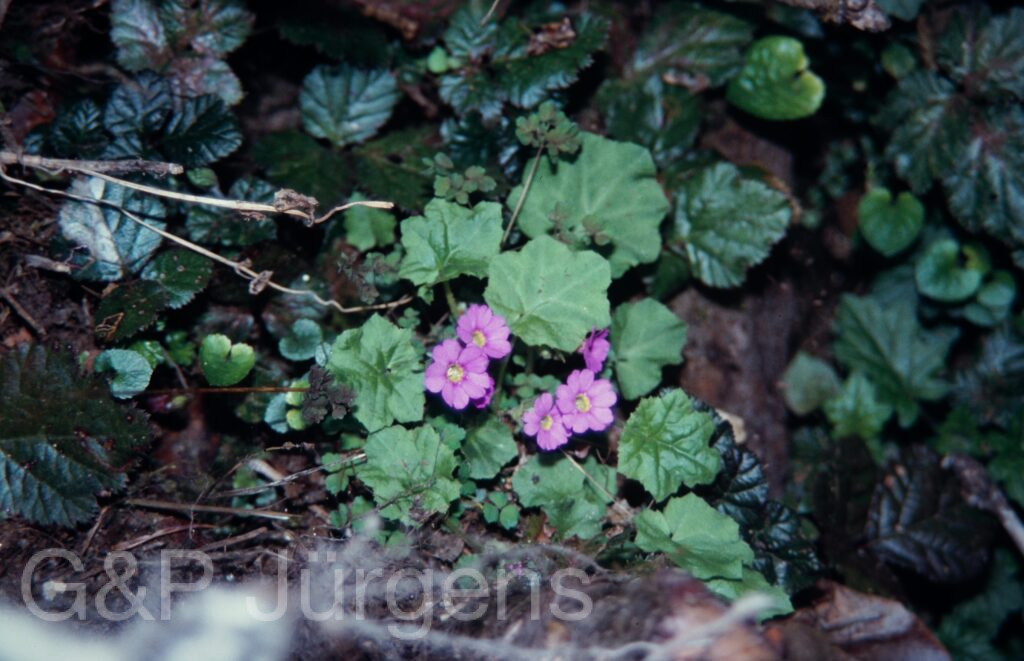
Primula listeri is an eastern Himalayan species distributed through Nepal, northern India, Bhutan, southern China (Xizang, Yunnan) and northern Myanmar, with GBIF documenting around 102 georeferenced records concentrated along the wetter eastern arc of the range. It occupies shaded, humid montane environments between roughly 2000 and 3000 m, growing on mossy banks, in the leaf litter of broad-leaved and mixed forest, and along seeping rock faces. The populations imaged in East Nepal at Mewa Khola (2300 m, April), Suketar (2400 m, March) and Gupka Pokhari (3000 m, April) typify its phenology, with flowering coinciding with the early pre-monsoon period when soils remain moist and cool.

The plant is a small, delicate perennial herb forming a slender rootstock from which arises a rosette of thin-textured leaves. The leaves are petiolate, ovate to oblong with a crenate to dentate margin, and frequently sparsely farinose or efarinose beneath. Flowers are borne on a slender scape in a loose few-flowered umbel, each subtended by narrow bracts; the calyx is tubular and lobed, and the corolla is rotate with a narrow tube and notched, lilac to pale violet limb-lobes, the throat marked by an annulus. As in many sect. Petiolares allies the species is heterostylous, producing pin and thrum flowers. The fruit is a small capsule dehiscing to release numerous minute seeds.

Taxonomically P. listeri belongs to the species-rich Primula sect. Petiolares, a complex assemblage of vernal-flowering, rosette-forming primroses centred on the eastern Himalaya. Its restricted elevational band and dependence on permanently humid forest microhabitats make it sensitive to forest clearance and desiccation, though it is not formally assessed as threatened. Biogeographically it forms part of the rich Sino-Himalayan endemic flora whose diversification is linked to the monsoon-driven moisture gradient of the eastern ranges.

Author: King ex Hook.f. · Sources: POWO (Kew), GBIF, Flora of Bhutan, Flora of China, Annotated Checklist of the Flowering Plants of Nepal, Richards' Primula (monograph)

G.Watt

Sikkim2004 142 G244
Sikkim/India Singalila 3800m April

Description

Primula pulchra is an eastern Himalayan species distributed across Nepal, India, Bhutan, southern China (Xizang, Yunnan) and northern Myanmar, with GBIF documenting some 39 georeferenced occurrences across this comparatively narrow range. It is a plant of the upper temperate and subalpine zones, typically growing between about 3000 and 4300 m on moist, humus-rich slopes, in open Rhododendron scrub, along stream margins and on grazed alpine meadows that remain snow-covered for much of the winter. The photographed material from the Singalila Ridge on the Sikkim–West Bengal border at roughly 3800 m, flowering in April, is characteristic: the species is among the earliest primulas to bloom as the snowmelt recedes.

It is a small, rosette-forming perennial arising from a short rhizome with fibrous roots. The leaves are obovate to oblong-spathulate, narrowed to a winged petiole, the margin crenate-dentate, and the lower surface typically clad in a pale to yellowish farina. The scape carries a one- to few-flowered umbel subtended by short bracts. Flowers are heterostylous and showy, the corolla rose-purple to violet with a pale or yellow eye, the lobes obcordate and emarginate; the calyx is campanulate and often farinose. The fruit is a small capsule about equalling the persistent calyx, releasing numerous angular seeds.

Primula pulchra belongs to section Petiolares, a large, taxonomically intricate group of Sino-Himalayan primulas characterised by early flowering and resting-bud overwintering. Within it the species is allied to P. calderiana and P. boothii, from which it is separated by leaf shape, farina distribution and corolla detail; intergradation has complicated its delimitation. As a snow-bed and meadow specialist it is sensitive to grazing and to shifts in snow-lie driven by climate warming, though its presence in several protected high-altitude areas affords some security.

Author: G.Watt · Sources: POWO (Kew), GBIF, Flora of China, Flora of Bhutan, Smith & Fletcher monograph of the genus Primula, Richards 'Primula' (2003)

(Bureau & Franch.) Pinto-Carr., E.Rico & M.M.Mart.Ort.

Bh09 414 P652
Bhutan Paro, 2500m June

Description

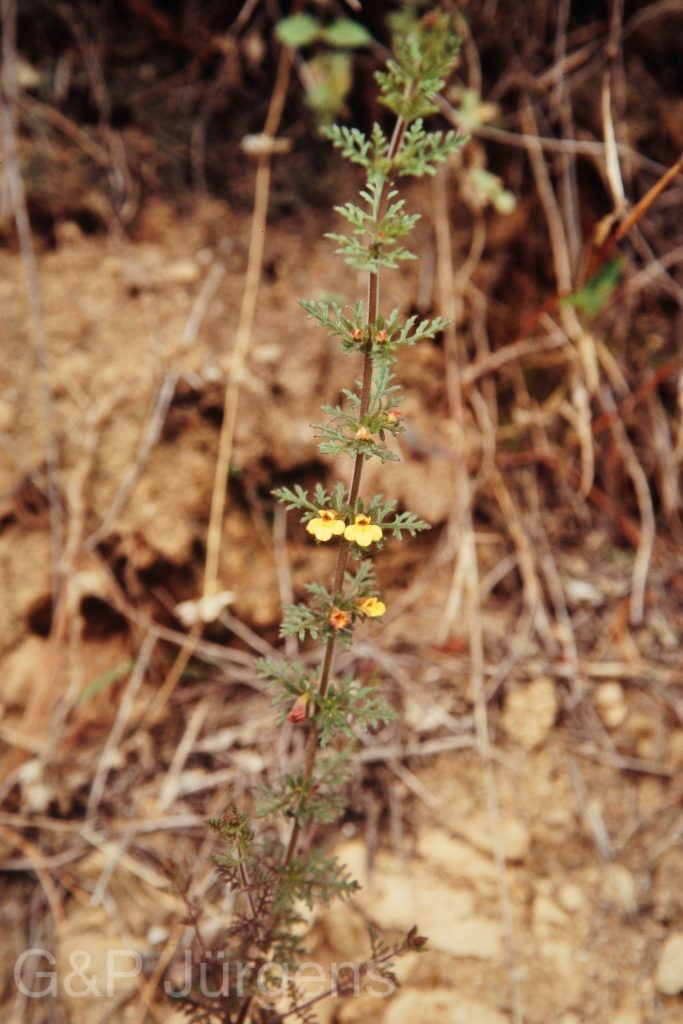
Pterygiella tenuisecta (Bureau & Franch.) Pinto-Carr., E.Rico & M.M.Mart.Ort. is a hemiparasitic annual herb of the Sino-Himalayan region, distributed through Bhutan, northern India and south-western China (notably Yunnan and Sichuan), with the GBIF dataset of roughly 883 occurrences also carrying determinations referable to material in Japan. Often treated under the name Phtheirospermum tenuisectum, it occupies open grassy slopes, forest margins, scrub and disturbed banks at montane elevations, where like other root-hemiparasites it attaches to the roots of neighbouring grasses and herbs while retaining functional green foliage. The illustrated plant was photographed at Paro in western Bhutan at around 2500 m in June, an elevation and season typical of its flowering in the temperate montane belt.

It is a slender, erect to ascending annual with branched, glandular-pubescent stems. The leaves are opposite below and may become alternate above, the blades pinnatisect to bipinnatisect with narrow, almost filiform ultimate segments, giving the foliage a finely divided, feathery appearance reflected in the epithet tenuisecta. The flowers are solitary in the upper leaf axils, shortly pedicellate, with a tubular, ribbed, glandular calyx of fused sepals. The corolla is yellow, two-lipped, the upper lip hooded and the lower three-lobed and spreading, enclosing four didynamous stamens. The fruit is a loculicidal, ovoid to oblong capsule containing numerous small seeds.

The species has been shuttled between several genera of the broomrape family, having been described in Gerardia and later placed in Phtheirospermum before molecular and morphological work supported its transfer to Pterygiella; the synonymy underlies the differing names on the source page. As a facultative hemiparasite it plays a part in regulating grassland community structure, drawing water and nutrients from hosts while contributing its own photosynthesis. No conservation concern is recorded, the plant being a widespread component of seasonally moist montane grasslands across its Sino-Himalayan range.

Author: (Bureau & Franch.) Pinto-Carr., E.Rico & M.M.Mart.Ort. · Sources: POWO (Kew), GBIF, Flora of China, Flora of Bhutan, Orobanchaceae phylogenetic studies (Pinto-Carrasco et al.)