Tag:

Yunnan

Flowers of Yunnan — 68 species from the mountains of Yunnan in southwest China, part of the Hengduan and eastern Himalayan biodiversity hotspot renowned worldwide for its rhododendrons, primulas and gentians. This region is one of the great cradles of temperate plant diversity. Each species page provides a botanical description, distribution, habitat and flowering time with the original photograph.

Wall.

Sikkim 2006 449 ergebnis
India West-Bengal, Tolung 2450m, May

Description

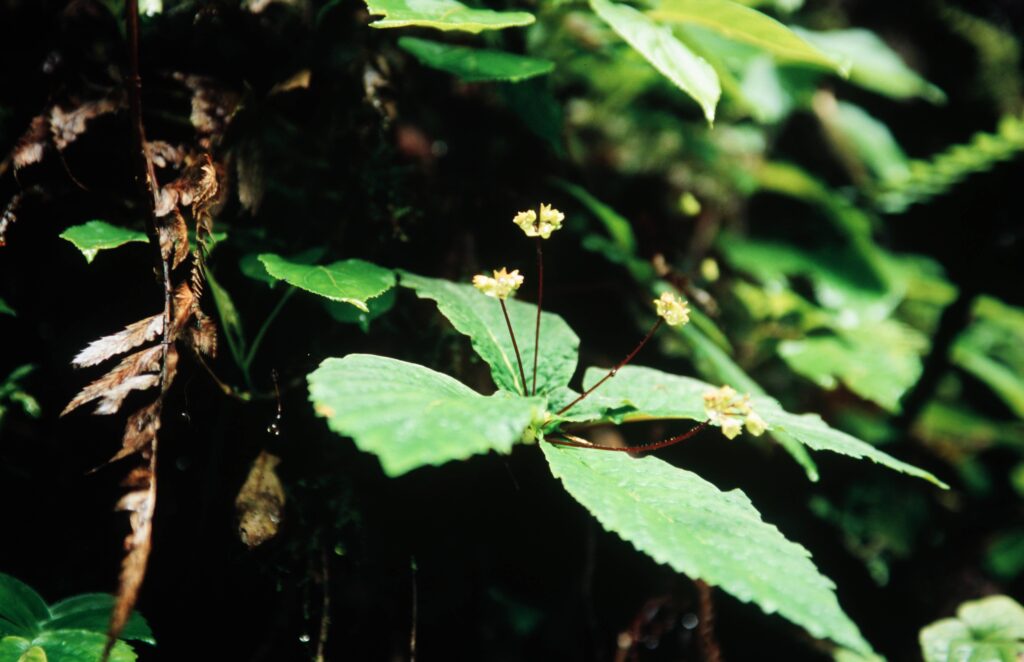
Didymocarpus oblongus is a relatively uncommon gesneriad endemic to the eastern Himalaya, recorded from Nepal, northeast India (Sikkim, Darjeeling, Assam), Bhutan, and adjacent parts of southern China (Xizang, Yunnan). It inhabits shaded, damp rock faces, mossy cliff ledges, and steep earth banks in montane broadleaved and mixed forests, typically at elevations between 1,800 and 3,000 m. The species has been documented from the Tolung area of West Bengal at approximately 2,450 m, where it grows in the moist understorey of temperate forests during the spring season.
The plant is a perennial herb with a short, erect stem 5–15 cm tall, arising from a fleshy rootstock. Leaves are arranged in an opposite, often crowded rosette-like cluster near the stem apex; they are oblanceolate to oblong, 5–15 cm long and 2–5 cm wide, with a crenate to serrate margin, the upper surface dark green and sparsely pilose, the lower surface paler and more densely pubescent. The inflorescence is a lax cyme of 2–6 flowers borne on a slender peduncle 5–10 cm long. The calyx is tubular, five-lobed. The corolla is tubular-funnelform, 2–3 cm long, typically pale purple to lavender with darker markings in the throat. Stamens are two, with the filaments inserted at mid-tube; the anthers are coherent face to face. The fruit is a slender, elongate capsule 2–4 cm long, dehiscing loculicidally.
Didymocarpus is a genus of approximately 100 species centred in mainland Asia, with the Himalayan region representing a significant centre of diversity. D. oblongus is distinguished from allied species by its oblong leaf shape, relatively long peduncles, and high-elevation habitat preference. With only 88 occurrence records in GBIF and a restricted distribution along the eastern Himalayan arc, the species warrants conservation attention, particularly as its cliff-face and forest-understorey habitats are sensitive to deforestation and landslide disturbance.

Author: Wall. · Sources: POWO (Kew), GBIF, Flora of Bhutan Vol. 2, Flora of China Vol. 18, Möller & Clark: Gesneriaceae classification (2013)
Dubyaea hispida

by GP Jürgens

DC.

Bhutan2012 56
Bhutan Shele-La, 4000m September

Description

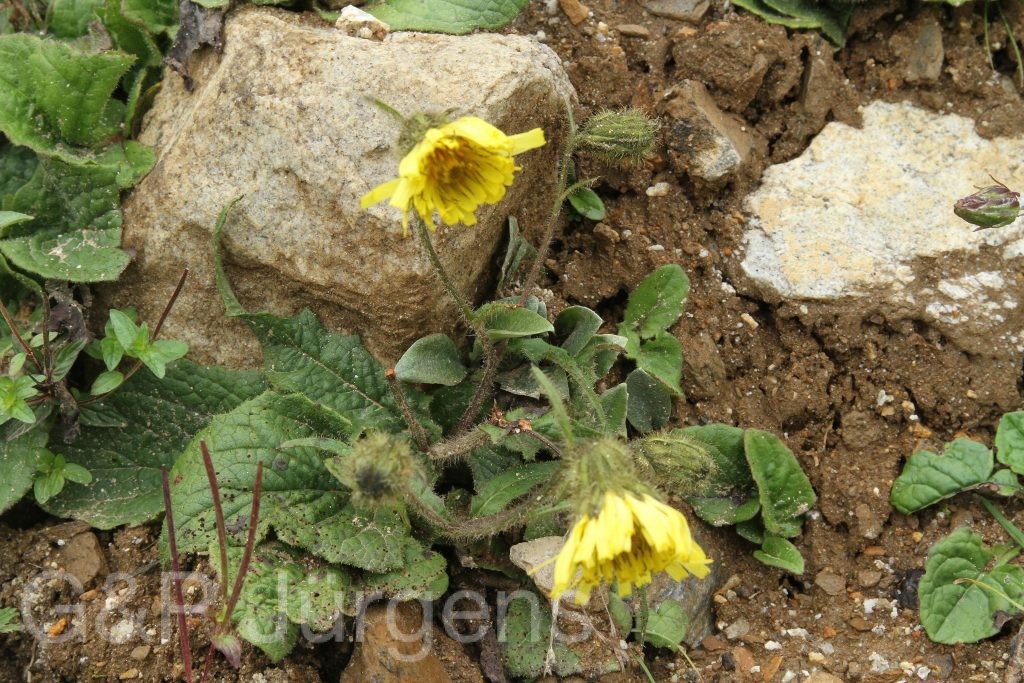
Dubyaea hispida is an alpine member of the lettuce tribe (Cichorieae) ranging across the eastern and central Himalaya into south-western China, with reliable records from Nepal, India, Bhutan, Myanmar, Pakistan and China (Xizang, Yunnan, Sichuan); extra-regional points in Austria and Great Britain among the 544 occurrences represent cultivated or misattributed material rather than native range. It grows in moist alpine meadows, scrub margins, rocky slopes and streamsides, typically between about 3000 and 4300 m. The plant figured from the Shele-La pass in Bhutan at roughly 4000 m in September reflects its characteristic late-season flowering in cool, humid high-mountain habitats.

The species is a perennial herb with a short rhizome and erect, hispid stems clothed, like the peduncles and involucres, in spreading blackish or purplish multicellular hairs. The leaves are thin, oblong to lyrate-pinnatifid, with a large terminal lobe and a winged, amplexicaul petiole base; the upper leaves are reduced. The capitula are several, nodding in a loose corymb, with an involucre of imbricate, hispid phyllaries. The florets are all ligulate and yellow, as in the milky-juiced Cichorieae. The cypselae are narrowly fusiform, ribbed and slightly narrowed above, bearing a pappus of soft, white, finely barbellate bristles.

Dubyaea is a small Sino-Himalayan genus of perhaps a dozen species centred on the eastern Himalaya and Hengduan Shan, segregated from the related Crepis and Soroseris by its nodding heads, dark-hispid indumentum and distinctive achene and pappus characters. The nodding capitula and abundant glandular-setose vestiture are adaptations to wet alpine conditions, sheltering florets from rain. As a widespread high-elevation species across multiple countries, D. hispida is not considered threatened, although it is naturally restricted to the narrow alpine belt.

Author: DC. · Sources: POWO (Kew), GBIF, Flora of China Vol. 20-21, Flora of Bhutan, Flora of Nepal, Stebbins Cichorieae of the Himalaya

Hook.f. & Thomson

Nepal 2009 88 ergebnis
Nepal Samthang 2410m, May

Description

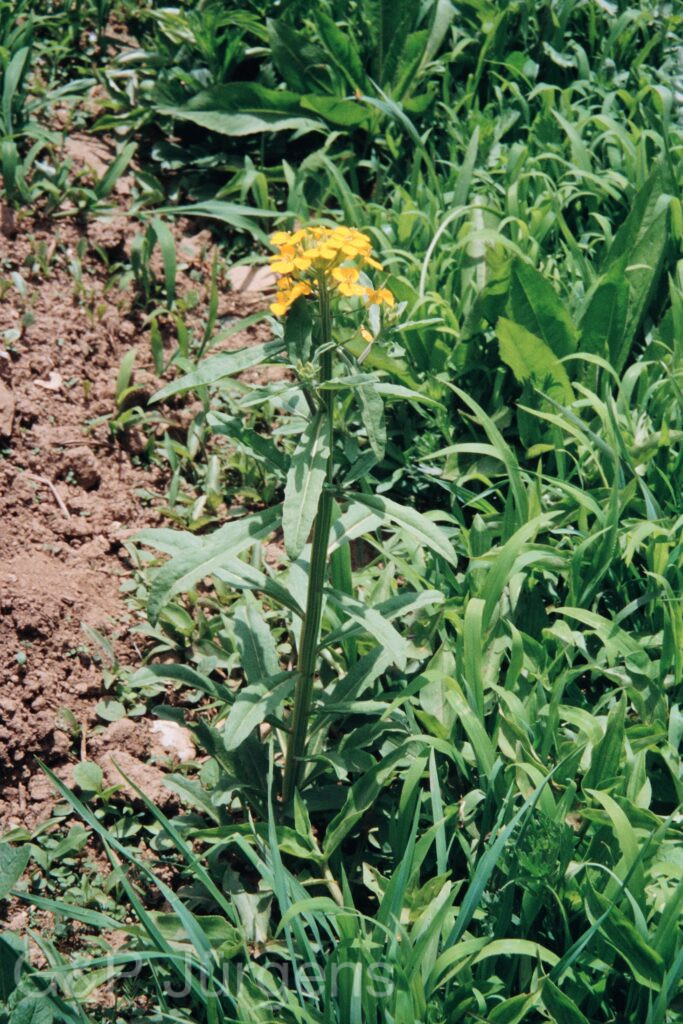
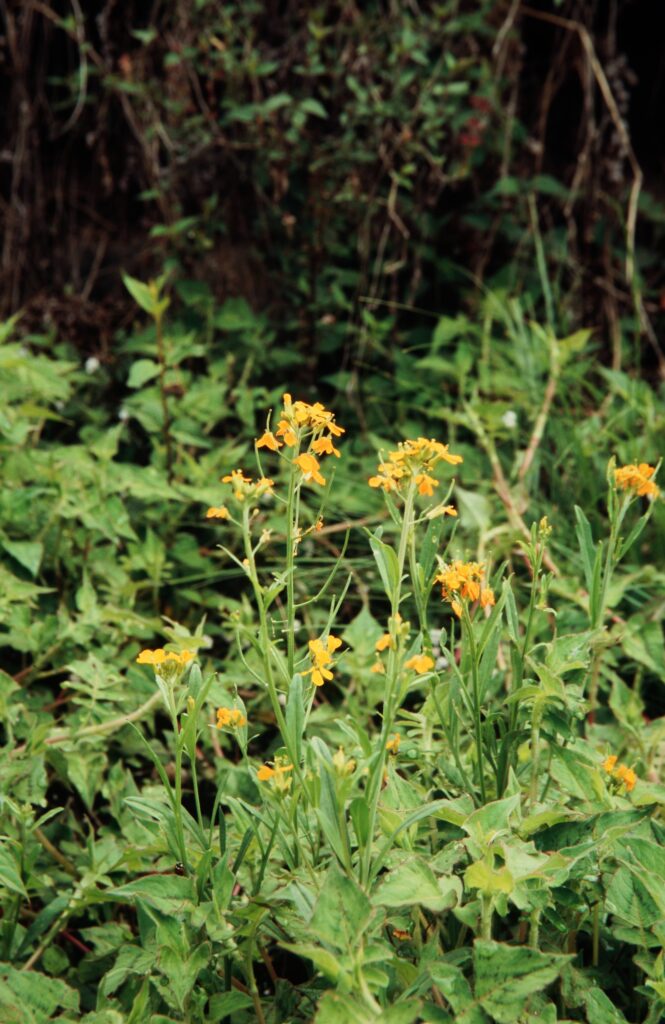
Erysimum pachycarpum is a Himalayan wallflower distributed across Nepal, Bhutan, northern India, and extending into southwestern China (Tibet, Yunnan). GBIF documents 39 occurrences from these countries. The species inhabits dry rocky slopes, open scrubland, disturbed ground along trails, and stony riverbanks in the warm to cool temperate zone, at elevations from approximately 1,800 to 3,500 m. The photograph from Samthang in Nepal at 2,410 m, taken in May, shows the species at a mid-elevation site during its spring flowering period.
The plant is a biennial or short-lived perennial herb, 20–60 cm tall, with erect, usually unbranched stems covered in appressed, medifixed (malpighian) trichomes characteristic of the genus. Basal leaves are oblanceolate, 3–8 cm long, with entire to sinuate-dentate margins, forming a rosette that may wither at flowering; cauline leaves are narrowly lanceolate, sessile, progressively smaller upward. The inflorescence is a dense, terminal raceme that elongates considerably in fruit. Flowers are tetramerous with yellow petals, 8–12 mm long, spatulate, clawed. Stamens six, tetradynamous. The silique is stout and thick-walled — hence the epithet pachycarpum (thick-fruited) — erect to slightly spreading, 3–6 cm long, quadrangular in cross-section, densely covered with appressed trichomes. Seeds are oblong, narrowly winged.
Erysimum pachycarpum is distinguished from other Himalayan Erysimum species primarily by its robust, thickened siliques and relatively large flowers. The genus Erysimum is taxonomically challenging due to frequent hybridisation and subtle morphological boundaries between species, and molecular studies are ongoing to resolve relationships within the Himalayan clade. The species is not currently assessed as threatened and appears locally common in suitable open, dry habitats across its range.

Author: Hook.f. & Thomson · Sources: POWO (Kew), GBIF, Flora of China Vol. 8, Grierson & Long: Flora of Bhutan Vol. 1

D.Don

Nepal 99 423 ergebnis
Nepal Talphi 2830m, July
Nepal 99 72 ergebnis
Nepal Chauta-valley, 2800m, July

Description

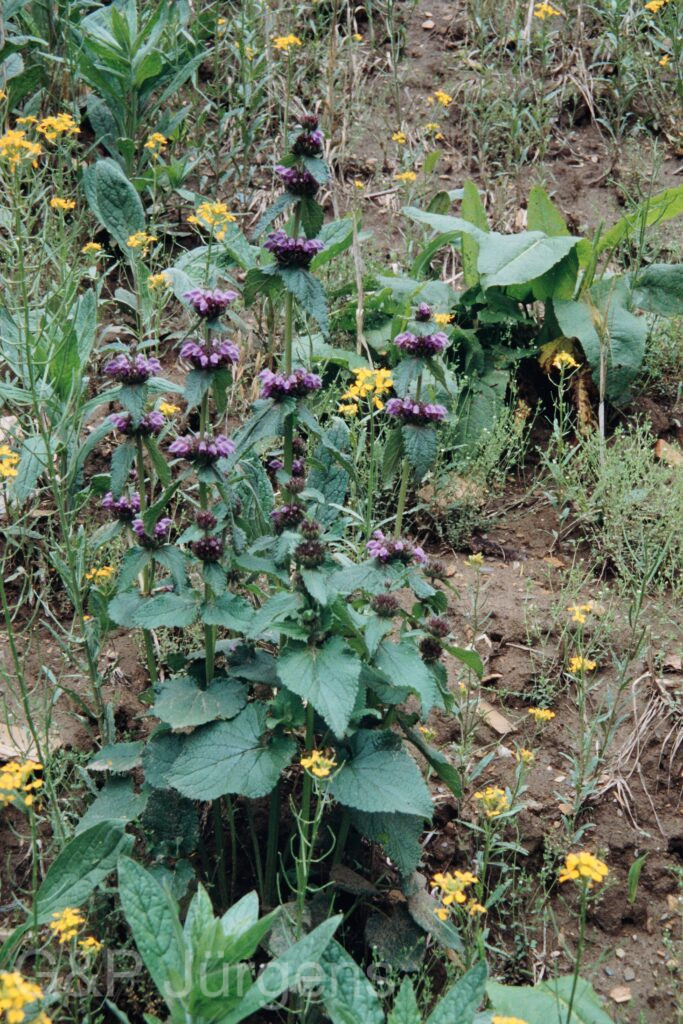
Erysimum robustum is a Himalayan wallflower distributed through Nepal, northern India and SW China (Xizang and Yunnan), as reflected in the GBIF country records (NP, IN, CN) and some 89 occurrences. The plants illustrated here were photographed in western Nepal at Talphi (c. 2,830 m) and in the Chauta valley (c. 2,800 m) in July. It is a montane to subalpine species favouring open, well-drained sites: stony pastures, dry slopes, roadside banks and the margins of cultivation, generally between 2,500 and 3,800 m, where it forms conspicuous yellow-flowered stands during the summer monsoon. The GBIF backbone treats the name as a synonym, but it is here regarded as the accepted name Erysimum robustum following regional floristic usage.

It is a biennial or short-lived perennial herb with an erect, robust, often branched stem clothed, like the rest of the plant, in appressed two- to several-rayed malpighiaceous hairs that give a greyish cast. The leaves are linear to oblanceolate, entire to remotely denticulate, the lower ones petiolate and the upper sessile. The inflorescence is an elongating ebracteate raceme of bright yellow flowers with four clawed petals in the cruciferous pattern and tetradynamous stamens. The fruit is a long, narrow, four-angled siliqua, somewhat torulose and ascending on a stout pedicel, containing a single row of oblong seeds in each locule.

The genus Erysimum is taxonomically difficult owing to extensive variation in indumentum and habit, and several Himalayan entities have been variously lumped or split; trichome branching patterns and siliqua characters remain the most reliable diagnostic features. As a widespread, weedy-tolerant species of disturbed montane ground, E. robustum is not of conservation concern and can act as an early colonist of bare slopes.

Author: D.Don · Sources: POWO (Kew), Flora of China Vol. 8, Flora of Nepal, GBIF, Polatschek: Revision der Gattung Erysimum

Wall.

Sikkim 2006 184 ergebnis
India West-Bengal, Samadan 2300m, May
BhutanPG2011 82 ergebnis scaled
Bhutan Menchuang 2850m, June

Description

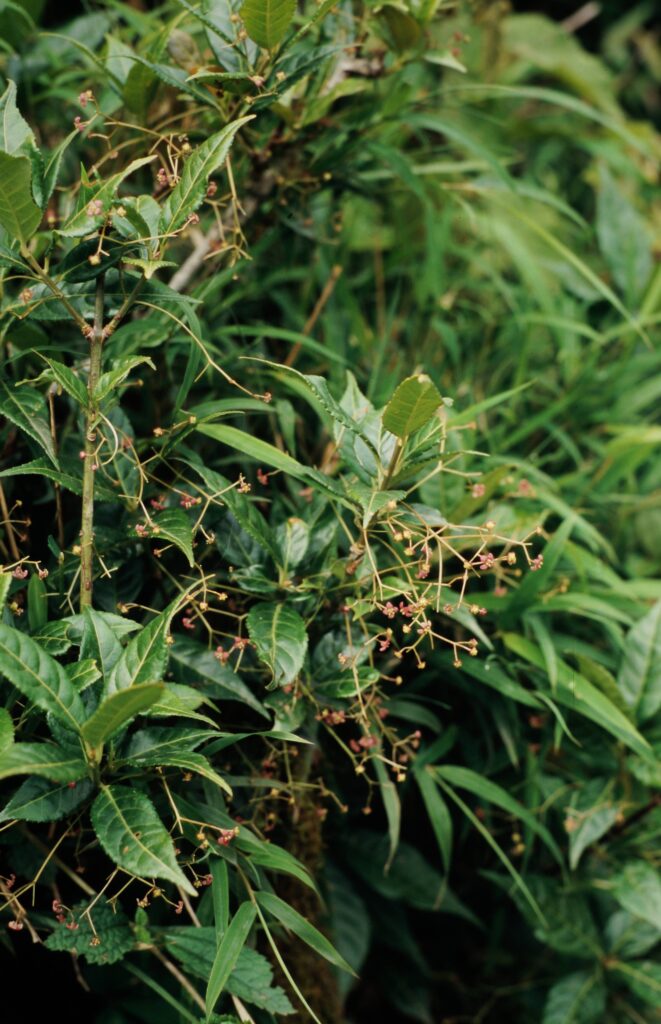
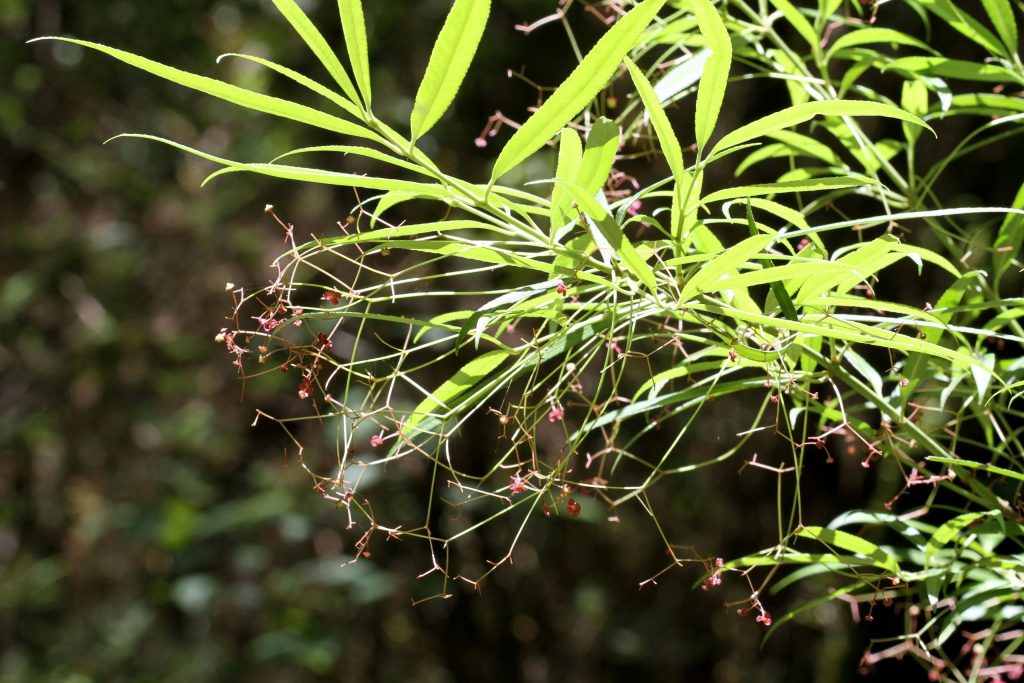
Euonymus frigidus is a Himalayan spindle tree distributed from central Nepal through northeast India, Sikkim, Bhutan, and northern Myanmar to southwest China (Yunnan, Sichuan, Xizang). GBIF records over 1,570 occurrences, with the majority from China and the eastern Himalayas. The species inhabits cool-temperate and subalpine broadleaved and mixed forests, often growing along forest margins, stream gullies, and shaded slopes at elevations of 1,800–3,200 m. Collections from Samadan in West Bengal at 2,300 m and from Menchuang in Bhutan at 2,850 m illustrate its typical occurrence in the mid-elevation broadleaved forest zone of the eastern Himalayan slopes.
Euonymus frigidus is a large deciduous shrub or small tree, reaching 3–8 m in height, with smooth, greyish-green bark on younger branches. Leaves are opposite, elliptic to oblong-lanceolate, 6–14 cm long, acuminate at the apex, cuneate at the base, with finely crenate-serrate margins, glabrous on both surfaces, and turning reddish-purple in autumn. The inflorescence is an axillary, dichasial cyme bearing 7–15 flowers on slender peduncles. Flowers are tetramerous, small, 6–8 mm in diameter, with greenish-yellow to purplish petals and a conspicuous four-lobed disc. The fruit is a deeply four-lobed capsule, pink to crimson at maturity, splitting to reveal four seeds each enclosed in a bright orange aril — a striking ornamental feature.
The specific epithet 'frigidus' alludes to the cold-temperate habitats in which this species predominantly occurs. Euonymus frigidus is distinguished from the closely related E. hamiltonianus by its generally larger leaves, more deeply lobed capsules, and preference for higher elevations. The conspicuous arillate fruits are an important food source for frugivorous birds, including minivets and laughingthrushes, which serve as effective dispersal agents. The species is occasionally cultivated as an ornamental in European and North American gardens for its vivid autumn colour and decorative fruit.

Author: Wall. · Sources: POWO (Kew), GBIF, Flora of China Vol. 11, Flora of Bhutan Vol. 2, Grierson & Long: Flora of Bhutan (1991)

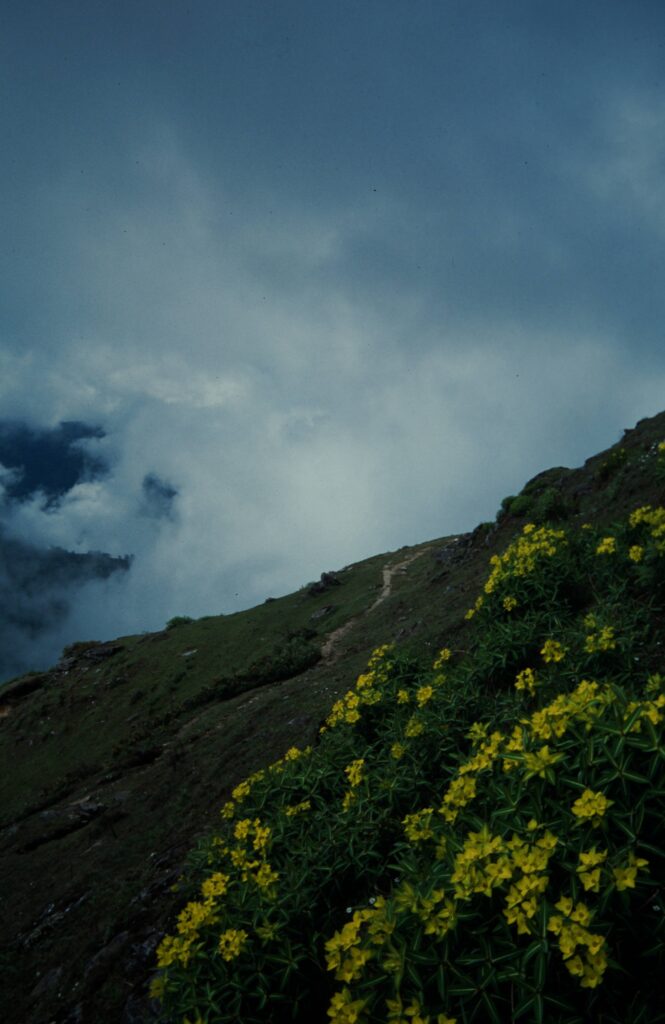
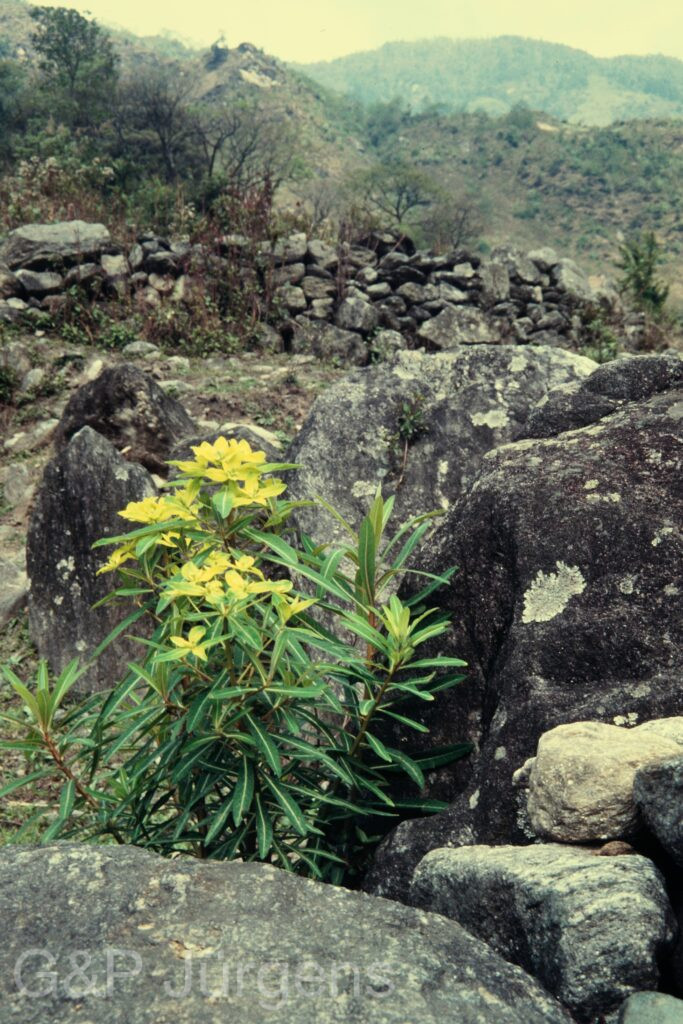
Boiss.

Nepal 2001 302 ergebnis ergebnis
Nepal (Gorkha) Lambra Kharka 3100m, May
Nepal 2001 301 ergebnis
Nepal (Gorkha) Lambra Kharka 3100m, May
Nepal 97 86 P146
Nepal Tankhu 2100m April

Description

Euphorbia sikkimensis is a robust herbaceous spurge distributed across the eastern and central Himalaya, from central Nepal through Sikkim, Bhutan, and northeast India into southern China (Xizang, Yunnan), with peripheral records from Myanmar, Laos, and Vietnam. It occurs in subalpine meadows, forest clearings, scrub margins, and open hillsides at elevations of 1,800–3,500 m. The species has been documented from the Gorkha district of Nepal at Lambra Kharka at 3,100 m in May and near Tankhu at 2,100 m in April, indicating a broad elevational amplitude and early-season phenology at lower altitudes.
The plant is a stout, erect perennial herb, 30–80 cm tall, with thick, fleshy rootstock and unbranched or sparingly branched stems that exude copious white latex when cut. Leaves are alternate, sessile, linear-lanceolate to oblanceolate, 8–15 cm long and 1–2.5 cm wide, with a prominent pale midrib, entire margins, and a glaucous undersurface. The inflorescence is a terminal, compound cyathium typical of the genus, with a broad umbel of 4–8 primary rays, each ray subtended by obovate, yellowish-green floral bracts. The cyathia bear crescent-shaped glands with short horns. The fruit is a smooth, trilocular capsule approximately 6–8 mm in diameter, explosively dehiscent at maturity, with carunculate seeds.
Euphorbia sikkimensis was described by Boissier from Sikkim collections and belongs to Euphorbia subgenus Esula, a predominantly Eurasian clade of herbaceous spurges. It is notable for its striking appearance in early spring, when the bright red or pink-tinged new stems contrast with the yellowish-green inflorescences. The species has gained horticultural recognition in temperate gardens and is increasingly cultivated as an ornamental perennial in Europe. Ecologically, its copious latex deters herbivory, and it plays a role in early-season pollinator support in montane grassland ecosystems.

Author: Boiss. · Sources: POWO (Kew), GBIF, Flora of China Vol. 11, Annotated Checklist of the Flowering Plants of Nepal

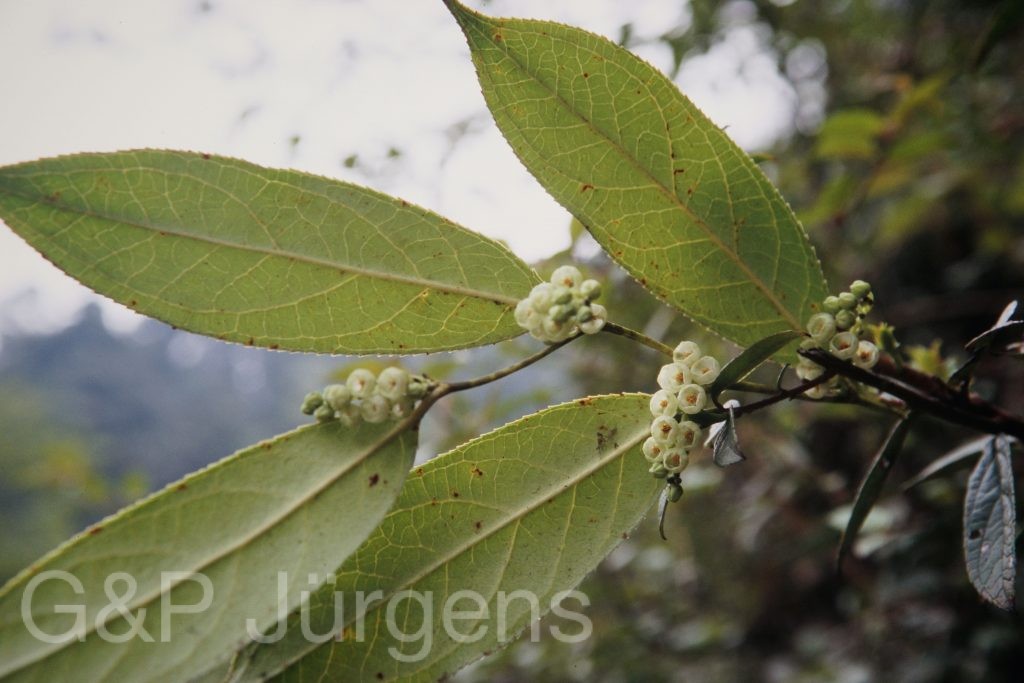
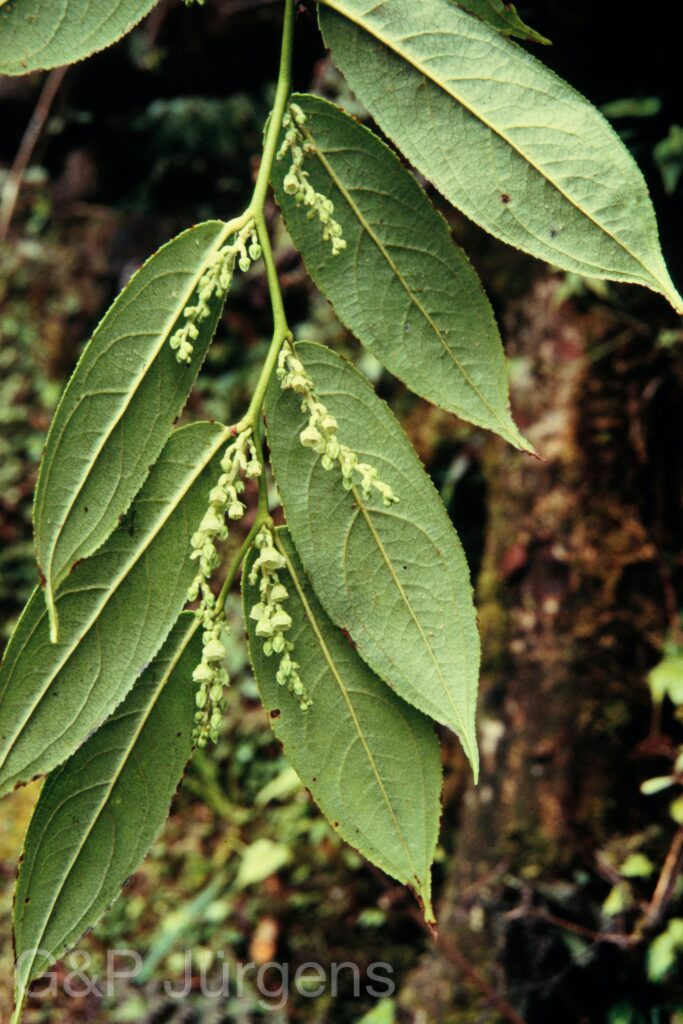
Wight

Bh2008 154 P253
Bhutan Trongtsa 2120m, April
Nepal 97 115 P198
Nepal Mewa-Khola 2470m April

Description

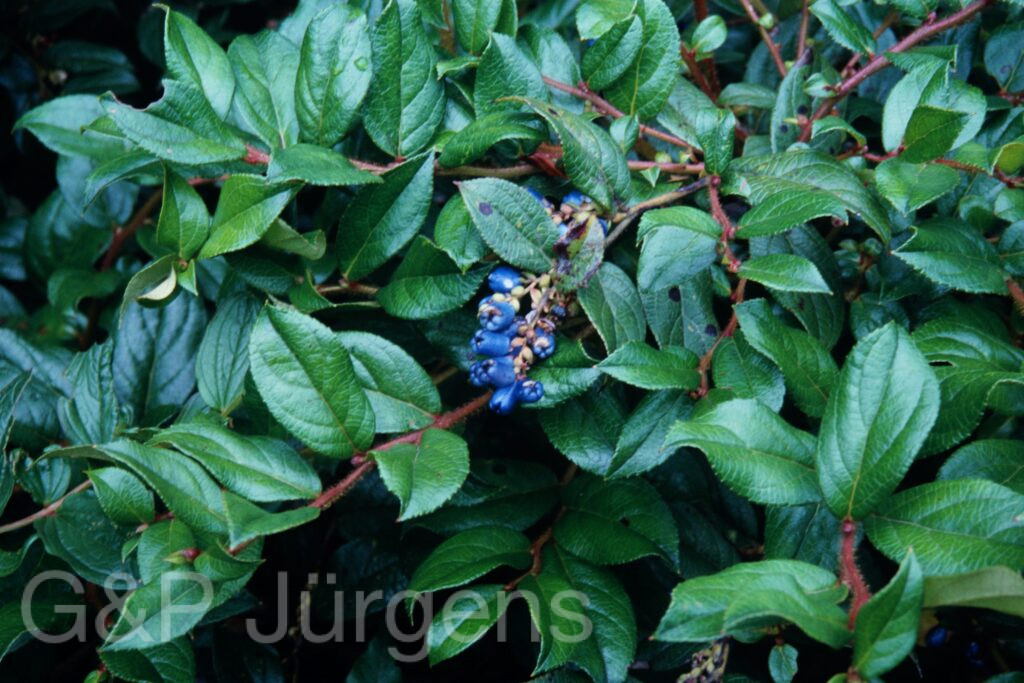
Gaultheria griffithiana is an evergreen shrub of the eastern Himalaya and Indo-Burmese mountains, distributed through Nepal, Sikkim and Darjeeling in India, Bhutan, southern China (Xizang, Yunnan), Myanmar, Laos and Vietnam, with nearly seven hundred georeferenced records. It grows in temperate broadleaved and conifer forest, on shrubby slopes, forest margins and rocky banks, often on acidic humus-rich soils. The cited collections at Trongtsa in Bhutan around 2120 m and Mewa-Khola in east Nepal at 2470 m, both flowering in April, reflect its spring anthesis in the montane forest belt.

The plant is a much-branched shrub with reddish, often bristly or glandular-setose young branchlets. The leaves are alternate, coriaceous, elliptic to oblong-lanceolate, finely serrate with gland-tipped teeth, glossy above and often with bristly hairs or glands, and aromatic when crushed. The flowers are borne in axillary racemes, each subtended by bracts; the calyx is five-lobed and the corolla is small, urceolate (urn-shaped), white to pinkish, with ten included stamens whose anthers open by terminal pores. The fruit is a small berry-like structure, the capsule being enclosed by the fleshy, accrescent calyx that turns blue-black or dark purple at maturity.

Gaultheria (Ericaceae, subfamily Vaccinioideae) is well represented in the Sino-Himalaya, and this species, named for William Griffith, belongs to the assemblage of wintergreen-scented shrubs containing methyl salicylate. The fleshy fruiting calyces are dispersed by birds, while the urceolate flowers are pollinated by bees. Locally common and ecologically widespread, the species is not regarded as threatened.

Author: Wight · Sources: POWO (Kew), GBIF, Flora of China, Flora of Bhutan, Middleton's revision of Asian Gaultheria (Ericaceae)

C.B.Clarke

Sikkim2003 409 P569
Sikkim Zemu Valley 3400m August

Description

Gaultheria hookeri is an evergreen shrub native to the eastern Himalayas and extending into southwestern China and northern Myanmar. Its range encompasses Nepal, northeast India (Sikkim, Arunachal Pradesh), Bhutan, Myanmar, and China (Yunnan, Xizang, Sichuan). The species is a characteristic element of upper temperate to subalpine forests, occurring at elevations of 2,500–4,000 m in Rhododendron-Abies forests, bamboo thickets, and along stream margins. It is well documented from the Zemu Valley in Sikkim at 3,400 m, where it can be found growing in the understorey of dense montane forests during August.
Gaultheria hookeri forms a densely branched, spreading to erect shrub 0.3–1.5 m tall. The young branchlets are setose-hispid with rusty brown hairs. The leaves are alternate, coriaceous, ovate to elliptic-ovate, 4–10 cm long, with a serrate to serrulate margin, the veins impressed above and prominent beneath. The flowers are borne in short axillary racemes; each flower has a campanulate to urceolate corolla, white to pinkish, 4–6 mm long. The calyx is five-lobed and becomes fleshy and enlarged in fruit, enclosing the capsule to form a conspicuous, globose, fleshy pseudoberry that is blue to deep purple-black at maturity, 8–12 mm in diameter.
Described by C.B. Clarke and named in honour of Sir Joseph Dalton Hooker, who extensively explored the Sikkim Himalaya, G. hookeri is one of the more robust and widely collected species in the genus across the eastern Himalayan region. With over 750 occurrence records in GBIF, it is comparatively well documented. The species is of ecological importance as a food source for montane birds and mammals that disperse its fleshy fruits. Its aromatic, wintergreen-scented foliage, rich in methyl salicylate, is occasionally used in traditional medicine. The species has also been introduced to cultivation in botanical gardens in Europe and North America.

Author: C.B.Clarke · Sources: POWO (Kew), GBIF, Flora of Bhutan Vol. 2, Flora of China Vol. 14, Hooker: Flora of British India Vol. 3 (1882)

C.Marquand

Sikkim2004 286 G499 ergebnis
Sikkim/India Dzongri 3900m May

Description

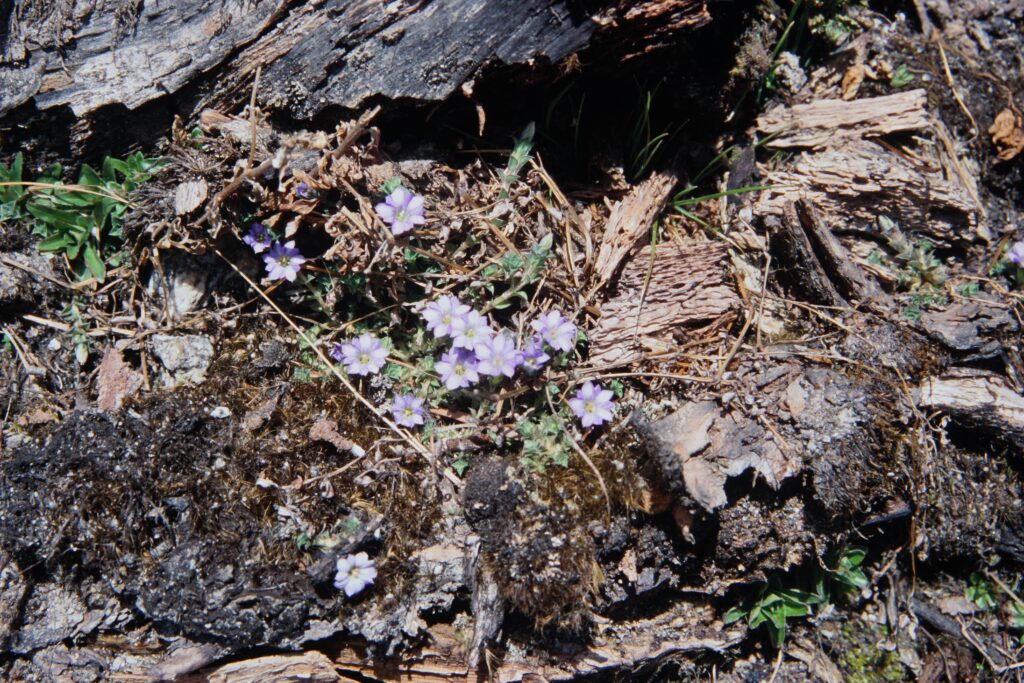
Gentiana simulatrix is an alpine gentian of the eastern Himalaya and adjacent China, with GBIF records concentrated in south-central China (Xizang, Yunnan) and Bhutan, and extending into Sikkim in the Indian Himalaya; the roughly forty-three documented occurrences indicate a localised but reasonably collected high-altitude range. It inhabits open alpine turf, moist pastures, stony slopes and seepage margins above the treeline. The illustrated plant from Dzongri in Sikkim at about 3900 m, flowering in May, exemplifies its spring-to-early-summer phenology in the upper alpine zone, where it emerges as snowmelt exposes the short-cropped sward.

The species is a small tufted perennial with a slender rootstock giving rise to numerous decumbent to ascending leafy shoots. The leaves are small, opposite, ovate to oblong and somewhat fleshy, forming dense basal and cauline pairs. The flowers are solitary and terminal or few in the upper axils; the calyx is tubular with narrow lobes, and the corolla is campanulate to narrowly funnelform, blue to deep azure with darker stripes and conspicuous plicae (folds) between the lobes. The capsule is stipitate within the persistent corolla and releases numerous small seeds.

Gentiana simulatrix belongs to the genus Gentiana (Gentianaceae) and is an accepted species, placed among the small-flowered alpine gentians of section Chondrophyllae, a critical complex where it has been confused with allied taxa such as G. prolata. Its cushion-forming habit, fused corolla plicae and protective floral folds are adaptations to the cold, windy, high-radiation alpine environment. No formal IUCN status has been published, but its dependence on intact alpine grassland makes it sensitive to overgrazing and climate-driven upslope shifts.

Author: C.Marquand · Sources: POWO (Kew), GBIF, Flora of China, Flora of Bhutan, Ho & Liu monograph of the genus Gentiana

Beauverd

Description

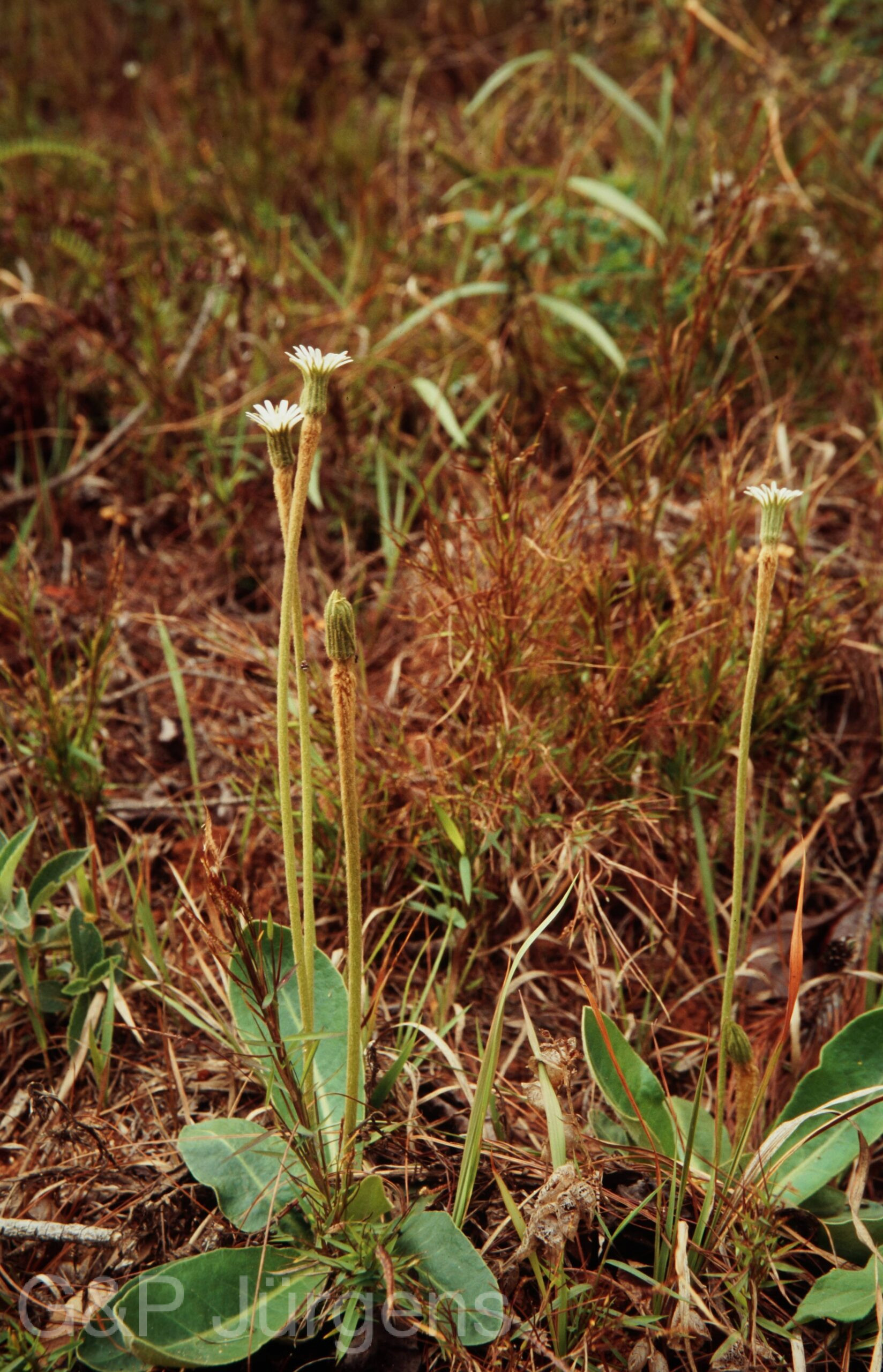
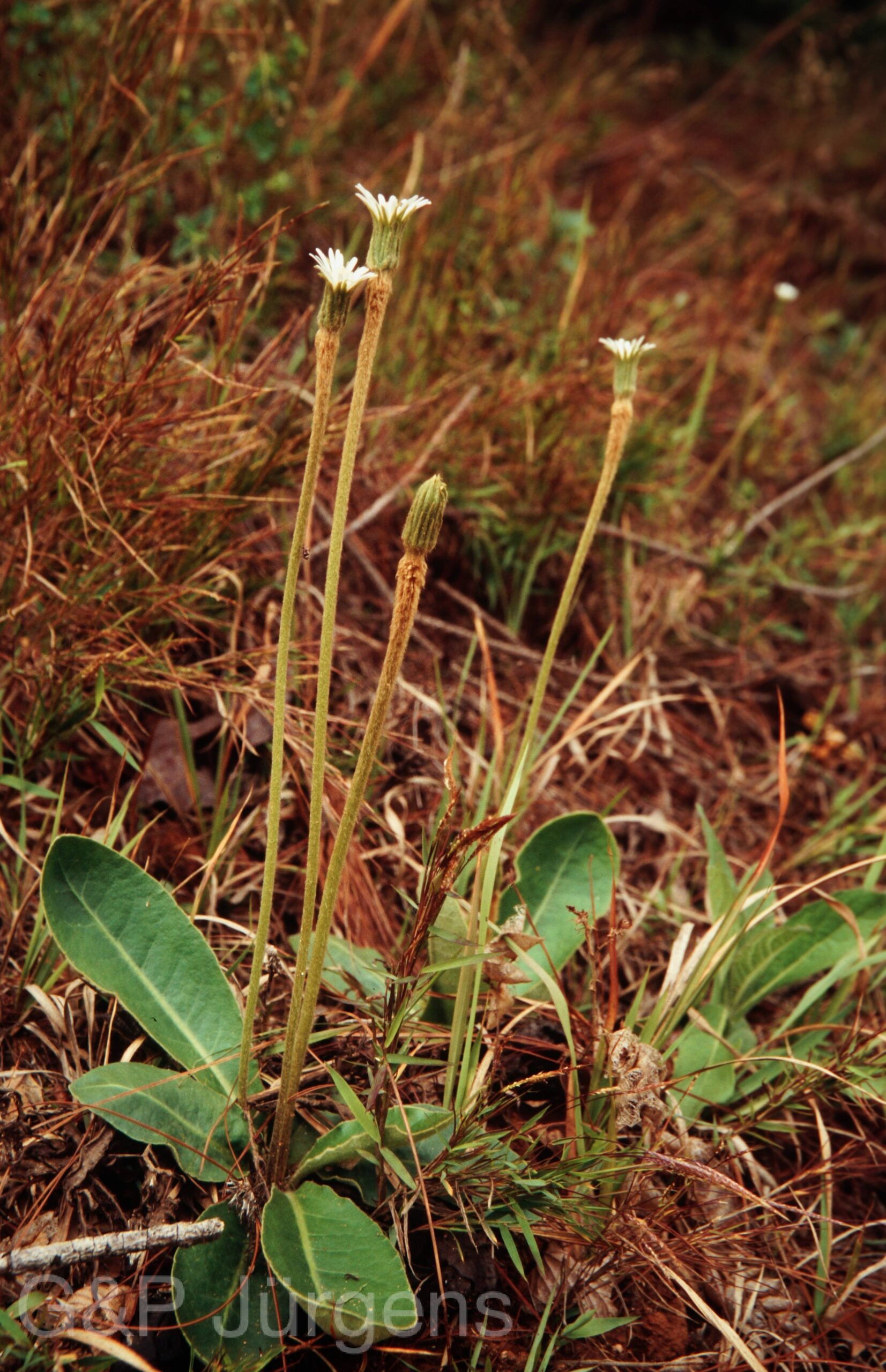
Gerbera maxima is an eastern Himalayan perennial herb distributed across Nepal, northern India, Bhutan and adjacent south-central China (Yunnan, Xizang), the modest tally of around seventeen georeferenced GBIF records reflecting its scattered occurrence rather than true rarity. It favours open grassy hillsides, forest margins, terraced banks and disturbed sunny slopes in the subtropical to lower temperate belt. The photographed plant, from the Indrawati-Khola valley in the Helambu region of central Nepal at roughly 1750 m and flowering in May, typifies its mid-montane preference for warm, well-drained, often grazed openings.

The species forms a stout caudex from which arises a basal rosette of large, lyrate-pinnatifid to broadly obovate leaves that are densely white-tomentose beneath and greener above, the margins sinuate-dentate and the petioles winged. From the rosette a leafless, woolly scape bears a solitary, comparatively large radiate capitulum. The involucral bracts are imbricate and tomentose; the ray florets are bilabiate, typically pale pink to whitish or yellowish, surrounding numerous tubular disc florets. The fruit is a slender, ribbed cypsela tapering into a beak and crowned by a pappus of barbellate bristles, adapted to wind dispersal.

Gerbera (Asteraceae, tribe Mutisieae) is an Old World genus centred on Africa and Asia, and G. maxima is here treated as the accepted name. The two-lipped ray corollas place it within the mutisioid lineage, and its tomentose indumentum is a xeromorphic adaptation to insolated, seasonally dry montane slopes. No formal conservation assessment exists; its tolerance of grazing and disturbance suggests local resilience, though habitat conversion across the mid-hills warrants monitoring.

Author: Beauverd · Sources: POWO (Kew), GBIF, Flora of China, Annotated Checklist of the Flowering Plants of Nepal, Hand-Mazzetti revision of Asian Gerbera (Mutisieae monograph)