
DC.
Description
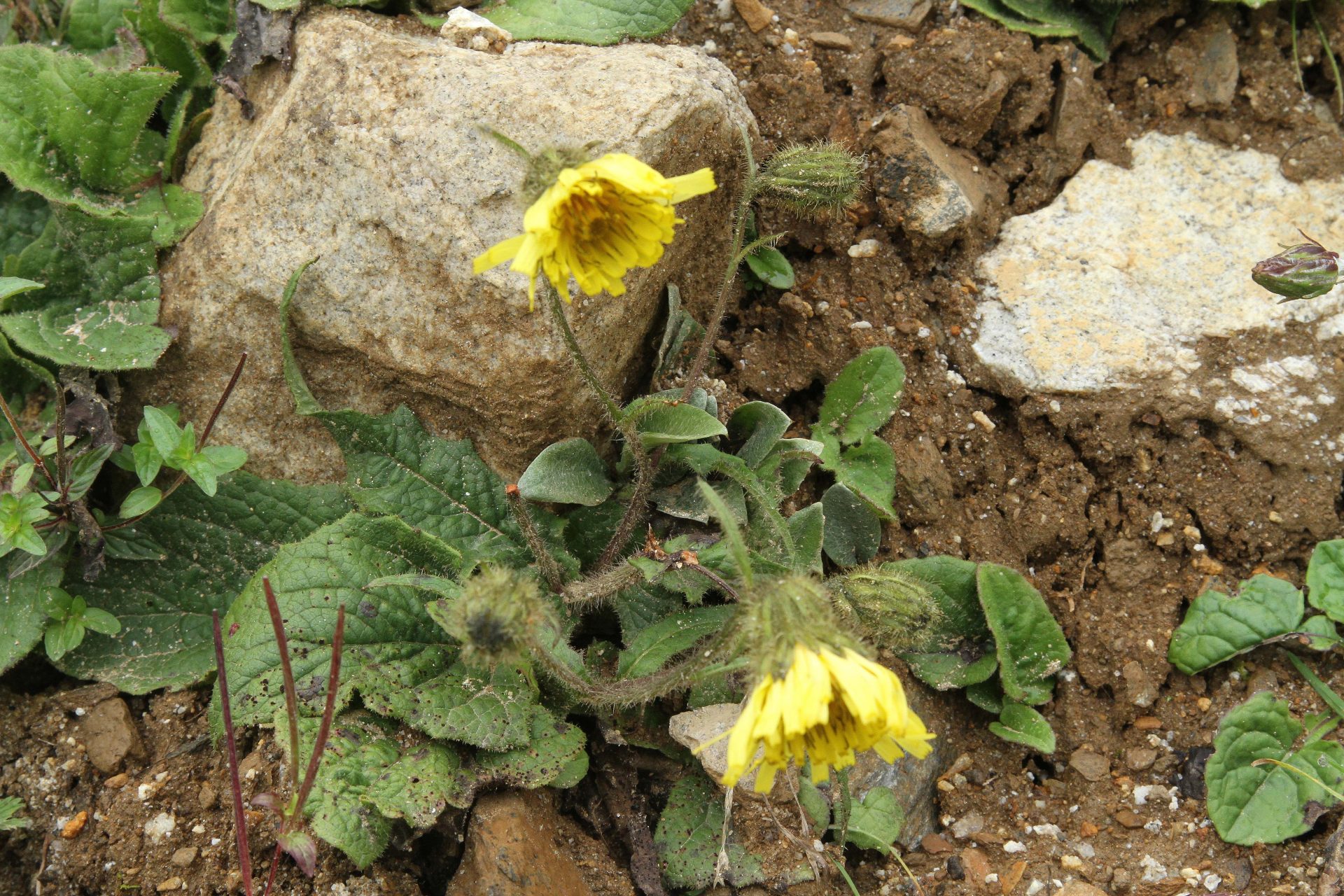
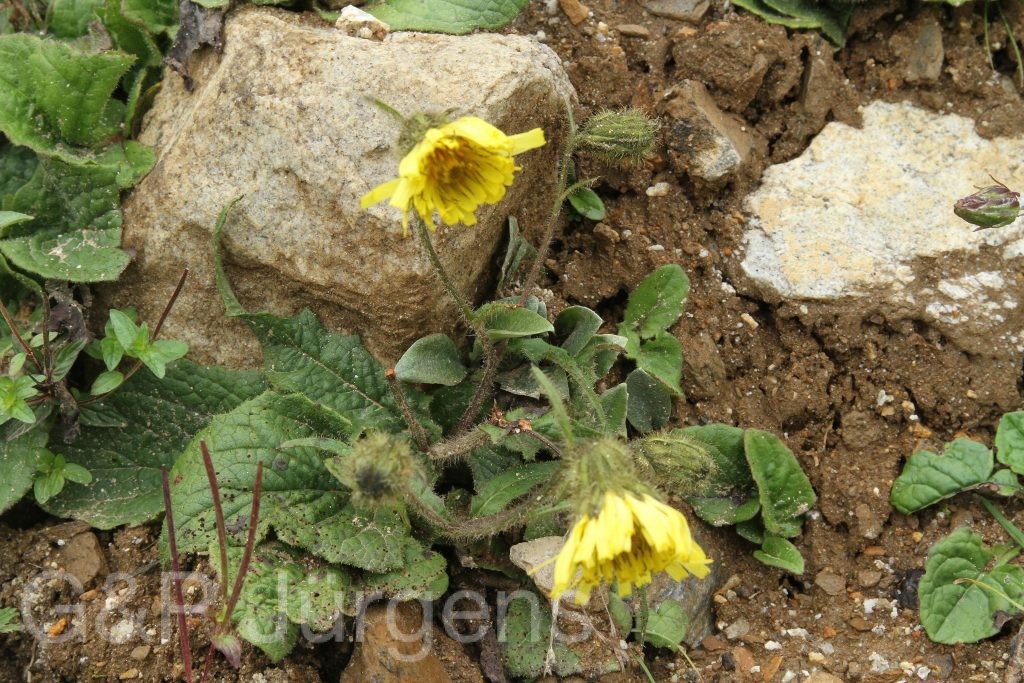
Dubyaea hispida is an alpine member of the lettuce tribe (Cichorieae) ranging across the eastern and central Himalaya into south-western China, with reliable records from Nepal, India, Bhutan, Myanmar, Pakistan and China (Xizang, Yunnan, Sichuan); extra-regional points in Austria and Great Britain among the 544 occurrences represent cultivated or misattributed material rather than native range. It grows in moist alpine meadows, scrub margins, rocky slopes and streamsides, typically between about 3000 and 4300 m. The plant figured from the Shele-La pass in Bhutan at roughly 4000 m in September reflects its characteristic late-season flowering in cool, humid high-mountain habitats.
The species is a perennial herb with a short rhizome and erect, hispid stems clothed, like the peduncles and involucres, in spreading blackish or purplish multicellular hairs. The leaves are thin, oblong to lyrate-pinnatifid, with a large terminal lobe and a winged, amplexicaul petiole base; the upper leaves are reduced. The capitula are several, nodding in a loose corymb, with an involucre of imbricate, hispid phyllaries. The florets are all ligulate and yellow, as in the milky-juiced Cichorieae. The cypselae are narrowly fusiform, ribbed and slightly narrowed above, bearing a pappus of soft, white, finely barbellate bristles.
Dubyaea is a small Sino-Himalayan genus of perhaps a dozen species centred on the eastern Himalaya and Hengduan Shan, segregated from the related Crepis and Soroseris by its nodding heads, dark-hispid indumentum and distinctive achene and pappus characters. The nodding capitula and abundant glandular-setose vestiture are adaptations to wet alpine conditions, sheltering florets from rain. As a widespread high-elevation species across multiple countries, D. hispida is not considered threatened, although it is naturally restricted to the narrow alpine belt.
Author: DC. · Sources: POWO (Kew), GBIF, Flora of China Vol. 20-21, Flora of Bhutan, Flora of Nepal, Stebbins Cichorieae of the Himalaya