
Hook.f. & Thomson
Description
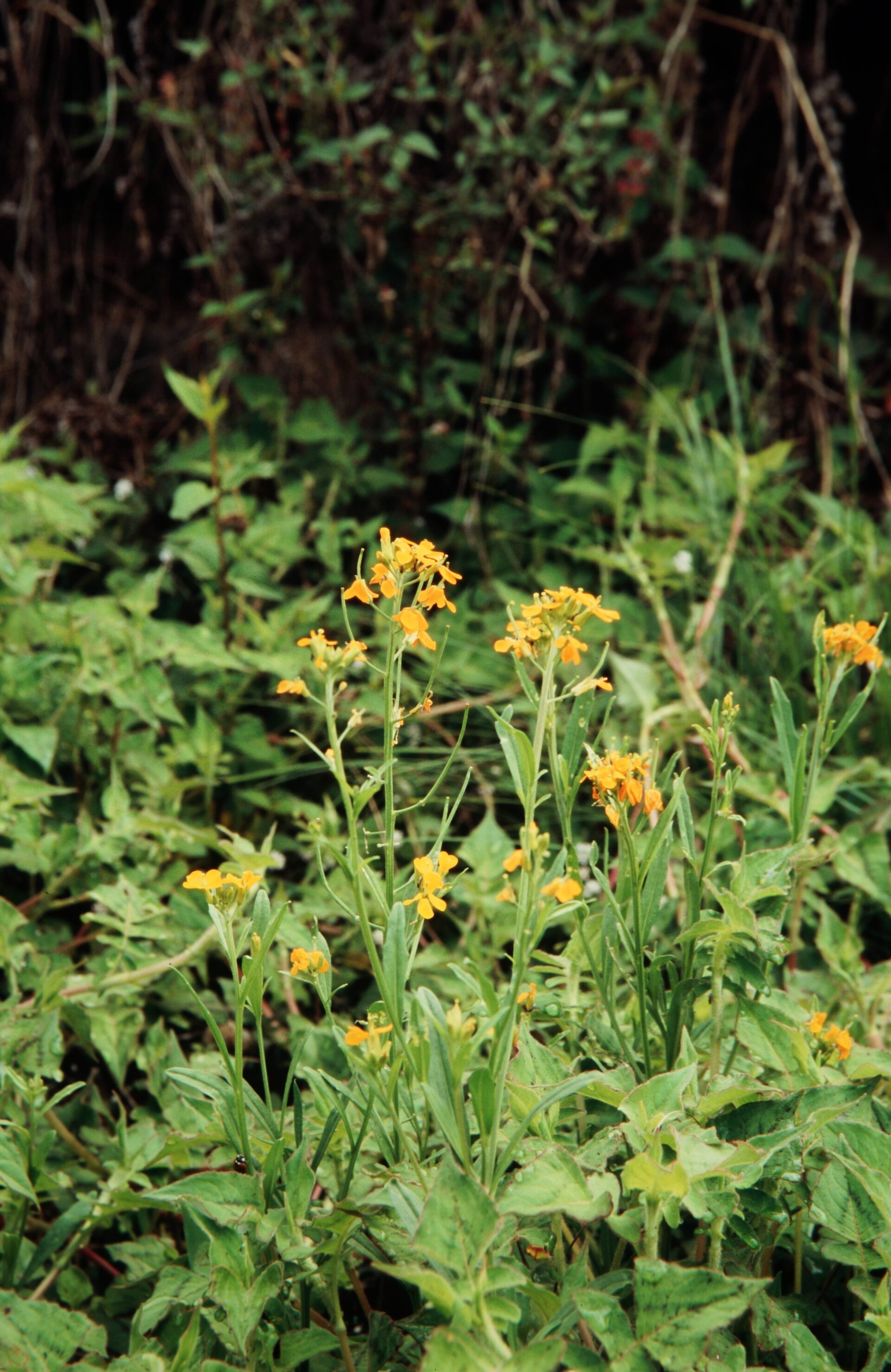
Erysimum pachycarpum is a Himalayan wallflower distributed across Nepal, Bhutan, northern India, and extending into southwestern China (Tibet, Yunnan). GBIF documents 39 occurrences from these countries. The species inhabits dry rocky slopes, open scrubland, disturbed ground along trails, and stony riverbanks in the warm to cool temperate zone, at elevations from approximately 1,800 to 3,500 m. The photograph from Samthang in Nepal at 2,410 m, taken in May, shows the species at a mid-elevation site during its spring flowering period.
The plant is a biennial or short-lived perennial herb, 20–60 cm tall, with erect, usually unbranched stems covered in appressed, medifixed (malpighian) trichomes characteristic of the genus. Basal leaves are oblanceolate, 3–8 cm long, with entire to sinuate-dentate margins, forming a rosette that may wither at flowering; cauline leaves are narrowly lanceolate, sessile, progressively smaller upward. The inflorescence is a dense, terminal raceme that elongates considerably in fruit. Flowers are tetramerous with yellow petals, 8–12 mm long, spatulate, clawed. Stamens six, tetradynamous. The silique is stout and thick-walled — hence the epithet pachycarpum (thick-fruited) — erect to slightly spreading, 3–6 cm long, quadrangular in cross-section, densely covered with appressed trichomes. Seeds are oblong, narrowly winged.
Erysimum pachycarpum is distinguished from other Himalayan Erysimum species primarily by its robust, thickened siliques and relatively large flowers. The genus Erysimum is taxonomically challenging due to frequent hybridisation and subtle morphological boundaries between species, and molecular studies are ongoing to resolve relationships within the Himalayan clade. The species is not currently assessed as threatened and appears locally common in suitable open, dry habitats across its range.
Author: Hook.f. & Thomson · Sources: POWO (Kew), GBIF, Flora of China Vol. 8, Grierson & Long: Flora of Bhutan Vol. 1