Tag:

Yunnan

Flowers of Yunnan — 68 species from the mountains of Yunnan in southwest China, part of the Hengduan and eastern Himalayan biodiversity hotspot renowned worldwide for its rhododendrons, primulas and gentians. This region is one of the great cradles of temperate plant diversity. Each species page provides a botanical description, distribution, habitat and flowering time with the original photograph.

Lindl.

Bhutan2012 689
Bhutan Galephu 850m, September

Description

Calanthe biloba is a terrestrial orchid native to the eastern Himalayas and adjacent regions, occurring in northeast India (Sikkim, Assam, Meghalaya), Bhutan, Nepal, southwest China (Yunnan), and northern Vietnam. It grows in the understory of warm, humid broadleaved forests and along shaded stream banks at 500–1,500 m elevation, in well-drained, humus-rich soils.

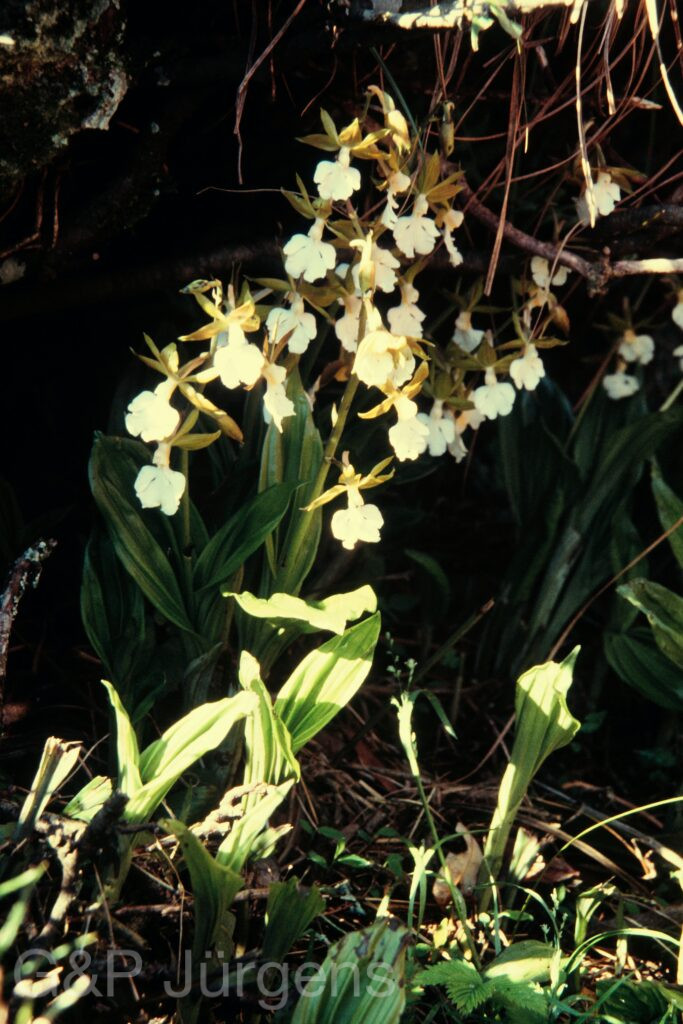
The plant produces prominent, conical pseudobulbs partially enclosed by the persistent leaf bases. The leaves are large, 30–50 cm long, broadly elliptic to obovate, plicate (folded lengthwise), and deciduous in the dry season. The inflorescence is an erect, pubescent raceme 30–60 cm tall, bearing 10–20 flowers. Flowers are 2.5–3.5 cm across, white to pale yellow. The lip is conspicuously bilobed (as the specific epithet indicates), with two diverging apical lobes, and bears a yellow callus of raised lamellae. The spur is slender, 1.5–2 cm long. Flowering occurs from August to October.

Calanthe biloba belongs to the deciduous group of Calanthe (subgenus Preptanthe), which shed their leaves before or during flowering. The relatively low elevation of the collecting locality at Galephu (850 m) reflects southern Bhutan's subtropical climate, where several thermophilic orchid species reach their northern distributional limit.

Author: Lindl. · Sources: POWO (Kew), Flora of Bhutan Vol. 3, GBIF, Pearce & Cribb: The Orchids of Bhutan (2002)
Lindl.

Nepal 97 299 P600
Nepal new Clepua 2370m May
Nepal 97 301 G602
Nepal new Clepua 2370m May
Nepal 2001 147 ergebnis ergebnis
East-Nepal Bhalukhop 2520m, April

Description

Calanthe chloroleuca is a terrestrial orchid of restricted distribution in the eastern Himalayas, known from Nepal, northeast India (Sikkim), Bhutan, and southwest China (Yunnan). With fewer than 20 documented occurrences in GBIF, it is one of the rarer Calanthe species in the region. The species grows in moist, shaded forest understory, on humus-rich soils among leaf litter, at elevations of 2,000–3,000 m.

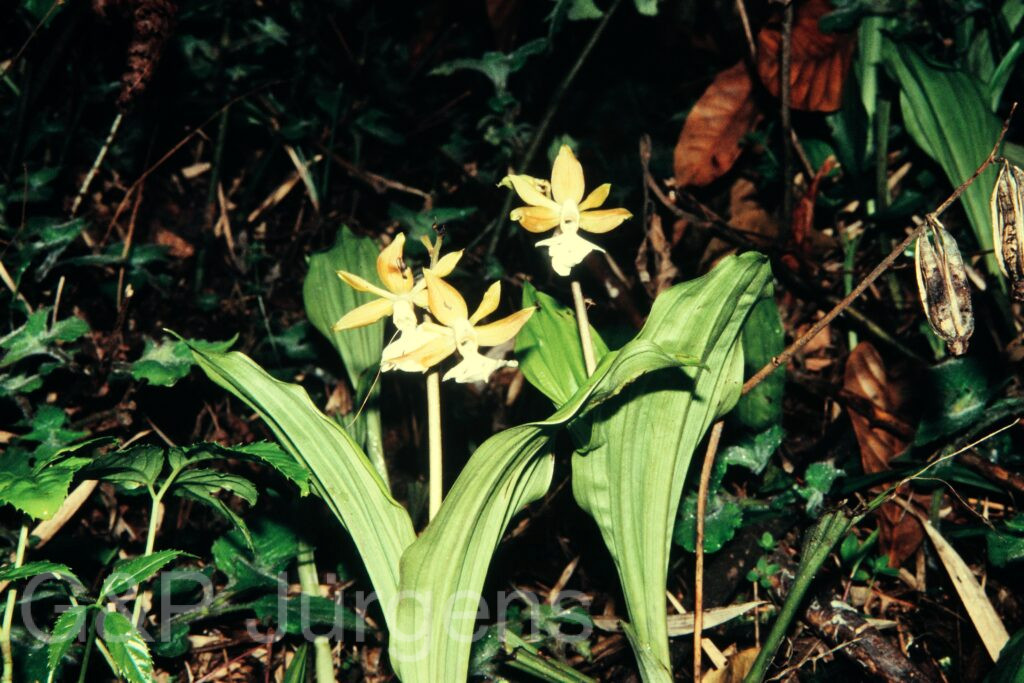
The plant is an evergreen species with reduced pseudobulbs hidden by leaf bases. It produces 3–5 elliptic, plicate leaves 15–25 cm long. The inflorescence is an erect raceme 20–40 cm tall, carrying 8–15 flowers. The name 'chloroleuca' derives from Greek chloros (green) and leukos (white), accurately describing the flower coloration: sepals and petals are greenish-white, and the lip is white with a greenish or yellowish tinge, trilobed, with low, parallel keels on the disc. The spur is slender, 1–1.5 cm long, slightly curved. Flowering occurs from April to May.

Calanthe chloroleuca is easily confused with the similarly coloured C. brevicornu, from which it differs in its longer spur, narrower lip lobes, and more elongated floral bracts. Its rarity in herbarium collections may partly reflect the difficulty of distinguishing it from congeners in the field.

Author: Lindl. · Sources: POWO (Kew), Flora of Nepal Checklist, GBIF, Flora of Bhutan Vol. 3

Hook.f.

Bhutan2014 804
Bhutan Mo-Chu 1600m, May
Bh2008 463 G724
Bhutan, Samtengang 1950m, May

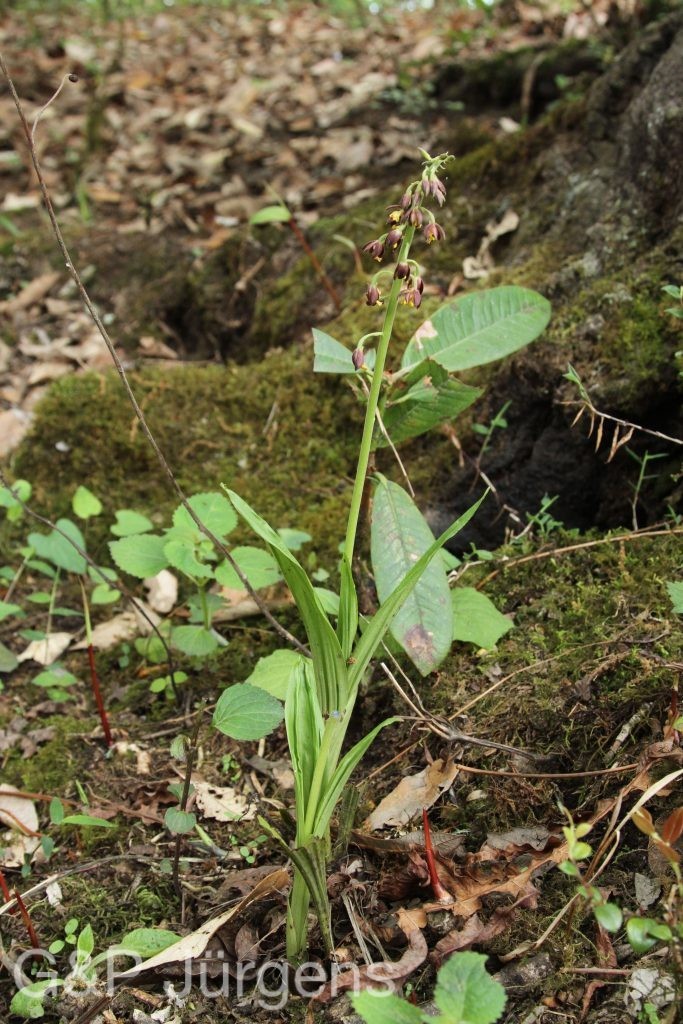
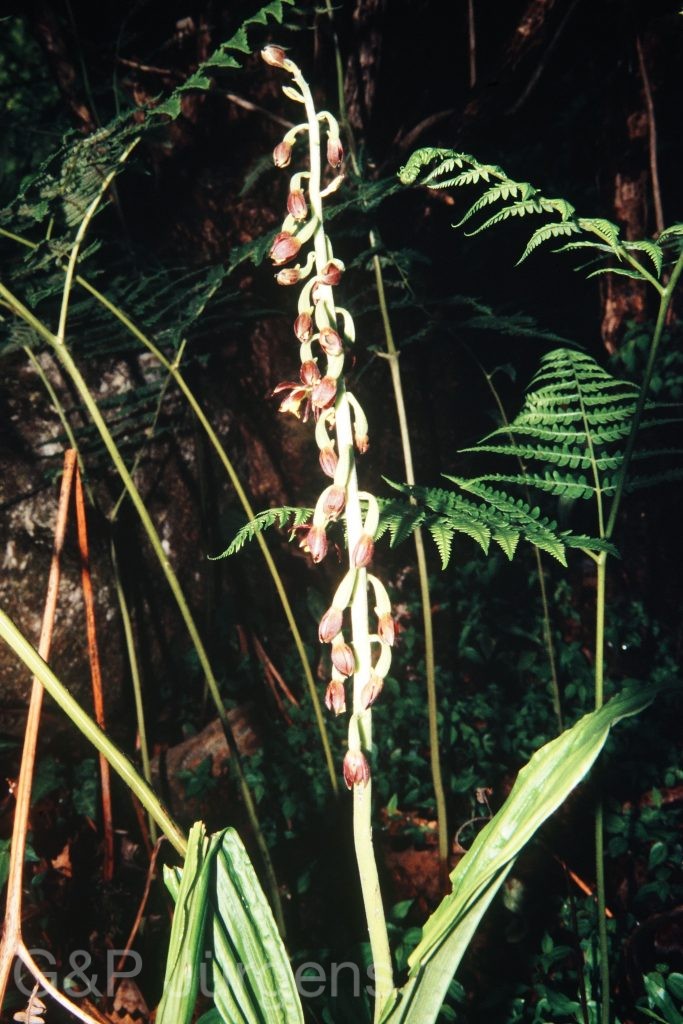
Description

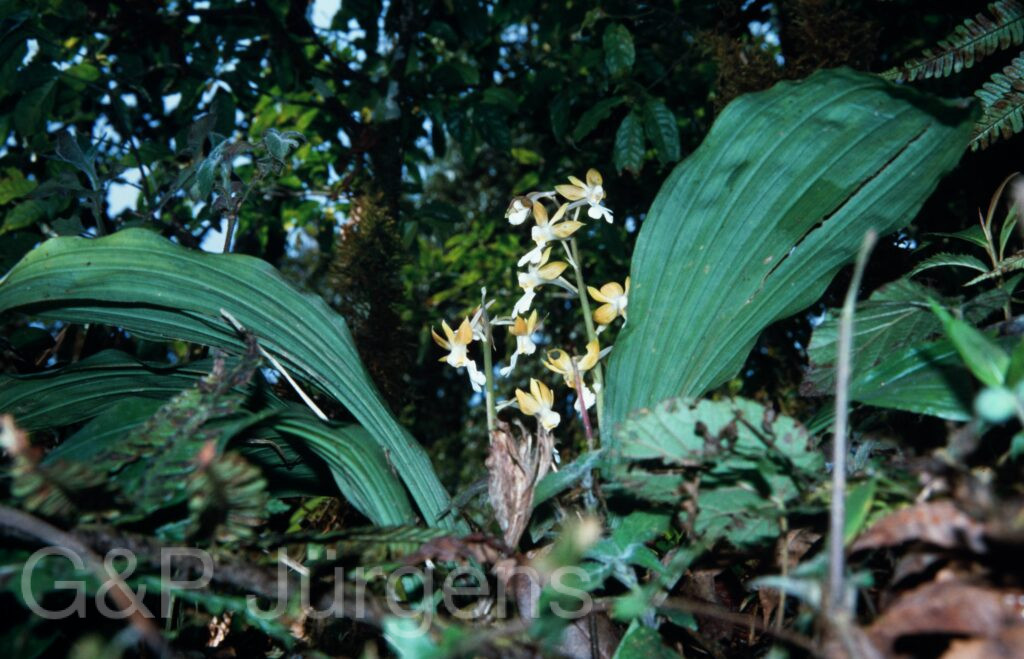
Calanthe mannii is a terrestrial orchid distributed across the eastern Himalayas and East Asia, from Nepal and northeast India through Bhutan, Myanmar, southern China (Yunnan, Guizhou, Guangxi), to Japan (Ryukyu Islands). GBIF records nearly 100 occurrences across this range. The species grows in warm to temperate broadleaved forests, often along streams and in ravines with rich humus soil, at elevations of 1,000–2,500 m.

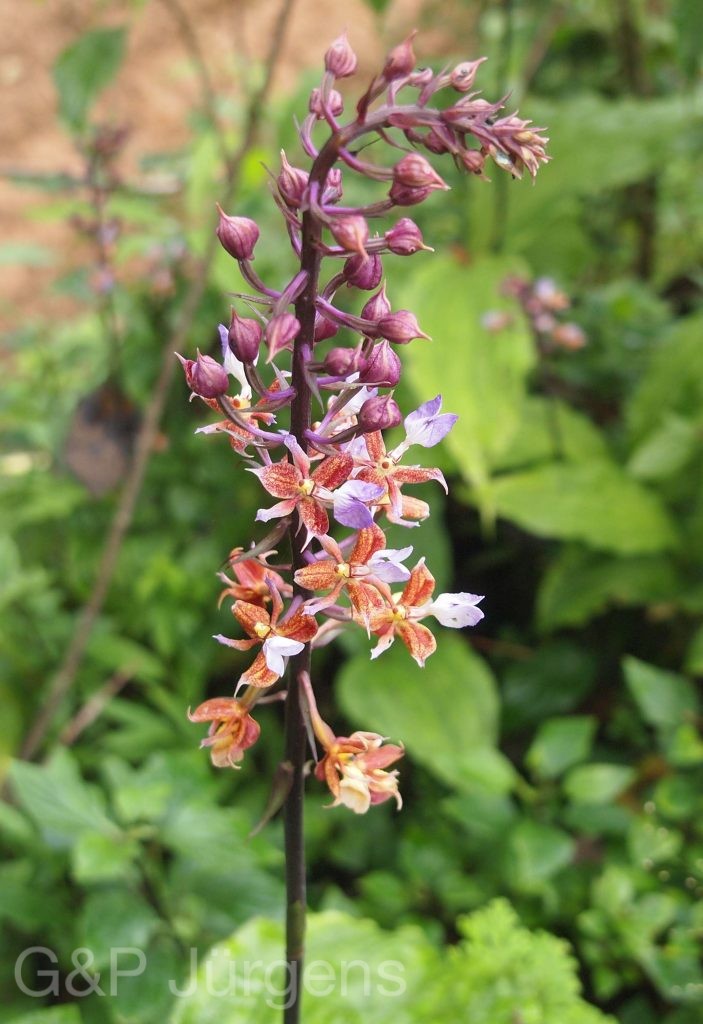
The plant is an evergreen Calanthe producing narrow, conical pseudobulbs partially enclosed by leaf sheaths. Leaves are 3–5, elliptic-lanceolate, 20–40 cm long, plicate, with prominent veins. The inflorescence is an erect, densely many-flowered raceme 30–50 cm tall, bearing 15–30 flowers. Flowers are 2–2.5 cm across, with a distinctive colour combination: the sepals and petals are yellowish-brown to olive-green, while the lip is pale, trilobed, with the mid-lobe deeply bilobed and a prominent yellow callus. The spur is curved, 8–12 mm long. Flowering occurs from April to June.

Calanthe mannii is named after Gustav Mann (1836–1916), the German-born botanical collector who worked in northeast India. The species is distinguished from the similar C. puberula by its more densely flowered raceme and different lip morphology. Its presence in both subtropical (Mo-Chu valley, 1,600 m) and temperate zones in Bhutan indicates broad ecological tolerance.

Author: Hook.f. · Sources: POWO (Kew), Flora of Bhutan Vol. 3, GBIF, Flora of China Vol. 25, Pearce & Cribb: The Orchids of Bhutan (2002)
(Wall.) Makino

Garh 07 234 ergebnis
India Garwahl Trijugi Narayan 2250m, June
Sikkim 2006 469 ergebnis
Sikkim Ringi Chu 2200, May
Sikkim 2006 471 ergebnis
Sikkim Ringi Chu 2200, May

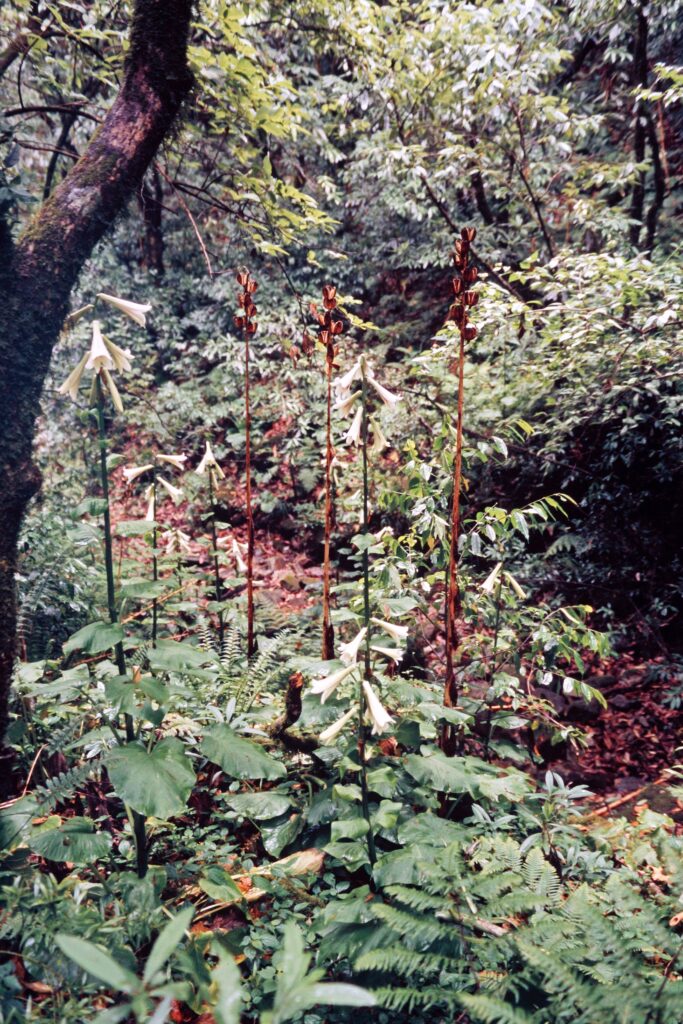
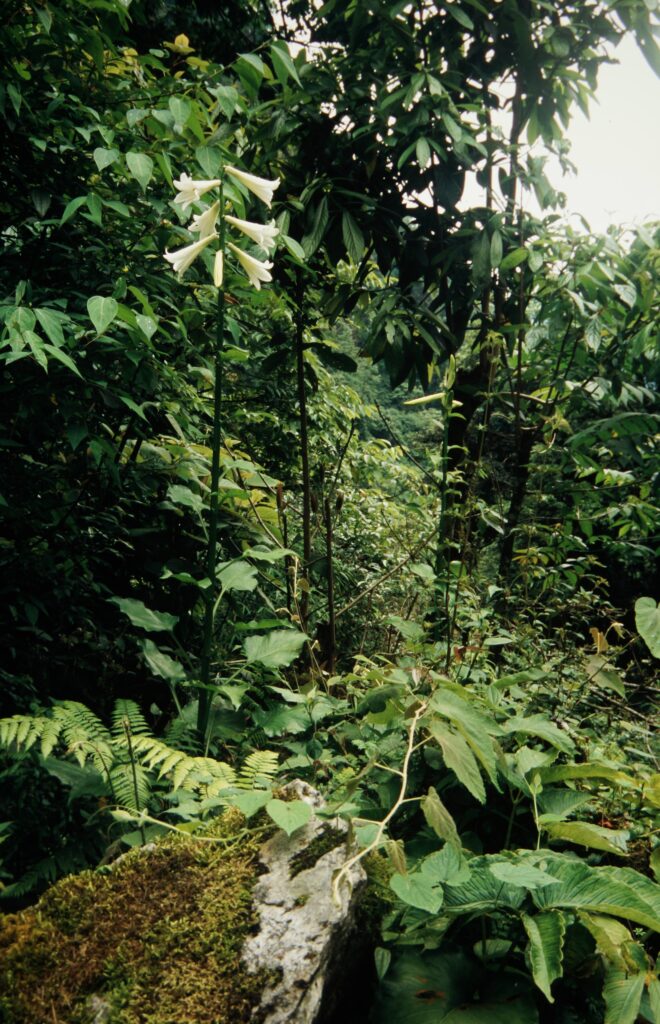
Description

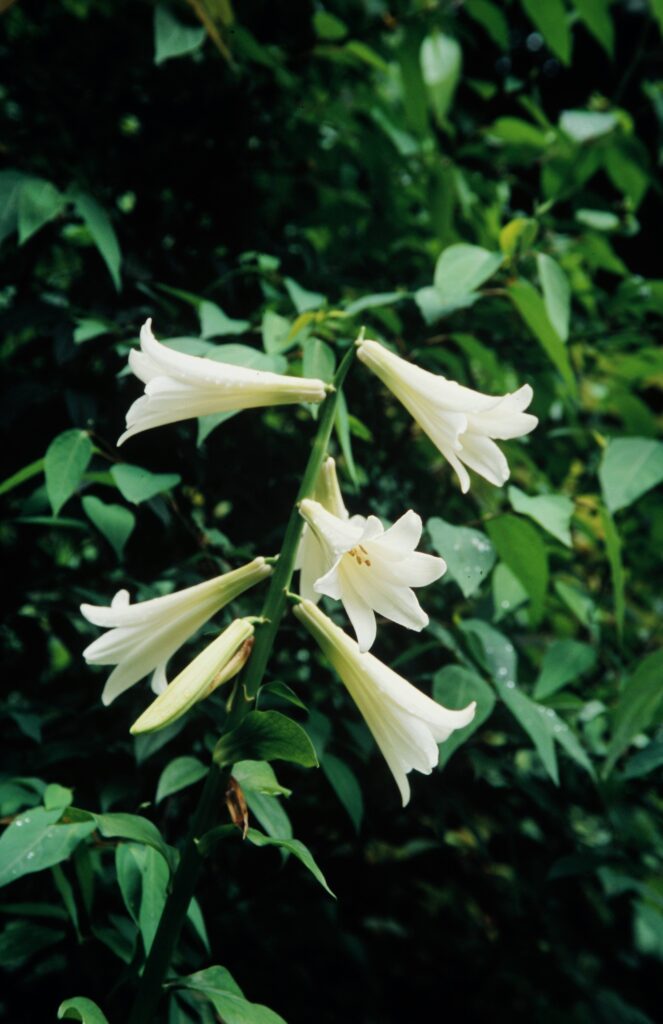
Cardiocrinum giganteum is the world's largest lily, distributed from central Nepal through Sikkim, Bhutan, and northeast India into upper Myanmar and southwestern China (Yunnan, Sichuan, Xizang). With over 1,370 occurrences recorded on GBIF, it is well-documented across its range. The species inhabits moist, shaded ravines and openings in temperate broadleaved and mixed forests at elevations of 1,500–2,800 m, favouring deep, humus-rich soils under canopies of Magnolia, Acer, and Rhododendron.
Cardiocrinum giganteum is a monocarpic perennial growing from a large, conical bulb up to 15 cm in diameter. In its final flowering year, the plant produces a stout, hollow stem reaching 1.5–3.5 m in height. Basal leaves are broadly cordate, glossy dark green, up to 45 cm long, with a conspicuous reticulate venation. The inflorescence is a terminal raceme of 10–20 large, trumpet-shaped, fragrant flowers, each 15–20 cm long, white with maroon-purple streaking inside the throat. The six tepals are slightly recurved at the tips. The fruit is an oblong, erect capsule, 4–6 cm long, containing numerous flat, winged seeds adapted for wind dispersal. After flowering and fruiting, the parent bulb dies, but several daughter bulblets persist at the base, requiring 5–7 years to reach flowering size.
The species was first described from material collected by Nathaniel Wallich in Nepal. The photographed specimens from Trijugi Narayan in Garhwal (2,250 m) and Ringi Chu in Sikkim (2,200 m) represent populations near the western and central portions of the range, respectively. Though widely cultivated in temperate gardens, wild populations face pressure from habitat fragmentation and collection. The var. yunnanense, sometimes recognized from southwestern China, differs in its bronze-flushed foliage, but its taxonomic distinctness remains debated.

Author: (Wall.) Makino · Sources: POWO (Kew), GBIF, Flora of China Vol. 24, Flora of Bhutan Vol. 3, Grierson & Long (1983)

(Hook.f.) Petr.

Bhutan2012 65
Bhutan Shele-La, 3900m September

Description

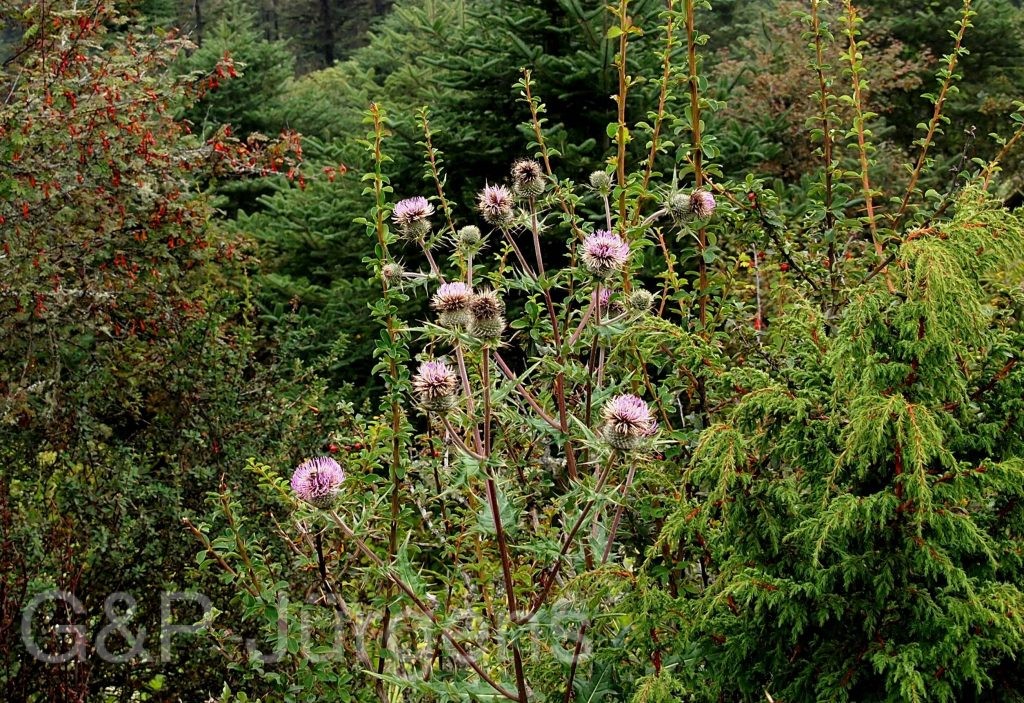
Cirsium falconeri is a robust subalpine to alpine thistle distributed along the Himalaya and adjacent ranges, recorded from Pakistan, India, Nepal, Bhutan, Myanmar and south-western China (Xizang, Yunnan), with some 207 georeferenced occurrences documenting its broad east-to-west arc. It favours open grassy hillsides, forest margins, moist meadows and disturbed slopes between roughly 2700 and 4300 m, where it forms scattered stands among tall-herb communities. The photographed plant from the Shele-La pass in Bhutan at about 3900 m in September typifies its preference for cool, humid high-altitude grasslands flowering toward the end of the monsoon.

The species is a stout biennial or short-lived perennial herb 0.6–2 m tall, with erect, longitudinally ribbed, often arachnoid-tomentose stems arising from a thickened taproot. The leaves are large, pinnatifid to pinnatisect, glabrescent to thinly cottony above and grey-tomentose beneath, with the lobes spiny-margined and the stem-leaves decurrent or amplexicaul. The capitula are large, hemispheric and usually nodding, solitary or few, subtended by reduced spiny floral leaves; the involucral bracts are linear-lanceolate and spinescent. Florets are numerous, tubular and purple to pinkish-red. The cypselae are oblong and glabrous, crowned by a copious pappus of plumose, basally connate bristles aiding wind dispersal.

Within Cirsium, a large Holarctic genus of spiny-leaved thistles, C. falconeri belongs to the Himalayan assemblage of stout nodding-headed species and was originally described under Cnicus before transfer to Cirsium. The nodding capitula are interpreted as protecting pollen and developing achenes from monsoon rain, while the nectar-rich heads attract bumblebees and other long-tongued alpine pollinators. The species remains widespread and locally common and is of no recognised conservation concern, though high-elevation grazing locally affects populations.

Author: (Hook.f.) Petr. · Sources: POWO (Kew), GBIF, Flora of China Vol. 20-21, Flora of Bhutan, Flora of Nepal, Kitamura Compositae of the Himalaya

(Franch.) Prain

Bhutan2014 67 ergebnis
Bhutan Tashigang 1500m, May
Bhutan2014 68 ergebnis
Bhutan Tashigang 1500m, May

Description

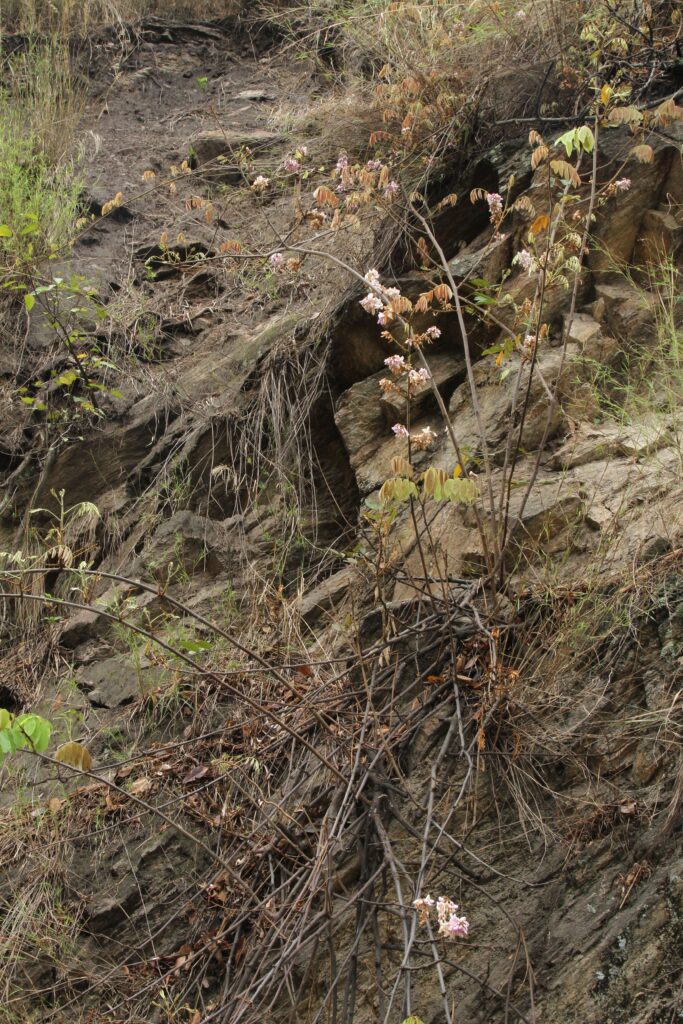
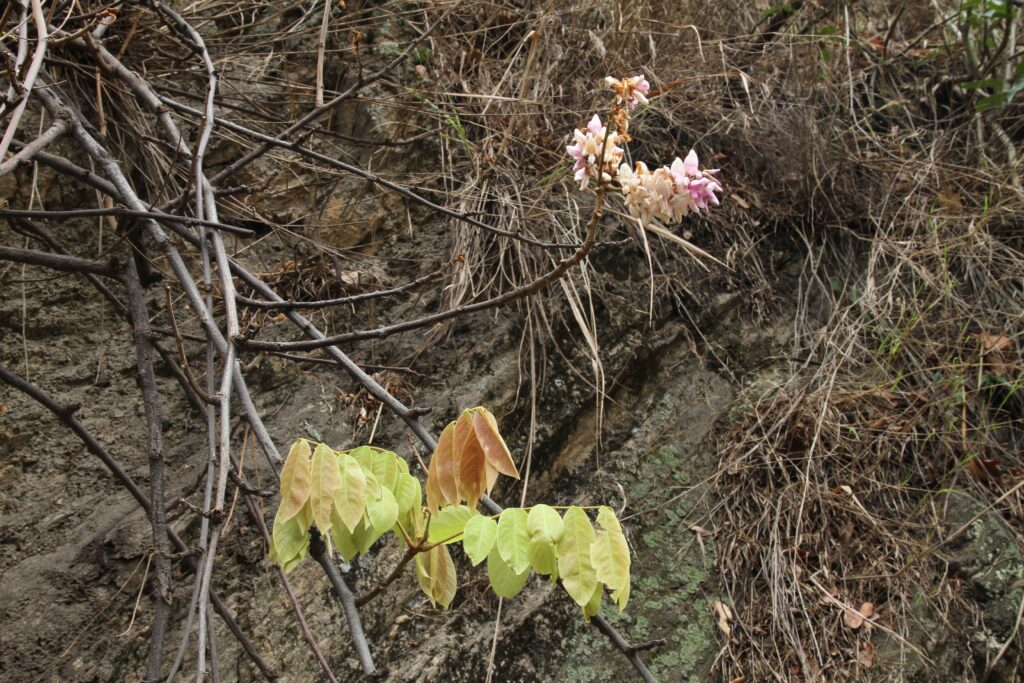
Cladrastis delavayi is a deciduous tree native to southern China (Yunnan, Sichuan, Guizhou, Guangxi) and the eastern Himalayan foothills, with records extending into Bhutan. The species occurs in warm-temperate to subtropical broadleaved forests, forest margins, and river valleys at elevations of 1,000–2,500 m, often growing on calcareous substrates. It has been documented from the Tashigang district in eastern Bhutan at 1,500 m, where it flowers in May before the onset of the summer monsoon, representing the western limit of its distribution in the Himalayan region.
Cladrastis delavayi is a medium-sized tree reaching 8–20 m in height, with a smooth, greyish bark. The leaves are alternate, imparipinnately compound, 15–30 cm long, with 9–13 leaflets that are ovate to elliptic, 4–10 cm long, papery in texture, glabrous above and sparsely pubescent beneath. The inflorescence is a terminal, erect panicle 15–30 cm long, bearing numerous papilionaceous flowers. The flowers are white to pale pink, approximately 1.5–2 cm long, fragrant, with a broadly campanulate calyx. The standard petal is reflexed and suborbicular. The fruit is a linear-oblong, flattened legume 5–10 cm long, indehiscent or tardily dehiscent, containing 1–4 seeds.
Originally described by Franchet as Sophora delavayi from material collected by Delavay in Yunnan and later transferred to Cladrastis by Prain, this species belongs to the small tribe Cladrastideae, which has a notable disjunct distribution between East Asia and eastern North America. With over 570 occurrence records in GBIF, C. delavayi is moderately well collected, though many records originate from cultivated specimens in botanical gardens in Europe, North America, and Japan. The presence of this species in Bhutan underscores the floristic affinity between eastern Bhutan and the Sino-Himalayan phytogeographic region. The tree is valued ornamentally for its attractive flowering and autumn foliage.

Author: (Franch.) Prain · Sources: POWO (Kew), GBIF, Flora of China Vol. 10, Grierson & Long: Flora of Bhutan Vol. 1 (1987), Duley & Vincent: Cladrastis (Leguminosae) Revisited (2003)

Hook.f. & Thomson

Description

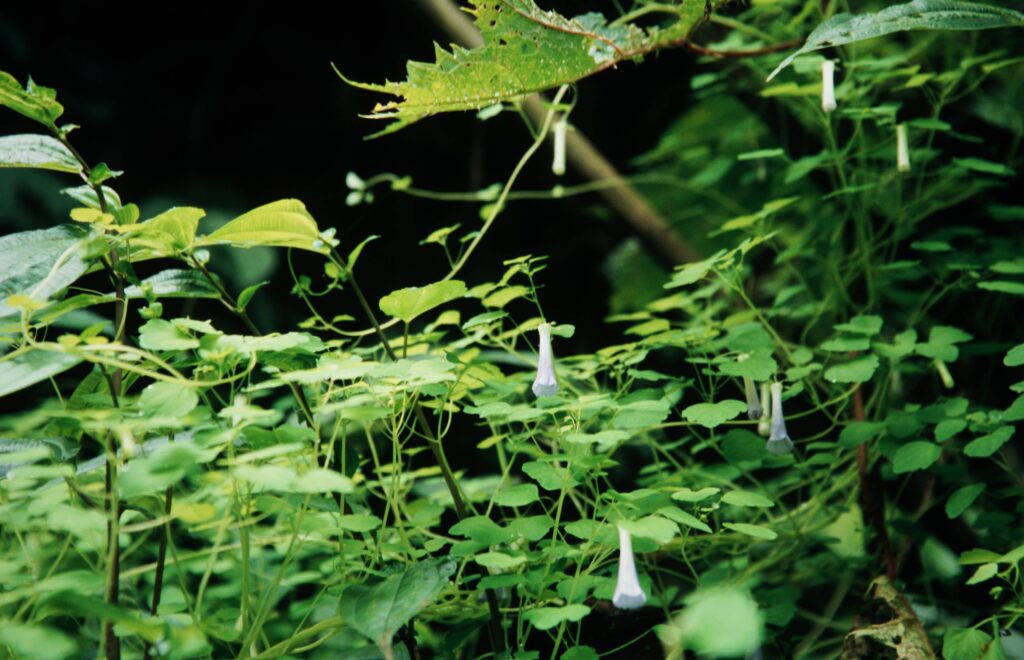
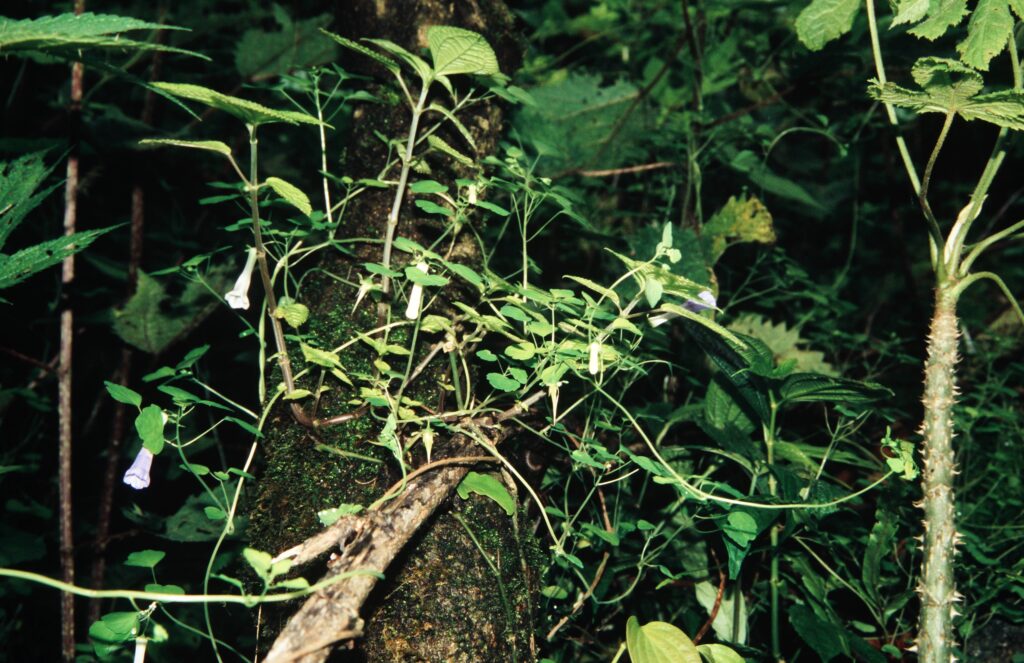
Codonopsis gracilis is a slender twining herb distributed across the eastern Himalaya and into mainland Southeast Asia and southern China. Its range extends from Nepal, Bhutan, and northeastern India (Sikkim, West Bengal, Assam, Meghalaya) through Myanmar and Vietnam to southern China (Yunnan, Sichuan, Guizhou). GBIF records 72 occurrences across these countries. The species grows in margins of subtropical and warm temperate broadleaved forests, thickets, hedgerows, and along streams, at elevations of 1,200–2,800 m. The photograph from Ruigi-Chu in West Bengal at 1,850 m, taken in May, shows the species at a mid-elevation site in the Sikkim-Darjeeling region during the early monsoon flowering period.
The plant is a perennial twining herb arising from a slender, fusiform or cylindrical root. Stems are slender, glabrous or sparsely pubescent, extensively twining through surrounding vegetation, reaching 1–3 m. Leaves are alternate or opposite on lower stems, ovate to broadly ovate, 2–5 cm long, with crenate to serrate margins, sparsely hairy above, paler beneath. Flowers are solitary, axillary, pendulous on slender pedicels. The calyx lobes are five, lanceolate to ovate, spreading. The corolla is broadly campanulate, 15–25 mm long, pale blue to lilac with darker purple veins and markings inside, particularly prominent reticulate venation in the throat. Stamens five, free; the ovary is semi-inferior. The fruit is a broadly conical capsule, dehiscing by apical valves.
Codonopsis gracilis is distinguished from congeners by its relatively small, delicate habit and slender roots, lacking the thick, fleshy taproots prized in traditional medicine that characterize species such as C. pilosula and C. tangshen. The genus Codonopsis comprises approximately 40 species centred on the Sino-Himalayan region, and molecular phylogenetic studies have confirmed its placement within Campanulaceae sensu lato. C. gracilis is not currently considered threatened and remains locally frequent in forest margins across its wide range.

Author: Hook.f. & Thomson · Sources: POWO (Kew), GBIF, Hong & Lammers: Campanulaceae in Flora of China Vol. 19, Grierson & Long: Flora of Bhutan Vol. 2

(D.Don) C.Norman

Nepal 99 273 ergebnis
West-Nepal Loccu 3800m, June

Description

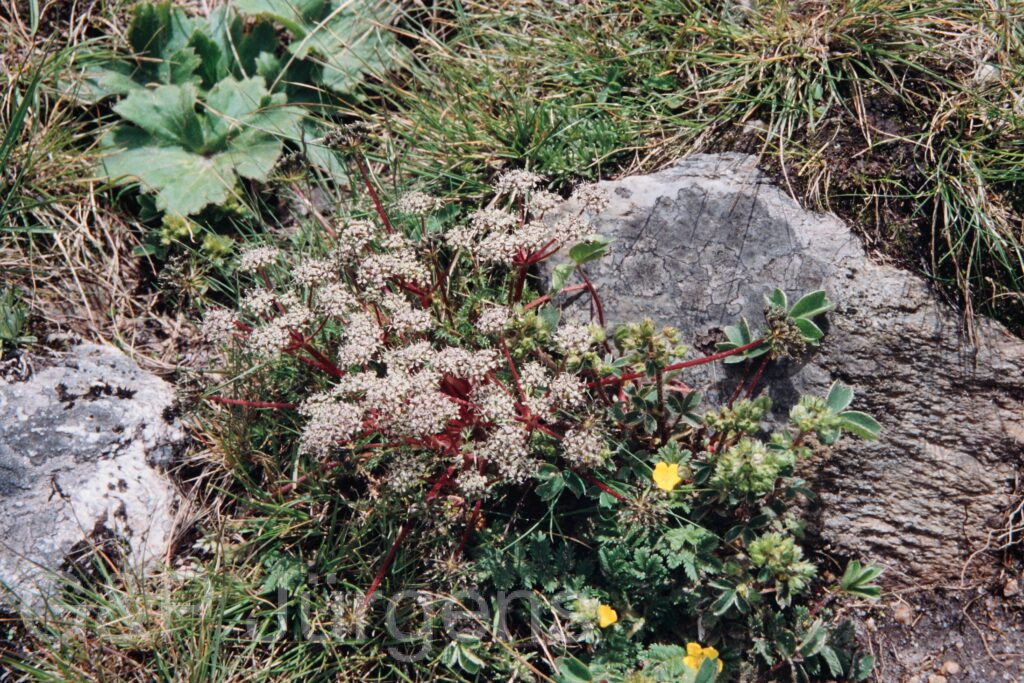
Cortia depressa is a cushion-forming alpine umbellifer distributed from Nepal through Sikkim, Bhutan, and northeast India into upper Myanmar and southwestern China (Yunnan, Xizang). GBIF records 284 occurrences, indicating a moderately well-collected species. It is characteristic of high-altitude open habitats including alpine meadows, rocky screes, dry turf, and exposed ridgetops at elevations of 3,200–4,800 m. The species is well adapted to the extreme conditions of the alpine zone, where it tolerates intense solar radiation, frost, and wind exposure by maintaining an extremely compact growth form pressed close to the substrate.
Cortia depressa is a dwarf, depressed-caespitose, perennial herb arising from a stout, woody taproot. The entire plant is typically only 2–5 cm tall, forming dense rosettes or low mats. Leaves are pinnately or bipinnately dissected into small, crowded, linear segments, 1–3 cm long, with sheathing petiolar bases that are often purple-tinged and somewhat scarious. The inflorescence is a simple or compound umbel, sessile or on very short peduncles barely exceeding the foliage. Umbellules are compact, with minute, white to pinkish flowers, 1–2 mm across, each with five petals and five stamens. The involucral and involucellar bracts are conspicuous relative to the diminutive plant. The fruit is a compressed, ellipsoid cremocarp, 3–5 mm long, with prominent dorsal ridges and well-developed vittae.
The photographed specimen from Loccu in western Nepal at 3,800 m in June documents an early-monsoon flowering occurrence, consistent with the brief alpine growing season. Cortia is a small genus of five to eight species endemic to the Sino-Himalayan region, and C. depressa is the most widespread member. It is distinguished from the related C. lindleyi by its more strongly depressed habit and sessile to subsessile umbels. The species exemplifies morphological adaptations to alpine environments — dwarfism, dense pubescence, and compact rosette architecture — that minimize heat and water loss. It serves as an indicator species for well-preserved alpine turf communities across the Himalayas.

Author: (D.Don) C.Norman · Sources: POWO (Kew), GBIF, Flora of China Vol. 14, Flora of Nepal Checklist, Pimenov & Leonov: The Genera of Umbelliferae (1993)

Prain

Nepal 99 291 ergebnis
Nepal Kalomura 4050m, June

Description

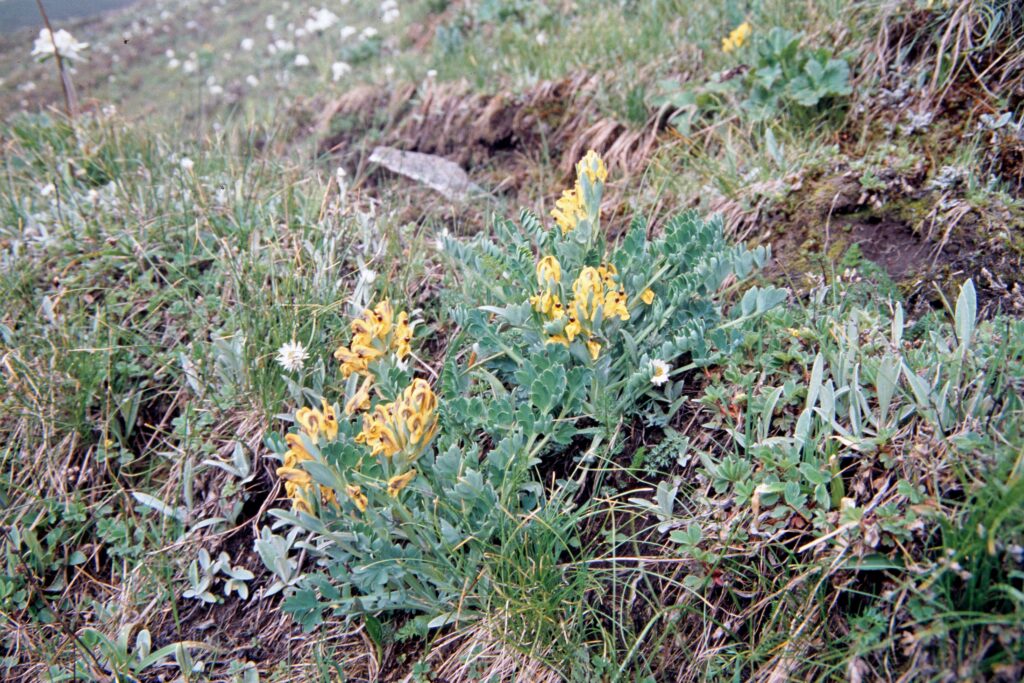
Corydalis hookeri is a high-alpine herb of the central and eastern Himalaya, recorded from Nepal, India, Bhutan and the adjacent Chinese provinces of the Tibetan plateau and Yunnan. GBIF aggregates roughly 111 georeferenced occurrences, a modest figure reflecting both its restricted alpine niche and the difficulty of access to its terrain. It occupies open stony slopes, moist screes, moraine debris and the margins of melting snow-beds, typically between 3500 and 4800 m. The photographed plant from Kalomura in Nepal at about 4050 m in June illustrates its characteristic flowering season, coinciding with the brief window following snowmelt when the short alpine summer permits rapid growth and anthesis on freshly exposed gravels.

The species is a small, glabrous, somewhat glaucous perennial arising from a slender tuberous or fibrous rootstock. The stems are weak, often decumbent to ascending and few-branched. Leaves are mostly basal and long-petiolate, the blades two- to three-ternately or pinnately dissected into narrow oblong to linear ultimate segments, imparting a delicate, finely divided aspect. The inflorescence is a lax few-flowered raceme subtended by entire or lobed bracts. Each zygomorphic flower bears four petals, the upper one prolonged backwards into a slender curved spur; the corolla is blue to purplish-blue, frequently with darker tips, an adaptation favouring bumblebee pollination at altitude. The fruit is a slender dehiscent capsule containing several small black shining seeds, often bearing an elaiosome.

Taxonomically the genus Corydalis is exceptionally species-rich in the Sino-Himalayan region, the principal centre of its global diversity, and C. hookeri belongs to one of the alpine blue-flowered assemblages whose delimitation has long challenged monographers. Its seeds are typically myrmecochorous, dispersed by ants attracted to the oily appendage, while the alkaloid-rich tissues characteristic of the genus deter herbivory. No specific conservation threat is documented and the plant appears locally frequent within suitable habitat, though high-altitude endemics of this kind remain potentially sensitive to glacial retreat and warming-driven upward shifts of the alpine zone.

Author: Prain · Sources: POWO (Kew), GBIF, Flora of China Vol. 7, Flora of Bhutan Vol. 1, Flora of Nepal, Lidén & Zetterlund Corydalis: A Gardener's Guide and a Monograph of the Tuberous Species

(Fedde.) Hand.-Mazz.

Bhutan2012 678
Bhuitan Tserang 1300m, June

Description

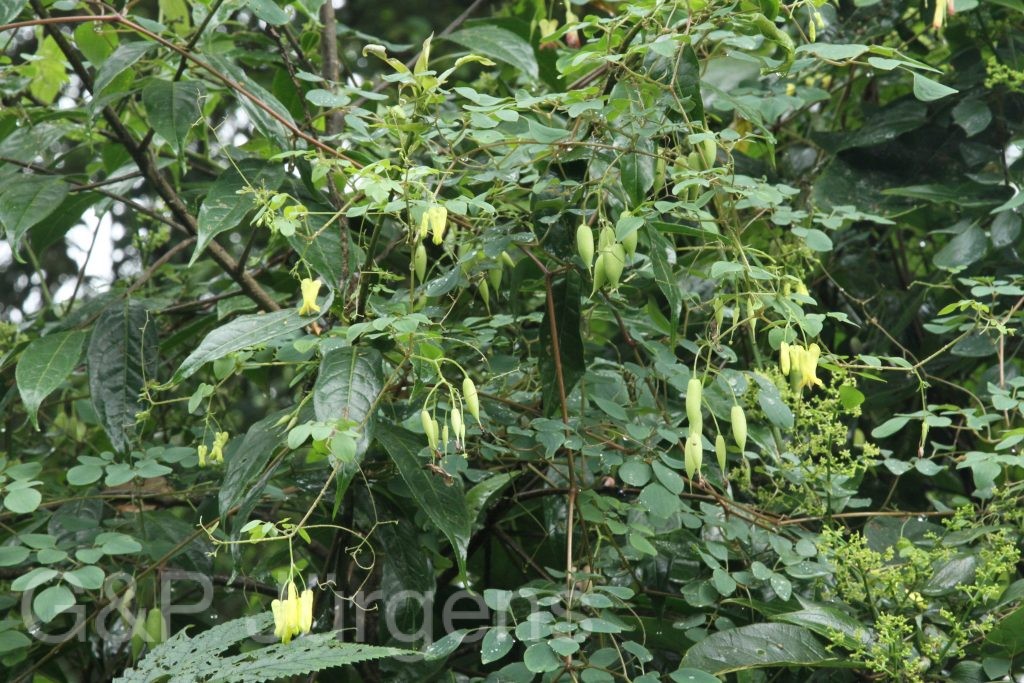
Dactylicapnos lichiangensis (Fedde) Hand.-Mazz. is a scandent herbaceous climber of the Fumarioideae, distributed across the eastern Himalaya and the Sino-Himalayan transition zone. GBIF records (136 occurrences) confirm its presence in southwest China (notably Yunnan, where the epithet references the Lijiang district) and Bhutan, where it ascends into the subtropical and warm-temperate belts. The species was photographed at Tserang in Bhutan at 1,300 m in June, a typical setting along moist forest margins, shaded ravines, and shrubby thickets where it scrambles over neighbouring vegetation. It favours humid, sheltered microhabitats on well-drained slopes between roughly 1,200 and 2,800 m.

The plant is a delicate, glabrous annual or short-lived perennial with slender, brittle, much-branched stems that climb by means of tendril-like terminations of the much-divided leaves. The foliage is biternately to triternately compound, the ultimate segments ovate to lanceolate, glaucous beneath. The pendent, few-flowered racemes bear distinctive yellow, heart-shaped flowers; the outer pair of petals is saccate at the base, forming a dorsal pouch characteristic of the genus, enclosing the inner petals. The fruit is a slender capsule containing several glossy black seeds, each typically bearing an elaiosome that promotes myrmecochorous dispersal.

Dactylicapnos was segregated from Dicentra on the basis of its climbing habit and tendrillar leaves, and lichiangensis sits within a cluster of yellow-flowered Sino-Himalayan species often confused in herbaria. Like many Fumarioideae it contains isoquinoline alkaloids of pharmacological interest. Although not formally assessed as threatened, its restricted distribution and dependence on intact forest-edge habitat make local populations sensitive to deforestation.

Author: (Fedde.) Hand.-Mazz. · Sources: POWO (Kew), Flora of China Vol. 7, Flora of Bhutan Vol. 1, GBIF, Lidén & Fukuhara: Taxonomy of Fumariaceae (1997)