
Hook.f. & Thomson
Description
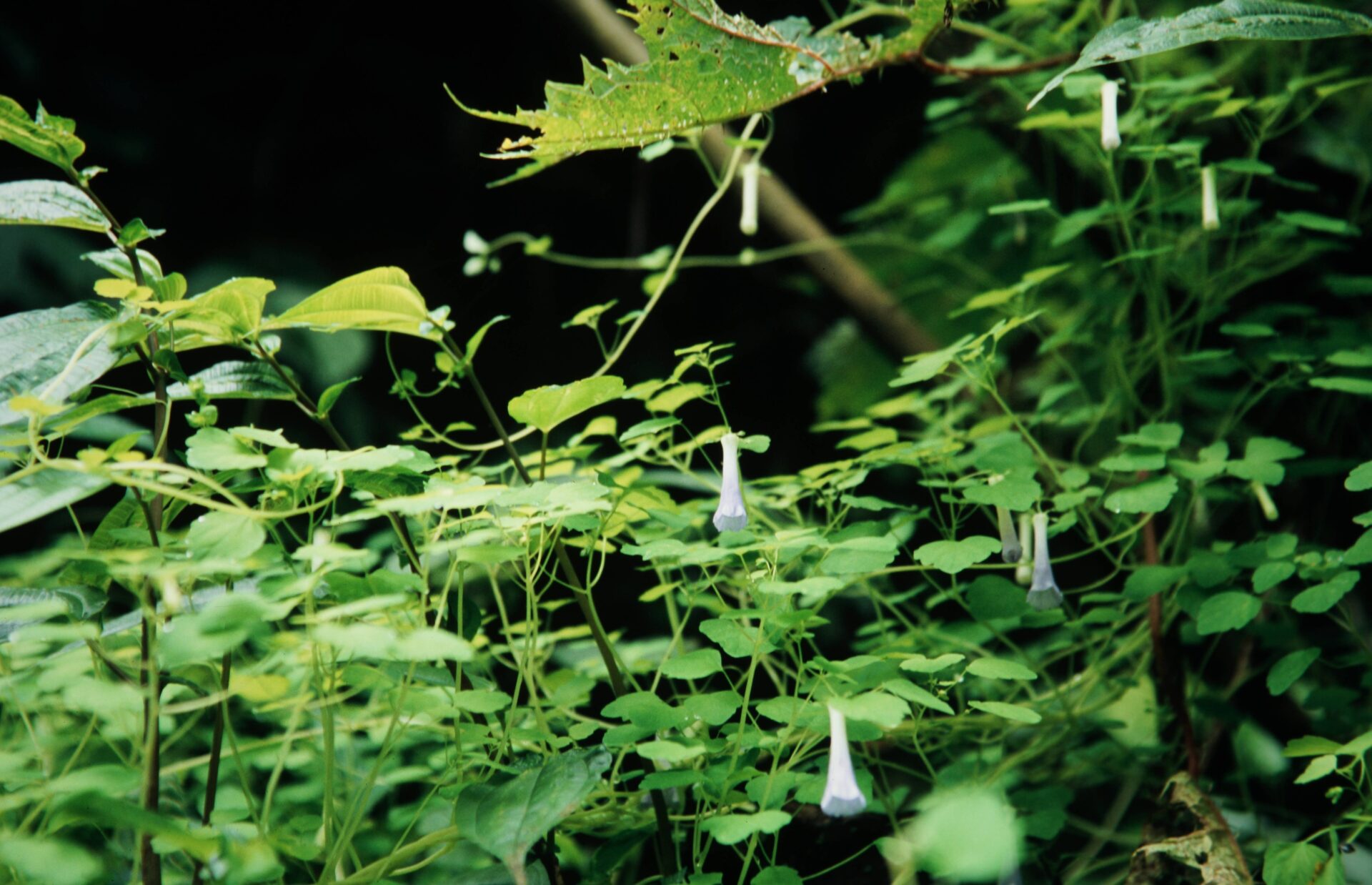
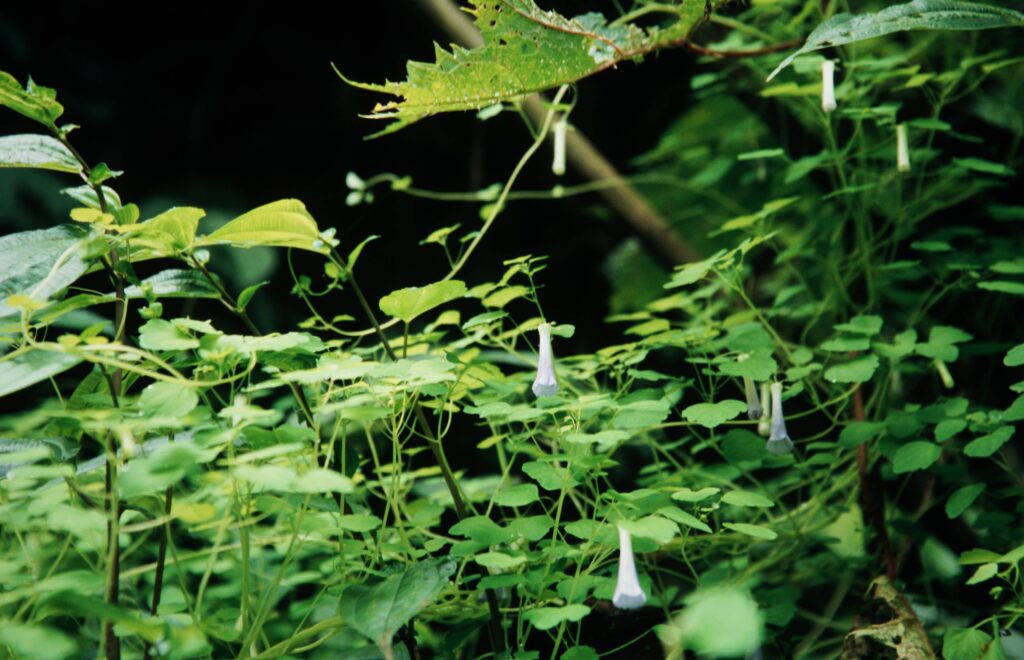
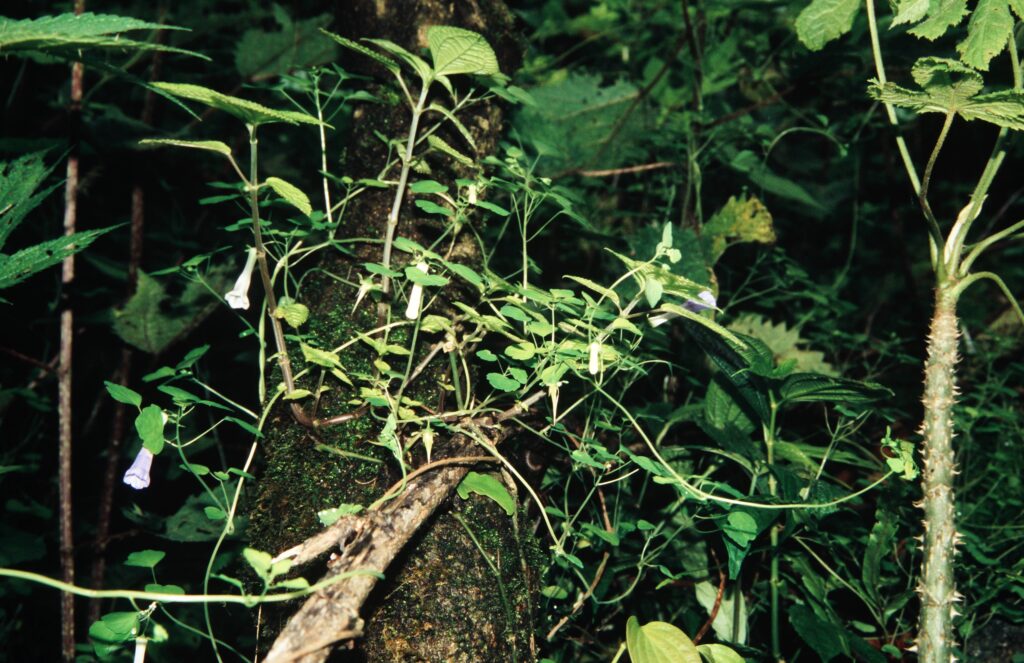
Codonopsis gracilis is a slender twining herb distributed across the eastern Himalaya and into mainland Southeast Asia and southern China. Its range extends from Nepal, Bhutan, and northeastern India (Sikkim, West Bengal, Assam, Meghalaya) through Myanmar and Vietnam to southern China (Yunnan, Sichuan, Guizhou). GBIF records 72 occurrences across these countries. The species grows in margins of subtropical and warm temperate broadleaved forests, thickets, hedgerows, and along streams, at elevations of 1,200–2,800 m. The photograph from Ruigi-Chu in West Bengal at 1,850 m, taken in May, shows the species at a mid-elevation site in the Sikkim-Darjeeling region during the early monsoon flowering period.
The plant is a perennial twining herb arising from a slender, fusiform or cylindrical root. Stems are slender, glabrous or sparsely pubescent, extensively twining through surrounding vegetation, reaching 1–3 m. Leaves are alternate or opposite on lower stems, ovate to broadly ovate, 2–5 cm long, with crenate to serrate margins, sparsely hairy above, paler beneath. Flowers are solitary, axillary, pendulous on slender pedicels. The calyx lobes are five, lanceolate to ovate, spreading. The corolla is broadly campanulate, 15–25 mm long, pale blue to lilac with darker purple veins and markings inside, particularly prominent reticulate venation in the throat. Stamens five, free; the ovary is semi-inferior. The fruit is a broadly conical capsule, dehiscing by apical valves.
Codonopsis gracilis is distinguished from congeners by its relatively small, delicate habit and slender roots, lacking the thick, fleshy taproots prized in traditional medicine that characterize species such as C. pilosula and C. tangshen. The genus Codonopsis comprises approximately 40 species centred on the Sino-Himalayan region, and molecular phylogenetic studies have confirmed its placement within Campanulaceae sensu lato. C. gracilis is not currently considered threatened and remains locally frequent in forest margins across its wide range.
Author: Hook.f. & Thomson · Sources: POWO (Kew), GBIF, Hong & Lammers: Campanulaceae in Flora of China Vol. 19, Grierson & Long: Flora of Bhutan Vol. 2