
Hook.f. & Thomson
Description
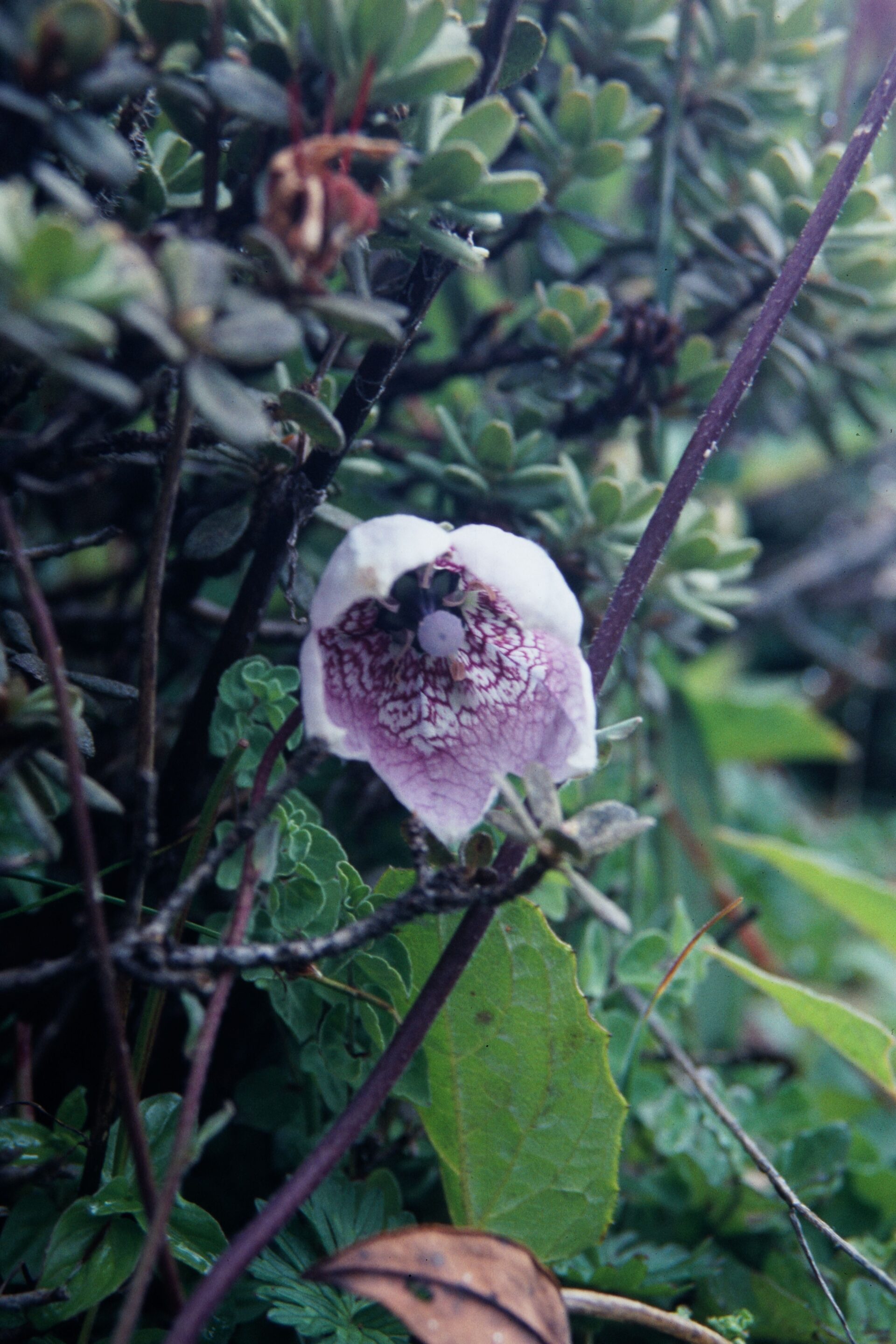
Codonopsis foetens is an alpine herb of the eastern Himalaya, distributed across China, Bhutan, India, Myanmar and Nepal, with about 712 georeferenced records in GBIF. It occupies high-elevation meadows, alpine scrub, screes and rocky slopes, typically between roughly 3500 and 4800 m. The plant illustrated was photographed in Sikkim's Chopta Valley at 4250 m in August, during the monsoon flowering season, where it grows among dwarf rhododendron scrub and damp alpine turf in the upper subalpine to alpine zone.
The species is an erect to ascending perennial herb arising from a thickened root, with simple or sparingly branched stems bearing small, scattered, ovate to lanceolate leaves. The flowers are solitary and terminal, nodding, with a broadly campanulate corolla that is pale blue to greyish-blue or violet and conspicuously marked internally with darker veins or blotches. The five corolla lobes are short and the throat often bears coloured patterning; the fruit is a capsule subtended by the persistent calyx lobes and releasing numerous minute seeds at maturity.
Codonopsis (Campanulaceae) is well diversified in the Sino-Himalayan alpine flora, and as the epithet foetens indicates, this species emits a strong, unpleasant odour when the foliage is bruised, a trait shared with several relatives and thought to deter herbivores while attracting particular insect visitors. The pendent bell-shaped flowers are pollinated chiefly by bumblebees. Restricted to high alpine habitats, C. foetens is not formally assessed as threatened but is dependent on intact alpine vegetation and is potentially sensitive to grazing pressure and climate-driven shifts in the alpine belt.
Author: Hook.f. & Thomson · Sources: POWO (Kew), GBIF, Flora of China, Flora of Bhutan, Annotated Checklist of the Flowering Plants of Nepal, Hong Monograph of the Genus Codonopsis