
(Hook.f.) Petr.
Description
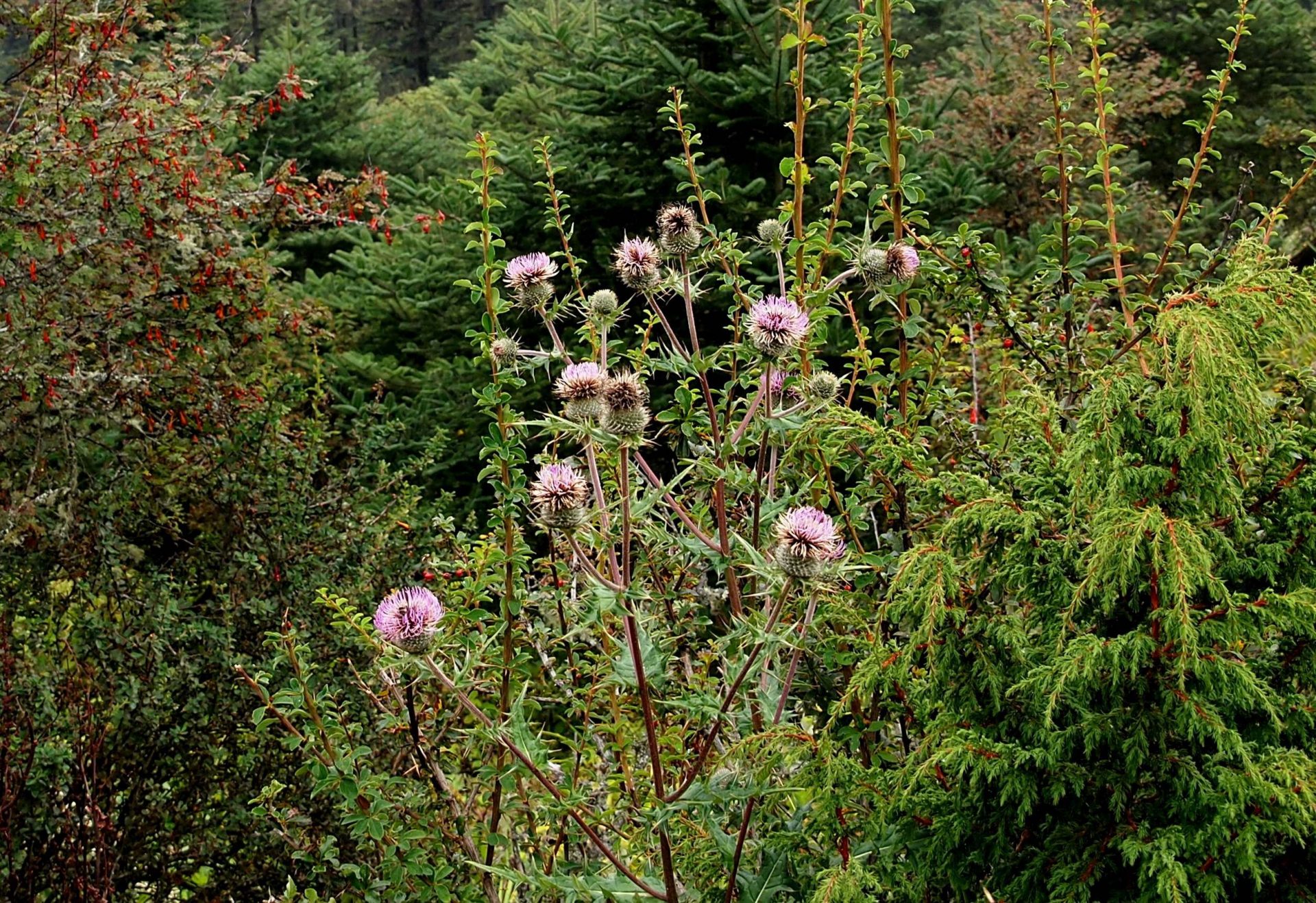
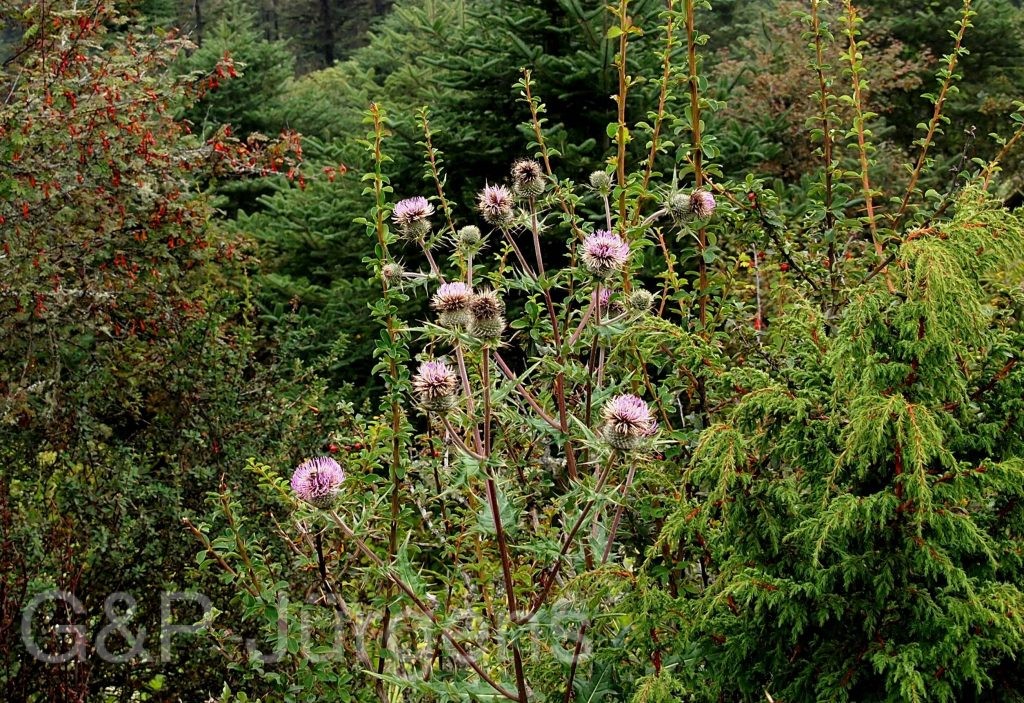
Cirsium falconeri is a robust subalpine to alpine thistle distributed along the Himalaya and adjacent ranges, recorded from Pakistan, India, Nepal, Bhutan, Myanmar and south-western China (Xizang, Yunnan), with some 207 georeferenced occurrences documenting its broad east-to-west arc. It favours open grassy hillsides, forest margins, moist meadows and disturbed slopes between roughly 2700 and 4300 m, where it forms scattered stands among tall-herb communities. The photographed plant from the Shele-La pass in Bhutan at about 3900 m in September typifies its preference for cool, humid high-altitude grasslands flowering toward the end of the monsoon.
The species is a stout biennial or short-lived perennial herb 0.6–2 m tall, with erect, longitudinally ribbed, often arachnoid-tomentose stems arising from a thickened taproot. The leaves are large, pinnatifid to pinnatisect, glabrescent to thinly cottony above and grey-tomentose beneath, with the lobes spiny-margined and the stem-leaves decurrent or amplexicaul. The capitula are large, hemispheric and usually nodding, solitary or few, subtended by reduced spiny floral leaves; the involucral bracts are linear-lanceolate and spinescent. Florets are numerous, tubular and purple to pinkish-red. The cypselae are oblong and glabrous, crowned by a copious pappus of plumose, basally connate bristles aiding wind dispersal.
Within Cirsium, a large Holarctic genus of spiny-leaved thistles, C. falconeri belongs to the Himalayan assemblage of stout nodding-headed species and was originally described under Cnicus before transfer to Cirsium. The nodding capitula are interpreted as protecting pollen and developing achenes from monsoon rain, while the nectar-rich heads attract bumblebees and other long-tongued alpine pollinators. The species remains widespread and locally common and is of no recognised conservation concern, though high-elevation grazing locally affects populations.
Author: (Hook.f.) Petr. · Sources: POWO (Kew), GBIF, Flora of China Vol. 20-21, Flora of Bhutan, Flora of Nepal, Kitamura Compositae of the Himalaya