Tag:

Yunnan

Flowers of Yunnan — 68 species from the mountains of Yunnan in southwest China, part of the Hengduan and eastern Himalayan biodiversity hotspot renowned worldwide for its rhododendrons, primulas and gentians. This region is one of the great cradles of temperate plant diversity. Each species page provides a botanical description, distribution, habitat and flowering time with the original photograph.

Maxim.

Sikkim2003 359 P502 ergebnis
India Sikkim Lachen 2840m, August

Description

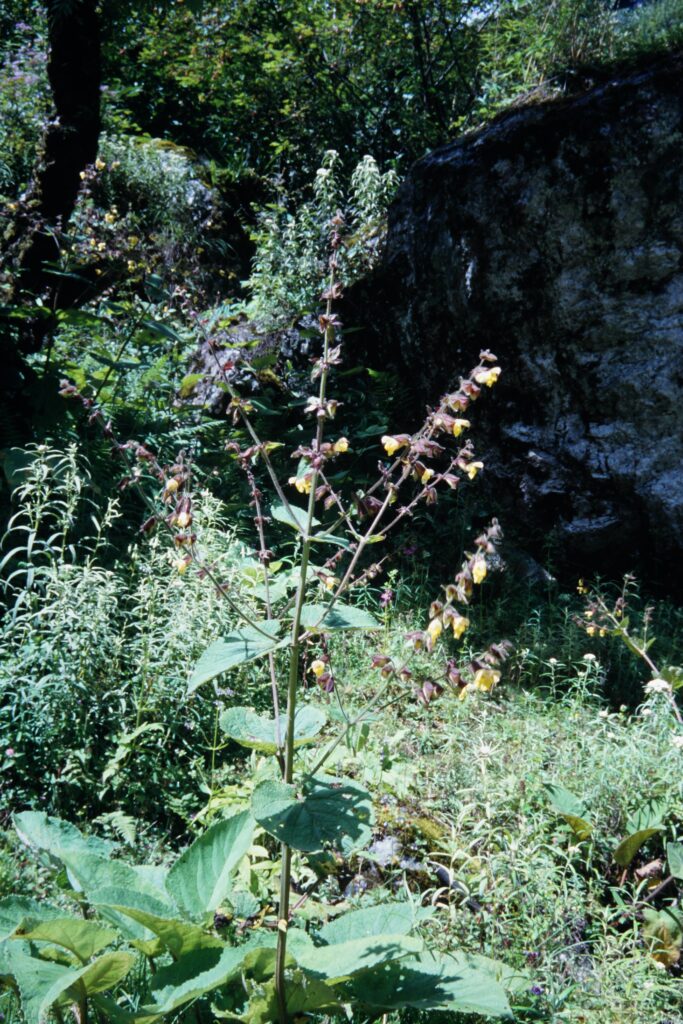
Salvia roborowskii is a perennial herb distributed from the Himalayas across the Sino-Himalayan region to western China. Its range encompasses Nepal, northeast India (Sikkim), Bhutan, and China (Xizang, Yunnan, Sichuan, Qinghai, Gansu). The species inhabits montane forest clearings, grassy slopes, thicket margins, and alpine meadows at elevations of 2,400–4,200 m. It has been recorded from the Lachen Valley in Sikkim at 2,840 m, flowering profusely in August during the monsoon season, where it grows in open, herbaceous vegetation along stream margins and disturbed ground.
The plant produces erect, square stems 30–80 cm tall from a perennial rootstock, often branched in the upper portion. The stems are pubescent with short, retrorse hairs. The basal and lower cauline leaves are pinnately compound to pinnatisect, with 1–3 pairs of lateral lobes and a larger terminal lobe, the lobes ovate to oblong, irregularly crenate-serrate, sparsely pilose on both surfaces. The upper leaves are progressively reduced. The inflorescence is a series of verticillasters arranged in elongate, terminal, spike-like racemes. The calyx is bilabiate, glandular-pubescent. The corolla is blue to violet-purple, 8–12 mm long, bilabiate with an arched upper lip and a spreading, trilobed lower lip. The nutlets are ovoid, smooth, dark brown.
Salvia roborowskii was described by Maximowicz from material collected during Przewalski's expeditions in the Sino-Tibetan borderlands. With over 400 occurrence records in GBIF, it is one of the more frequently collected high-altitude salvias in the region. The species is ecologically significant as a nectar source for montane bumblebees and other long-tongued pollinators. Its broad elevational range and tolerance of disturbed habitats suggest a degree of ecological resilience, though it remains dependent on the persistence of open montane grasslands and forest margins. Taxonomically, it is placed within Salvia subgenus Salvia and is allied to other pinnate-leaved species of the Sino-Himalayan region.

Author: Maxim. · Sources: POWO (Kew), GBIF, Flora of China Vol. 17, Flora of Bhutan Vol. 2, Hedge: Salvia in Flora Iranica (1982)
Maxim.

Sikkim2003 511 G712
Sikkim Yume Samdong 4600m August

Description

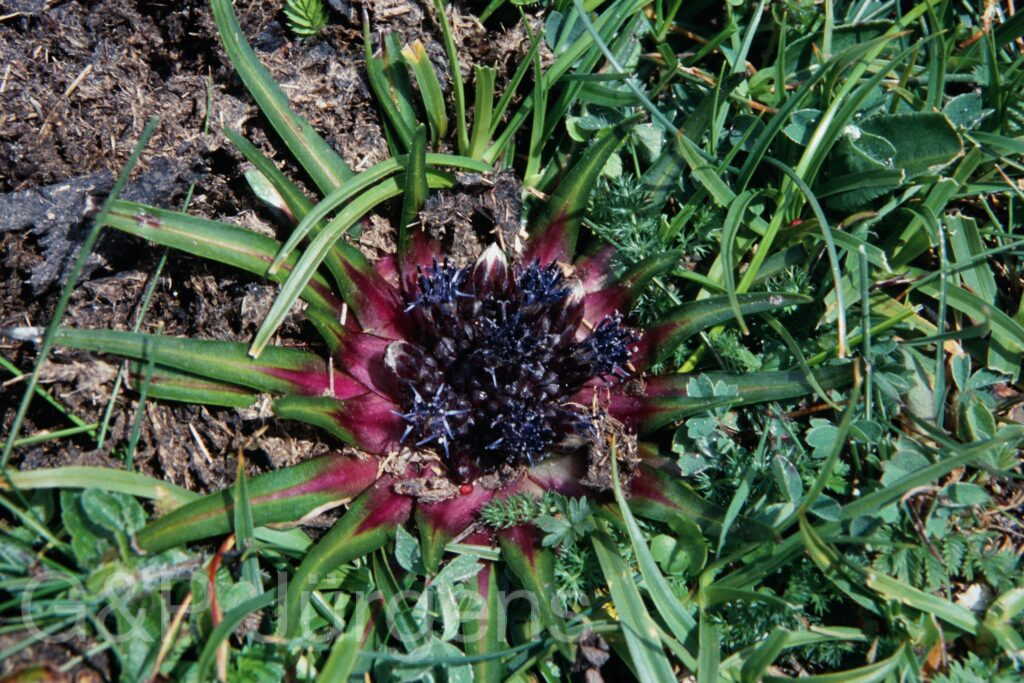
Saussurea stella is a high-alpine herb distributed across the eastern Himalaya and the Tibetan Plateau, recorded from China (Xizang, Yunnan, Sichuan, Qinghai, Gansu), Bhutan and India, with some 821 georeferenced occurrences documented in GBIF. It occupies open alpine meadows, marshy turf, gravelly flushes and the margins of glacial streams, typically between 3000 and 5400 m. The plant photographed at Yume Samdong in northern Sikkim at about 4600 m in August is characteristic of the wet, peaty seepage slopes the species favours during the monsoon, where it forms part of a low cushion-and-rosette sward exposed to intense radiation, nightly frost and a brief growing season.

The species is a stemless, near-acaulescent perennial forming a flat, star-shaped rosette pressed against the substrate from a stout taproot. The numerous lanceolate to linear leaves are glabrous, entire and often suffused with purplish-red, radiating symmetrically and giving the plant its epithet stella. The capitula are sessile and densely clustered at the rosette centre, each involucre with imbricate, purple-tinged phyllaries enclosing tubular purple florets; the corollas are deeply lobed and the anthers tailed at the base. Fruit is a glabrous cylindrical achene with a double pappus of short outer and longer plumose inner bristles.

A member of the large genus Saussurea (subtribe Saussureinae, tribe Cardueae), S. stella belongs to the rosette-forming, ground-hugging guild that recurs in Tibetan alpine floras as an adaptation to cold, windy, high-irradiance environments, the flattened habit and dark pigmentation enhancing heat capture and protecting against ultraviolet stress. Pollination is by alpine flies and bees, and the plumose pappus enables wind dispersal. Though not formally assessed as threatened and locally abundant, it is sensitive to grazing and the warming-driven contraction of alpine seepage habitats.

Author: Maxim. · Sources: POWO (Kew), GBIF, Flora of China, Flora of Bhutan, Lipschitz Monograph of Saussurea

Wall. ex Ser.

Bhutan2012 499
Bhutan Pele-La 3100m, September
Bhutan2012 888
Bhutan Ura 3200m, October
Bhutan2012 890
Bhutan Ura 3200m, October

Description

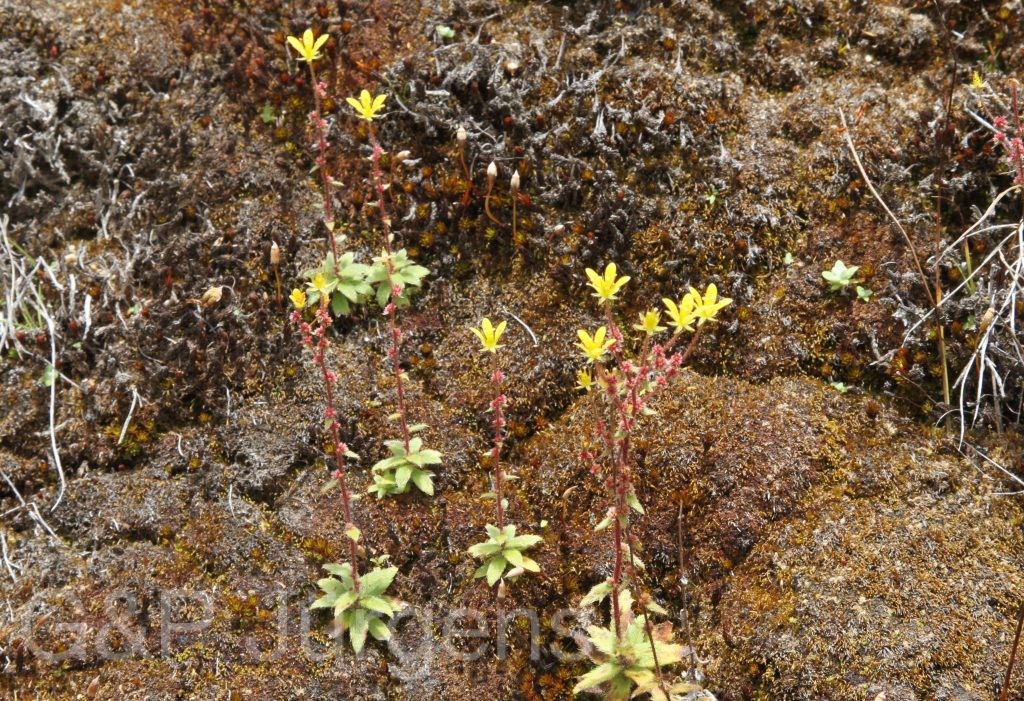
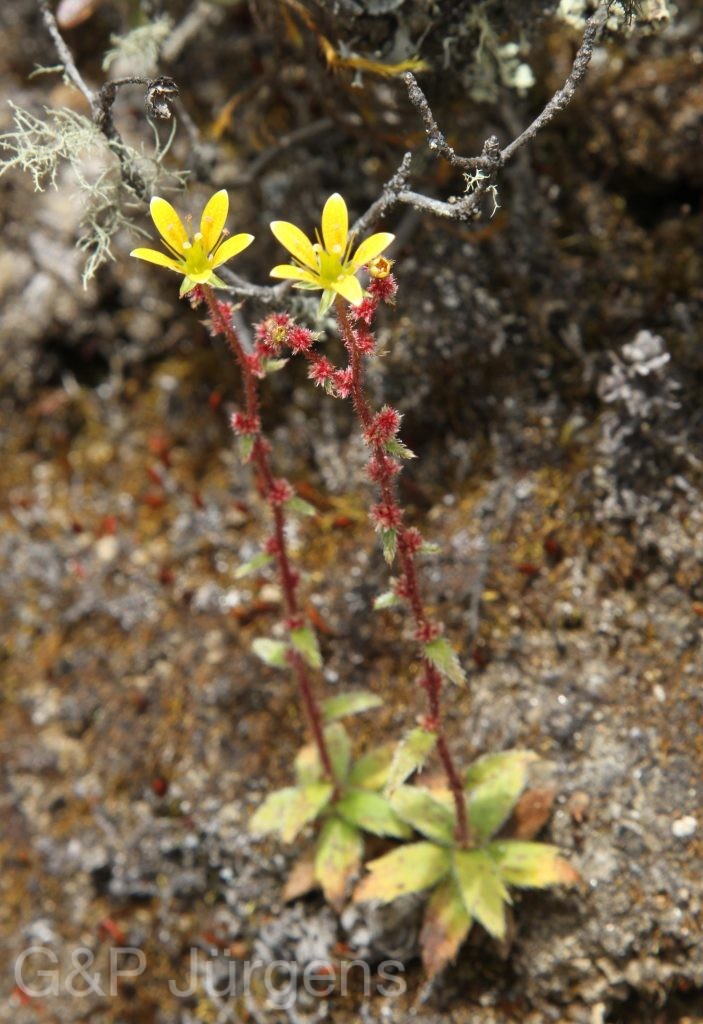
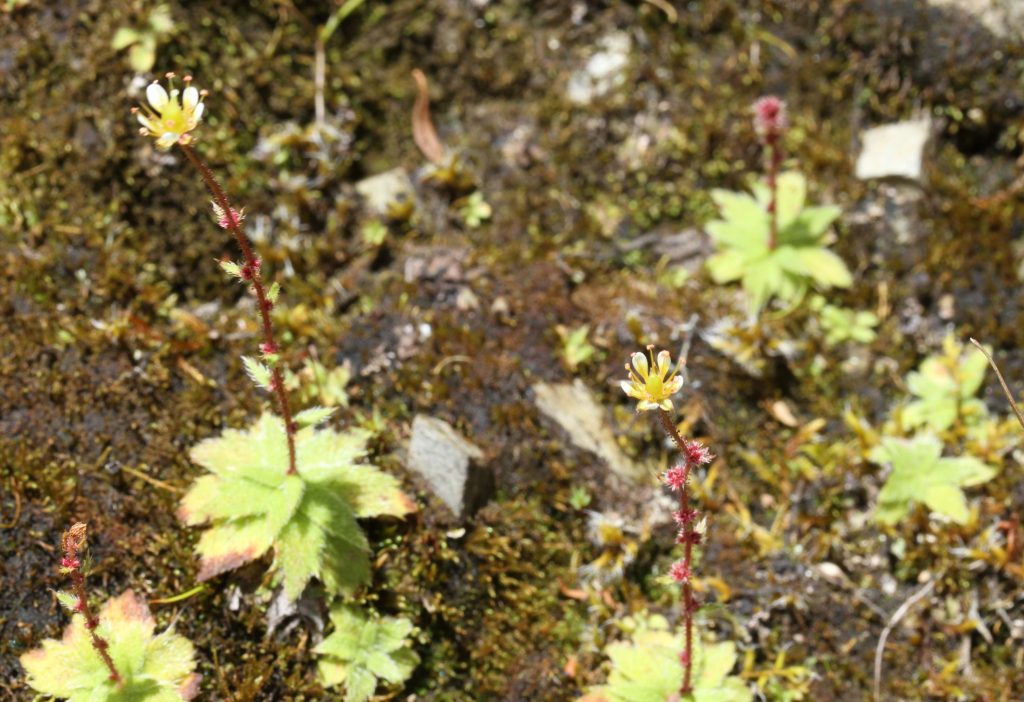
Saxifraga strigosa is a Sino-Himalayan herb distributed through China (including Xizang and Yunnan), Nepal, Bhutan, the Indian Himalaya and northern Myanmar, with several hundred georeferenced records. It occupies cool, damp temperate to subalpine habitats, growing on shaded mossy banks, rock ledges, streamsides and moist forest floors. In Bhutan it has been recorded at Pele-La around 3100 m in September and at Ura near 3200 m in October, its late-season flowering coinciding with the post-monsoon period in well-watered montane terrain.

The plant is a slender annual or short-lived perennial herb with weak, often reddish, strigose-hairy stems that may root at the lower nodes. The basal and lower leaves are petiolate with ovate to orbicular, coarsely toothed or shallowly lobed blades, becoming smaller and sessile upward. The inflorescence is a lax, few- to several-flowered cyme of small flowers on filiform pedicels. Each flower has five spreading, reflexed sepals, five white petals frequently marked with yellow basal spots and reddish dots, ten stamens with clavate filaments, and a bicarpellate ovary that is half-inferior. The fruit is a two-beaked capsule splitting between the divergent styles to release numerous minute seeds.

Saxifraga is a large, predominantly arctic-alpine genus, and S. strigosa belongs to the small-flowered annual element formerly placed in section Diptera (genus Hydatica of some authors). It was described by Seringe from Wallich's collections. Adapted to ephemeral moist microhabitats, it relies on small insects for pollination and on abundant seed for persistence. Common and widespread across the eastern Himalaya, it is of no particular conservation concern.

Author: Wall. ex Ser. · Sources: POWO (Kew), GBIF, Flora of China, Flora of Bhutan, Gornall's classification of Saxifraga (Saxifragaceae)

(Cardot) Hand.-Mazz.

Bhutan2015 495
  Bhutan Pele-La 3000m, October
Bhutan2015 497
  Bhutan Pele-La 3000m, October

Description

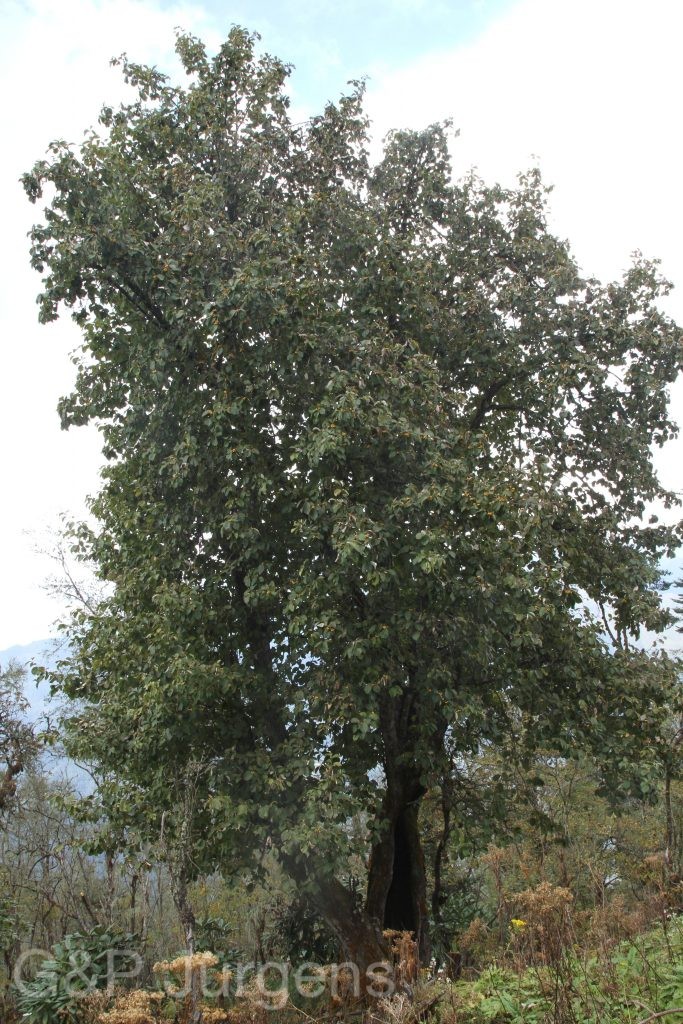
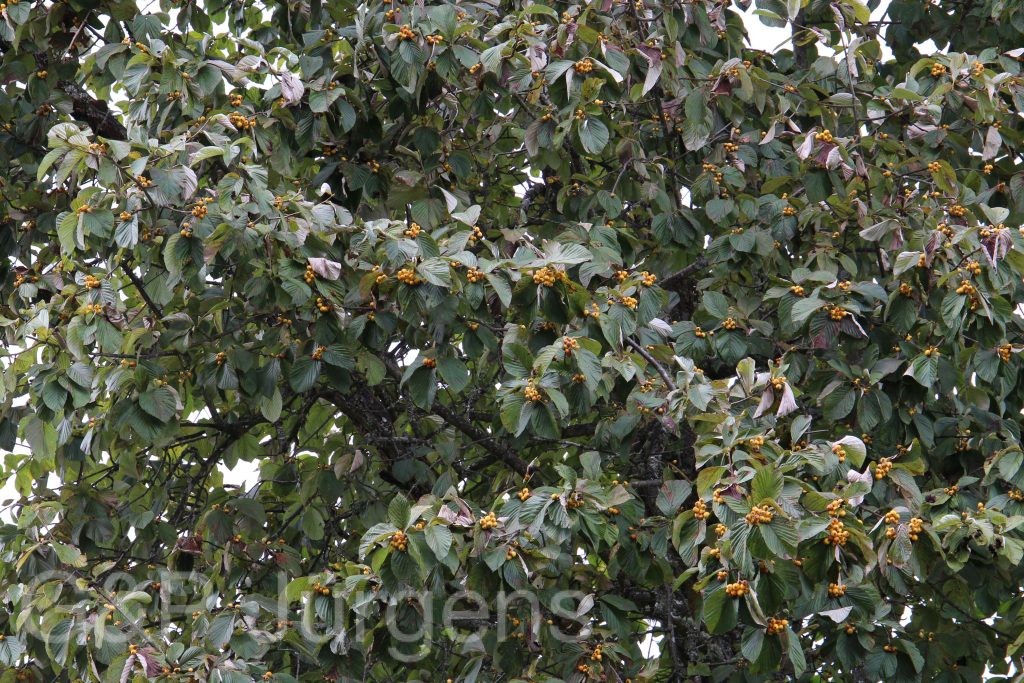
Sorbus thibetica is a Sino-Himalayan whitebeam distributed along the eastern Himalaya and adjacent China, from Nepal through northern India, Sikkim and Bhutan into south-western China (Xizang, Yunnan) and northern Myanmar; its roughly 470 georeferenced occurrences include numerous cultivated records in Britain and northern Europe (GB, NO, DK), reflecting its long-standing horticultural use. It grows in temperate and subalpine forest, woodland margins, rocky slopes and open hillsides, generally between about 2500 and 3600 m. The tree photographed at Pele-La in Bhutan at 3000 m in October, in autumn fruit and leaf-colour, is typical of its cool, montane forest habitat.

It is a deciduous tree to 10-20 m, with a rounded crown and grey bark; the stout twigs and buds are densely white-tomentose when young. The leaves are simple (not pinnate), broadly elliptic to obovate, entire-leaved members of the Aria group, dark green and glabrescent above but persistently covered beneath with a thick, silvery-white felted tomentum, the margins finely and shallowly toothed. The white flowers are borne in flat-topped corymbs, each with five petals, numerous stamens and an inferior ovary. The fruit is a small subglobose pome, ripening orange-brown to russet and bearing scattered lenticels, typical of the simple-leaved whitebeams.

Sorbus thibetica belongs to the Aria group of simple-leaved whitebeams (sometimes segregated as the genus Aria), distinct from the pinnate-leaved rowans of Sorbus sensu stricto. The selection 'John Mitchell', with very large leaves, is widely grown ornamentally. Apomixis and hybridisation complicate species limits throughout the group. Widespread and frequent, it is not considered threatened.

Author: (Cardot) Hand.-Mazz. · Sources: POWO (Kew), GBIF, Flora of China, Flora of Bhutan, Flora of Nepal, McAllister's The Genus Sorbus: Mountain Ash and other Rowans

Wall.

Garw 2005 277 ergebnis
India Garhwal Kunol 2650m, October

Description

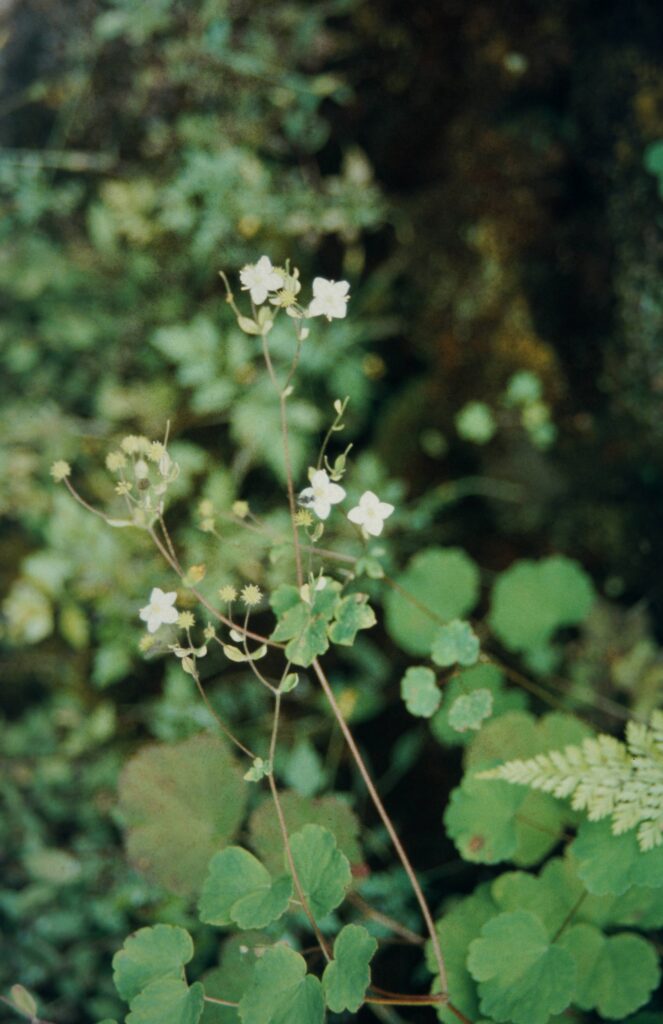
Thalictrum reniforme is a perennial herb distributed across the Himalayan arc from northern India through Nepal and Bhutan to southwestern China (Yunnan, Xizang, Sichuan). It occurs in moist, shaded habitats including forest margins, thickets, stream banks, and damp meadows at elevations of 1,800–3,500 m. The species is well represented in the western Himalayan foothills, as demonstrated by collections from Kunol in the Garhwal region of Uttarakhand, India, at 2,650 m, where plants have been observed in fruit as late as October.
The plant produces erect to ascending stems 30–80 cm tall from a short, fibrous-rooted rhizome. The leaves are bi- to triternately compound; the leaflets are distinctive for the genus, being reniform to orbicular, 1–3 cm wide, with a crenate to shallowly lobed margin. The leaflet surfaces are thin-textured and often glaucous beneath. The inflorescence is a lax, terminal panicle bearing numerous small, apetalous flowers. The sepals are four, ovate, greenish to purplish, caducous. The stamens are pendulous, with slender filaments and oblong anthers. The achenes are few per flower, stipitate, fusiform to obliquely ovoid, ribbed longitudinally, 3–5 mm long including the stipe.
Thalictrum reniforme is readily distinguished from most congeners by its conspicuously reniform leaflets, a character that inspired Wallich's specific epithet. The species belongs to a taxonomically challenging genus in which species boundaries are often obscured by morphological plasticity and hybridisation. With approximately 248 occurrence records in GBIF spanning India, Nepal, Bhutan, and China, it is moderately well collected. Ecologically, it contributes to the herbaceous understorey diversity of Himalayan temperate forests. No specific conservation concerns have been raised, though continued monitoring of its forest-dependent habitats remains advisable given ongoing pressures from logging and agricultural encroachment.

Author: Wall. · Sources: POWO (Kew), GBIF, Flora of China Vol. 6, Flora of Bhutan Vol. 1, Tamura: Thalictrum in Die Natürlichen Pflanzenfamilien (1995)

(D.Don) Eichler

Nepal 2001 283 ergebnis ergebnis
Nepal (Gorkha) Lambra Kharka 3000m, May

Description

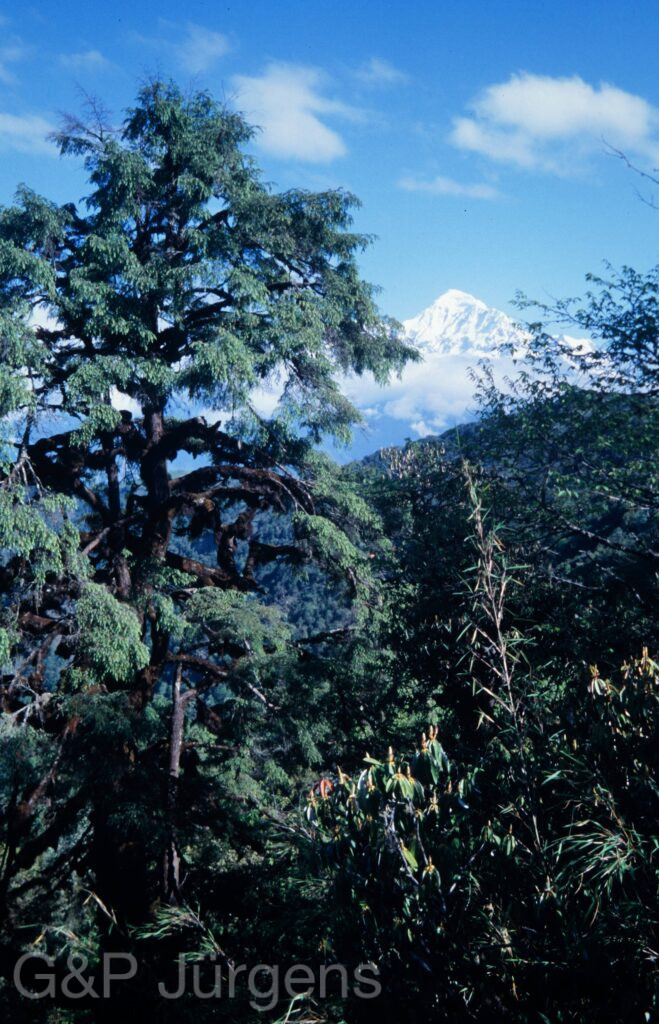
Tsuga dumosa, the Himalayan hemlock, is a large evergreen conifer distributed across the Himalaya from central Nepal eastward through Sikkim, Bhutan, and northeast India into southern China (Xizang, Yunnan, Sichuan, Guizhou), Myanmar, and northern Vietnam. It is a characteristic component of cool temperate and upper montane forests at elevations of 2,000–3,500 m, where it often forms pure stands or grows in association with Abies, Picea, Acer, and Rhododendron species. The species has been documented at Lambra Kharka in the Gorkha district of Nepal at approximately 3,000 m, near the upper limit of its elevational range.
Tsuga dumosa is a tree attaining 25–40 m in height with a trunk up to 1.5 m in diameter, bearing a broadly conical to irregular crown. The bark is dark greyish-brown, deeply fissured and scaly on mature trees. Leaves are linear, flattened, 10–25 mm long and 2–3 mm wide, with a rounded or emarginate apex, dark glossy green above with two conspicuous white stomatal bands beneath, arranged in a pectinate (comb-like) pattern on lateral shoots. Male strobili are small, axillary, and globose. Female seed cones are pendulous, ovoid to oblong, 1.5–2.5 cm long, with thin, rounded cone scales that open at maturity to release two small winged seeds per scale. The cones mature in a single season.
Tsuga dumosa is the sole Himalayan representative of the genus Tsuga, which comprises approximately nine species with a disjunct distribution between eastern Asia and North America. Phylogenetic studies place it sister to the East Asian T. chinensis complex. The species is of considerable ecological importance as a canopy dominant in Himalayan temperate forests, providing critical habitat for epiphytic bryophytes, lichens, and orchids. Its timber is locally valued for construction. While not currently assessed as threatened globally, localized deforestation and climate-driven upward range shifts pose potential concerns for some populations.

Author: (D.Don) Eichler · Sources: POWO (Kew), GBIF, Flora of China Vol. 4, Flora of Bhutan Vol. 1, Farjon: A Handbook of the World's Conifers (2017)

Wall. ex Benth.

Sikkim 2006 333 ergebnis
India West-Bengal, Tolung 2450m, May

Description

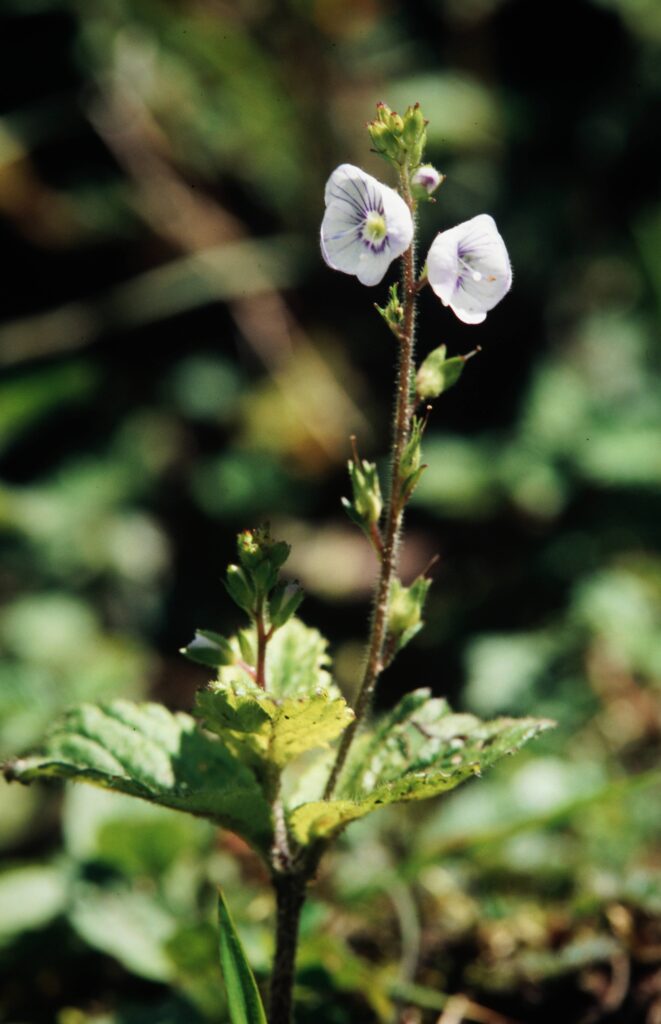
Veronica cana is a Himalayan speedwell distributed from Pakistan and northern India (Kashmir to Arunachal Pradesh) through Nepal, Bhutan, and Myanmar to southwestern China (Xizang, Yunnan) and Japan. It occurs in open forest clearings, grassy slopes, rocky banks, and montane scrub at elevations of 1,500–3,500 m. The species has been recorded from the Tolung area in West Bengal at 2,450 m, where it flowers in May during the pre-monsoon season. It favours well-drained, often stony soils in areas receiving moderate to high rainfall.
Veronica cana is an erect to ascending perennial herb, 15–40 cm tall, arising from a slender, creeping rhizome. The stems are simple or sparingly branched, densely covered with short, grey-white, appressed hairs that give the plant a characteristically canescent appearance — hence the epithet "cana" (grey-haired). Leaves are opposite, sessile or subsessile, ovate to lanceolate, 2–5 cm long and 1–2 cm wide, with a crenate to serrate margin and dense, soft pubescence on both surfaces. The inflorescence is a terminal raceme, 5–15 cm long, bearing numerous flowers on short, erect pedicels. The corolla is rotate, four-lobed, 5–8 mm in diameter, pale blue to lilac with darker veins. Stamens are two, exserted. The fruit is an obcordate, compressed capsule 3–5 mm wide, emarginate at the apex, containing numerous minute seeds.
Veronica cana belongs to a complex of pubescent, racemose-flowered Himalayan speedwells that have been variously treated taxonomically. Molecular phylogenetic studies have confirmed that Veronica in the broad sense (including former Pseudolysimachion and Veronicastrum segregates) is monophyletic within Plantaginaceae. V. cana is distinguished from the related V. laxa by its denser canescent indumentum and more compact racemes. Ecologically, the species is a characteristic element of Himalayan montane grasslands and forest-edge communities, contributing to ground-layer diversity in habitats increasingly threatened by overgrazing and land-use intensification.

Author: Wall. ex Benth. · Sources: POWO (Kew), GBIF, Flora of China Vol. 18, Flora of Bhutan Vol. 2, Albach et al.: Phylogeny of Veronica (2004)

Lindl.

Bhutan2012 1024
Bhutan Trithangebe 900m, October
Bhutan2012 1025
Bhutan Trithangebe 900m, October

Description

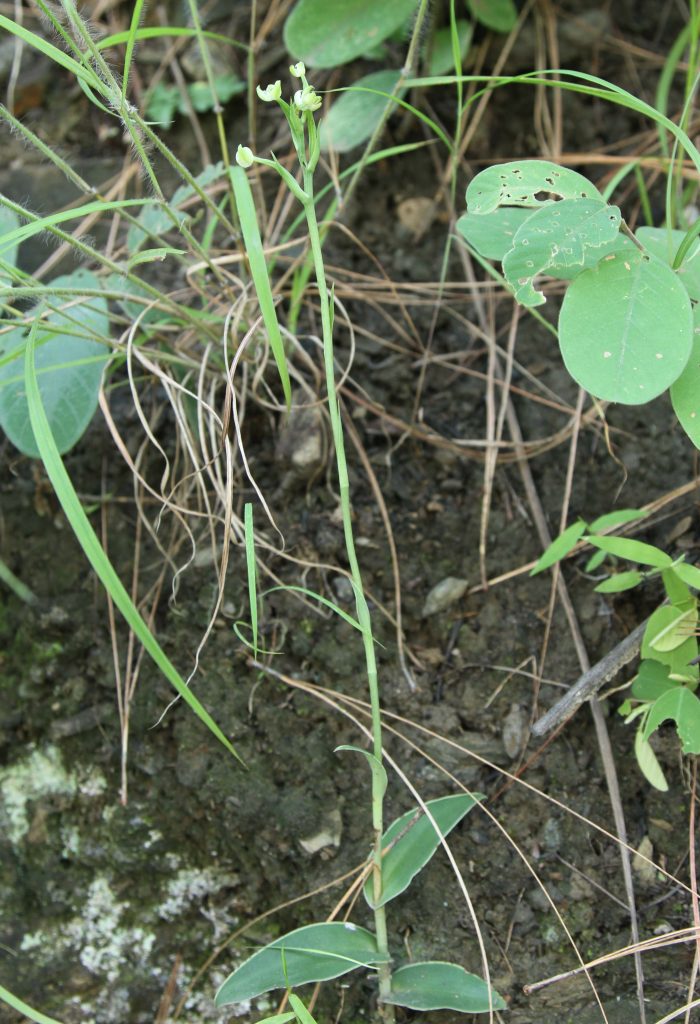
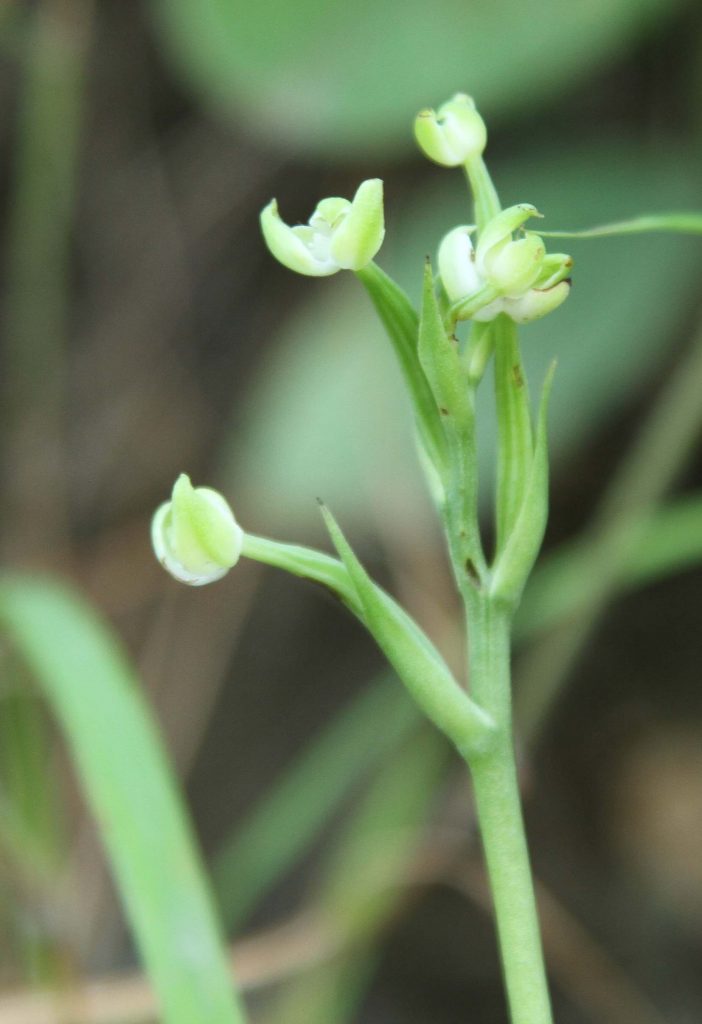
Zeuxine goodyeroides is a terrestrial orchid of shaded forest floors in the eastern Himalaya and adjoining mountains of China (including Yunnan and Tibet), India, Nepal, Bhutan, Myanmar and Sri Lanka, with around 56 documented occurrences indicating a scattered but wide distribution. It grows in leaf litter and humus-rich soils of subtropical to lower-temperate broad-leaved and mixed forest, generally between about 800 and 2000 m. The photographed plant was recorded at Trithangebe in Bhutan at 900 m, flowering in October, when the post-monsoon humidity favours the development of these inconspicuous ground orchids.

The species is a small herb arising from a creeping, fleshy rhizome that roots at the nodes, the erect stem bearing several spirally arranged leaves toward the base. The leaves are ovate-lanceolate, somewhat fleshy, often with a pale midrib, recalling the genus Goodyera to which the epithet alludes. The inflorescence is a slender, pubescent terminal raceme of numerous small, non-resupinate-appearing white to greenish flowers; the sepals are pubescent dorsally, the petals adhere to the dorsal sepal forming a hood, and the diagnostic labellum is saccate at the base with two basal glands and bears a transversely dilated, bilobed epichile. The fruit is a small dehiscent capsule with dust-like seeds.

Zeuxine belongs to subtribe Goodyerinae of the Orchidaceae (here spelled Orchideaceae as supplied), the jewel-orchid alliance, distinguished by the spurless, basally pouched labellum bearing internal glands. Easily overlooked owing to its small stature, it depends like most terrestrial Goodyerinae on mycorrhizal associations in undisturbed forest humus. It is not formally assessed but is sensitive to forest-floor disturbance.

Author: Lindl. · Sources: POWO (Kew), GBIF, Flora of Bhutan, Flora of China, The Genera Orchidacearum (Pridgeon et al.)