Author

GP Jürgens

(Kurz) Airy Shaw

Bh2008 326 P504
Bhutan Jakar, 3000m April

Description

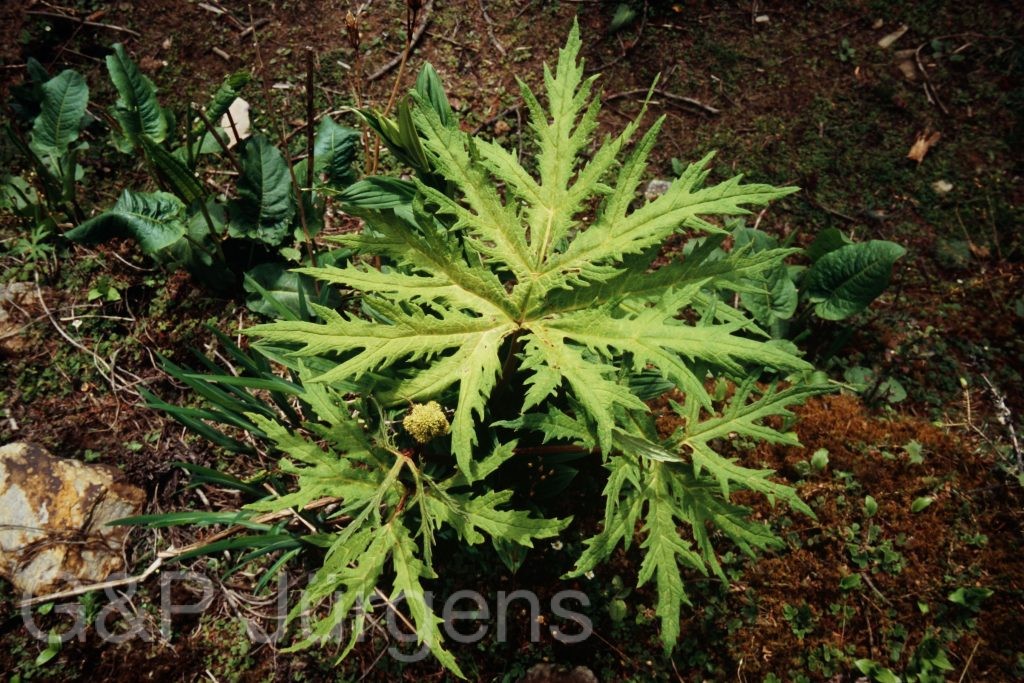
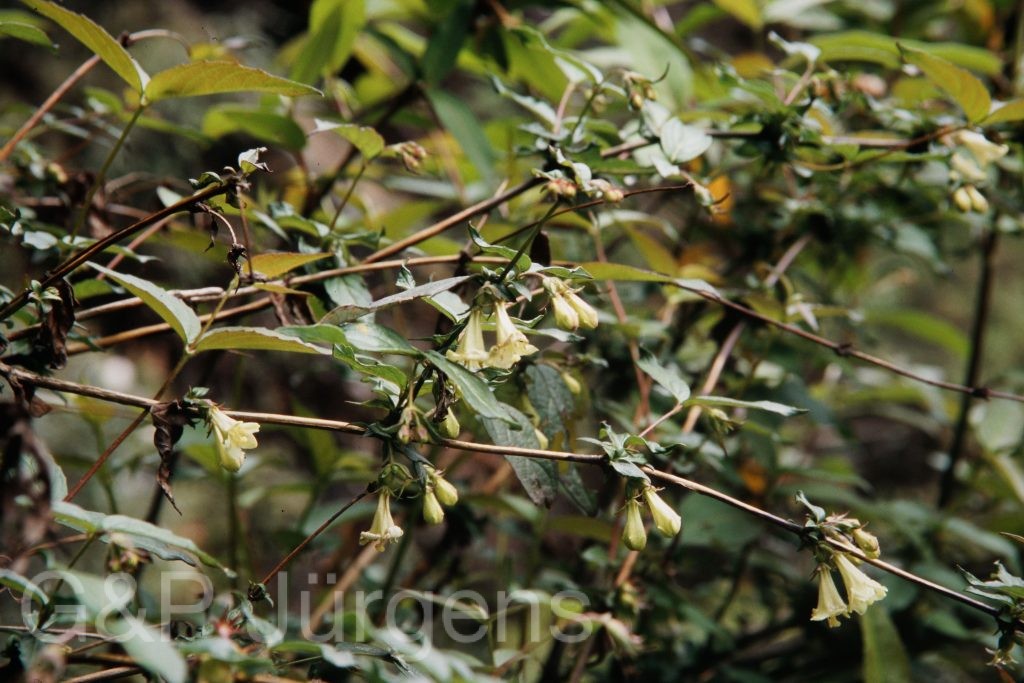
Leycesteria gracilis is a Himalayan and Sino-Himalayan shrub, GBIF recording around 232 occurrences from China, India, Bhutan, Nepal and Myanmar, with scattered records from Japan. It grows in the understorey and at the margins of temperate broadleaved and mixed forest, in shrubberies, along forest tracks and on shaded, moist banks, generally at mid to upper montane elevations between about 2400 and 3300 m. The plant photographed from Jakar (Bumthang) in central Bhutan at 3000 m, in early flower in April, is characteristic of its preference for cool, humid montane forest where it leafs and blooms in spring ahead of the summer rains.

It is a slender, erect to arching deciduous shrub with hollow, often glaucous young stems, more delicate in habit than its relative L. formosa—hence "gracilis." The leaves are opposite, ovate-lanceolate to lanceolate, long-acuminate, entire to finely toothed and thin in texture. The flowers are borne in pendulous, interrupted spikes or whorled clusters subtended by leafy, sometimes purplish bracts; each has a small calyx and a tubular to funnel-shaped, five-lobed corolla in shades of white, pink or pale purple. The fruit is a small, several-seeded berry ripening dark purplish to nearly black.

Transferred by Airy Shaw from Kurz's original epithet, L. gracilis belongs to the small Himalayan genus Leycesteria, now placed in Caprifoliaceae in its broad modern sense. It is locally frequent and not regarded as threatened, though dependent on intact montane forest. Ecologically its tubular flowers attract insect and bird pollinators, while its fleshy dark berries are taken by birds that disperse the seed, making it a useful component of regenerating montane scrub.

Author: (Kurz) Airy Shaw · Sources: POWO (Kew), GBIF, Flora of Bhutan, Flora of China, Airy Shaw revision of Leycesteria (Caprifoliaceae)
(C.B.Clarke) S.W.Liu

Sikkim2003 365 P512 2
Sikkim Lachen 2740m, August

Description

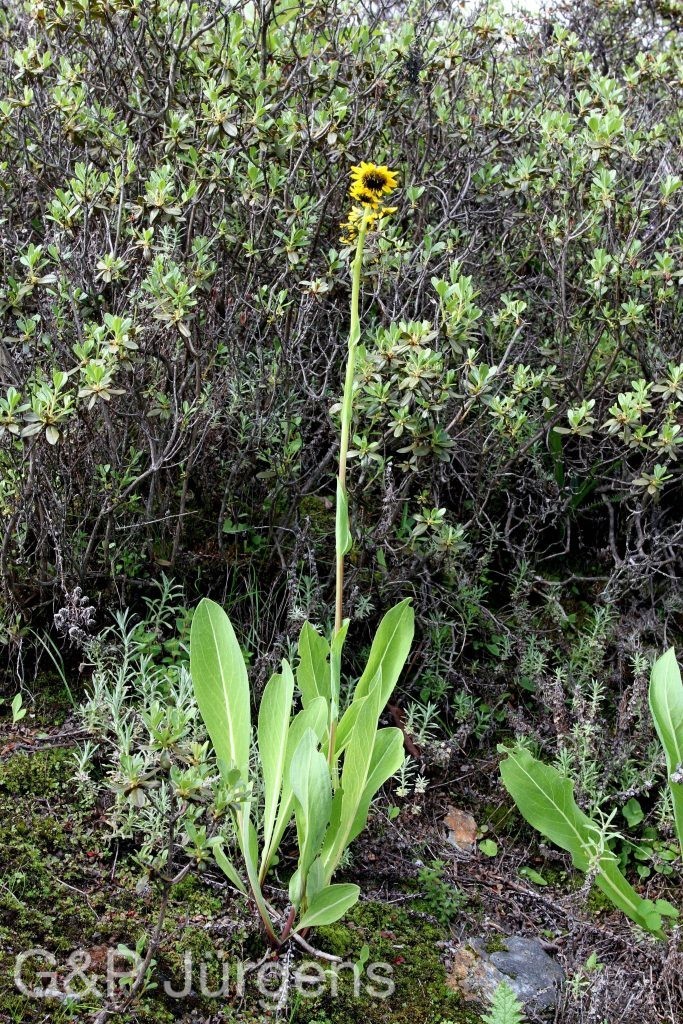
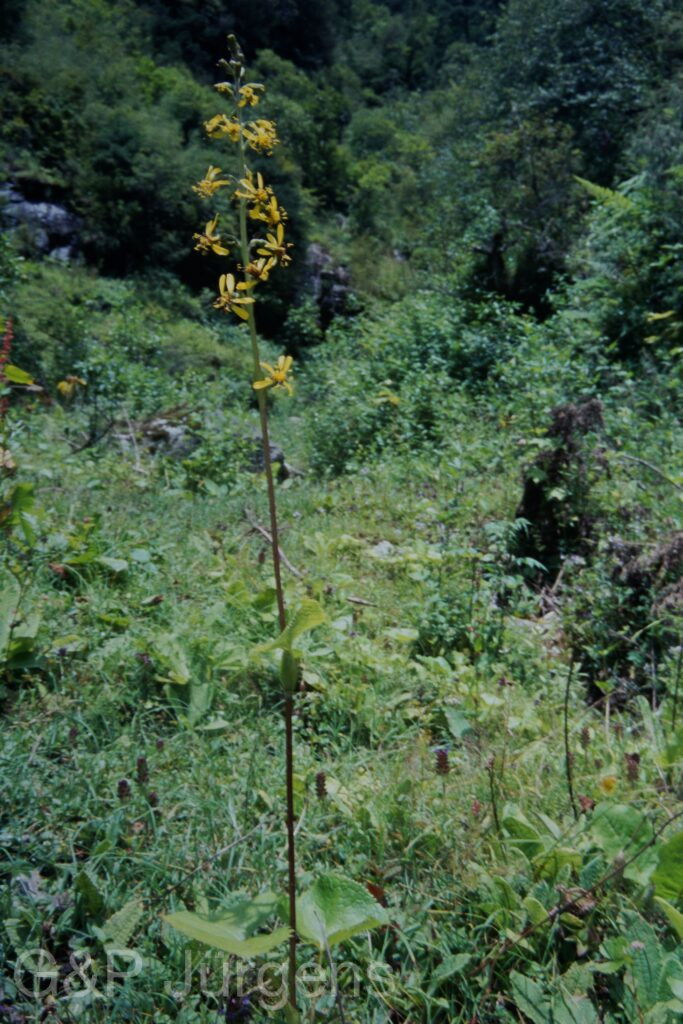
Ligularia atkinsonii is a tall herbaceous perennial of the Himalaya and adjacent China, with verified occurrences in Nepal, China, Bhutan, India and Myanmar. It favours moist, cool situations such as forest margins, streamsides, damp meadows and shrubby slopes through the temperate and subalpine zones, broadly between about 2500 and 4000 m. The plant photographed at Lachen in northern Sikkim at around 2740 m in August represents its late-summer flowering, when these golden composites are conspicuous in the monsoon-fed grasslands and clearings of the inner valleys.

The species arises from a stout rootstock bearing large, long-petioled basal leaves; these are broadly cordate to reniform, with toothed margins and a soft texture, the bases of the petioles often sheathing the stem. The flowering stem is erect, leafy below and bears a narrow elongate inflorescence (a raceme or narrow panicle) of numerous radiate capitula. Each head has an involucre of few narrow phyllaries and carries several spreading yellow ray florets around a disc of tubular florets. The fruit is a glabrous cylindrical achene topped by a pappus of fine brownish bristles aiding wind dispersal.

Ligularia, of tribe Senecioneae, is a large and taxonomically demanding genus centred on the Sino-Himalayan region, and L. atkinsonii, transferred to the genus by S.W. Liu from a C.B. Clarke basionym, is distinguished by its leaf shape and narrow inflorescence. Ecologically these robust herbs are important late-season nectar sources in subalpine meadows. The species is reasonably widespread along the Himalaya and is not currently considered to be of conservation concern, though it depends on the persistence of moist montane grassland.

Author: (C.B.Clarke) S.W.Liu · Sources: POWO (Kew), GBIF, Flora of China, Flora of Bhutan, Annotated Checklist of the Flowering Plants of Nepal

Turcz.

BhutanPG2011 810 01 01
Bhutan Chele-La 3900m, August

Also: Primula smithiana Craib / Primula sikkimensis Hook.f.

Description

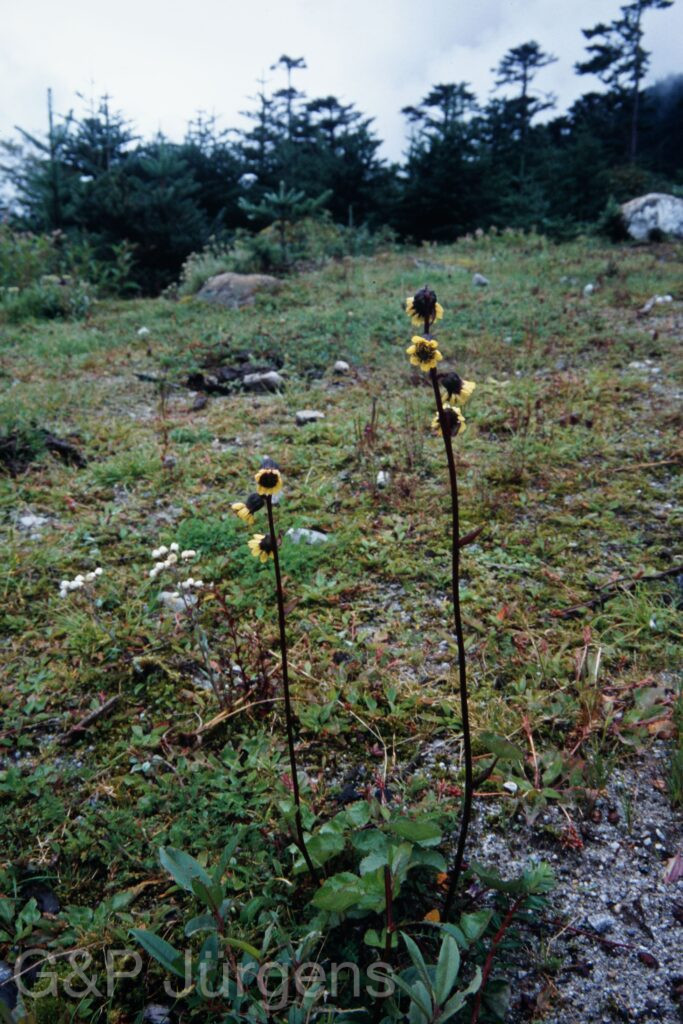
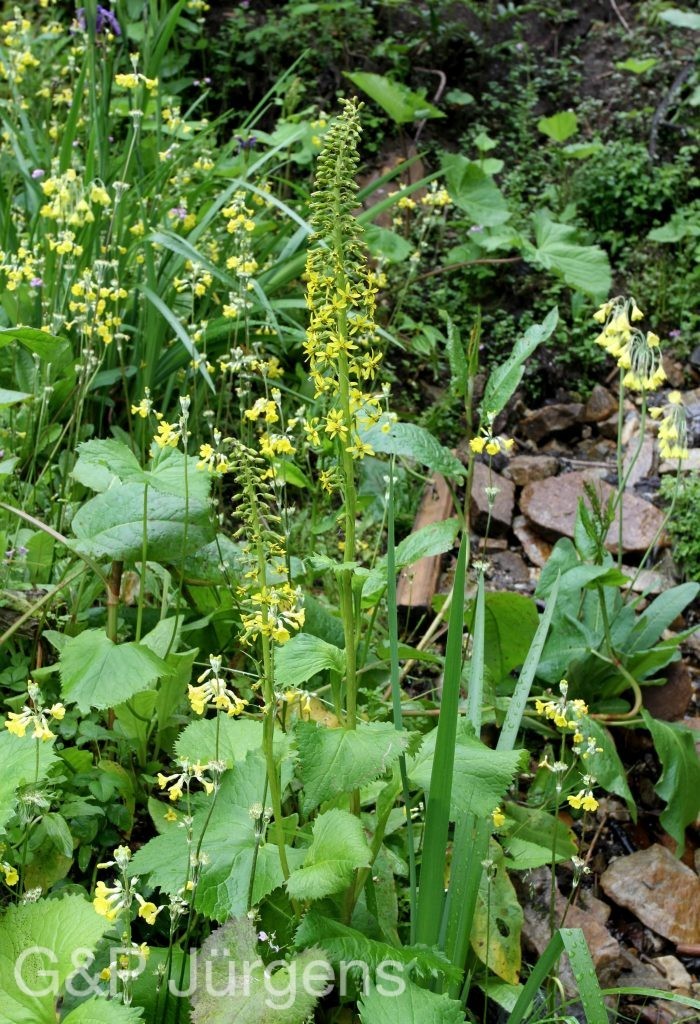
Ligularia fischeri is a robust, broadly distributed temperate-montane composite ranging across East Asia and the Himalaya, recorded from Japan, Korea (KR, KP), China, Russia, Mongolia, Nepal, India, Bhutan, Pakistan and Myanmar (JP, KR, CN, RU, NP, KP, IN, MN, BT, PK, MM), with nearly 3000 GBIF occurrences; further records from Europe and North America reflect cultivation and naturalisation. It favours moist, fertile situations: streamsides, wet meadows, marshy ground, forest margins and damp open slopes from montane to alpine elevations. The photographed plant grew on the Chele-La in Bhutan at 3900 m in August, flowering through the monsoon among tall herbaceous vegetation, here associated with Primula smithiana and Primula sikkimensis.

It is a stout perennial herb with a thick, fibrous-rooted rhizome producing erect flowering stems up to 1–1.5 m or more. The basal leaves are large, long-petiolate and reniform-cordate, with toothed margins and a broad, deeply cordate base, the petioles sheathing at the stem; cauline leaves diminish upward and become more clasping. The inflorescence is an elongate terminal raceme or narrow panicle of several to many radiate capitula, each subtended by a cylindric involucre of few phyllaries. The heads bear a few showy, ligulate, golden-yellow ray florets surrounding numerous yellow tubular disc florets. The fruit is a glabrous, cylindric, ribbed cypsela crowned by a pappus of whitish to brownish capillary bristles.

Ligularia (tribe Senecioneae) is a large genus of the temperate Old World especially diverse in the mountains of China; L. fischeri, described by Turczaninow, is among its most familiar and economically used species, its young leaves and shoots being gathered as a traditional vegetable and the plant valued horticulturally for damp gardens. Ecologically it is a tall-herb component of moist subalpine communities and a generalist food source for late-summer pollinators. Common and widespread, it is of least conservation concern.

Author: Turcz. · Sources: POWO (Kew), GBIF, Flora of China Vol. 20-21, Flora of Bhutan, Flora of Nepal, Ligularia monograph (Liu, Senecioneae of China)

(C.B.Clarke) Hand.-Mazz.

Bh09 38 P69
Bhutan Paro 2400m, June

Description

Ligularia mortonii is an East Himalayan endemic distributed across Bhutan, Nepal and adjacent north-eastern India, with GBIF documenting some 81 georeferenced occurrences concentrated along the inner Himalayan ranges. It is a plant of moist subalpine to temperate environments, favouring damp meadows, streamsides, forest margins and open grassy slopes where summer monsoon moisture is reliable. The photographed material from Paro in western Bhutan at around 2400 m, flowering in June, typifies its altitudinal preference in the temperate broadleaf and conifer belt, though populations ascend higher into subalpine pastures. Its restricted range marks it as a regional element of the Sino-Himalayan flora.

A robust perennial herb arising from a short stout rhizome bearing fibrous roots, it produces erect, often purplish, sparsely arachnoid-pubescent stems. The basal and lower cauline leaves are long-petiolate with reniform to cordate, palmately veined blades, the margins dentate to denticulate; upper leaves are progressively reduced and amplexicaul with sheathing bases. The capitula are radiate, several to many in an elongate raceme or narrow panicle, each subtended by small bracts. Involucral phyllaries are uniseriate and herbaceous; ray florets are yellow, ligulate and pistillate, surrounding numerous tubular yellow disc florets. The fruit is a glabrous cylindric cypsela crowned by a pappus of fine barbellate bristles.

The genus Ligularia (tribe Senecioneae) is centred on the mountains of China and the Himalaya, where it has radiated extensively, and species delimitation often rests on leaf shape, capitulescence form and phyllary characters. L. mortonii, based on Senecio mortonii, exemplifies the taxonomic complexity of the group. Like many congeners it accumulates pyrrolizidine alkaloids, and its nectar-rich heads attract bumblebees and other montane pollinators. Though not formally assessed as threatened, its dependence on intact subalpine meadow and forest-edge habitat renders it locally vulnerable to grazing pressure and land-use change.

Author: (C.B.Clarke) Hand.-Mazz. · Sources: POWO (Kew), GBIF, Flora of Bhutan, Flora of China, Annotated Checklist of the Flowering Plants of Nepal, Liu's Monograph of Ligularia (Senecioneae)

DC.

Sikkim2003 446 P619
Sikkim Chopta-Valley 4250m, August

Description

Ligularia retusa is a robust perennial composite of the alpine zone of the eastern Himalaya and adjacent China, native to China, Nepal, Bhutan and India, with about 201 documented occurrences. It grows in moist alpine meadows, streamsides, marshy turf and damp open slopes, typically between about 3500 and 4500 m. The photographed plant was recorded in the Chopta Valley of northern Sikkim at 4250 m, flowering in August, at the height of the monsoon when meltwater and rainfall sustain the lush herbaceous communities of the high pastures.

The species is a stout herb arising from a short rhizome with fibrous roots, producing a few large basal leaves on long petioles; the blades are reniform to broadly cordate with a retuse or shallowly notched apex (the epithet retusa) and a crenate-dentate margin, glabrous or thinly hairy. The cauline leaves are smaller and clasping. The inflorescence is a raceme or narrow corymb of several to many radiate capitula; the involucral bracts are in one or two series, and the heads bear bright yellow to orange-yellow ligulate ray florets surrounding numerous tubular disc florets. The fruit is a glabrous cylindrical cypsela crowned by a pappus of slender bristles.

Ligularia, of the tribe Senecioneae, is a large genus centred on the Sino-Himalayan mountains, distinguished from Senecio by its few-seriate involucre and habit; species delimitation in the Himalayan radiation is often difficult. As a tall meadow herb it is a conspicuous element of late-summer alpine flora and is visited by a range of insects. Widely distributed across the eastern Himalaya, it is not regarded as being of conservation concern.

Author: DC. · Sources: POWO (Kew), GBIF, Flora of Bhutan, Flora of China, The Genera Ligularia, Cremanthodium and Parasenecio (Liu)

Mattf. ex Rehder & Kobuski

BhutanPG2011 799 01 01
Bhutan 2011
Sikkim2003 537 G747
Sikkim, 08.2003

Description

Ligularia virgaurea is a robust perennial of alpine meadows and grasslands centred on the Qinghai-Tibetan Plateau and extending into the Himalaya, with native records from China, Russia, Bhutan, Nepal and India; among the 777 occurrences, the European and other extra-regional points reflect garden cultivation rather than wild range. It forms extensive colonies on moist meadows, marshy pasture, riverbanks and open slopes, typically between about 2600 and 4700 m, and can dominate overgrazed grassland as an unpalatable increaser. The material documented from Bhutan in 2011 and Sikkim in August 2003 places it in the well-watered subalpine to alpine zone of the eastern Himalaya.

The species is a clump-forming herb with a stout rootstock and erect, glabrous to thinly hairy stems. The basal leaves are long-petiolate, with elliptic to ovate-oblong, entire or denticulate blades and sheathing petiole bases; the cauline leaves are reduced and clasping. The capitula are numerous, small and radiate, borne in a dense, narrow, racemose to spike-like synflorescence. Each head has a cylindric involucre of few phyllaries, a small number of yellow ray florets and yellow tubular disc florets. The cypselae are cylindric, glabrous and ribbed, crowned by a pappus of reddish-brown to whitish barbellate bristles.

Ligularia is a large Old World genus of the Senecioneae, richly developed on the Tibetan Plateau, distinguished from the closely allied Cremanthodium by its erect, non-nodding capitula. L. virgaurea is notably variable in leaf shape and inflorescence density, and several infraspecific forms have been recognised. Its tissues contain pyrrolizidine alkaloids and other deterrents, so livestock avoid it, allowing the species to expand under heavy grazing. It is widespread and abundant and is of no conservation concern.

Author: Mattf. ex Rehder & Kobuski · Sources: POWO (Kew), GBIF, Flora of China Vol. 20-21, Flora of Bhutan, Flora of Nepal, Liu Revision of Ligularia

(DC.) Pimenov & Kljuykov

Sikkim2003 98 P135
Sikkim below Dzongri 3700m 08.2003
Sikkim2003 161 P214
Sikkim below Dzongri 3900m, August

Description

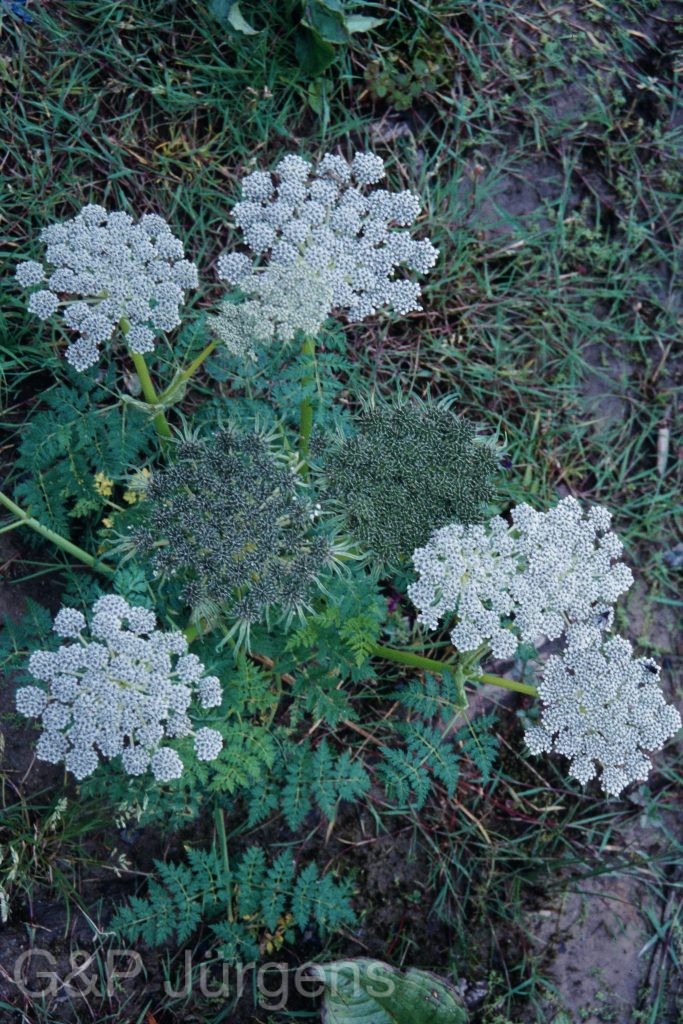
Ligusticopsis wallichiana is a Himalayan umbellifer ranging from Pakistan and northern India through Nepal, Sikkim and Bhutan into south-western China and Myanmar. The 406 GBIF records lie chiefly within this native arc, the European and North American points reflecting herbarium and garden material. It occupies subalpine and alpine meadows, forest clearings, open slopes and streamsides, generally between about 3000 and 4300 m, where it is a characteristic tall herb of moist Himalayan grassland. The plants photographed below Dzongri in Sikkim at 3700 to 3900 m in August illustrate the species at the height of the monsoon flowering season on these damp, herb-rich slopes.

It is a stout, glabrous perennial herb arising from a thick, aromatic rootstock, with erect, ribbed, often purplish stems. The leaves are large and several times pinnate (ternate-pinnate), the ultimate segments lanceolate to ovate and toothed, the lower leaves long-petiolate with sheathing bases. The inflorescence is a terminal compound umbel with numerous rays, subtended by narrow bracts and bracteoles; the small flowers are white. The fruit is an oblong-ellipsoid, dorsally compressed schizocarp with prominently winged lateral ribs, splitting into two mericarps.

Long familiar as Selinum wallichianum (its WordPress URL preserves that name), the species was transferred to Ligusticopsis by Pimenov and Kljuykov in their revision of the Selinum-Ligusticum complex, reflecting carpological and molecular evidence. The aromatic root has a history of use in Himalayan folk medicine. Common and widespread across its range, it is not considered threatened and forms a conspicuous element of high Himalayan meadow vegetation.

Author: (DC.) Pimenov & Kljuykov · Sources: POWO (Kew), GBIF, Flora of Bhutan, Flora of China, Pimenov & Kljuykov Umbelliferae revision

Lilium nanum

by GP Jürgens

Klotzsch

BhutanPG2011 250
Bhutan Tsochenchen, 3800m June
Nepal 99 123 ergebnis
West-Nepal South of Rara-Lake 3650m, June

Description

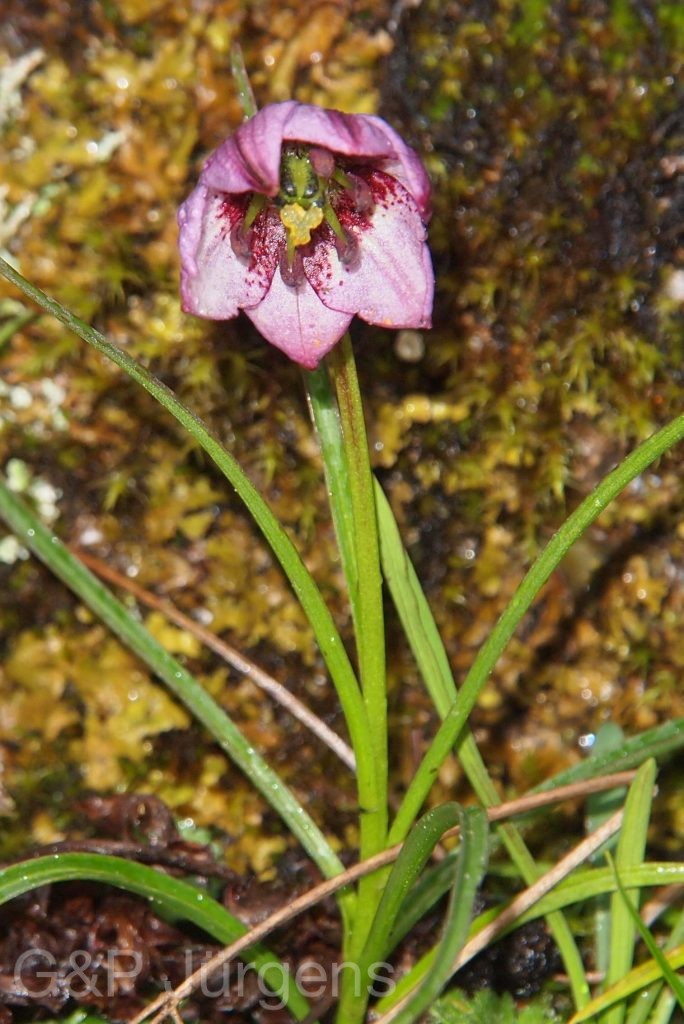
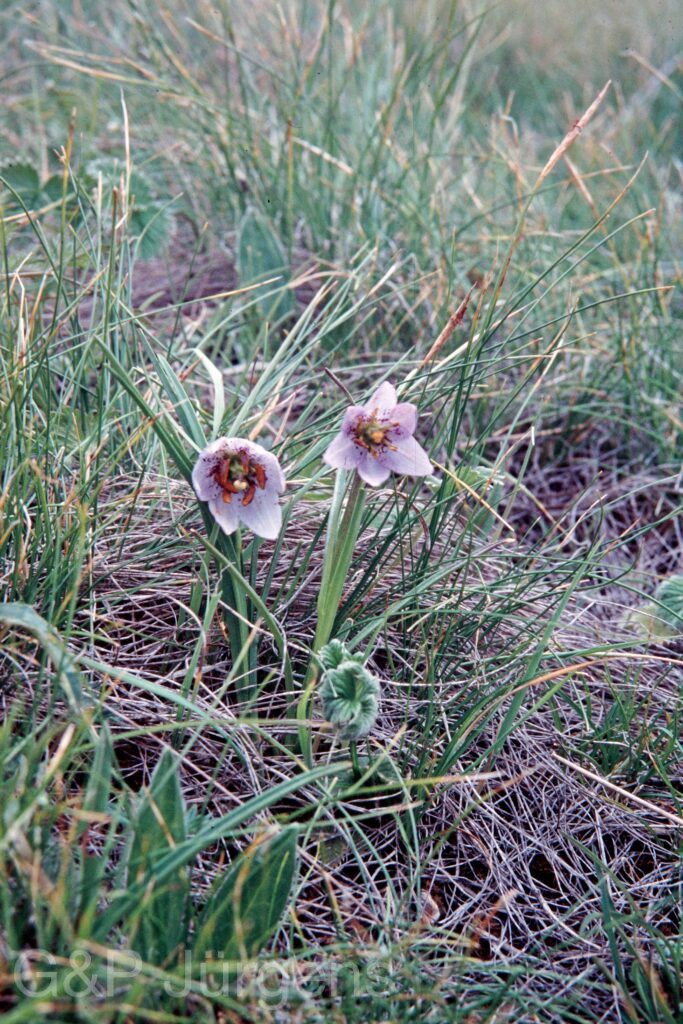
Lilium nanum is a diminutive alpine lily of the Himalaya and adjoining China, recorded from China, Nepal, India, Bhutan and Myanmar, with GBIF documenting some 410 occurrences (outlying records reflecting cultivation). It grows in subalpine and alpine meadows, open Rhododendron and juniper scrub, grassy slopes and stabilised screes, generally between 3000 and 4500 m. The photographed plants were found in Bhutan at Tsochenchen at 3800 m and in West Nepal south of Rara Lake at 3650 m, both in June, when this early-summer flowerer nods amid the freshly greening alpine sward soon after snowmelt.

It is a small bulbous perennial, the bulb ovoid with few lanceolate scales, giving rise to a slender, erect, unbranched stem rarely exceeding a hand-span in height. The leaves are scattered, linear to narrowly lanceolate, sessile and grass-like. The plant bears a solitary (rarely paired), nodding, broadly campanulate flower with six free, recurved-tipped tepals coloured pinkish-purple to deep purple, often tessellated or veined darker within and yellowish at the base. There are six stamens with versatile anthers and a superior, three-locular ovary topped by a slender style; the fruit is an erect, ribbed, loculicidal capsule producing flat, winged, wind-dispersed seeds.

The species belongs to genus Lilium (Liliaceae) and is among the smallest of all true lilies, sometimes treated with var. flavidum, a yellow-flowered variant of the eastern Himalaya. Prized by alpine gardeners, it is challenging in cultivation owing to its high-altitude requirements. While its broad range buffers it against extinction, local populations face pressure from grazing, bulb collection and warming-driven habitat shifts.

Author: Klotzsch · Sources: POWO (Kew), GBIF, Flora of China, Flora of Bhutan, Flora of Nepal, The Genus Lilium (Comber/McRae)

Lilium nepalense

by GP Jürgens

D.Don

BhutanPG2011 703 01 01
Bhutan Luksor, 2700m July
Nepal 99 900 ergebnis
West-Nepal Sepka 2700m, July
Nepal 99 1005 ergebnis
West-Nepal Sepka 2700m, July
Nepal 99 1006 ergebnis
West-Nepal Sepka 2700m, July

Description

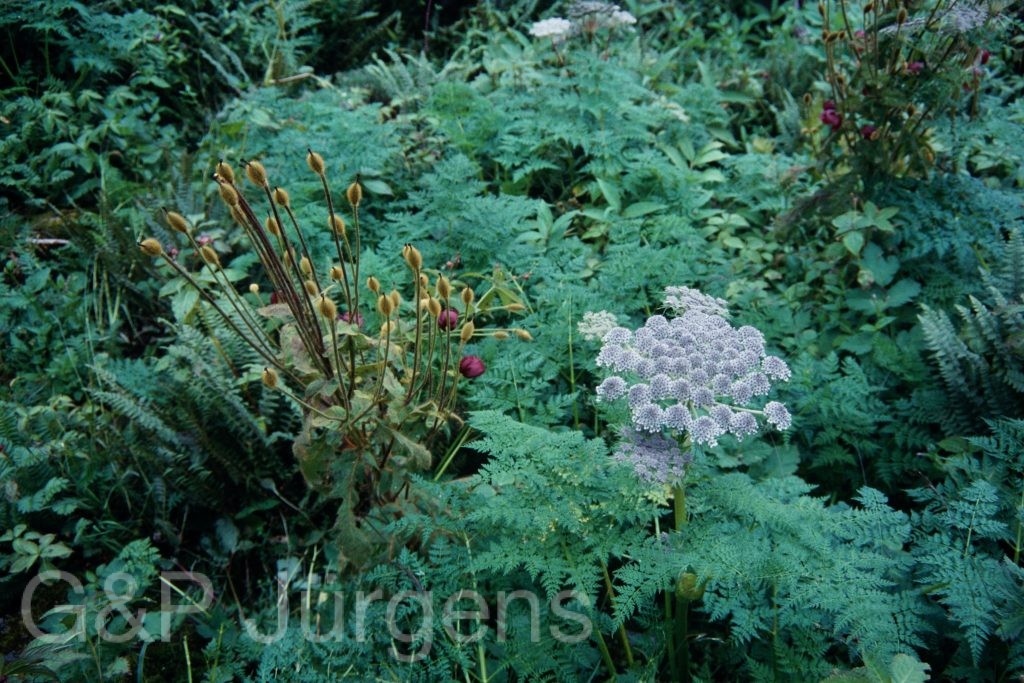
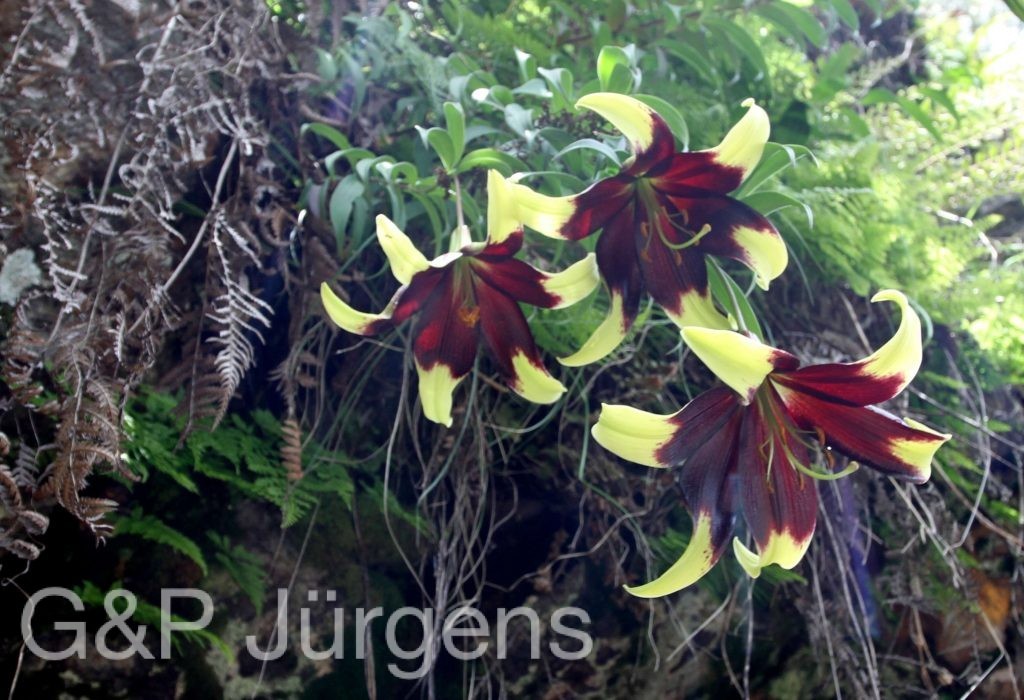
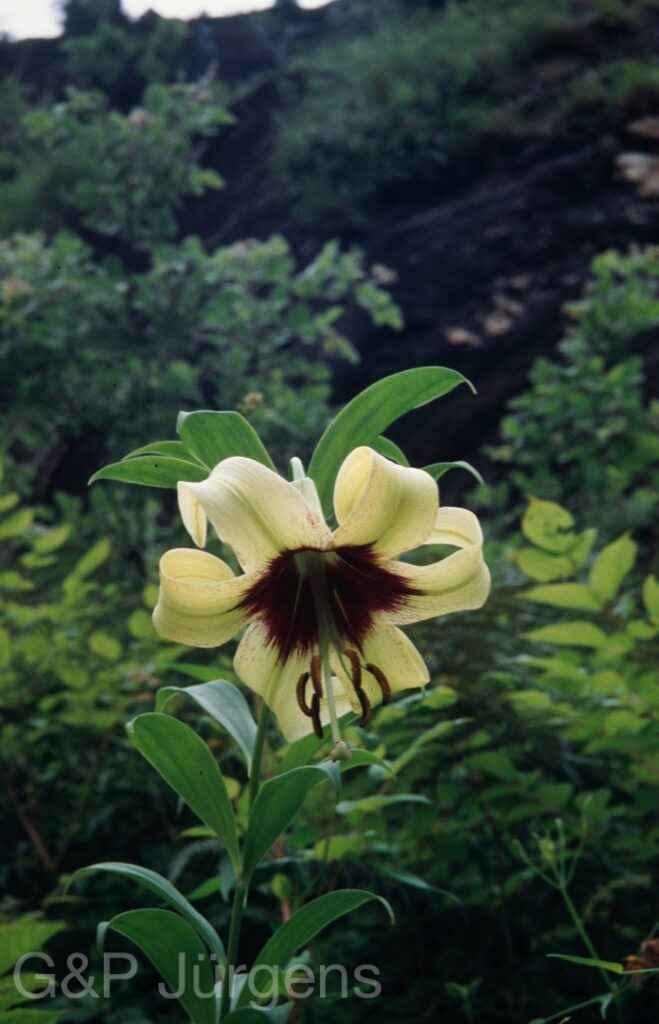
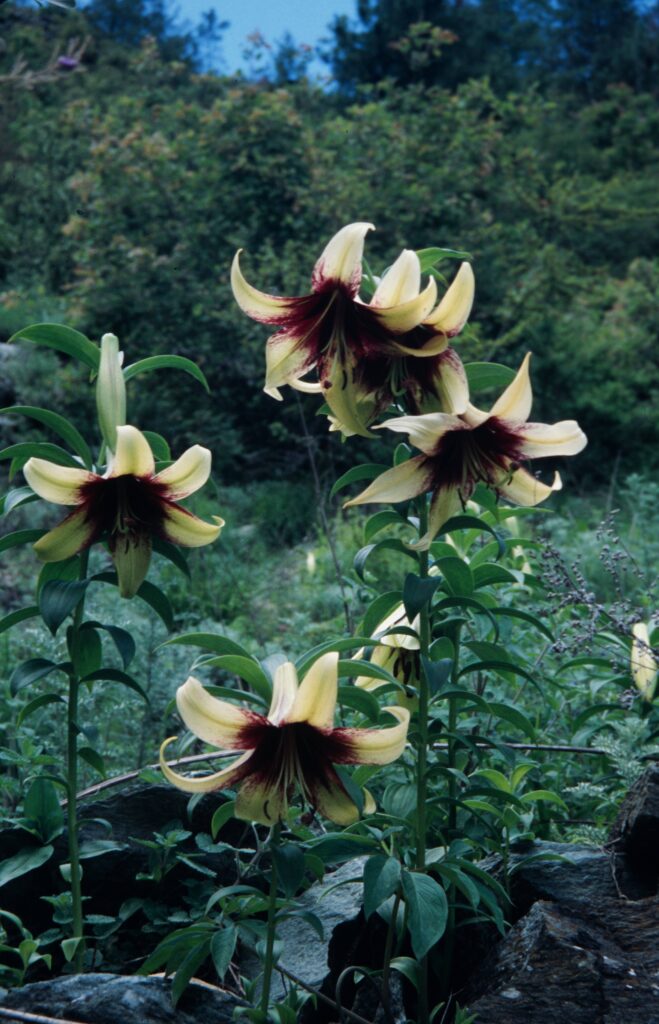
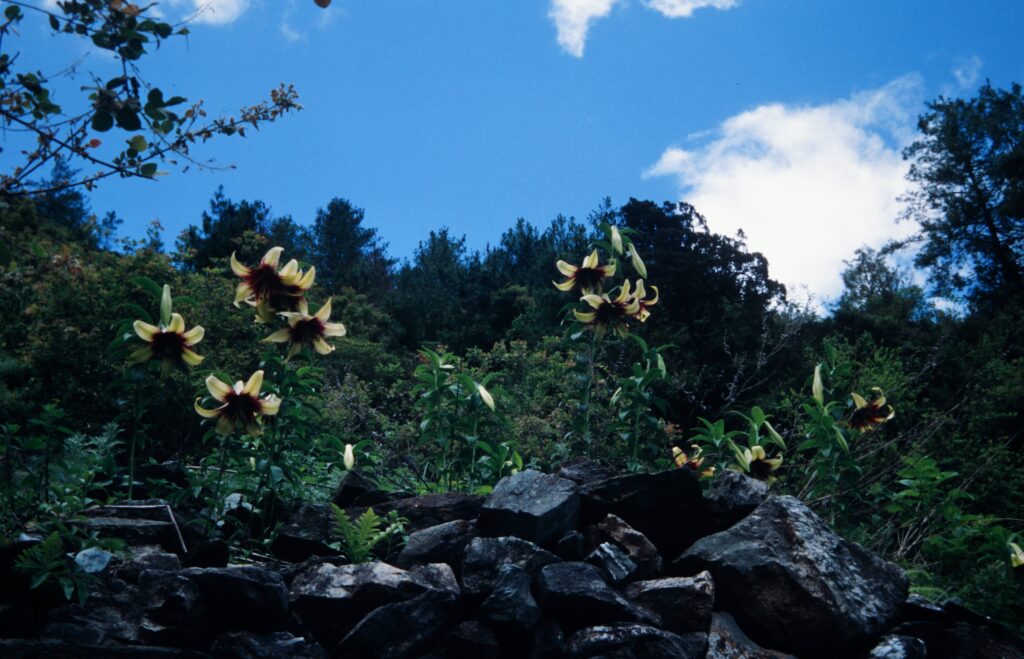
Lilium nepalense is a striking Himalayan lily native to Nepal, Bhutan, northern India and south-western China, extending into Myanmar; GBIF records (around 206 occurrences) also reflect numerous cultivated and naturalised collections in Europe and South-East Asia, as it is widely grown as an ornamental. In its natural range it inhabits cool, humid temperate to subalpine slopes, growing among shrubberies, in forest clearings, on grassy banks and along the margins of oak, rhododendron and conifer woodland on rich, well-drained humic soils. The collections from Luksor in Bhutan and Sepka in western Nepal, both near 2700 m in July, illustrate its mid-montane elevation and monsoon-season flowering.

The plant grows from a stoloniferous bulb with loosely imbricate white scales, the underground stem often wandering before emerging. The erect, leafy aerial stem bears scattered, lanceolate to ovate, sessile or shortly petiolate leaves with prominent parallel venation. The flowers, borne singly or few in a lax raceme, are large, nodding and broadly funnelform to trumpet-shaped; the six recurved tepals are luminous greenish-yellow to pale chartreuse with a dramatic deep maroon to purple-black throat blotch, giving the species its horticultural celebrity. The six stamens carry large versatile anthers, and the slender style ends in a capitate three-lobed stigma. The superior ovary develops into an erect, oblong, three-valved capsule with numerous flat, winged seeds.

Described by D. Don, Lilium nepalense belongs to a Sino-Himalayan group of trumpet lilies and is prized in cultivation for its colour contrast and fragrance, having earned horticultural recognition in temperate gardens. Its stoloniferous bulb is an adaptation for vegetative spread through loose montane soils. While locally frequent, wild populations face pressure from over-collection of bulbs, grazing and habitat disturbance, making sustainable propagation important for relieving demand on natural stands.

Author: D.Don · Sources: POWO (Kew), GBIF, Flora of Bhutan, Flora of China, Stainton Flowers of the Himalaya, The Genus Lilium (Jefferson-Brown)

Benth.

Nepal 95 249 P429 ergebnis
Nepal Valley of Buri Gandaki, Kholabensi 2100m October

Description

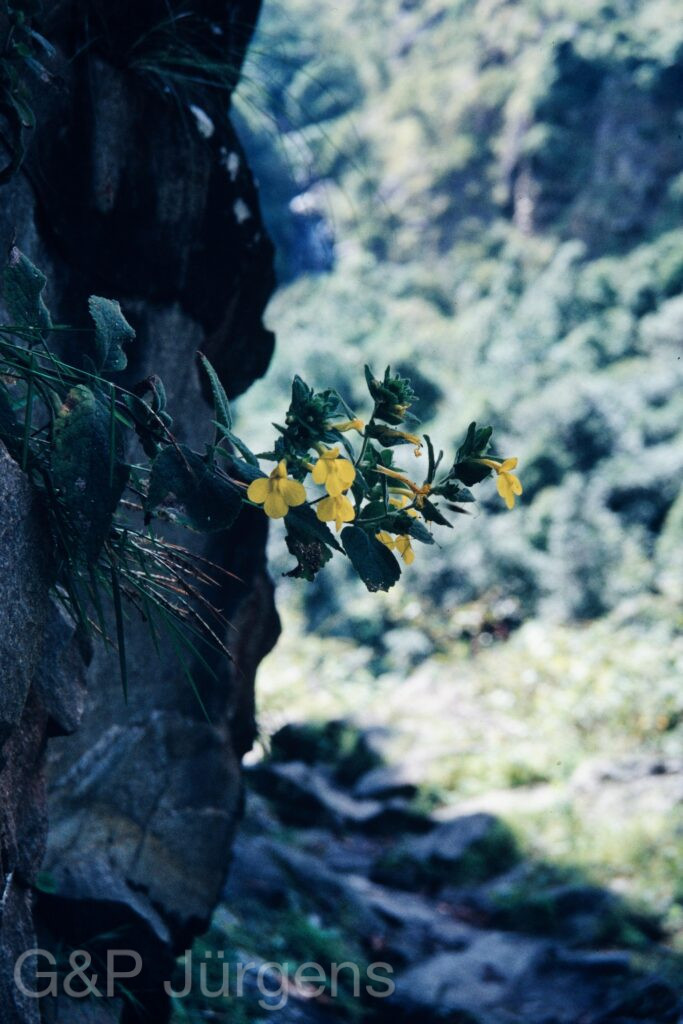
Lindenbergia grandiflora is a Himalayan herb ranging from Nepal and northern India through Bhutan into south-western China, with naturalised or introduced records noted elsewhere (including Italy and Vietnam among the catalogued occurrences). It is characteristically a plant of rocky places, old walls, dry banks, cliff ledges and other lithic, sun-exposed habitats at low to mid elevations, broadly between about 700 and 2,400 m. The plant photographed in the valley of the Buri Gandaki at Kholabensi, Nepal, at 2,100 m in October, captures its autumn flowering on the steep, well-drained slopes of an inner Himalayan river gorge.

It is an erect, branched, glandular-pubescent perennial or biennial herb with somewhat woody-based stems. The leaves are opposite below, ovate to lanceolate, with crenate-serrate margins and a softly hairy surface. The flowers are borne in the upper leaf axils, forming a leafy terminal raceme; the corolla is comparatively large for the genus, bright yellow, weakly two-lipped with a short tube and spreading lobes, the throat often bearing reddish markings. The calyx is campanulate and five-toothed; stamens four, didynamous. The fruit is a septicidal capsule with numerous small seeds.

Lindenbergia, formerly placed in Scrophulariaceae, is now referred variously to Orobanchaceae or, as here, to Plantaginaceae depending on classification; molecular studies place it among the basal, non-parasitic lineages near the Orobanchaceae, unlike its hemiparasitic relatives. The genus is a small Old World group centred on tropical Asia and Africa. The species is locally frequent on suitable rocky substrates and is not regarded as threatened.

Author: Benth. · Sources: POWO (Kew), Flora of China Vol. 18, Flora of Bhutan Vol. 2, GBIF, Fischer: Scrophulariaceae (Genera Orobanchaceae & allies)