Author

GP Jürgens

Buch.-Ham. ex D.Don

Bh09 168 P297
Bhutan Labana 3600m May

Description

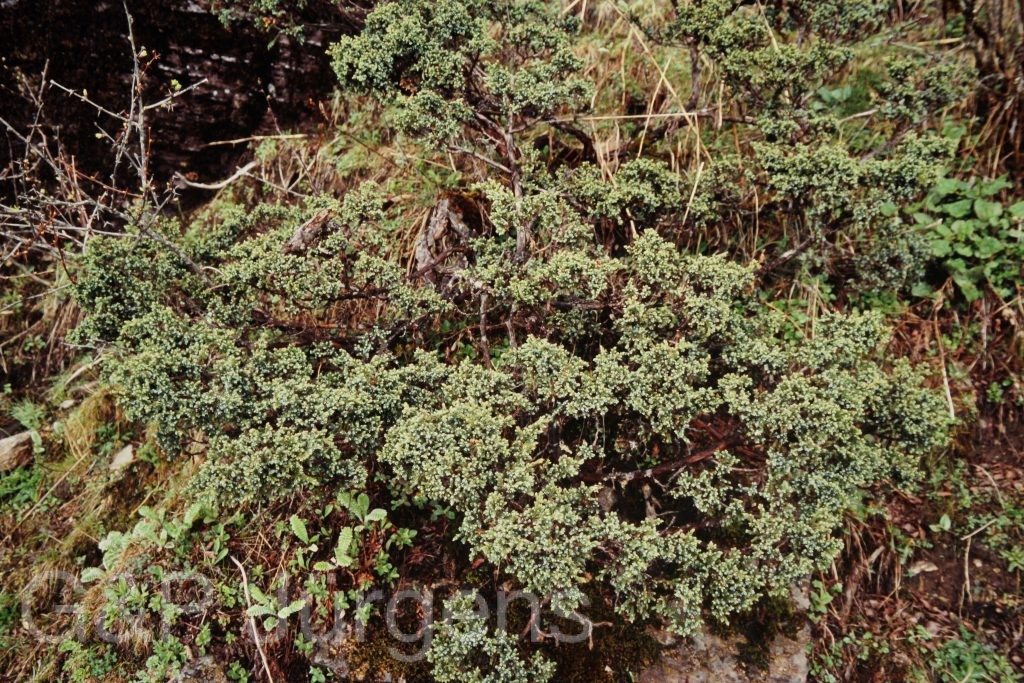
Juniperus squamata Buch.-Ham. ex D.Don is a variable, mostly prostrate to shrubby juniper of the Cupressaceae, native across the Himalaya and central and western China and recorded from Nepal, India, Bhutan, Pakistan, Afghanistan and Myanmar; with over 3,300 georeferenced records, many from cultivation in Europe, North America and Australasia, it is a widely grown ornamental as well as a wild montane species. In the wild it occupies high-altitude scrub, rocky alpine slopes, open conifer forest margins, ridges and exposed crests near and above the treeline. The photographed plant from Labana in Bhutan at about 3,600 m in May is typical of its subalpine to alpine station, where it often forms low spreading mats anchoring thin stony soils.

It is an evergreen shrub, frequently decumbent and mat-forming but sometimes erect and small-tree-like, with reddish-brown, flaking bark and ascending branchlet tips that are characteristically nodding. The foliage is entirely needle-like (acicular) and arranged in dense whorls of three, each leaf rigid, sharply pointed, concave and glaucous-white on the upper surface, giving the plant a frosted appearance. The species is usually dioecious; the seed cones are small, ovoid, ripening from green through reddish to glossy black, fleshy and berry-like, and contain a single seed.

Juniperus squamata belongs to section Juniperus, the needle-leaved junipers, and is morphologically variable across its range, having given rise to numerous horticultural cultivars selected for habit and foliage colour. As a slow-growing pioneer of harsh exposed sites it contributes to soil stabilisation at high elevation. The species is widespread and assessed as Least Concern, though local stands are affected by grazing and fuelwood collection.

Author: Buch.-Ham. ex D.Don · Sources: POWO (Kew), Flora of China Vol. 4, Flora of Bhutan Vol. 1, GBIF, Adams: Junipers of the World (2014)
L.

Nepal1992 15 P20 ergebnis
Nepal Tumlingtar 1200m March 
Nepal1992 16 P21 ergebnis
Nepal Tumlingtar 1200m March 

Description

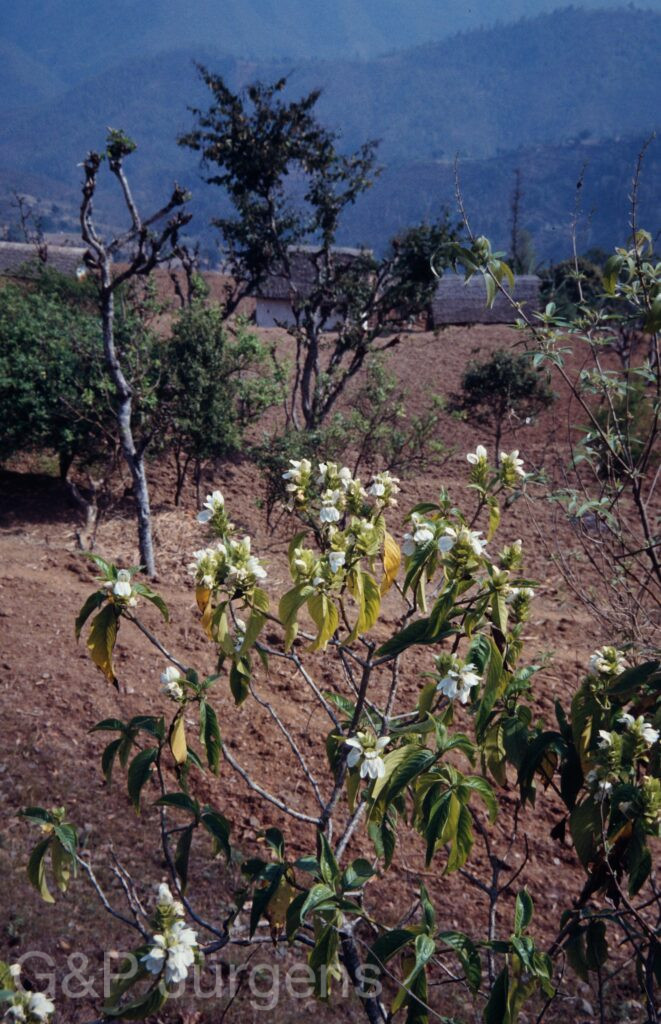
Justicia adhatoda, the Malabar nut or vasaka, is a widely distributed shrub native to the Indian subcontinent and now naturalised or cultivated across much of the tropics and subtropics; GBIF records (over 1500) span India, Nepal, Pakistan, Sri Lanka, China, Southeast Asia and many introduced regions in the Americas, Europe and beyond. In its Himalayan range it grows in the subtropical foothills and warm valleys, along streamsides, forest margins, fallow land and roadside scrub, generally below about 1300 m. The photographed plant from Tumlingtar in eastern Nepal (1200 m, flowering in March) sits squarely within this lower-elevation, dry-season-flowering habitat.

The plant is a robust, evergreen, much-branched shrub reaching 1–3 m, with opposite, lanceolate to elliptic-oblong, entire leaves that are pinnately veined and emit a strong odour when crushed. The flowers are borne in dense, axillary or terminal, bracteate spikes, the large ovate bracts conspicuous. Each flower is strongly two-lipped (bilabiate): the corolla is white to pale, the lower lip marked with purple to pinkish veining and a yellow throat. There are two stamens with bithecous anthers whose cells are unequally inserted. The fruit is a clavate, four-seeded capsule that dehisces explosively, the seeds projected from retinacula in the manner characteristic of Acanthaceae.

The species is of considerable economic and ethnobotanical importance, long used in Ayurvedic and Unani medicine for respiratory complaints; its leaves contain the quinazoline alkaloid vasicine (peganine) and related compounds with bronchodilatory and expectorant activity. Taxonomically it was formerly segregated in the monotypic genus Adhatoda but is now embedded within a broadly circumscribed Justicia. Being weedy and widely cultivated, it is of no conservation concern.

Author: L. · Sources: POWO (Kew), GBIF, Flora of Nepal, Flora of British India, Flora of China (Acanthaceae), A Revision of the genus Justicia (Acanthaceae)

L.

Nepal 97 410 P792
Nepal Tashigaon 3000m May
Nepal 2001 173 ergebnis ergebnis
East-Nepal Sabha-Khola 2100m, April

Description

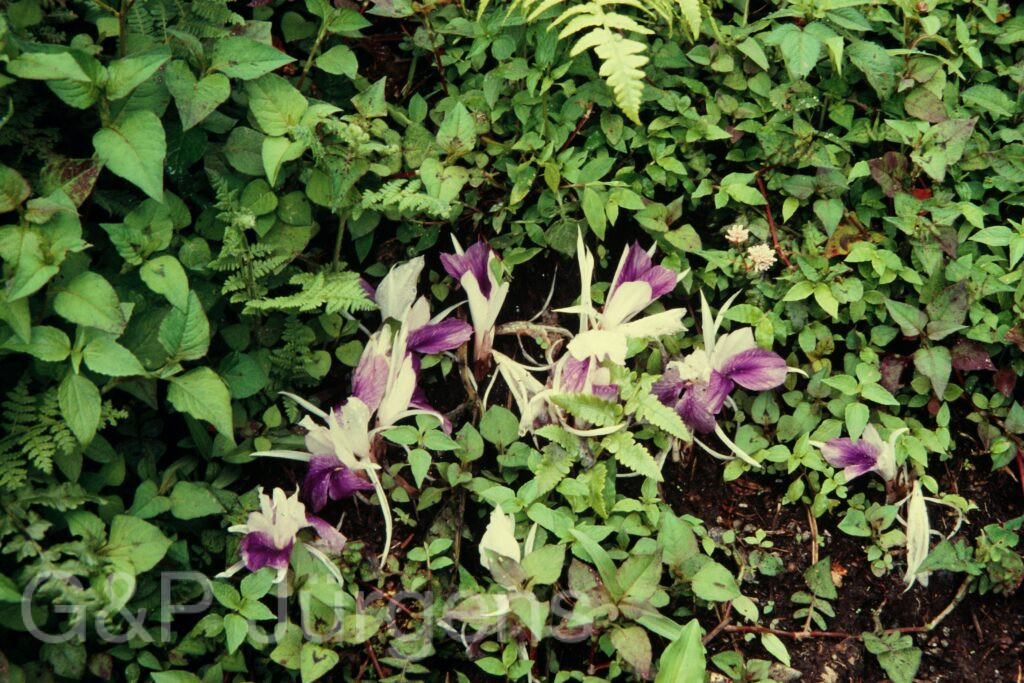
Kaempferia rotunda L. is a tuberous, rhizomatous herb of the ginger family native to tropical and subtropical Asia and very widely cultivated, so that its GBIF record (586 occurrences) spans India, Myanmar, China, Thailand, Bangladesh, Cambodia, Laos, Vietnam, Indonesia and the Philippines alongside many introduced localities in the Neotropics, North America and the Pacific. In the Himalayan foothills it grows in warm, shaded forest, scrub and disturbed ground; it was recorded in eastern Nepal at Sabha-Khola near 2100 m in April and at Tashigaon around 3000 m in May, the latter elevation being unusually high and probably reflecting sheltered, low-frost microsites or local cultivation.

The plant arises from a clustered, aromatic rhizome bearing fleshy tuberous roots. The leaves, two to four per shoot, are oblong-lanceolate, often handsomely variegated with dark and silvery-green zones above and purplish beneath, and appear after or with flowering. The inflorescence is hysteranthous, emerging directly from the rhizome at ground level before the leaves expand: a cluster of short-lived flowers with white, narrowly oblong corolla lobes, two petaloid white staminodes, and a conspicuous, deeply bilobed lilac to violet labellum. The fruit is a three-valved capsule, though propagation is largely vegetative.

Kaempferia rotunda is the type species of its genus and is grown ornamentally as 'peacock ginger' and used in traditional medicine across South and Southeast Asia, its rhizomes valued for fragrant essential oils. Its enormous naturalised range testifies to long human movement of the species. Pollination of the showy ephemeral flowers is by bees and other insects attracted to the labellar nectar guides, while persistence in cultivation buffers it against any wild conservation concern.

Author: L. · Sources: POWO (Kew), GBIF, Flora of China, Flora of Bhutan, Flora of British India, Zingiberaceae monograph (Larsen & Larsen; K. Schumann Zingiberaceae)

Cauwet & S.B.Malla

Bhutan2012 244
Bhutan Shele-La, 3900m September

Description

Keraymonia cortiformis is a high-alpine umbellifer of the eastern Himalaya, restricted to Nepal, Bhutan and adjacent China, where GBIF records only about 30 occurrences, reflecting its narrow range and limited collection. It is a plant of the upper subalpine to alpine zone, growing on open stony slopes, screes, rock crevices and short alpine turf above the treeline, typically between roughly 3500 and 4500 m. The image from Shele-La in Bhutan at about 3900 m in September captures it in a characteristic exposed high-pass habitat, where late-season fruiting plants persist among cushion vegetation and frost-disturbed gravels.

It is a low, tufted perennial herb arising from a stout, often woody rootstock crowned by fibrous remains of old leaf bases. The stems are short, decumbent to ascending and few. Leaves are mostly basal, petiolate with sheathing bases, the blades one- to two-pinnate or ternately divided into small, crowded, oblong to cuneate segments, somewhat fleshy and glabrous to minutely scabrid. The inflorescence is a compact compound umbel with few short, unequal rays, subtended by bracts and bracteoles; flowers are small with white to pinkish petals. The fruit is an ovoid to oblong schizocarp, the mericarps dorsally compressed with prominent ribs and vittae characteristic of the genus.

Keraymonia is a small Himalayan genus segregated from broader concepts within the Apiaceae on fruit and habit characters; this species was described by Cauwet and S.B. Malla. Its cushion-forming, taprooted habit and reduced umbels are typical adaptations to cold, wind-exposed alpine environments with short growing seasons. Owing to its restricted distribution and small known population, it is of biogeographic interest as a high-elevation endemic, and warrants monitoring given the vulnerability of narrowly ranging alpine taxa to climatic warming.

Author: Cauwet & S.B.Malla · Sources: POWO (Kew), GBIF, Flora of Bhutan, Flora of China (Apiaceae), Pimenov & Leonov Genera of the Umbelliferae

(Royle ex Benth.) Rupr.

Sikkim2003 197 P275
Sikkim Dzongri 4100m 08.2003
Nepal 99 650 ergebnis
West-Nepal Kagmara-La 5000m, July
Nepal 99 648 ergebnis
West-Nepal Kagmara-La 5000m, July
Nepal 99 662 ergebnis
West-Nepal Kagmara-La 5000m, July

Description

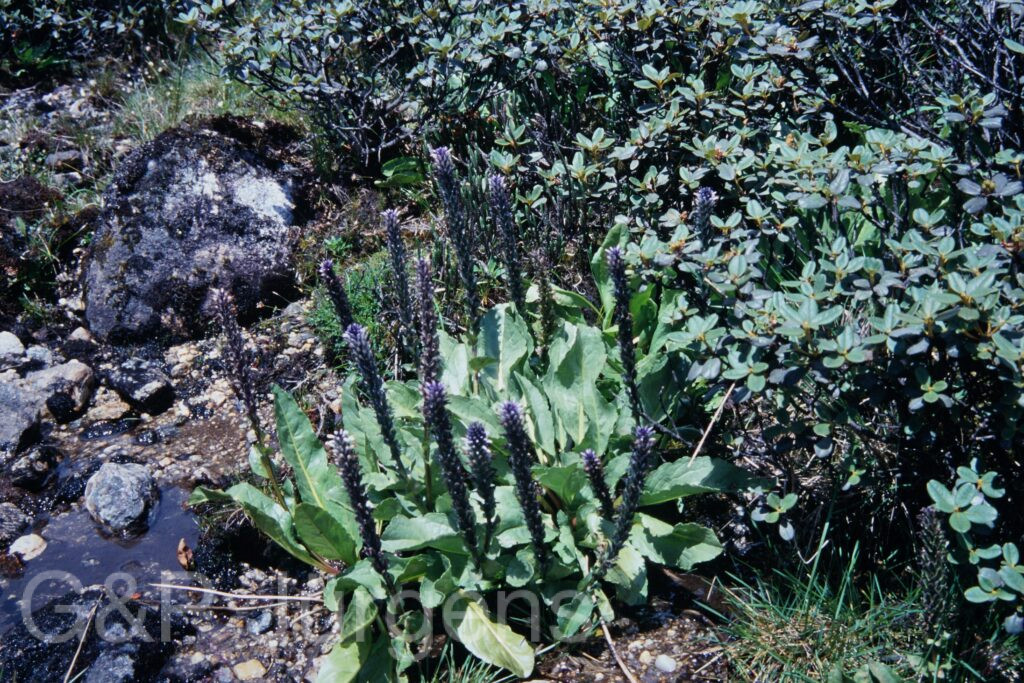
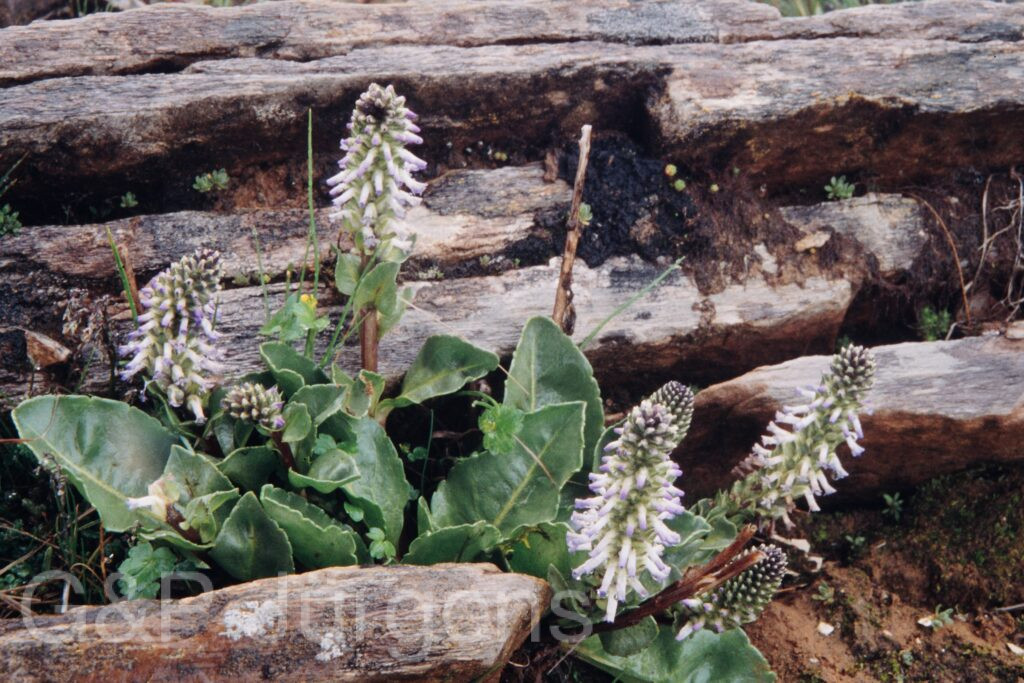
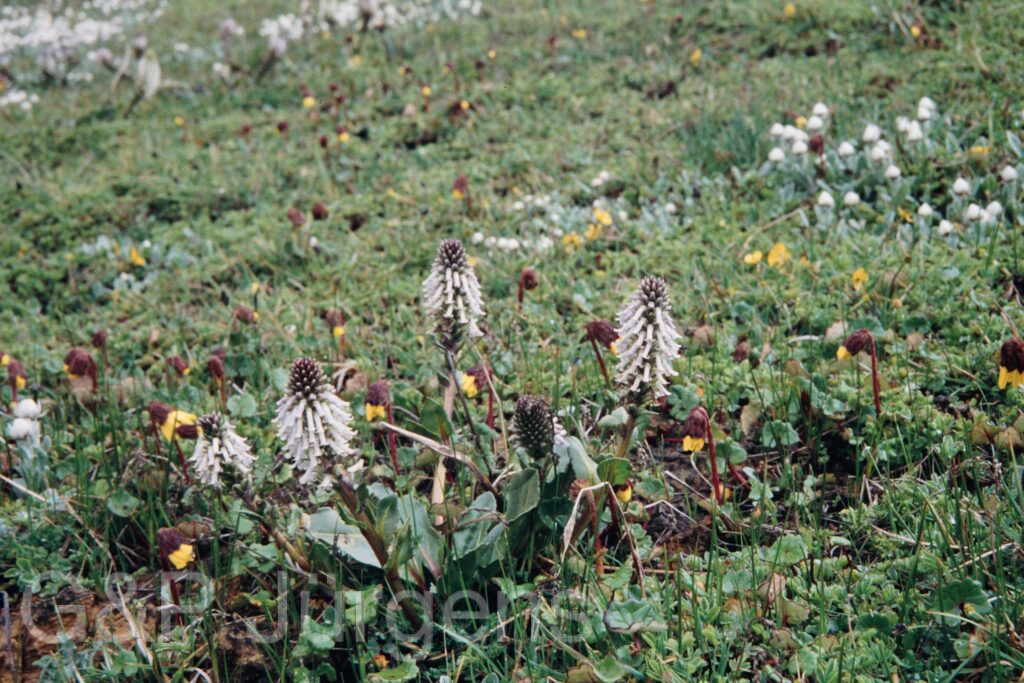
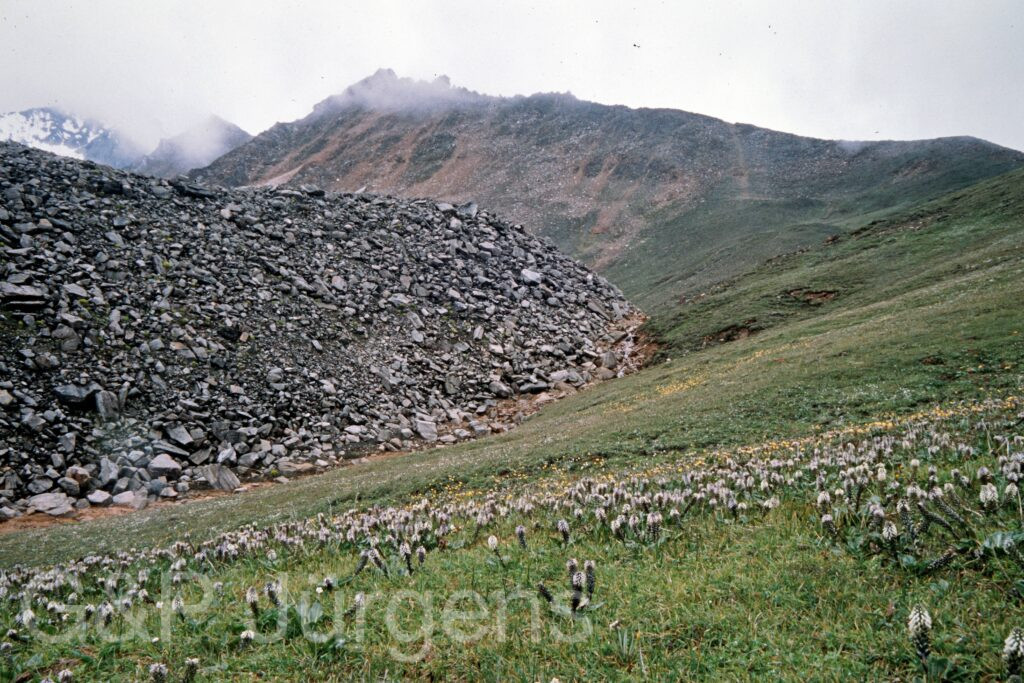
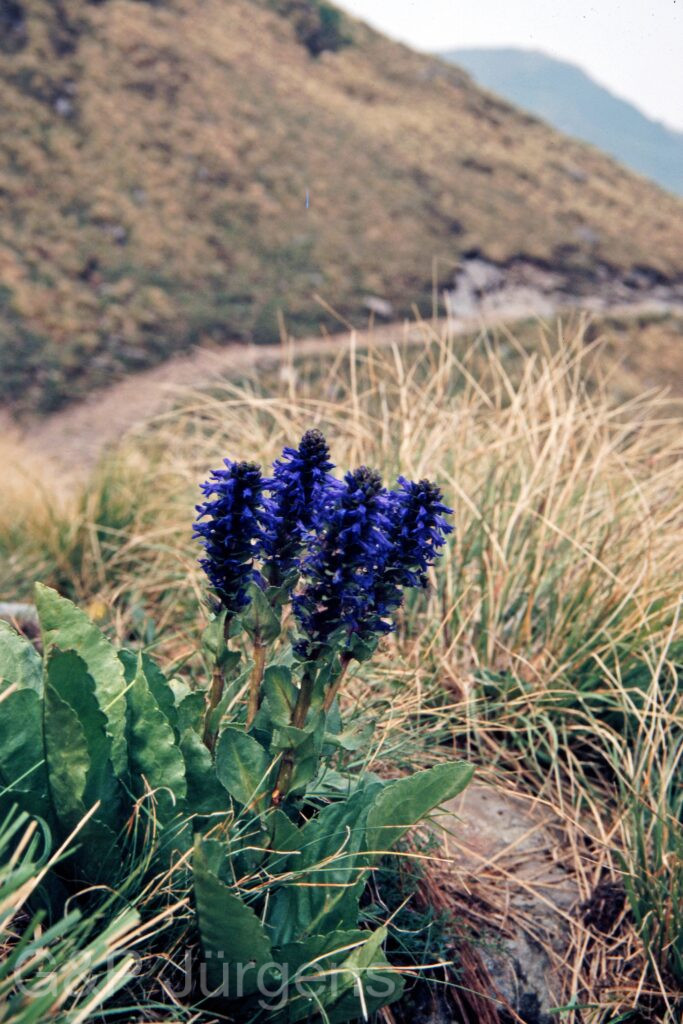
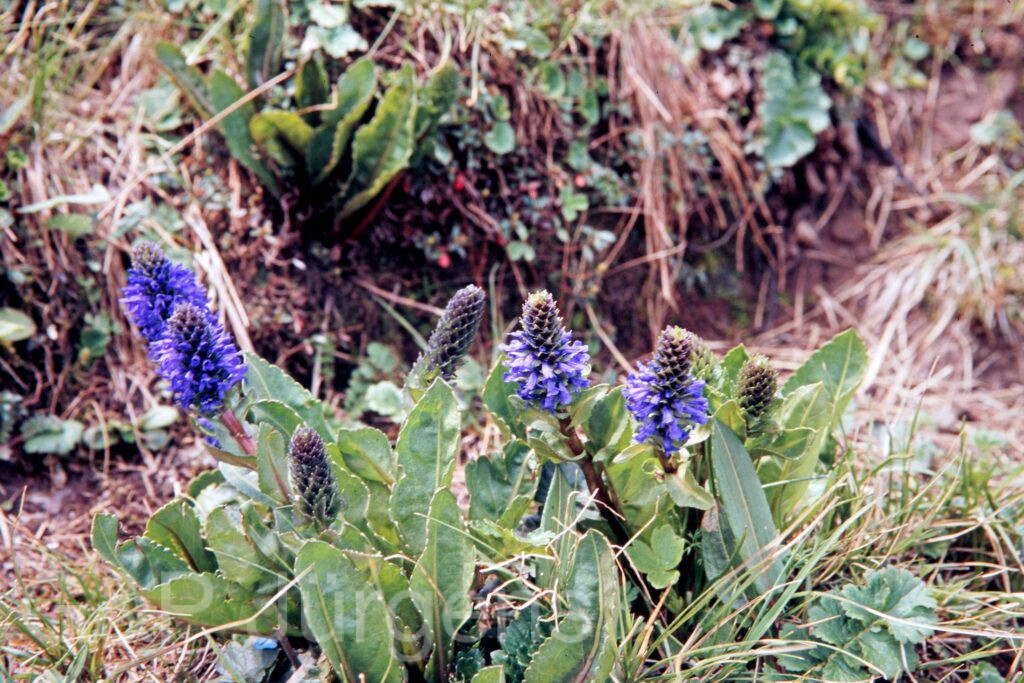
Lagotis kunawurensis is a low alpine herb of the high Himalaya, recorded by GBIF (about 116 occurrences) from Nepal, India, Pakistan and Bhutan, tracing the alpine belt from the western to the eastern part of the range. It is a plant of cold, open, high-elevation ground: short turf, stony slopes, moist alpine meadows, moraines and snow-flush margins, typically from 3500 m to well above 5000 m. The collections cited for the image span this full amplitude, from Dzongri in Sikkim at about 4100 m, to Kinkhola in Garhwal at 3550 m in June, up to the Kagmara-La in West Nepal at around 5000 m in July, the last representing one of the highest zones colonised by flowering plants in the region.

It is a small, fleshy, glabrous perennial arising from a stout rhizome or caudex with thickened roots. The leaves are mostly basal, long-petiolate, with ovate to oblong, somewhat succulent blades that are entire or shallowly crenate-toothed. The flowering stems are short and stout, the inflorescence a dense terminal spike or head of small bracteate flowers. The corolla is two-lipped (bilabiate), blue to violet or purplish, with the upper lip entire or notched and a lower lip of one to three lobes; there are typically two stamens. The fruit is a small drupe-like or two-seeded structure rather than the dry dehiscent capsule of many relatives, a feature distinctive of the genus.

Lagotis, with its concentration of species across the high mountains of Central Asia, the Himalaya and the Tibetan plateau, is now placed in Plantaginaceae following the molecular dismantling of the old Scrophulariaceae. The cushion-like, fleshy habit, short stature and early flowering are classic adaptations to the brief, cold, wind-exposed alpine growing season. Several Lagotis species are used in Tibetan and Himalayan ethnomedicine. As a widespread high-elevation specialist L. kunawurensis is not of conservation concern, though such strictly alpine taxa are intrinsically vulnerable to the upslope compression of habitat under climate warming.

Author: (Royle ex Benth.) Rupr. · Sources: POWO (Kew), GBIF, Flora of China Vol. 18, Flora of Pakistan, Flora of Nepal, Hong Monograph of the Subtribe Lagotidinae (Scrophulariaceae)

(D.Don) Tzvelev

Sikkim2004 102 P173
India West-Bengal, Utaray 2000m April
Sikkim 2006 186 ergebnis
India West-Bengal, Samadan 2400m, May

Description

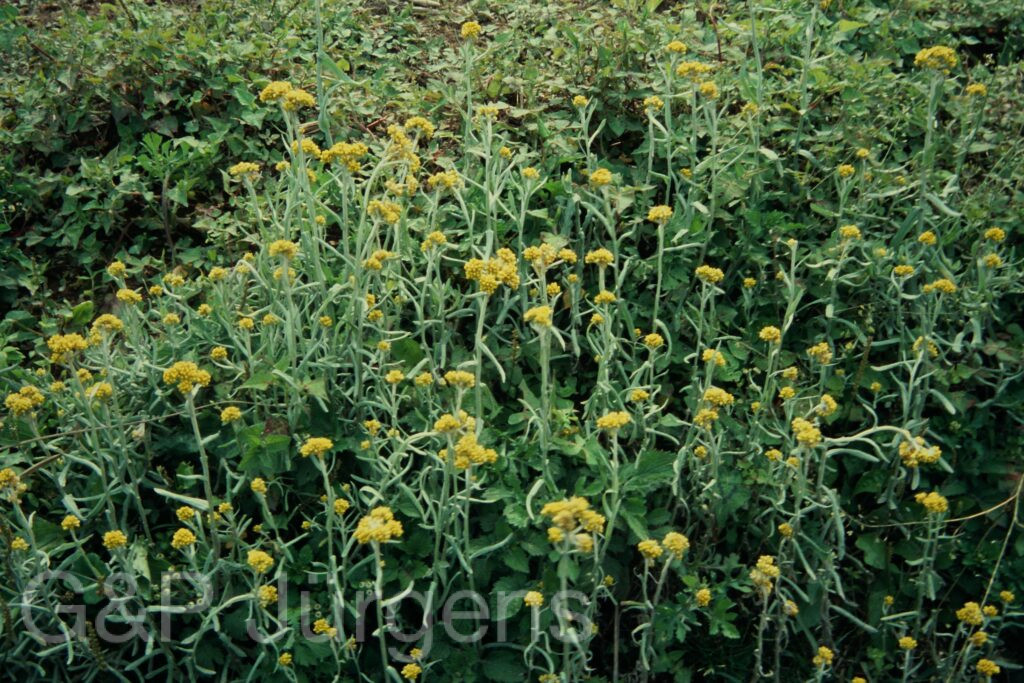
Laphangium affine is a widespread East and South Asian cudweed recorded from China, Japan, India, Taiwan, Vietnam, Nepal, Pakistan, Thailand, Georgia and Turkey, the roughly 99 georeferenced occurrences reflecting a broad continental range that extends westward into the Caucasus and Anatolia. It occurs from lowland to mid-montane elevations, the images documenting plants in West Bengal, India, at Utaray about 2000 m in April and Samadan about 2400 m in May. A plant of open, disturbed and seasonally moist ground, it colonises fields, fallows, roadsides, terrace banks, streamsides and weedy grassland, behaving as a fast-growing ruderal of cultivated and human-modified landscapes.

It is an erect annual or short-lived herb with simple or branched stems clothed, like the foliage, in a soft greyish-white woolly tomentum. The leaves are alternate, sessile, narrowly oblanceolate to linear-spathulate, entire-margined and densely lanate on both surfaces, the lower often withered at flowering. The numerous small capitula are aggregated into dense terminal and axillary glomerules; each head bears straw-coloured to yellowish, dry, scarious involucral bracts and contains many slender female florets surrounding a few central bisexual ones. The cypselae are minute and crowned by a caducous pappus of barbellate bristles, adapted for wind dispersal.

Under GBIF this name is treated as a synonym, with Laphangium affine itself standing as the accepted name; the taxon has been variously placed in Gnaphalium and Pseudognaphalium, reflecting the unsettled generic limits of the woolly cudweeds in tribe Gnaphalieae. Originally described by D. Don and transferred by Tzvelev, it is a successful weed across much of Asia, valued in some regions for medicinal and edible use. Given its wide range and ruderal ecology it is of no conservation concern.

Author: (D.Don) Tzvelev · Sources: POWO (Kew), GBIF, Flora of China, Flora of Pakistan, Gnaphalieae generic revision (Asteraceae)

DC.

BhutanPG2011 507
Bhutan Ludlow-Sherriff-Trail Shashuna, 4000m June
Nepal 99 528 ergebnis
West-Nepal Churta-Khola 3800m, June

Description

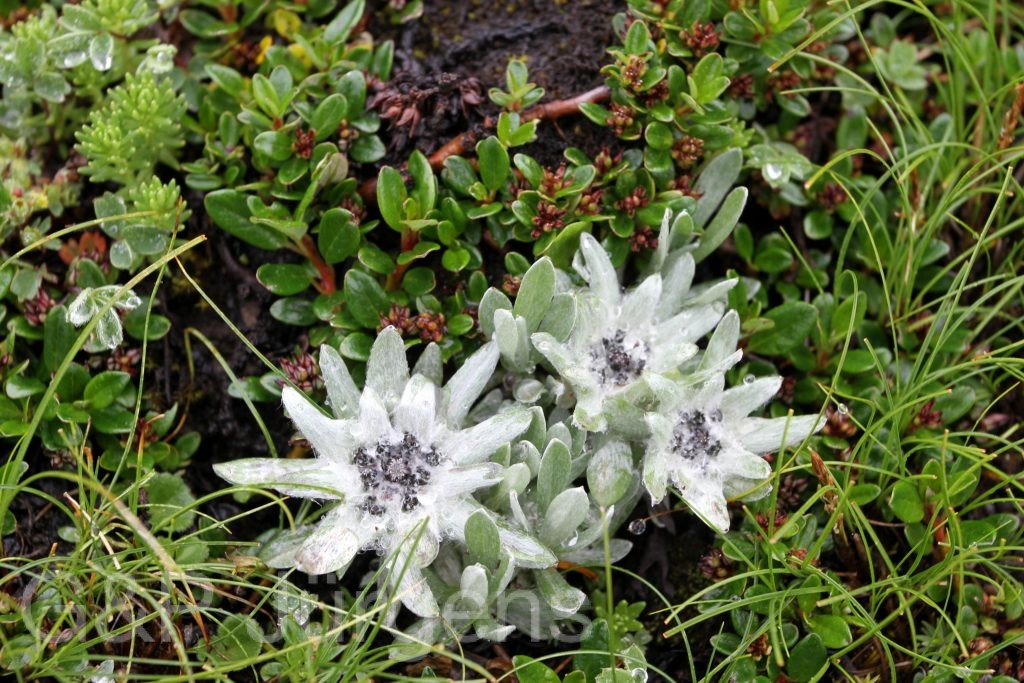
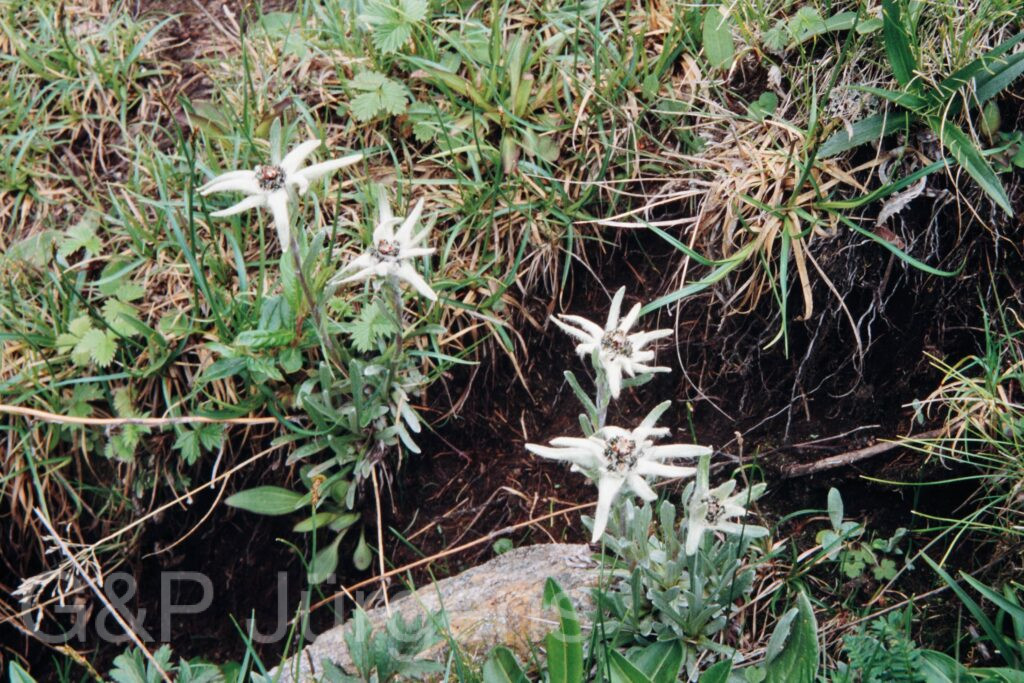
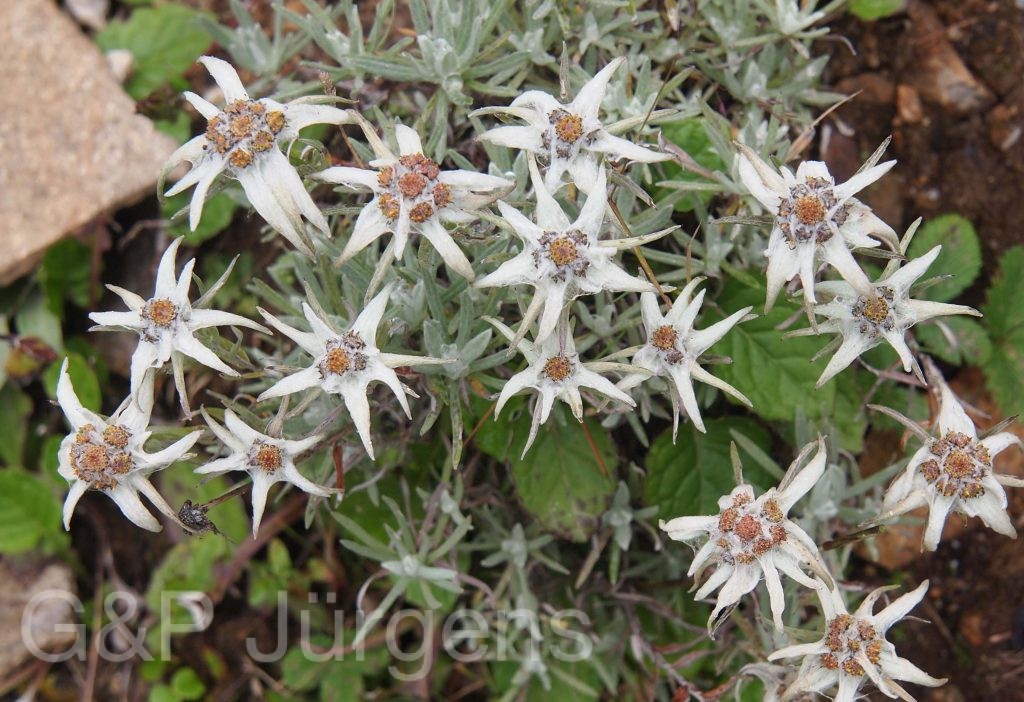
Leontopodium himalayanum is the characteristic Himalayan edelweiss, distributed across China, Nepal, India, Bhutan, Pakistan and Myanmar (CN, NP, IN, BT, PK, MM), with about 437 GBIF occurrences mapping a broad but strictly montane range along the chain. It occupies alpine and subalpine meadows, open grassy and stony slopes, screes and rocky banks, generally above the forest limit. The photographed plants were recorded on the Ludlow-Sherriff Trail at Shashuna in Bhutan at 4000 m and at the Churta-Khola in West Nepal at 3800 m, both in June, flowering early in the high-mountain season on exposed turf.

It is a tufted perennial herb growing from a short branched rhizome, producing several erect or ascending flowering stems 5–30 cm tall, the herbage greyish with a dense appressed white tomentum. The leaves are linear, linear-lanceolate or oblong-spathulate, sessile, woolly especially beneath. The inflorescence is crowned by a spreading rosette of lanceolate floral bracts much more densely white-lanate than the foliage, forming the radiating star that distinguishes the edelweiss. Several small subglobose capitula are clustered at the centre of this ruff; the heads bear yellowish tubular florets and are functionally subdioecious. The fruit is a minute cypsela tipped with a pappus of slender, barbellate to subplumose bristles facilitating wind dispersal.

Within Leontopodium (tribe Gnaphalieae) the Himalayan species form a closely allied group differentiated chiefly by indumentum density and bract proportions, and L. himalayanum (described by DC.) is the most widespread representative across the range. Its conspicuous woolly star is a classic alpine adaptation buffering the reproductive organs against ultraviolet exposure, cold and water loss. The species is common and not regarded as threatened, although picking and collection have locally reduced populations near trekking routes.

Author: DC. · Sources: POWO (Kew), GBIF, Flora of China Vol. 20-21, Flora of Bhutan, Flora of Nepal, Leontopodium monograph (Handel-Mazzetti, revision of the genus)

Beauverd

Bhutan2012 57
Bhutan Shele-La, 4100m September
Bhutan2012 61
Bhutan Shele-La, 4100m September

Description

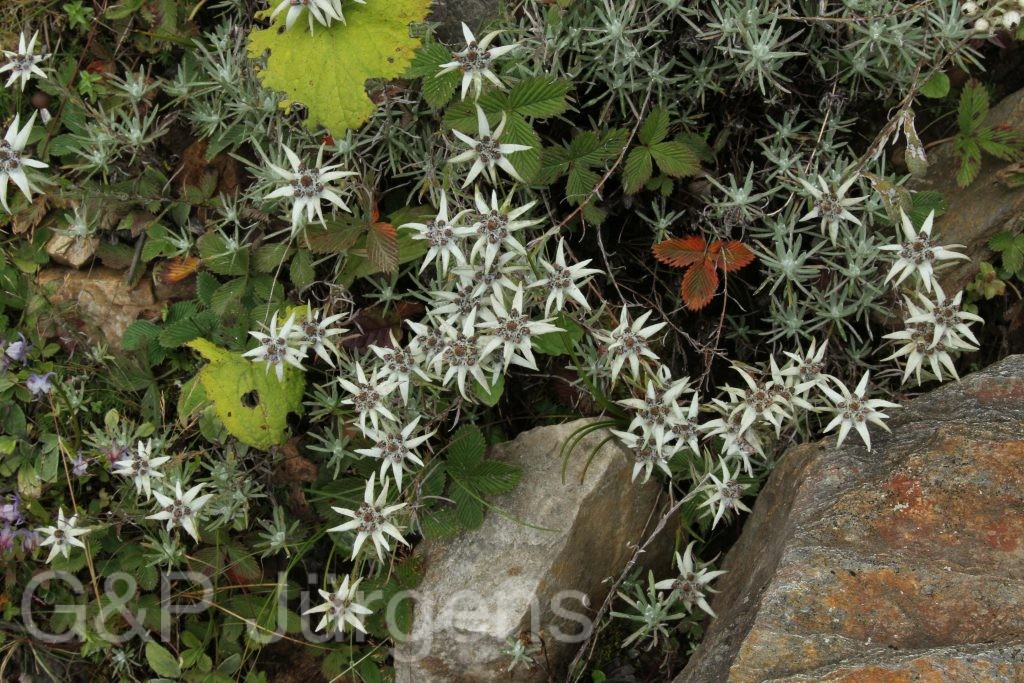
Leontopodium jacotianum is a high-alpine edelweiss of the Sino-Himalayan region, recorded from Nepal, China, India, Bhutan, Pakistan and Myanmar (NP, CN, IN, BT, PK, MM), with a modest 546 GBIF occurrences reflecting its restriction to lofty, difficult terrain. It inhabits open alpine meadows, stony slopes, screes and rocky crevices above the treeline, where snow lies long and the growing season is brief. The photographed plant grew on the Shele-La in Bhutan at about 4100 m in September, flowering at the close of the monsoon season on exposed alpine turf typical of the genus across the eastern Himalaya.

It is a tufted perennial herb arising from a stout, branched caudex, forming compact cushions or small clumps of several flowering stems 5–25 cm tall, the whole densely grey-white lanate-tomentose. The basal and cauline leaves are spathulate to linear-oblong, sessile, woolly on both surfaces. The diagnostic feature is the terminal star of leaf-like floral bracts radiating beyond the capitula, densely felted with white woolly hairs and forming the familiar edelweiss "flower". Within this stellate ruff sit several crowded capitula; the heads contain yellowish tubular florets, the plants typically subdioecious with outer female and central functionally male florets. The fruit is a small cypsela crowned by a pappus of barbellate to subplumose bristles.

The genus Leontopodium (tribe Gnaphalieae) reaches its greatest diversity in the Himalaya and the mountains of western China, where numerous species are differentiated by indumentum, bract shape and habit; L. jacotianum, described by Beauverd, belongs to this dense Asiatic radiation. The thick woolly investment is an adaptation to intense ultraviolet radiation, desiccation and cold at high elevation. Though not currently assessed as threatened, such narrowly alpine specialists are sensitive to climatic warming and the upslope contraction of suitable habitat.

Author: Beauverd · Sources: POWO (Kew), GBIF, Flora of China Vol. 20-21, Flora of Bhutan, Flora of Nepal, Leontopodium monograph (Handel-Mazzetti, revision of the genus)

(H.Hara) Al-Shehbaz

BhutanPG2011 417
Bhutan Ludlow-Sherriff-Trail Warrtlang-La, 4400m June

Description

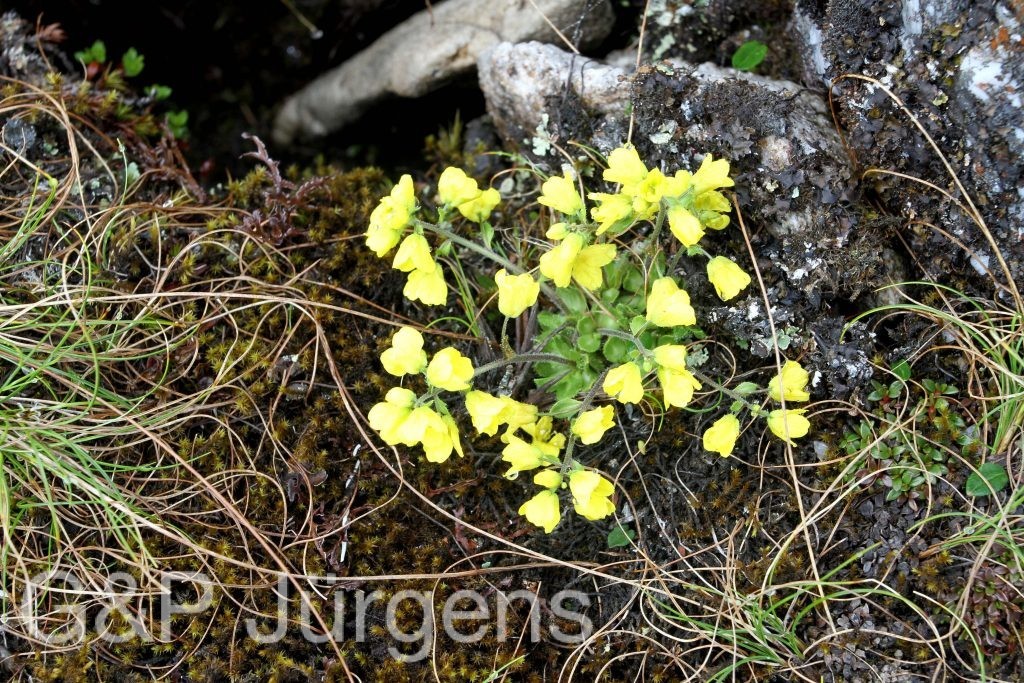
Lepidostemon williamsii is a rare high-alpine crucifer known only from Nepal and Bhutan, and is among the most sparsely documented species in this account, with merely about 12 GBIF records. It is confined to the upper alpine zone, growing on open screes, moraines, gravelly slopes and rock crevices near the limit of vascular plant life. The single cited collection, from the Ludlow-Sherriff-Trail at Warrtlang-La in Bhutan at about 4400 m in June, exemplifies its restriction to cold, exposed, well-drained mineral substrates where snow lies late and the growing season is extremely short.

The plant is a small, often cushion-forming or low tufted perennial herb adapted to severe alpine conditions, with a basal cluster of leaves that are entire to shallowly toothed or lobed. The flowers are typical of the family, with four sepals and four clawed petals arranged in a cross and arrayed in a short, congested raceme. The genus Lepidostemon is diagnosed by its distinctive stamens, whose filaments bear conspicuous scale-like or winged appendages, a feature reflected in the generic name. The fruit is a short silicula or silique characteristic of high-alpine Brassicaceae, splitting to release the seeds.

The species was originally described by H. Hara and transferred to Lepidostemon by Al-Shehbaz, whose revisions have clarified the circumscription of the small Sino-Himalayan genera of Brassicaceae. As a narrow-range endemic occupying a very specialised and harsh high-alpine niche with very few known populations, L. williamsii is inherently vulnerable, and its restricted distribution makes it a priority for monitoring against habitat disturbance and climatic change.

Author: (H.Hara) Al-Shehbaz · Sources: POWO (Kew), GBIF, Flora of Bhutan, Annotated Checklist of the Flowering Plants of Nepal, Al-Shehbaz's revision of Himalayan Brassicaceae

(C.B. Clarke) Benth. ex Gamble

BhutanPG2011 823 01 01
Bhutan Paro 3000m, July

Description

Leptoboea multiflora is a perennial herb of the eastern Himalaya and adjacent Southeast Asia, with 153 GBIF occurrences recorded from India, Nepal, Bhutan, China, Myanmar, Thailand, Vietnam and Cambodia. As a member of the Gesneriaceae, it grows in shaded, humid forest, typically on mossy rocks, boulders, banks and tree bases in damp, sheltered situations of the temperate broad-leaved zone, often between about 1500 and 3000 m. The plant photographed at Paro in Bhutan at 3000 m in July occupies the upper end of this range, flowering during the moist monsoon period when atmospheric humidity is high.

The species is a low, herbaceous to slightly succulent perennial with short stems and leaves that may be clustered or subopposite, the blades ovate to elliptic, crenate to serrate at the margins and frequently pubescent, with the asymmetric, anisophyllous tendency common in the family. The flowers are numerous, as the epithet indicates, borne in axillary cymes; each has a small five-lobed calyx and a tubular, somewhat bilabiate corolla, with the typically reduced fertile stamen number of the gesneriad tribe and a superior ovary. The fruit is a slender, elongate capsule dehiscing to release very numerous minute seeds.

The entry lists the family as Trichosporeae, which is in fact a tribe of Gesneriaceae rather than a family; the accurate placement is Gesneriaceae, subfamily Didymocarpoideae, tribe Trichosporeae, within which Leptoboea is a small Asian genus allied to Boea and Paraboea. As a humidity-dependent epilithic forest herb, it is sensitive to canopy disturbance, though it remains locally frequent in undisturbed montane forest.

Author: (C.B. Clarke) Benth. ex Gamble · Sources: POWO (Kew), GBIF, Flora of China Vol. 18, Flora of Bhutan Vol. 2, Flora of Nepal, Flora of Pakistan, Weber's classification of Gesneriaceae