
Cauwet & S.B.Malla

Description
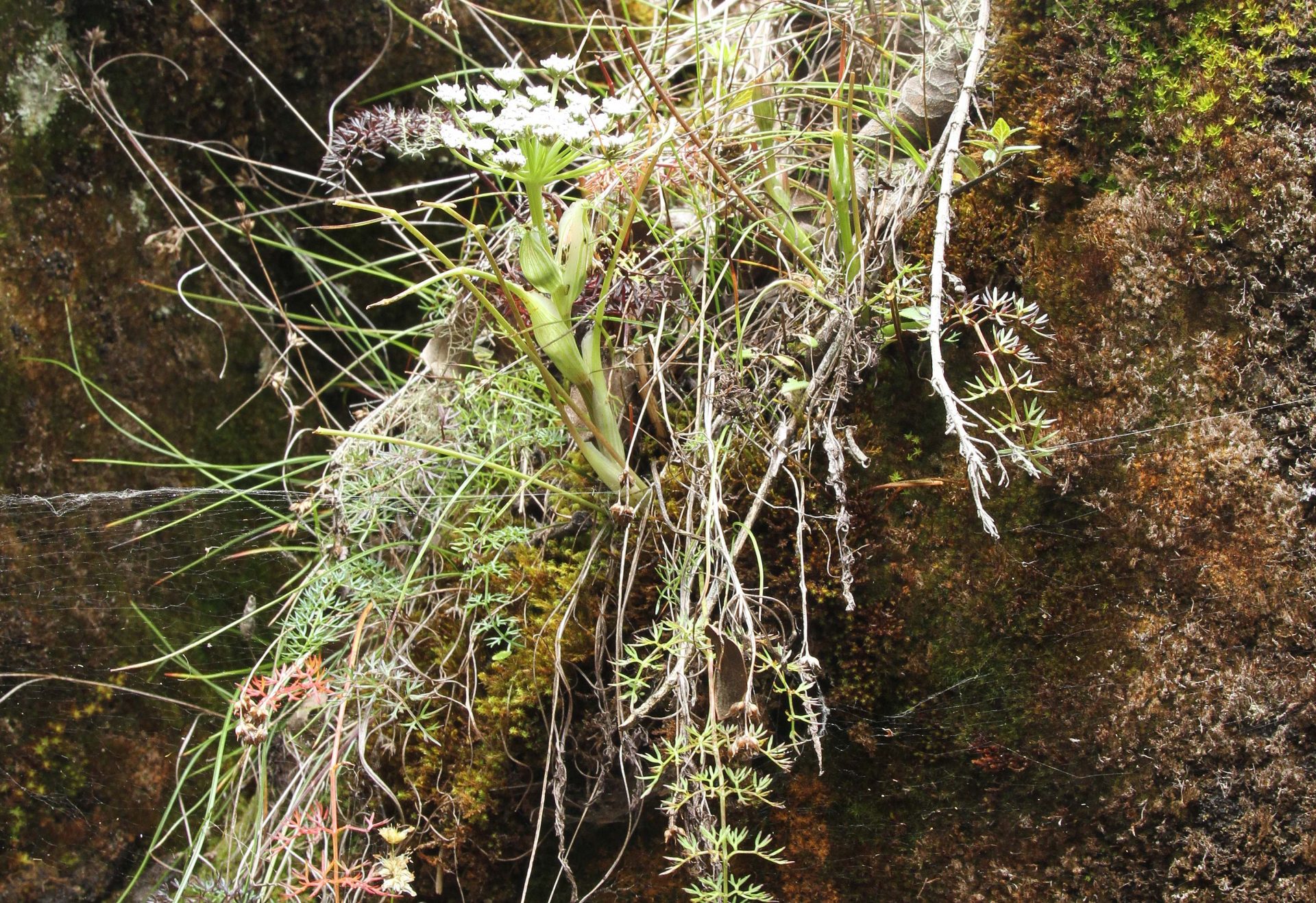
Keraymonia cortiformis is a high-alpine umbellifer of the eastern Himalaya, restricted to Nepal, Bhutan and adjacent China, where GBIF records only about 30 occurrences, reflecting its narrow range and limited collection. It is a plant of the upper subalpine to alpine zone, growing on open stony slopes, screes, rock crevices and short alpine turf above the treeline, typically between roughly 3500 and 4500 m. The image from Shele-La in Bhutan at about 3900 m in September captures it in a characteristic exposed high-pass habitat, where late-season fruiting plants persist among cushion vegetation and frost-disturbed gravels.
It is a low, tufted perennial herb arising from a stout, often woody rootstock crowned by fibrous remains of old leaf bases. The stems are short, decumbent to ascending and few. Leaves are mostly basal, petiolate with sheathing bases, the blades one- to two-pinnate or ternately divided into small, crowded, oblong to cuneate segments, somewhat fleshy and glabrous to minutely scabrid. The inflorescence is a compact compound umbel with few short, unequal rays, subtended by bracts and bracteoles; flowers are small with white to pinkish petals. The fruit is an ovoid to oblong schizocarp, the mericarps dorsally compressed with prominent ribs and vittae characteristic of the genus.
Keraymonia is a small Himalayan genus segregated from broader concepts within the Apiaceae on fruit and habit characters; this species was described by Cauwet and S.B. Malla. Its cushion-forming, taprooted habit and reduced umbels are typical adaptations to cold, wind-exposed alpine environments with short growing seasons. Owing to its restricted distribution and small known population, it is of biogeographic interest as a high-elevation endemic, and warrants monitoring given the vulnerability of narrowly ranging alpine taxa to climatic warming.
Author: Cauwet & S.B.Malla · Sources: POWO (Kew), GBIF, Flora of Bhutan, Flora of China (Apiaceae), Pimenov & Leonov Genera of the Umbelliferae