Author

GP Jürgens

DC.

Bhutan2012 138 1
Bhutan Haar-Valley, 3100m September

Description

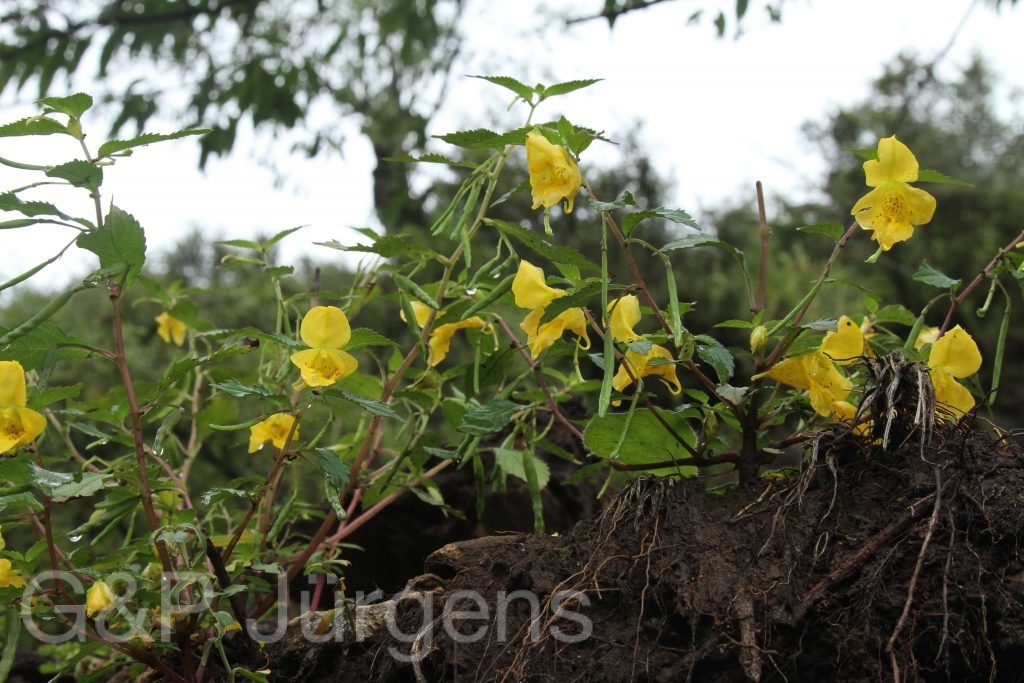
Impatiens scabrida is a robust annual balsam native to the Himalaya, its core range spanning India, Nepal, Pakistan, China and Bhutan, though GBIF's 243 occurrences also include many records from Europe and elsewhere (Portugal, the Netherlands, Great Britain, Germany, Poland and others), reflecting its naturalisation as a garden escape outside its homeland. In its native range it grows on moist shaded banks, forest margins, ravines and streamsides. The photographed plant is from the Haa Valley in Bhutan at about 3100 m, flowering in September, in cool, damp temperate woodland.

The plant is a succulent, erect annual with translucent, often reddish, branched stems that are scabrid (rough), as the epithet records. The leaves are ovate to lanceolate, serrate, with gland-tipped teeth. The yellow flowers are zygomorphic and spurred in the manner of the genus: a saccate lower sepal drawn into a slender curved spur, an upper standard petal and paired lateral united petals forming wings. The fruit is a fleshy, explosively dehiscent capsule that ejects its seeds on contact, giving balsams their touch-me-not behaviour.

The species is accepted. Impatiens is a vast, taxonomically complex genus centred on tropical Asia and Africa, with the Himalaya a major centre of diversity and endemism. The yellow-flowered Himalayan balsams are pollinated chiefly by long-tongued bees, and the ballistic seed dispersal aids rapid colonisation, the very trait underlying this species' spread in European riparian and disturbed habitats. Its naturalised populations make it a subject of interest in invasion ecology.

Author: DC. · Sources: POWO (Kew), GBIF, Flora of Bhutan, Grey-Wilson's monograph Impatiens of Africa and Asian studies, Flora of Nepal
Wall.

Bh09 387 P613
Bhutan Mo-Chu, 1500m June

Description

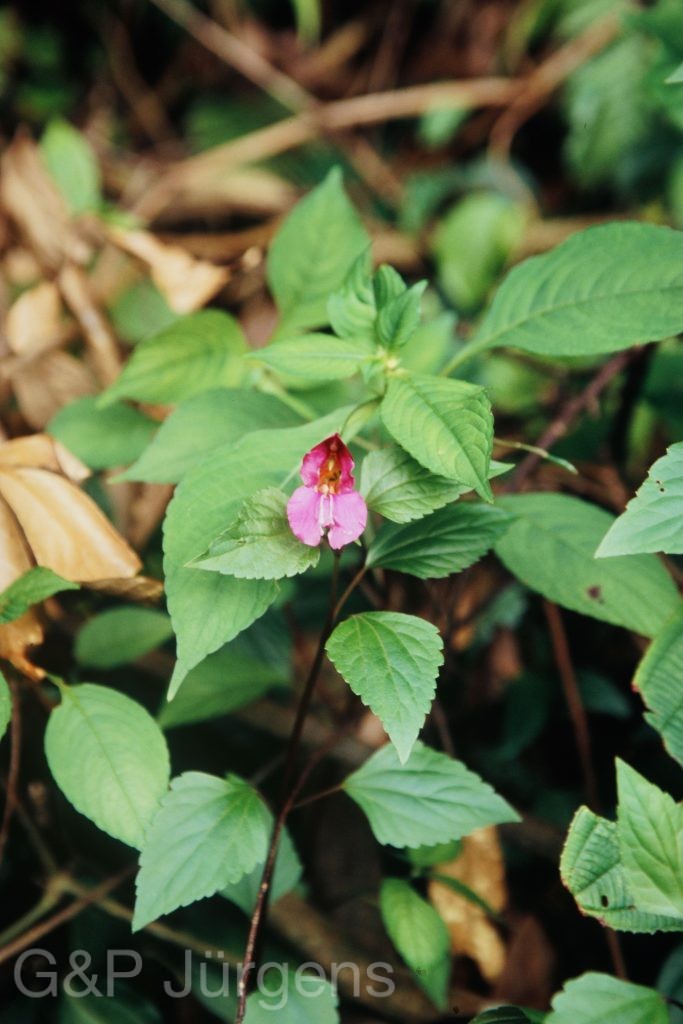
Impatiens sulcata is a tall, robust annual balsam of the Himalaya, recorded by GBIF (361 occurrences) from India, Nepal, Bhutan, Pakistan and adjacent China and Myanmar. It favours damp, nutrient-rich ground along streams, ditches, forest margins, roadside seepages and disturbed moist sites, principally from around 1500 to 3000 m in the warm-temperate and subtropical belts. The cited gathering from the Mo-Chu in Bhutan at 1500 m in June reflects its riparian preference, the plant typically forming dense, gregarious stands in the early monsoon along watercourses where the soil remains saturated.

The species is a succulent herb often exceeding a metre in height, with stout, conspicuously grooved (sulcate), reddish, hollow stems that root at the lower nodes. The leaves are large, ovate to ovate-lanceolate, serrate with crenate-glandular teeth, and arranged oppositely or in whorls toward the apex. Flowers are large and showy, pink to purplish, borne in axillary racemose clusters; the lower sepal forms a saccate spur, the standard is dorsally carinate, and the lateral united petals carry broad auricles. The fruit is a fleshy, club-shaped capsule that dehisces explosively, scattering the seeds by elastic recoil of the valves.

Belonging to the speciose, taxonomically complex genus Impatiens, the species sits among the tall Himalayan annual balsams and is allied to such forms as I. glandulifera, with which it shares vigorous growth and explosive seed dispersal. Its annual, fast-growing, ruderal habit makes it an effective colonist of disturbed riparian ground, while its open flowers are pollinated by bees and butterflies. It is widespread and not threatened.

Author: Wall. · Sources: POWO (Kew), GBIF, Flora of China Vol. 12, Flora of Bhutan Vol. 1, Flora of Nepal, Grey-Wilson Impatiens of Africa and the Himalaya

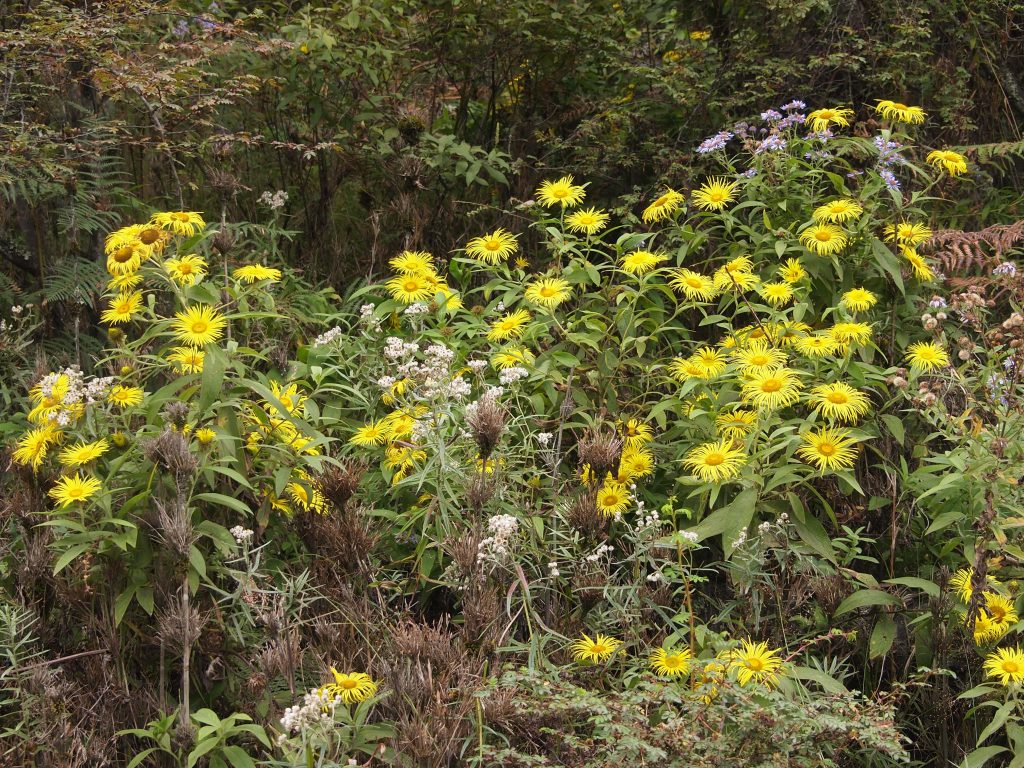
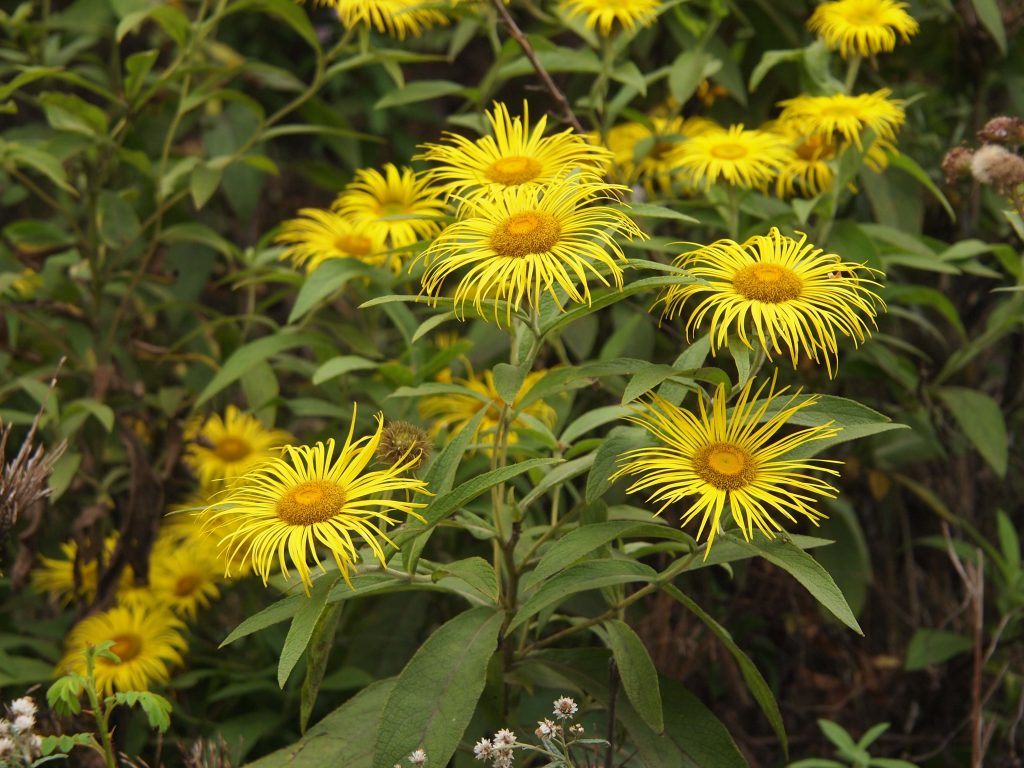
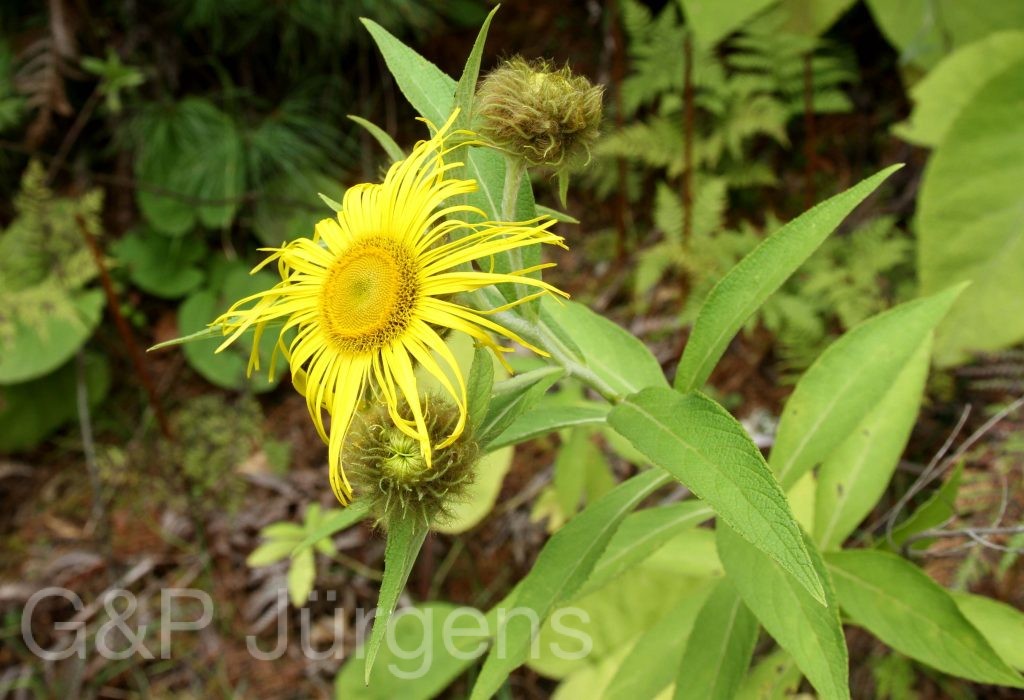
Inula hookeri

by GP Jürgens

C.B.Clarke

Bhutan2012 181
Bhutan Haar-Valley, 3200m September
Bhutan2012 846
Bhutan Nangsephal, 2700m October
Bhutan2012 848
Bhutan Nangsephal, 2700m October

Description

Inula hookeri is a showy yellow-flowered composite of the eastern Himalaya, native to China, Bhutan, Nepal, India and Myanmar, and frequently cultivated in temperate gardens, which accounts for British, Irish, North American and Antipodean records; GBIF lists about 383 occurrences. It grows in subalpine meadows, open forest, shrubby slopes and grassy clearings, mostly between about 2400 and 3600 m. The photographed plants are from the Haar valley in Bhutan at 3200 m in September and from Nangsephal at 2700 m in October, flowering through the late monsoon into autumn.

The plant is an erect, hairy perennial herb arising from a short rhizome, with leafy, softly pubescent stems. The leaves are alternate, oblong-lanceolate to elliptic, acuminate, finely toothed and clasping or sessile at the base, hispid on both surfaces. The capitula are large and solitary or few at the stem tips, radiate, with numerous very narrow, thread-like, pale to greenish-yellow ray florets spreading in a fringed circle around a disc of deeper yellow tubular florets; the involucre is hemispherical with linear, leafy, spreading phyllaries. The fruit is a small ribbed cypsela bearing a pappus of a single row of barbellate bristles.

Inula belongs to the tribe Inuleae, and I. hookeri, named for J. D. Hooker, is distinctive for its softly spidery, narrow-rayed heads that open from woolly buds. Valued in horticulture for its long flowering and attractiveness to pollinators, it is common in the wild and not considered threatened.

Author: C.B.Clarke · Sources: POWO (Kew), GBIF, Flora of Bhutan, Flora of China, Annotated Checklist of the Flowering Plants of Nepal, Systematics of Inula and allied genera (Inuleae)

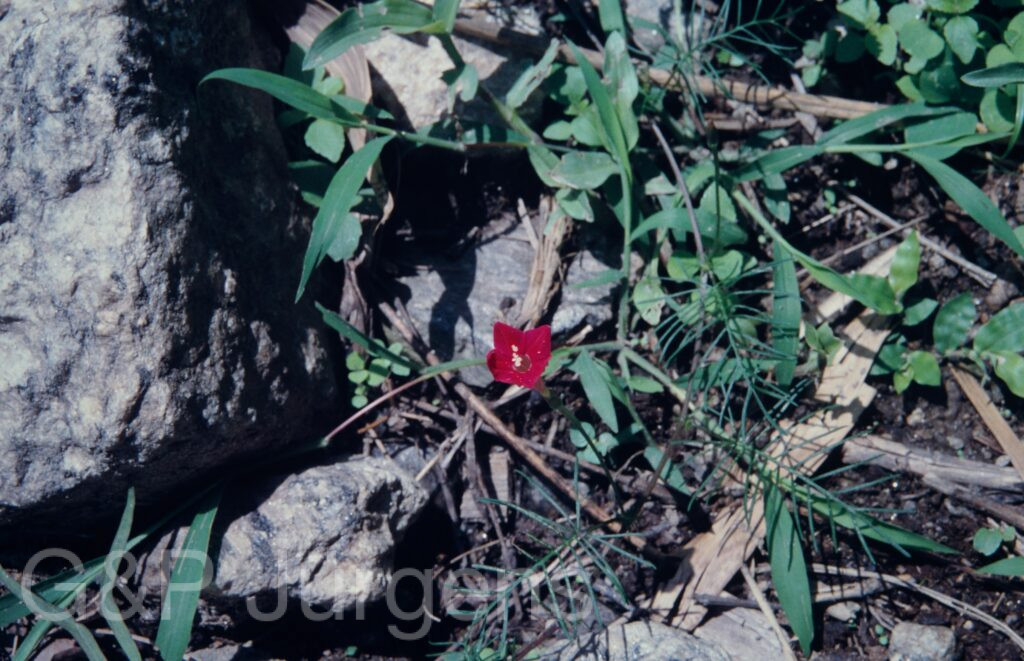
L.

Nepal 1994 231 ergebnis
Ost-Nepal Mewa-Khola 1800m April 

Description

Ipomoea quamoclit, the cypress vine, is a twining annual of Neotropical origin now pantropically naturalised, with over 11,650 GBIF occurrences spanning the Americas (USA, Mexico, Brazil, Colombia, Ecuador, Peru, Venezuela), Asia (India, China, Taiwan, Korea, Japan, Indonesia, Thailand, Nepal), Australia and Africa. In its adventive Asian range it occupies disturbed ground, hedgerows, field margins, riverbanks and village thickets, frequently escaping from cultivation as an ornamental. The collection from the Mewa Khola in eastern Nepal at about 1,800 m in April reflects its establishment in warm low- to mid-montane situations.

It is a slender, glabrous, herbaceous climber to several metres. Its most distinctive feature is the foliage: the leaves are alternate, ovate in outline but pinnately divided almost to the midrib into numerous fine, filiform, parallel segments, giving a delicate feathery appearance. The flowers are solitary or few in axillary cymes, with a long, slender corolla tube expanding into a flat, five-angled, salverform limb about 1.5–2 cm across, brilliant scarlet (rarely white), with exserted stamens and style. The fruit is a small ovoid capsule containing few blackish, ovoid seeds.

The species, sometimes segregated as Quamoclit pinnata, is firmly placed within an enlarged Ipomoea, and GBIF treats the name as accepted. Its salverform red corolla and long tube reflect specialisation for pollination by hummingbirds in its native America and by butterflies and sunbirds elsewhere. Widely grown and self-seeding, it is locally weedy but of no conservation concern.

Author: L. · Sources: POWO (Kew), Flora of China Vol. 16, Flora of Nepal, GBIF, Austin & Huáman: A Synopsis of Ipomoea in the Americas (1996)

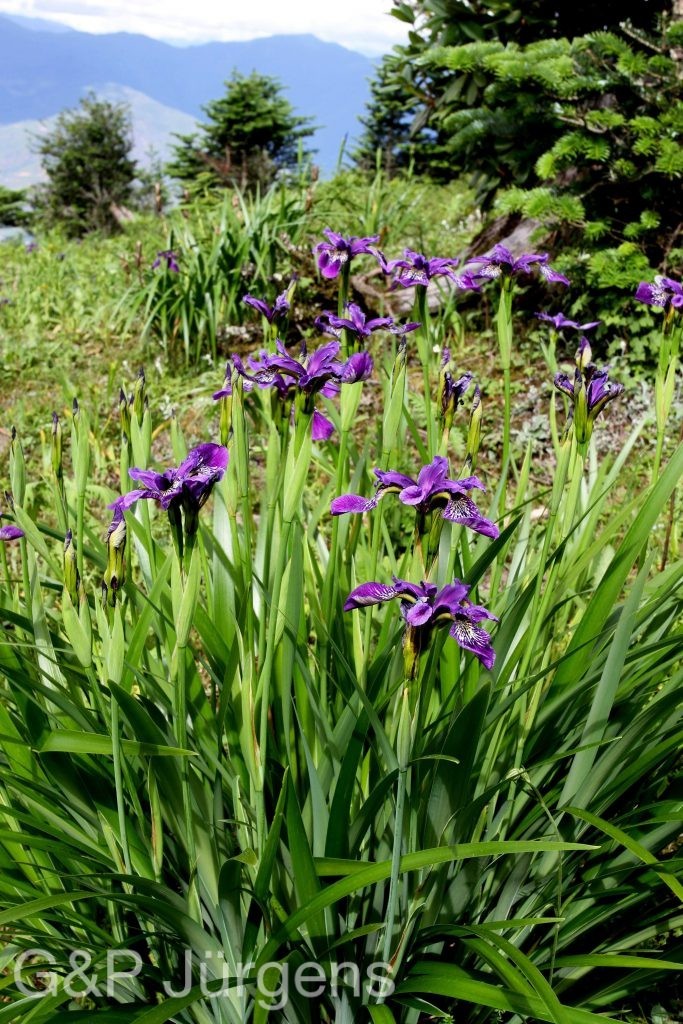
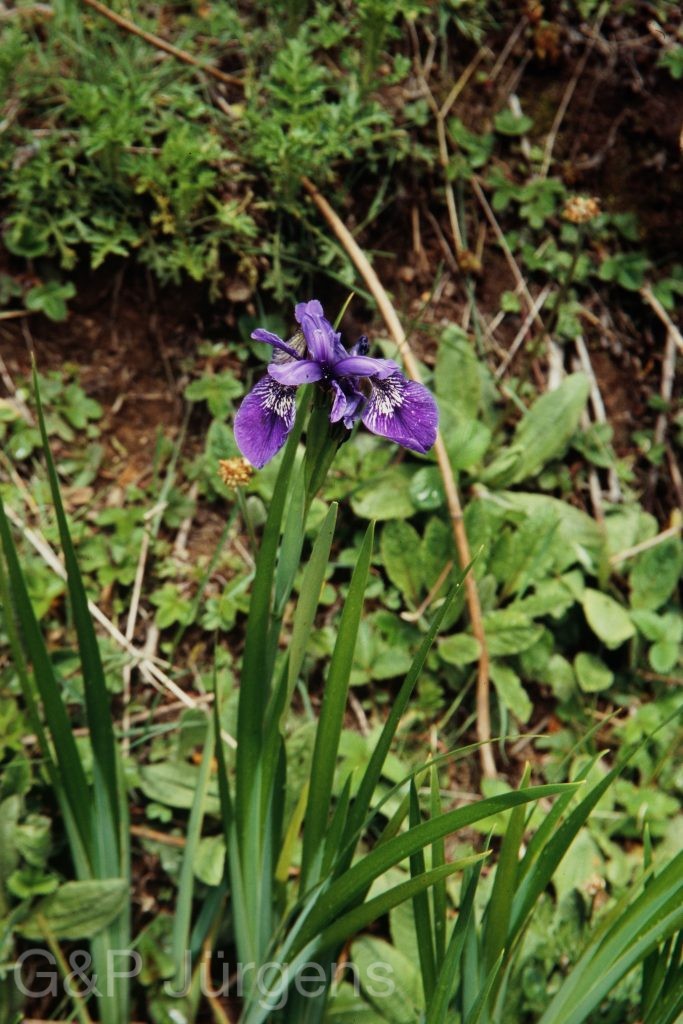
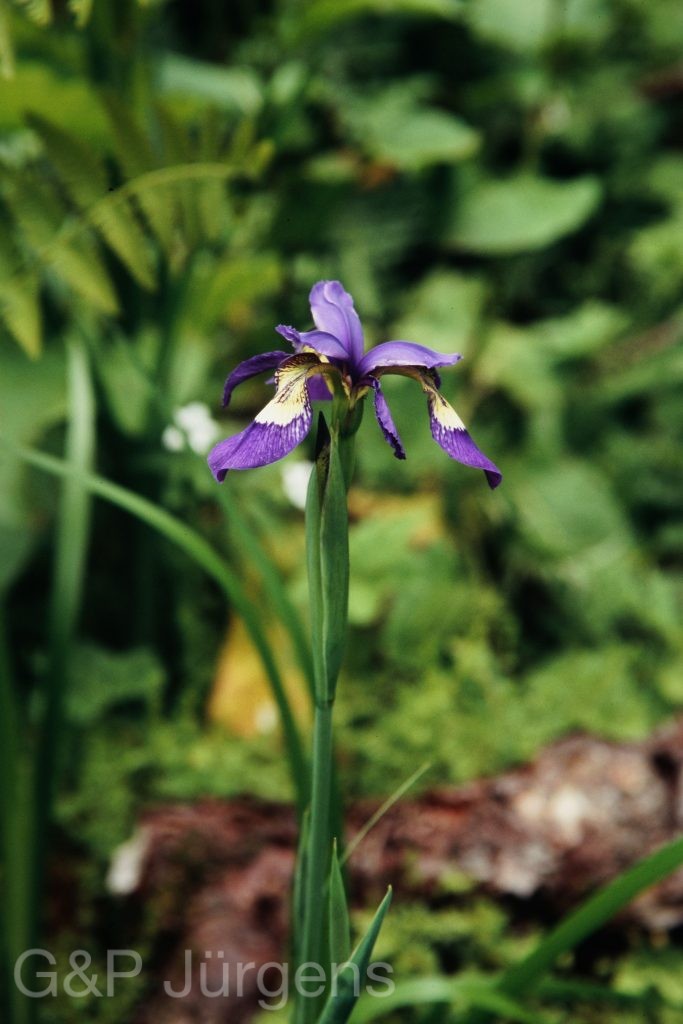
Iris clarkei

by GP Jürgens

Baker ex Hook.f.

BhutanPG2011 773 01 01
Bhutan Chele-La, 3900m June
Bh09 35 P65
Bhutan Dochu-La, 3000m June
Bh09 206 P346
Bhutan Dochu-La, 3000m June

Description

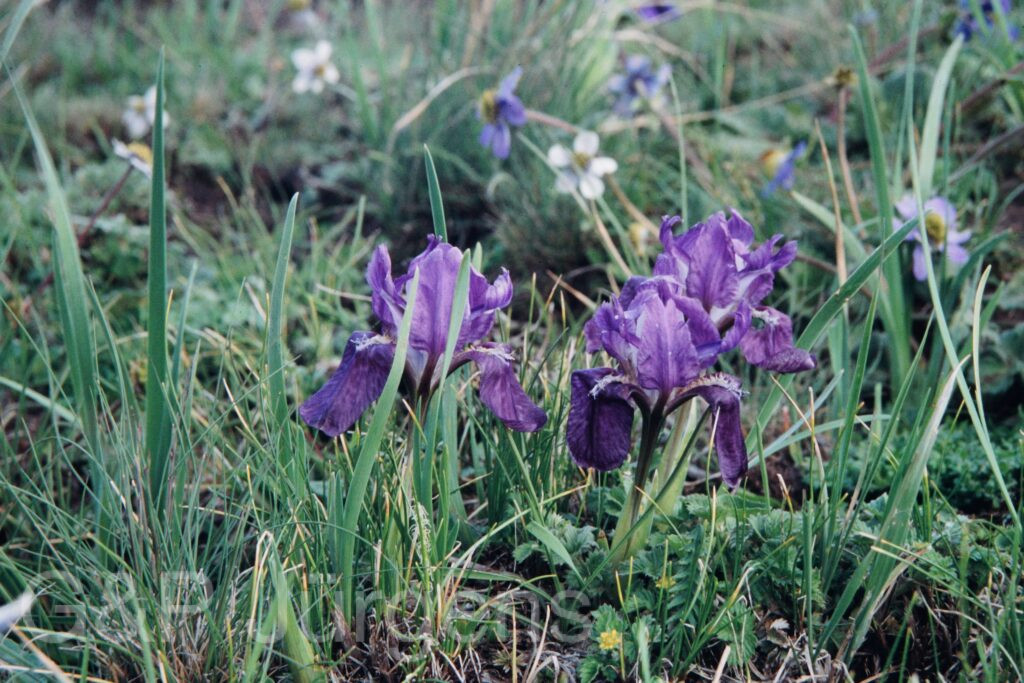
Iris clarkei is an eastern Himalayan beardless iris distributed through Bhutan, Sikkim and northeastern India, Nepal, southern Tibet (China) and northern Myanmar, with GBIF holding about 174 occurrences. It is a subalpine to alpine moisture-lover, recorded here from two Bhutanese passes, Chele-La at 3900 m and Dochu-La at 3000 m, both flowering in June. The species favours wet alpine meadows, marshy hollows, stream sides and seasonally flushed turf on slopes, typically between roughly 3000 and 4300 m, where it forms colonies in the open, moist grassland of the upper temperate and subalpine zones.

It is a tufted rhizomatous perennial of the Sibiricae group, with slender creeping rhizomes producing erect, solid (not hollow) flowering stems that are characteristically branched and bear a distinctive solid pith. The leaves are linear-ensiform, grass-like, ribbed and grouped in basal fans. Each stem carries one to several flowers; the perianth is blue-violet to reddish-purple, the spreading or deflexed falls bearing a paler, conspicuously veined and blotched signal patch, and the standards are smaller and more erect, the flowers beardless and crestless. The fruit is a three-angled loculicidal capsule containing flattened seeds.

Described by Baker (ex Hook.f.) and named for C. B. Clarke, the species belongs to series Sibiricae, the Asian relatives of Iris sibirica, and is of horticultural interest for its solid stems and richly marked falls. Though restricted to specialised wetland habitats, it remains locally common within its range; pressures such as grazing, trampling and drainage of montane mires are the principal local threats to its boggy habitat.

Author: Baker ex Hook.f. · Sources: POWO (Kew), GBIF, Flora of Bhutan, Flora of China, Mathew The Iris, British Iris Society A Guide to Species Irises

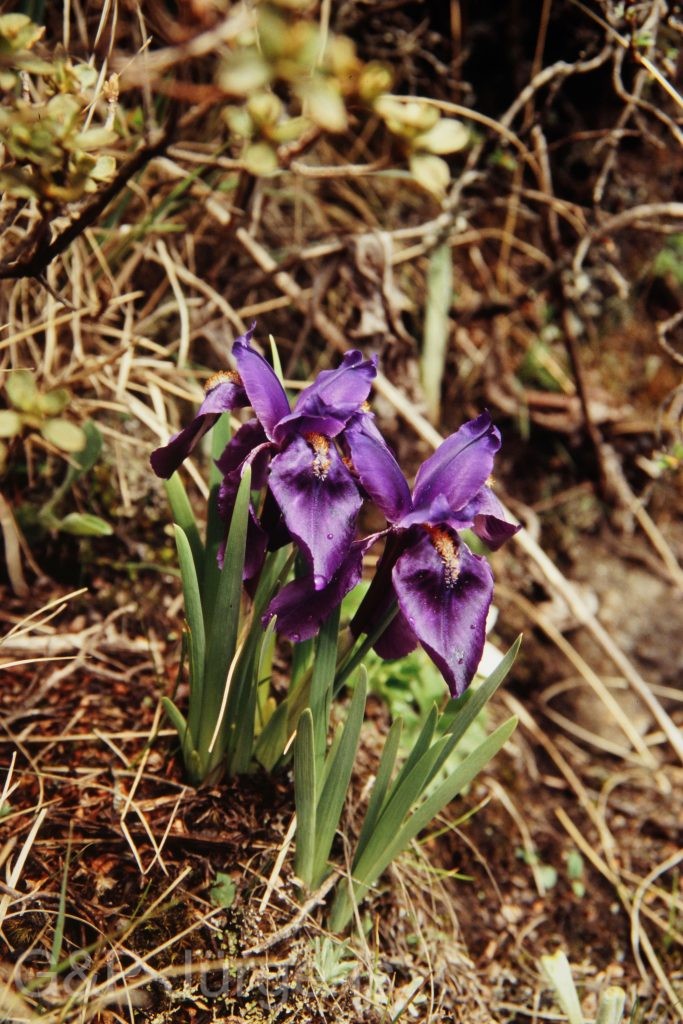
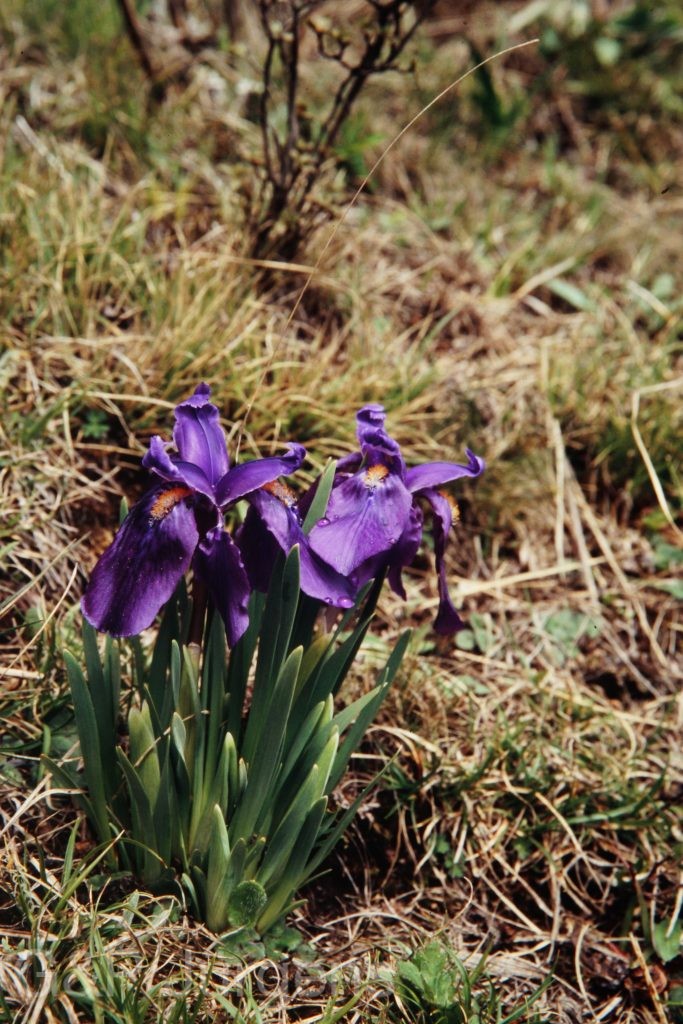
Noltie

Bh09 30 G56
Bhutan Shele-La 4000m, June
Bh09 31 P57
Bhutan Shele-La 4000m, June

Description

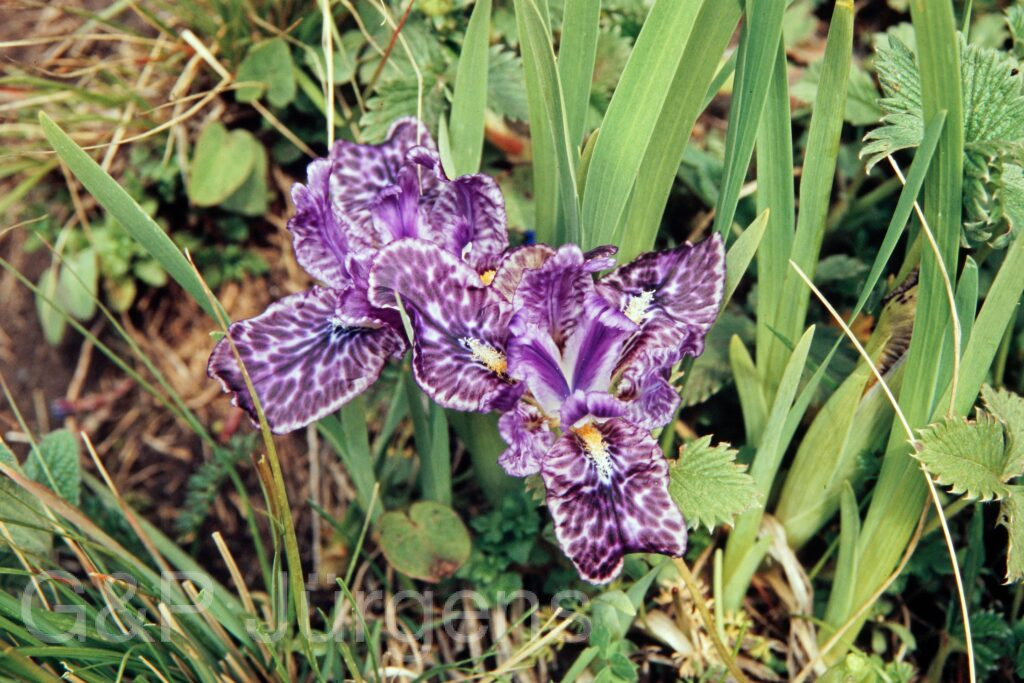
Iris dolichosiphon is a high-alpine dwarf iris restricted to the eastern Himalaya and adjacent China, a narrow-range endemic recorded by GBIF from only China, Bhutan and India, with a small total of around 77 occurrences reflecting both its limited distribution and the remoteness of its habitat. It grows in open alpine turf, meadows, grassy slopes and rocky pastures above the treeline, generally between about 3500 and 4500 m, where snow-melt and short cool summers govern its brief flowering season. The photographed plant from the Shele La in Bhutan, at roughly 4000 m and flowering in June, is exactly typical of its occurrence on exposed high passes, where it forms low cushions among short alpine vegetation soon after the snow recedes.

It is a small, tufted perennial of the dwarf-crested and beardless Himalayan iris assemblage, arising from a slender, fibrous-coated rhizome and producing narrow, linear, grass-like leaves. The flowers are nearly sessile at ground level but are raised, in effect, by an extremely long, slender perianth tube, the character that gives the species its epithet (dolichos, long; siphon, tube), so that the floral parts are presented well above the very short stem. The flowers are violet to lilac-blue, the three outer tepals (falls) spreading and signalled with a paler, veined and crested or ridged blaze, the three inner tepals (standards) smaller and erect; the three petaloid style branches arch over the stamens.

Described by H. J. Noltie, who clarified much of the Sino-Himalayan iris flora, I. dolichosiphon belongs to the alpine, beardless dwarf irises and is allied to species such as I. kemaonensis and the I. goniocarpa group, from which the conspicuously elongate perianth tube distinguishes it. Its pollination by long-tongued bumblebees is favoured by the deep tube, and seed is set in a capsule that ripens as the brief alpine season closes. As a narrowly distributed high-altitude endemic with few records, it warrants monitoring; while not formally assessed as threatened, its restricted range and sensitivity to climate-driven shifts in the alpine zone make it of biogeographic and conservation interest.

Author: Noltie · Sources: POWO (Kew), GBIF, Flora of China Vol. 24, Flora of Bhutan Vol. 3, Flora of Nepal, Flora of Pakistan, Noltie's account of the Sino-Himalayan irises

Iris kemaonensis

by GP Jürgens

Wall. ex D.Don

Nepal 99 299 ergebnis
West-Nepal Kalmura 4200m, June
Nepal 99 298 ergebnis
West-Nepal Kalmura 4200m, June
Garh 07 172 ergebnis
India Garhwal Kinkhola 3545m, June

Description

Iris kemaonensis is a dwarf alpine iris of the Himalaya and adjacent ranges, distributed across Pakistan, Nepal, NW India, Bhutan and SW China, with 346 GBIF occurrences. It grows on open alpine meadows, grassy slopes, stony pastures and recently snow-freed ground in the upper subalpine to alpine zone. The cited collections from Kalmura in West Nepal at about 4,200 m and Kinkhola in Garhwal at 3,545 m, both in June, are characteristic of its early-summer flowering as snow melts on high turf, where it forms low scattered clumps.

It is a rhizomatous perennial with a short, stout, branching rhizome bearing fibrous remains of old leaves. The leaves are linear-ensiform, appearing with or shortly after the flowers and elongating considerably as the fruit ripens. The flowers are usually solitary and almost sessile at ground level, lilac to pale purple, mottled and spotted with deeper purple; the falls are obovate with a yellow or white beard along the median crest, the standards smaller and erect. The perianth tube is long and slender, raising the flower above the spathes. The fruit is a trigonous capsule, often borne on an elongating stalk emerging after anthesis.

The species belongs to Iris subgen. Pseudoregelia, the bearded, mottled-flowered, rhizomatous group centred on the Himalaya and Central Asia. GBIF records it as accepted. It is a charismatic, ground-hugging alpine bearing close ecological resemblance to other cushion-meadow geophytes, and remains widespread and unthreatened, though locally subject to grazing pressure.

Author: Wall. ex D.Don · Sources: POWO (Kew), Flora of China Vol. 24, Flora of Bhutan Vol. 3, GBIF, Mathew: The Iris (1989)

Wall.

Nepal 97 92 P153
Nepal above Meta-Khola 2250m April
Nepal 97 312 P616
Nepal above Meta-Khola 2250m April

Description

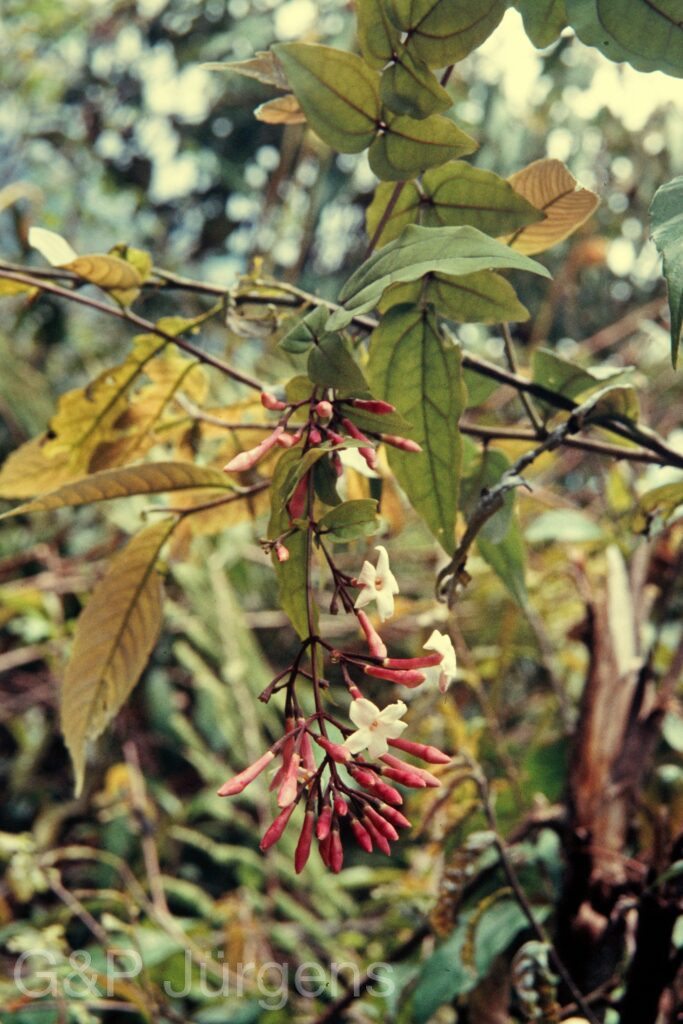
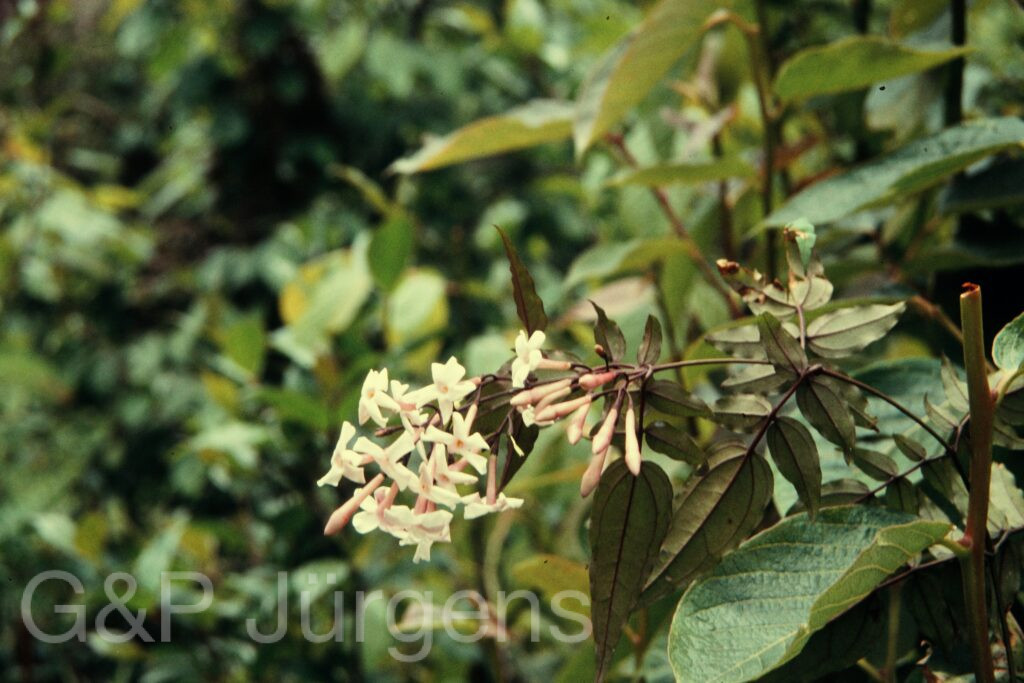
Jasminum dispermum is a scandent or climbing jasmine widely distributed across the Himalaya and montane south-east Asia, recorded from China, India, Nepal, Myanmar, Thailand and Bhutan, with outlying records (ID, KR, RU, ZZ) reflecting cultivation and herbarium material. Of more than 400 georeferenced collections, the core range lies along the subtropical-to-temperate forest belt of the Himalayan foothills. It grows in forest margins, scrub, ravines and along streams, scrambling over rocks and shrubs in the warm-temperate zone. The photographed plant from above the Meta-Khola in Nepal at 2250 m, flowering in April, is typical of its lower montane habitat and its spring flowering ahead of the monsoon.

It is a woody, twining shrub or liana with terete, often pubescent branchlets. The leaves are opposite and pinnately compound, usually with five to seven leaflets (sometimes reduced to three or trifoliolate uppermost ones), the leaflets ovate to lanceolate, acuminate and entire. The fragrant flowers are borne in terminal and axillary cymose panicles; each has a small, toothed calyx and a salverform corolla with a slender tube and spreading lobes, white within and frequently flushed pink or rose-purple on the outside in bud. Two stamens are inserted in the corolla tube. The fruit, reflected in the epithet dispermum, is a paired or two-seeded berry that ripens black.

Jasminum is a large Old World genus of the olive family centred on tropical and warm-temperate Asia and Africa, many species prized for their scent. J. dispermum is a vigorous, ornamentally attractive climber, occasionally cultivated, and remains common throughout its native range with no conservation concern. Its nocturnally fragrant, pale flowers suggest pollination by long-tongued moths and other nectar-seeking insects.

Author: Wall. · Sources: POWO (Kew), GBIF, Flora of China Vol. 15, Flora of Bhutan Vol. 2, Flora of Nepal, Green's Synopsis of the Oleaceae

Buch.-Ham. ex D.Don

Bh2008 394 P610
Bhutan Gogona 3160m, May

Description

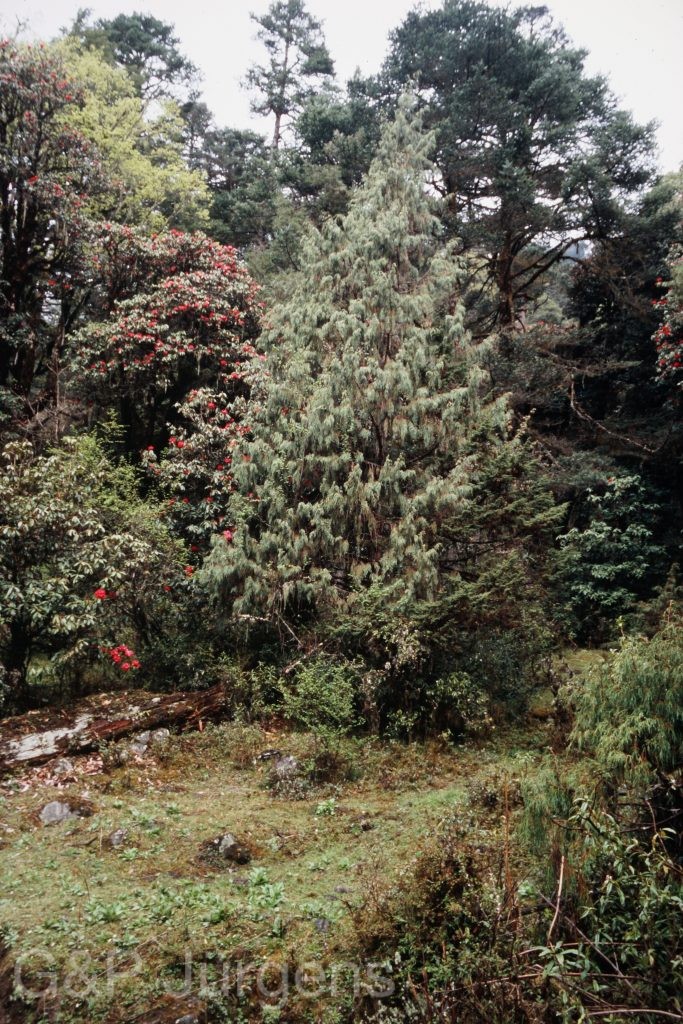
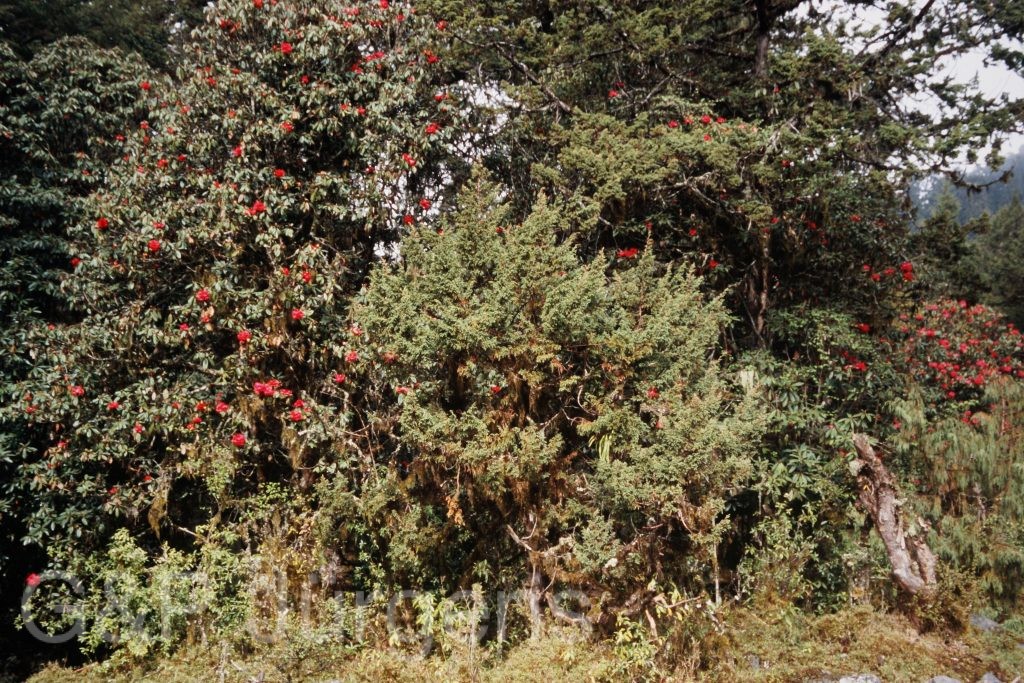
Juniperus recurva, the drooping or Himalayan weeping juniper, is a high-mountain conifer native across the Himalaya and adjacent China, with a core distribution in China, Nepal, India, Bhutan, Myanmar, Afghanistan and Pakistan; its very large GBIF tally of around 1185 records includes numerous cultivated occurrences in Great Britain, the United States, Spain, New Zealand, Japan and Germany, reflecting its long history in horticulture. In the wild it is a tree of the subalpine and alpine zones, forming open woodland, krummholz and scattered stands at and above the timberline on dry, rocky slopes. The tree photographed at Gogona in Bhutan at about 3160 m in May typifies its occurrence in the upper subalpine belt, where it often mingles with Abies, Rhododendron and Betula.

It is an evergreen tree or large shrub with characteristically pendulous, drooping branchlets and reddish-brown, fibrous bark that peels in long strips. The foliage consists of needle-like (acicular) juvenile-type leaves borne in whorls of three, incurved and sharply pointed, with a glaucous adaxial band; the leaves are retained as adults rather than reduced to scales. The species is typically dioecious, with small terminal pollen cones and ovulate cones that mature over two seasons into fleshy, berry-like galbuli that ripen blue-black to brownish and usually contain a single seed.

Juniperus recurva belongs to section Juniperus (the needle-leaved junipers) and includes the well-known coffin-juniper variant (var. coxii) with especially long pendulous shoots. Its fleshy cones are dispersed by birds and mammals, and the aromatic foliage is traditionally burned as incense across the Buddhist Himalaya. Although globally widespread and not classed as threatened, local populations near settlements are depleted by cutting for incense and fuel, and as a slow-growing timberline species it is potentially sensitive to warming-driven shifts in the upper forest limit.

Author: Buch.-Ham. ex D.Don · Sources: POWO (Kew), GBIF, Flora of China Vol. 4, Flora of Bhutan Vol. 1, Flora of Nepal, Adams Junipers of the World: The Genus Juniperus

Siebold & Zucc.

Bh2008 391 P606
Bhutan Gogona 3250m, May

Description

Juniperus rigida is a coniferous shrub or small tree of temperate East Asia, very well represented in GBIF with 6235 occurrences centred on Korea, Japan, China and the Russian Far East, alongside numerous cultivated records in Europe and North America. It grows on dry, rocky slopes, exposed ridges, sandy soils and open montane woodland, tolerating poor substrates and cold, often from the hills to the subalpine zone. The individual photographed at Gogona in Bhutan at 3250 m in May reflects its occurrence at higher Himalayan elevations, where it persists on stony, well-drained ground in cool montane conditions.

The plant is a dioecious, evergreen shrub or tree with spreading to pendulous branches and reddish-brown, fibrous bark that peels in strips. The leaves are all needle-like (acicular), borne in whorls of three, rigid, sharply pointed and deeply grooved adaxially with a single white stomatal band, a combination giving the foliage a harsh, prickly texture reflected in the epithet rigida. The male cones are small and axillary, shedding pollen in spring; the female structures develop into fleshy, berry-like seed cones (galbuli) that ripen blue-black with a glaucous bloom over about two years, each typically enclosing three seeds.

Juniperus rigida belongs to section Juniperus, the needle-leaved junipers, and is closely allied to J. communis, from which it differs in its longer, more rigid leaves and arching habit. It is widely cultivated as an ornamental and for bonsai, explaining many of its extralimital records. Ecologically it is a hardy pioneer of disturbed and stressful sites, and it remains common and of least concern across its broad native range.

Author: Siebold & Zucc. · Sources: POWO (Kew), GBIF, Flora of China Vol. 4, Flora of Bhutan Vol. 1, Flora of Nepal, Flora of Pakistan, Adams' Junipers of the World