

Noltie
Description
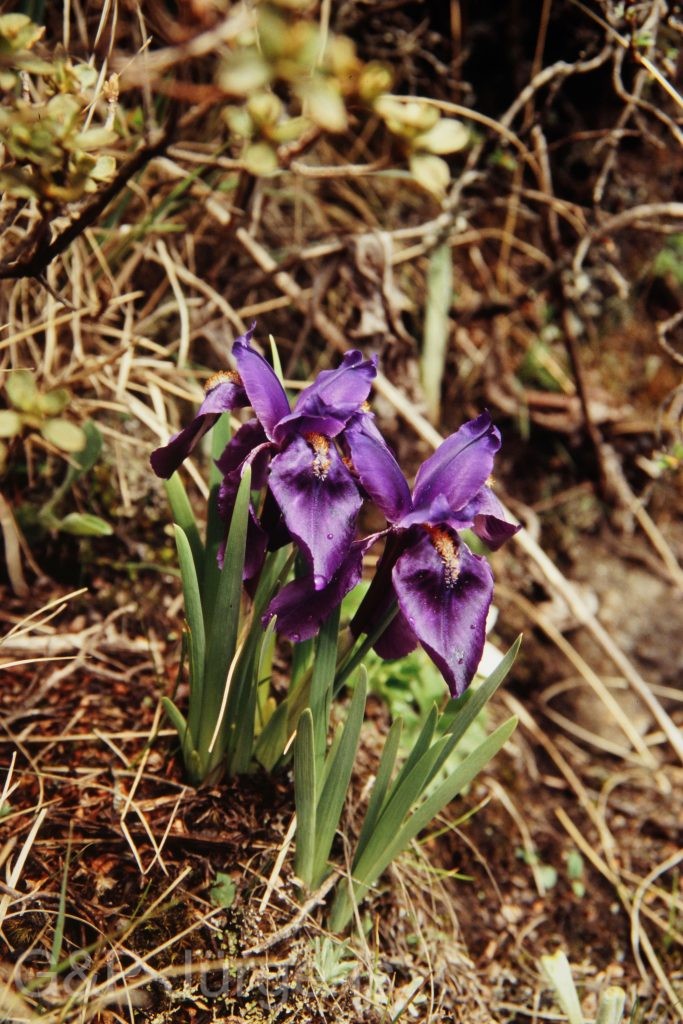
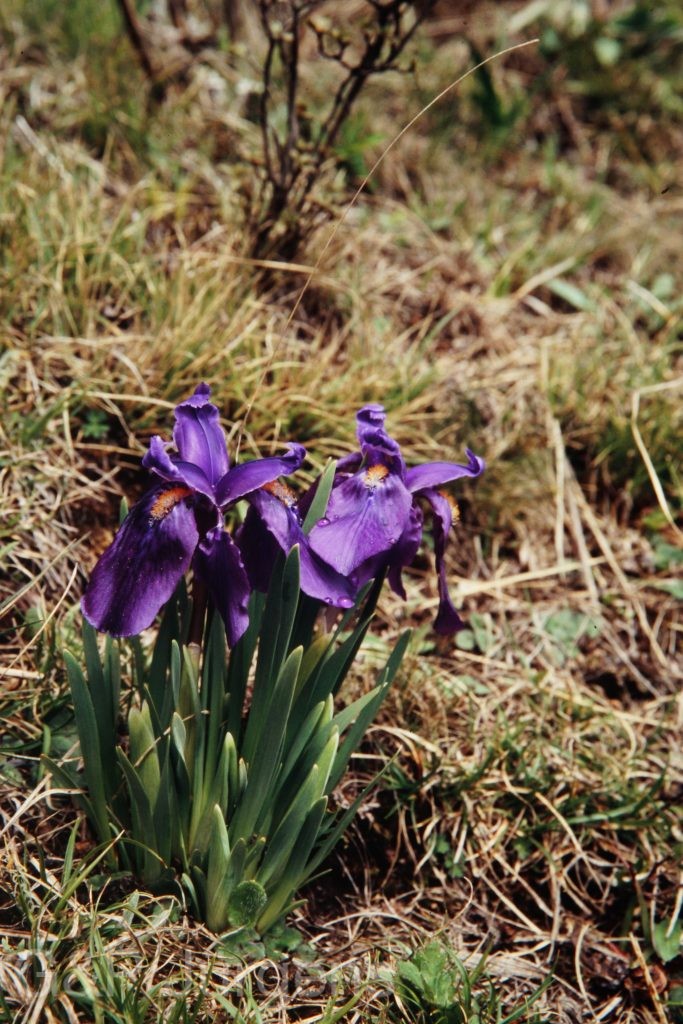
Iris dolichosiphon is a high-alpine dwarf iris restricted to the eastern Himalaya and adjacent China, a narrow-range endemic recorded by GBIF from only China, Bhutan and India, with a small total of around 77 occurrences reflecting both its limited distribution and the remoteness of its habitat. It grows in open alpine turf, meadows, grassy slopes and rocky pastures above the treeline, generally between about 3500 and 4500 m, where snow-melt and short cool summers govern its brief flowering season. The photographed plant from the Shele La in Bhutan, at roughly 4000 m and flowering in June, is exactly typical of its occurrence on exposed high passes, where it forms low cushions among short alpine vegetation soon after the snow recedes.
It is a small, tufted perennial of the dwarf-crested and beardless Himalayan iris assemblage, arising from a slender, fibrous-coated rhizome and producing narrow, linear, grass-like leaves. The flowers are nearly sessile at ground level but are raised, in effect, by an extremely long, slender perianth tube, the character that gives the species its epithet (dolichos, long; siphon, tube), so that the floral parts are presented well above the very short stem. The flowers are violet to lilac-blue, the three outer tepals (falls) spreading and signalled with a paler, veined and crested or ridged blaze, the three inner tepals (standards) smaller and erect; the three petaloid style branches arch over the stamens.
Described by H. J. Noltie, who clarified much of the Sino-Himalayan iris flora, I. dolichosiphon belongs to the alpine, beardless dwarf irises and is allied to species such as I. kemaonensis and the I. goniocarpa group, from which the conspicuously elongate perianth tube distinguishes it. Its pollination by long-tongued bumblebees is favoured by the deep tube, and seed is set in a capsule that ripens as the brief alpine season closes. As a narrowly distributed high-altitude endemic with few records, it warrants monitoring; while not formally assessed as threatened, its restricted range and sensitivity to climate-driven shifts in the alpine zone make it of biogeographic and conservation interest.
Author: Noltie · Sources: POWO (Kew), GBIF, Flora of China Vol. 24, Flora of Bhutan Vol. 3, Flora of Nepal, Flora of Pakistan, Noltie's account of the Sino-Himalayan irises