
Mill.
Description
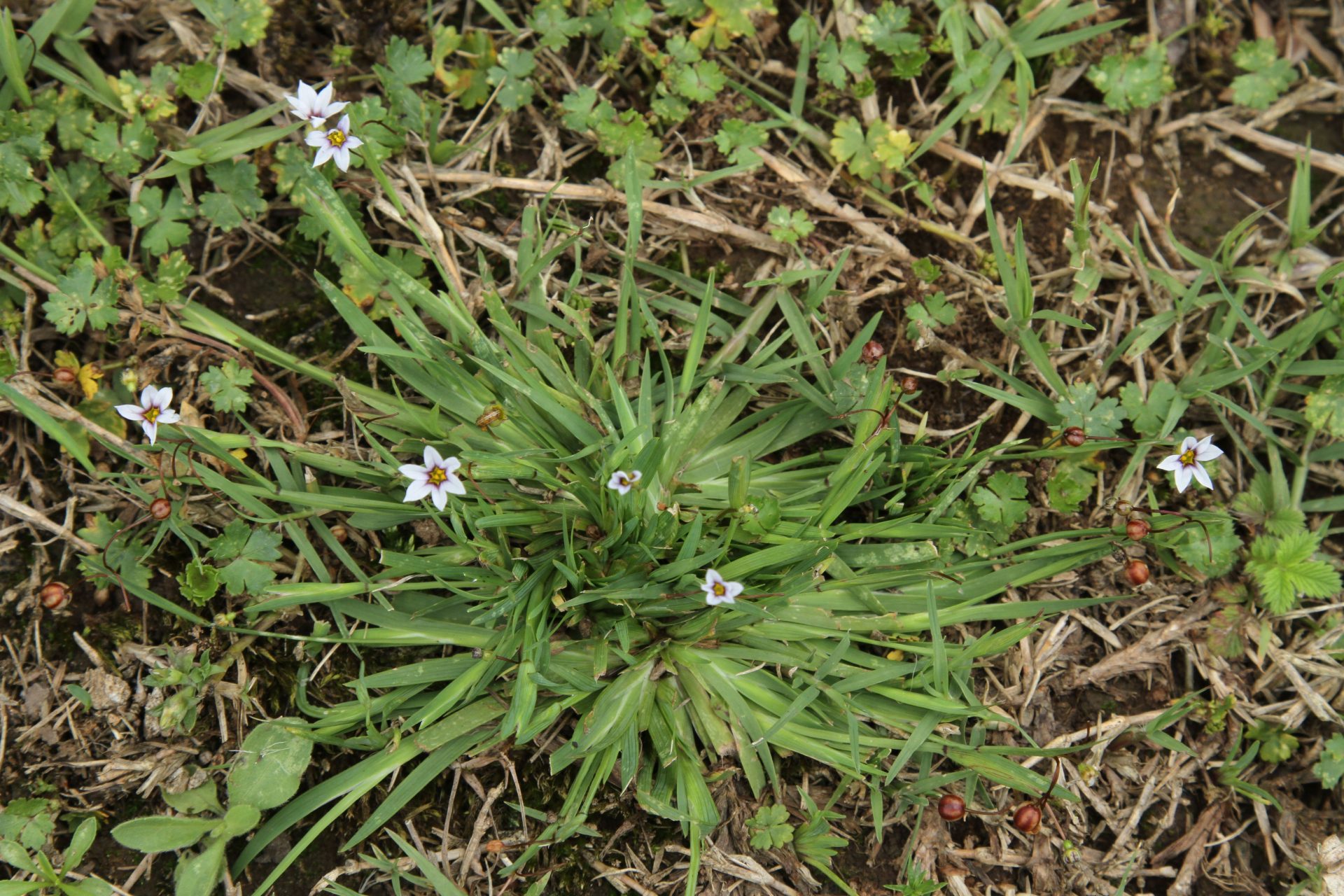
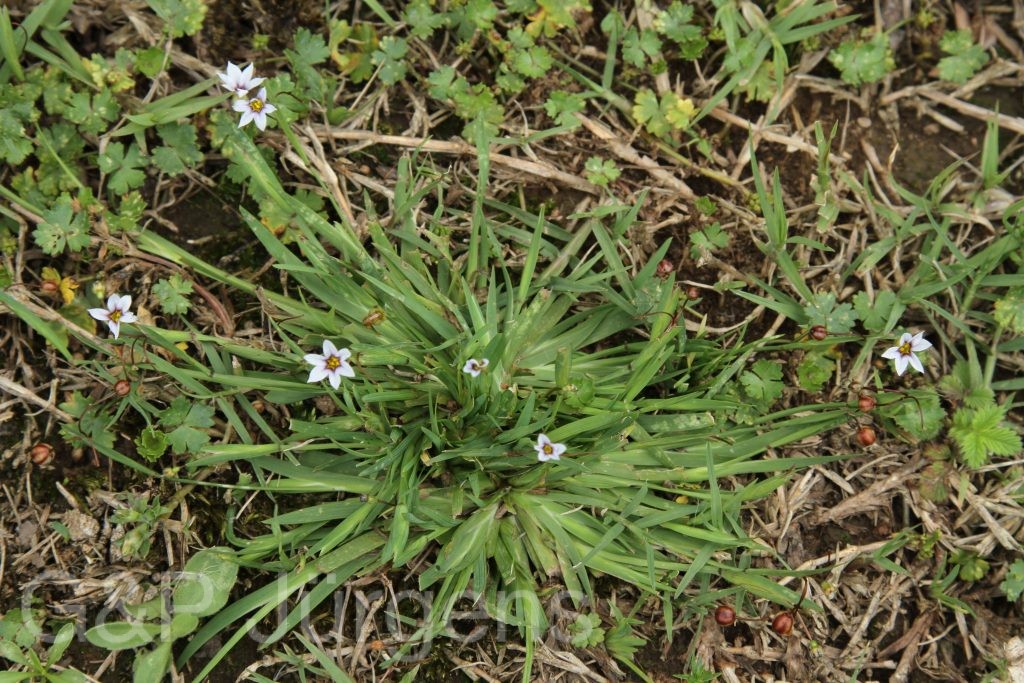
Sisyrinchium angustifolium, the narrow-leaved blue-eyed grass, is native to eastern North America (US, CA) but is widely naturalised, with more than 15,000 GBIF occurrences extending across western Europe (FR, ES, IE, GB, DE, BE), eastern Asia (KR, JP) and elsewhere. In the Himalaya it occurs as an introduced and locally established plant of damp meadows, lawns, ditches and grassy roadsides. The individual recorded at Trashigang in eastern Bhutan at 1550 m in May reflects its naturalisation in moist, open, subtropical to warm-temperate grassland, where it flowers in spring on seasonally moist ground.
Despite the common name it is no grass but a tufted perennial of the Iridaceae, forming clumps of narrow, linear, equitant leaves arising in two ranks from a short rhizome. The flowering stems are markedly flattened and conspicuously winged, often branched, and bear terminal clusters of flowers subtended by paired green spathes. Each ephemeral flower has six spreading blue to violet tepals abruptly apiculate with a small terminal mucro, contrasting with a yellow centre; the three stamens have filaments united into a tube around the style. The fruit is a small globose to obovoid loculicidal capsule containing numerous black, rounded seeds.
The species belongs to the large American genus Sisyrinchium and is taxonomically complex, with several allied microspecies and frequent confusion with S. montanum and S. bermudiana. Its flowers open only in sunshine and are bee-pollinated, while prolific seed favours self-establishment in mown swards. Outside its native range it behaves as a benign garden escape.
Author: Mill. · Sources: POWO (Kew), GBIF, Flora of Bhutan Vol. 3, Flora of Nepal, Flora of China Vol. 24, The Genus Sisyrinchium (Iridaceae) Monograph