Author

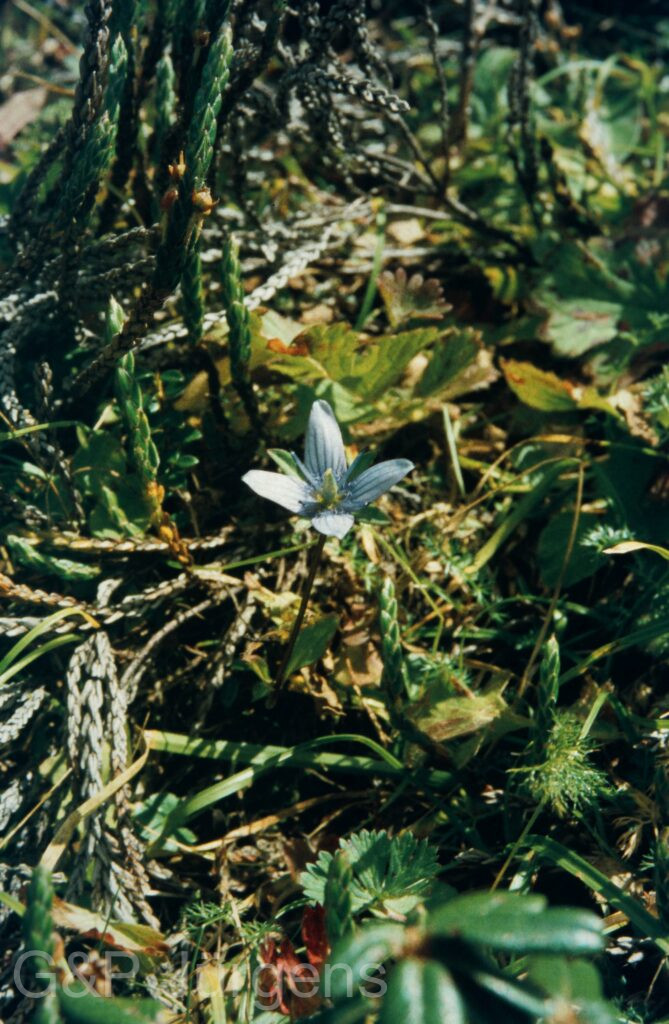
G & P Jürgens

(Wulfen) A.Braun

Garw 2005 135 ergebnis ergebnis
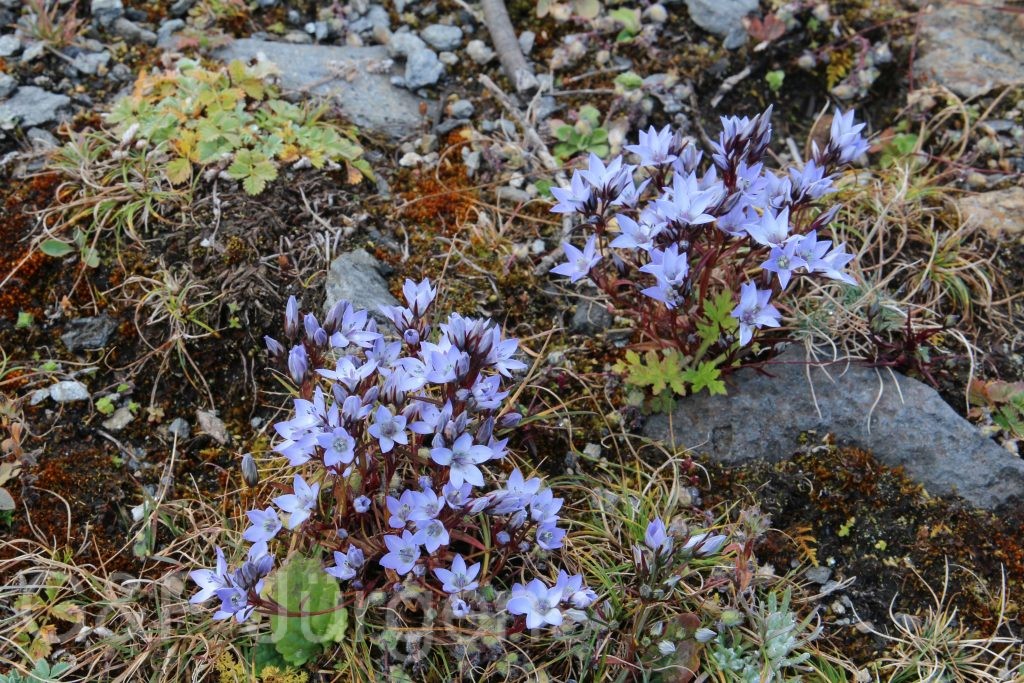
India Garhwal Kuari-Pass 3600m, September

Description

Lomatogonium carinthiacum is a small alpine gentian with an exceptionally broad Eurasian distribution, reaching from the European Alps eastward through the Caucasus, central Asia and the Himalaya to the Tibetan Plateau and Mongolia; GBIF records (over 2600) span Austria, Switzerland, China, Russia, India, Pakistan, Nepal and many other countries. It grows in alpine and subalpine meadows, damp turf, stream banks and open grassy slopes, generally between about 2500 and 4500 m. The photographed plant from the Kuari Pass in Garhwal, India (3600 m, September), is typical of the species flowering in late summer in moist alpine grassland.

The plant is a small annual or short-lived herb with an erect, often branched, somewhat quadrangular stem and opposite, sessile, ovate to lanceolate leaves. The flowers are solitary or few in lax cymes, with a rotate, deeply five-lobed corolla coloured pale blue to bluish-violet, often with darker veining; the lobes lack the plicate folds and basal fringed scales of Swertia and Gentiana. Diagnostically for the genus, the nectaries take the form of paired, scale-fringed grooves at the base of each corolla lobe. The five stamens alternate with the lobes, and the ovary is unilocular, maturing into a many-seeded capsule with the persistent styles forming decurrent ridges (the basis of the generic name).

Lomatogonium (tribe Swertieae) is closely allied to Swertia, from which it is separated chiefly by its decurrent stigmatic lines running down the ovary and by the form of its nectaries. The genus is centred on the Sino-Himalayan region, with L. carinthiacum being by far its most widespread member and a classic example of a circum-boreal/alpine disjunct distribution. It is common across much of its range and is not of conservation concern.

Author: (Wulfen) A.Braun · Sources: POWO (Kew), GBIF, Flora of China (Gentianaceae), Flora Europaea, Flora of Pakistan, A revision of Lomatogonium (Gentianaceae)
(Burkill) Harry Sm.

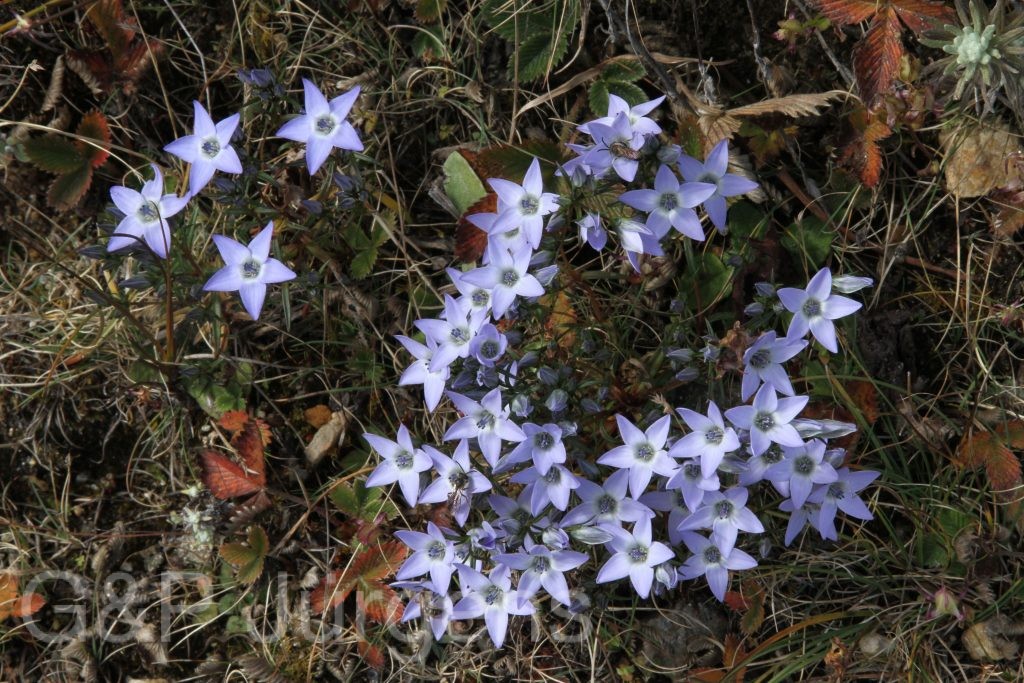
Bhutan2015 666
Bhutan Chele-La 4000m, October
Bhutan2015 682
Bhutan Chele-La 4000m, October
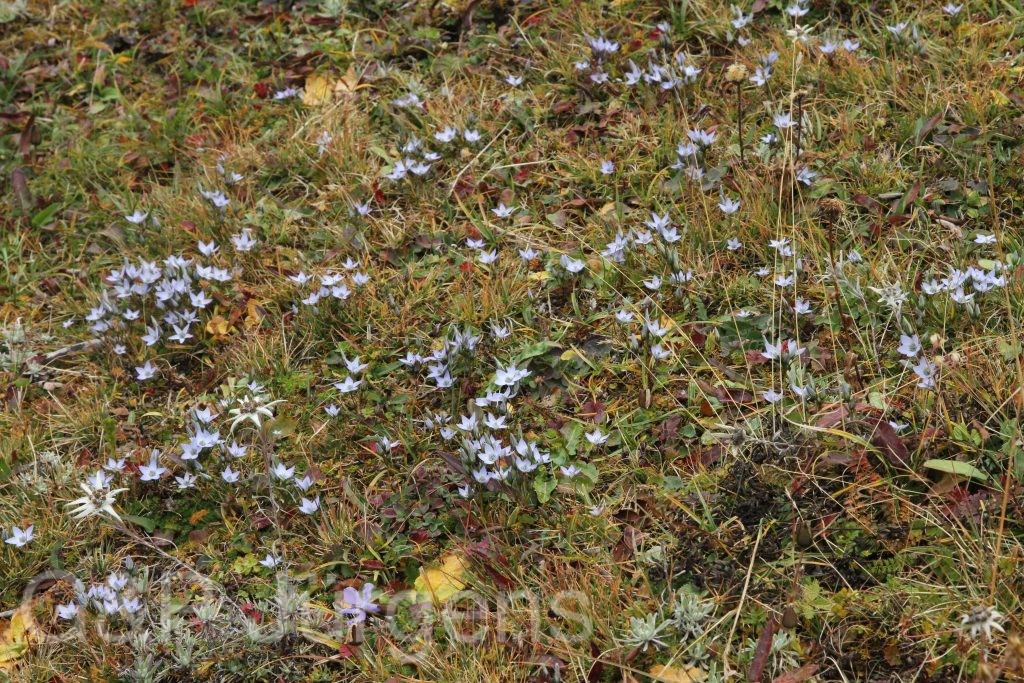
Bhutan2015 685
Bhutan Chele-La 4000m, October

Description

Lomatogonium sikkimense is a high-alpine gentian relative restricted to the eastern Himalaya and adjacent Tibet, recorded from Nepal, India, Bhutan and China, with about 74 occurrences in GBIF. It grows in the alpine zone on open turf, moist meadows, streamsides and gravelly slopes, characteristically between about 3500 and 4500 m, flowering late as the monsoon ends. The plants photographed at the Chele-La in Bhutan at around 4000 m in October exemplify this habitat, where the species blooms among short alpine vegetation just before the onset of winter.

It is a slender annual or short-lived herb with erect or ascending, often branched stems bearing opposite, sessile, narrowly lanceolate to linear leaves. The flowers, borne singly or in a few-flowered cyme, are rotate and deeply five-lobed, the blue to violet-blue corolla lobes acute and often delicately veined; characteristically for the genus, each lobe bears a pair of fringed nectary scales at its base, distinguishing Lomatogonium from the closely related Swertia and Gentianella. The five stamens alternate with the lobes, and the superior ovary develops into a many-seeded capsule.

Lomatogonium is a small Eurasian genus of high mountains and is centred on the Sino-Himalayan and Tibetan flora, with L. sikkimense among its narrowly distributed eastern Himalayan members, as its epithet referencing Sikkim records. The fringed paired nectaries and rotate corolla are key diagnostic features separating it from allied swertioid gentians. No formal conservation assessment exists; the species appears locally frequent within its restricted alpine range, though such narrowly zoned high-altitude annuals are potentially vulnerable to climate-driven shifts in alpine meadow vegetation.

Author: (Burkill) Harry Sm. · Sources: POWO (Kew), GBIF, Flora of Bhutan, Flora of China, Annotated Checklist of the Flowering Plants of Nepal, Ho & Liu Worldwide Monograph of Swertia and its Allies

Wall.

BhutanPG2011 3
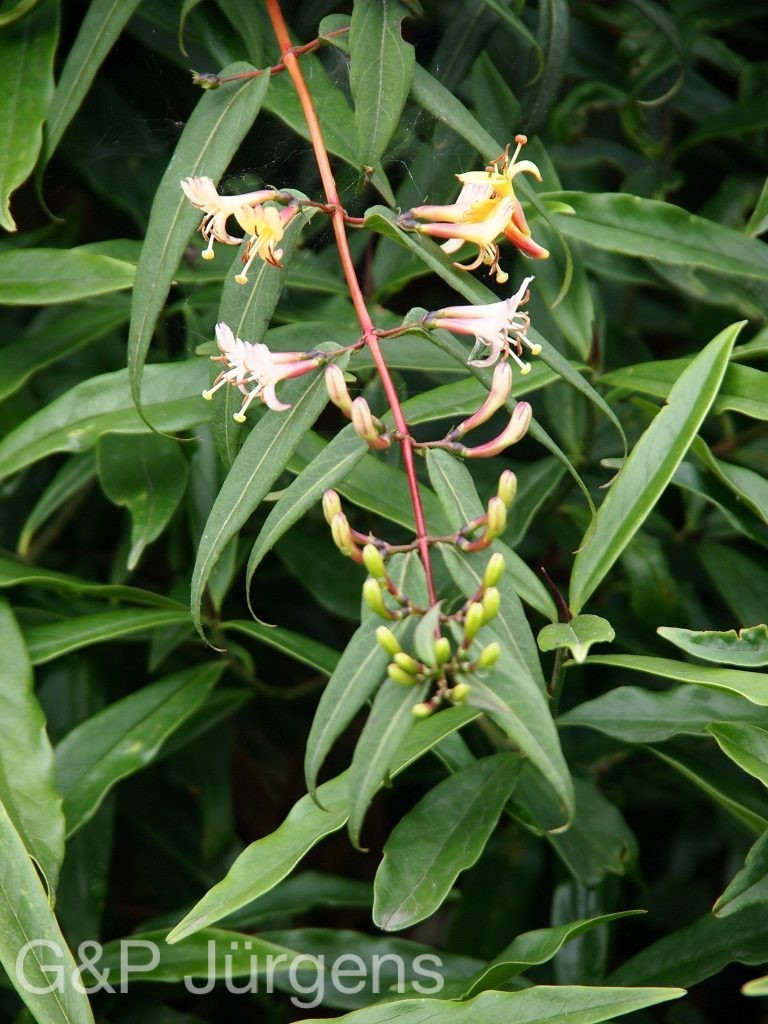
Bhutan Paro, 2400m June

Description

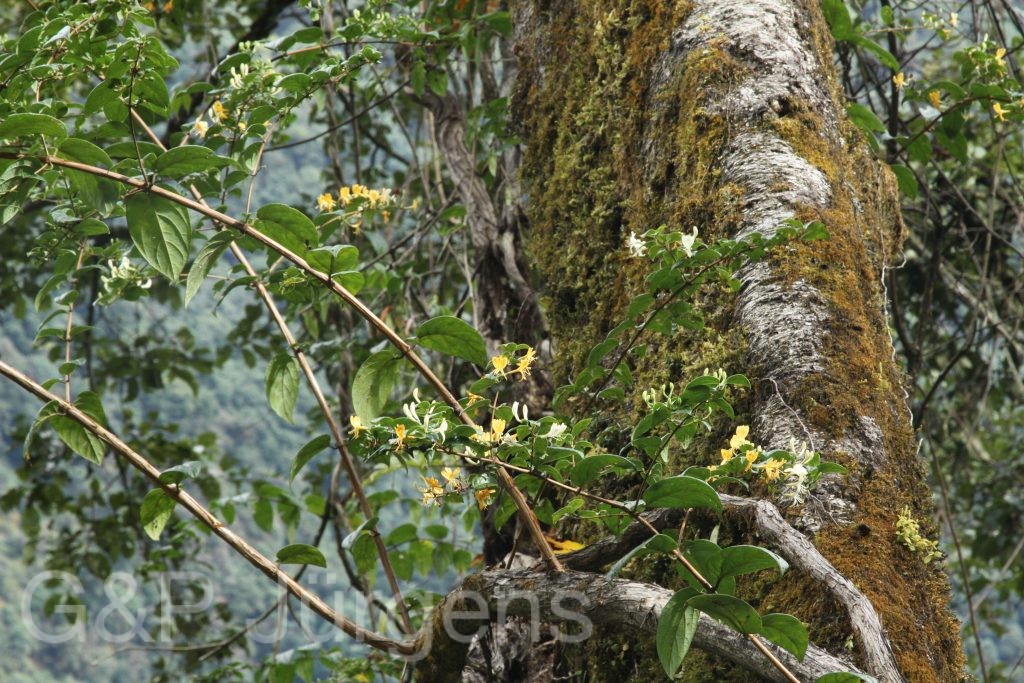
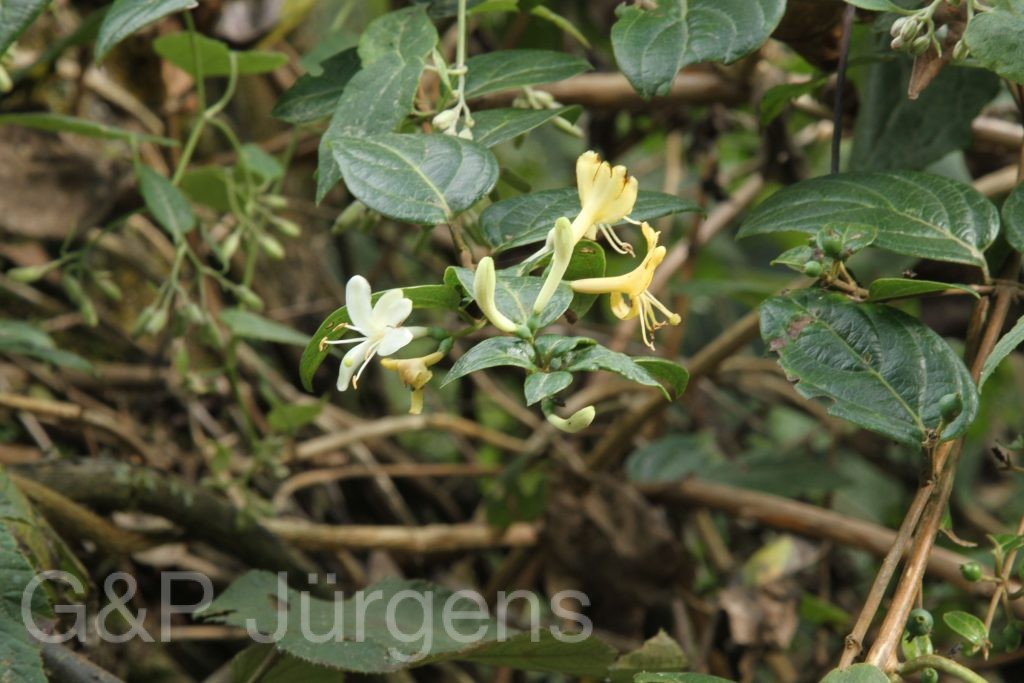
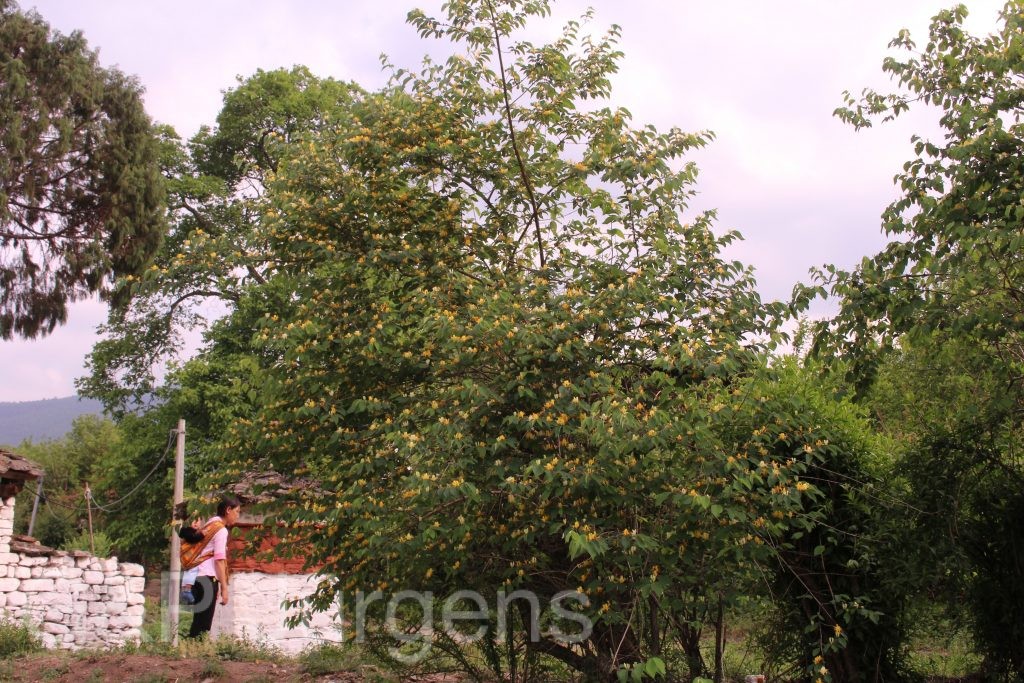
Lonicera acuminata is a widespread evergreen or semi-evergreen climbing honeysuckle distributed across the Himalaya and montane East and Southeast Asia, with native records from China, Taiwan, Japan, Nepal, India, Bhutan, the Philippines and Indonesia, alongside numerous cultivated and naturalised occurrences in Europe and North America; GBIF documents over 12,000 occurrences. It inhabits forest margins, thickets, ravines and scrubby slopes, mostly between 1000 and 3000 m, scrambling over shrubs and trees in mixed broadleaf and conifer forest. The Bhutanese photograph from Paro at about 2400 m in June shows it flowering in its typical mid-elevation woodland-edge setting.

The plant is a twining woody liana with slender, often purplish, hairy young branches. The leaves are opposite, ovate-oblong to lanceolate, acuminate at the apex as the epithet indicates, entire, and frequently ciliate and pubescent along the margins and veins. The flowers are paired in the leaf axils on short peduncles, the corolla bilabiate and tubular, opening pale yellow and often suffused with reddish or purplish tones, the slender tube exceeding the lobes and the stamens and style exserted. The bracts are small and the calyx teeth short. The fruit is a small globose to ovoid berry, ripening purple-black and bearing few seeds.

Within the large, taxonomically intricate genus Lonicera (Caprifoliaceae), L. acuminata belongs to the climbing subgenus Periclymenum and shows considerable variation in indumentum and leaf form across its range, accounting for a long list of synonyms. Its tubular, exserted-stamen flowers point to pollination by long-tongued insects, while the fleshy berries are dispersed by birds. Broadly distributed and frequent, it is of no conservation concern and is grown ornamentally for its fragrant flowers and vigorous growth.

Author: Wall. · Sources: POWO (Kew), GBIF, Flora of China, Flora of Bhutan, Annotated Checklist of the Flowering Plants of Nepal, Rehder's revisions of Lonicera

Wall. ex DC.

BhutanPG2011 141
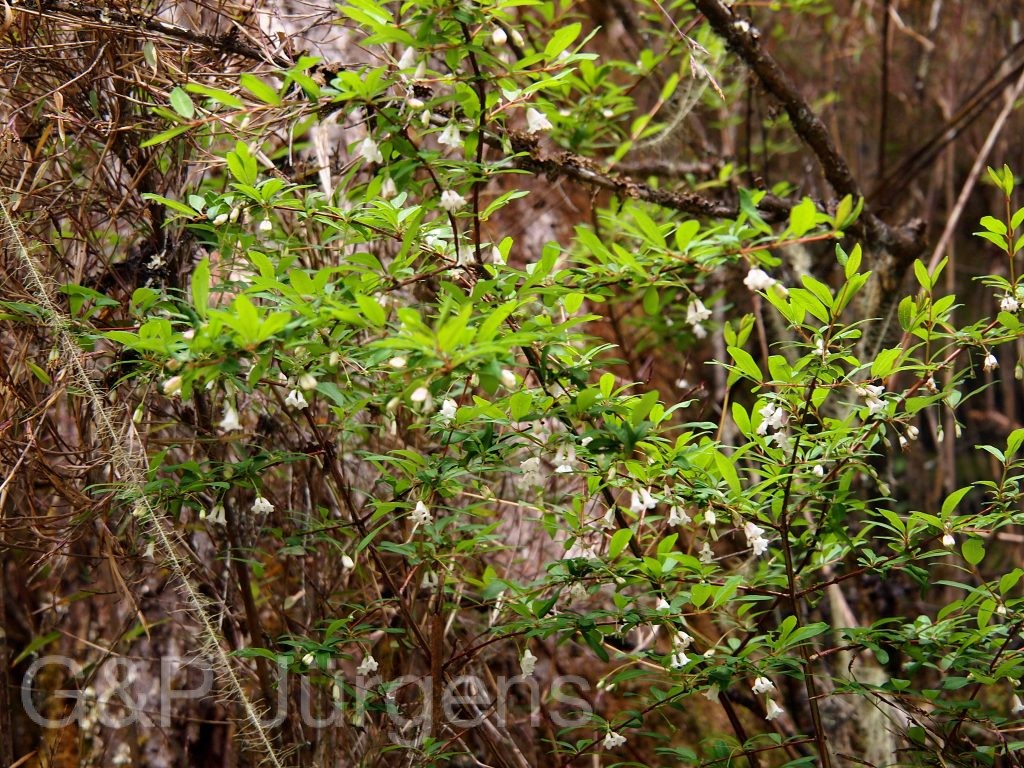
Bhutan Tsochenchen, 3550m June
Bh09 325 P531
Bhutan Tumching, 3700m June

Description

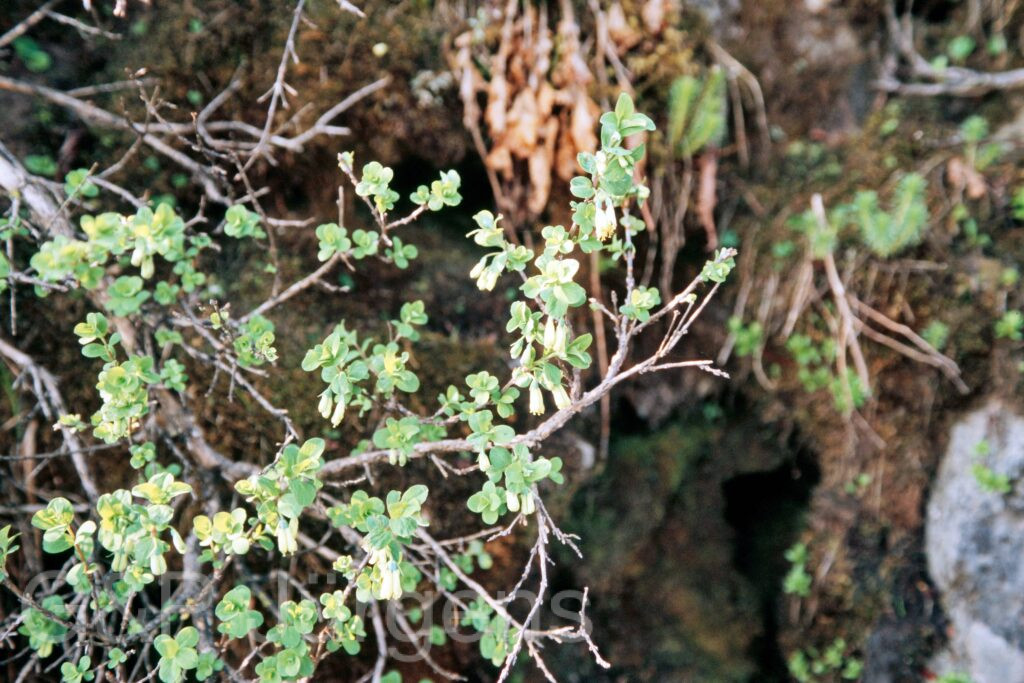
Lonicera angustifolia is a Sino-Himalayan honeysuckle distributed along the Himalaya from Afghanistan and Pakistan through India, Nepal and Bhutan to south-western China, with scattered records eastward to Myanmar; GBIF lists around 1,200 occurrences, several reflecting cultivation in Europe and North America. It is a shrub of the upper temperate and subalpine zones, occupying open coniferous and mixed forest, scrub, forest margins and rocky slopes, broadly from 2,400 to 4,000 m. The plants photographed at Tsochenchen at 3,550 m and Tumching at 3,700 m in Bhutan, both in June, show it flowering in early summer within high subalpine shrubbery near the upper forest limit.

It is an erect, much-branched deciduous shrub reaching 1-2.5 m, with slender greyish branchlets. The leaves are opposite, narrowly elliptic to oblong-lanceolate or linear, hence the epithet angustifolia ('narrow-leaved'), 1-4 cm long, entire and glabrous to thinly pubescent. The flowers are borne in axillary pairs on a common peduncle, each pair subtended by small bracts; the corolla is tubular-funnelform, two-lipped and pale pink to whitish, and the paired ovaries are partly fused. The two berries are connate at the base, ripening red and remaining largely free at the apex, each containing several seeds.

Lonicera section Isika, to which L. angustifolia belongs, comprises numerous shrubby, paired-flowered honeysuckles that are particularly diverse in the Himalaya and western China. Its tubular pink corollas are adapted to pollination by bees and long-tongued insects, while the bright red, partly fused berries are dispersed by birds and form an important food source in the subalpine zone. As a widespread, hardy and ecologically tolerant species spanning a broad elevational range, it is of least concern; its cold-hardiness and ornamental berries account for its occasional cultivation in temperate gardens.

Author: Wall. ex DC. · Sources: POWO (Kew), GBIF, Flora of China, Flora of Bhutan, Flowers of the Himalaya (Polunin & Stainton), monograph of Lonicera (Caprifoliaceae)

Wall.

Bhutan2015 600
Bhutan Gasa 1950m, October
Bhutan2015 601
Bhutan Gasa 1950m, October

Description

Lonicera glabrata is a Himalayan and Sino-Himalayan honeysuckle distributed from Nepal and India through Bhutan and Myanmar into south-western China; its c. 150 georeferenced records concentrate along the temperate forest belt of the eastern Himalaya. It grows in broadleaf and mixed forest, forest margins, thickets and shrubby slopes, generally between 1500 and 3000 m. The plant photographed at Gasa in northern Bhutan at 1950 m in October occupies the temperate forest zone, where its autumn fruiting follows the late-spring to early-summer flowering typical of the species.

It is a glabrous deciduous shrub, sometimes scandent, 1.5-3 m tall, distinguished as the epithet "glabrata" implies by its smooth, hairless foliage. The leaves are opposite, ovate to lanceolate, acuminate, entire and rather thin in texture. The flowers are borne in axillary pairs on a slender common peduncle, each two-lipped and creamy-white to pale yellow, fragrant, with a slender tube. Paired bracteoles subtend the ovaries. The fruit is a paired berry, the two ripening red to purplish-black, the partly fused pairs offering a conspicuous food reward. The four to five stamens and slender style are exserted from the corolla mouth.

Described by Wallich (as Wall.), L. glabrata belongs to Lonicera section Coeloxylosteum of the Caprifoliaceae, a group of paired-flowered Himalayan shrubs. The tubular, nectar-rich flowers are pollinated by bees and long-tongued insects, while the colourful berries are dispersed by birds. The species is widespread within its range and locally common in forest understorey, with no significant conservation concern, though it is sensitive to deforestation of mid-elevation broadleaf woodland.

Author: Wall. · Sources: POWO (Kew), GBIF, Flora of Bhutan, Flora of China, Flora of Nepal, Rehder's monograph of Lonicera (Caprifoliaceae)

Royle ex Hook.f. & Thomson

Garh 07 116 ergebnis
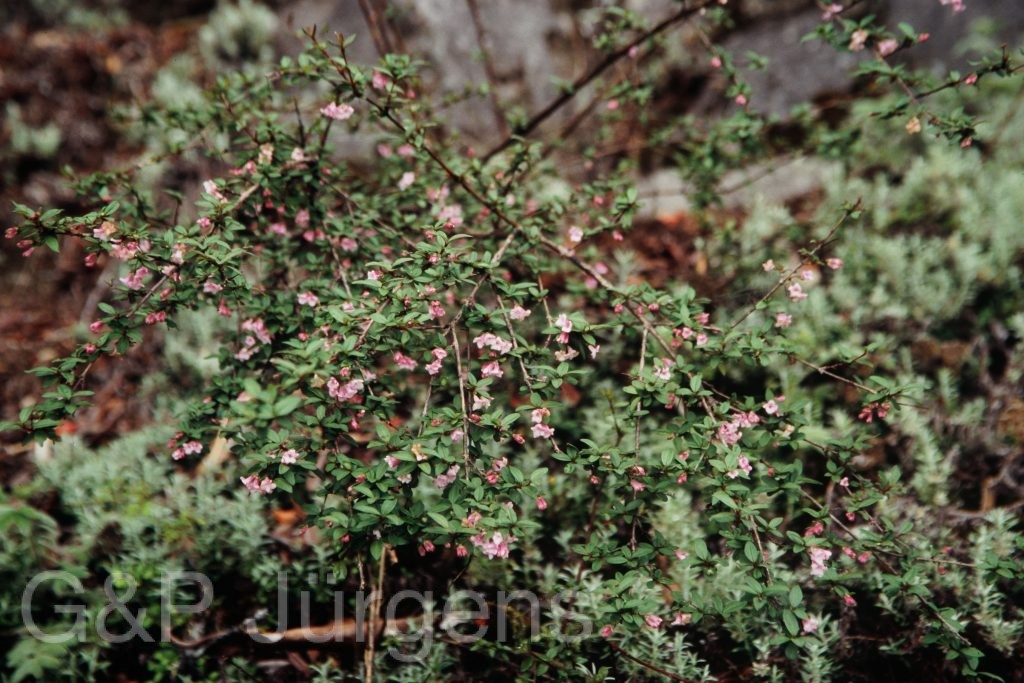
India Garhwal Meggu Kichatti 3300m, June

Description

Lonicera obovata is a Himalayan shrubby honeysuckle distributed through Afghanistan, Pakistan, Nepal, NW India, Bhutan and SW China, with 424 occurrences recorded in GBIF. It inhabits high-elevation shrubberies, open coniferous and birch woodland margins, rocky slopes and the upper subalpine to alpine zone. The photographed material from Meggu Kichatti in Garhwal, India, at about 3,300 m in June, represents typical habitat where the plant flowers as the snow recedes, often forming low thickets among rocks and dwarf rhododendron.

It is a deciduous, much-branched dwarf shrub usually 0.3–1 m tall with slender, often arching branches. The leaves are opposite, small, obovate to elliptic as the epithet implies, 1–3 cm long, rounded or retuse at the apex and somewhat glaucous, with short petioles. The flowers are borne in axillary pairs on short peduncles; the twin corollas are funnelform, pale yellow to creamy white, two-lipped, with the ovaries of the paired flowers partly connate. The fruit is a fused, ovoid, red berry crowned by the persistent calyx teeth, the paired ovaries coalescing into a single bilocular fruit.

The species belongs to Lonicera sect. Isika, a group of paired-flowered honeysuckles with connate fruits. GBIF records it as accepted. It is a hardy element of the West and Central Himalayan alpine flora, ecologically important as a nectar source for high-altitude pollinators and as cover in exposed terrain, and is not considered threatened across its broad montane range.

Author: Royle ex Hook.f. & Thomson · Sources: POWO (Kew), Flora of China Vol. 19, Flora of Pakistan, GBIF, Rehder: Synopsis of the Genus Lonicera (1903)

Walp.

Garh 07 112 ergebnis
India Garhwal Meggu Kichatti 3200m, June

Description

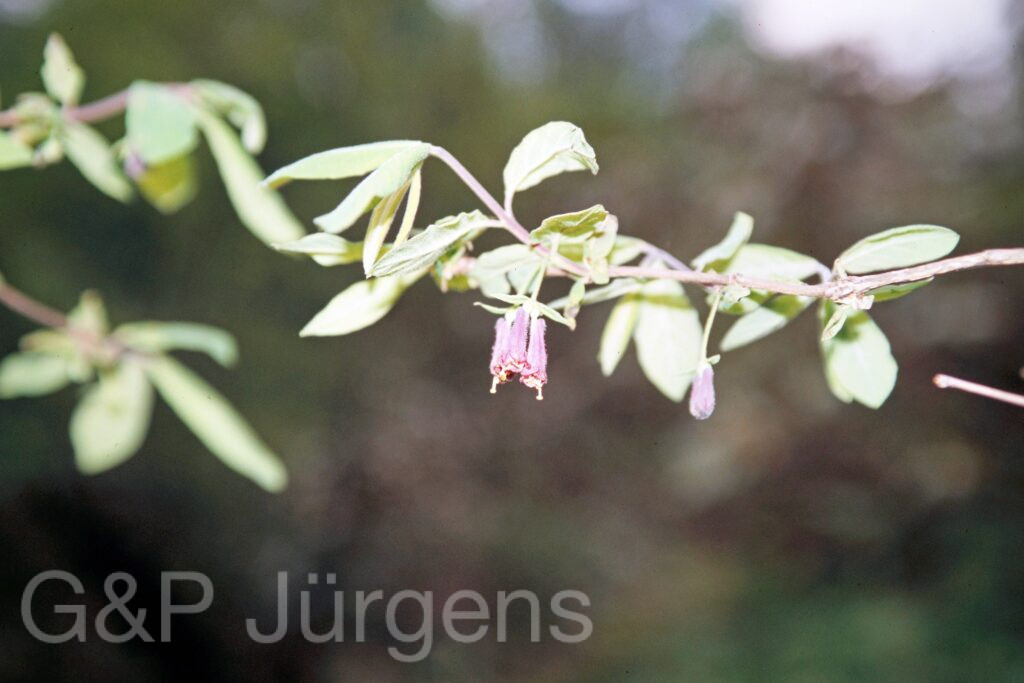
Lonicera purpurascens Walp. is a deciduous shrubby honeysuckle of the western and central Himalaya. GBIF occurrence data place it principally in India, Pakistan, Nepal, Afghanistan, Bhutan and Myanmar, confirming a chiefly Himalayan distribution. It is a plant of subalpine forest and shrubberies, growing among Abies, Betula and Rhododendron stands and along open rocky slopes, generally between about 2,800 and 3,800 m. The illustrated plant from Meggu Kichatti in Garhwal at 3,200 m, flowering in June, is characteristic of its occurrence in the upper temperate to subalpine belt where it blooms shortly after snowmelt.

It is an erect to spreading shrub up to 1.5–2 m tall with terete, glabrescent young branches and ovate to elliptic, entire leaves that are often glaucous and purplish-tinged beneath. The flowers are borne in axillary pairs on a common peduncle, subtended by bracts; the corolla is two-lipped, gibbous at the base, and ranges from yellowish to purple-flushed, hence the epithet. The paired ovaries are partly fused, and the resulting berries are red, more or less connate, each containing several seeds.

The species is one of numerous Himalayan Lonicera within the section Isika, and the purplish foliage and connate fruits distinguish it from allied taxa such as L. quinquelocularis and L. webbiana. Its berries provide food for montane birds, contributing to seed dispersal. The species is widespread within the Himalayan arc and is not currently regarded as of conservation concern.

Author: Walp. · Sources: POWO (Kew), GBIF, Flora of Pakistan, Flora of Bhutan Vol. 2, Rehder: Synopsis of the Genus Lonicera

Hardw.

Bhutan2014 1083
Bhutan Paro 2000m, May

Description

Lonicera quinquelocularis is a deciduous shrub of the Himalayan and Sino-Himalayan temperate zone, ranging from Afghanistan and Pakistan eastward through India, Nepal and Bhutan into south-western China; with some 873 georeferenced records it is among the better-documented honeysuckles of the region (European and North American records reflect cultivation). It grows in open forest, scrub, forest margins, riverine thickets and rocky hillsides, chiefly between 1500 and 3000 m. The illustrated plant from Paro in western Bhutan at 2000 m, flowering in May, typifies its occurrence in the temperate broadleaf and conifer zone where it forms part of the understorey and forest-edge shrub community.

It is a much-branched shrub 2-5 m tall with greyish, peeling bark and ovate to elliptic, entire leaves that are softly pubescent, often greyish beneath, arranged in opposite pairs. The flowers are borne in axillary pairs on a common peduncle; each is two-lipped and creamy-white, ageing to yellow, fragrant, with a short tube. The bracts and bracteoles subtend the paired ovaries. A diagnostic feature reflected in the epithet is the five-locular ovary. The most striking character is the fruit: the two berries of each pair fuse and ripen translucent, the seeds visible within, turning purple-black, giving rise to the English name "translucent-berry honeysuckle."

Described by Hardwicke (as Hardw.), the species belongs to Lonicera section Coeloxylosteum of the Caprifoliaceae. The conspicuous semi-transparent berries are dispersed by birds, while the nectar-rich flowers attract bees and other insects. The species is widespread and locally common, used as fuel and hedging and occasionally cultivated as an ornamental; it is not considered threatened.

Author: Hardw. · Sources: POWO (Kew), GBIF, Flora of Bhutan, Flora of Pakistan, Flora of China, Rehder's monograph of Lonicera (Caprifoliaceae)

Ghose

Nepal 95 346 P619 ergebnis
Nepal Tiblung 2810m, October

Description

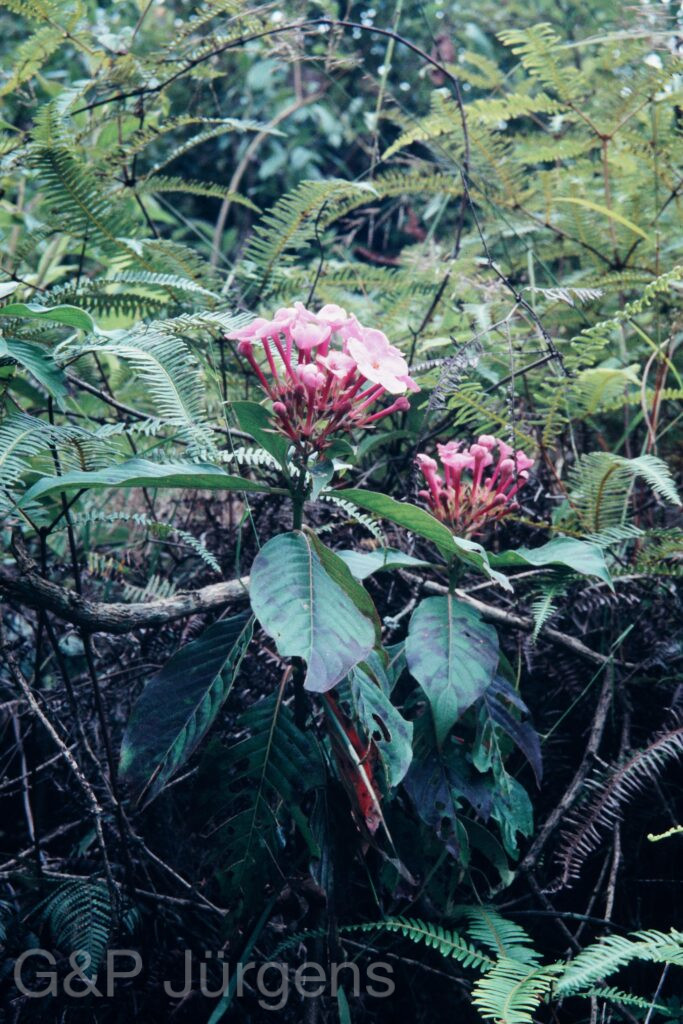
Luculia grandifolia is a rare and poorly known shrub or small tree endemic to the eastern Himalayas, recorded from Bhutan, northeast India (Sikkim, Arunachal Pradesh), and central-eastern Nepal. Only 30 occurrences are documented on GBIF, making it one of the least collected species in the genus. It grows in moist, evergreen montane forests and along shaded ravines at elevations of 2,000–3,200 m, where it is associated with Rhododendron, Magnolia, and Lithocarpus in the upper warm-temperate to lower cloud-forest zone. The species favours humid, sheltered microsites on steep slopes with deep humus.
Luculia grandifolia is a semi-evergreen to evergreen shrub or small tree, 2–5 m tall, with stout, terete branches. The leaves are the largest in the genus, opposite, broadly elliptic to obovate, 15–30 cm long and 8–15 cm wide, coriaceous, with entire margins and prominent venation beneath; petioles are stout, 2–4 cm long. Stipules are interpetiolar, triangular, and caducous. The inflorescence is a terminal, dense, corymbose cyme bearing numerous fragrant flowers. Each flower has a salverform corolla, 2.5–3.5 cm long, with five spreading, rounded lobes; the colour ranges from white to pale pink. The calyx is five-lobed, with lobes often tinged reddish. The fruit is a septicidal capsule containing numerous small, winged seeds.
Luculia is a small genus of approximately five species restricted to the Sino-Himalayan region, all prized for their showy, sweetly fragrant flowers. Luculia grandifolia is distinguished from the more widely cultivated L. gratissima by its significantly larger leaves and more robust overall habit. The photographed specimen from Tiblung in Nepal at 2,810 m in October represents a late-season flowering event, consistent with the autumnal blooming period reported for the genus. Given its limited distribution, small population sizes, and dependence on undisturbed montane forest, L. grandifolia is of considerable conservation interest and would likely qualify as Vulnerable under IUCN criteria if formally assessed.

Author: Ghose · Sources: POWO (Kew), GBIF, Flora of Bhutan Vol. 2, Press et al.: Annotated Checklist of the Flowering Plants of Nepal (2000), Springate et al. (2015)

Sweet

Bhutan2012 418
Bhutan Tserang 1300m, September
Bhutan2012 1341
Bhutan Sandrup 1500m, September
Nepal 95 346 P619 ergebnis
Nepal Tibling 2200m October

Description

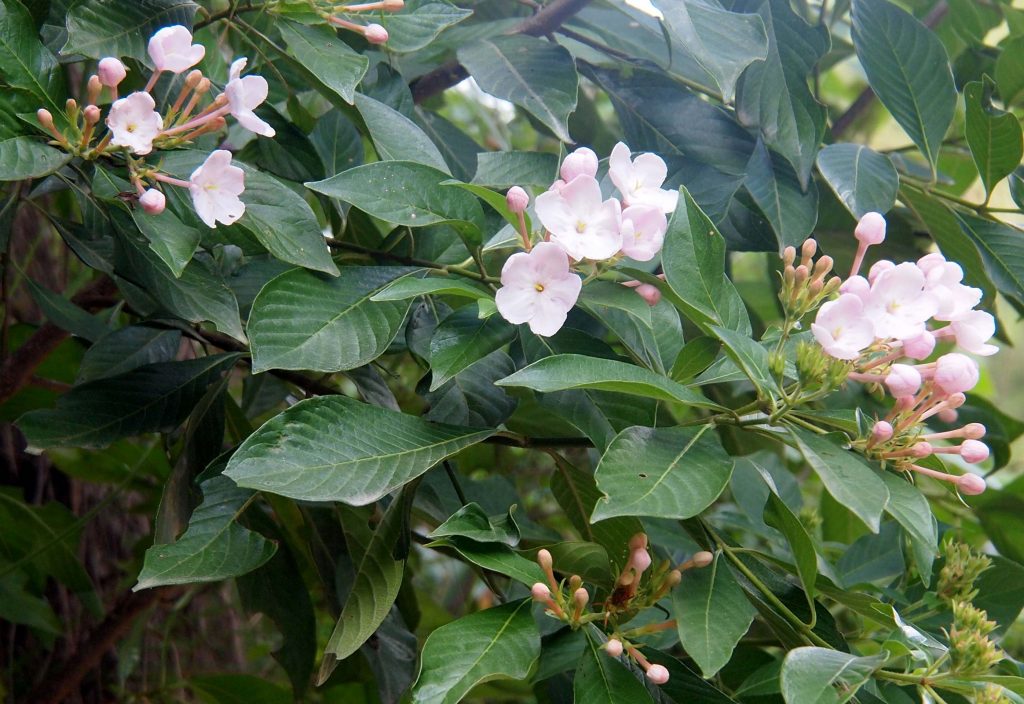
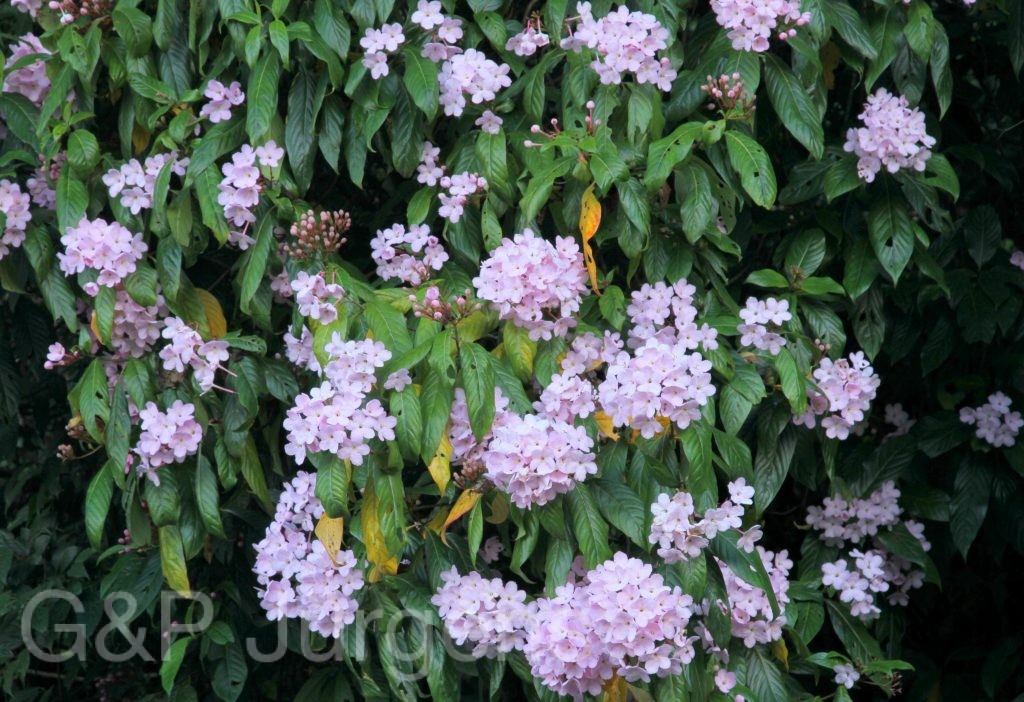
Luculia gratissima is a Himalayan and southwest Chinese shrub or small tree ranging from Nepal through Bhutan and northeast India into southern China, Myanmar, Thailand and Vietnam. GBIF records some 404 occurrences, including many cultivated specimens in temperate and subtropical regions worldwide. It inhabits subtropical to warm-temperate forest, forest margins, open hillsides and stream banks, generally between about 1000 and 2500 m. The photographed plants come from Bhutan at Tserang (1300 m) and Sandrup (1500 m) in September and from Tibling in Nepal at about 2200 m in October, the autumn flowering period typical of this fragrant species.

The species is an erect, branched shrub or small tree with terete, glabrescent branchlets. The leaves are opposite, large, elliptic to ovate-lanceolate, acuminate, with prominent pinnate venation and interpetiolar stipules. The flowers are borne in large terminal corymbose cymes and are showy and sweetly scented; each has a slender, elongate corolla tube opening into five spreading pink lobes, with small paired scales at the throat and exserted anthers. The fruit is an obovoid, ribbed, two-valved capsule that splits to release numerous small winged seeds adapted to wind dispersal.

Luculia gratissima Sweet is prized horticulturally for its fragrant pink autumn flowers and is widely grown in mild and subtropical gardens, which accounts for its many extralimital GBIF records. Within its native Himalayan and Indo-Chinese range it is widespread and not considered threatened. The genus Luculia, with its long-tubed scented flowers and winged capsular seeds, is of phylogenetic interest as an early-diverging lineage within the Rubiaceae.

Author: Sweet · Sources: POWO (Kew), GBIF, Flora of Bhutan, Flora of China, taxonomic revisions of Luculia (Rubiaceae)