Author

G & P Jürgens

Prain

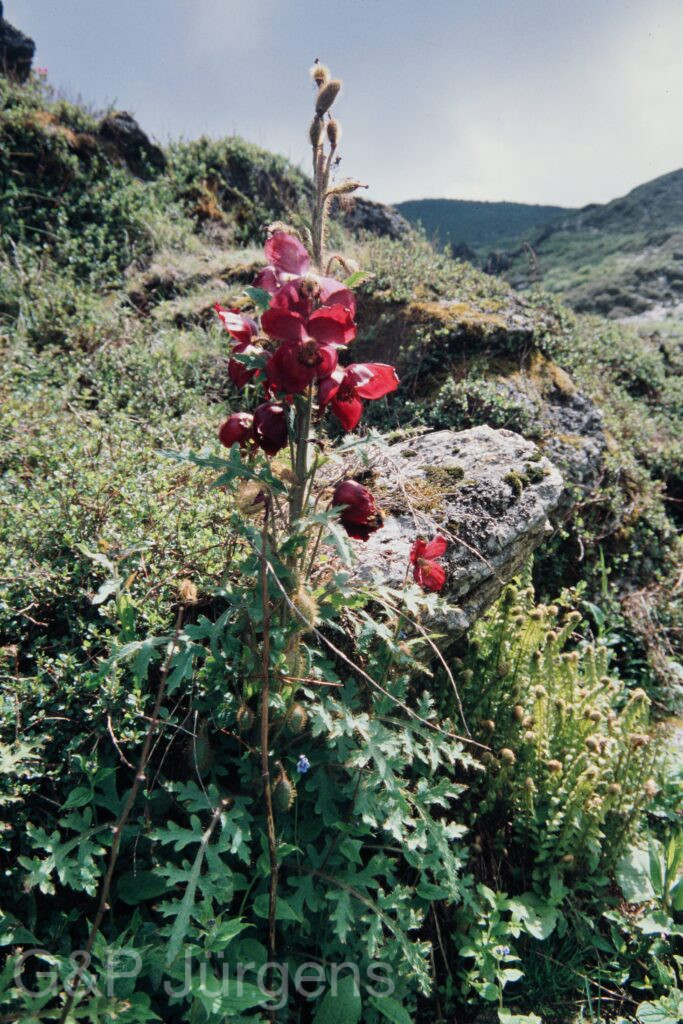
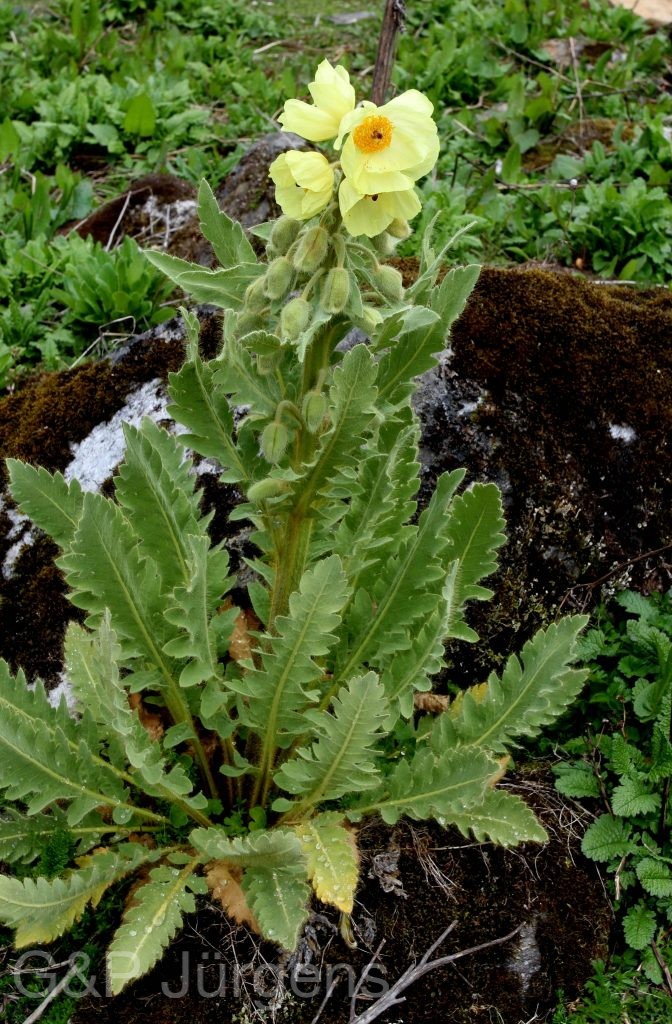
BhutanPG2011 198
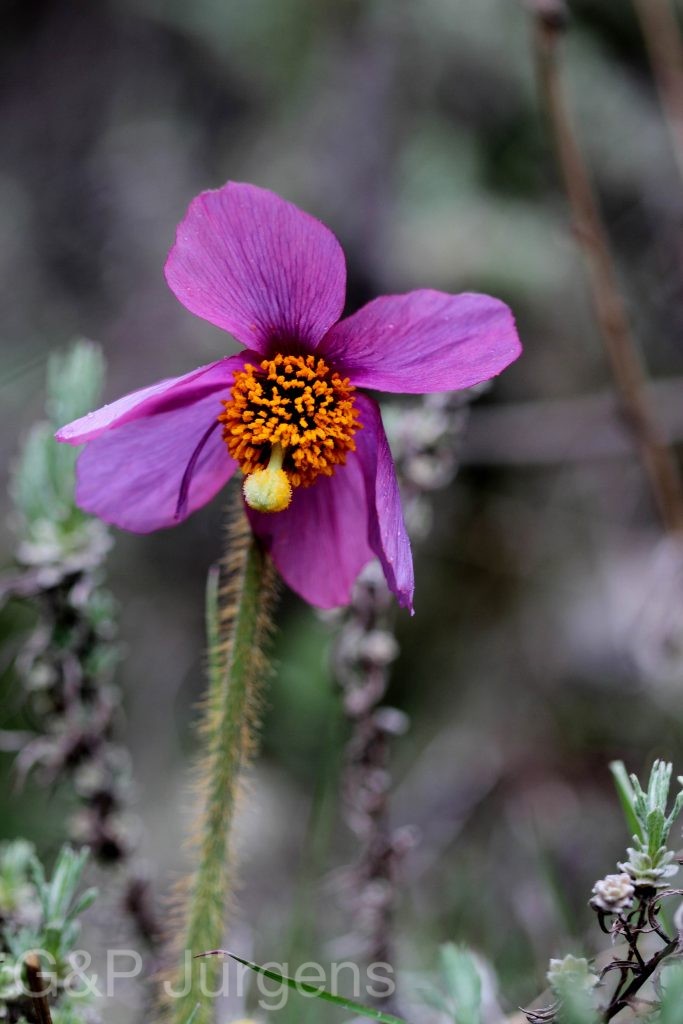
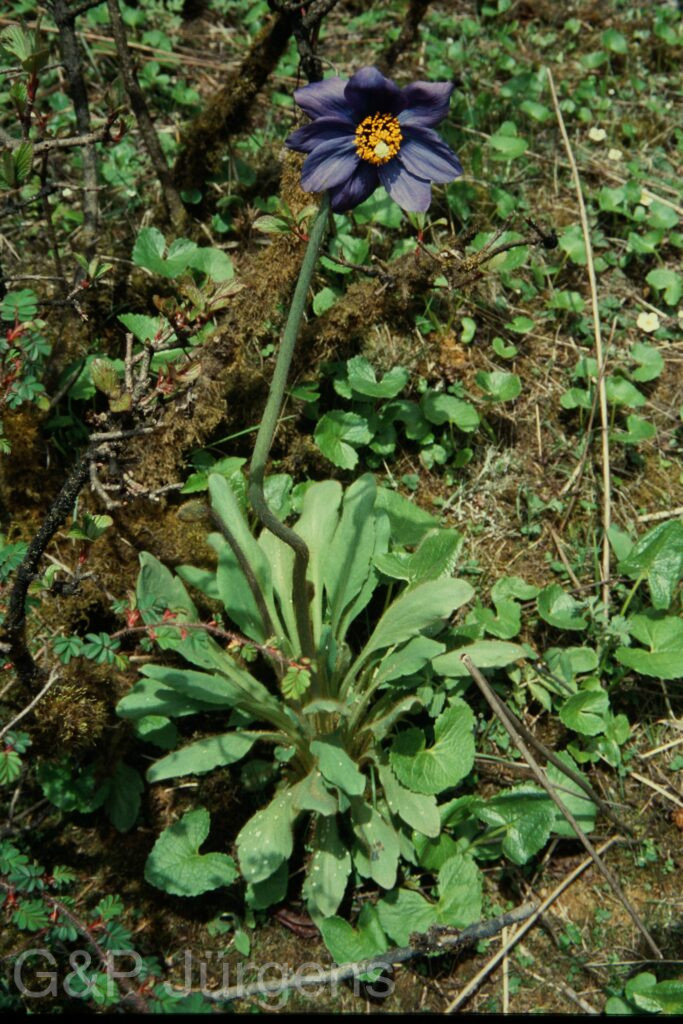
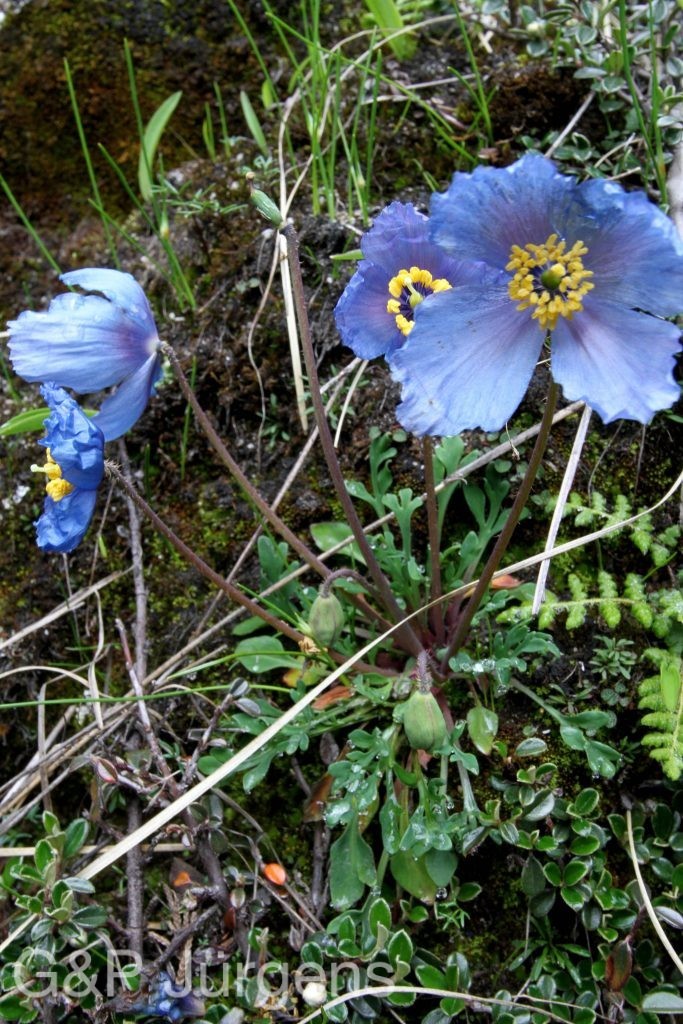
Bhutan Tsochenchen, 3650m June
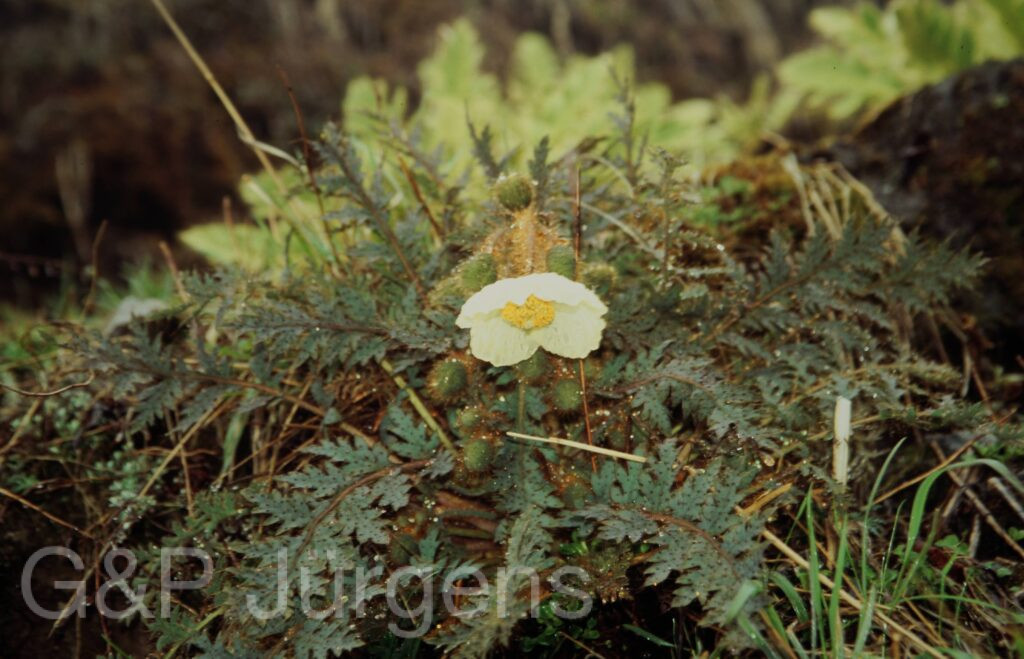
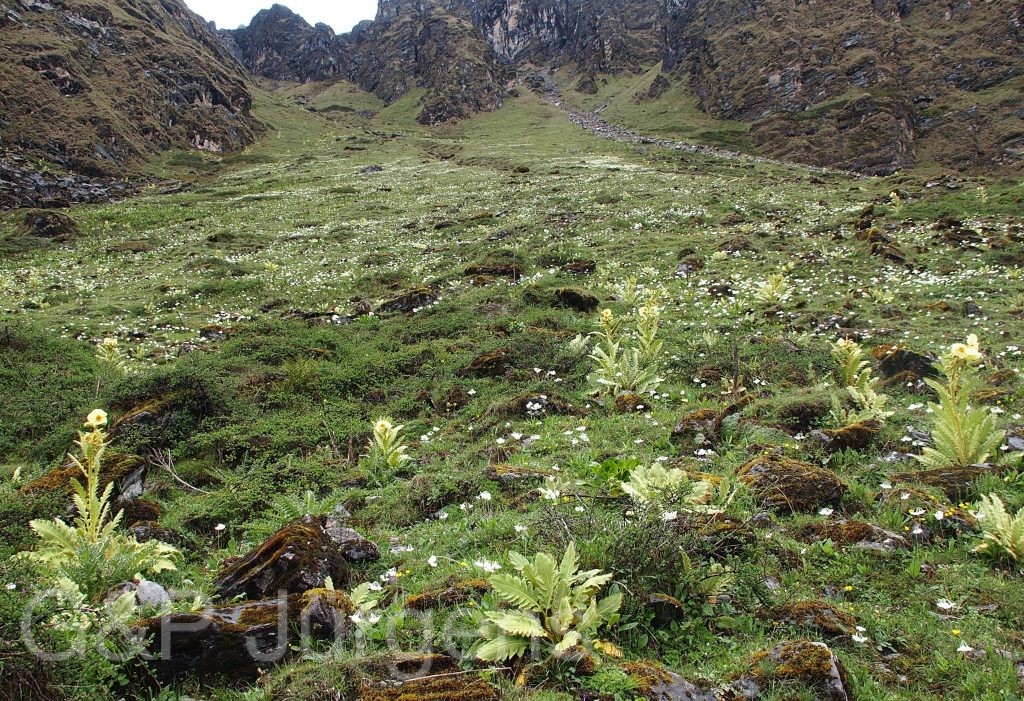
BhutanPG2011 206
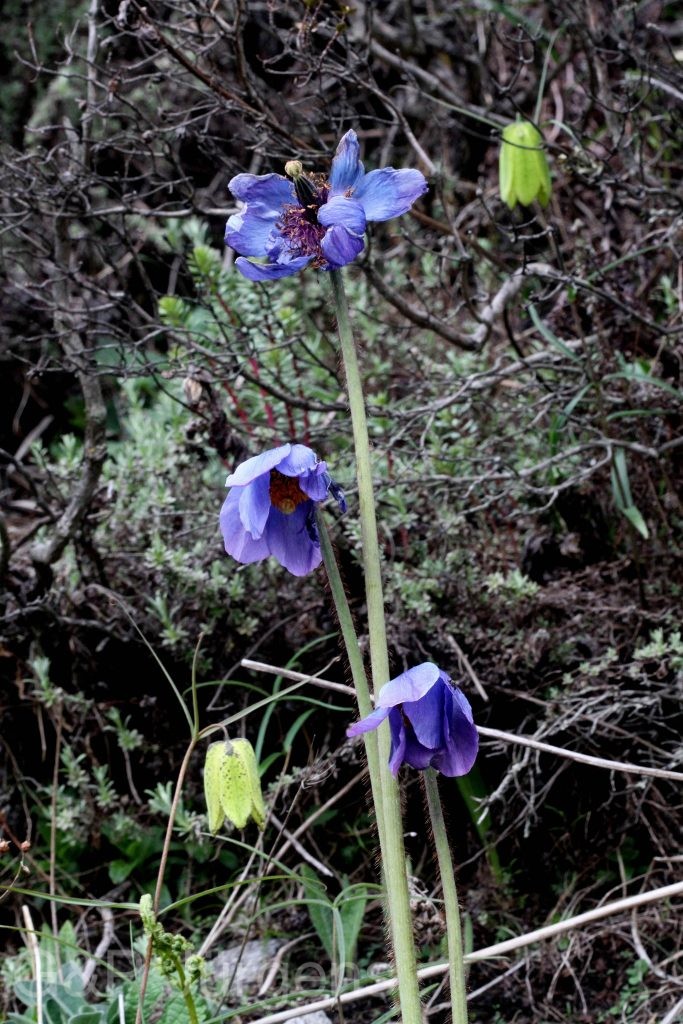
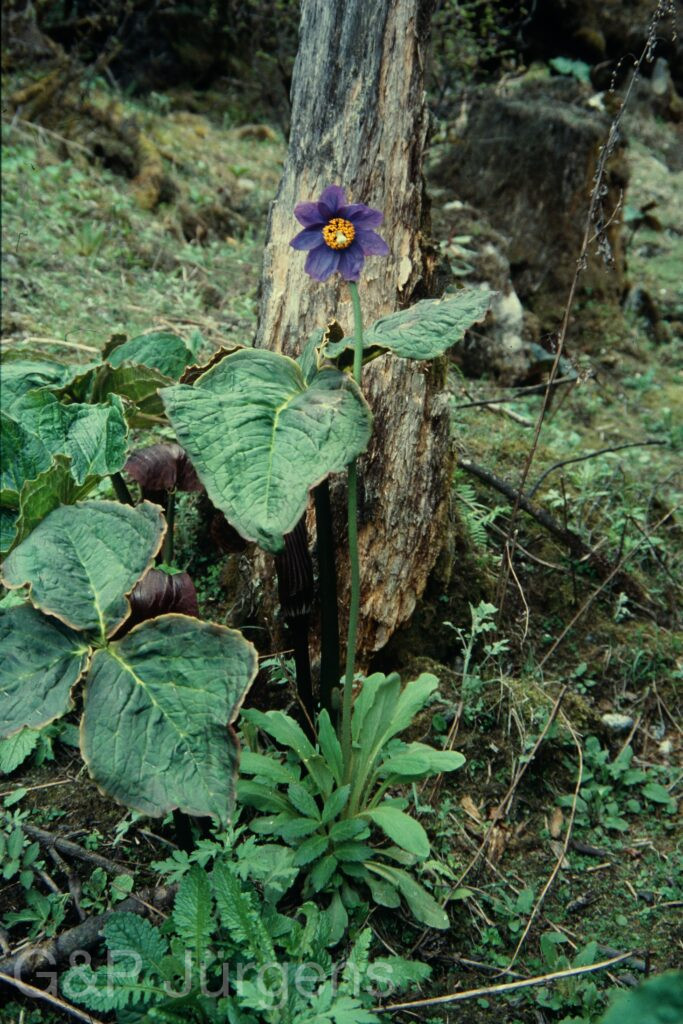
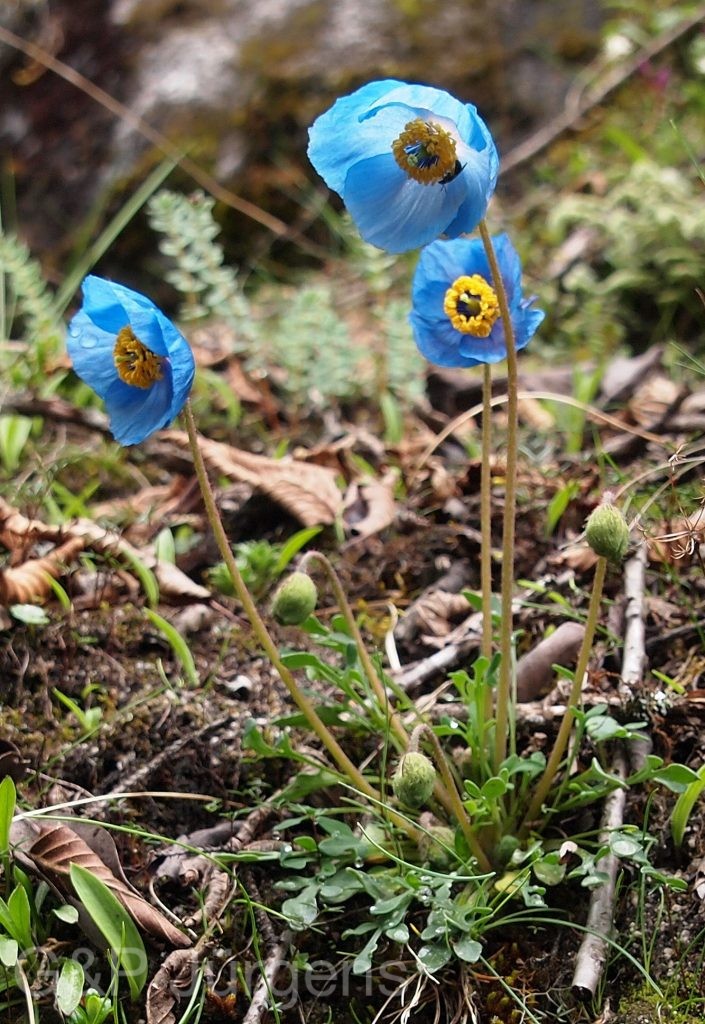
Bhutan Tsochenchen, 3650m June

Description

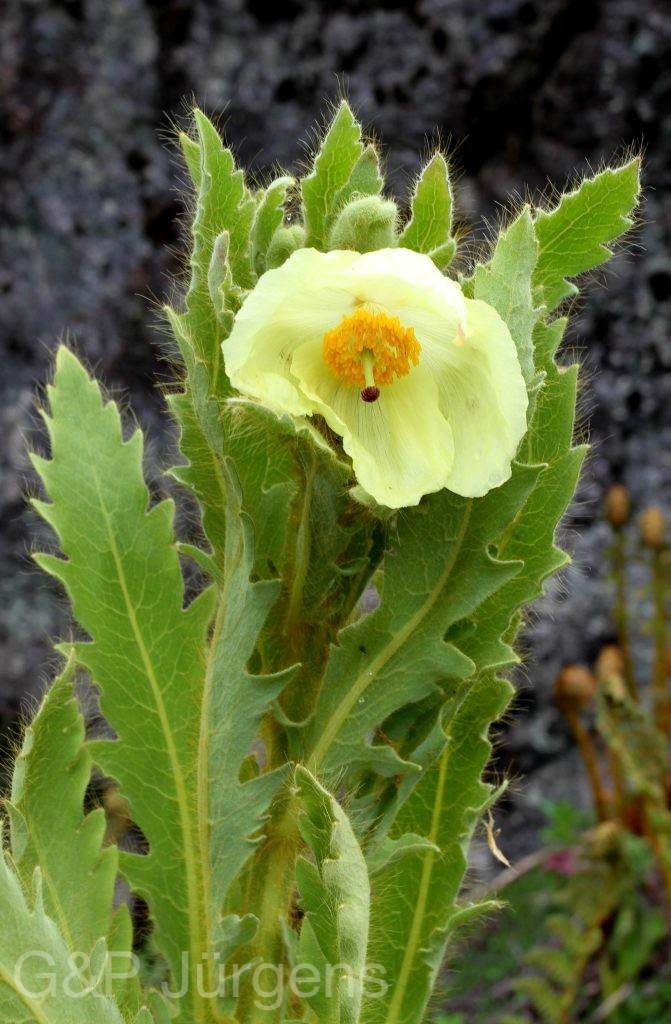
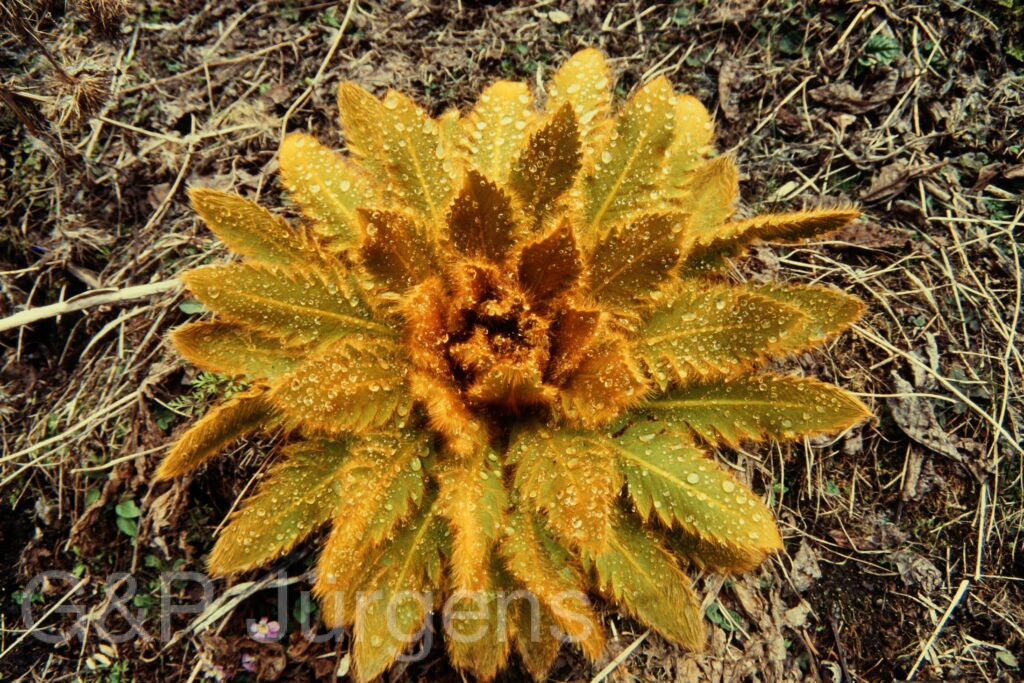
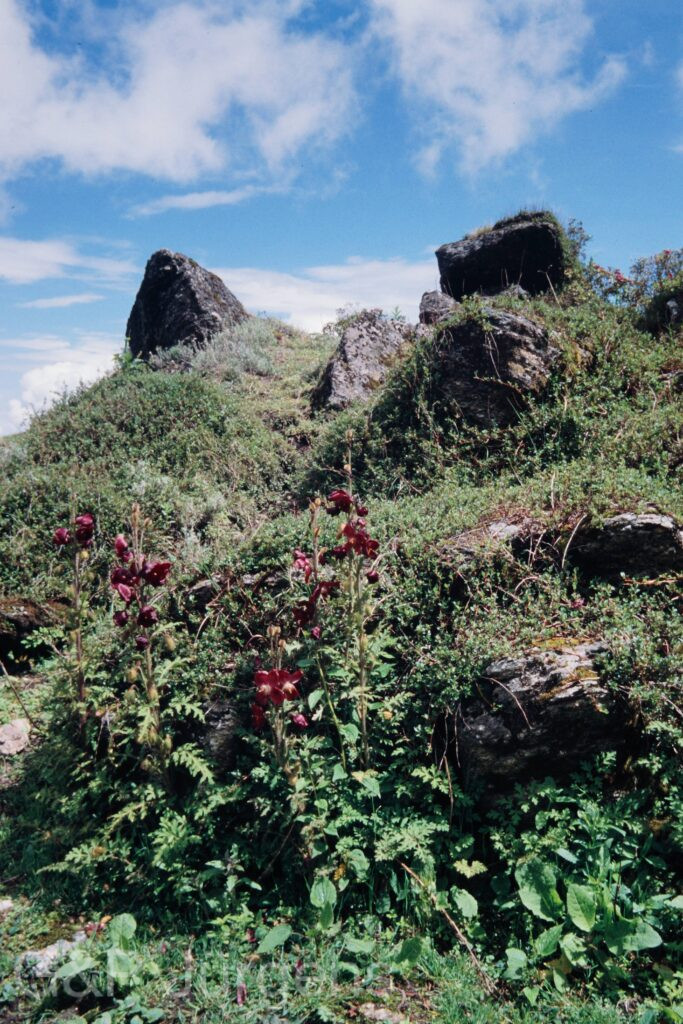
Meconopsis bella is a dwarf, exquisite blue poppy endemic to the eastern Himalaya, recorded from Nepal, northern India, Bhutan and adjacent southern China, the 79 GBIF occurrences reflecting its narrow range and the inaccessibility of its habitat. It grows in cool, moist, sheltered situations at high elevation, characteristically rooted in crevices of rock faces, cliff ledges, moraines and shaded banks between roughly 3300 and 4500 m. The photographed plant was found at Tsochenchen in Bhutan at 3650 m in June, the early-summer flowering season when it blooms amid the monsoon mists of the subalpine zone.

It is a small, slender, tap-rooted perennial lacking a leafy stem, the few leaves forming a basal tuft; the blades are obovate and pinnately lobed or coarsely toothed, on long slender petioles, bearing scattered fine hairs. The flowers are solitary on long, thread-like leafless scapes that arise directly from the rootstock and nod gracefully. Each flower has four broad, satiny petals in pale sky-blue to lavender or, in some forms, soft pink-mauve, surrounding a boss of yellow stamens and a prominent ovary tipped by a clavate stigma. The fruit is a narrow erect capsule dehiscing apically to shed numerous small seeds.

The genus Meconopsis is the celebrated assemblage of Asiatic blue poppies, and M. bella is among the smallest and most delicate, belonging to the crevice-dwelling group. Its scattered, cliff-bound populations and exacting requirements for cool humid air and sharp drainage render it both horticulturally prized and intrinsically vulnerable to collection and climatic shifts. Although not formally Red-Listed, its restricted eastern Himalayan endemism warrants conservation attention, and seed-grown stock underpins its limited cultivation in specialist gardens.

Author: Prain · Sources: POWO (Kew), GBIF, Flora of Bhutan, Grey-Wilson: The Genus Meconopsis, Flora of China
Grey-Wilson

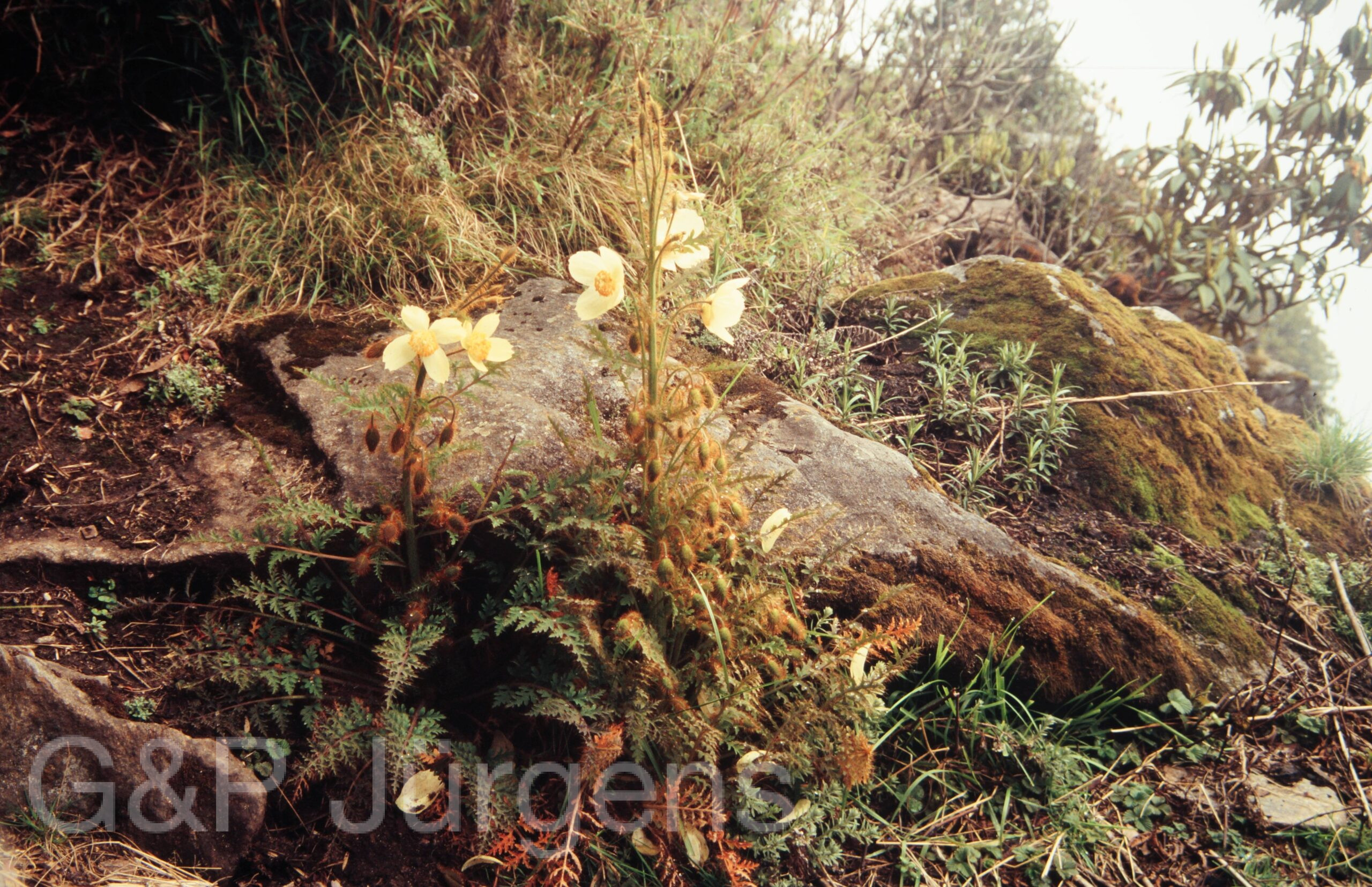
Nepal 99 248 ergebnis
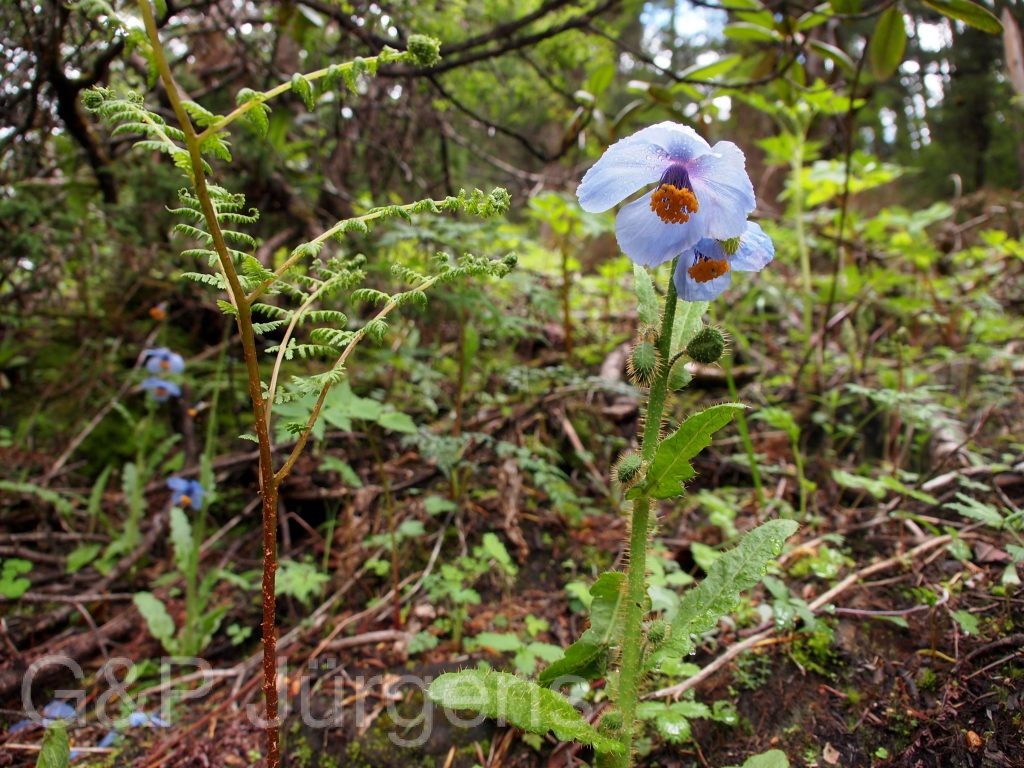
West-Nepal Tallekh 3155m, June
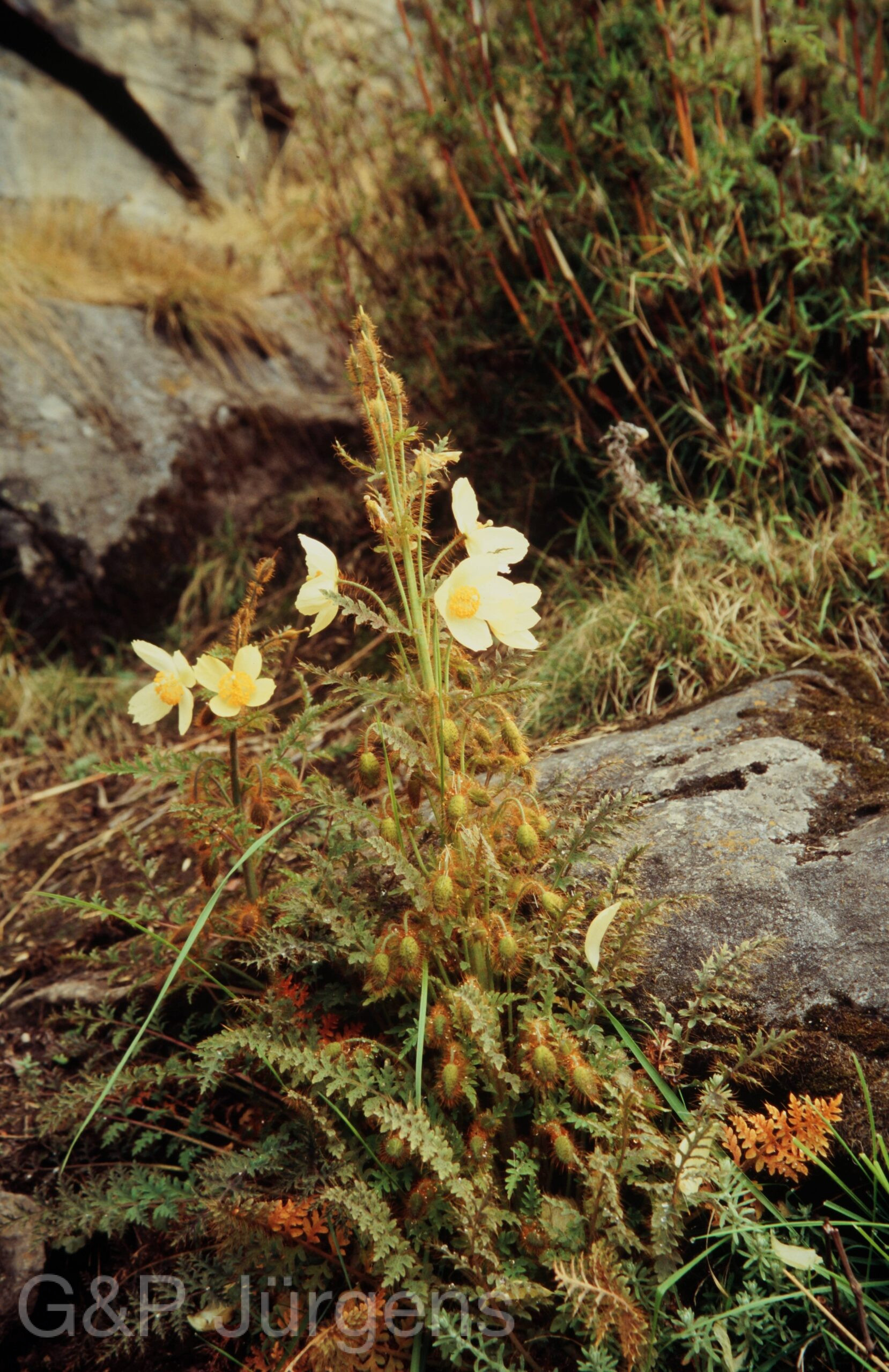
Nepal 99 265 ergebnis
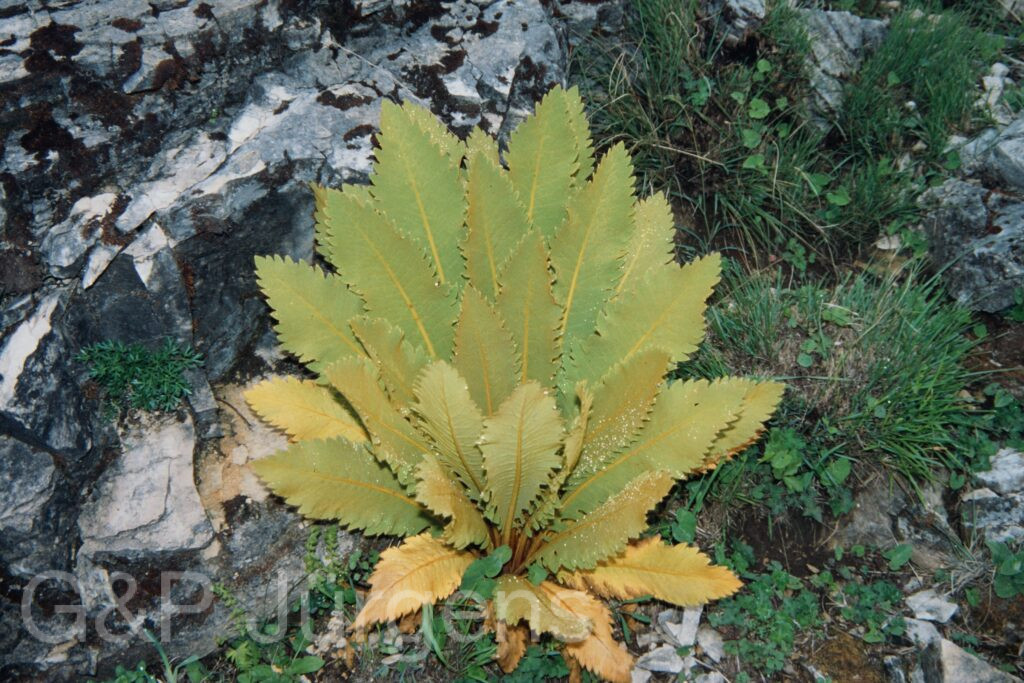
West-Nepal Tallekh 3155m, June
Nepal 99 266 ergebnis
West-Nepal Tallekh 3155m, June

Description

Meconopsis chankheliensis is a narrowly endemic poppy of the western Himalaya, presently documented only from Nepal, where the comparatively small number of records (18 georeferenced occurrences) reflects both its restricted range and the remoteness of its habitat. It is a plant of moist, sheltered situations in the upper temperate and subalpine zones, typically growing in damp meadows, on humus-rich banks and among rocks beside seepages and streamsides. The photographed material from Tallekh in West Nepal, at about 3155 m and flowering in June, is characteristic of the moderate elevations at which the species comes into bloom following the onset of the early summer monsoon moisture.

The plant is a tufted herb arising from a basal rosette of leaves and a stout taproot. The foliage is more or less covered in spreading bristly hairs; the leaves are oblanceolate to obovate, narrowed to a winged petiole, with entire to lobed or coarsely toothed margins. Flowering stems are erect and bristly, bearing one to several flowers. The blooms are bowl-shaped and showy, with four (occasionally more) broad, satiny petals in shades of blue to purplish-blue, surrounding a dense boss of numerous stamens with slender filaments and a short style crowned by a lobed stigma. The fruit is an elongate, bristly capsule dehiscing by apical valves to release many small seeds.

Meconopsis is a genus of the Sino-Himalayan region whose blue poppies have attracted intense horticultural and taxonomic attention, much of it through the monographic work of Christopher Grey-Wilson, whose name is associated with this taxon. As a localised Nepalese endemic restricted to a single mountain region, M. chankheliensis is of conservation concern, vulnerable to grazing pressure, habitat disturbance and the climatic shifts increasingly affecting Himalayan alpine floras. Its narrow distribution makes accurate field documentation and protection of known populations particularly important.

Author: Grey-Wilson · Sources: POWO (Kew), GBIF, Flora of Nepal, Annotated Checklist of the Flowering Plants of Nepal, Grey-Wilson: The Genus Meconopsis (monograph)

G.Taylor

Nepal 2009 48 ergebnis
Nepal Helambu Hile-Bhangyang 3380, May

Description

Meconopsis dhwojii is a narrow Central Himalayan endemic, restricted to the high mountains of Nepal, where GBIF records cluster; the remaining occurrences in Great Britain and Canada represent cultivated and herbarium material. The 46 georeferenced records reflect its rarity and confined range. It inhabits the upper subalpine and alpine zone between roughly 3000 and 4300 m, growing on open rocky slopes, screes, moist cliff ledges and disturbed grazed turf. The plant photographed at Hile-Bhangyang in Helambu at about 3380 m in May typifies this monsoon-influenced montane habitat, where flowering coincides with snowmelt and the early growing season.

This is a monocarpic herb forming a dense basal rosette of pinnatifid to pinnatisect leaves, the whole plant conspicuously clothed in spreading, pale yellowish-brown to purple-based bristly hairs arising from dark spotted bases. From the rosette a stout, leafy, bristly flowering stem ascends, bearing the flowers in a leafy raceme. The nodding to half-spreading flowers have four broad, pale yellow petals; the numerous stamens surround a single style topped by a clavate stigma. The fruit is a narrowly oblong, bristly capsule dehiscing by short apical valves and releasing many small seeds.

Named for Dhwoj, a Nepali plant collector of the early-twentieth-century explorations, M. dhwojii belongs to the bristly, monocarpic poppyworts and is allied to M. paniculata and M. napaulensis within section Aculeatae. Like its relatives it dies after a single flowering, relying entirely on copious seed for persistence, an adaptation to unstable scree and disturbed alpine ground. Though not formally assessed as threatened, its restricted Nepalese distribution and collection for horticulture make habitat integrity important to its survival.

Author: G.Taylor · Sources: POWO (Kew), GBIF, Flora of Nepal, Annotated Checklist of the Flowering Plants of Nepal, Grey-Wilson Meconopsis monograph

G.Taylor

Description

Meconopsis gracilipes is a rare Himalayan poppy of restricted range, recorded from Nepal and adjacent south-western China. The low GBIF tally of 50 occurrences reflects both its scarcity and its confinement to remote high-mountain terrain. It grows in the subalpine and lower alpine zone, on shaded rocky banks, moist cliff ledges, mossy boulders and the margins of forest and shrubbery, generally between about 3000 and 4000 m. The plant photographed at Koktrok in the Helambu region of Nepal at about 3100 m in May exemplifies this damp, sheltered montane habitat, where it flowers early in the growing season before the full monsoon.

It is a slender, monocarpic or short-lived herb forming a rosette of petiolate, lobed to pinnatifid leaves, the plant sparsely clothed in fine bristly hairs. From the rosette arise delicate, thread-like (gracile) flowering stems, the specific epithet referring to these slender pedicels. The nodding flowers have four broad petals in shades of pale blue to lavender or purple; numerous stamens surround a short style with a small capitate stigma. The fruit is a narrow, few-valved capsule opening at the apex to shed many minute seeds.

Meconopsis gracilipes belongs among the blue-flowered Himalayan poppies and is allied to slender-stemmed species such as M. bella, sharing their preference for moist, shaded rock habitats rather than open scree. Its restricted distribution, low recorded abundance and dependence on specialised microhabitats make it of potential conservation interest, though it has not been formally assessed; the integrity of its high-elevation rock and forest-margin habitats is key to its persistence.

Author: G.Taylor · Sources: POWO (Kew), GBIF, Flora of Nepal, Annotated Checklist of the Flowering Plants of Nepal, Grey-Wilson Meconopsis monograph

(D. Don) Prain

Sikkim2011 89
Sikkim Chopta-valley 4200m, June
BhutanPG2011 321
Bhutan
Sikkim2011 252
Sikkim Yumthang 3700m, June
Nepal 97 136 G252
Nepal Mewa-Khola 3100m April

Description

Meconopsis paniculata is a stately Himalayan poppy distributed through Nepal, the Indian states of Sikkim and Darjeeling, Bhutan and southern Tibet (China), with cultivated records in Britain and Canada; GBIF documents about 440 occurrences. It grows in the upper temperate to subalpine and lower alpine zone, on open grassy slopes, forest clearings, streamsides and shrubby hillsides, as recorded in the Chopta valley (4200 m) and at Yumthang (3700 m) in Sikkim and at Mewa-Khola (3100 m) in Nepal. Spanning roughly 3000-4200 m, it flowers from spring into early summer (April-June), often forming conspicuous stands on damp, humus-rich slopes.

It is a robust monocarpic herb, forming in its first years a large basal rosette before producing a single tall, branched flowering stem up to 1.5-2 m. The whole plant is densely clothed in golden to rusty, spreading bristly hairs. The basal leaves are large, oblong-lanceolate and pinnately lobed or deeply cut, narrowing into a winged petiole. The inflorescence is an elongate, leafy panicle (the epithet "paniculata") of nodding, broadly cup-shaped flowers; the four (rarely more) petals are pale to clear yellow, surrounding a boss of numerous yellow stamens and a stout ovary crowned by a short style and lobed stigma. The fruit is an oblong, bristly capsule dehiscing by apical pores to shed many small seeds.

Described by Prain from D. Don's basionym, M. paniculata belongs to the monocarpic, bristly-fruited group of Meconopsis allied to M. napaulensis and M. wallichii, a complex whose taxonomy has long been debated owing to hybridisation and variable indumentum. As a monocarpic species it dies after a single flowering, relying entirely on abundant seed for regeneration. The flowers are visited by bumblebees foraging at altitude. Widespread across its range, it is not considered globally threatened, though seed collection and grazing can affect local populations.

Author: (D. Don) Prain · Sources: POWO (Kew), GBIF, Flora of Bhutan, Flora of Nepal, Grey-Wilson's monograph of the genus Meconopsis

(D. Don) Walp.

Description

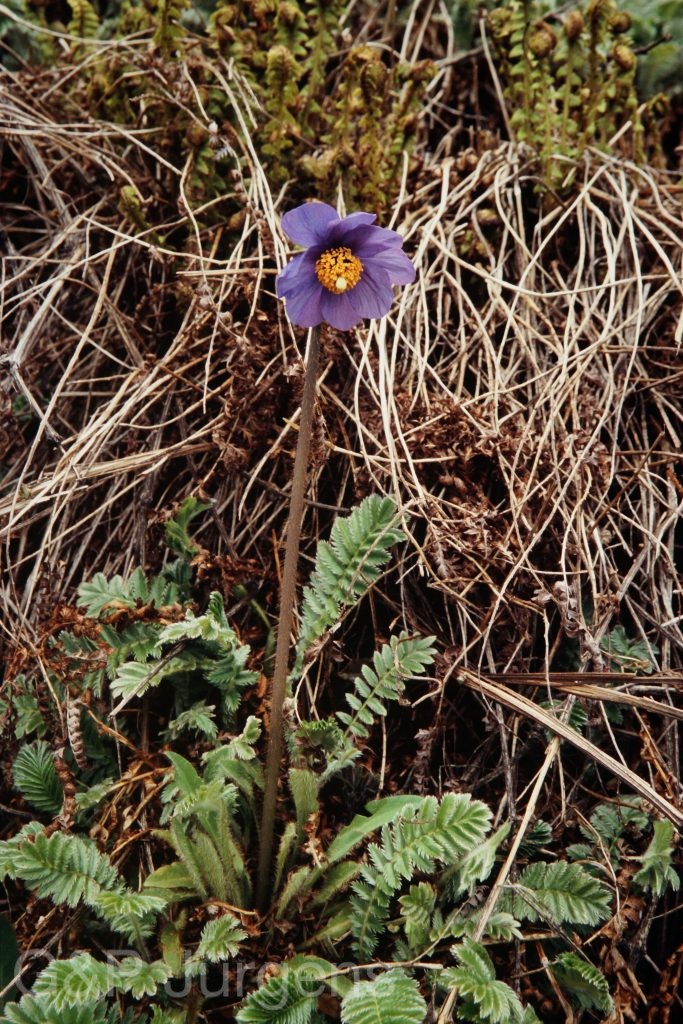
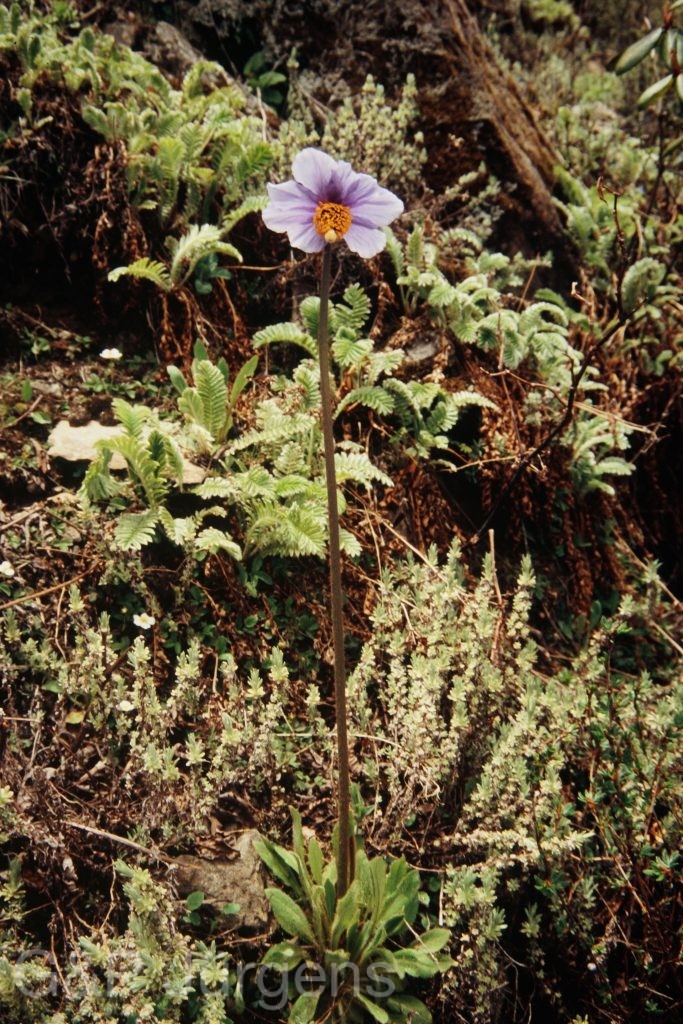
Meconopsis simplicifolia (D. Don) Walp. is a high-mountain perennial blue poppy of the central and eastern Himalaya, ranging through Nepal, Sikkim and northern India, Bhutan and southern Tibet (China), with cultivated records accounting for the United Kingdom entries in a GBIF dataset of roughly 267 occurrences. It inhabits alpine meadows, open turf, rocky slopes and the margins of Rhododendron scrub on moist, humus-rich, well-drained acidic soils, typically within the snowmelt-fed alpine zone. The illustrated collections cluster between about 3200 and 3900 m, from Tanghu in Sikkim at 3900 m and Chele-La in Bhutan at 3200 m in June to Yumthang on the Sikkim-India border at 3600 m in May, marking a late-spring to early-summer flowering as the snow retreats.

It forms a perennial herb with a basal rosette of simple, undivided leaves, oblanceolate to elliptic or narrowly lanceolate, entire to faintly toothed and clothed in soft, often fulvous to fawn-coloured bristly hairs, narrowing to a winged petiole; the simple, unlobed foliage gives the species its epithet. From the rosette arise one or several slender, bristly, leafless scapes, each bearing a solitary, nodding flower. The flowers have four (sometimes more) broad, silky, overlapping petals of clear sky-blue to violet or, in some forms, reddish-purple, surrounding a tuft of golden stamens and a stout ovary topped by a short, distinct style and capitate stigma. The fruit is an ellipsoid, bristly capsule opening by short apical valves.

Meconopsis simplicifolia is part of the perennial, scapose blue-poppy assemblage and is distinguished from allies such as M. grandis by its single-flowered scapes and entirely simple leaves; it is variable in flower colour and in whether it behaves as monocarpic or polycarpic. Pollinated chiefly by bumblebees, it is a celebrated ornamental long grown in cool temperate gardens. Across its range populations are localised and sensitive to grazing, trampling and the warming of alpine habitats, making it, like its relatives, a species of interest for Himalayan alpine conservation though not formally assessed as threatened.

Author: (D. Don) Walp. · Sources: POWO (Kew), GBIF, Flora of Bhutan, Flora of Nepal, Christopher Grey-Wilson – The Genus Meconopsis

Prain

BhutanPG2011 155
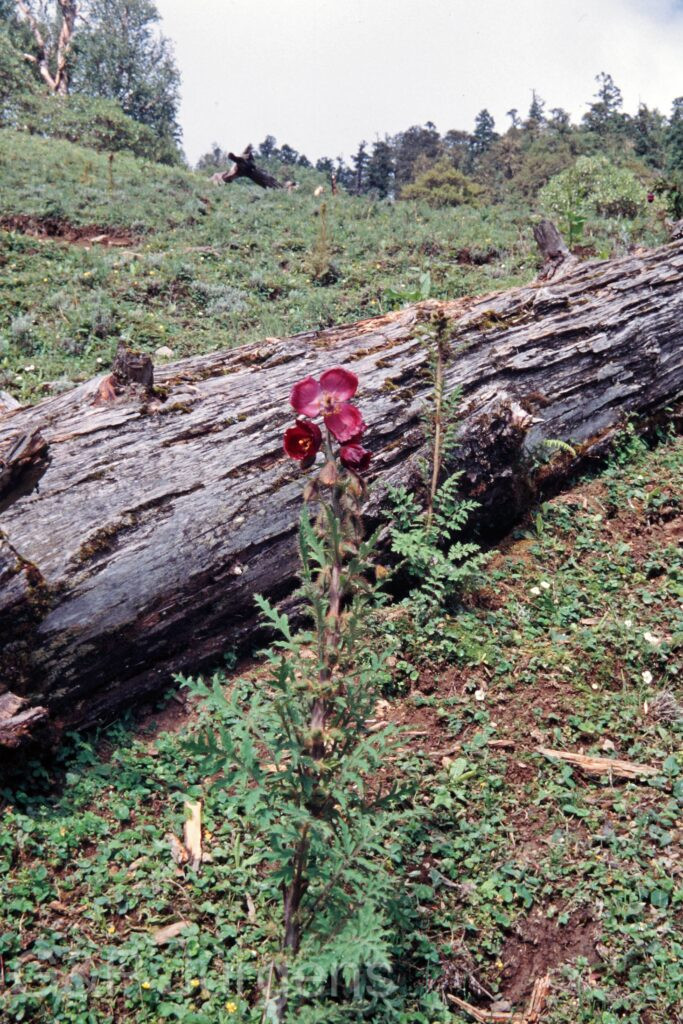
Bhutan Tsochenchen, 3500m June

Description

Meconopsis sinuata is a blue poppy of the eastern Himalaya. GBIF records it from India, Nepal, Bhutan and China, with around 60 occurrences distributed along the moist eastern Himalayan ranges. It grows in subalpine and alpine meadows, open shrubberies, forest clearings and rocky slopes, typically between 3000 and 4300 m, in the high-rainfall belt swept by the summer monsoon. The plant figured here was photographed at Tsochenchen in Bhutan at 3500 m in June, flowering early in the season among damp alpine herbage characteristic of this genus of cool, humid mountain habitats.

It is a slender perennial or biennial poppy bearing bristly hairs throughout. The basal leaves are oblanceolate with a distinctly sinuate to lobed margin, narrowing to a winged petiole, and the cauline leaves diminish upward. The nodding flowers are borne singly on bristly pedicels in the upper axils; the four (occasionally more) delicate, crinkled petals are sky-blue to purplish-blue, sometimes mauve, surrounding a boss of numerous yellow stamens. The superior ovary bears a short style, and the fruit is an elongate, bristly capsule dehiscing by apical valves to shed many small seeds.

Meconopsis, the celebrated Himalayan blue poppies, is a centre of endemism in the eastern Himalaya and Hengduan mountains, and the group has been extensively recircumscribed by molecular work separating Asian species from the European M. cambrica. The vivid blue pigmentation, attractive to bumblebee pollinators, has also made these poppies prized in cultivation. Restricted to specialised high-rainfall alpine habitats, M. sinuata is sensitive to grazing and habitat disturbance, and several congeners are of conservation concern.

Author: Prain · Sources: POWO (Kew), GBIF, Flora of China, Flora of Bhutan, Annotated Checklist of the Flowering Plants of Nepal, The Genus Meconopsis: Blue Poppies and their Relatives

Nepal 99 41 ergebnis
West-Nepal Nyor Gaad 2800m, June
Nepal 99 38 ergebnis
West-Nepal Nyor Gaad 2800m, June
Nepal 99 39 ergebnis
West-Nepal Nyor Gaad 2800m, June

Description

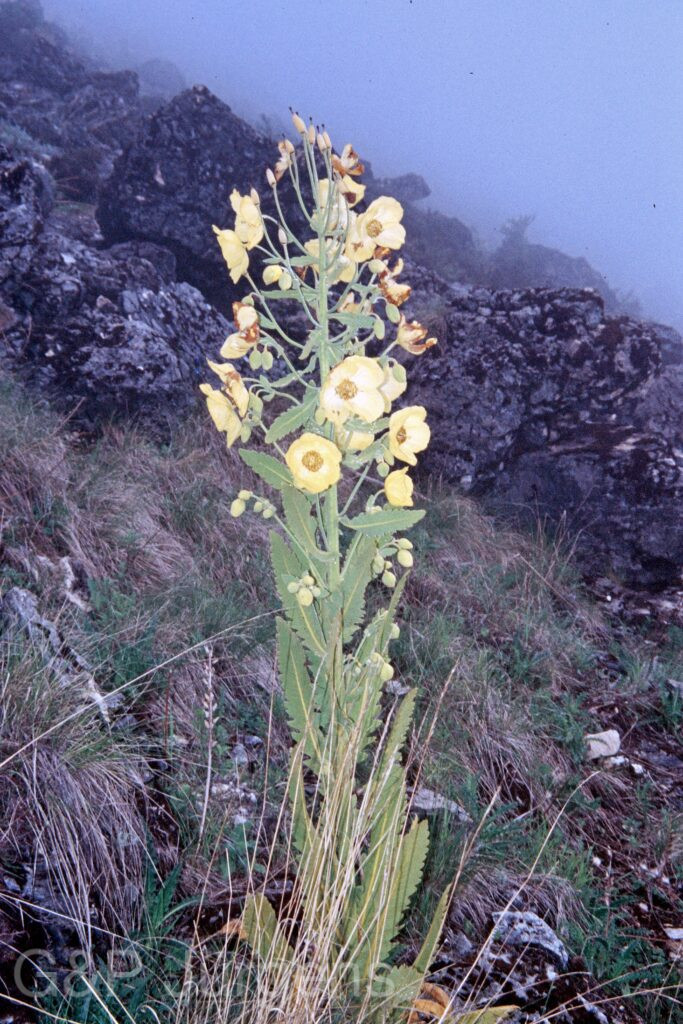
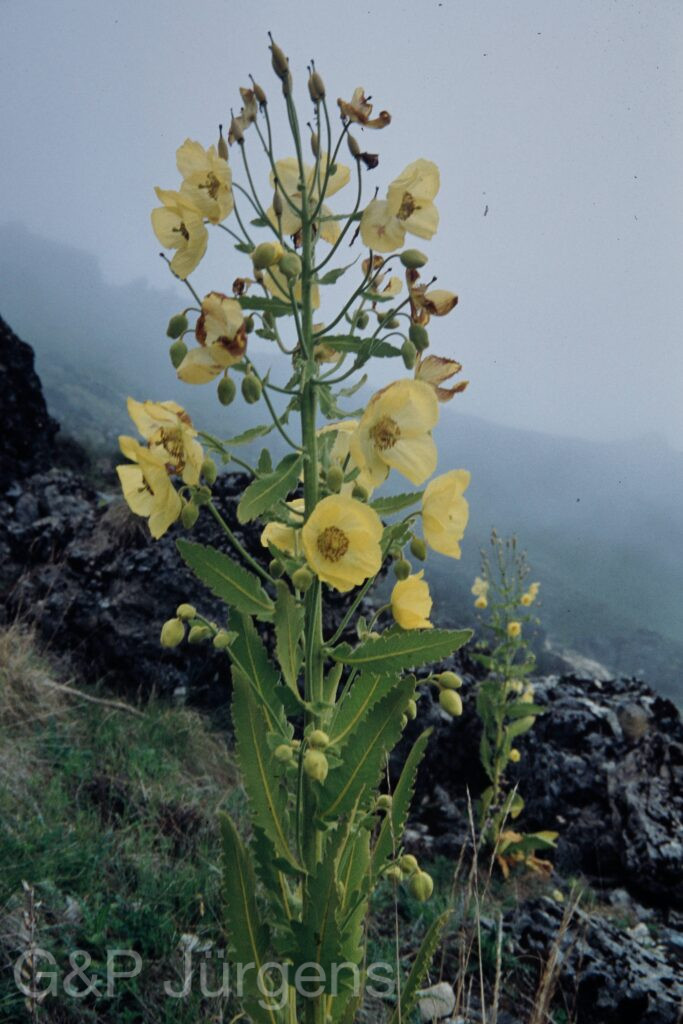
Meconopsis is a genus of approximately 50–80 species of poppy-like herbs predominantly centred on the Sino-Himalayan region, with a single outlying species (M. cambrica) in western Europe. The genus ranges from Pakistan through the Himalayas to southwestern China and northern Myanmar, with its greatest species diversity in southeastern Xizang, northwestern Yunnan, and western Sichuan. Species occupy diverse montane to alpine habitats including forest clearings, scrub, rocky slopes, scree, and high-altitude meadows at elevations from 2,000 to over 5,500 m. The present specimen, photographed in the Nyor Gaad valley of western Nepal at 2,800 m in June, represents a population in the lower elevational range typical for the genus.
Meconopsis species are annual, biennial, or monocarpic to polycarpic perennial herbs, producing rosettes of basal leaves that are variously lobed, pinnatifid, or entire, and typically covered with bristly or plumose hairs. The flowers are borne singly or in racemose to paniculate inflorescences and are characteristically large and showy, 3–10 cm across, with 4–8 petals in shades of blue, purple, red, yellow, or white. The stamens are numerous, with conspicuous yellow to orange anthers. The gynoecium consists of a syncarpous ovary that matures into a capsule dehiscing by apical valves. Identification to species level often requires examination of fruit morphology, indumentum type, and style characters.
Species-level determination in Meconopsis from photographs alone is frequently unreliable, as many taxa overlap in floral colour and vegetative morphology, and the genus has undergone considerable taxonomic revision. Western Nepal harbours several species including M. regia, M. napaulensis, and M. paniculata, among others. Over 9,200 occurrence records in GBIF attest to the genus's wide distribution and collecting interest. Many species are of significant horticultural value, particularly the blue-flowered taxa, while several narrow endemics face conservation concerns due to climate-driven habitat shifts and overcollection. Continued field surveys and molecular phylogenetic studies are essential for resolving species boundaries within this iconic Himalayan genus.

Sources: POWO (Kew), GBIF, Grey-Wilson: The Genus Meconopsis (2014), Flora of China Vol. 7, Flora of Nepal

Benth.

Nepal 99 293 ergebnis
West-Nepal Kalmura 4100m, June
Nepal 99 294 ergebnis
West-Nepal Kalmura 4100m, June

Description

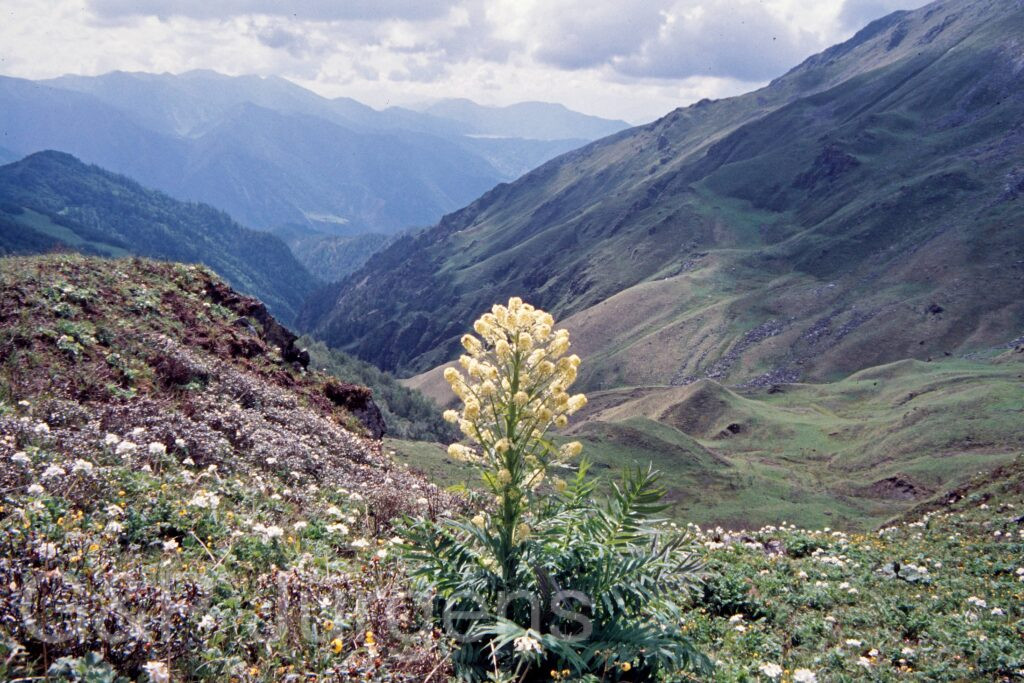
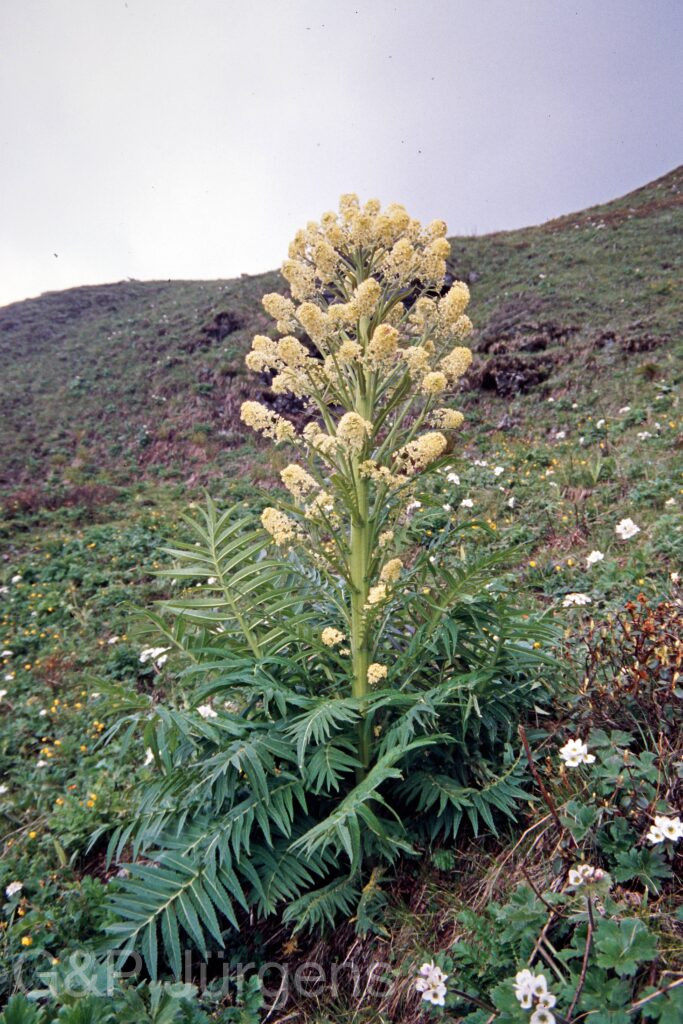
Megacarpaea polyandra Benth. is a robust alpine crucifer of the western and central Himalaya, known from about 99 records in India, Nepal and Pakistan, with scattered extralimital reports. It grows on open grassy and rocky alpine slopes, in subalpine scrub, forest clearings and along the margins of high pastures, generally between about 3000 and 4300 m. The plant photographed at Kalmura in West Nepal at 4100 m in June is typical of its preference for deep, moist, fertile soils on sunny slopes where it can attain a conspicuously large stature for an alpine herb.

The species is a stout perennial herb arising from a thick rootstock, with an erect, branching stem and large, deeply pinnatisect to lyrate leaves with several pairs of toothed lobes. The inflorescence is a broad panicle of many flowers; uniquely among most Brassicaceae the flowers bear numerous stamens (well in excess of the usual six), giving rise to the epithet "polyandra," and the petals are pale yellow to whitish. The fruit is the diagnostic feature: a large, flattened, didymous (two-lobed) silicle with broadly winged, papery valves, each loculus one-seeded, the whole readily wind-dispersed.

Megacarpaea is a small genus of central and high Asia notable for its polyandrous flowers and large winged fruits, features that set it apart within the mustard family and have made it of interest in studies of floral evolution in Brassicaceae. The young shoots and leaves are gathered locally as a potherb in parts of the Himalaya. Although widespread, its showy habit and use as a wild vegetable expose it to collection pressure, and as a narrow-belt alpine endemic it merits monitoring.

Author: Benth. · Sources: POWO (Kew), GBIF, Flora of Pakistan, Flora of Nepal, Hooker's Flora of British India, revision of Megacarpaea and tribe Megacarpaeeae

L.

Bhutan2015 547
Bhutan Mo-Shu 1450m, October
Bhutan2015 548
Bhutan Mo-Shu 1450m, October
Nepal 97 70 P109
Nepal above Mewa-Khola 1400m April

Description

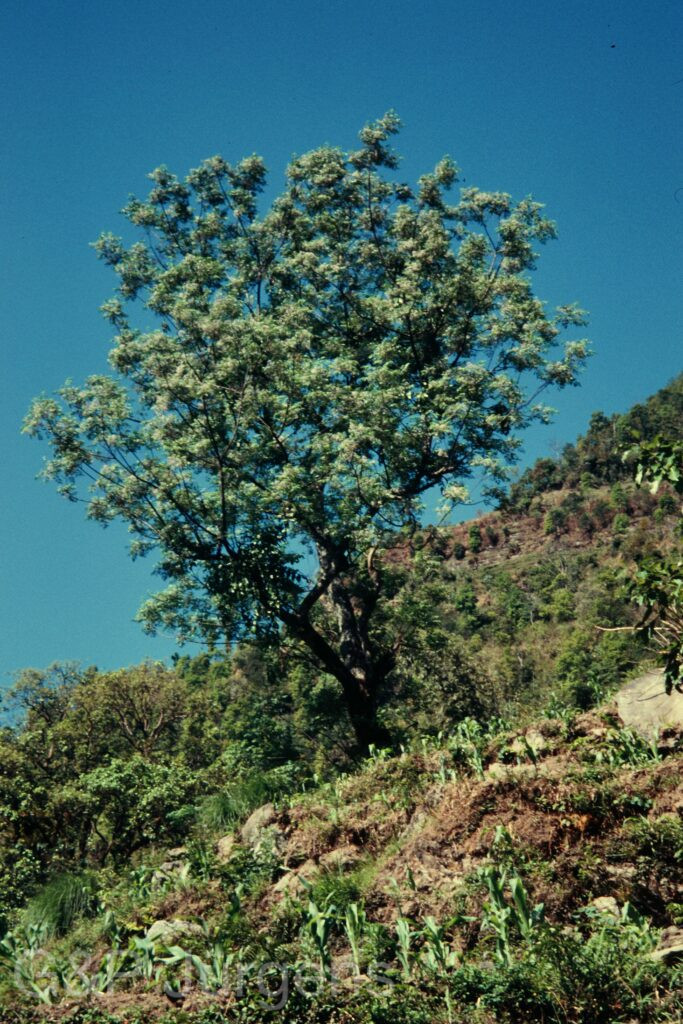
Melia azedarach, the chinaberry or Persian lilac, is a fast-growing deciduous tree of immense range, native across South and Southeast Asia and into Australia but now widely cultivated and naturalised throughout the warm temperate and tropical world, a ubiquity reflected in its GBIF total of over 66,000 occurrences spanning the United States, Australia, South Africa, Spain, France, China, Brazil, India, Japan, Korea, Argentina and far beyond. In the Himalayan region it is common in the lower hills, around villages, on field margins and along roadsides up to about 1800 m. The images from Mo-Shu in Bhutan at 1450 m, in October, and from above the Mewa-Khola in Nepal at 1400 m, in April, capture both its fruiting and flowering seasons in the warm subtropical hill belt where it thrives on a wide range of soils.

It is a tree to 10-20 m with a spreading, rounded crown and fissured, dark bark. The large leaves are alternate and bipinnate to tripinnate, with numerous ovate-lanceolate, serrate, acuminate leaflets giving a light, feathery canopy. The fragrant flowers are borne in lax axillary panicles, each with five spreading lilac to pale-purple petals and a characteristic dark purple staminal tube formed from the fused filaments, a hallmark of the genus. The fruit is a globose, yellowish drupe that persists on the bare branches well into winter, containing a hard, ridged, several-seeded stone dispersed by birds.

Melia is a small Old World genus of the mahogany family Meliaceae, of which M. azedarach is by far the most widespread and variable, with numerous forms and cultivated selections; it is valued for timber, shade and traditional medicine, though its fruits and foliage are toxic to humans and many animals owing to limonoid compounds. Outside its native range it is frequently an aggressive coloniser of disturbed ground and is classed as an invasive weed in parts of the Americas, Africa and Australia, even as it remains a familiar and useful tree across the Himalayan foothills.

Author: L. · Sources: POWO (Kew), GBIF, Flora of China Vol. 11, Flora of Nepal, Flora of Pakistan, Pennington and Styles' monograph of the Meliaceae