

L.


Description
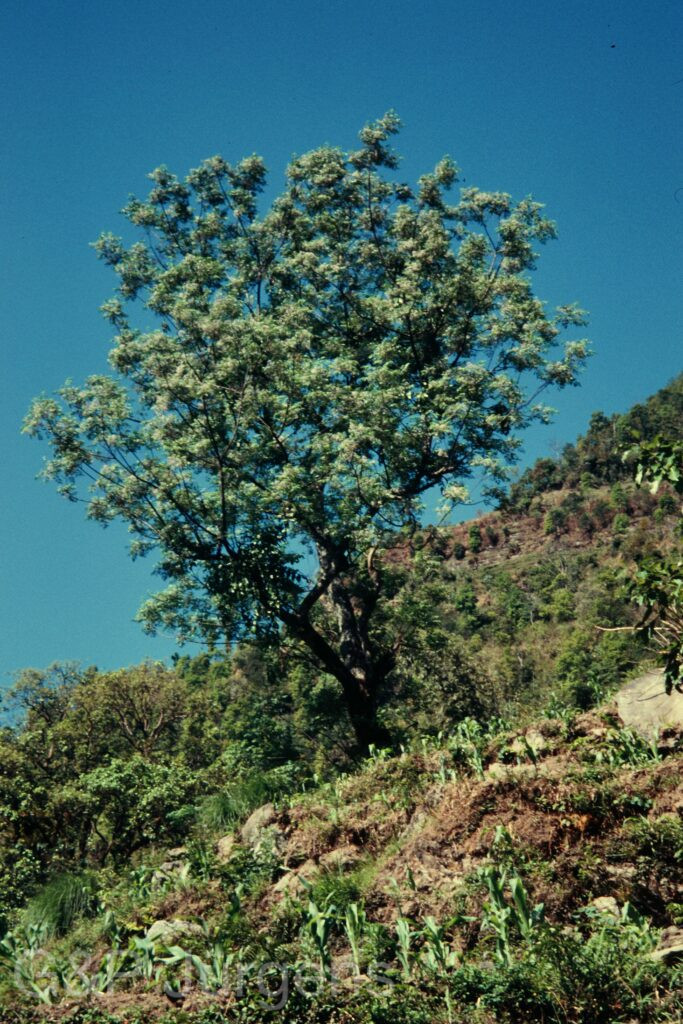
Melia azedarach, the chinaberry or Persian lilac, is a fast-growing deciduous tree of immense range, native across South and Southeast Asia and into Australia but now widely cultivated and naturalised throughout the warm temperate and tropical world, a ubiquity reflected in its GBIF total of over 66,000 occurrences spanning the United States, Australia, South Africa, Spain, France, China, Brazil, India, Japan, Korea, Argentina and far beyond. In the Himalayan region it is common in the lower hills, around villages, on field margins and along roadsides up to about 1800 m. The images from Mo-Shu in Bhutan at 1450 m, in October, and from above the Mewa-Khola in Nepal at 1400 m, in April, capture both its fruiting and flowering seasons in the warm subtropical hill belt where it thrives on a wide range of soils.
It is a tree to 10-20 m with a spreading, rounded crown and fissured, dark bark. The large leaves are alternate and bipinnate to tripinnate, with numerous ovate-lanceolate, serrate, acuminate leaflets giving a light, feathery canopy. The fragrant flowers are borne in lax axillary panicles, each with five spreading lilac to pale-purple petals and a characteristic dark purple staminal tube formed from the fused filaments, a hallmark of the genus. The fruit is a globose, yellowish drupe that persists on the bare branches well into winter, containing a hard, ridged, several-seeded stone dispersed by birds.
Melia is a small Old World genus of the mahogany family Meliaceae, of which M. azedarach is by far the most widespread and variable, with numerous forms and cultivated selections; it is valued for timber, shade and traditional medicine, though its fruits and foliage are toxic to humans and many animals owing to limonoid compounds. Outside its native range it is frequently an aggressive coloniser of disturbed ground and is classed as an invasive weed in parts of the Americas, Africa and Australia, even as it remains a familiar and useful tree across the Himalayan foothills.
Author: L. · Sources: POWO (Kew), GBIF, Flora of China Vol. 11, Flora of Nepal, Flora of Pakistan, Pennington and Styles' monograph of the Meliaceae