Lamiaceae

(E.Peter)

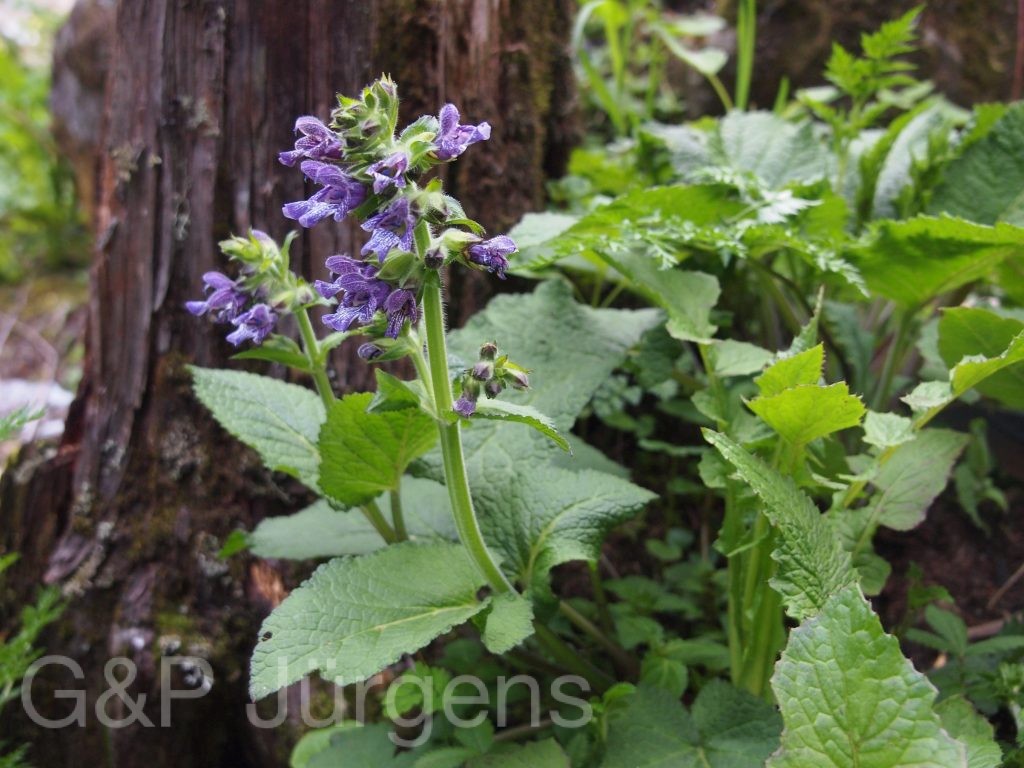
BhutanPG2011 130
Bhutan Kupang 3550m, June

Description

Salvia wardii is a Sino-Himalayan sage distributed across the eastern Himalaya and adjacent China, recorded from southern China (the Tibetan borderlands), Bhutan, Nepal and India, with an outlying record from Sri Lanka and only around 73 GBIF occurrences, a comparatively narrowly known species. It is a plant of subalpine and alpine habitats, growing on open grassy slopes, scrub margins, rocky banks and meadow clearings in the upper temperate to subalpine zone. The image documents the species at Kupang in Bhutan at about 3550 m in June, where it flowers among summer meadow vegetation alongside other perennial herbs of the high pastures.

It is an erect perennial herb arising from a woody rootstock, with quadrangular, pubescent stems. The leaves are mostly basal and lower-cauline, ovate to oblong, cordate to truncate at the base, crenate-serrate, rugose and softly hairy, on long petioles. The inflorescence is a lax terminal raceme of widely spaced verticillasters, each with few flowers. The calyx is bilabiate and glandular-pubescent; the corolla is showy, deep violet to purple-blue, with an exserted upper lip and a broad spreading lower lip, and the connective of the two fertile stamens is elongated and lever-like, characteristic of Salvia. The fruit comprises four smooth nutlets.

Named for the plant collector Frank Kingdon-Ward, Salvia wardii belongs to the Asian section of Salvia centred on the Sino-Himalayan mountains, a centre of diversity for the genus. The staminal lever mechanism promotes outcrossing by long-tongued bees and bumblebees foraging in the brief alpine summer. Its restricted range and small number of records suggest it warrants monitoring, though no formal threat assessment has been made.

Author: (E.Peter) · Sources: POWO (Kew), GBIF, Flora of China, Flora of Bhutan, Salvia: Flora Sinica account, World Checklist of Lamiaceae
Benth.

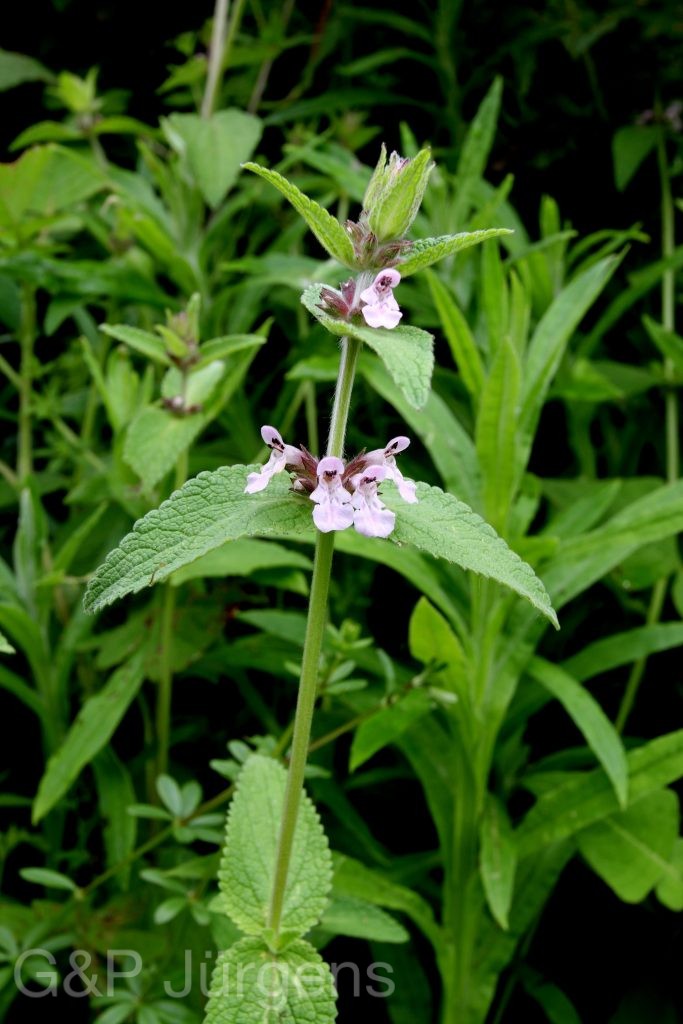
BhutanPG2011 841
Bhutan Paro-Chu, 2400m July
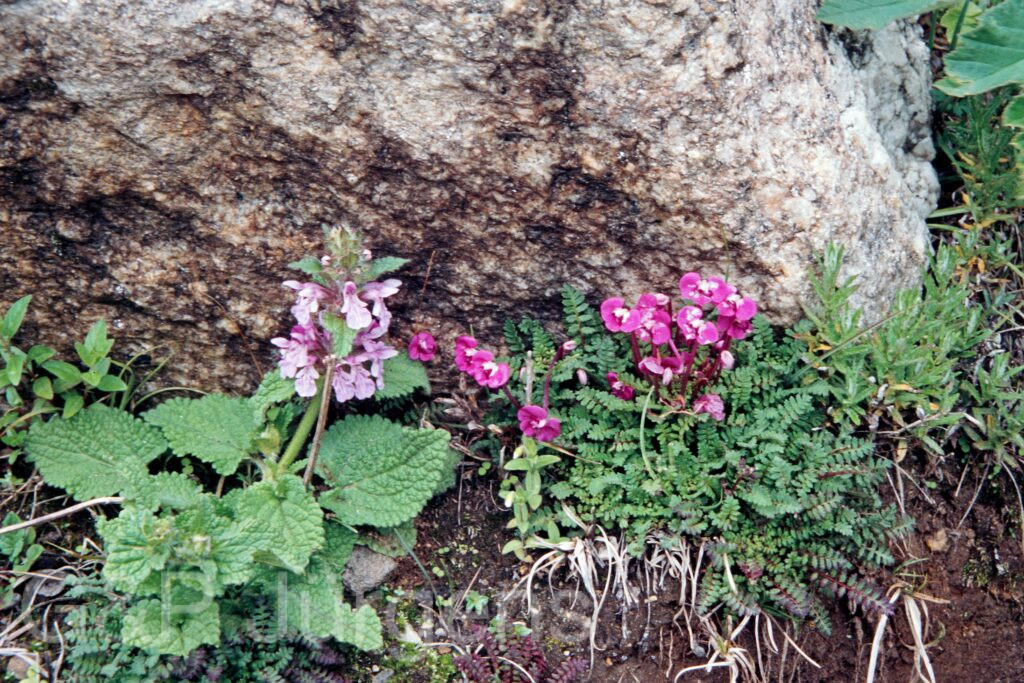
Nepal 99 587 ergebnis
West-Nepal Garpung-Khola 3300m, July

Description

Stachys melissifolia is a perennial mint-family herb of the Himalaya and adjacent mountains, recorded from Nepal, China, India, Bhutan and Pakistan, with around 146 occurrences in GBIF; under its current treatment the name is accepted for the Himalayan plant. It occupies forest margins, moist shaded banks, shrubberies and grassy slopes of the temperate and lower subalpine belt, broadly between 2000 and 3500 m. The photographs from the Paro Chu in Bhutan at about 2400 m and from the Garpung Khola in West Nepal at about 3300 m, both in July, show the species in flower during the summer monsoon in its typical mid-montane woodland-edge habitat.

The plant is an erect to ascending perennial with the quadrangular stems characteristic of the Lamiaceae, usually softly hairy. The leaves are opposite, ovate to oblong with a cordate to rounded base, crenate-serrate margins and a rugose, wrinkled surface, somewhat resembling those of balm (Melissa), as the epithet melissifolia denotes. The flowers are borne in distinct whorls (verticillasters) forming an interrupted terminal spike; the calyx is tubular-campanulate with five subequal teeth, and the bilabiate corolla is pinkish to purple with a short, erect upper lip and a spreading three-lobed lower lip. The fruit comprises four small ovoid nutlets enclosed in the persistent calyx.

Stachys is a large, cosmopolitan genus of the Lamiaceae subfamily Lamioideae, and its Himalayan members have been subject to repeated nomenclatural revision, several names having passed in and out of synonymy. The verticillate inflorescence and bilabiate corolla are adapted to pollination by bees and other long-tongued insects. Widely distributed through the temperate Himalaya, S. melissifolia is common and of no conservation concern.

Author: Benth. · Sources: POWO (Kew), GBIF, Flora of China, Flora of Bhutan, Annotated Checklist of the Flowering Plants of Nepal, Harley et al. Labiatae in The Families and Genera of Vascular Plants

L.f.

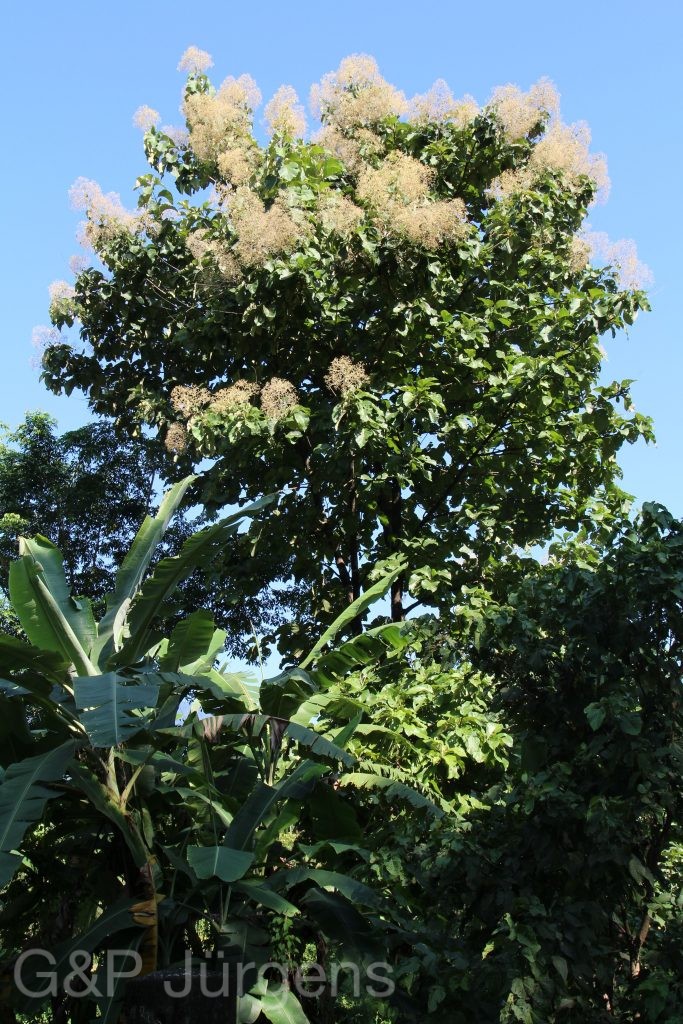
Bhutan2015 95
Bhutan Galephug 300m, October
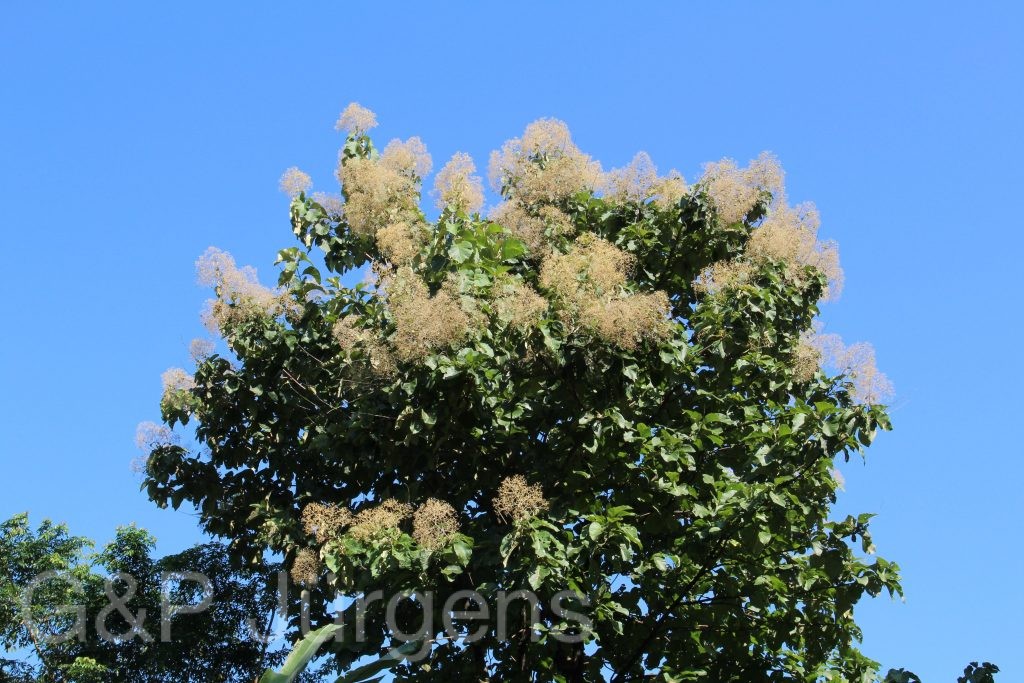
Bhutan2015 96
Bhutan Galephug 300m, October

Description

Tectona grandis L.f., the teak, is a large deciduous tree native to the monsoonal forests of South and Southeast Asia, including India, Myanmar, Thailand, Laos and Sri Lanka, and now widely planted and naturalised across the tropics in Indonesia, Brazil, Nigeria, Tanzania, Costa Rica and beyond. In the Himalayan foothills it is recorded from Bhutan at Galephug near 300 m in October, at the warm, low-elevation southern margin of the region. The species grows in tropical dry and moist deciduous forest, on well-drained alluvial and lateritic soils, typically below 1000 m, where a pronounced dry season triggers leaf fall. Its roughly 37 411 GBIF records reflect both its native range and its enormous footprint as a cultivated timber tree.

It is a tall tree reaching 30–40 m with a tall, often fluted bole and pale, fibrous, longitudinally fissured bark. The leaves are very large, opposite or sub-opposite, broadly elliptic to obovate, scabrid above and densely stellate-tomentose beneath, exuding a reddish sap when crushed. The small whitish to pale lilac flowers are five- to six-merous and borne in massive, much-branched terminal panicles. The fruit is a hard, four-chambered drupe enclosed in a conspicuously inflated, bladder-like accrescent calyx that aids wind and water dispersal.

Formerly placed in Verbenaceae, Tectona is now assigned to Lamiaceae (subfamily Tectonoideae) on molecular grounds, here matching the input family. Its heartwood, rich in protective tectoquinones and natural oils, is among the world's most prized timbers for its durability, dimensional stability and resistance to decay and insects, underpinning a vast plantation industry. While extensively cultivated, genuinely wild teak forests have been much reduced and fragmented by logging, and conservation of natural provenances and their genetic diversity is an ongoing priority.

Author: L.f. · Sources: POWO (Kew), GBIF, Flora of British India, Flora of Bhutan, Trees of Tropical Asia, Teak: A Global Overview (FAO monograph)

Roxb.

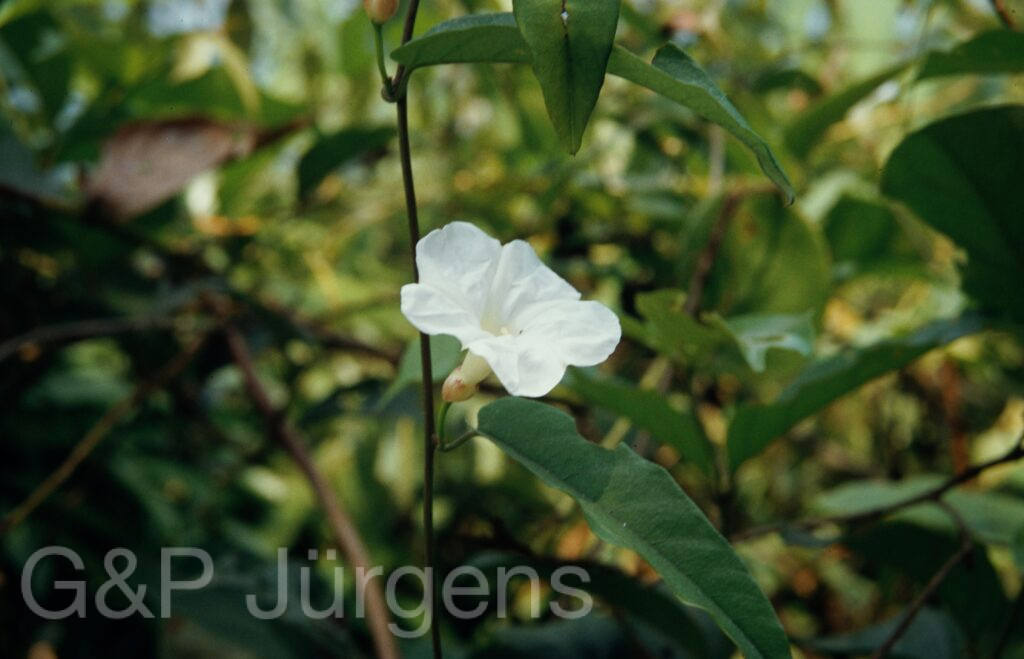
Nepal 1994 16 ergebnis
Ost-Nepal Kandbari 490m April

Description

Thunbergia fragrans is a slender twining herbaceous climber native to tropical and subtropical Asia, from the Indian subcontinent and the Himalayan foothills eastward to China, Sri Lanka and Southeast Asia, and now naturalised across the Americas, the Pacific and Australia. It grows in thickets, hedgerows, forest edges, scrub and disturbed ground in the warm lowlands and lower hills, generally below about 1500 m. The photographed plant comes from Kandbari in East Nepal at around 490 m, flowering in April. With nearly 4900 georeferenced records, many from its introduced range, it is a conspicuous and frequently collected vine. Although filed here under Lamiaceae, the species belongs to the Acanthaceae.

The stems are twining, slender and angled, often finely hairy. The leaves are opposite, ovate to triangular-hastate, with a cordate to truncate base, entire to sinuately lobed or toothed margins, and a slender petiole. The flowers are solitary in the leaf axils on long peduncles, subtended by two large leafy bracteoles that enclose the much-reduced calyx. The corolla is salverform with a broad spreading limb of five rounded lobes and is pure white, the throat sometimes pale, the flowers faintly fragrant. Four didynamous stamens are inserted within the corolla tube. The fruit is a beaked, woody, explosively dehiscent capsule, the persistent style forming a long apical beak, scattering the few seeds.

Widely grown as an ornamental for its clean white flowers, T. fragrans has escaped cultivation in many warm regions and is regarded as an environmental weed in parts of Australia, the Pacific and the neotropics, where it smothers low vegetation. Within Thunbergia it is recognised by its white, fragrant corolla and hastate leaves. Abundant and expanding, it is of least conservation concern.

Author: Roxb. · Sources: POWO (Kew), GBIF, Flora of China, Flora of Nepal, Acanthaceae monographs (Thunbergia)