

(Buch.-Ham. ex Roxb.) Maxim.

Description
Mosla dianthera is a widespread annual mint of monsoonal Asia, ranging from the Himalaya (Nepal, Bhutan, India, Pakistan, Bangladesh, Myanmar) across China, Korea, Japan, Taiwan and the Russian Far East south into mainland and insular Southeast Asia; with over 7000 GBIF occurrences it is among the most frequently recorded species of its genus. It grows in disturbed and seasonally moist ground, including roadsides, field margins, fallow land, streambanks and open grassy slopes from the lowlands into the temperate hills, as recorded at Dochu-La in Bhutan at 2800 m. As an autumn-flowering annual it completes its cycle on the late monsoon moisture, flowering and fruiting in October.
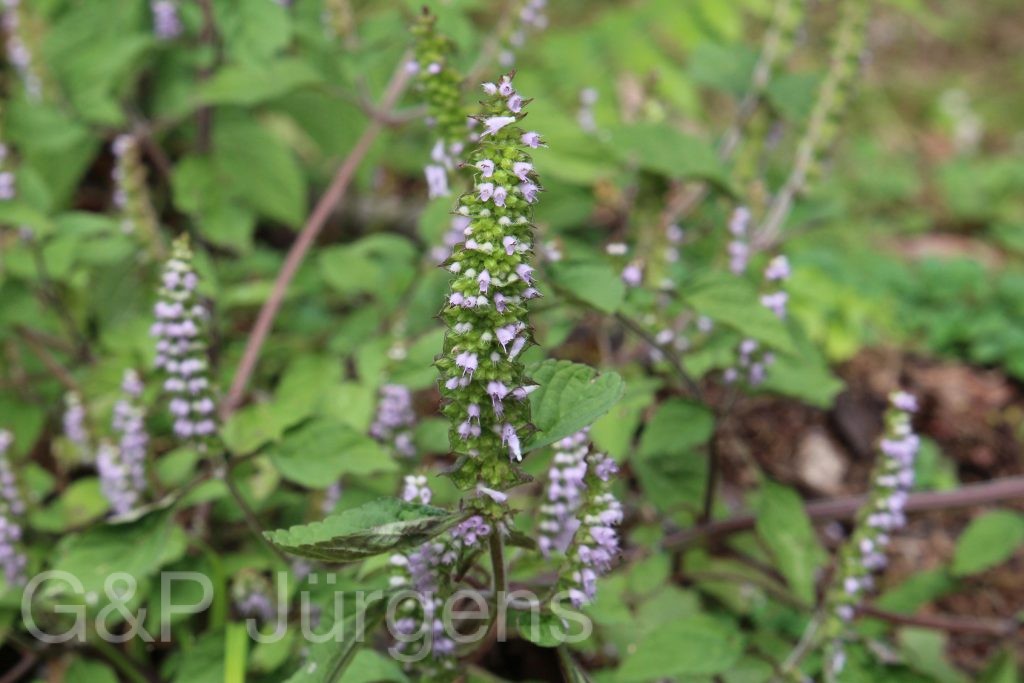
It is a slender, erect, aromatic annual herb with the quadrangular stems typical of the Lamiaceae, often much branched and sparsely hairy. The leaves are opposite, petiolate, ovate-lanceolate to lanceolate, serrate along the margin and gland-dotted, releasing a pungent scent when crushed. The flowers are borne in lax, terminal and axillary racemes; each two-lipped corolla is small, pale pink to purplish, with a notched upper lip and a three-lobed lower lip. Diagnostic for Mosla are the two fertile stamens (the epithet "dianthera" referring to the two anthers) and the reticulately pitted nutlets. The fruit comprises four small, dry, one-seeded nutlets enclosed in the persistent, gland-dotted calyx.
Mosla is a small Asian genus segregated from Orthodon and allied to Perilla and Elsholtzia within the subfamily Nepetoideae, characterised by the reduction to two stamens and by aromatic terpene-rich foliage. The essential oils of M. dianthera are used in traditional medicine, and the plant is a minor nectar source for bees and other insects. Being a ruderal, broadly tolerant annual of vast geographic range, it is of least conservation concern and is sometimes weedy. (The associated WordPress link erroneously references Pogostemon benghalensis; the taxon treated here is Mosla dianthera.)
Author: (Buch.-Ham. ex Roxb.) Maxim. · Sources: POWO (Kew), GBIF, Flora of China, Flora of Bhutan, Li & Hedge's treatment of the Lamiaceae