Lamiaceae

Phlomoides rotata

by GP Jürgens

(Benth. ex Hook.f.) Mathiesen
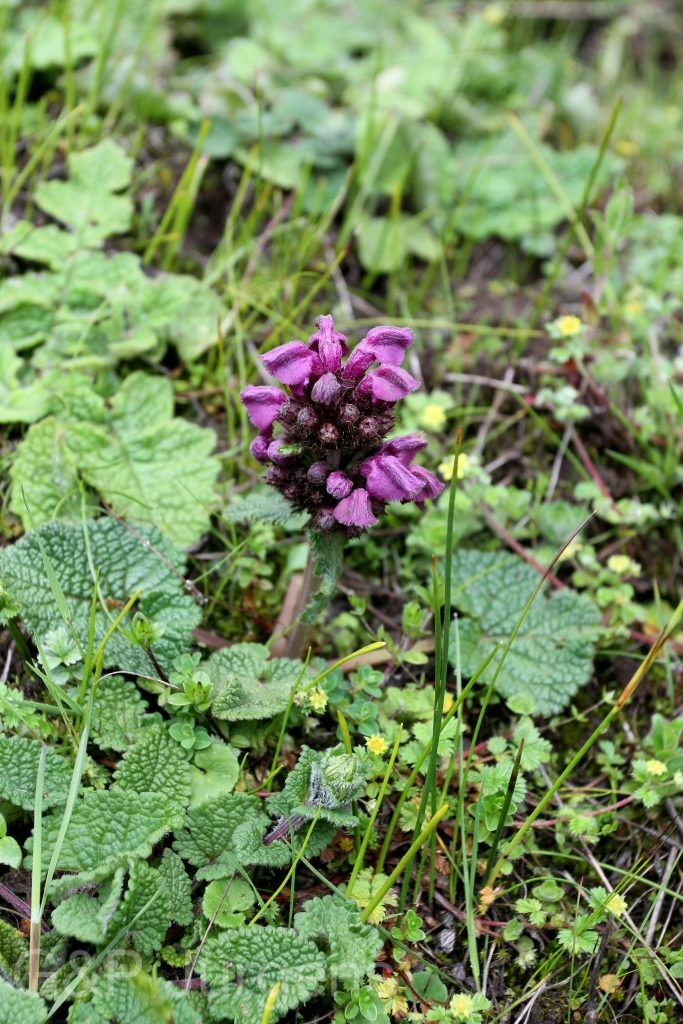
BhutanPG2011 369
Bhutan Jule-Tso, 4000m June

Description

Phlomoides rotata (formerly Phlomis rotata) is a distinctive stemless mint of the high Himalaya and Tibetan plateau. GBIF records it from China, Nepal, India, Bhutan and Pakistan, with around 700 occurrences spanning the alpine zone of the Sino-Himalayan region. It grows on open stony slopes, gravelly alpine turf, screes and pasture between roughly 3700 and 5200 m. The plant illustrated was photographed at Jule-Tso in Bhutan at 4000 m in June, forming a flattened rosette pressed against the ground, the characteristic habit by which the species hugs the substrate in the windswept high-alpine environment.

It is an acaulescent (stemless) perennial arising from a thick rootstock, the leaves forming a low basal rosette appressed to the soil. The leaves are ovate to orbicular, crenate, rugose with impressed venation and clothed in greyish indumentum. As the epithet rotata (wheel-like) implies, the verticillasters are condensed into a dense, radiating, disc-like terminal head sessile in the centre of the rosette. The bilabiate corollas are purple to violet, the hooded upper lip protecting the four didynamous stamens; the fruit comprises four smooth nutlets enclosed in the persistent tubular calyx.

The genus Phlomoides was reinstated and broadened to absorb much of Phlomis following molecular phylogenetic studies in subfamily Lamioideae, hence the binomial transfer. The ground-hugging rosette habit is a classic adaptation to alpine cold, wind and grazing, minimising exposure while exploiting the warmer boundary layer at soil level. Widely used in Tibetan medicine, the species is collected from the wild; it remains common across its broad high-altitude range and is not considered threatened.

Author: (Benth. ex Hook.f.) Mathiesen · Sources: POWO (Kew), GBIF, Flora of China, Flora of Pakistan, Annotated Checklist of the Flowering Plants of Nepal, Phylogeny and classification of subfamily Lamioideae (Lamiaceae)
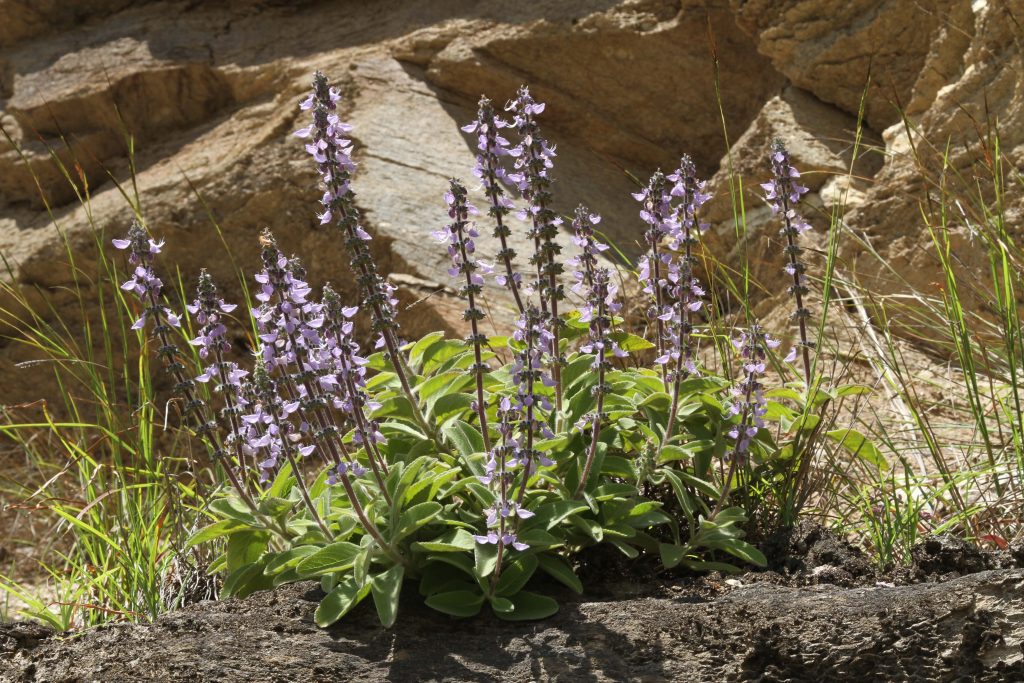
Andrews

Bhutan2012 398
Bhutan Wangdi 2600m, September

Description

Plectranthus barbatus Andrews is an aromatic perennial herb or subshrub with a broad palaeotropical distribution, recorded from tropical and southern Africa (Ethiopia, Kenya, Tanzania, South Africa) and the Arabian Peninsula through to the Indian subcontinent, Nepal, Bhutan and Sri Lanka, where it is both native and widely cultivated and naturalised. In the Himalaya it grows on warm, dry, rocky banks, terrace margins, scrub and open hill slopes, often near villages. The photographed plant from Wangdi (Wangdue Phodrang) in Bhutan at 2600 m, flowering in September at the close of the monsoon, illustrates its tolerance of sunny, well-drained sites in the lower-temperate zone. GBIF treats the listed name as a synonym, with Plectranthus barbatus the accepted name.

The plant forms an erect, branching, softly woody-based herb with quadrangular, finely pubescent stems. The opposite leaves are broadly ovate, crenate-margined, somewhat fleshy and strongly aromatic, narrowing to a winged petiole and densely glandular and hairy. The flowers are borne in whorls along elongate, terminal racemose inflorescences; the bilabiate corolla is blue to violet-blue, with a short upper lip and a deflexed, boat-shaped lower lip enclosing the four didynamous stamens. As in other Lamiaceae the fruit comprises four smooth nutlets seated in the persistent calyx.

Long cultivated for medicine and as a hedge plant, P. barbatus (often called Coleus forskohlii in pharmacological literature) is the principal source of the diterpenoid forskolin, which has driven extensive cultivation across India and Africa. Its taxonomy is complicated by this synonymy and by horticultural movement blurring native and introduced ranges. The species is not of conservation concern, being weedy, easily propagated and widely naturalised.

Author: Andrews · Sources: POWO (Kew), GBIF, Flora of Bhutan, Flora of Tropical East Africa (Lamiaceae), Plectranthus and Allied Genera (Lukhoba, Simmonds & Paton)

Kuntze

Bhutan2012 1165
Bhutan Trashiyangtse 1780m, October

Description

Pogostemon linearis is an Asian mint distributed through India, China, Bhutan, Myanmar, Bangladesh and westward to Iran, with around 99 georeferenced records in GBIF. It is a plant of warm-temperate to subtropical hill country, occurring on open grassy slopes, forest edges, streambanks and disturbed ground in the lower and middle montane zone. The Bhutanese material photographed near Trashiyangtse at about 1780 m in October reflects its typical autumn flowering at modest elevation, where it benefits from the warm, moist conditions of the eastern Himalayan foothills and frequently colonises seasonally damp, sunny situations.

The species is an erect to ascending herb or subshrub with quadrangular stems that are often pubescent. The leaves, as the epithet indicates, are narrow, linear to linear-lanceolate, sessile or shortly petiolate, with serrate to subentire margins and an acute apex. The flowers are borne in dense, cylindrical, spike-like verticillasters forming a terminal thyrse; each small flower has a tubular, five-toothed calyx and a campanulate, weakly two-lipped corolla. The four stamens are characteristically long-exserted and bear conspicuously bearded filaments, a diagnostic feature of Pogostemon, giving the inflorescence a fluffy appearance. The fruit comprises four smooth nutlets enclosed by the persistent calyx.

Described by Kuntze, P. linearis belongs to a genus best known for P. cablin, the source of patchouli oil. The bearded, far-exserted stamens place it firmly within Pogostemon and distinguish it from related Lamiaceae genera. Its broad distribution, ecological tolerance and association with open and disturbed habitats indicate a secure conservation status throughout its range.

Author: Kuntze · Sources: POWO (Kew), GBIF, Flora of Bhutan, Flora of China, Bhatti & Ingrouille revision of Pogostemon

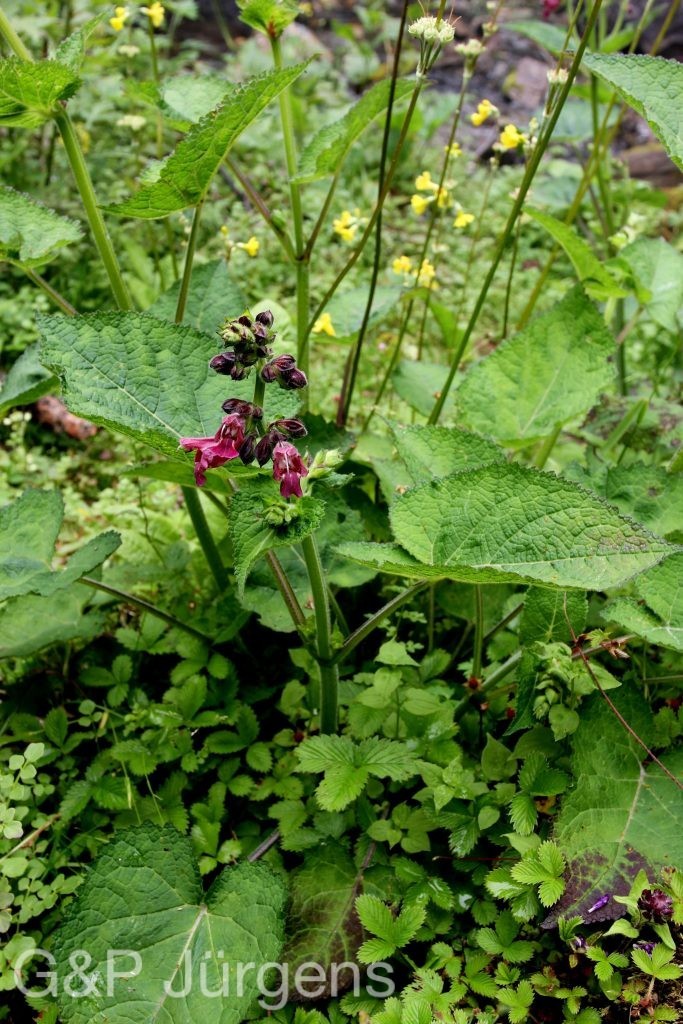
Salvia castanea

by GP Jürgens

Diels

BhutanPG2011 828 01 01
Bhutan Chele-La, 3400m July

Description

Salvia castanea is a montane perennial distributed across the eastern Himalaya and adjoining south-western China, with georeferenced collections recorded from China, Bhutan, Nepal and India; some 202 occurrences are documented in GBIF. It favours open forest margins, scrub, alpine meadows and grassy slopes between roughly 2700 and 4000 m, the photographed plant having been gathered at Chele-La in Bhutan at about 3400 m in July, at the height of the monsoon flowering season. It thrives on humus-rich, well-drained soils in cool, moist subalpine conditions.

The plant forms an erect, woody-based perennial herb 30-60 cm tall from a stout rootstock, with quadrangular, sparsely pubescent stems. The basal and lower cauline leaves are long-petiolate, the lamina ovate to oblong-lanceolate, cordate or subcordate at the base, crenate-serrate, and rugose with impressed venation. The inflorescence is a lax raceme of distant 2-6-flowered verticillasters; flowers bear a campanulate calyx and a chestnut-brown to dull purplish-red corolla 2.5-3.5 cm long, with an arched, galeate upper lip and the characteristic Salvia lever mechanism of two stamens. The fruit comprises four smooth nutlets enclosed in the persistent calyx.

The distinctive chestnut corolla colour, reflected in the epithet castanea, separates this species from most Himalayan sages, which tend toward blue or violet flowers. As a member of the large genus Salvia (Lamiaceae, subfamily Nepetoideae), it relies on long-tongued bees and occasionally birds for pollination via the staminal lever. Though not formally assessed as threatened, it is locally frequent within its restricted Sino-Himalayan range, where habitat continuity in subalpine meadows underpins its persistence.

Author: Diels · Sources: POWO (Kew), GBIF, Flora of China, Flora of Bhutan, A Revision of Salvia (Lamiaceae) in Asia

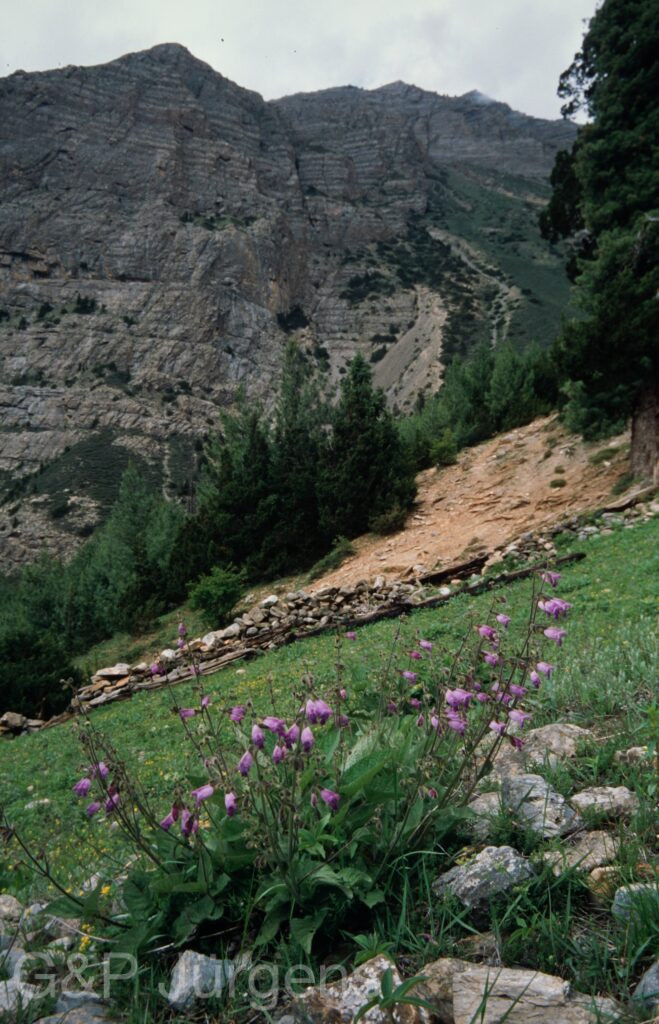
Royle ex Benth.

Nepal 99 867 ergebnis
West-Nepal Sanu Bheri 3500m, July

Description

Salvia hians is a Himalayan herbaceous perennial of the temperate to subalpine belt of the western and central Himalaya, with occurrences in India, Nepal, Pakistan and adjacent China; its c. 217 georeferenced records (further reports from Europe and North America reflect cultivated material). It favours open grassy slopes, forest margins, alpine meadows and moist rocky banks, typically between 2400 and 4000 m. The photographed plant from the Sanu Bheri valley in West Nepal at 3500 m, flowering in July, is characteristic of its summer-flowering subalpine habitat among tall herbs in the monsoon-watered turf.

It forms an erect, somewhat sticky-pubescent herb 30-90 cm tall arising from a stout rootstock, with mostly basal, long-petioled, ovate-cordate leaves bearing crenate to doubly serrate margins and a rugose surface. The inflorescence is a lax terminal raceme of distant verticillasters. The corolla is showy, c. 3-5 cm long and deep violet-blue to purple, conspicuously bilabiate with a strongly hooded, gaping (hence "hians") upper lip and a broad lower lip. The calyx is bell-shaped and two-lipped, and the two fertile stamens bear the characteristic lever mechanism of Salvia. The fruit comprises four smooth ovoid nutlets enclosed in the persistent calyx.

Described by Royle ex Bentham, S. hians belongs to the large, near-cosmopolitan genus Salvia, the most species-rich genus of Lamiaceae, and represents the showy Himalayan element of the subgenus Sclarea-group. The flowers are pollinated by long-tongued bees and bumblebees exploiting the staminal lever. Locally the species enters folk medicine and is occasionally grown ornamentally. It remains widespread and is not currently regarded as threatened, though habitat degradation through grazing and tourism affects some populations.

Author: Royle ex Benth. · Sources: POWO (Kew), GBIF, Flora of Nepal, Flora of Pakistan, Flora of China, Hedge's revision of Himalayan Salvia (Lamiaceae)

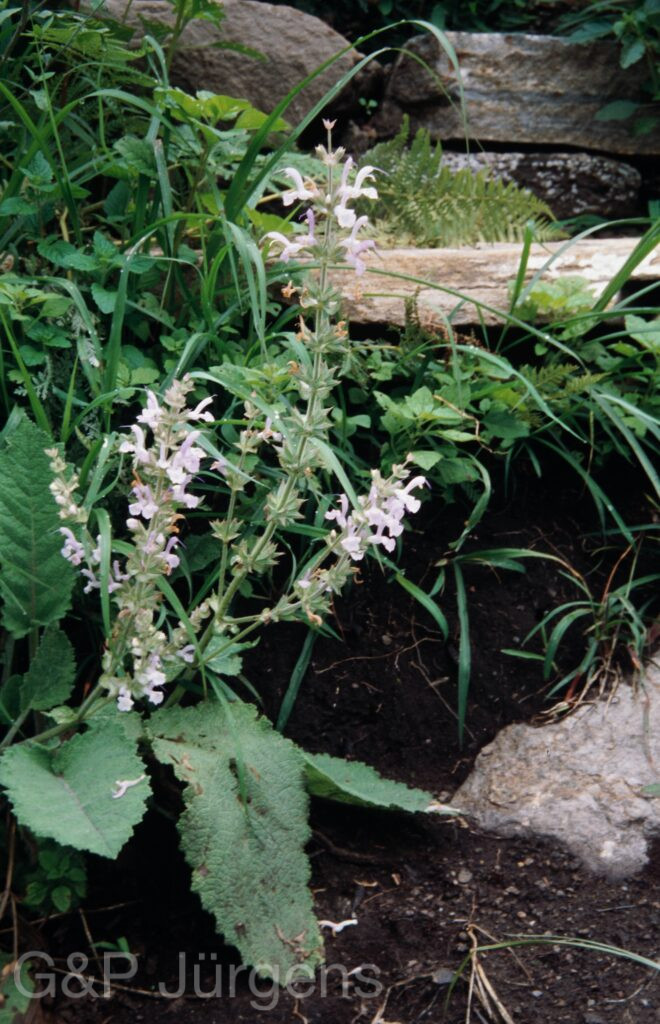
Wall. ex Benth.

Nepal 99 913 ergebnis
West-Nepal Roha 2800m, July

Description

Salvia moorcroftiana is a stout perennial sage of the western and central Himalaya, ranging from Afghanistan and Pakistan through northern India into Nepal, with cultivated and adventive records noted from Iran, Britain, Brazil and the United States. GBIF holds some 403 occurrences, concentrated in Pakistan, India, Afghanistan and Nepal. It is a plant of dry, open hillsides, overgrazed pastures, road banks, fallow fields and stony waste ground, generally between about 1500 and 3000 m, often forming conspicuous stands on degraded land. The specimen illustrated was recorded in West Nepal at Roha at 2800 m in July, flowering during the monsoon on open montane slopes.

The plant forms a large basal rosette of broadly ovate to oblong, rugose, wavy-margined leaves that are densely white-woolly beneath and borne on long petioles. From this rises a tall, branched, glandular inflorescence axis bearing well-separated verticillasters of large flowers subtended by coloured bracts. The two-lipped corolla is white to pale lilac, often flushed or veined with purple, the hooded upper lip enclosing two stamens with the characteristic lever-like connective of Salvia. The calyx is bell-shaped and persistent, and the fruit comprises four smooth nutlets retained within the dry calyx until dispersed.

Salvia, the largest genus of the Lamiaceae, is defined by its specialised staminal lever mechanism promoting precise pollen placement on visiting bees. S. moorcroftiana, named for the explorer William Moorcroft, is a long-established medicinal plant of the Himalayan foothills, its mucilaginous seeds and leaves used in traditional remedies for skin and digestive ailments. Tolerant of grazing and disturbance, it is widespread and of no conservation concern; indeed it often increases on degraded rangeland.

Author: Wall. ex Benth. · Sources: POWO (Kew), GBIF, Flora of Pakistan, Flora of British India, An Annotated Checklist of the Flowering Plants of Nepal, Salvia: The Genus Salvia

Bennet & Raizada

Garh 07 18 ergebnis
India Garhwal Uniana at Mandakini 1350m, June

Description

Salvia mukerjeei is a Himalayan endemic distributed along the southern flank of the western and central ranges, with georeferenced records spanning Pakistan, northern India and Nepal (GBIF documents 91 occurrences across these three countries). It favours shaded banks, forest margins and disturbed slopes in the warm-temperate to lower montane belt; the illustrated material was gathered in India, Garhwal, at Uniana near the Mandakini valley at about 1350 m in June, a setting typical of the moist mid-elevation gorges where the species recurs. Within this zone it grows on humus-rich soils beneath broad-leaved canopy and along streamsides flushed by the early monsoon.

The plant is an erect herb arising from a fibrous-rooted base, the quadrangular stems clothed in spreading eglandular and shorter glandular hairs. Leaves are opposite, petiolate and ovate to broadly cordate, with a crenate-serrate margin, an acuminate apex and a rugose, prominently veined lamina pubescent on both faces. The inflorescence is a lax terminal raceme of distant verticillasters, each subtended by deciduous bracts. Flowers show the characteristic bilabiate calyx and a two-lipped corolla with a hooded upper lip and spreading lower lip; the two fertile stamens bear the elongated connective lever diagnostic of the genus. The fruit comprises four smooth nutlets enclosed in the persistent calyx.

Described from Garhwal collections, the species honours the botanist Mukerjee and belongs to a complex of Asian Salvia centred on the Himalaya. POWO and GBIF treat the name as the accepted taxon. Its restricted range and dependence on undisturbed shaded habitats make it sensitive to forest clearance, though no formal IUCN assessment has been published.

Author: Bennet & Raizada · Sources: POWO (Kew), GBIF, Flora of Pakistan, Flora of British India, A Revision of Salvia in Asia (Lamiaceae monograph), Annotated Checklist of the Flowering Plants of Nepal

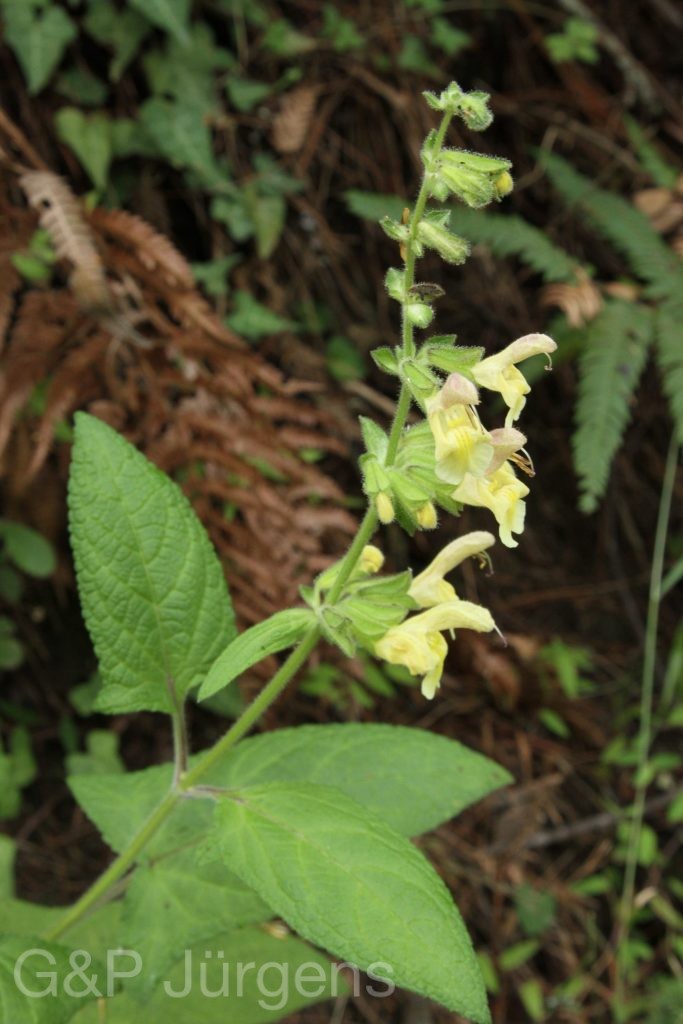
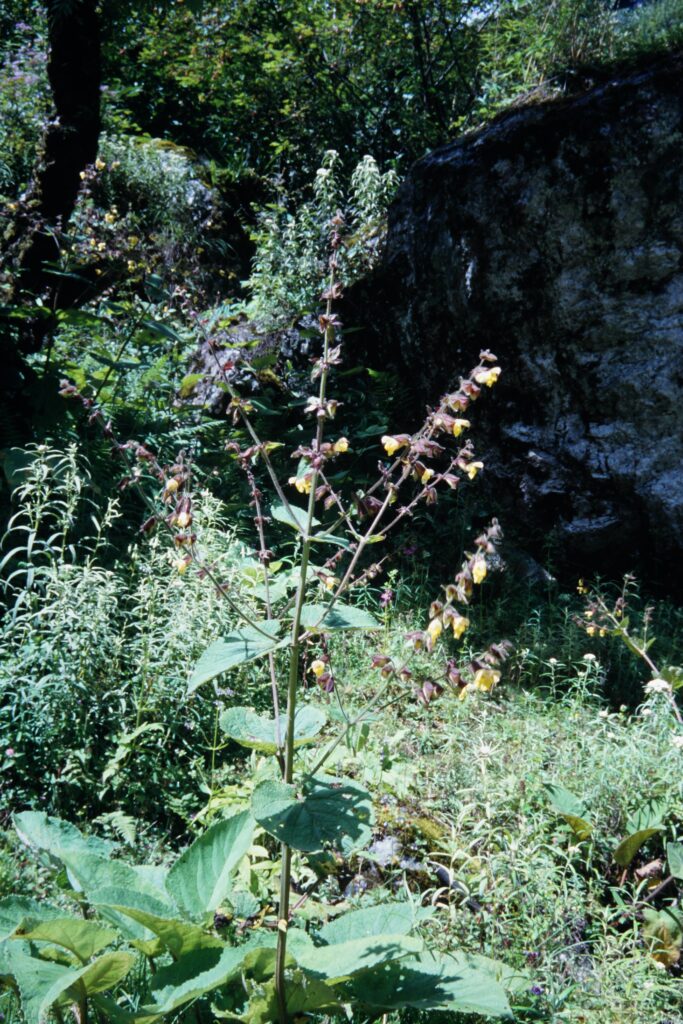
Salvia nubicola

by GP Jürgens

Wall. ex Sweet

Bhutan2012 15 scaled
Bhutan Paro, 2300m September

Description

Salvia nubicola is a robust herbaceous sage of the Himalaya and adjacent mountains, distributed from Afghanistan and Pakistan through Nepal, northern India and Bhutan into south-western China, with 372 GBIF occurrences that include naturalised or cultivated material in Europe, North America, Iran and New Zealand. It favours open slopes, forest margins, clearings, roadsides and disturbed ground in the temperate montane zone, broadly between 1800 and 3600 m. The illustrated plant was photographed at Paro in Bhutan at 2300 m in September, in the late-summer to autumn flowering season characteristic of the species at mid-elevations.

It is a stout perennial herb up to 1-1.5 m tall with quadrangular, glandular-hairy stems and a strong aromatic scent. The leaves are large, ovate-triangular to hastate with a cordate or sagittate base and crenate margin, long-petiolate and rugose. The flowers are arranged in widely spaced verticillasters forming an elongate terminal inflorescence, subtended by conspicuous bracts. The corolla is pale yellow, often blotched or veined with purple or brown on the lower lip, strongly two-lipped with a hooded galea-like upper lip; the two fertile stamens bear the characteristic lever-like connective of Salvia. The fruit comprises four smooth nutlets enclosed in the persistent two-lipped calyx.

The staminal lever mechanism deposits pollen on visiting long-tongued bees and is a defining synapomorphy of Salvia; in S. nubicola the pale, dark-marked flowers attract bumblebees. The species belongs to a Himalayan group of large-leaved yellowish-flowered sages allied to S. glutinosa of Europe. Wide-ranging, weedy-tolerant and locally common, it is of least concern, and like many sages it has minor local use in traditional medicine and is grown as an ornamental in temperate gardens.

Author: Wall. ex Sweet · Sources: POWO (Kew), GBIF, Flora of China, Flora of Pakistan, Hedge: Labiatae of South-West Asia

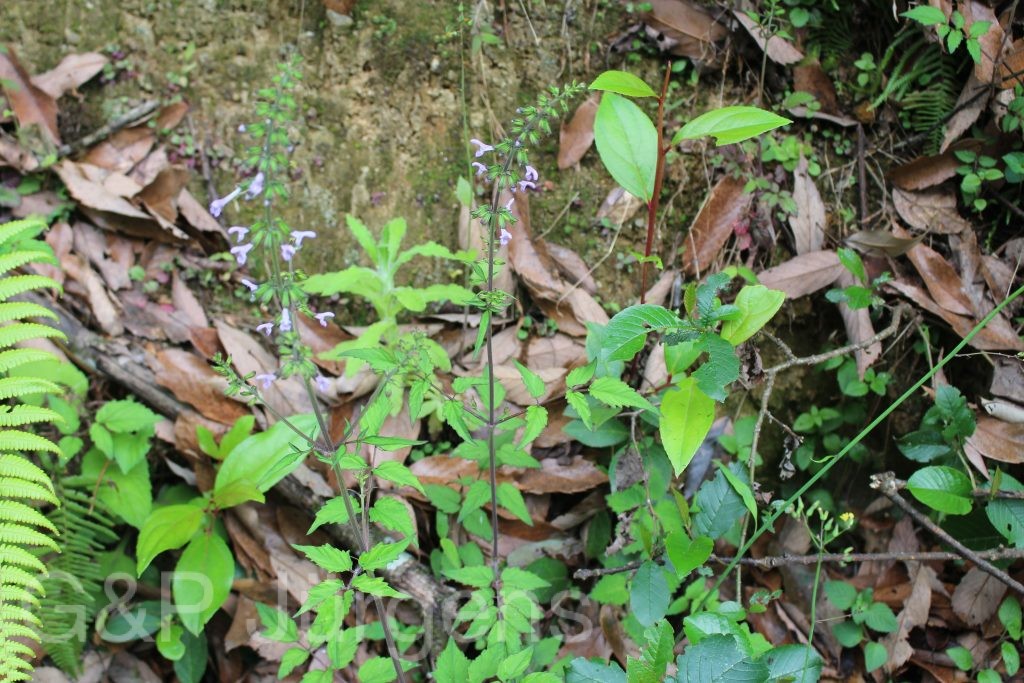
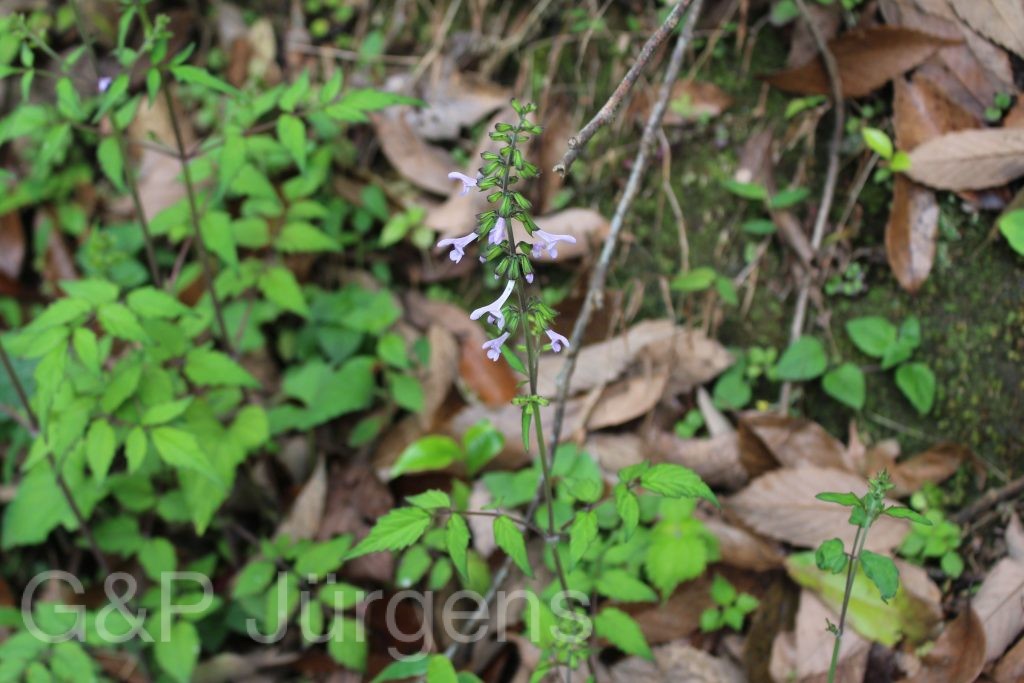
Griff.

Bhutan2014 162
Bhutan Trashigang 2100m, May
Bhutan2014 163
Bhutan Trashigang 2100m, May

Description

Salvia plectranthoides Griff. is an Eastern Himalayan and Sino-Himalayan element distributed across southern China, Bhutan and northeastern India (gbif_countries: CN, BT, IN), with some 391 georeferenced occurrences recorded in GBIF. It occupies warm-temperate to subtropical montane habitats, favouring open forest margins, shrubby slopes, roadside banks and disturbed grassy ground between roughly 1500 and 2700 m. The photographed plant from Trashigang in eastern Bhutan at 2100 m, flowering in May, typifies its preference for the mid-elevation broad-leaved forest belt of the eastern monsoon ranges, where humid summers and mild winters prevail.

It is an erect perennial herb arising from a woody rootstock, with quadrangular, often purple-tinged and retrorsely pubescent stems. The leaves are opposite, petiolate, ovate to ovate-lanceolate with a cordate to truncate base, an acuminate apex and a crenate-serrate margin, the lamina rugose and pubescent on both surfaces. The inflorescence is a lax terminal panicle of verticillasters, each whorl 2–6-flowered. Flowers bear a campanulate, two-lipped calyx and a bilabiate corolla, pale violet to bluish-purple, the upper lip galeate and the lower lip three-lobed; the two fertile stamens display the characteristic Salvia lever mechanism. The fruit comprises four smooth ovoid nutlets enclosed in the persistent calyx.

Within the large genus Salvia (subfamily Nepetoideae), this species belongs to the East Asian assemblage and the specific epithet alludes to a superficial resemblance to Plectranthus. The staminal lever, a hallmark of the genus, facilitates precise pollen placement on visiting bees and contributes to floral isolation among congeners. It is not of conservation concern given its broad range and tolerance of disturbed habitats.

Author: Griff. · Sources: POWO (Kew), GBIF, Flora of China (Lamiaceae), Flora of Bhutan, A Revision of Salvia (Lamiaceae) and allied genera

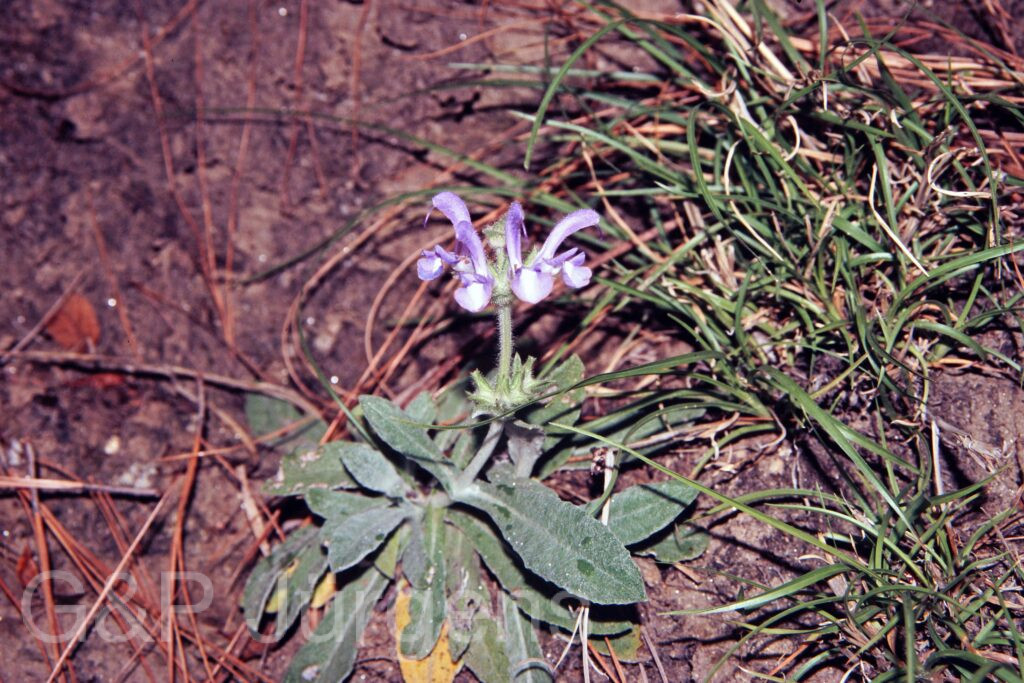
Maxim.

Sikkim2003 359 P502 ergebnis
India Sikkim Lachen 2840m, August

Description

Salvia roborowskii is a perennial herb distributed from the Himalayas across the Sino-Himalayan region to western China. Its range encompasses Nepal, northeast India (Sikkim), Bhutan, and China (Xizang, Yunnan, Sichuan, Qinghai, Gansu). The species inhabits montane forest clearings, grassy slopes, thicket margins, and alpine meadows at elevations of 2,400–4,200 m. It has been recorded from the Lachen Valley in Sikkim at 2,840 m, flowering profusely in August during the monsoon season, where it grows in open, herbaceous vegetation along stream margins and disturbed ground.
The plant produces erect, square stems 30–80 cm tall from a perennial rootstock, often branched in the upper portion. The stems are pubescent with short, retrorse hairs. The basal and lower cauline leaves are pinnately compound to pinnatisect, with 1–3 pairs of lateral lobes and a larger terminal lobe, the lobes ovate to oblong, irregularly crenate-serrate, sparsely pilose on both surfaces. The upper leaves are progressively reduced. The inflorescence is a series of verticillasters arranged in elongate, terminal, spike-like racemes. The calyx is bilabiate, glandular-pubescent. The corolla is blue to violet-purple, 8–12 mm long, bilabiate with an arched upper lip and a spreading, trilobed lower lip. The nutlets are ovoid, smooth, dark brown.
Salvia roborowskii was described by Maximowicz from material collected during Przewalski's expeditions in the Sino-Tibetan borderlands. With over 400 occurrence records in GBIF, it is one of the more frequently collected high-altitude salvias in the region. The species is ecologically significant as a nectar source for montane bumblebees and other long-tongued pollinators. Its broad elevational range and tolerance of disturbed habitats suggest a degree of ecological resilience, though it remains dependent on the persistence of open montane grasslands and forest margins. Taxonomically, it is placed within Salvia subgenus Salvia and is allied to other pinnate-leaved species of the Sino-Himalayan region.

Author: Maxim. · Sources: POWO (Kew), GBIF, Flora of China Vol. 17, Flora of Bhutan Vol. 2, Hedge: Salvia in Flora Iranica (1982)