
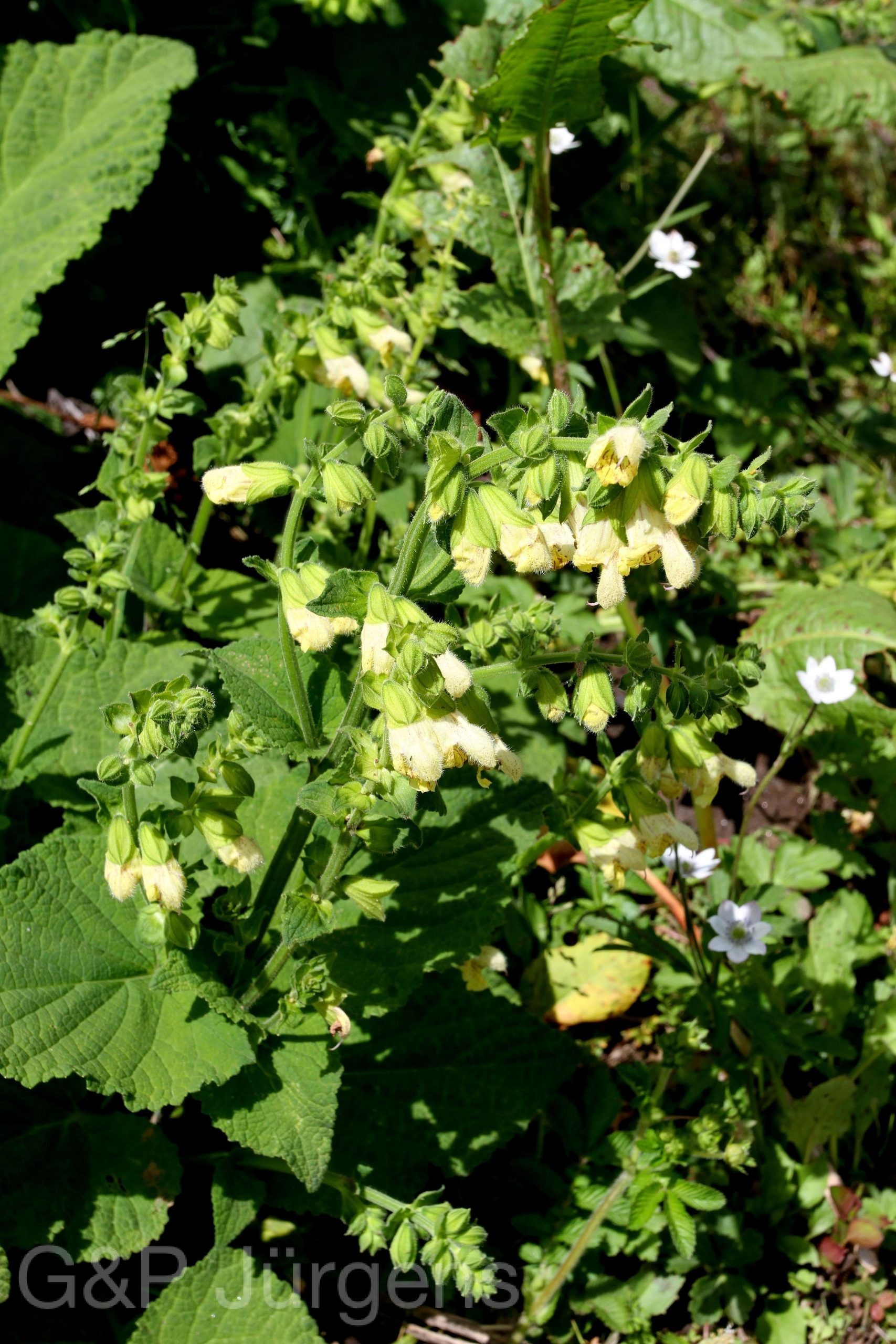
Wall. ex Benth.
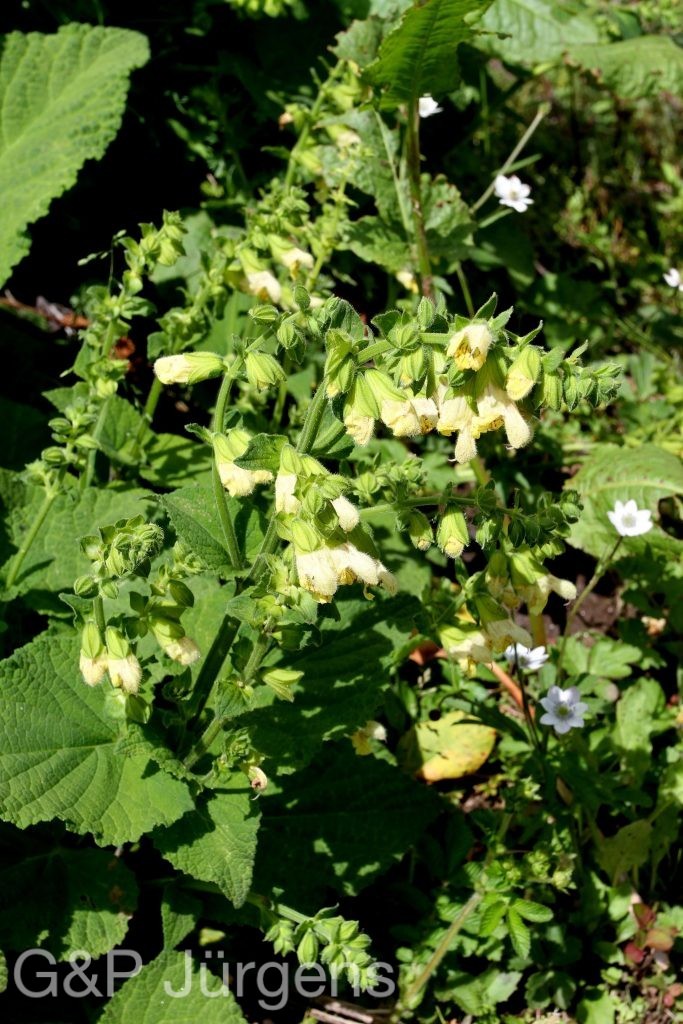
also included: Anemone rivularis DC.
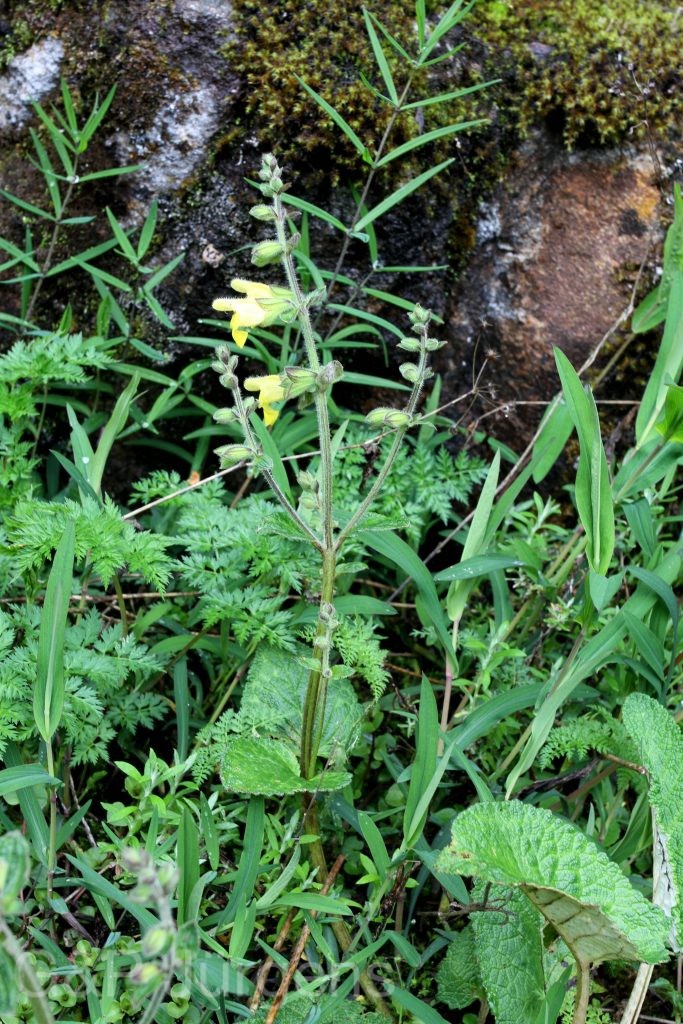
Description
Salvia campanulata is a robust perennial sage of the Himalaya and adjacent China, with verified occurrences in Nepal, China, India, Bhutan and Myanmar. It grows on open grassy slopes, in forest clearings, scrub and along streamsides through the upper-temperate and subalpine zones, broadly between about 2500 and 3800 m. The plant illustrated from near Dur-Tso in Bhutan at around 3600 m in June, where it grows in company with Anemone rivularis, exemplifies its preference for moist, open subalpine grassland flowering early in the monsoon season.
The species arises from a stout rootstock and produces erect, quadrangular stems clothed, like the foliage, in soft hairs. The leaves are mostly basal and on the lower stem, large, broadly ovate to triangular-hastate with cordate bases and crenate-serrate margins, and long-petiolate. The inflorescence is an elongate terminal raceme of remote whorls (verticillasters), each of a few flowers. The calyx is bell-shaped, the feature noted in the epithet campanulata, and the corolla is comparatively large, yellow to greenish-yellow often marked with brown or purple, strongly two-lipped with a hooded upper lip enclosing the two functional stamens characteristic of the genus. The fruit comprises four smooth nutlets enclosed in the persistent calyx.
Salvia, the largest genus of Lamiaceae, is distinguished by its specialised lever-arm stamen mechanism that promotes precise pollen placement on visiting bees and other long-tongued insects. S. campanulata, described by Bentham from a Wallich collection, belongs to the Himalayan assemblage of large-leaved montane sages. It is widespread and locally common across its range and is not regarded as being of conservation concern.
Author: Wall. ex Benth. · Sources: POWO (Kew), GBIF, Flora of China, Flora of Bhutan, Annotated Checklist of the Flowering Plants of Nepal