Lamiaceae

Benth.

Garw 2005 241 ergebnis ergebnis
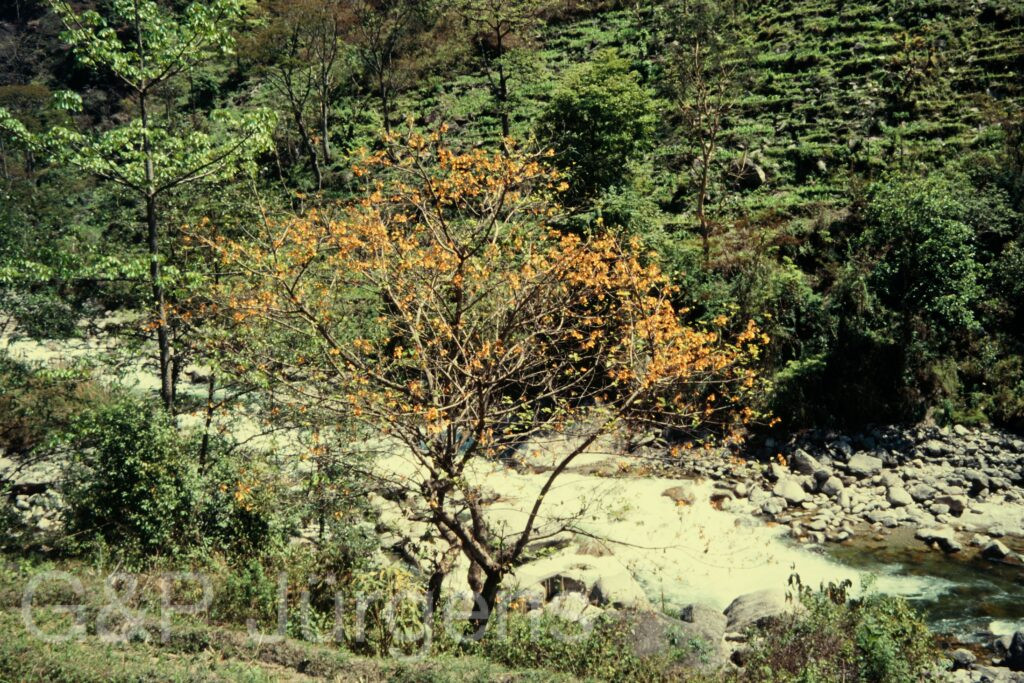
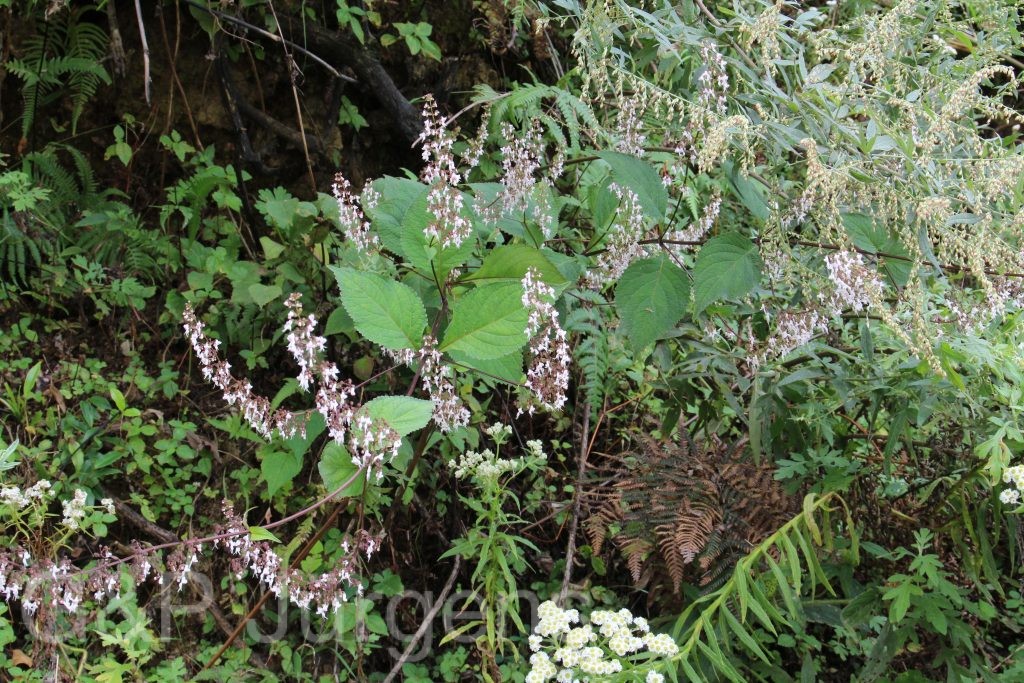
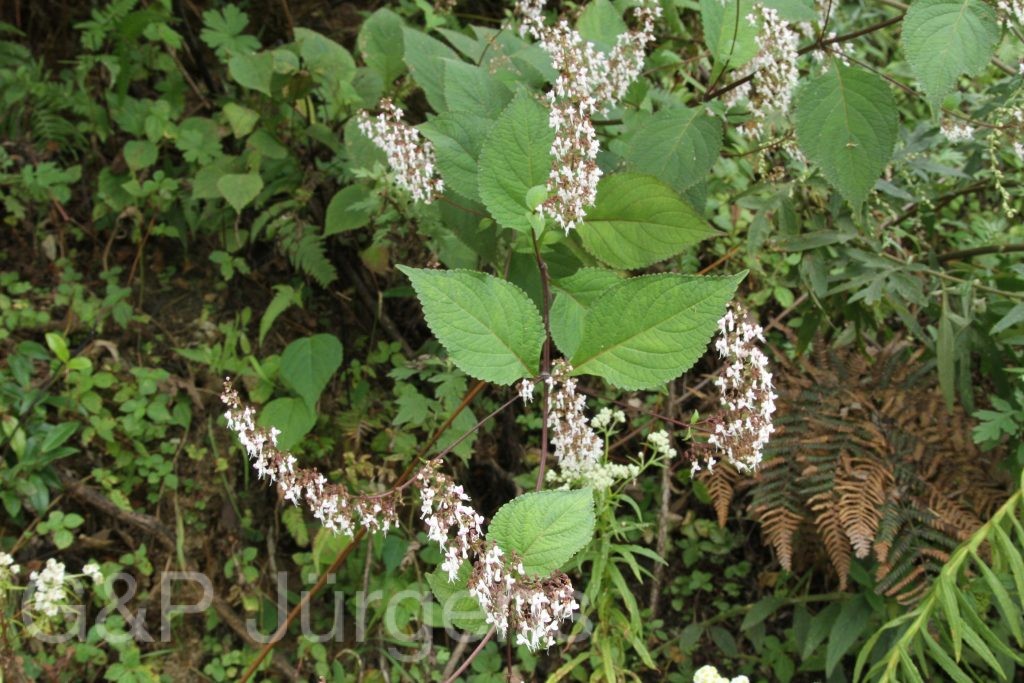
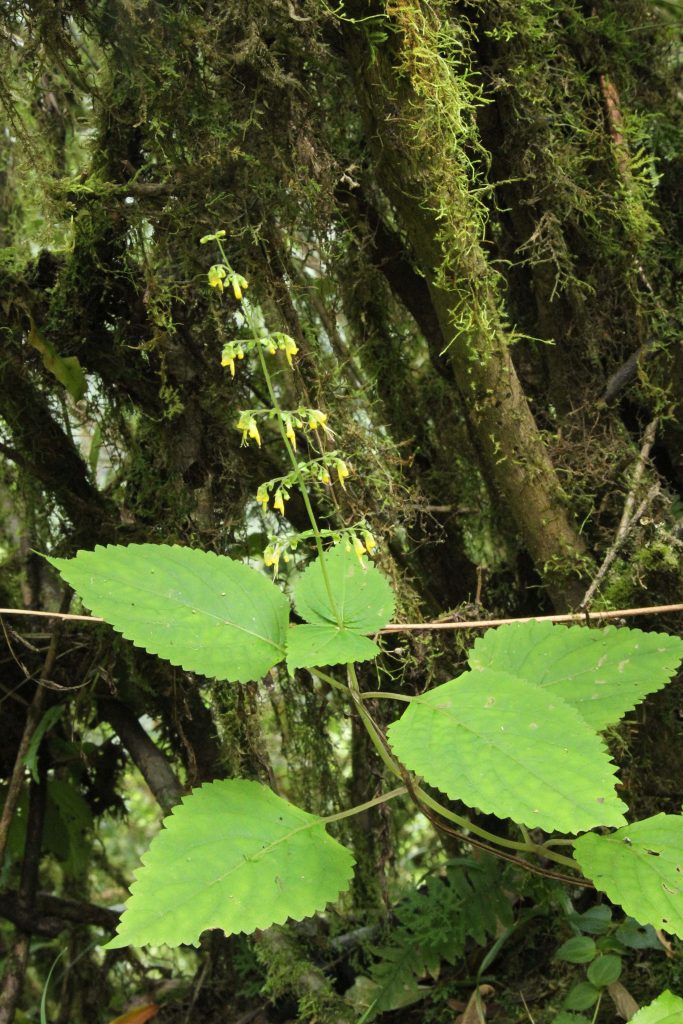
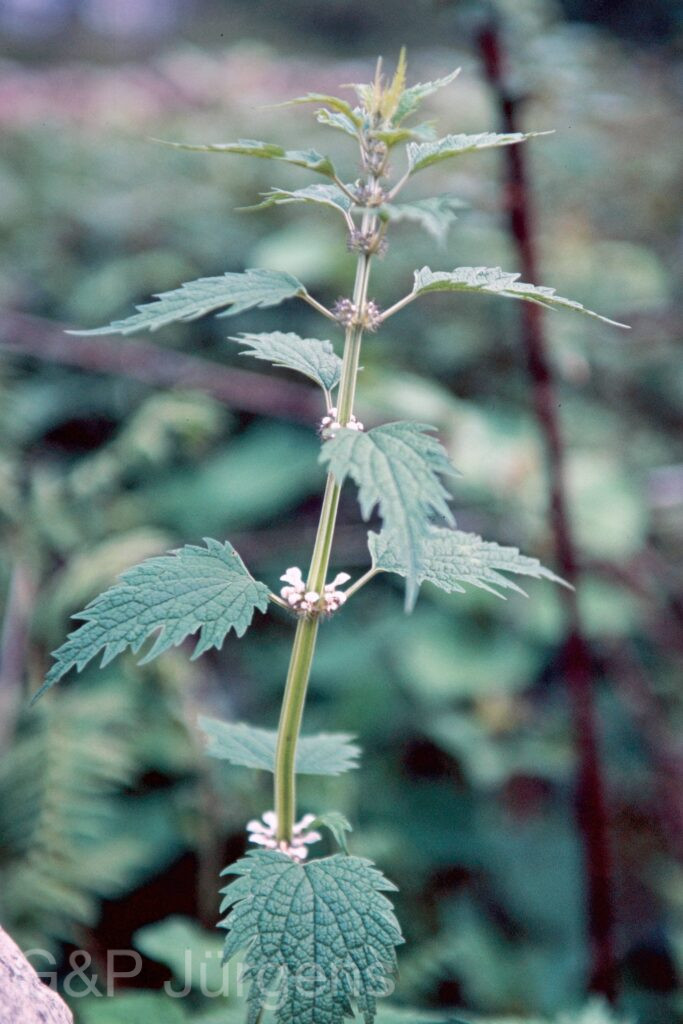
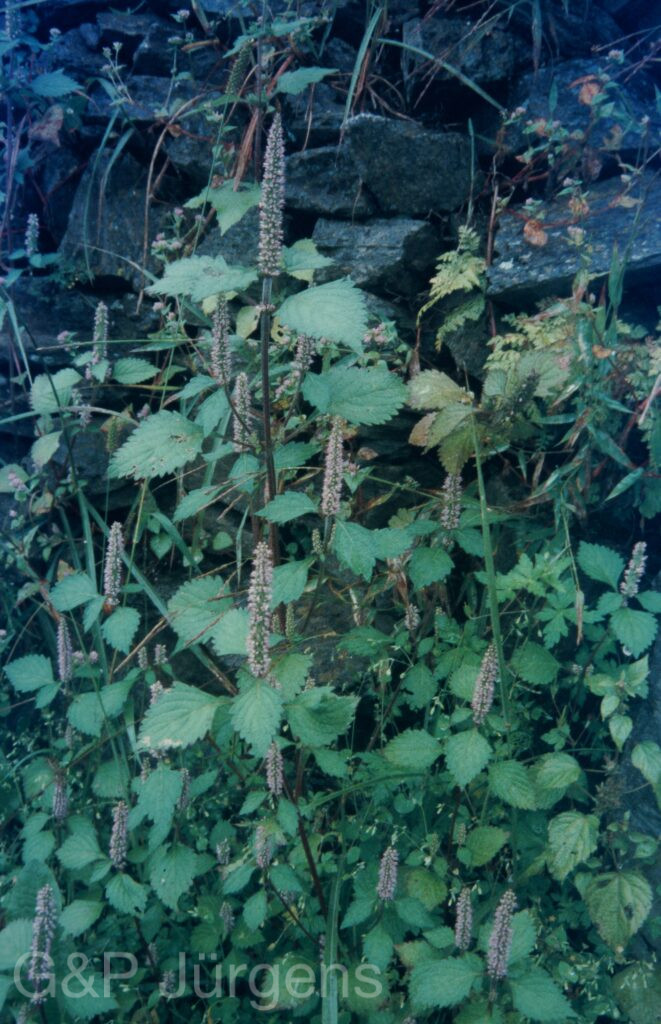
India Garhwal Bora 2200m, September

Description

Elsholtzia pilosa is a wide-ranging Asian mint distributed from the Indian Himalaya, Nepal and Bhutan eastward through Bangladesh, Myanmar, Thailand and Vietnam to southern China, with nearly 400 GBIF occurrences indicating it is a frequent component of its region. It is a plant of open, disturbed and seasonally moist ground, growing along forest margins, on grassy banks, in fallow fields, by paths and on damp slopes, often as a weedy colonist of cultivated and waste land. The plant figured from Bora in Garhwal, India, at about 2200 m in September is typical of its montane range of roughly 1500-3000 m, the autumn flowering coinciding with the close of the monsoon.

It is an erect, aromatic annual herb with a quadrangular, usually pilose stem branching from the base. The leaves are opposite, ovate to lanceolate, with a serrate-crenate margin, an acuminate apex and a cuneate base tapering to a slender petiole, sparsely hairy and gland-dotted. The small flowers are crowded into dense, one-sided, spike-like terminal verticillasters, each subtended by a bract; the corolla is purplish to pinkish-white and bilabiate, with the four stamens exserted as in the genus. The calyx is tubular and ribbed, becoming enlarged in fruit and enclosing the four smooth, ovoid nutlets characteristic of the mint family.

The epithet pilosa refers to the soft, spreading hairiness of the herbage. Elsholtzia is a mainly eastern Asian genus of aromatic herbs and subshrubs, several species of which are used medicinally and as flavourings, the essential oils giving the foliage its pungent scent. As a pioneer of disturbed ground, E. pilosa is well adapted to anthropogenic habitats, which accounts for its broad and locally abundant distribution across the Himalaya and southern China.

Author: Benth. · Sources: POWO (Kew), GBIF, Flora of China, Flora of Bhutan, Hooker Flora of British India, Press Labiatae of the Himalaya
Benth.

Bhutan2012 306
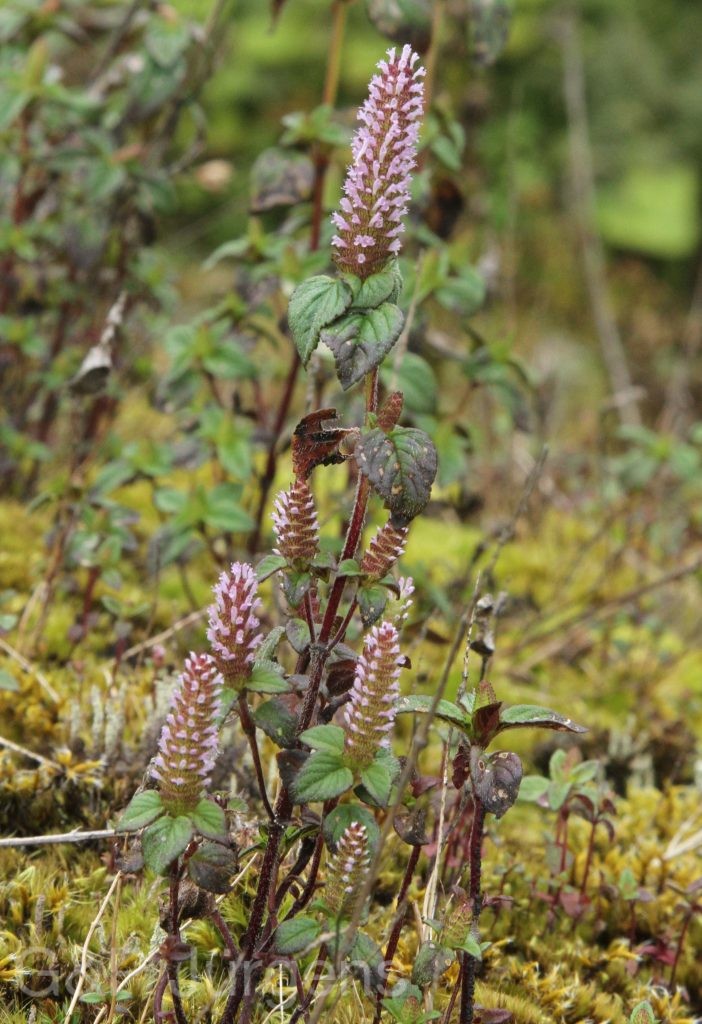
Bhutan Shele-La 4100m, October
Bhutan2012 915
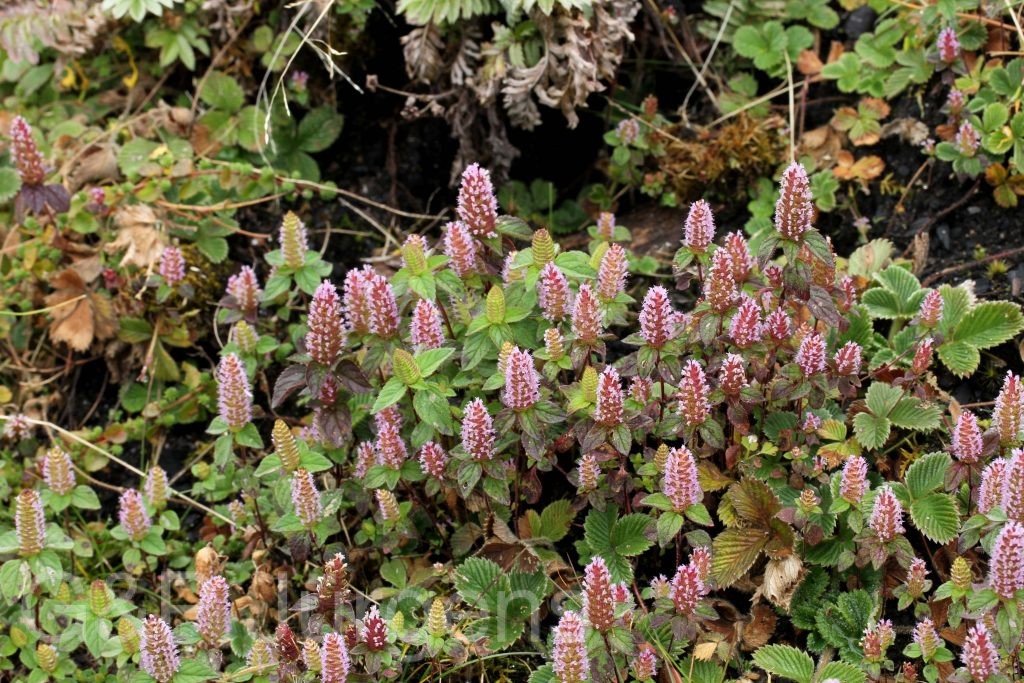
Bhutan Tumching-La 4000m, October

Description

Elsholtzia strobilifera is a high-montane to alpine herb widely distributed across the Sino-Himalayan region, recorded from Nepal, India, Bhutan, Pakistan, Myanmar, China and Taiwan, with some 493 georeferenced occurrences documented in GBIF. It is a plant of open stony slopes, grazed alpine meadows, screes and forest margins, typically between 3000 and 4300 m. The collections illustrated here, from the Bhutanese passes Shele-La at 4100 m and Tumching-La at 4000 m in October, exemplify its characteristic late-season flowering at the upper limits of vegetation, where it often forms part of dwarf-herb communities on disturbed and well-drained substrates.

It is an annual or short-lived herb, usually 5-30 cm tall, with erect or ascending, often purplish, quadrangular stems that are puberulent and frequently branched from the base. The leaves are opposite, ovate to elliptic, shortly petiolate, with crenate-serrate margins and gland-dotted surfaces emitting an aromatic scent when bruised. The inflorescence is a dense, ovoid to shortly cylindrical terminal spike of crowded verticillasters, the conspicuous broad floral bracts giving the cone-like appearance reflected in the epithet. Each tubular, bilabiate corolla is pale violet to pinkish, two-lipped and exserted-stamened; the fruit comprises four smooth, ellipsoid nutlets enclosed in the persistent calyx.

The genus Elsholtzia (Lamiaceae, subfamily Nepetoideae) comprises aromatic herbs and subshrubs centred on eastern Asia, several yielding essential oils. E. strobilifera is among the most cold-tolerant members, ascending higher than most congeners. Its capacity to colonise grazed and physically disturbed alpine ground confers ecological resilience, and it is not regarded as threatened given its broad range and abundance, though high-altitude populations are sensitive to changing grazing regimes and warming treelines.

Author: Benth. · Sources: POWO (Kew), GBIF, Flora of China, Flora of Bhutan, A Revision of the Genus Elsholtzia (Lamiaceae)

(Hedge) Ryding

Nepal 99 751 ergebnis
West-Nepal Poksundo-Lake 3650m, July

Description

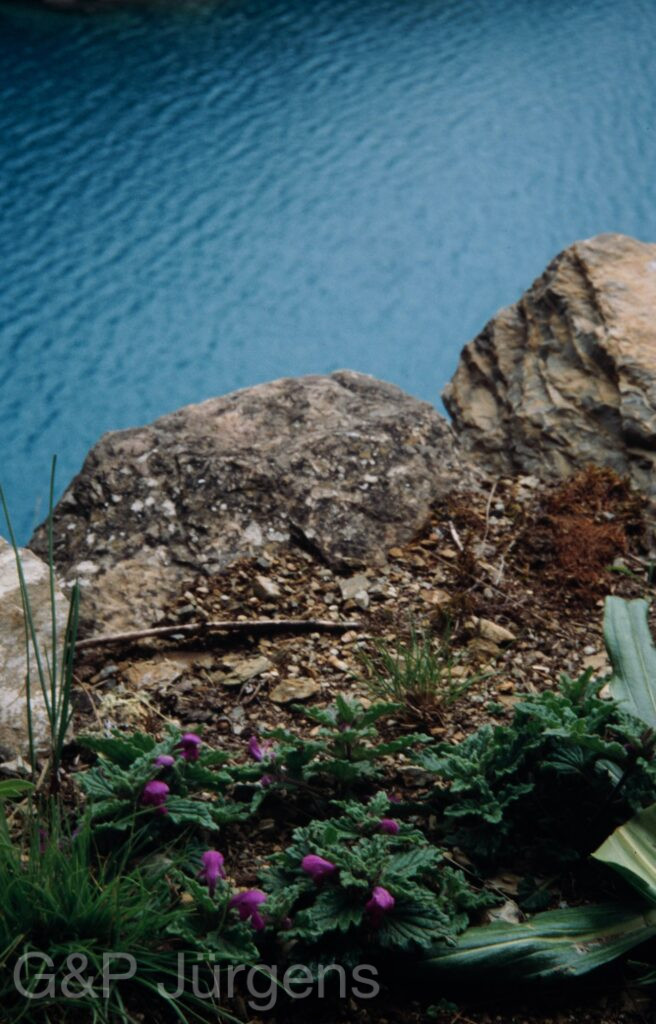
Eriophyton tuberosum is a high-alpine Himalayan labiate with a narrow distribution, GBIF holding only about 46 occurrences from Nepal, India and China. It is a plant of the alpine and subnival zones, occurring on open turf, scree margins, moist rocky slopes and stream-side flushes generally between about 3300 and 4300 m, enduring intense insolation, short growing seasons and cold nights. The population photographed beside Phoksundo (Poksundo) Lake in West Nepal at 3650 m, flowering in July at the height of the monsoon growing season, is typical of its restricted occurrence in cool, moist, high-elevation meadow and rock habitats of the western and central Himalaya.

It is a low perennial herb arising from a swollen tuberous rootstock, as the epithet indicates, with short, ascending to decumbent stems. The leaves are opposite and decussate, ovate to rounded, crenate, and—like many members of this alpine assemblage—somewhat fleshy and often woolly or villous, an adaptation to the harsh climate. The flowers are borne in axillary whorls toward the stem apex; each has a tubular, toothed calyx and a two-lipped corolla in shades of pink, purple or violet, with four didynamous stamens beneath the upper lip. The fruit comprises four smooth nutlets in the persistent calyx.

Transferred by Ryding to Eriophyton from Hedge's original placement, this species reflects a modern recircumscription absorbing several small Himalayan genera (notably Alajja) into an expanded Eriophyton of woolly alpine mints. Its very low occurrence count and narrow high-altitude band make it a regional endemic of conservation interest, sensitive to grazing and alpine warming, and a nectar source for high-altitude bumblebees.

Author: (Hedge) Ryding · Sources: POWO (Kew), GBIF, Flora of China, Annotated Checklist of the Flowering Plants of Nepal, Ryding revision of Eriophyton (Lamiaceae)

Benth.

Sikkim2003 319 P458
Sikkim Saniti-Lake 4300m August
Sikkim2003 322 P457
Sikkim Saniti-Lake 4300m August

Description

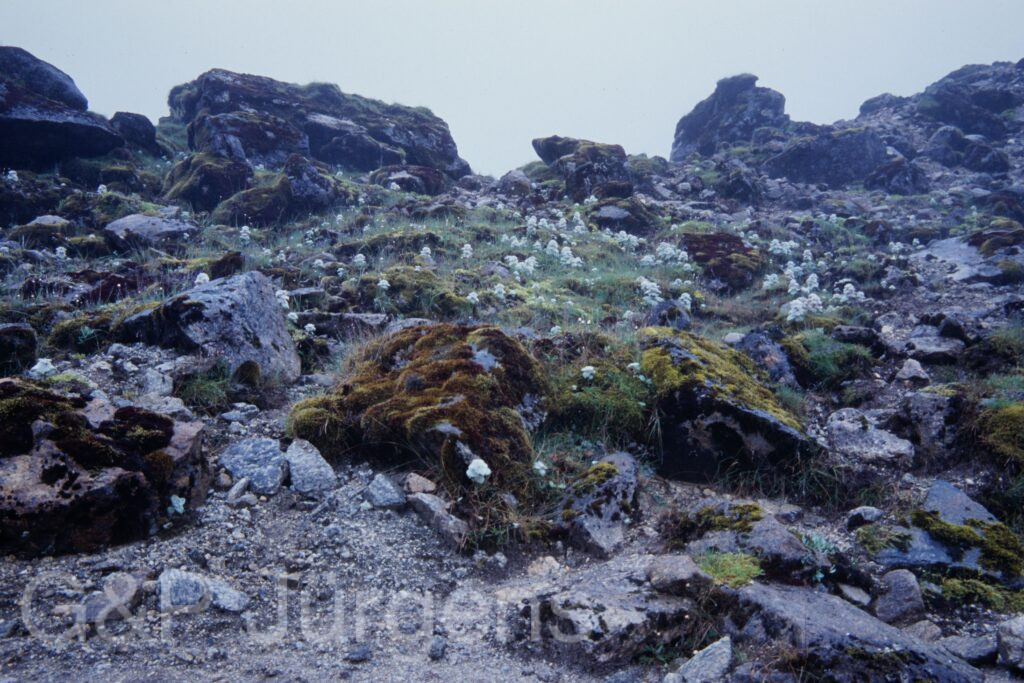
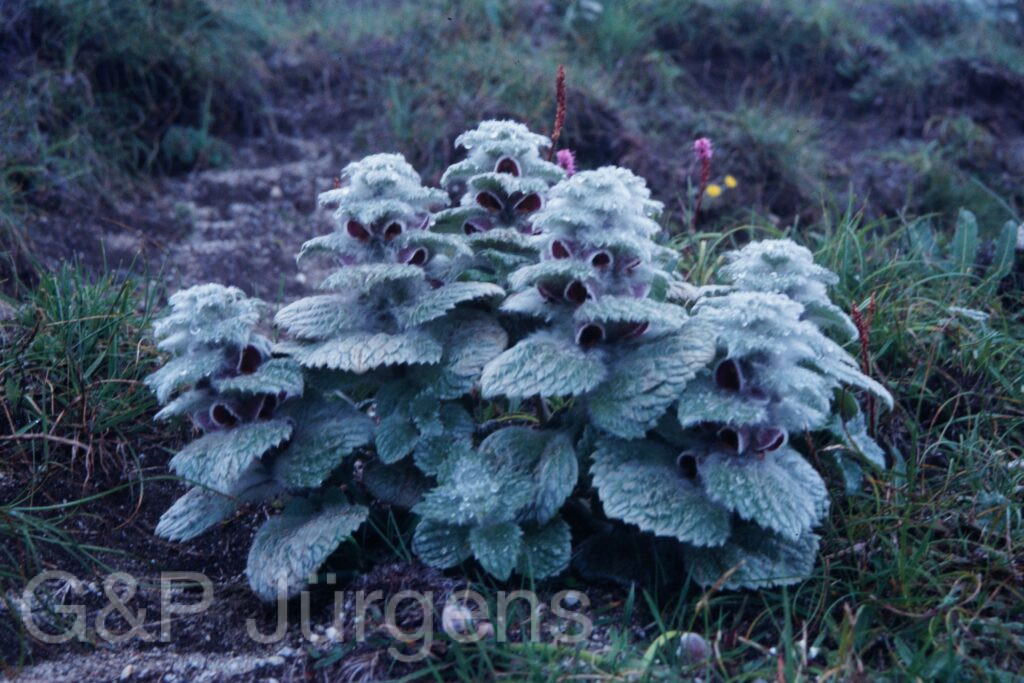
Eriophyton wallichii is a high-alpine perennial of the central and eastern Himalaya and the Tibetan Plateau, recorded from China, Nepal, India, Bhutan and Afghanistan, with some 605 georeferenced occurrences documented in GBIF. It is a characteristic plant of open screes, moraines and frost-heaved gravels of the upper alpine and subnival zones, typically between 3500 and 5000 m, where the growing season is brief. The photograph from the Saniti Lake area of Sikkim at about 4300 m in August captures the species in its preferred scree habitat at the height of the short montane summer.

The plant forms a stout, deeply buried rhizome from which arise short, ascending stems almost entirely concealed by the foliage. The most conspicuous feature is the dense covering of long, silky white woolly hairs that envelop the upper leaves, an adaptation buffering the flowers against cold and excessive radiation. The leaves are opposite, broadly ovate to suborbicular, becoming progressively larger and more densely lanate upward, where the uppermost pairs form a protective bracteal cup. The bilabiate flowers are borne in the axils of these terminal leaves, with a tubular calyx and a pink to purplish corolla whose lower lip is spreading; the fruit comprises four smooth nutlets enclosed within the persistent calyx.

The genus Eriophyton sensu lato (incorporating elements formerly placed in Alajja and Stachyopsis) is a small, distinctly Sino-Himalayan group of the Lamiaceae adapted to the harshest alpine environments. The pronounced indumentum exemplifies the convergent woolliness seen in unrelated subnival cushion and scree plants such as Saussurea and Soroseris. Long valued in Tibetan and Himalayan ethnomedicine, E. wallichii remains locally frequent across its broad range and is not presently considered threatened, though its specialised scree habitat is sensitive to glacial retreat and shifting alpine climates.

Author: Benth. · Sources: POWO (Kew), GBIF, Flora of China, Flora of Bhutan, Annotated Checklist of the Flowering Plants of Nepal, Harley et al. Labiatae in The Families and Genera of Vascular Plants

Gmelina arborea

by GP Jürgens

Roxb.

Nepal 97 56 P78
Nepal Mewa-Khola 1160m April
Nepal 97 54 P84
Nepal Mewa-Khola 1160m April

Description

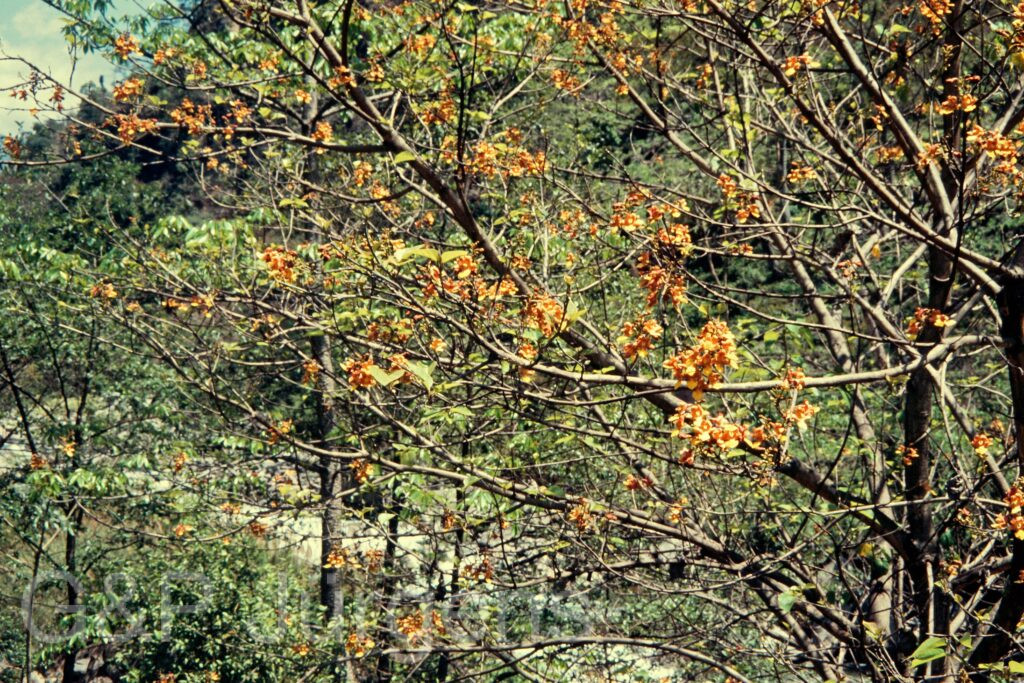
Gmelina arborea, known as gamhar or white teak, is a fast-growing tropical tree native to the Indian subcontinent and Southeast Asia, ranging through Nepal, India, Sri Lanka, Myanmar, Thailand, Indochina, China, Indonesia and the Philippines; it is now extensively planted in tropical Africa and the Americas, and its 12,900 GBIF occurrences across countries from Colombia and Brazil to Nigeria, Tanzania and Mexico largely reflect this pantropical forestry use. In its native range it grows in moist and dry deciduous forest and along watercourses from the lowlands to about 1,500 m. The plant photographed along the Mewa Khola in eastern Nepal at 1,160 m in April shows it flowering in the leafless or newly leafing state typical of the dry pre-monsoon season in the Himalayan foothills.

It is a medium-sized to large deciduous tree reaching 15-30 m, with a straight bole, greyish bark and a spreading crown. The leaves are opposite, broadly ovate to cordate, 10-25 cm long, acuminate and entire, glabrescent above and finely fulvous-tomentose beneath, with gland-dotted petioles. The flowers are showy and brownish-yellow to orange-yellow, borne in terminal panicles that appear when the tree is largely leafless; the corolla is bilabiate and funnelform with a swollen tube, and the four didynamous stamens are included. The fruit is a fleshy, ovoid to obovoid drupe, yellow when ripe, with a hard stone enclosing one to several seeds.

Gmelina, traditionally placed in Verbenaceae but now referred to Lamiaceae, comprises some thirty-five Old World tropical species, of which G. arborea is by far the most economically important. Its rapid growth, pale lightweight timber and suitability for pulp and plantation forestry have made it one of the most widely cultivated hardwoods in the tropics, while its nectar-rich flowers attract bees and its drupes are taken by mammals and birds. Long valued in traditional medicine and listed among the classical Ayurvedic drugs, the species is abundant and of least concern, though its plantations occasionally naturalise beyond cultivation.

Author: Roxb. · Sources: POWO (Kew), GBIF, Flora of China, Annotated Checklist of the Flowering Plants of Nepal, World Agroforestry database, revision of Gmelina (Lamiaceae)

(Benth.) Murata

Bhutan2015 29
Bhutan Dochu-La 2800m, October

Description

Isodon hispidus (Benth.) Murata is a perennial herb of the mint family distributed across the eastern Himalaya and the mountains of southern China and mainland Southeast Asia. GBIF records confirm its presence in Bhutan, India, China, Myanmar, Laos, Vietnam, Thailand and Korea, with an outlying record from Tanzania likely representing a cultivated or misidentified collection. It favours moist forest margins, shrubby clearings and open slopes in the temperate and subalpine zones, typically between 1,500 and 3,000 m. The photographed plant at the Dochu-La in Bhutan, at 2,800 m and flowering in October, exemplifies its preference for cool, humid montane habitats where autumn blooms persist after the monsoon.

The species forms an erect, branched herb 0.5–1.5 m tall arising from a woody rootstock, with quadrangular stems that are densely hispid with spreading hairs. The opposite leaves are ovate to broadly ovate, acuminate, with a coarsely serrate margin and a rugose, pubescent surface, narrowing to a winged petiole. The inflorescence is a lax terminal panicle composed of numerous cymes; the small flowers have a campanulate, two-lipped calyx and a pale violet to purplish corolla with the characteristic declinate lower lip of the genus, enclosing four exserted stamens. The fruit comprises four smooth, ovoid nutlets.

Isodon hispidus belongs to a large and taxonomically intricate genus (formerly placed in Rabdosia and Plectranthus) noted for diterpenoid chemistry of pharmacological interest. Several congeners are used in traditional Asian medicine, and the genus is a focus of phytochemical research into ent-kaurene diterpenoids. The species is widespread and not considered threatened across its broad range.

Author: (Benth.) Murata · Sources: POWO (Kew), GBIF, Flora of China Vol. 17, Flora of Bhutan Vol. 2, Murata: Revision of Asian Isodon (Lamiaceae)

(Buch.-Ham. ex D.Don) H.Hara

Bhutan2015 586
Bhutan Mo-Chu 1800m, October
Bhutan2015 587
Bhutan Mo-Chu 1800m, October

Description

Isodon lophanthoides is a widespread herb of the Sino-Himalayan region, recorded from China, the Indian Himalaya, Nepal, Bhutan, Pakistan, Myanmar, Thailand, Laos, Vietnam, Bangladesh, Malaysia and Hong Kong, and represented by nearly two thousand georeferenced collections. It occupies a broad subtropical to warm-temperate belt, growing on moist shaded banks, forest margins, streamsides, grassy slopes and disturbed ground. In Bhutan it descends to warm river valleys, as along the Mo-Chu at about 1800 m where it was photographed flowering in October, the late-season anthesis typical of the genus.

The plant is an erect to ascending annual or short-lived perennial herb with quadrangular, often purple-tinged and pubescent or glandular stems. The leaves are opposite, ovate to broadly ovate, crenate-serrate, acuminate, and narrowed at the base into a winged petiole, often gland-dotted beneath. The inflorescence is a lax, much-branched terminal panicle of small cymes. The flowers have a bilabiate, glandular calyx that enlarges in fruit, and a small two-lipped corolla that is white to pale pink or purplish, dotted with darker spots, with a flat lower lip and four declinate didynamous stamens. The fruit consists of four smooth ovoid nutlets (mericarps).

Isodon (formerly included in a broad Rabdosia and Plectranthus) belongs to subfamily Nepetoideae of Lamiaceae; this species was described as Plectranthus lophanthoides by Buchanan-Hamilton and transferred by Hara. Several intraspecific varieties have been recognised across its range. Rich in bioactive ent-kaurane diterpenoids, it is used in Chinese herbal medicine, and its broad ecological tolerance and frequency mean it is not of conservation concern.

Author: (Buch.-Ham. ex D.Don) H.Hara · Sources: POWO (Kew), GBIF, Flora of China, Flora of Bhutan, Flora of Pakistan, taxonomic revisions of Isodon (Lamiaceae) by H. W. Li

(Wall.) Murata

Bhutan2012 352
Bhutan Wangdi 2200m, October

Description

An erect perennial mint of the Himalaya and adjacent mountains, recorded from Nepal, China, India, Bhutan and Myanmar, with about 180 GBIF occurrences. It grows on open slopes, scrub margins, forest edges, roadbanks and disturbed clearings in the warm-temperate and subtropical zones, generally between about 1500 and 2800 m, flowering into the autumn. The illustrated plant was photographed in October at Wangdi in Bhutan at around 2200 m, a sunny mid-elevation montane site typical of its late-season flowering.

The species is a tall, branching herb or subshrub with the characteristic quadrangular stems of the mint family, often finely pubescent. The leaves are opposite and decussate, ovate to ovate-lanceolate, acuminate, with serrate margins and a glandular-punctate, aromatic surface, borne on distinct petioles. The inflorescence is a lax, much-branched terminal panicle of small cymes. Each flower has a campanulate, two-lipped calyx and a small bilabiate corolla, pale lilac to whitish or bluish, with a short tube, a four-lobed upper portion and a larger boat-shaped lower lip enclosing the four declinate stamens. The fruit comprises four small, smooth, ovoid nutlets seated in the persistent calyx.

Accepted by POWO and GBIF, I. scrophularioides belongs to the genus Isodon (formerly within Rabdosia and Plectranthus), a group of mints rich in bioactive diterpenoids and of interest in traditional medicine and phytochemistry. The deflexed lower lip forms a landing platform for bee pollinators, and the dry nutlets are dispersed by gravity and disturbance. Adaptable and frequent in secondary habitats across its range, it is of no conservation concern and exemplifies the largely Asian, montane radiation of the genus.

Author: (Wall.) Murata · Sources: POWO (Kew), GBIF, Flora of China, Flora of Bhutan, Li revision of Isodon

(D.Don) Kudô

Bhutan2015 461
Bhutan Trongtsa 2100m, October

Description

Isodon ternifolius is a shrubby mint distributed across the eastern Himalaya and Southeast Asia, recorded by GBIF (477 occurrences) from China, India, Thailand, Nepal, Myanmar, Vietnam, Bhutan, Bangladesh and Laos. It occupies forest margins, thickets, open hillsides, roadsides and disturbed slopes, mostly at lower to mid montane elevations between roughly 500 and 2500 m. The plant photographed at Trongsa in central Bhutan at 2100 m in October illustrates its autumn flowering, when the airy inflorescences come into bloom along forested valley margins toward the upper end of its altitudinal range.

The species is an erect perennial herb or soft shrub with quadrangular, often densely pubescent stems. As suggested by the epithet, the leaves are frequently borne in whorls of three (ternate), in addition to the opposite arrangement typical of the family; they are ovate to lanceolate, crenate-serrate and shortly petiolate, with a velvety to tomentose indumentum. The flowers are small and arranged in many-flowered thyrses formed of axillary cymes. The corolla is bilabiate with a short tube, the upper lip four-lobed and reflexed and the lower lip boat-shaped and declinate to enclose the four stamens and the bifid style. The fruit comprises four smooth, ovoid nutlets enclosed within the persistent campanulate calyx.

Isodon, long included within Plectranthus or Rabdosia, is now recognised as a distinct genus of Old World mints noted for its rich array of bioactive ent-kaurane diterpenoids, several species being used in traditional Chinese medicine. The nectariferous bilabiate flowers are pollinated by bees and other insects, and the nutlets are dispersed passively from the persistent calyces. The species is common, weedy in disturbed habitats and not regarded as threatened.

Author: (D.Don) Kudô · Sources: POWO (Kew), GBIF, Flora of China, Flora of Bhutan, Flora of Thailand, Revision of the Genus Isodon (Li)

L.

Garh 07 310 ergebnis
India Garhwal Bebra 2450m, June

Description

Leonurus cardiaca, motherwort, is a perennial herb of Eurasian origin that has become widely naturalised, with a very large GBIF dataset of 79501 occurrences concentrated in Europe, Russia and temperate North America. It is a plant of disturbed, nutrient-rich ground, occurring on roadsides, hedgerows, waste places, field margins, fallows and around habitation. The plant recorded at Bebra in the Garhwal Himalaya at 2450 m in June represents an introduced or naturalised montane occurrence, where it grows on open, anthropogenically disturbed ground and flowers in early summer.

The species is an erect perennial reaching 0.5-1.2 m, with the quadrangular stems typical of Lamiaceae, often branched and somewhat pubescent. The leaves are opposite and decussate, long-petiolate, the lower palmately three- to five-lobed with coarsely toothed lobes, grading to narrower, fewer-lobed leaves above. The small flowers are borne in dense axillary verticillasters subtended by stiff, spinescent bracteoles; each has a five-toothed, rigid, sharply pointed calyx and a two-lipped pinkish to pale purple corolla, the upper lip densely white-villous and the lower three-lobed, enclosing four didynamous stamens. The fruit comprises four trigonous nutlets.

Leonurus belongs to the subfamily Lamioideae, and L. cardiaca has long been valued in herbal medicine as a cardiac and nervine tonic, the basis of both its scientific and common names. As a hardy, seed-prolific ruderal, it spreads readily in disturbed temperate habitats and is locally established well beyond its native Eurasian range; it is of no conservation concern and is sometimes regarded as a minor weed.

Author: L. · Sources: POWO (Kew), GBIF, Flora of China Vol. 17, Flora of Bhutan Vol. 2, Flora of Nepal, Flora of Pakistan, Krestovskaja's revision of Leonurus