
(Wall.) Murata
Description
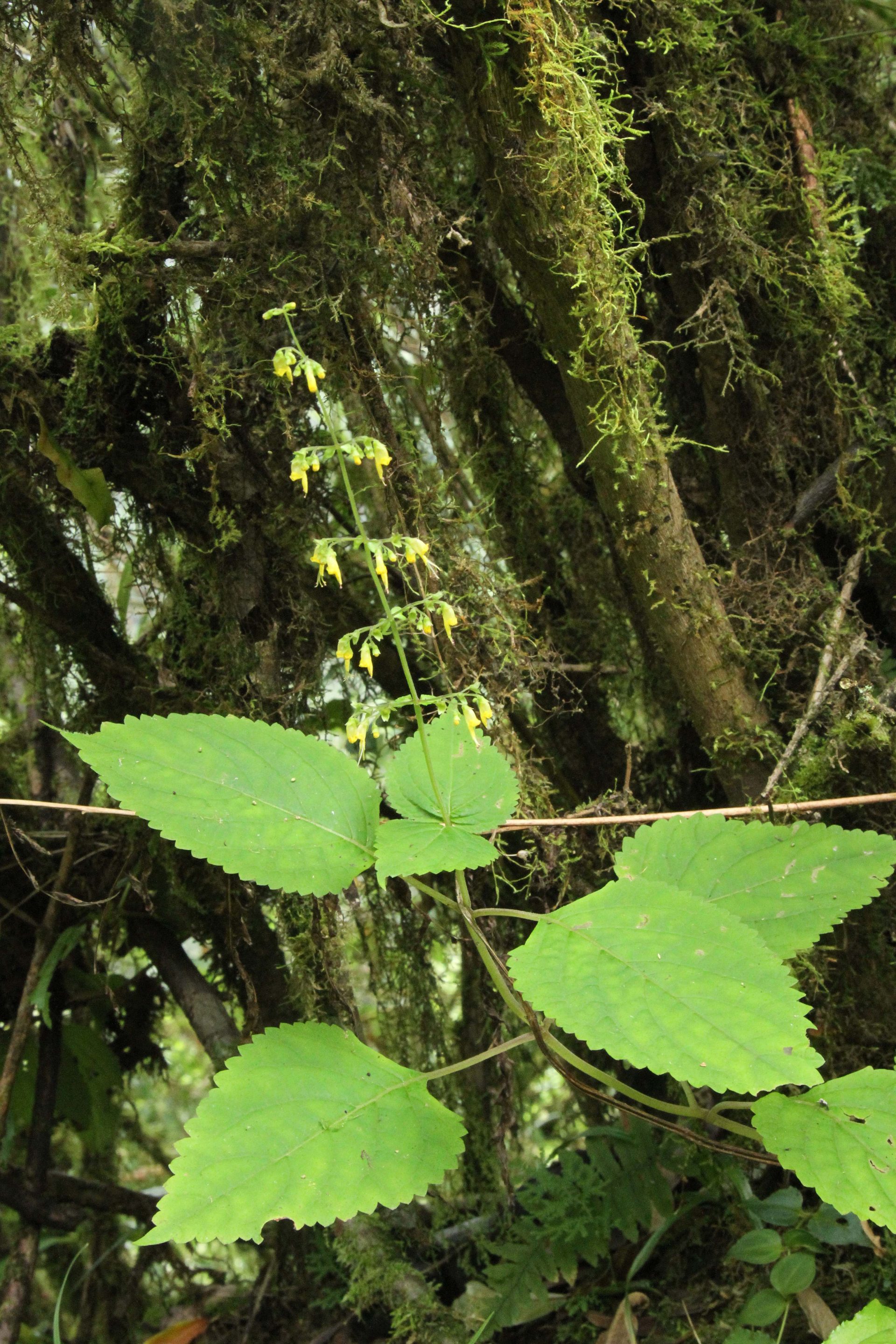
An erect perennial mint of the Himalaya and adjacent mountains, recorded from Nepal, China, India, Bhutan and Myanmar, with about 180 GBIF occurrences. It grows on open slopes, scrub margins, forest edges, roadbanks and disturbed clearings in the warm-temperate and subtropical zones, generally between about 1500 and 2800 m, flowering into the autumn. The illustrated plant was photographed in October at Wangdi in Bhutan at around 2200 m, a sunny mid-elevation montane site typical of its late-season flowering.
The species is a tall, branching herb or subshrub with the characteristic quadrangular stems of the mint family, often finely pubescent. The leaves are opposite and decussate, ovate to ovate-lanceolate, acuminate, with serrate margins and a glandular-punctate, aromatic surface, borne on distinct petioles. The inflorescence is a lax, much-branched terminal panicle of small cymes. Each flower has a campanulate, two-lipped calyx and a small bilabiate corolla, pale lilac to whitish or bluish, with a short tube, a four-lobed upper portion and a larger boat-shaped lower lip enclosing the four declinate stamens. The fruit comprises four small, smooth, ovoid nutlets seated in the persistent calyx.
Accepted by POWO and GBIF, I. scrophularioides belongs to the genus Isodon (formerly within Rabdosia and Plectranthus), a group of mints rich in bioactive diterpenoids and of interest in traditional medicine and phytochemistry. The deflexed lower lip forms a landing platform for bee pollinators, and the dry nutlets are dispersed by gravity and disturbance. Adaptable and frequent in secondary habitats across its range, it is of no conservation concern and exemplifies the largely Asian, montane radiation of the genus.
Author: (Wall.) Murata · Sources: POWO (Kew), GBIF, Flora of China, Flora of Bhutan, Li revision of Isodon