
Wall. ex Sweet
Description
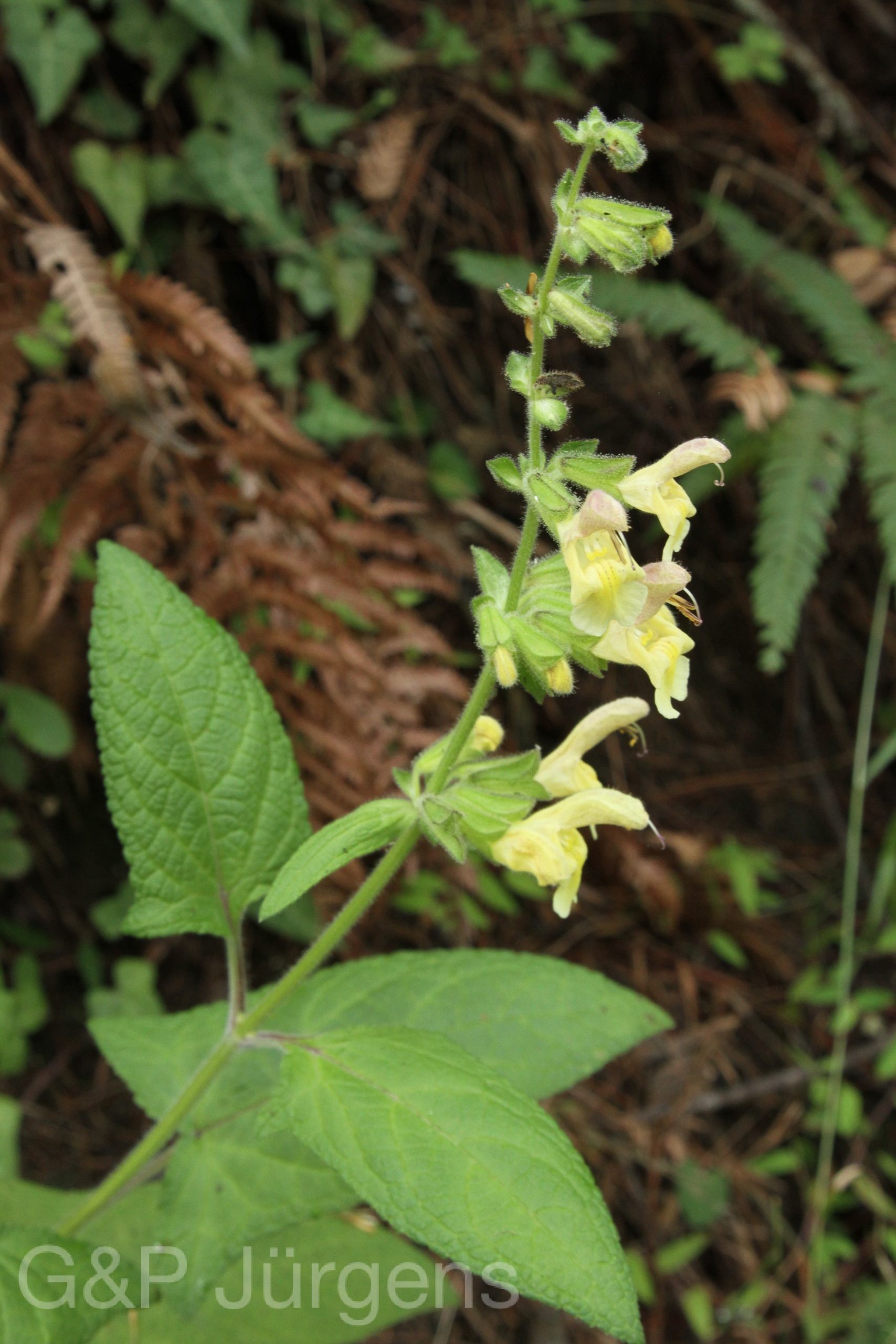
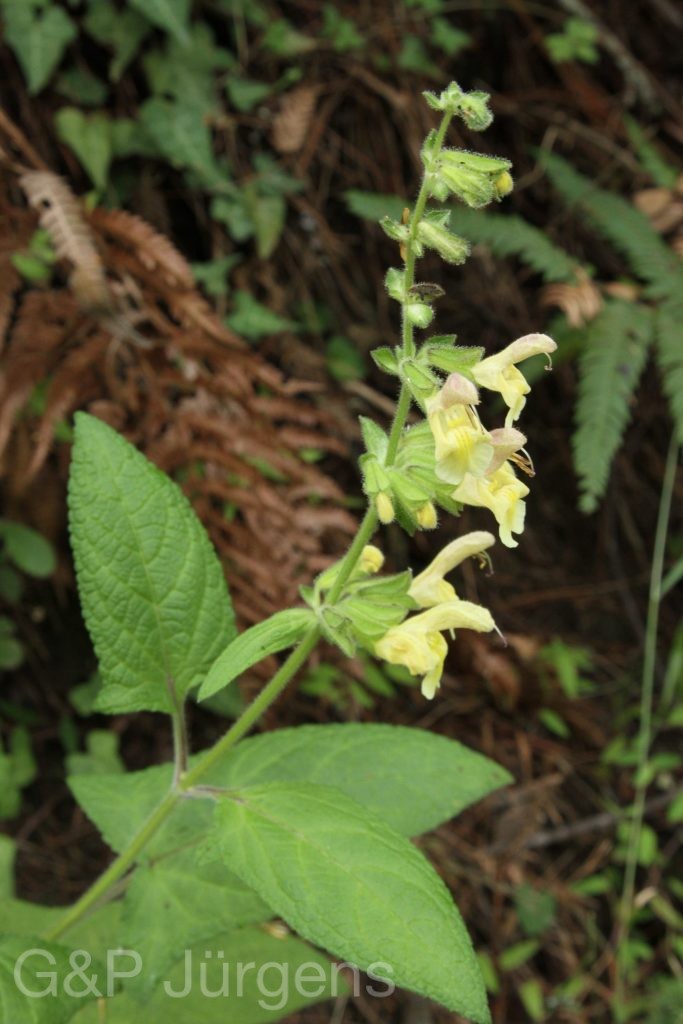
Salvia nubicola is a robust herbaceous sage of the Himalaya and adjacent mountains, distributed from Afghanistan and Pakistan through Nepal, northern India and Bhutan into south-western China, with 372 GBIF occurrences that include naturalised or cultivated material in Europe, North America, Iran and New Zealand. It favours open slopes, forest margins, clearings, roadsides and disturbed ground in the temperate montane zone, broadly between 1800 and 3600 m. The illustrated plant was photographed at Paro in Bhutan at 2300 m in September, in the late-summer to autumn flowering season characteristic of the species at mid-elevations.
It is a stout perennial herb up to 1-1.5 m tall with quadrangular, glandular-hairy stems and a strong aromatic scent. The leaves are large, ovate-triangular to hastate with a cordate or sagittate base and crenate margin, long-petiolate and rugose. The flowers are arranged in widely spaced verticillasters forming an elongate terminal inflorescence, subtended by conspicuous bracts. The corolla is pale yellow, often blotched or veined with purple or brown on the lower lip, strongly two-lipped with a hooded galea-like upper lip; the two fertile stamens bear the characteristic lever-like connective of Salvia. The fruit comprises four smooth nutlets enclosed in the persistent two-lipped calyx.
The staminal lever mechanism deposits pollen on visiting long-tongued bees and is a defining synapomorphy of Salvia; in S. nubicola the pale, dark-marked flowers attract bumblebees. The species belongs to a Himalayan group of large-leaved yellowish-flowered sages allied to S. glutinosa of Europe. Wide-ranging, weedy-tolerant and locally common, it is of least concern, and like many sages it has minor local use in traditional medicine and is grown as an ornamental in temperate gardens.
Author: Wall. ex Sweet · Sources: POWO (Kew), GBIF, Flora of China, Flora of Pakistan, Hedge: Labiatae of South-West Asia