
Roxb.
Description
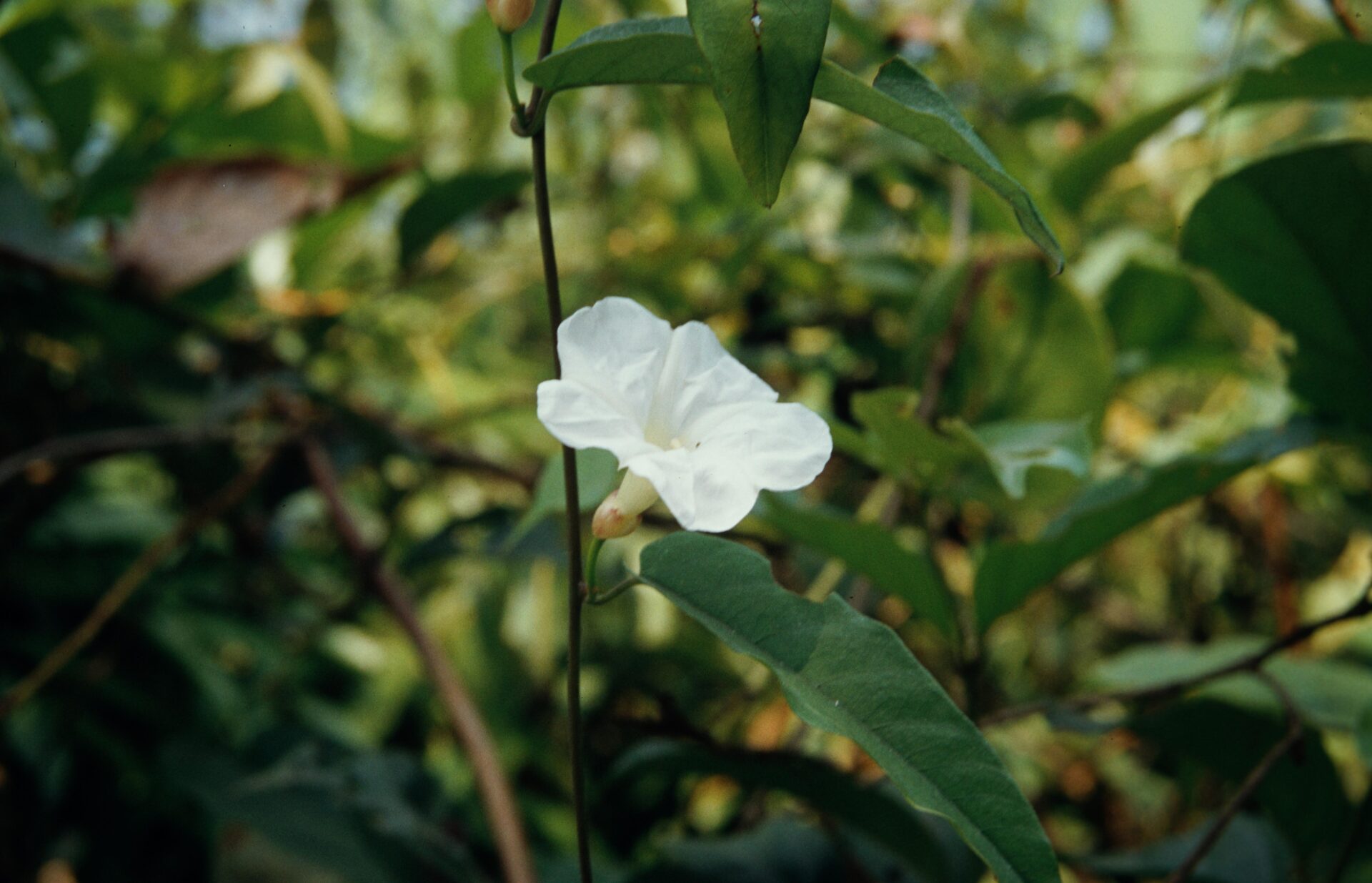
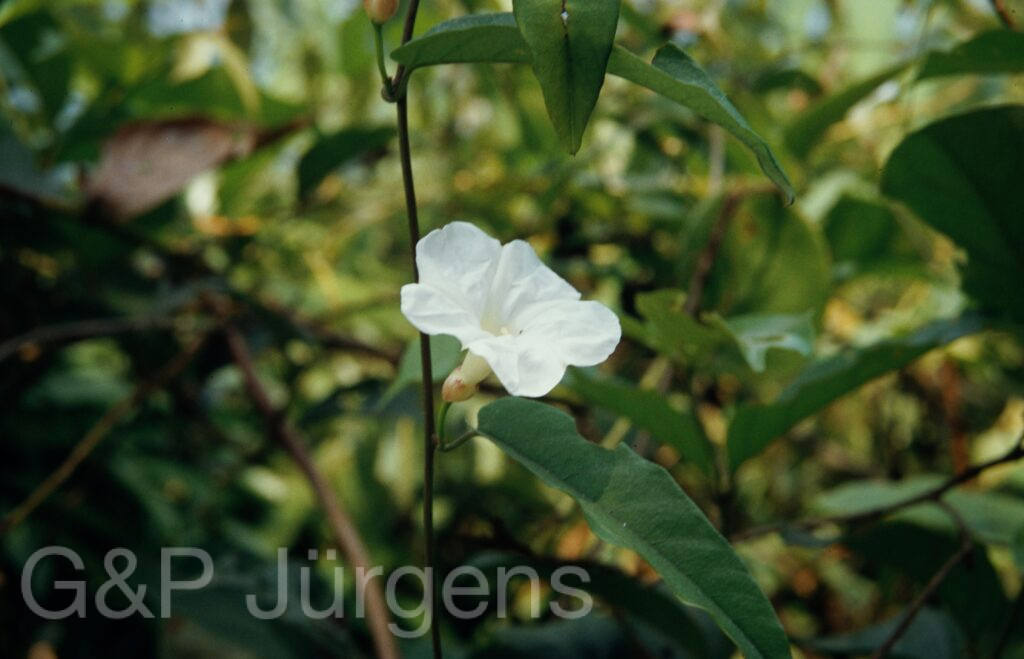
Thunbergia fragrans is a slender twining herbaceous climber native to tropical and subtropical Asia, from the Indian subcontinent and the Himalayan foothills eastward to China, Sri Lanka and Southeast Asia, and now naturalised across the Americas, the Pacific and Australia. It grows in thickets, hedgerows, forest edges, scrub and disturbed ground in the warm lowlands and lower hills, generally below about 1500 m. The photographed plant comes from Kandbari in East Nepal at around 490 m, flowering in April. With nearly 4900 georeferenced records, many from its introduced range, it is a conspicuous and frequently collected vine. Although filed here under Lamiaceae, the species belongs to the Acanthaceae.
The stems are twining, slender and angled, often finely hairy. The leaves are opposite, ovate to triangular-hastate, with a cordate to truncate base, entire to sinuately lobed or toothed margins, and a slender petiole. The flowers are solitary in the leaf axils on long peduncles, subtended by two large leafy bracteoles that enclose the much-reduced calyx. The corolla is salverform with a broad spreading limb of five rounded lobes and is pure white, the throat sometimes pale, the flowers faintly fragrant. Four didynamous stamens are inserted within the corolla tube. The fruit is a beaked, woody, explosively dehiscent capsule, the persistent style forming a long apical beak, scattering the few seeds.
Widely grown as an ornamental for its clean white flowers, T. fragrans has escaped cultivation in many warm regions and is regarded as an environmental weed in parts of Australia, the Pacific and the neotropics, where it smothers low vegetation. Within Thunbergia it is recognised by its white, fragrant corolla and hastate leaves. Abundant and expanding, it is of least conservation concern.
Author: Roxb. · Sources: POWO (Kew), GBIF, Flora of China, Flora of Nepal, Acanthaceae monographs (Thunbergia)