Tag:

Bhutan

Flowers of Bhutan — 1326 plant species documented across the Bhutanese Himalaya, from dense broadleaf and conifer forests to alpine scrub and meadows. Bhutan’s largely intact wilderness shelters an exceptional diversity of orchids, rhododendrons, primulas and Himalayan poppies, many of them regional endemics. Each species page includes a botanical description, distribution, habitat and flowering time, with the original photograph and its recorded altitude and locality.

Rehder

Bhutan2015 463
  Bhutan Jakar 2100m, October
Bhutan2012 104
Bhutan Shele-La, 3600m September
Garw 2005 203 ergebnis ergebnis
India Garhwal Pana 2750m, September
Bhutan2015 607
Bhutan Gasa 1950m, October

Description

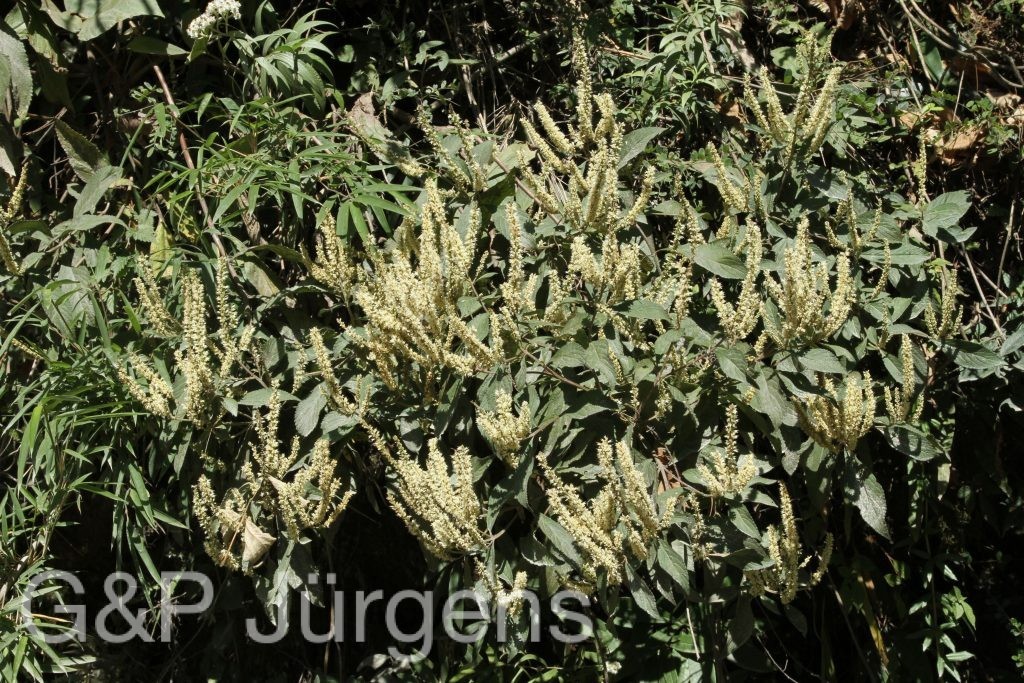
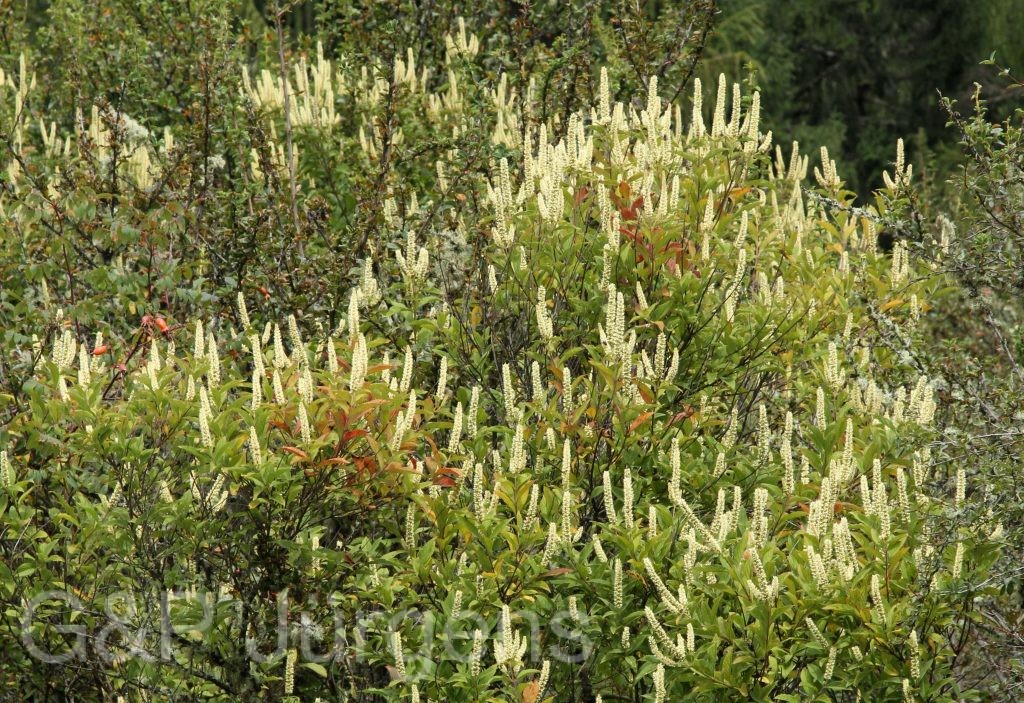
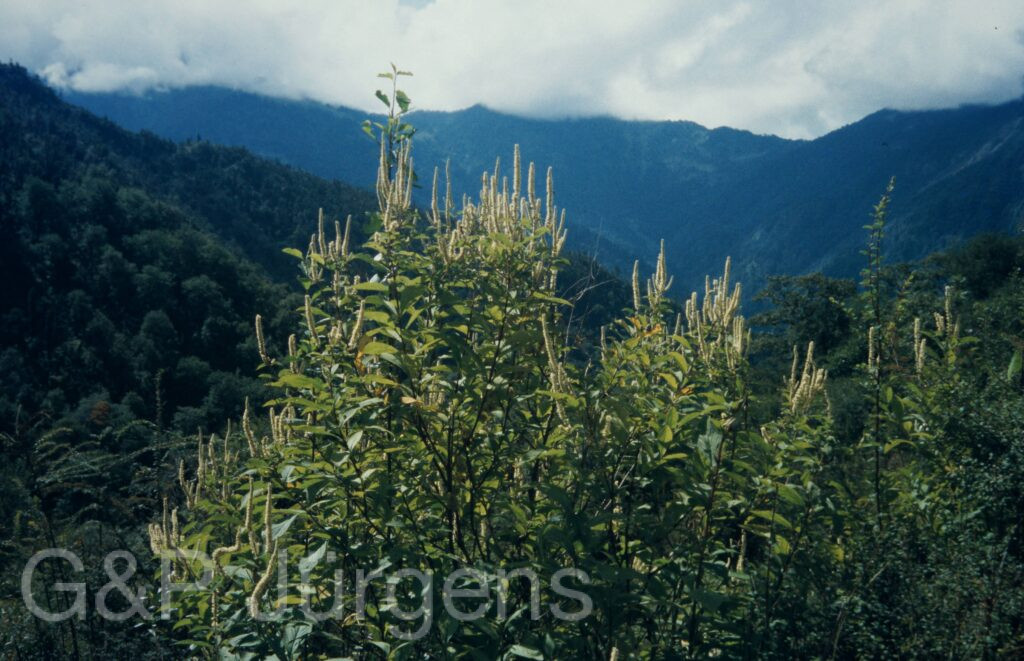
Elsholtzia fruticosa is a widespread shrubby mint of the Himalaya and south-western China, recorded by GBIF (1928 occurrences) from China, Nepal, India, Bhutan, Pakistan, Malaysia and Myanmar. It is a plant of open, disturbed and sunny situations, colonising forest margins, scrub, roadsides, terraced field edges, river banks and clearings, broadly between 1500 and 3600 m. The cited collections span a wide elevational and seasonal range, from Bhutan's Gasa (1950 m) and Jakar (2100 m), through Garhwal in India (Pana, 2750 m), up to the Shele-La pass at 3600 m, flowering from September into October, reflecting its autumn-blooming habit across the central and eastern Himalaya.

The species is an aromatic, much-branched shrub or subshrub reaching 1-3 m, with quadrangular, pubescent stems woody at the base. The opposite leaves are lanceolate to elliptic, serrate, pinnately veined, often greyish-tomentose beneath and dotted with aromatic glands. The small flowers are crowded into dense, cylindrical, spike-like terminal and axillary thyrses, frequently secund, with the whitish to pale-yellow flowers turned to one side of the axis. Each flower has a campanulate calyx and a bilabiate corolla; the four stamens are exserted, giving the inflorescence a feathery aspect. The fruit comprises four small, smooth nutlets (mericarps) enclosed within the persistent calyx.

Described under the combination by Rehder, the species belongs to genus Elsholtzia (subfamily Nepetoideae, tribe Elsholtzieae), a group of aromatic herbs and shrubs centred on temperate Asia. Its essential-oil-rich foliage is used in local traditional medicine and as a minor source of nectar for late-season pollinators. As a vigorous, pioneer-like colonist of disturbed ground with a very broad range, it is of least conservation concern and is locally abundant rather than rare.

Author: Rehder · Sources: POWO (Kew), GBIF, Flora of China, Flora of Bhutan, A Revision of the Genus Elsholtzia (Lamiaceae)
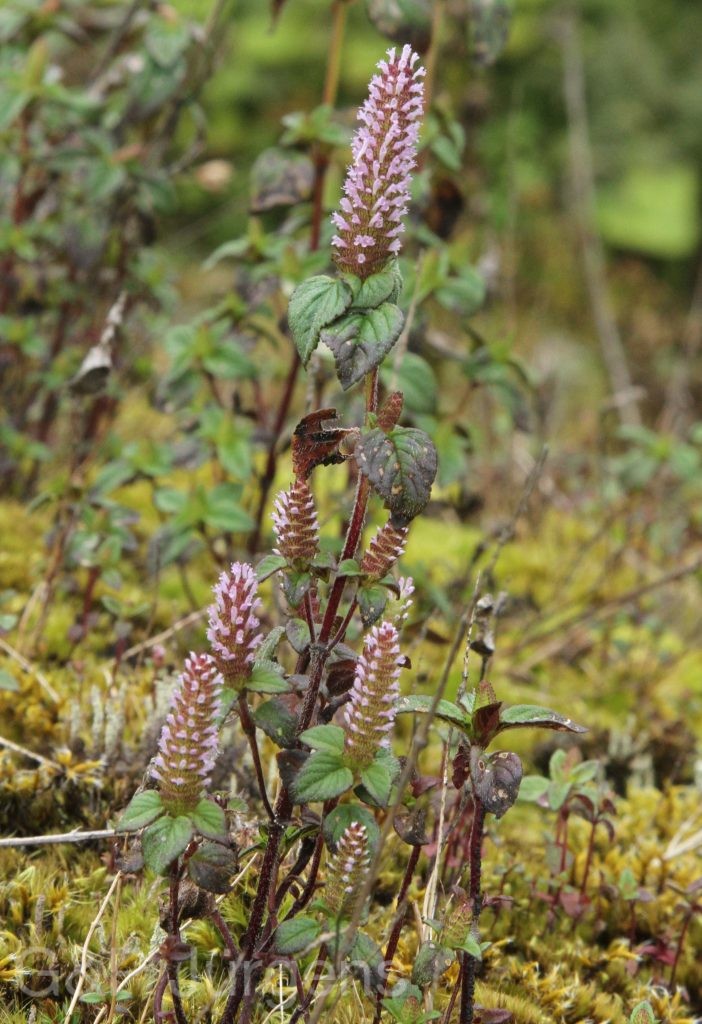
Benth.

Garw 2005 241 ergebnis ergebnis
India Garhwal Bora 2200m, September

Description

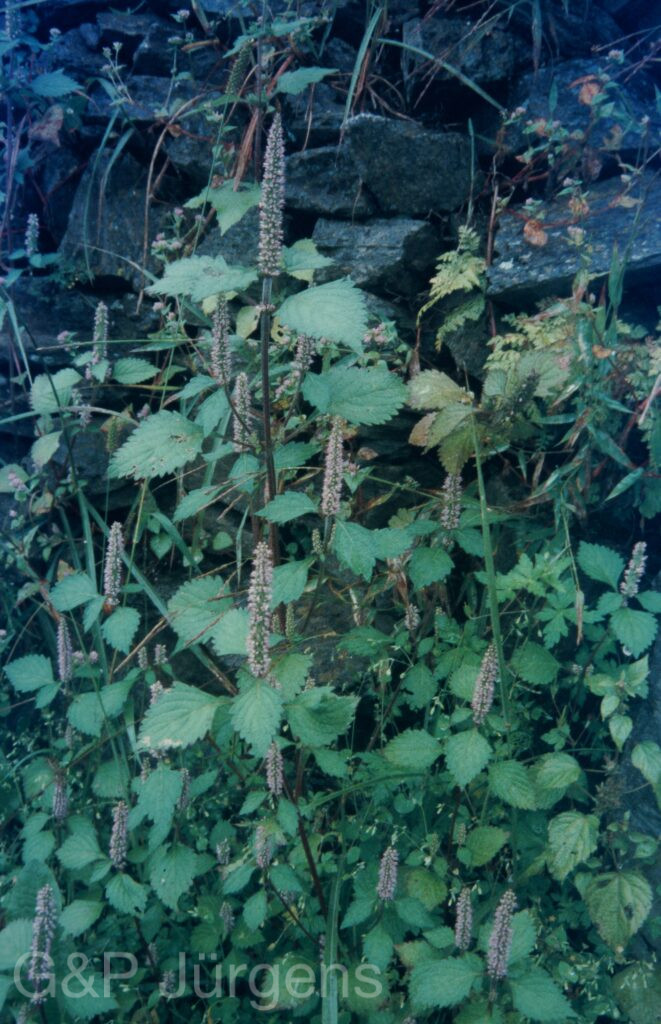
Elsholtzia pilosa is a wide-ranging Asian mint distributed from the Indian Himalaya, Nepal and Bhutan eastward through Bangladesh, Myanmar, Thailand and Vietnam to southern China, with nearly 400 GBIF occurrences indicating it is a frequent component of its region. It is a plant of open, disturbed and seasonally moist ground, growing along forest margins, on grassy banks, in fallow fields, by paths and on damp slopes, often as a weedy colonist of cultivated and waste land. The plant figured from Bora in Garhwal, India, at about 2200 m in September is typical of its montane range of roughly 1500-3000 m, the autumn flowering coinciding with the close of the monsoon.

It is an erect, aromatic annual herb with a quadrangular, usually pilose stem branching from the base. The leaves are opposite, ovate to lanceolate, with a serrate-crenate margin, an acuminate apex and a cuneate base tapering to a slender petiole, sparsely hairy and gland-dotted. The small flowers are crowded into dense, one-sided, spike-like terminal verticillasters, each subtended by a bract; the corolla is purplish to pinkish-white and bilabiate, with the four stamens exserted as in the genus. The calyx is tubular and ribbed, becoming enlarged in fruit and enclosing the four smooth, ovoid nutlets characteristic of the mint family.

The epithet pilosa refers to the soft, spreading hairiness of the herbage. Elsholtzia is a mainly eastern Asian genus of aromatic herbs and subshrubs, several species of which are used medicinally and as flavourings, the essential oils giving the foliage its pungent scent. As a pioneer of disturbed ground, E. pilosa is well adapted to anthropogenic habitats, which accounts for its broad and locally abundant distribution across the Himalaya and southern China.

Author: Benth. · Sources: POWO (Kew), GBIF, Flora of China, Flora of Bhutan, Hooker Flora of British India, Press Labiatae of the Himalaya

Benth.

Bhutan2012 306
Bhutan Shele-La 4100m, October
Bhutan2012 915
Bhutan Tumching-La 4000m, October

Description

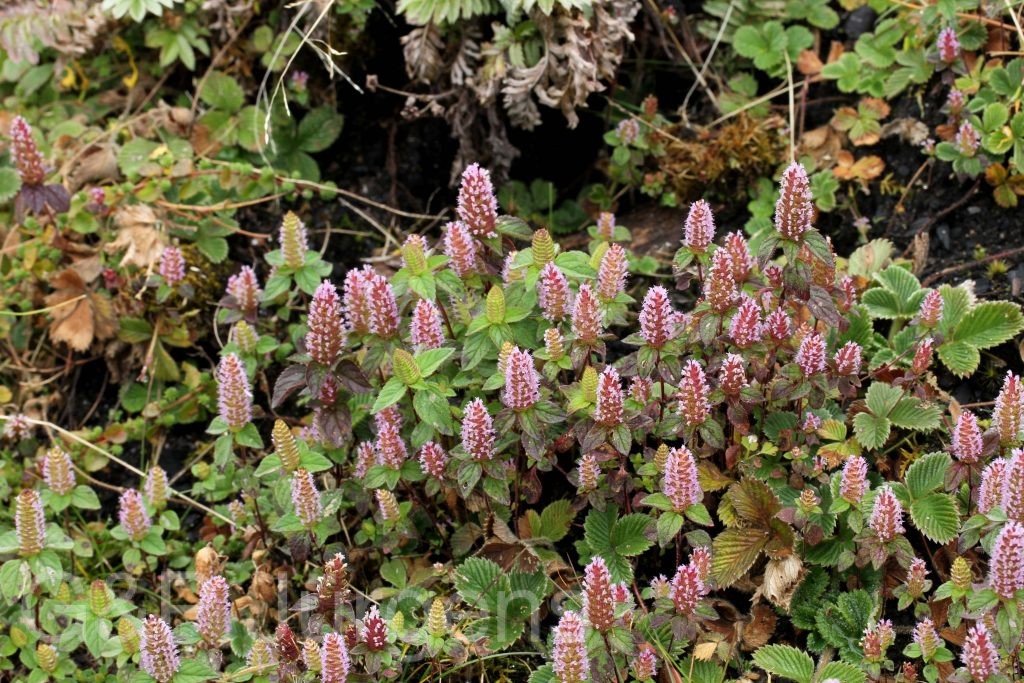
Elsholtzia strobilifera is a high-montane to alpine herb widely distributed across the Sino-Himalayan region, recorded from Nepal, India, Bhutan, Pakistan, Myanmar, China and Taiwan, with some 493 georeferenced occurrences documented in GBIF. It is a plant of open stony slopes, grazed alpine meadows, screes and forest margins, typically between 3000 and 4300 m. The collections illustrated here, from the Bhutanese passes Shele-La at 4100 m and Tumching-La at 4000 m in October, exemplify its characteristic late-season flowering at the upper limits of vegetation, where it often forms part of dwarf-herb communities on disturbed and well-drained substrates.

It is an annual or short-lived herb, usually 5-30 cm tall, with erect or ascending, often purplish, quadrangular stems that are puberulent and frequently branched from the base. The leaves are opposite, ovate to elliptic, shortly petiolate, with crenate-serrate margins and gland-dotted surfaces emitting an aromatic scent when bruised. The inflorescence is a dense, ovoid to shortly cylindrical terminal spike of crowded verticillasters, the conspicuous broad floral bracts giving the cone-like appearance reflected in the epithet. Each tubular, bilabiate corolla is pale violet to pinkish, two-lipped and exserted-stamened; the fruit comprises four smooth, ellipsoid nutlets enclosed in the persistent calyx.

The genus Elsholtzia (Lamiaceae, subfamily Nepetoideae) comprises aromatic herbs and subshrubs centred on eastern Asia, several yielding essential oils. E. strobilifera is among the most cold-tolerant members, ascending higher than most congeners. Its capacity to colonise grazed and physically disturbed alpine ground confers ecological resilience, and it is not regarded as threatened given its broad range and abundance, though high-altitude populations are sensitive to changing grazing regimes and warming treelines.

Author: Benth. · Sources: POWO (Kew), GBIF, Flora of China, Flora of Bhutan, A Revision of the Genus Elsholtzia (Lamiaceae)
(Lindl. ex Wall.) Koord. & Valeton

Bhutan2012 649
Bhutan Tserang 1660m, September

Description

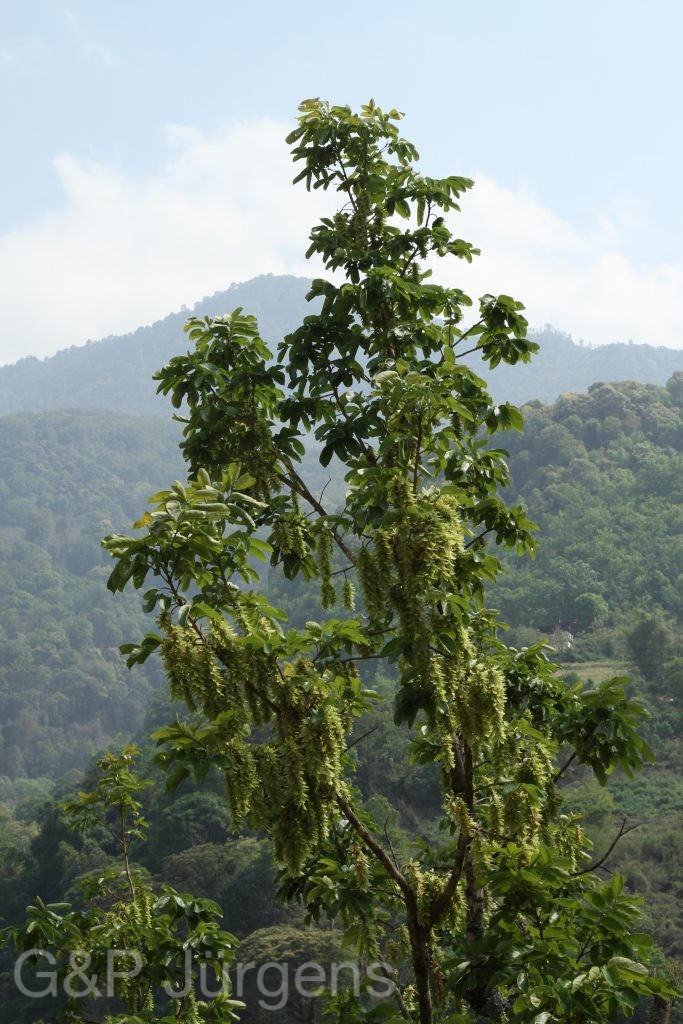
Engelhardia spicata var. colebrookeana is a subtropical tree of the walnut family ranging across the southern Himalaya and into Southeast Asia, with GBIF records from China, India, Nepal, Bhutan, Thailand, Vietnam, Indonesia and the Philippines. It is a component of warm broad-leaved and pine-oak forest, secondary woodland and forest margins, mostly between 800 and 2,000 m. The photographed tree grows at Tserang in southern Bhutan at about 1,660 m in September, when the long, drooping fruiting catkins with their winged nutlets are conspicuous in the subtropical foothill forest.

The plant is a medium-sized to large deciduous or semi-evergreen tree with grey, somewhat fissured bark. The leaves are alternate and pinnately compound, with several pairs of opposite to subopposite, elliptic-oblong, entire leaflets that are glabrous to finely hairy and oblique at the base. The species is monoecious, with slender pendulous catkins; the female flowers develop into a characteristic infructescence in which each small, hard nutlet is subtended by a large, three-lobed, membranous wing-bract that acts as a samara for wind dispersal. This trilobed wing readily distinguishes Engelhardia from its relatives in the family.

Following GBIF, this taxon is treated as a synonym under the accepted name Engelhardia spicata colebrookeana, a variety distinguished from typical E. spicata by indumentum and leaflet characters. The Juglandaceae are an economically and phylogenetically important temperate-to-tropical family, and Engelhardia represents its warm Asian element. The tree is widespread, used locally for timber, fuel and tannin, and is not considered threatened, persisting well in disturbed and secondary forest.

Author: (Lindl. ex Wall.) Koord. & Valeton · Sources: POWO (Kew), GBIF, Flora of China Vol. 4 (Juglandaceae), Grierson & Long: Flora of Bhutan Vol. 1, Manning: The Genera of Juglandaceae

(Kurz) W.E.Manning ex Steenis

Bhutan2014 684
Bhutan Wangdi-Phodrang 2280m, May

Description

Engelhardia spicata var. integra (Kurz) W.E.Manning ex Steenis is a tree of the walnut family, Juglandaceae, native to the subtropical and warm-temperate forests of South and Southeast Asia. GBIF (around 136 occurrences) records the taxon from China, India, Indonesia, the Philippines, Thailand, Bhutan, Vietnam, Myanmar and Nepal, where it forms a component of broad-leaved hill and montane forest, often on forest margins and slopes. It typically occurs in the subtropical mid-montane belt; the tree photographed at Wangdi-Phodrang in Bhutan at 2,280 m in May represents it in early-season flower within this characteristic elevational zone.

Engelhardia spicata is a medium to large deciduous tree with pinnately compound leaves; in var. integra the leaflets are characteristically entire-margined (hence "integra"), distinguishing it from forms with toothed leaflets. The leaflets are opposite to subopposite along the rachis, elliptic to oblong, glabrous to thinly pubescent. The species is monoecious, with flowers borne in long, pendulous catkin-like spikes; the most striking feature is the fruit, a small nutlet subtended by a conspicuous, enlarged, three-lobed membranous wing (an accrescent bract) that develops into a samaroid structure adapted for wind dispersal, the spikes hanging in long tassels at maturity.

The genus Engelhardia (sometimes spelled Engelhardtia) belongs to subfamily Engelhardioideae of the Juglandaceae, a primarily tropical Asian lineage distinguished from the temperate walnuts and hickories by its winged, bract-derived fruits. The wind-dispersed samaras are an important diagnostic and ecological character, enabling the tree to colonise open and disturbed hill forest. As a widespread but variable species, E. spicata has been treated with several infraspecific taxa, of which var. integra is recognised on the basis of its entire leaflet margins.

Author: (Kurz) W.E.Manning ex Steenis · Sources: POWO (Kew), Flora of China Vol. 4, Flora of Bhutan Vol. 1, GBIF, Manning: The genus Engelhardia (Juglandaceae)

(Griff.) C.K.Schneid.

Sikkim2004 377 G654
Sikkim/India Lachung 2900m May
Nepal 1994 259 ergebnis
Ost-Nepal Milka-Danda 2850m May 

Description

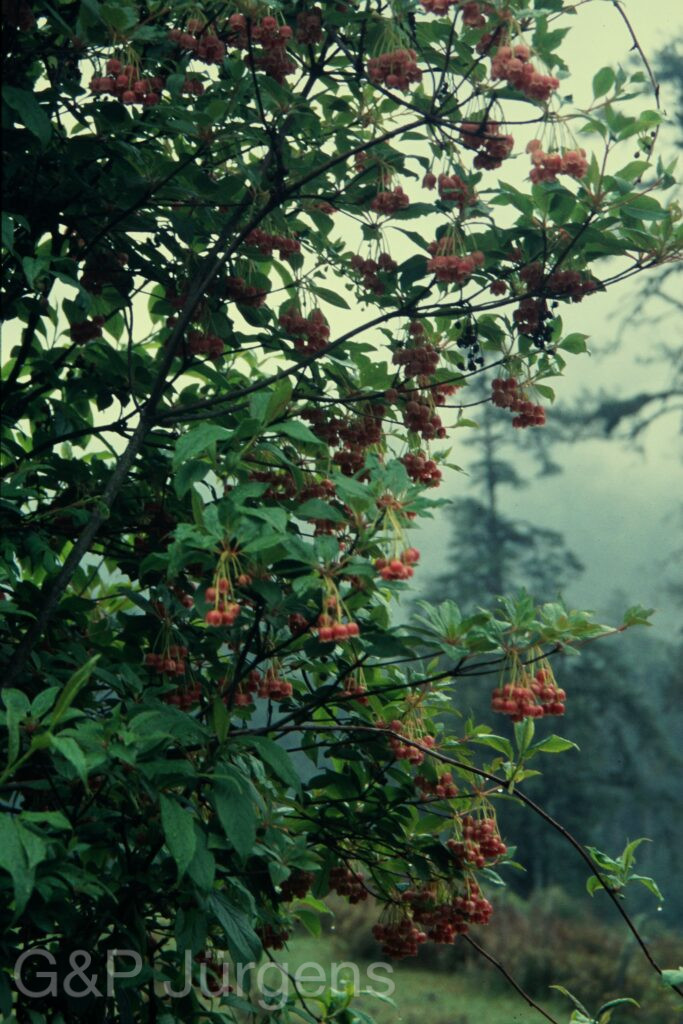
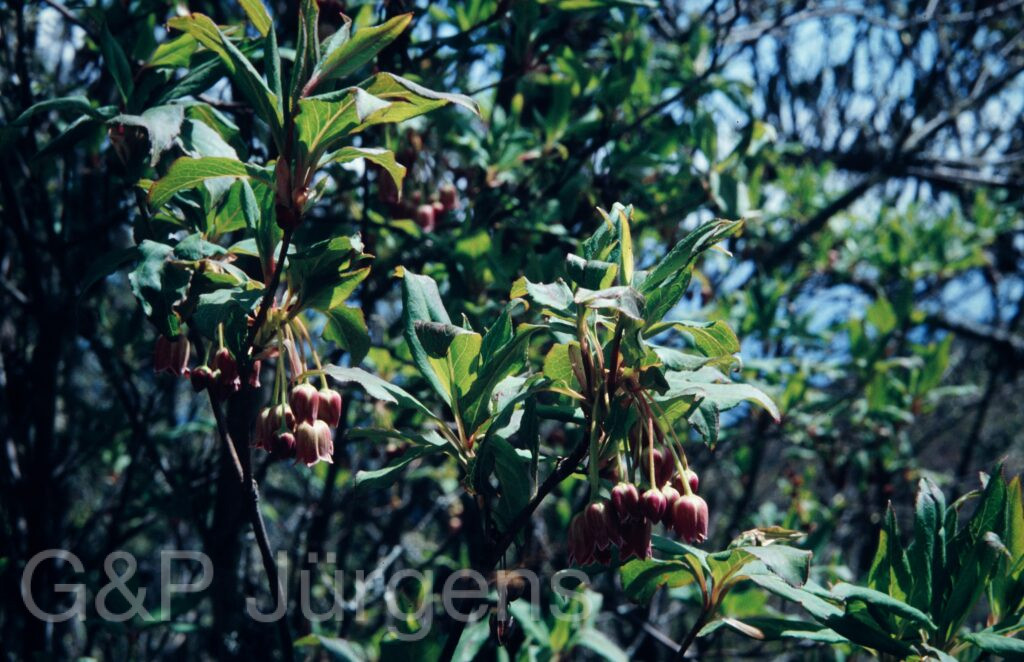
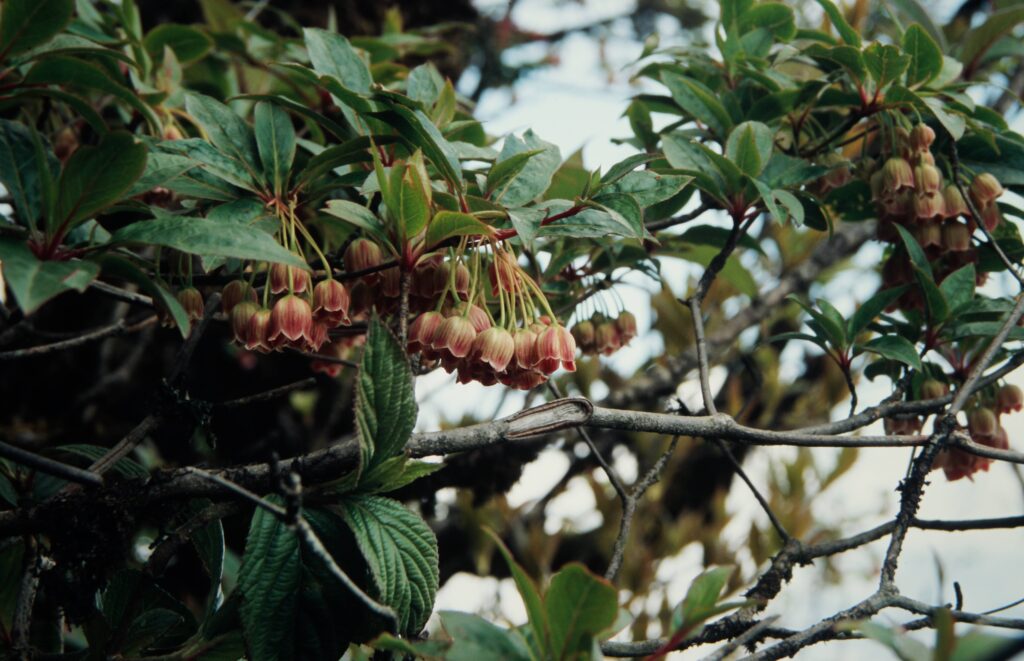
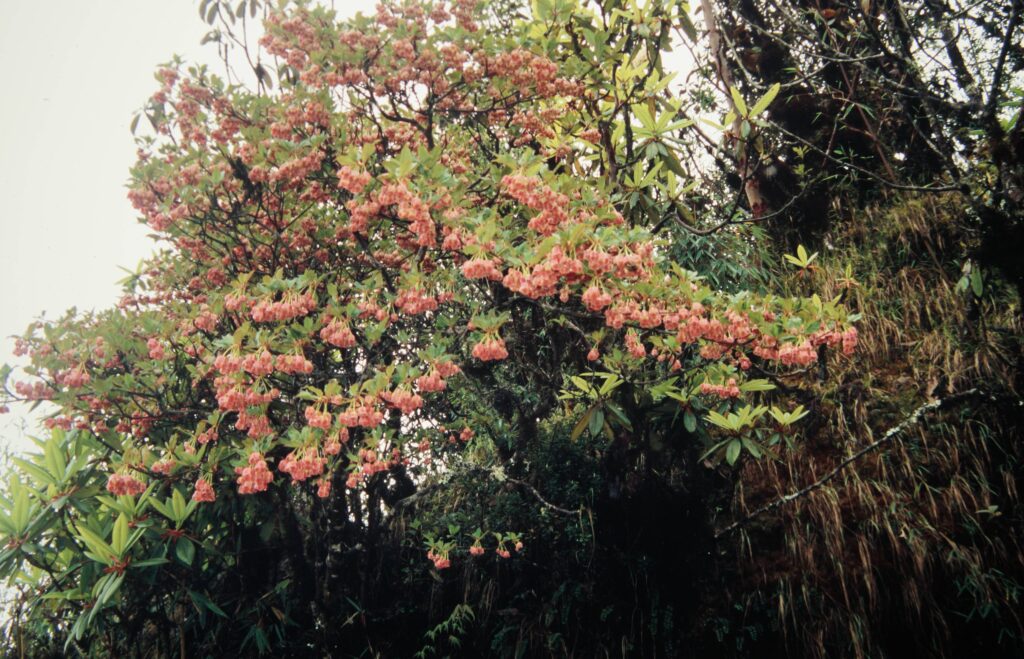
Enkianthus deflexus is a deciduous shrub or small tree of the temperate Himalaya and southwestern China, distributed through China, India, Nepal, Bhutan and Myanmar, and very well documented with around 1667 GBIF records (further records reflect wide cultivation in Europe, North America and East Asia). It forms part of the understorey and forest-margin vegetation of moist temperate forest and Rhododendron-dominated slopes, typically between about 2400 and 3600 m. The cited collections from Lachung in Sikkim (2900 m), Milka Danda in east Nepal (2850 m) and Tonglu in West Bengal (3100 m), all flowering in May, mark its synchronous late-spring anthesis across the cool, humid mid-montane belt.

The species is a many-branched shrub whose leaves cluster toward the ends of the twigs in pseudowhorls; they are obovate to elliptic, finely serrulate, often colouring richly in autumn, and subtended by reddish young growth. The flowers are borne in pendent terminal racemes or umbel-like clusters, each on a slender, often reflexed pedicel (whence deflexus). The corolla is campanulate, creamy to yellowish suffused with red veining, with five short recurved lobes; ten stamens are enclosed within. The fruit is an erect, dehiscent woody capsule on the recurving pedicel, releasing small winged or angled seeds.

Enkianthus is an early-diverging genus of the Ericaceae, sister to much of the rest of the family, and its bell-shaped, nectar-bearing flowers are pollinated by bees and other insects. E. deflexus is valued horticulturally for its dainty blossoms and brilliant autumn foliage, explaining its broad cultivated footprint. Within its native range it is common and not of conservation concern, a characteristic and widespread component of Himalayan temperate forest understoreys.

Author: (Griff.) C.K.Schneid. · Sources: POWO (Kew), GBIF, Flora of Bhutan, Flora of China (Ericaceae), Stevens Revision of Enkianthus

(Grierson & D.G.Long) Panigrahi

Nepal 97 51 P77
Nepal Mewa-Khola 1130m April
Nepal 97 50 P76
Nepal Mewa-Khola 1130m April

Description

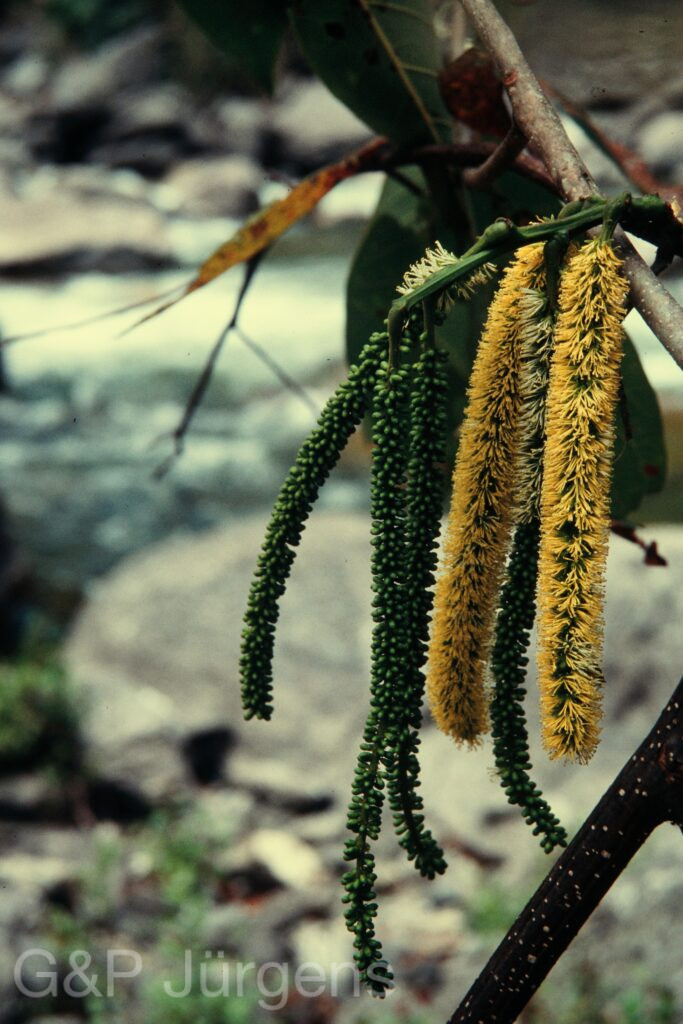
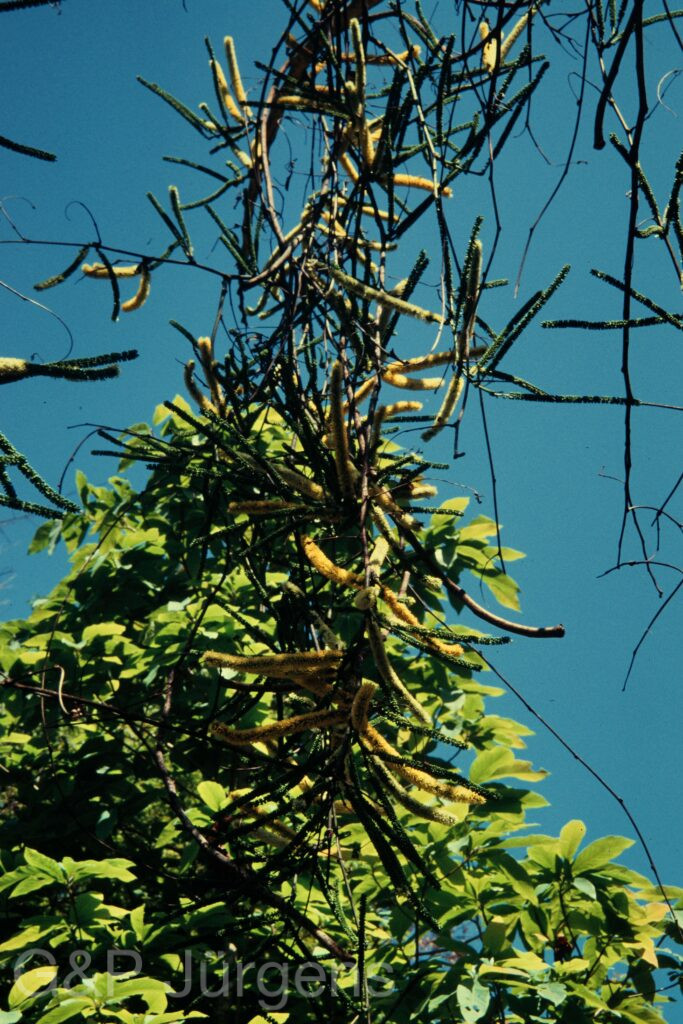
Entada rheedii subsp. sinohimalensis is a Sino-Himalayan liana of warm lower-montane forest, treated by GBIF as a synonym of the accepted Entada rheedii sinohimalensis (under E. rheedii Spreng.). It is a localised eastern Himalayan taxon ranging from Nepal and Sikkim into Bhutan and adjacent China and Myanmar; GBIF holds a single Bangladesh record, underscoring how sparsely this giant climber is documented. It grows in broadleaved subtropical forest and ravine vegetation at low elevations, as in the Mewa Khola of eastern Nepal at 1130 m in April, where it scrambles high into the canopy along humid river valleys.

It is a massive woody liana with stout, twining stems and tendrillate, bipinnate leaves whose pinnae bear several pairs of asymmetric oblong leaflets, the terminal pair of pinnae often modified into a coiling tendril. The flowers are small, sessile and crowded in slender elongate spikes, creamy white to greenish-yellow, with a five-toothed calyx, five free petals and ten exserted stamens giving the inflorescence a feathery aspect. The fruit is among the largest of any legume – a huge, woody, flattened pod up to a metre long that breaks transversely into one-seeded segments, each enclosing a large, hard, glossy brown "sea bean" capable of long-distance hydrochory.

Within the mimosoid clade of Fabaceae, Entada is a pantropical genus of lianas, and subsp. sinohimalensis represents the inland Himalayan-Chinese expression of the widespread E. rheedii. The buoyant, durable seeds are dispersed by water and ocean currents and are used as charms and in folk medicine. The taxon is rarely collected and its conservation status remains unassessed.

Author: (Grierson & D.G.Long) Panigrahi · Sources: POWO (Kew), GBIF, Flora of China, Flora of Bhutan, Annotated Checklist of the Flowering Plants of Nepal, Brenan monograph of Entada

Wall. ex  Klotzsch & Garcke

Nepal 99 7 ergebnis
Westnepal, Jumla 2300m June

Description

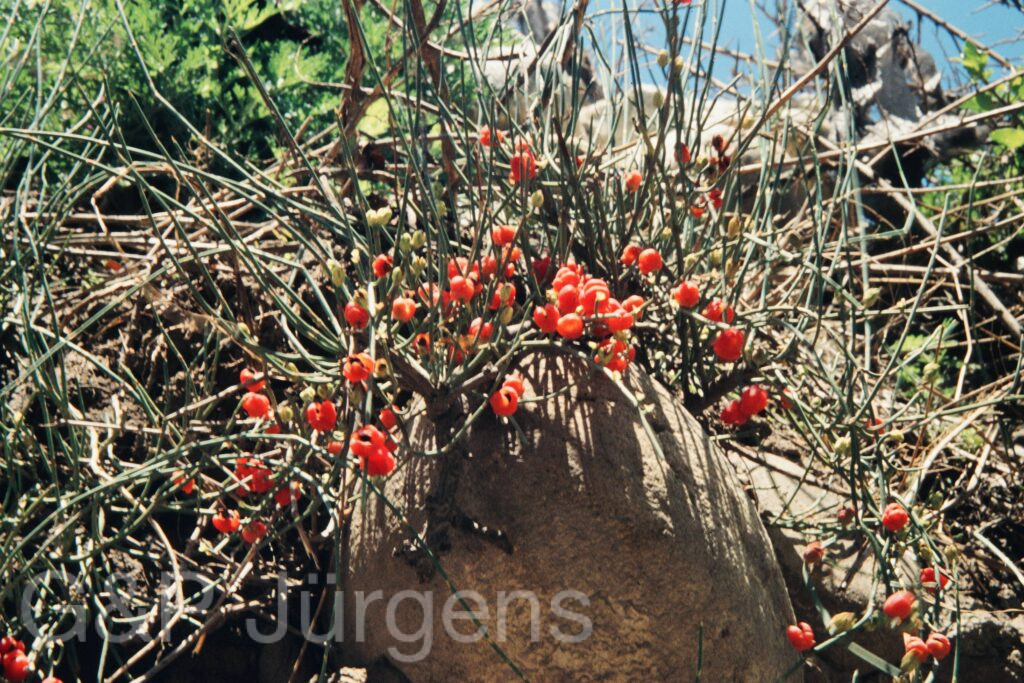
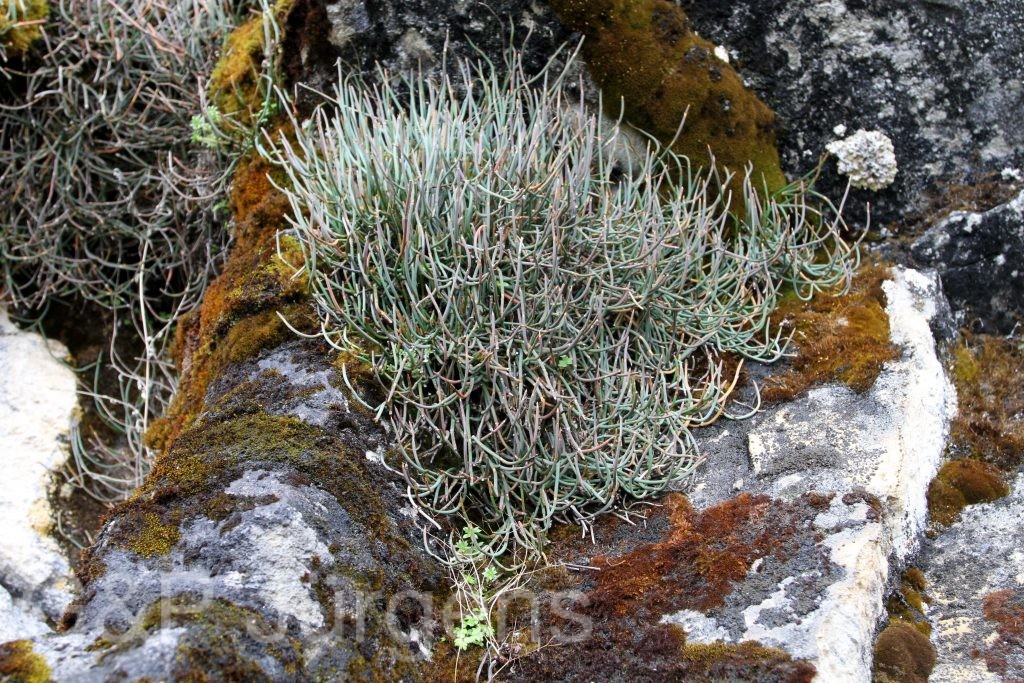
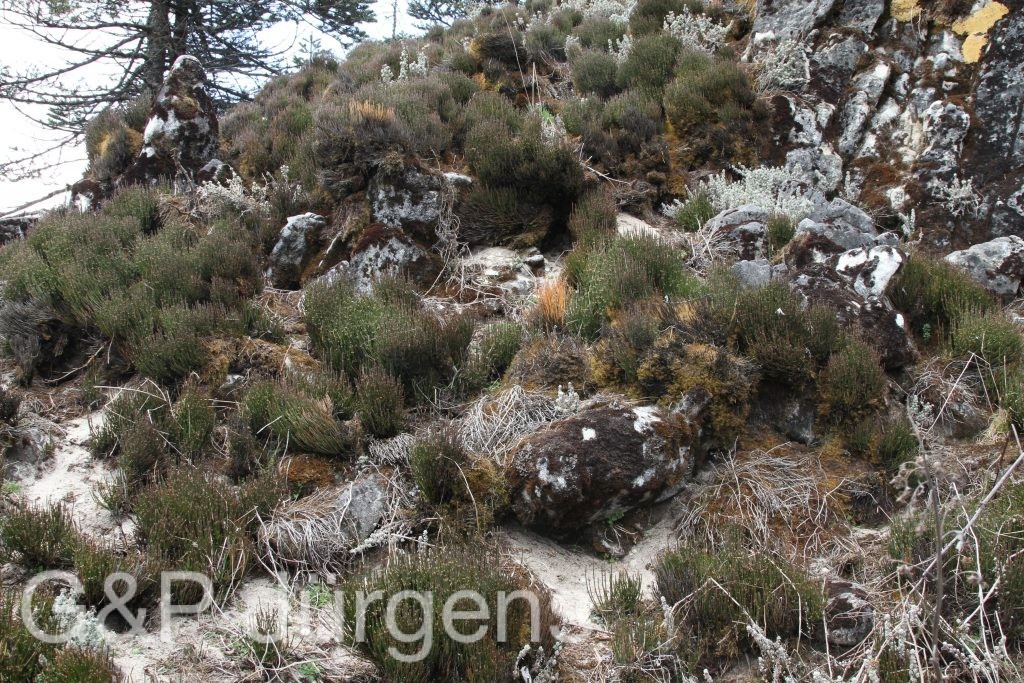
Ephedra gerardiana is a dwarf gymnosperm shrub of the high mountains of central and southern Asia, native across China, Nepal, India, Pakistan, Afghanistan, Bhutan, Tajikistan and Kyrgyzstan; its roughly 539 GBIF occurrences cluster along the Himalaya and the Tibetan plateau margins. It is a plant of dry, cold, high-elevation environments, as recorded near Jumla in West Nepal at about 2300 m in June, and ascends well above the treeline into the alpine and steppe zone. It thrives on stony slopes, gravel terraces and dry riverbeds, tolerating intense insolation, drought and winter cold in the rain-shadow valleys of the inner Himalaya.

The plant is a low, densely tufted, mat-forming shrublet with rigid, jointed, green photosynthetic stems that perform the work of the much-reduced, scale-like leaves borne in pairs at the swollen nodes. As a gymnosperm it bears no true flowers; reproductive structures are small cones, the plants typically dioecious, with pollen in axillary microsporangiate cones and ovules in compact megasporangiate cones. After pollination the female bracts become fleshy and bright red, forming a berry-like structure enclosing one or two seeds, dispersed by birds.

Ephedra is the sole genus of Ephedraceae within the gnetophytes, an isolated lineage of seed plants; E. gerardiana is the principal Himalayan species and a traditional source of the alkaloid ephedrine, harvested medicinally as somlata. This value, combined with slow growth and harsh, slowly regenerating habitats, has made wild populations locally vulnerable to over-collection and grazing, prompting conservation attention in parts of its range even though the species remains widespread overall.

Author: Wall. ex  Klotzsch & Garcke · Sources: POWO (Kew), GBIF, Flora of China Vol. 4, Flora of Pakistan, Flora of Nepal, Monograph of the Genus Ephedra (Stapf)

Stapf.

BhutanPG2011 338
Bhutan Jule-Tso 4250m, June
Bhutan2014 937
Bhutan Chele-La 4100m, May
Sikkim2003 522 P727
Sikkim Yume Samdong 4700m August

Description

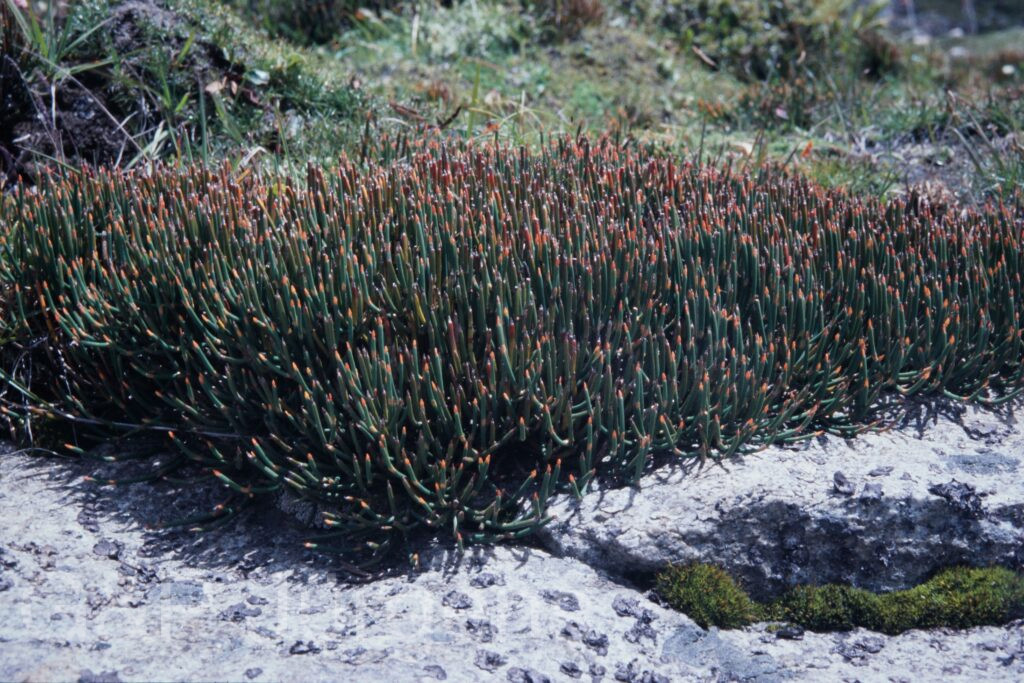
Ephedra gerardiana var. sikkimensis is a high-alpine gymnosperm shrublet of the Himalaya and Tibetan plateau margins, recorded from China, Bhutan, India and Nepal, with the species complex widely held in cultivation across Europe and North America. It is a plant of dry, exposed, stony alpine slopes, gravel flats, moraine and rocky pasture in the arid trans-Himalayan and high-alpine zone, characteristically between about 3500 and 5000 m. The cited collections from Jule-Tso (4250 m) and Chele-La (4100 m) in Bhutan and Yume Samdong in Sikkim at 4700 m exemplify its occurrence at the very upper limits of vascular plant growth, on wind-swept, well-drained, frost-exposed ground.

The plant is a low, densely tufted, mat-forming or cushion shrublet with slender, jointed, longitudinally grooved green branchlets that perform photosynthesis, the true leaves reduced to small connate scales at the nodes. Like all Ephedra it is dioecious and non-flowering: pollen is borne in small ovoid male strobili, while the female cones, after fertilisation, develop fleshy red, berry-like seed cones enclosing one or two seeds, an adaptation to bird dispersal in an otherwise austere environment.

The epithet sikkimensis denotes the type region in the eastern Himalaya, var. sikkimensis being a high-elevation segregate of the polymorphic E. gerardiana. Members of this genus are notable sources of ephedrine alkaloids and have a long history of medicinal and ritual use. As pioneers of stabilised scree and moraine, these dwarf shrubs are ecologically important in fragile alpine systems; though not currently threatened, harvesting and climate-driven habitat shifts warrant monitoring.

Author: Stapf. · Sources: POWO (Kew), GBIF, Flora of China Vol. 4, Flora of Bhutan Vol. 1, Flora of Nepal, A Monograph of the Genus Ephedra (Stapf)

Hausskn.

Sikkim2003 213 G297
Sikkim Dzongri 3900m, August

Description

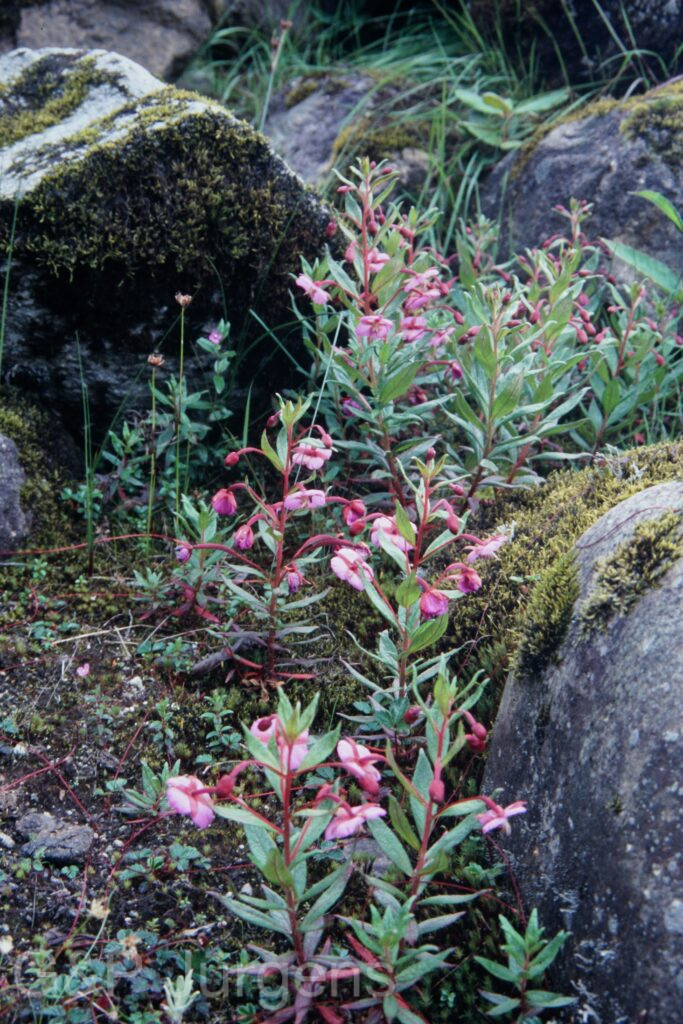
Epilobium conspersum is a perennial herb of the Sino-Himalayan and East Asian mountains, distributed through southwestern China, Nepal, northern India, Myanmar, Bhutan and Japan, with introduced records in the United States; GBIF documents about 134 occurrences. It is a plant of moist, open subalpine and alpine habitats such as stream banks, wet meadows and gravelly flushes, typically between about 3000 and 4200 m. The photographed plant was collected at Dzongri in western Sikkim at around 3900 m in August, on the cool, wet ground this willowherb favours during the monsoon. In GBIF the name carries the status SYNONYM, while Epilobium conspersum is here recognised as the accepted name for this Himalayan material.

The plant produces erect to ascending stems from a perennating base that overwinters by leafy rosettes or short turions. The leaves are opposite below and alternate above, sessile or shortly petiolate, lanceolate to ovate, with a toothed margin, the stems often finely hairy in lines. The flowers are borne in the upper leaf axils; as in the genus they have an inferior, elongate ovary, four notched pink to rose-purple petals, four sepals and eight stamens. The fruit is a long, slender, four-valved capsule that splits to release numerous seeds, each bearing a silky coma for wind dispersal.

Epilobium (Onagraceae) is a large temperate and cold-region genus in which the comose seeds and elongate capsular fruit are diagnostic. The Himalayan species form a taxonomically intricate group, and the synonymy reflected in the GBIF status underscores their nomenclatural complexity. Widespread along its moist alpine corridor, the species is not considered threatened.

Author: Hausskn. · Sources: POWO (Kew), GBIF, Flora of China Vol. 13, Flora of Bhutan Vol. 2, Flora of Nepal, Flora of Pakistan, Raven monograph of Old World Epilobium