Boiss.
Description
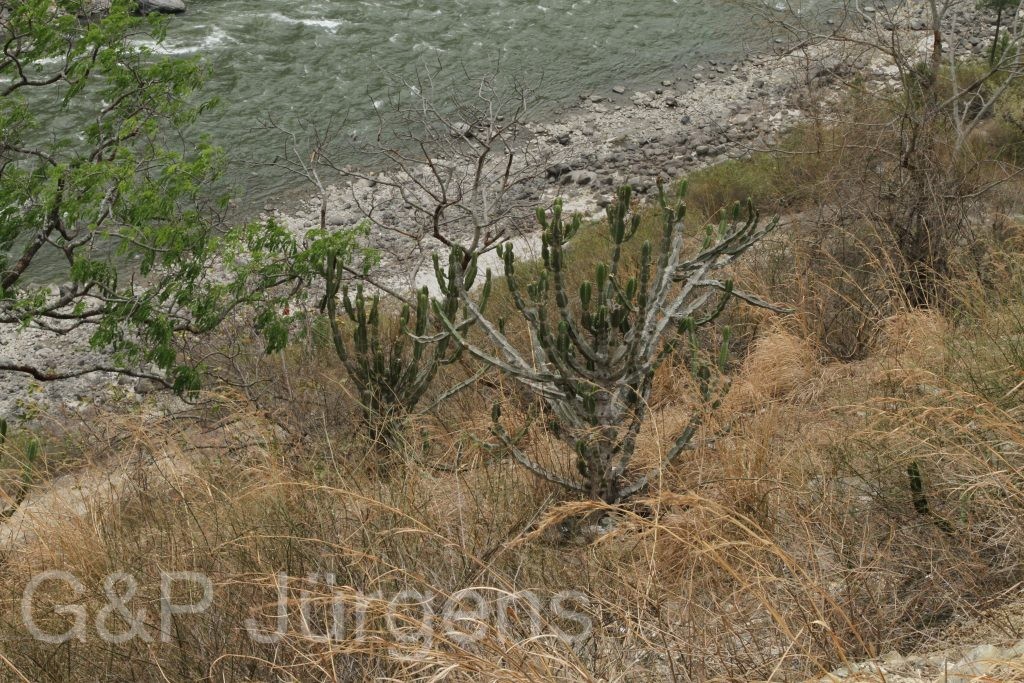
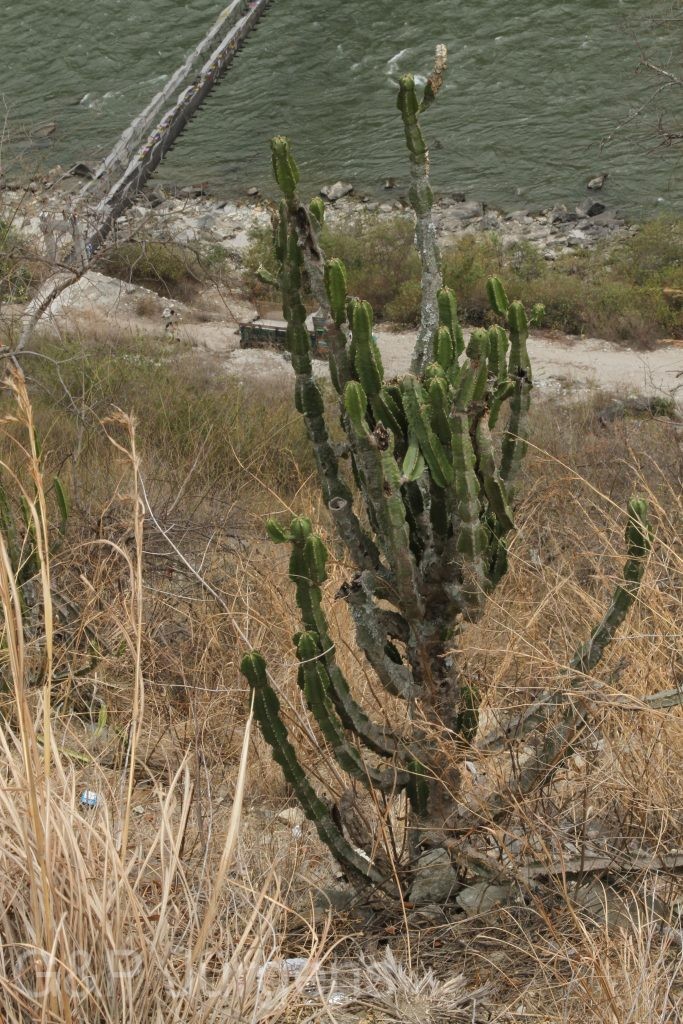
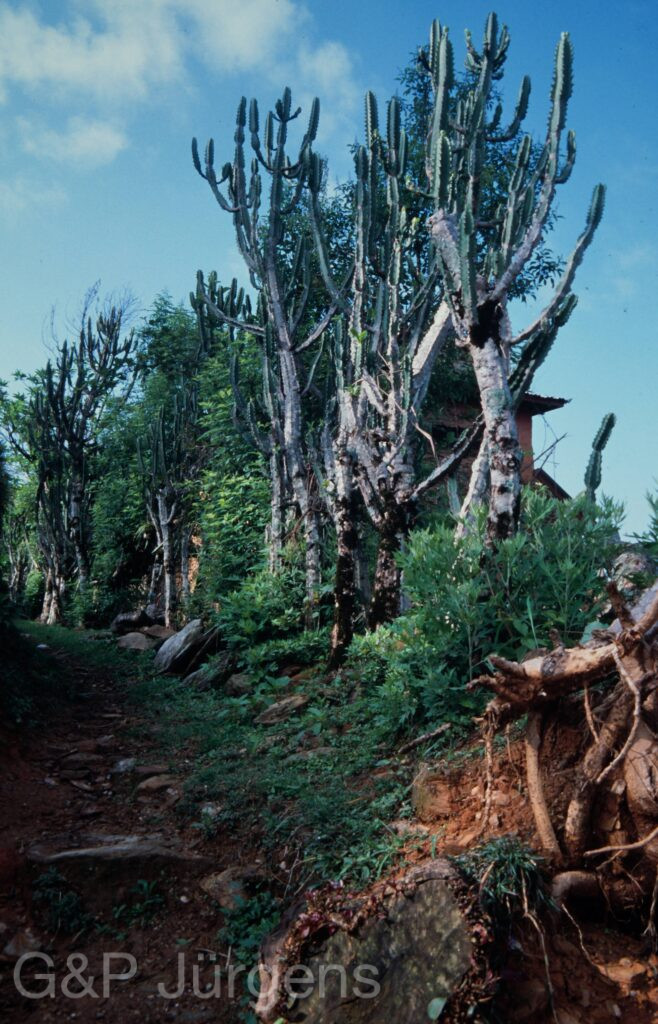
Euphorbia royleana is a succulent, tree-like spurge of warm, dry valleys across the Himalaya and adjacent regions. With 148 GBIF occurrences, it ranges through Nepal, India, China, Pakistan and Bhutan, with cultivated or introduced records noted elsewhere including Belgium, Egypt and the United States, reflecting its use as an ornamental and hedge plant. It is characteristic of hot, semi-arid slopes, rocky hillsides and degraded scrub in the subtropical to lower temperate zone, often on south-facing rain-shadow exposures. It was recorded at Trashyangtse in Bhutan at about 2100 m and at Mulabari in Gorkha, Nepal, at about 1340 m, both in May.
It is a stout, cactus-like succulent shrub or small tree with a short woody trunk and erect, candelabriform branches that are fleshy, grey-green and obtusely five- to seven-angled. Paired, short stipular spines arise on the angles, subtending small, fugacious leaves clustered near the branch tips. As in all Euphorbia the inflorescence is a cyathium: cup-like involucres bearing nectar glands enclose the reduced unisexual flowers, here borne in small cymose clusters and yielding the abundant caustic white latex typical of the genus. The fruit is a three-lobed capsule splitting into three mericarps.
Euphorbia (Euphorbiaceae) is among the largest of all plant genera, and E. royleana belongs to its succulent, xerophytic Old World element adapted to seasonal aridity. Long valued in the region for living fences and traditional medicine, it is widely planted, and its milky latex is irritant and toxic. The species is not of conservation concern, being common and frequently cultivated, but it is an important structural and biogeographic component of dry inner-Himalayan valley vegetation.
Author: Boiss. · Sources: POWO (Kew), GBIF, Flora of China, Flora of Pakistan, Annotated Checklist of the Flowering Plants of Nepal, Boissier's monograph of Euphorbia in de Candolle's Prodromus