
(R.Br. ex Griff.) R.W.Br.
Description
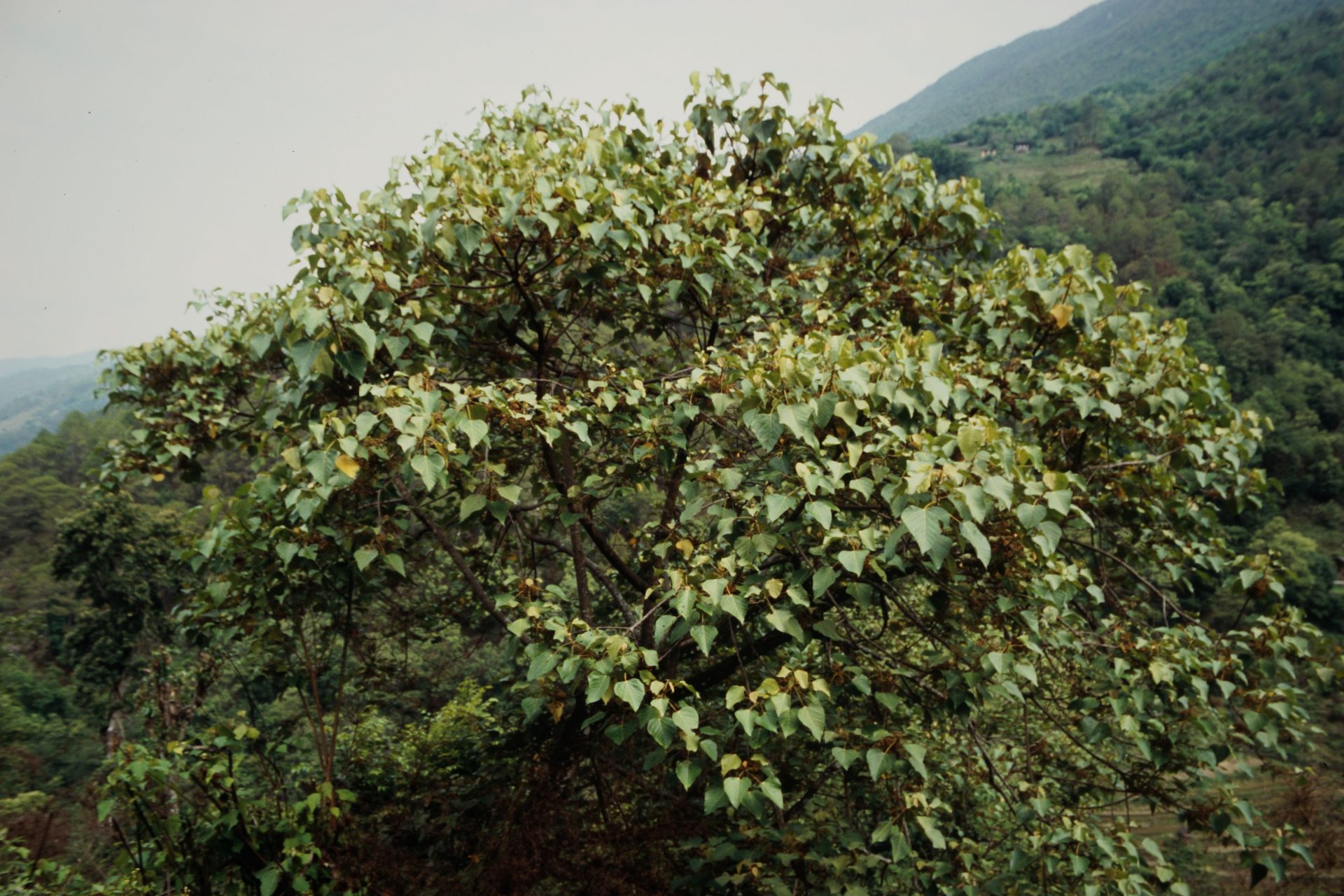
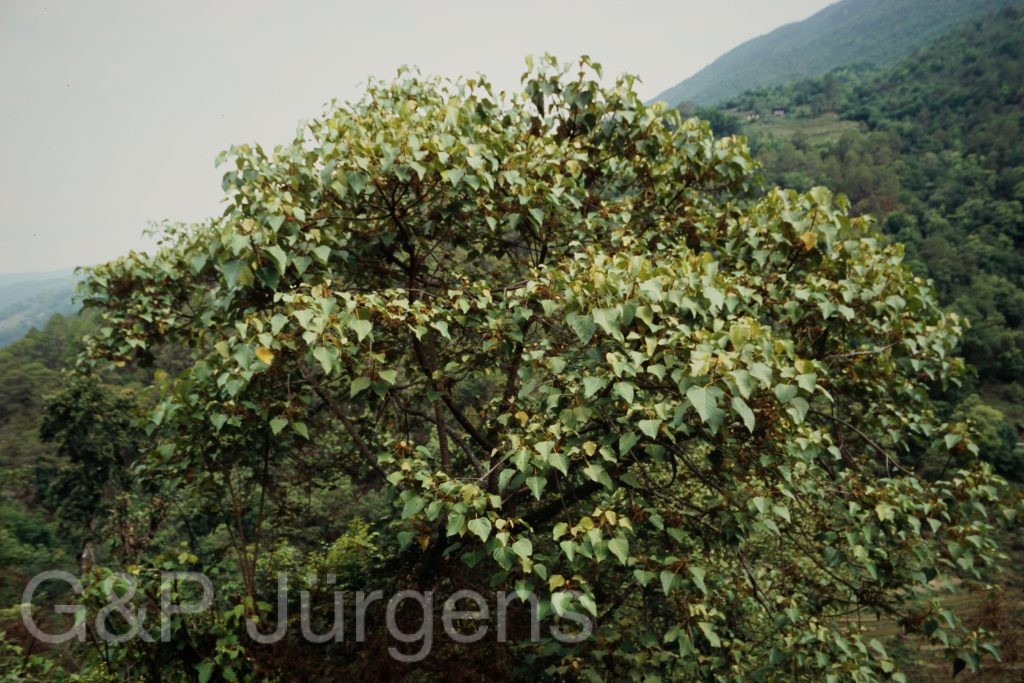
Exbucklandia populnea is an evergreen tree of the family Hamamelidaceae, distributed through the eastern Himalaya and into Southeast Asia. GBIF records document its presence in China, India, Bhutan, Nepal, Myanmar, Thailand, Laos, Vietnam, Malaysia, Indonesia and Sri Lanka, defining a broad Sino-Himalayan to Indo-Malayan range. It is a tree of moist, montane evergreen broad-leaved forest, often locally dominant in mid-elevation forest and on ridge crests, typically between about 1,000 and 2,500 m. The individual illustrated near Wangdue Phodrang (Wangdi) in Bhutan at around 1,700 m in June is characteristic of this humid mid-montane forest belt.
The species is a tall tree reaching 20–30 m with a straight bole and smooth grey bark. The leaves are alternate, long-petiolate, with broadly ovate, palmately three- to five-veined, often shallowly lobed blades reminiscent of a poplar, hence the epithet populnea; they are leathery and glabrous, with the petiole bearing conspicuous, large, paired stipules that sheath the bud and leave an annular scar on falling. The flowers are small, apetalous and aggregated into dense, rounded, capitate heads, the heads themselves grouped on a common axis; each head bears stamens and bicarpellate ovaries. The fruit is a woody capsule, several aggregated into a globose head, dehiscing to release small winged seeds.
The genus Exbucklandia is an isolated member of the relictual, largely Asian family Hamamelidaceae, a group of considerable phylogenetic interest in understanding early angiosperm woody lineages. The conspicuous stipules and capitate, apetalous inflorescences are diagnostic. The timber is locally used in construction and the species is an important canopy component of eastern Himalayan evergreen forest. Though widely distributed and not globally threatened, its montane forest habitat is locally subject to logging and conversion.
Author: (R.Br. ex Griff.) R.W.Br. · Sources: POWO (Kew), GBIF, Flora of China Vol. 9, Flora of Bhutan Vol. 1, Flora of Nepal, Endress: Hamamelidaceae and adjacent families