Mill.
Description
Ageratum houstonianum Mill. is native to Mexico and Central America but is now a widely naturalised tropical and subtropical weed; GBIF records over 25,000 occurrences spanning Mexico, the United States, China, Taiwan, Hong Kong, Nepal, India, South Africa, Tanzania, Malawi and much of western and central Europe. It colonises waste ground, roadsides, field margins, ditches and clearings, particularly in moist, disturbed habitats. The record from the Tista valley in Sikkim at 1800 m in June reflects its thorough naturalisation in the lower Eastern Himalaya, where it flowers through the warm, humid monsoon season.
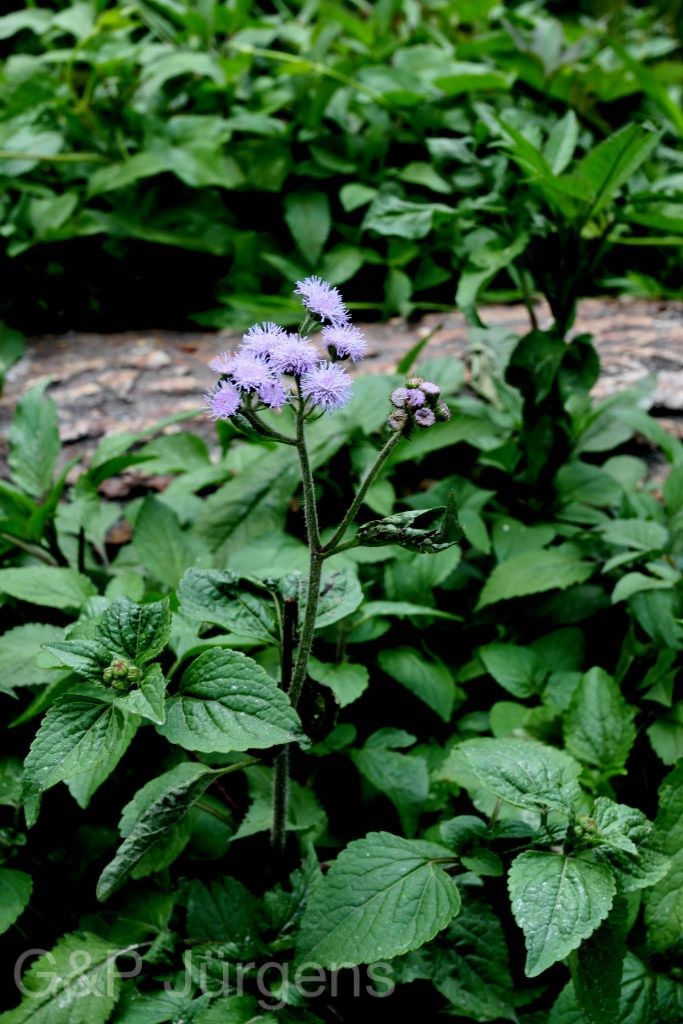
It is an erect to ascending annual herb with stems clothed in spreading, often viscid hairs. The leaves are mostly opposite, ovate to deltoid, with a crenate-serrate margin, a truncate to cordate base and conspicuous palmate venation, and are softly pubescent. The small capitula are aggregated in dense, flat-topped corymbs; each head is wholly discoid, lacking ray florets, with an involucre of narrow phyllaries and numerous blue, lavender or occasionally white tubular florets whose long, exserted styles give the inflorescence a characteristic fluffy texture. The fruit is a black, five-angled cypsela bearing a pappus of awned scales.
Widely grown as the ornamental "floss flower", A. houstonianum has escaped cultivation throughout the warmer world and is regarded as an invasive weed in parts of Asia, Africa and Australia; like its relatives it contains pyrrolizidine alkaloids and is toxic to livestock. It is of no conservation concern and is instead managed as a weed.
Author: Mill. · Sources: POWO (Kew), GBIF, Flora of China, Flora of North America, Johnson revision of Ageratum