
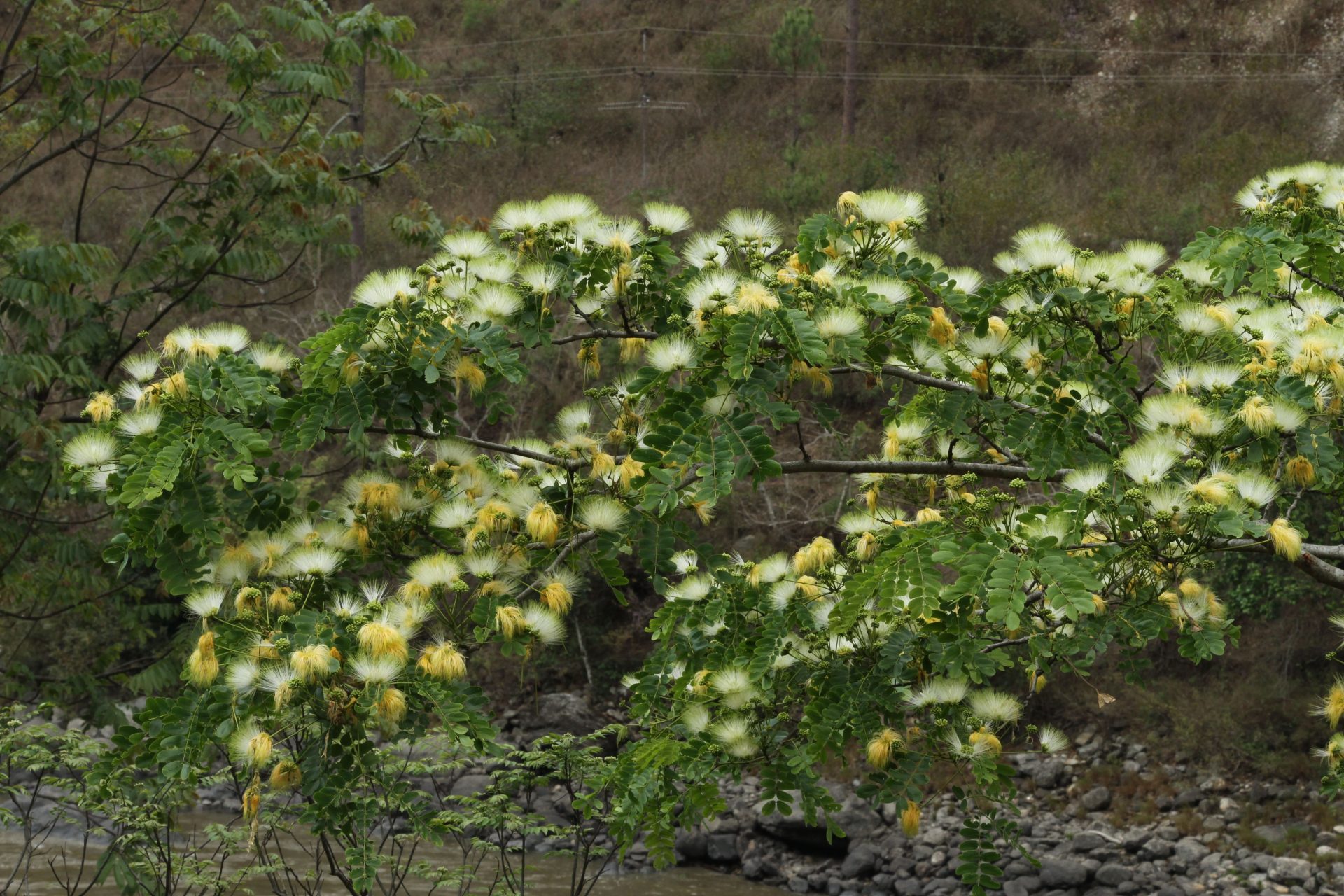
(L.) Benth.
Description
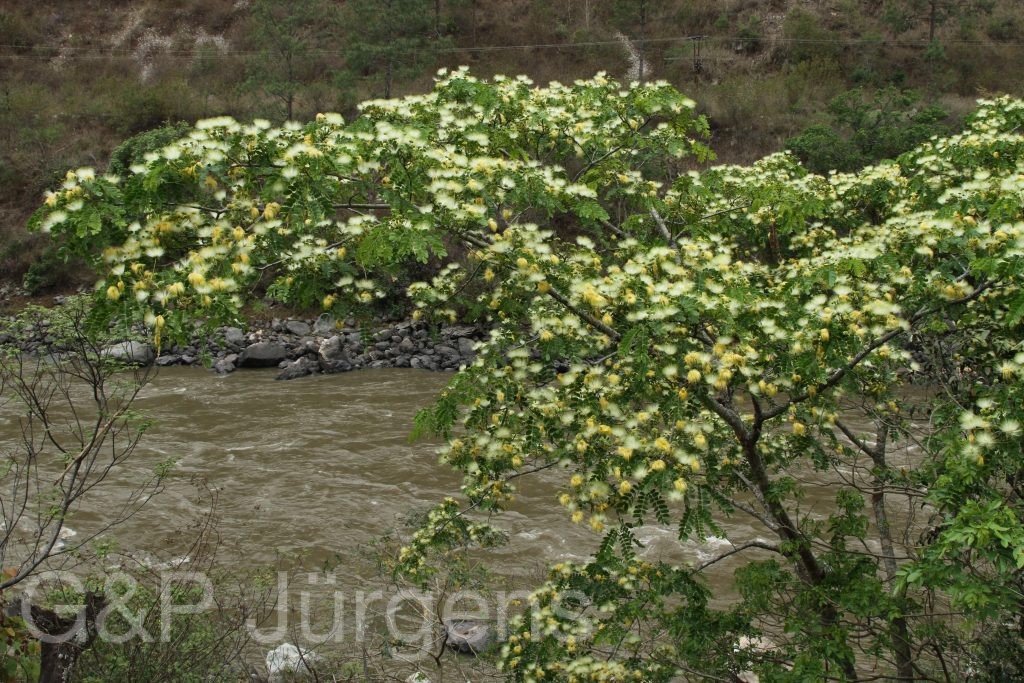
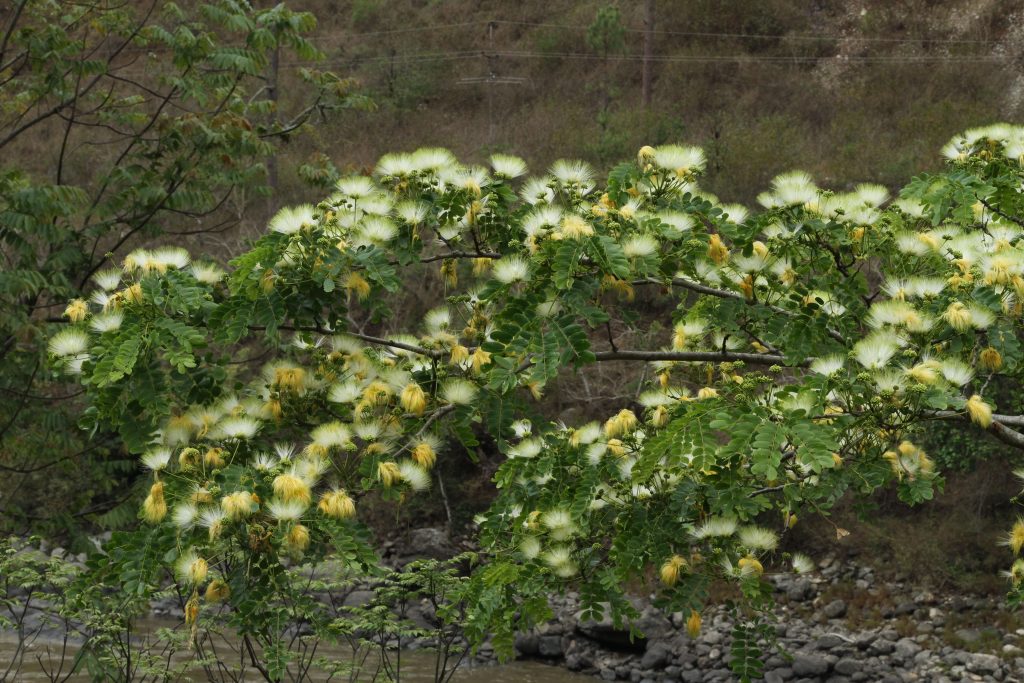
Albizia lebbeck is a fast-growing tropical tree native to the Indian subcontinent and tropical Asia but now pantropically naturalised, as its 13,114 GBIF occurrences from India, Australia, Brazil, Mexico, the United States, Madagascar, Nigeria and many other countries attest. It occupies open woodland, savanna, riverbanks, roadsides and disturbed ground from the lowlands to about 1800 m, and is widely planted for shade, timber and fodder. The photographed tree was recorded in Bhutan along the Karu-Chu at about 1800 m in May, near the upper limit of its altitudinal range in the warm Himalayan foothills.
It is a deciduous tree to 15-25 m with a spreading, flat-topped crown and grey, fissured bark. The leaves are bipinnate with 2-4 pairs of pinnae, each bearing 4-9 pairs of oblong, asymmetric leaflets, and a conspicuous gland on the petiole. The flowers are massed in showy, hemispherical axillary heads, each flower with a small calyx and corolla but numerous long, greenish-white to cream stamens fused below into a tube, giving a powder-puff appearance and a sweet fragrance. The fruit is a flat, straw-coloured, papery legume 15-30 cm long, persisting on the tree and rattling in the wind, containing several flattened seeds.
A member of the Fabaceae (subfamily Caesalpinioideae, mimosoid clade), Albizia lebbeck fixes nitrogen through root nodules and is valued in agroforestry, though it behaves as an invasive weed in parts of the Neotropics, Australia and Pacific islands. Pollination is by insects and birds attracted to the nectar-rich stamen brushes, and the buoyant pods aid wind and water dispersal. It is of least concern and globally abundant.
Author: (L.) Benth. · Sources: POWO (Kew), GBIF, Flora of British India, Flora of Bhutan, Nielsen Monograph of Asian Albizia