Tag:

Nepal

Flowers of Nepal — 1313 wild plant species documented from the Nepalese Himalaya, from subtropical foothills to high alpine meadows above 4,000 m. Nepal’s dramatic elevation gradient makes it one of the richest botanical regions on Earth, home to rhododendrons, primulas, gentians and the famed blue poppies (Meconopsis). Every entry gives a botanical description, native distribution, habitat and flowering season, alongside the original field photograph and the location where it was taken.

(D.Don) Hochr.

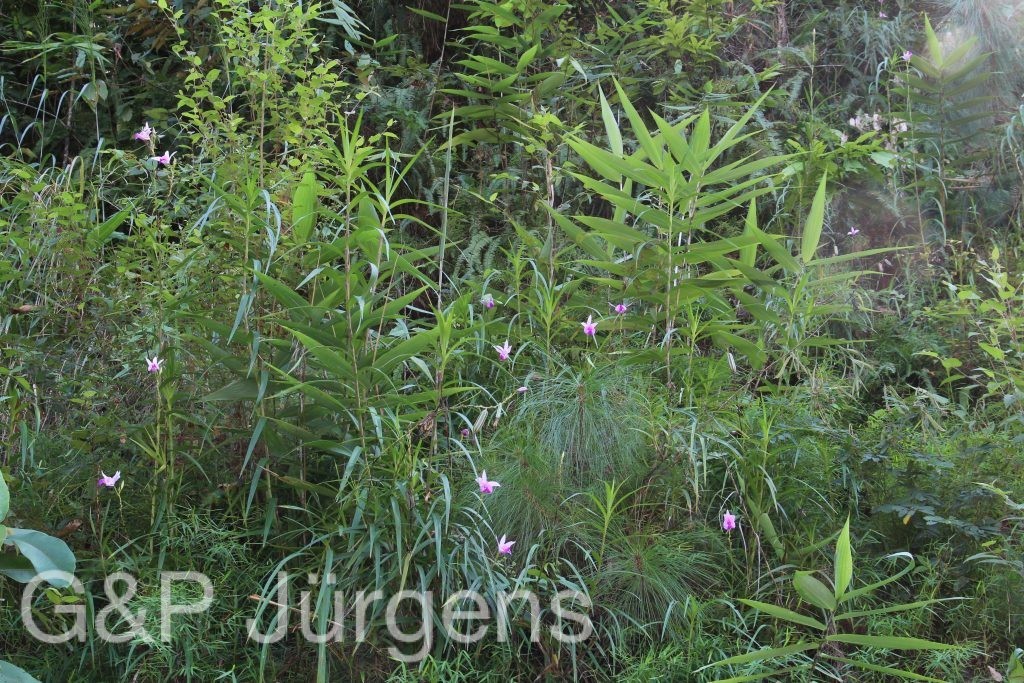
Bhutan2012 523
Bhutan Wangdi Phodrang 2400m, September
Bhutan2015 247
Bhutan Zhemgang 1000m, October

Description

Arundina graminifolia, commonly known as the bamboo orchid, is a robust terrestrial species with a remarkably wide distribution from the Himalayas (Nepal, India, Bhutan) through Southeast Asia to southern China, the Malay Archipelago, and the Pacific Islands. It has become naturalised in parts of tropical America, Hawaii, and the Caribbean. In the Himalayas, it grows on exposed banks, road cuttings, landslide scars, and open grasslands at 200–2,800 m elevation, favoring well-drained, acidic soils with good light exposure.

The plant forms dense clumps of erect, reed-like stems 60–150 cm tall, bearing linear-lanceolate, grass-like leaves 10–20 cm long that are arranged distichously. Flowers are produced terminally, 5–8 cm across, resembling small Cattleya blooms: the sepals and petals are white to pale pink, while the lip is deep rose-purple with a tubular base and a broad, ruffled apical lobe. Flowers open successively over an extended period, with individual blooms lasting only 2–3 days. In the eastern Himalayas, flowering peaks from August to November.

Arundina graminifolia is one of very few orchids that thrives as a pioneer species on disturbed ground. Its wide ecological amplitude and capacity for rapid colonisation are facilitated by its production of numerous wind-dispersed seeds. The species exhibits considerable morphological variation across its vast range, and several subspecific taxa have been proposed.

Author: (D.Don) Hochr. · Sources: POWO (Kew), Flora of Bhutan Vol. 3, GBIF, Seidenfaden: The Orchids of Indochina (1992)
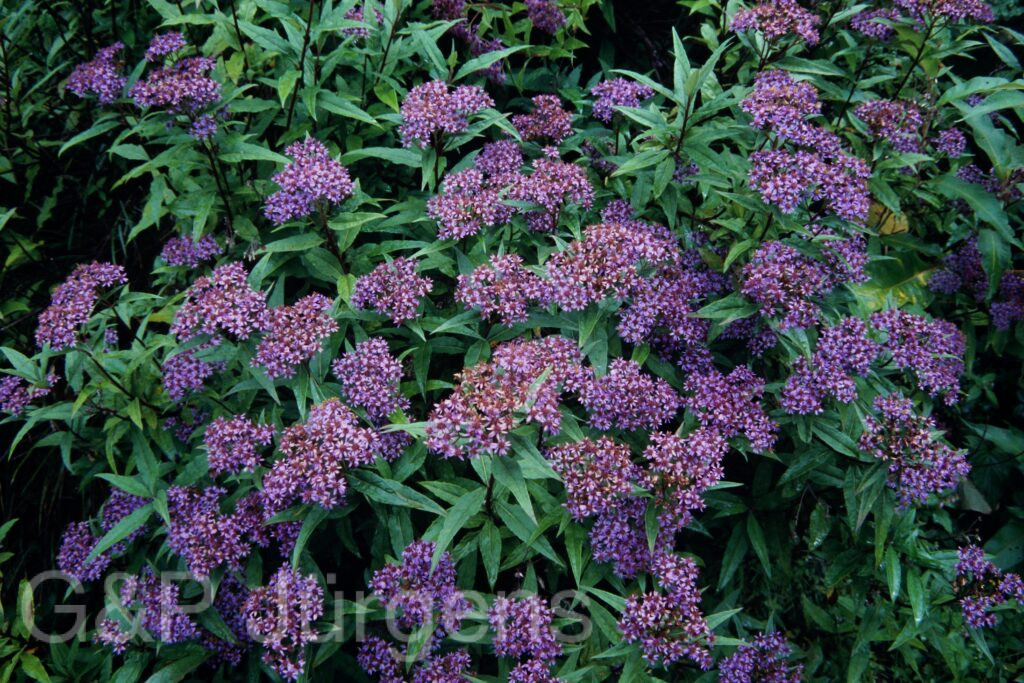
Turcz.

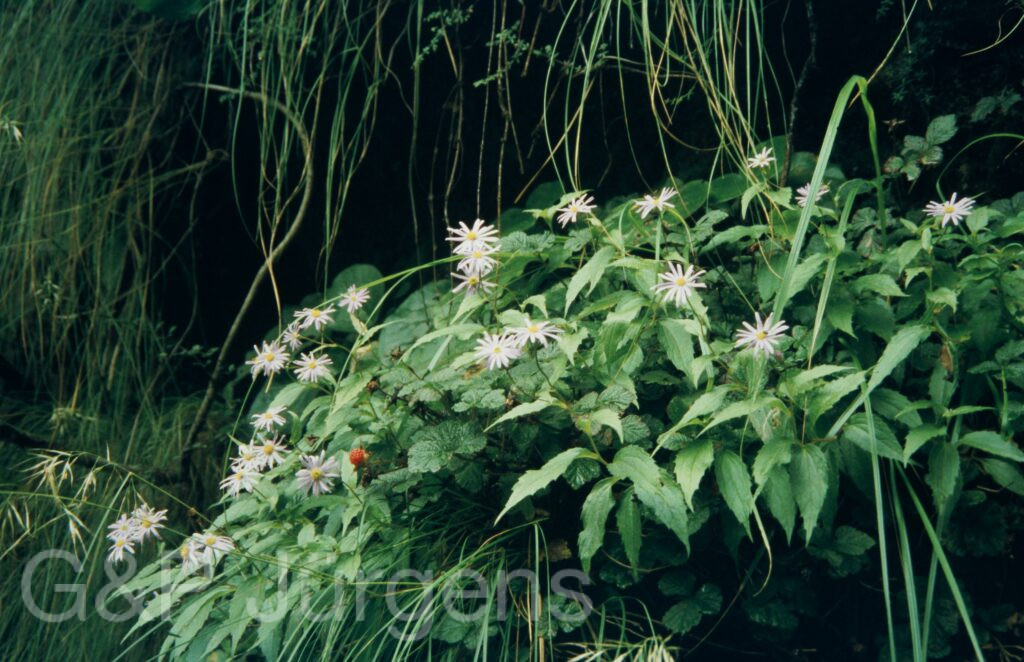
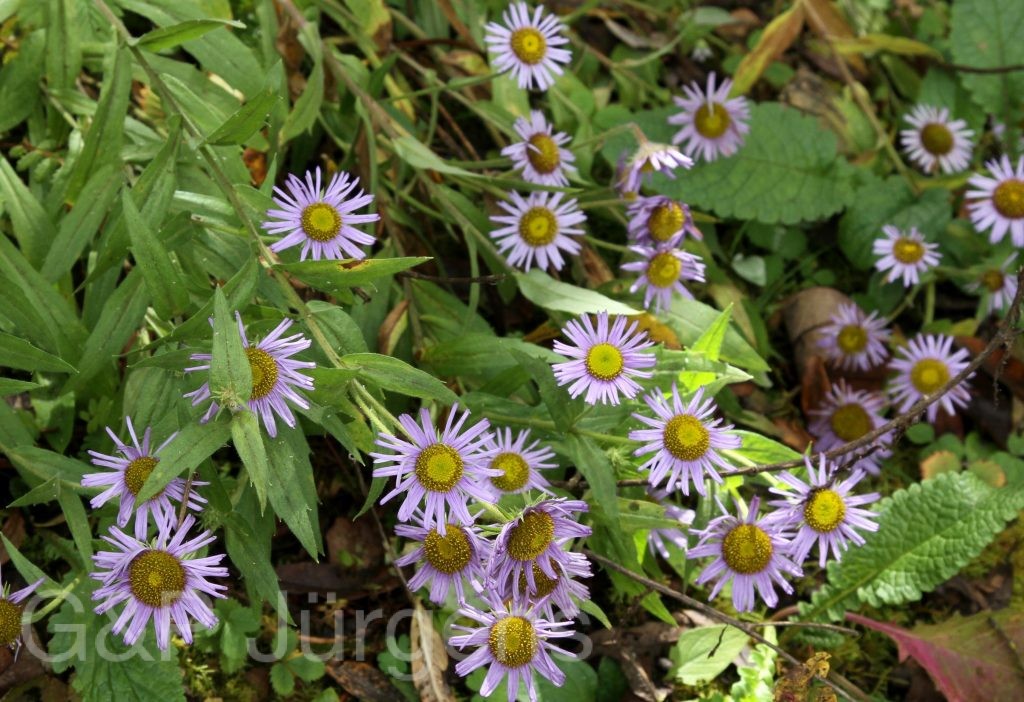
Bhutan2012 866
Bhutan Jakar 2200m, October

Description

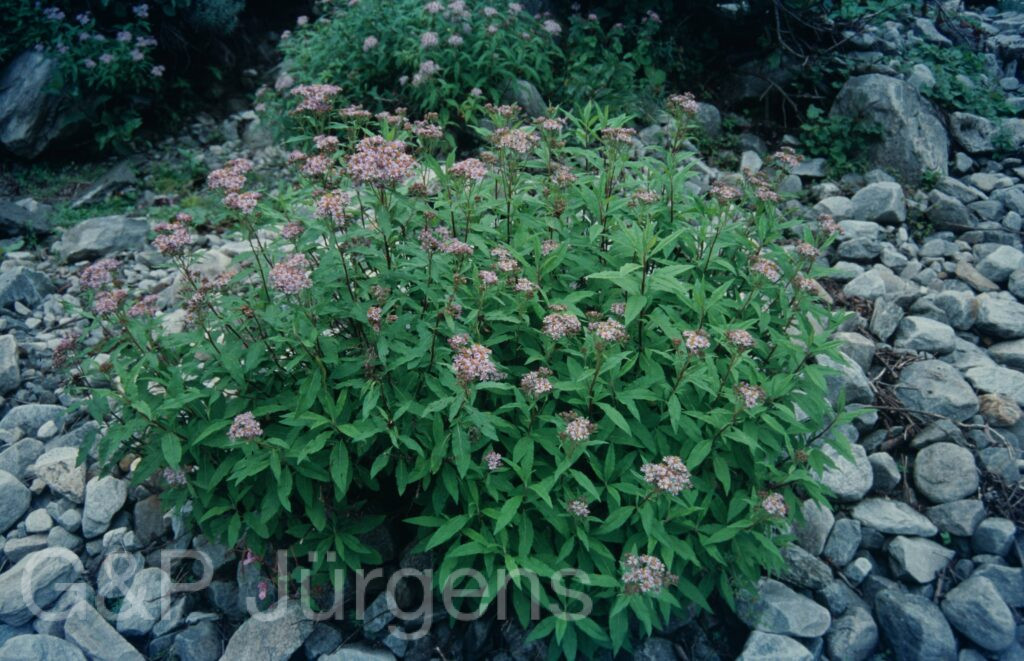
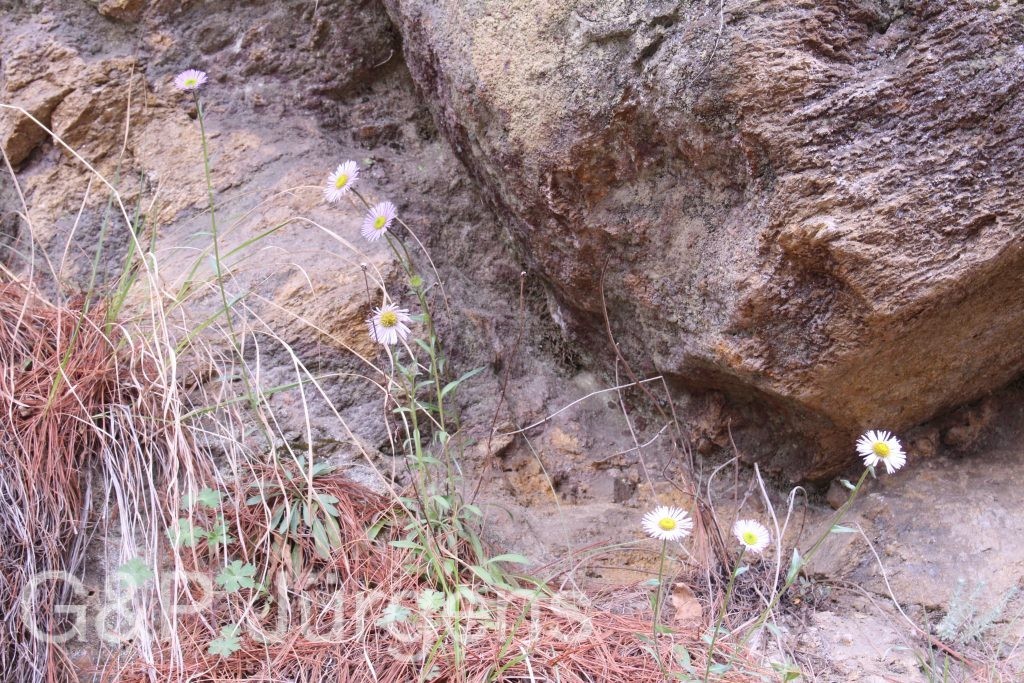
Aster ageratoides Turcz. is a widespread and variable East Asian aster ranging through China, Japan, Korea, Taiwan, Russia, Vietnam, Thailand, Nepal, India and Bhutan, with more than 14,000 georeferenced occurrences in GBIF and an increasing presence as an introduction in parts of Europe and North America. It occupies forest margins, grassy slopes, thickets, streamsides and roadside banks across a broad altitudinal range. The plant recorded at Jakar at 2200 m in October is typical of its late-season flowering in the mid-elevation temperate zone of the Bhutan Himalaya.

It is a rhizomatous perennial herb with erect, often branched stems that are scabrid to pubescent. The leaves are alternate, ovate-lanceolate to elliptic, with a serrate to coarsely toothed margin, three more or less prominent main veins, and a rough surface; the lower leaves are petiolate and the upper ones become sessile. The capitula are arranged in a lax corymbose array; each radiate head has an involucre of imbricate, graduated phyllaries, a single series of white to pale violet or purplish ray florets, and numerous yellow disc florets. The fruit is a compressed, hairy cypsela crowned by a pappus of reddish bristles.

A.ageratoides is notoriously polymorphic, and numerous subspecies, varieties and forms have been described across its range based on leaf shape, indumentum and head size. Modern molecular systematics has reorganised the broad genus Aster, but this Asian species is retained in Aster sensu stricto. Common and ecologically flexible, it is of no conservation concern.

Author: Turcz. · Sources: POWO (Kew), GBIF, Flora of China, Flora of Bhutan, Nesom systematic studies of Astereae

Aster albescens

by GP Jürgens

(DC.) Wall. ex Hand.-Mazz.

Sikkim2003 379 G532
Sikkim Tista valley 3600m August
Garw 2005 38 ergebnis ergebnis
India Garhwal Valley of flowers 3200m, September

Description

Aster albescens is a variable shrubby aster widespread through the Himalaya and into China, Myanmar and East Asia, with 1,298 GBIF occurrences from China, Nepal, India, Bhutan, Japan, Korea and Myanmar. It grows on forest margins, open slopes, shrubberies and stream banks in the upper temperate to subalpine zone, broadly between about 2000 and 4000 m. The images derive from Sikkim's Tista valley at 3600 m in August and from the Valley of Flowers in Garhwal, India, at 3200 m in September, monsoon-watered slopes where this late-summer flowerer is a frequent component of the shrub layer.

Unusually for an aster, it is a woody shrub or subshrub up to about 1-2 m, with erect, branched, often whitish-tomentose stems. The leaves are alternate, ovate to lanceolate or elliptic, shortly petiolate, with serrate to entire margins and a characteristically pale, white-felted lower surface (whence albescens), the upper surface greener and thinly hairy. The capitula are numerous and small, arranged in dense terminal corymbose panicles; each head bears few short white, pinkish or pale purple ray florets around a disc of yellow florets. The cypselae are compressed and pubescent, with a pappus of reddish to brownish barbellate bristles.

Described as Diplopappus albescens by de Candolle and transferred to Aster by Wallich ex Handel-Mazzetti, the species is highly polymorphic and has spawned numerous infraspecific taxa across its range. Its shrubby habit places it among the woody Himalayan-Sino asters retained in Aster sensu lato. Common and ecologically resilient across a broad area, it is not considered threatened.

Author: (DC.) Wall. ex Hand.-Mazz. · Sources: POWO (Kew), GBIF, Flora of Bhutan, Flora of China, Flowers of the Himalaya (Polunin & Stainton), Asteraceae of the Himalaya

(DC.) Benth. ex C.B.Clarke

Bhutan2012 248
Bhutan Haar-Valley, 4000m September

Description

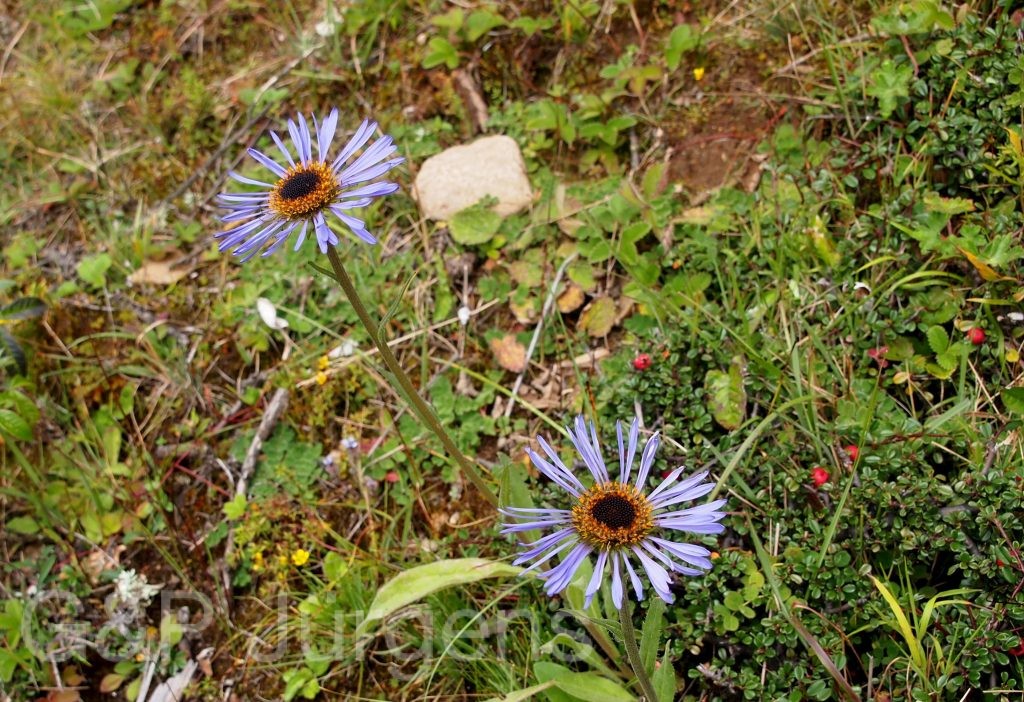
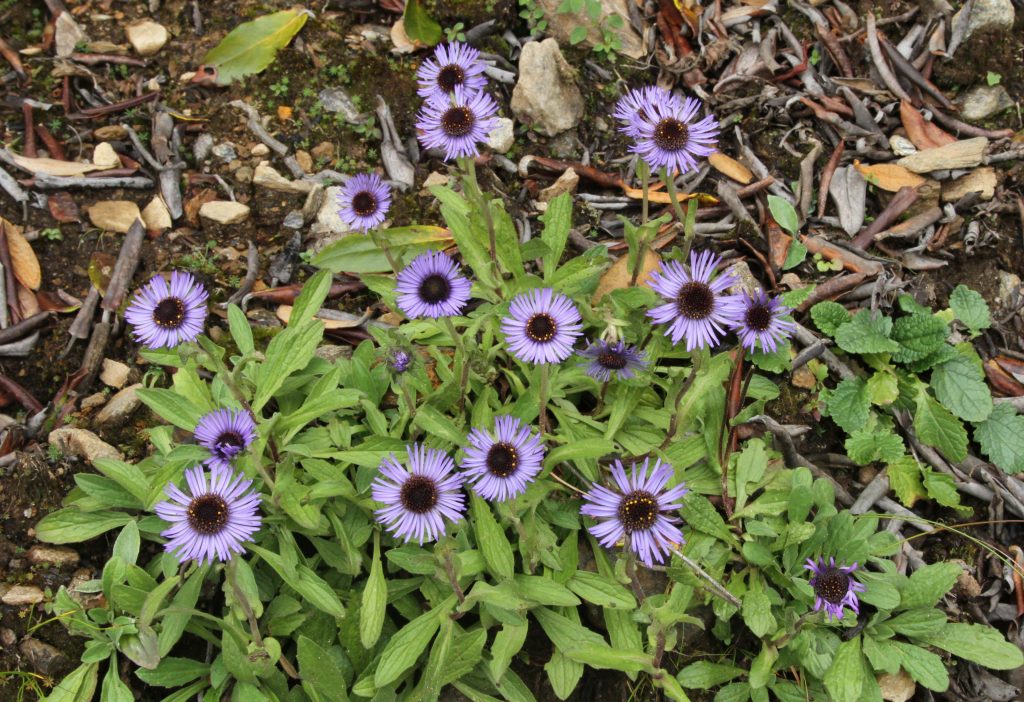
Aster diplostephioides is a striking alpine daisy of the high Himalaya and Tibetan borderlands, recorded by GBIF (322 occurrences) from China, India, Nepal and Bhutan. It inhabits open alpine meadows, grassy slopes, stony pastures and stream margins, typically between about 3000 and 4500 m. The plant illustrated was photographed in Bhutan's Haa (Haar) Valley at 4000 m in September, a high subalpine-to-alpine zone where short summers and intense insolation favour large-headed, single-flowered composites that bloom into the post-monsoon period.

It is a perennial herb arising from a stout, woody rhizome, producing erect, simple, glandular-hairy stems usually to 30-50 cm. The leaves are alternate, oblanceolate to spathulate, entire, somewhat clasping above, and clothed in spreading hairs. Each stem bears a single large, solitary capitulum subtended by herbaceous, often purple-tinged phyllaries in two or three rows. The numerous narrow ray florets are blue to violet-purple and conspicuously long, surrounding a central disc of yellow florets that turns orange-purple with age. The cypselae are flattened and hairy, bearing a pappus of unequal barbellate bristles.

The species was described as Heterochaeta diplostephioides by de Candolle and transferred to Aster by Bentham ex C.B. Clarke. Although molecular work has redistributed much of the former broad Aster, the high-elevation Himalayan asters such as this remain referable to Aster sensu stricto. Its conspicuous solitary heads make it a notable component of Himalayan alpine meadows. It is widespread within its montane range and not regarded as threatened, though alpine habitats face pressure from grazing intensification and climate warming.

Author: (DC.) Benth. ex C.B.Clarke · Sources: POWO (Kew), GBIF, Flora of Bhutan, Flora of China, Flowers of the Himalaya (Polunin & Stainton), Asteraceae of the Himalaya

(C.B.Clarke) Hutch.

Nepal 99 93 ergebnis
West-Nepal Bhulbhule 3600m, June
Nepal 99 258 ergebnis
West-Nepal Loccu 3155m, June
Nepal 99 122 ergebnis
West-Nepal South of Rara-Lake 3500m, June

Description

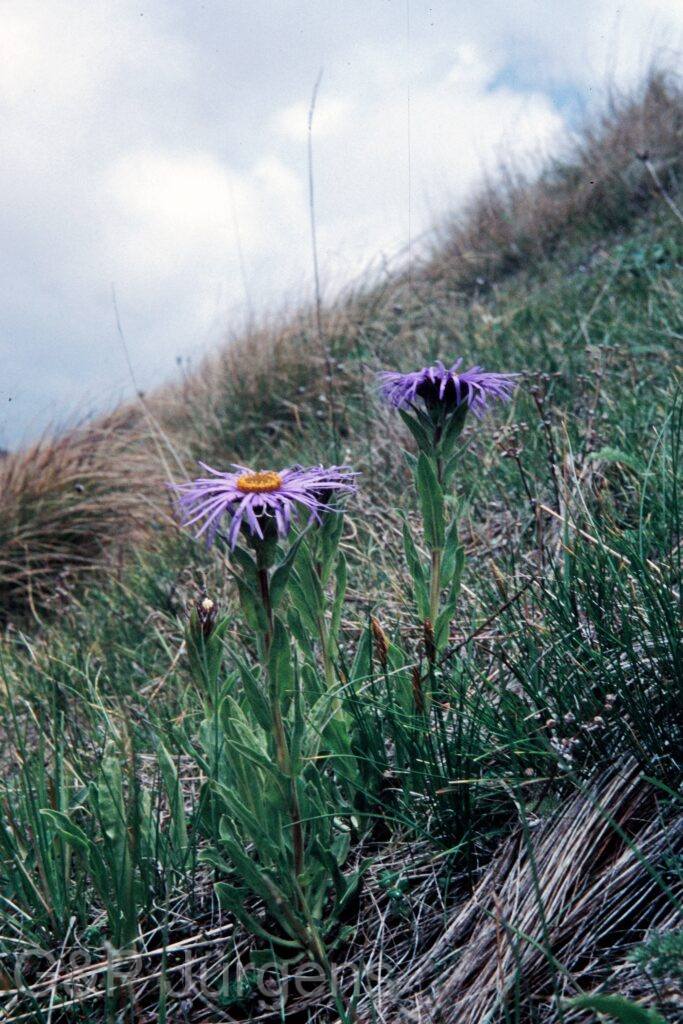
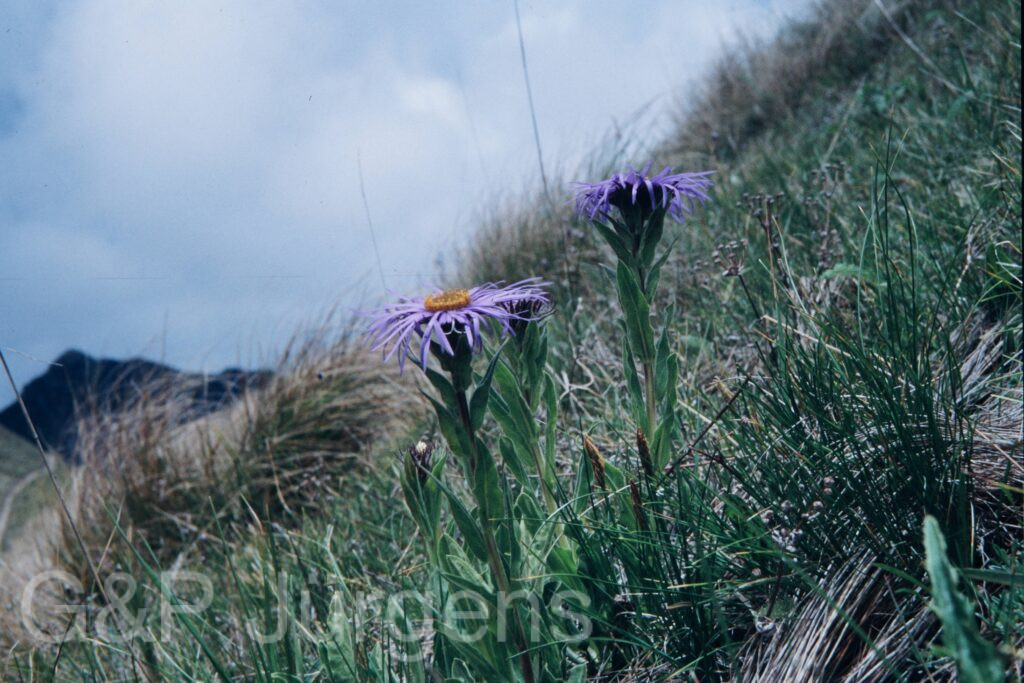
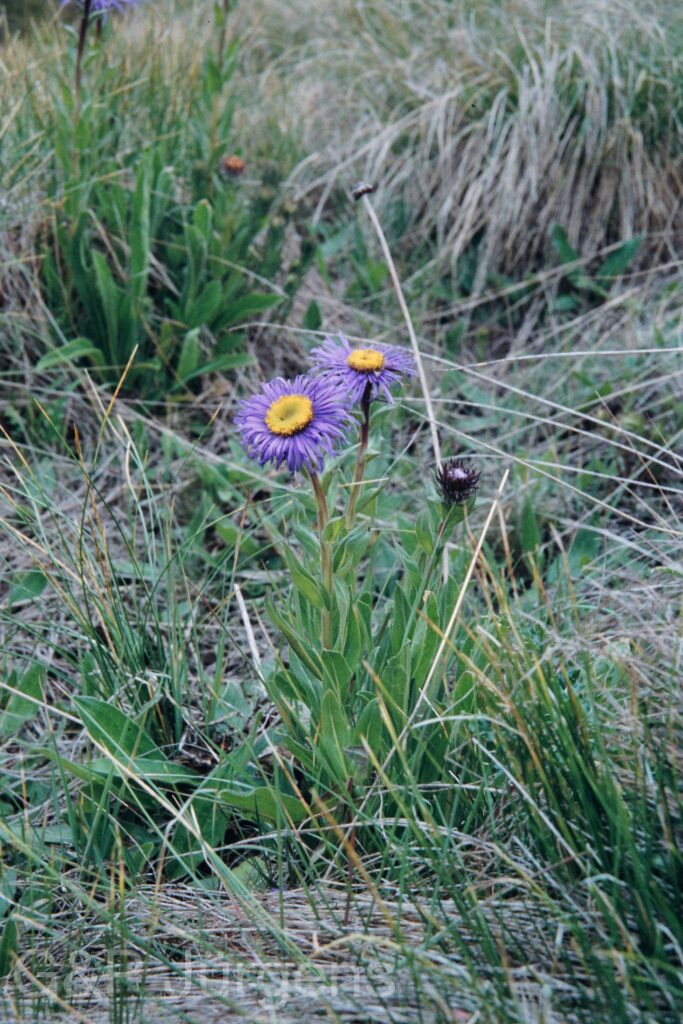
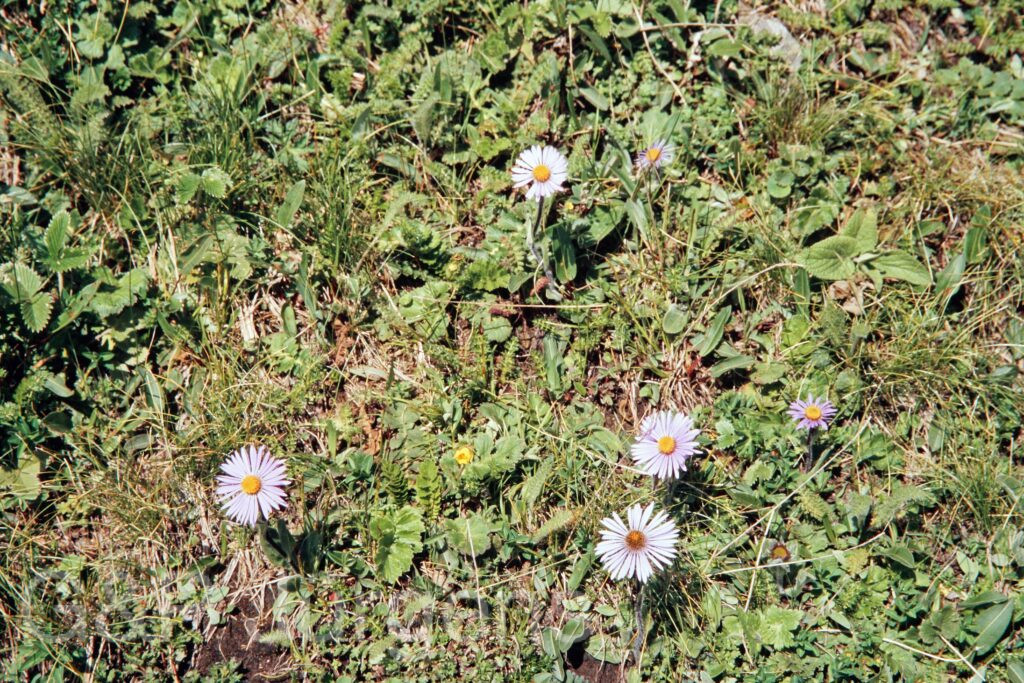
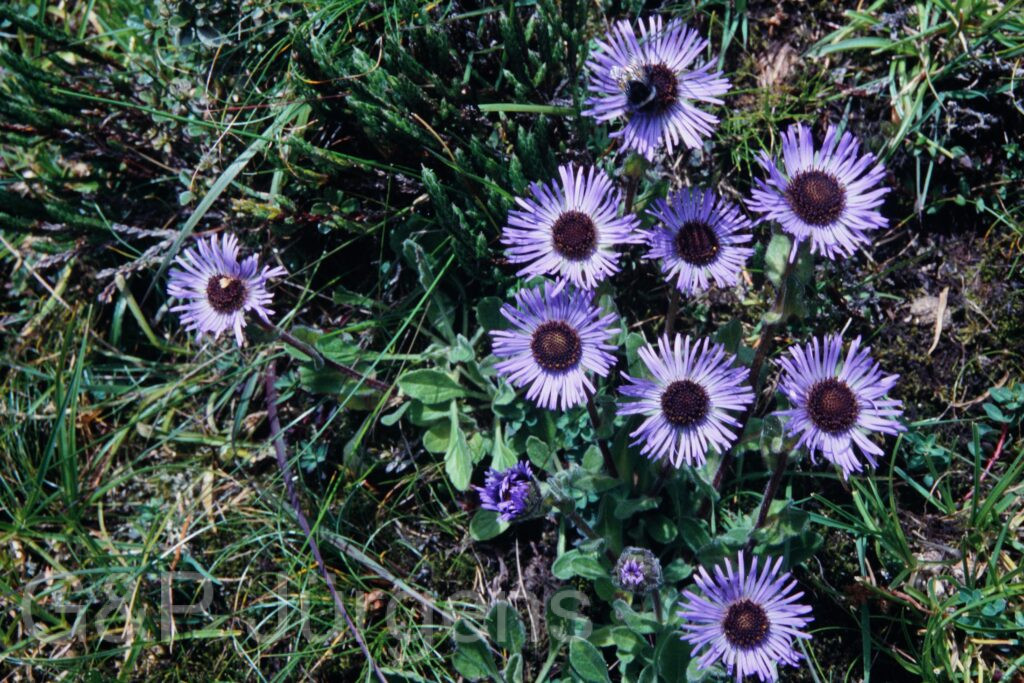
Aster falconeri is a high-alpine herb of the north-western and western Himalaya, recorded from India, Pakistan and Nepal, with some 147 georeferenced collections documenting a relatively narrow but well-sampled range. It occupies open turf, moist alpine meadows, grazed grassland and the margins of seepages and snowmelt flushes, typically between about 3100 and 4000 m. The photographed populations from West Nepal—Bhulbhule at 3600 m, Loccu at 3155 m and the slopes south of Rara Lake at 3500 m, all flowering in June—are characteristic of its early-summer phenology, the plants emerging and blooming soon after the snowpack recedes.

It is a perennial forming low tufts from a short rootstock, the stems erect to ascending, simple, glandular-hairy and bearing reduced cauline leaves. Basal and lower leaves are oblanceolate to spathulate, narrowed to a winged petiole, entire or obscurely toothed and somewhat hairy. The solitary terminal capitula are radiate, subtended by an involucre of subequal, herbaceous, often purple-tinged phyllaries; the ray florets are ligulate and blue to violet, surrounding a disc of yellow tubular florets. The fruit is a compressed, hairy cypsela crowned by a pappus of barbellate bristles aiding wind dispersal.

First described as a member of Erigeron by C. B. Clarke and transferred by Hutchinson, the taxon is treated under the name Aster falconeri, regarded as the accepted name notwithstanding its synonym status in the source dataset. As with many Sino-Himalayan asters, generic limits between Aster and Erigeron have shifted repeatedly with morphological and molecular reappraisal. Though not formally assessed for conservation, its restriction to montane pastures exposes it to heavy grazing pressure across the western ranges.

Author: (C.B.Clarke) Hutch. · Sources: POWO (Kew), GBIF, Flora of Pakistan, Annotated Checklist of the Flowering Plants of Nepal, Grierson & Long Flora of Bhutan, Grierson's revision of Himalayan Aster (Asteraceae)

Bunge

Description

Aster flaccidus is a widespread alpine daisy of the high mountains of Asia, with extensive GBIF records (over 1600 occurrences) from China, India, Pakistan, Russia, Nepal, Afghanistan, Tajikistan, Mongolia, Bhutan, Uzbekistan, Kazakhstan, Myanmar, Kyrgyzstan and Turkey. It is a true alpine of stony meadows, scree, gravelly slopes, moraines and short turf, mostly above the treeline but descending where open ground occurs. The record from Belak Khal in Garhwal, India, at about 2900 m in June is a lower, early-season occurrence; across its range the species ascends well above 4000 m, flowering through the brief alpine summer. Here gbif_status is SYNONYM, with the name Aster flaccidus treated as the accepted taxon.

It is a low, tufted perennial herb arising from a short rhizome, the stems solitary or few, simple, erect and conspicuously clothed in long, soft, white or purplish, often glandular hairs. The basal leaves are spathulate to oblanceolate, entire and narrowed to a petiole, the cauline leaves few, sessile and reduced. Each stem terminates in a single large capitulum; the numerous ray florets are violet, blue-purple to lilac and spread around a central disc of yellow tubular florets. The involucre is hemispherical with herbaceous, hairy, purple-margined phyllaries in two or three subequal series. Achenes are flattened and pubescent, surmounted by a pappus of reddish barbellate bristles.

A member of Aster section Alpigenia, A. flaccidus is morphologically variable and has accumulated numerous synonyms and infraspecific names reflecting its vast range and the influence of altitude on stature and indumentum. It is a hardy, cushion-tolerant pioneer of cold, exposed habitats and an important component of alpine sward. Being abundant and broadly distributed it is of least concern, although high-altitude populations may serve as sensitive indicators of climate-driven vegetation change.

Author: Bunge · Sources: POWO (Kew), GBIF, Flora of China, Flora of Pakistan, Polunin & Stainton Flowers of the Himalaya, Onno revision of Aster Alpigenia

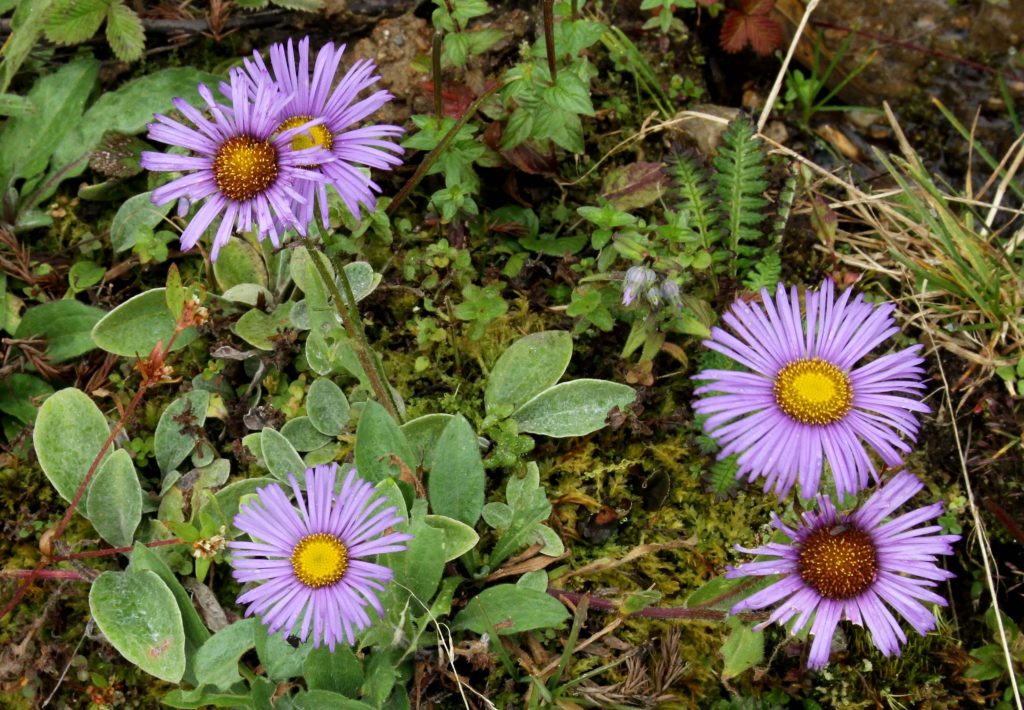
Aster himalaicus

by GP Jürgens

C.B.Clarke

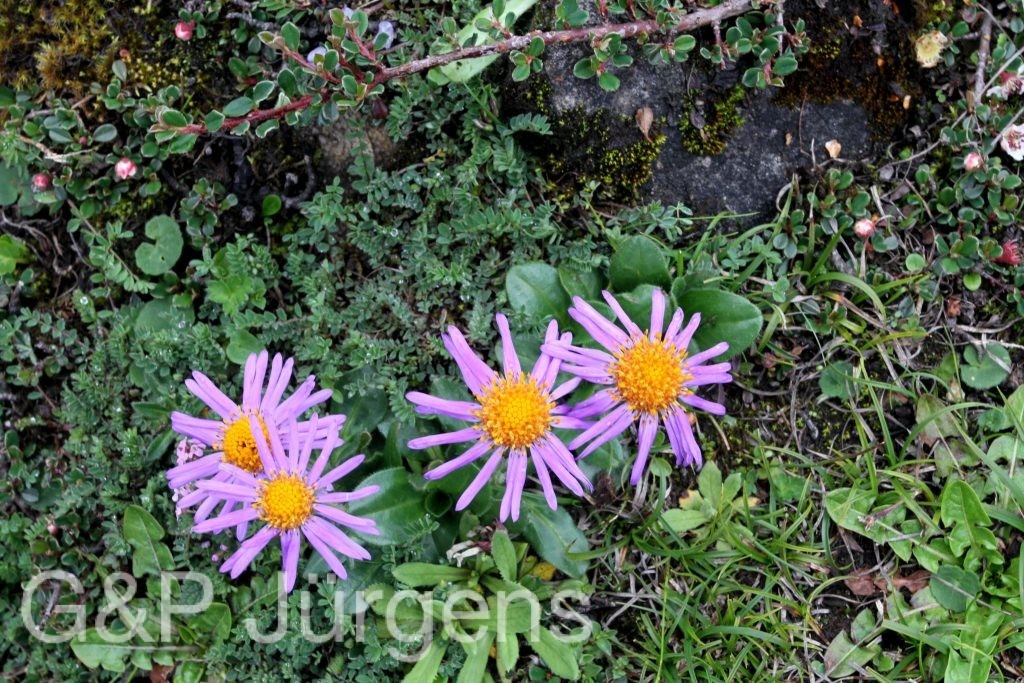
Bhutan2012 53
Bhutan Shele-La, 4000m September
Bhutan2012 55
Bhutan Shele-La, 4000m September
Bhutan2012 292
Bhutan Shele-La, 4100m September
Sikkim2003 138 P186
Sikkim Dzongri 3950m, August

Description

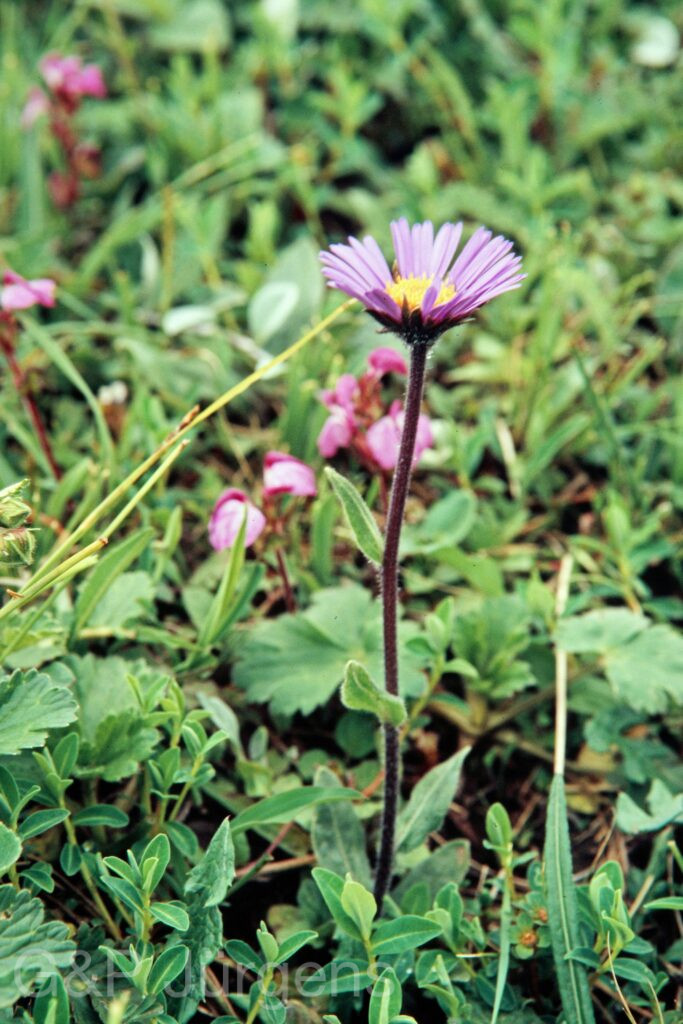
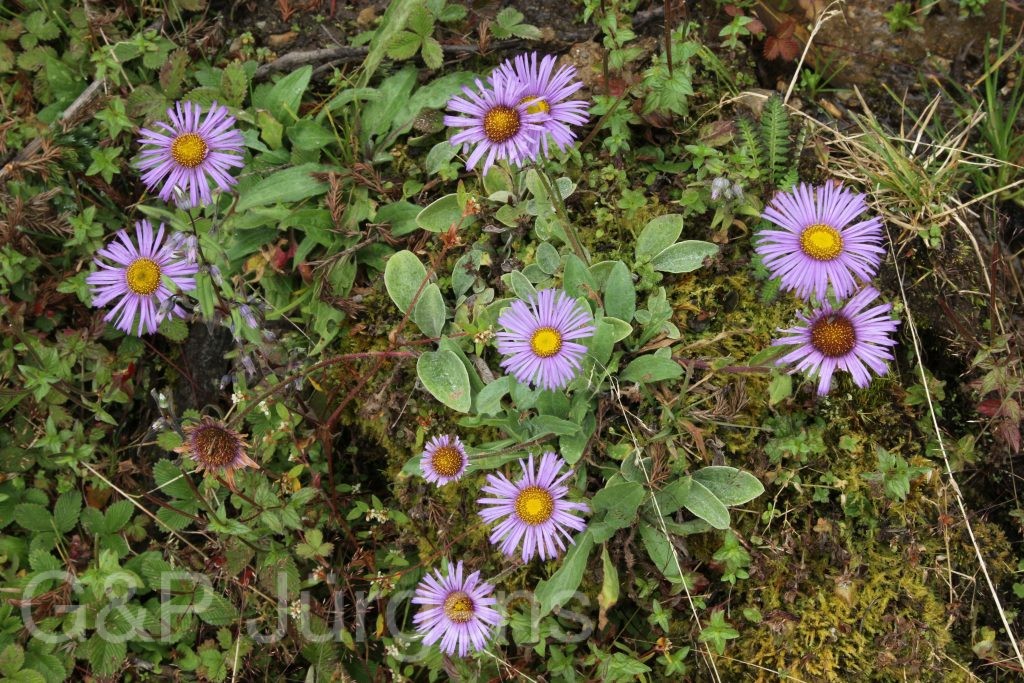
Aster himalaicus is an alpine aster of the eastern and central Himalaya, distributed through Nepal, China, Bhutan, India, Myanmar and Pakistan (NP, CN, BT, IN, MM, PK), with around 277 GBIF occurrences indicating a genuinely high-mountain, comparatively restricted range. It grows in alpine meadows, on grassy and stony slopes, moist turf and the margins of dwarf-rhododendron scrub above the treeline. The photographed populations occur on the Shele-La in Bhutan at 4000–4100 m in September and at Dzongri in Sikkim at 3950 m in August, flowering through the late monsoon on open alpine grassland. Note that under GBIF this name carries SYNONYM status, though the accepted name is likewise given as Aster himalaicus.

It is a low perennial herb with a short, woody rhizome bearing solitary or few erect, simple stems usually 5–20 cm tall, more or less hispid with spreading hairs. The leaves are mostly basal and lower-cauline, obovate to oblanceolate or spathulate, tapering to a winged petiole, with entire ciliate margins and sparse hairs. The capitula are large and solitary, terminal and radiate, subtended by an involucre of several series of narrow, often purple-tinged, hairy phyllaries. The ray florets are conspicuous, ligulate and blue-violet to purple, encircling a disc of numerous yellow tubular florets. The fruit is a flattened, hairy cypsela crowned by a pappus of fine barbellate bristles in one or two series.

Aster sensu lato in the Himalaya has been much reorganised, several alpine taxa having been segregated into genera such as Aster s.str. of the tribe Astereae; the synonymy attached to this binomial reflects that ongoing taxonomic flux. The large solitary heads borne on dwarf stems are characteristic of cushion-forming alpine asters adapted to short, cool growing seasons. The species is not assessed as threatened, but its dependence on high alpine turf renders it locally vulnerable to grazing pressure and climatic shifts.

Author: C.B.Clarke · Sources: POWO (Kew), GBIF, Flora of China Vol. 20-21, Flora of Bhutan, Flora of Nepal, Asteraceae monograph (Grierson, revision of Himalayan Aster)

Aster neoelegans

by GP Jürgens

Grierson

Bhutan2014 411
Bhutan Jakar 2400m, May

Description

Aster neoelegans is an eastern Himalayan composite native to Bhutan, China (Tibet), India and Nepal, with 53 georeferenced occurrences indicating a fairly localised distribution along the main range. It grows on open grassy slopes, in scrub, forest clearings and on rocky banks in the temperate montane zone. It was photographed near Jakar in central Bhutan at 2400 m in May, flowering in spring on warm, well-drained slopes of the mid-montane belt, where it is a component of meadow and open-woodland communities.

It is an erect perennial herb arising from a short rhizome, with simple or sparingly branched, leafy, finely hairy stems. The alternate leaves are oblong to lanceolate or oblanceolate, entire to slightly toothed, narrowing to a sessile or clasping base and roughly pubescent. The flower heads are radiate and solitary or few in a loose corymb at the stem tips; each head has a hemispherical involucre of imbricate green phyllaries, an outer ring of spreading ligulate ray florets that are pale blue, lilac or mauve, and a central disc of yellow tubular florets. The fruit is a flattened, hairy cypsela bearing a pappus of barbellate bristles.

The genus Aster s.str. belongs to tribe Astereae and, following the segregation of numerous American and Asian species into other genera, comprises a predominantly Eurasian group well represented in the Sino-Himalaya. Aster neoelegans, described by Grierson, is one of several closely related Himalayan asters distinguished by subtle differences in leaf shape, indumentum and phyllary form. Ecologically it is an insect-pollinated meadow species. Owing to its restricted range it warrants monitoring, though it is not currently assessed as threatened.

Author: Grierson · Sources: POWO (Kew), GBIF, Flora of Bhutan, Flora of China, Asteraceae of the Himalaya (Grierson & Long studies)

Wall.

Garw 2005 171 ergebnis
India Garhwal Shertoli 3200m, September

Description

Aster peduncularis is a western and central Himalayan daisy recorded from India, Nepal and Pakistan, with about 76 GBIF occurrences. It occupies the temperate to subalpine zone, growing in open forest, grassy slopes, meadows, clearings and shrubby banks, broadly between about 2500 and 3800 m. The collection from Shertoli in Garhwal, India, at 3200 m in September corresponds to its late-summer to autumn flowering, when such mid-montane meadows of the western Himalaya are bright with composites following the monsoon rains.

It is a perennial herb with erect or ascending stems arising from a rootstock, bearing alternate, ovate to lanceolate leaves that diminish upwards, the lower ones petiolate and the upper sessile and sometimes clasping. The capitula are radiate and borne on conspicuously long peduncles, the feature evoked by the epithet "peduncularis". Each head has an involucre of several rows of graded bracts; the ray florets are ligulate and bluish-purple to mauve, encircling a disc of yellow tubular florets. The achenes are compressed and crowned by a pappus of fine barbellate bristles aiding wind dispersal.

In GBIF this name is treated as a synonym, with the accepted taxon being the same epithet under current circumscription; placement of Himalayan asters has shifted considerably as the broad genus Aster has been split into segregate genera, several Sino-Himalayan species moving to allied groups within tribe Astereae. Pollination is by a range of generalist insects, and the plumose pappus disperses the seed on wind. The species is widespread and not regarded as threatened.

Author: Wall. · Sources: POWO (Kew), GBIF, Flora of China, Flora of Pakistan, Asteraceae of the Himalaya (Grierson / Nesom)

Aster souliei

by GP Jürgens

Franch.

BhutanPG2011 475
Bhutan Ludlow-Sherriff-Trail Warrtlang-La, 4450m June

Description

Aster souliei is an alpine aster centred on the Sino-Himalayan mountains, recorded principally from China, Bhutan, India and Myanmar (CN, BT, MM, IN), with around 549 GBIF occurrences reflecting a range concentrated in the high mountains of the eastern Himalaya and south-west China; scattered records elsewhere (US) represent cultivation. It grows in alpine meadows, on grassy and rocky slopes, screes and open turf above the treeline, where it forms low mats. The photographed plant occurred on the Ludlow-Sherriff Trail at the Warrtlang-La in Bhutan at 4450 m in June, flowering early in the season at considerable altitude on exposed alpine grassland.

It is a dwarf, mat- or tuft-forming perennial herb arising from a short, thick rhizome, with very short or almost stemless flowering scapes, the whole plant rarely exceeding 5–15 cm. The leaves are chiefly in a basal rosette, spathulate to obovate or oblanceolate, narrowed into a winged petiole, with entire, often ciliate margins and sparsely hairy surfaces. The capitula are large and solitary, terminal and radiate, subtended by an involucre of several series of narrow, frequently purple-flushed and hairy phyllaries. The ray florets are numerous, ligulate and deep blue-violet to purple, surrounding a central disc of yellow tubular florets. The fruit is a compressed, hairy cypsela bearing a pappus of fine, barbellate, reddish to whitish bristles.

Described by Franchet from the Sino-Himalayan borderlands, A. souliei belongs to the cushion- and rosette-forming alpine asters of the tribe Astereae that have undergone repeated taxonomic revision in the region. Its near-stemless habit and disproportionately large violet heads are adaptations to the short, cold growing season at high elevation, maximising display to scarce pollinators. Widespread within its montane belt, it is not considered threatened, though like other high-alpine specialists it may be sensitive to warming-driven habitat contraction.

Author: Franch. · Sources: POWO (Kew), GBIF, Flora of China Vol. 20-21, Flora of Bhutan, Flora of Nepal, Asteraceae monograph (Grierson, revision of Himalayan Aster)