Tag:

Nepal

Flowers of Nepal — 1313 wild plant species documented from the Nepalese Himalaya, from subtropical foothills to high alpine meadows above 4,000 m. Nepal’s dramatic elevation gradient makes it one of the richest botanical regions on Earth, home to rhododendrons, primulas, gentians and the famed blue poppies (Meconopsis). Every entry gives a botanical description, native distribution, habitat and flowering season, alongside the original field photograph and the location where it was taken.

C.B.Clarke

Nepal 99 958 ergebnis
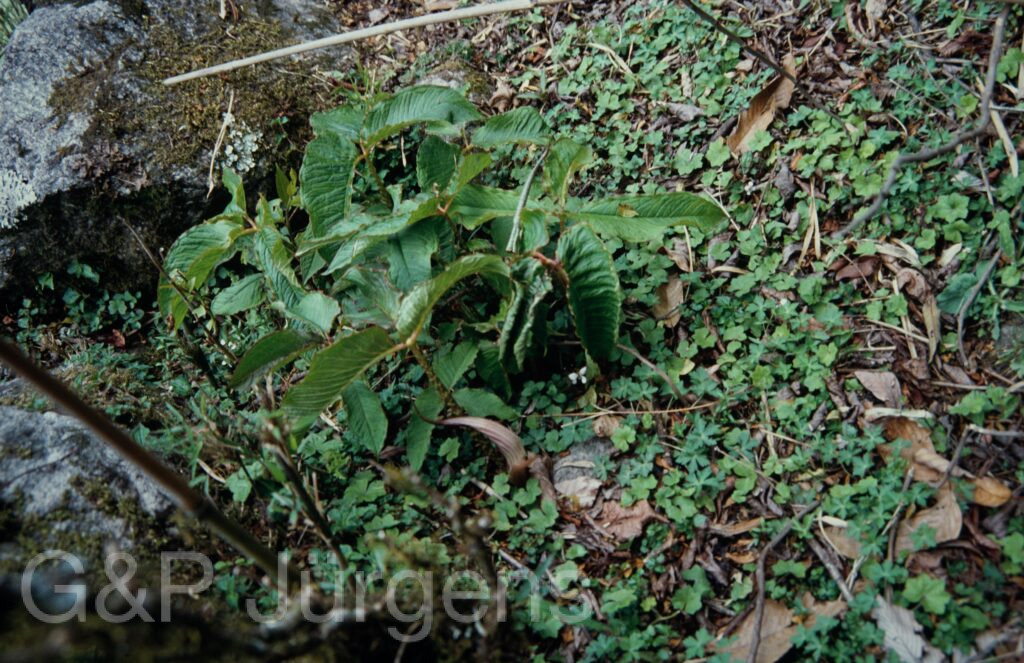
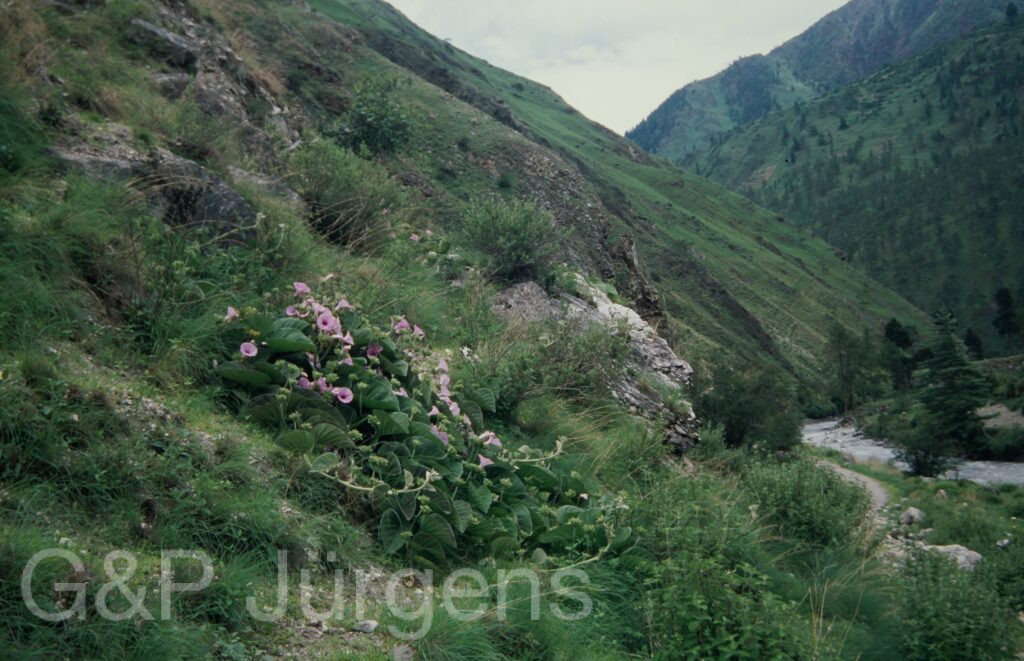
West-Nepal Thuli Bheri 2150m, July
Nepal 99 959 ergebnis
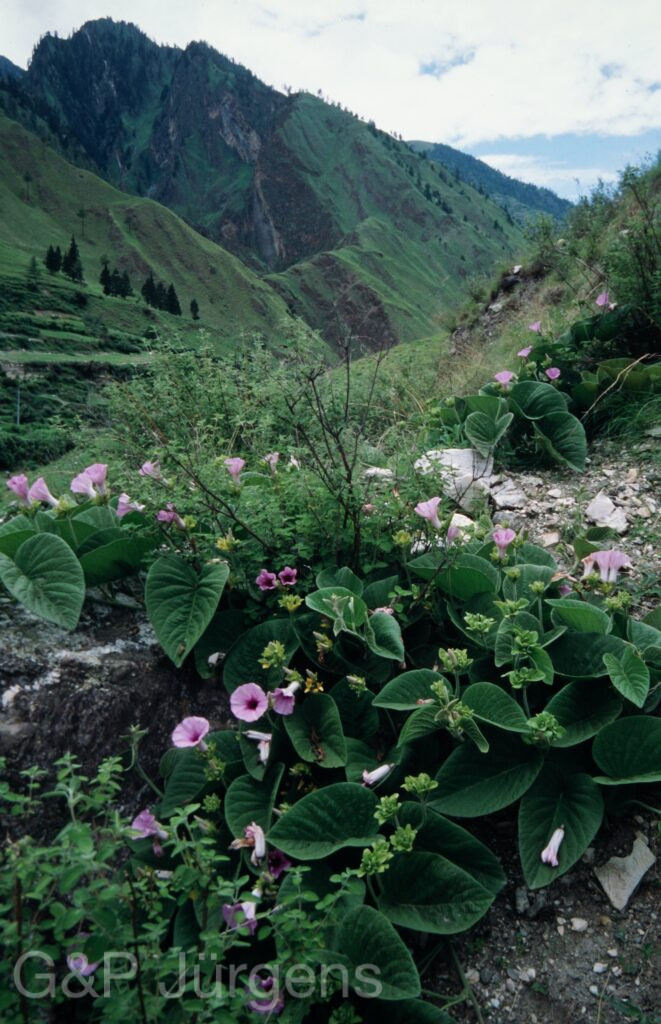
West-Nepal Thuli Bheri 2150m, July
Nepal 99 960 ergebnis
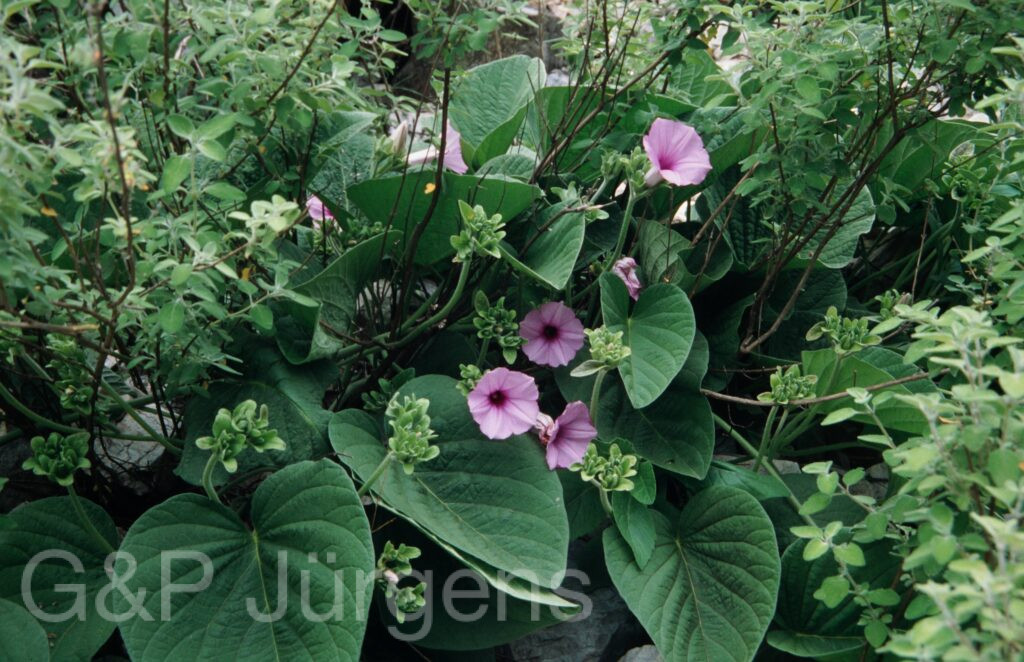
West-Nepal Thuli Bheri 2150m, July

Description

Argyreia hookeri C.B.Clarke is a woody climber of the morning-glory family native to the Himalaya and adjacent Indo-Malesian region. GBIF records indicate occurrences in Nepal, India, Bhutan, China, Myanmar, Thailand and Indonesia, marking a distribution that spans the Himalayan foothills into Southeast Asia. It grows in forest margins, thickets and along streamsides in subtropical to lower temperate forest, generally between about 1,000 and 2,300 m. The plant photographed in the Thuli Bheri valley of west Nepal at 2,150 m, flowering in July, reflects its monsoon-season anthesis in moist hill forest.

The species is a perennial twining liana with stems that are pubescent when young. The leaves are large, ovate to broadly cordate, entire, acuminate, and softly hairy beneath, borne on long petioles. The flowers are arranged in axillary, peduncled cymose clusters subtended by conspicuous bracts; the corolla is funnelform and showy, rose-pink to purple with a darker throat, the limb shallowly lobed. As in Argyreia, the fruit is an indehiscent berry enclosed by the enlarged, somewhat fleshy persistent sepals, containing a few hard seeds.

Argyreia is distinguished from the related Ipomoea chiefly by its baccate, non-capsular fruit. A. hookeri is one of numerous Himalayan species of the genus and is occasionally cultivated as an ornamental climber. The genus is noted for indole alkaloid content, and several species feature in ethnobotanical use. The species remains locally frequent across its wide range.

Author: C.B.Clarke · Sources: POWO (Kew), GBIF, Flora of China Vol. 16, Flora of Bhutan Vol. 2, Staples: Revision of Asiatic Convolvulaceae
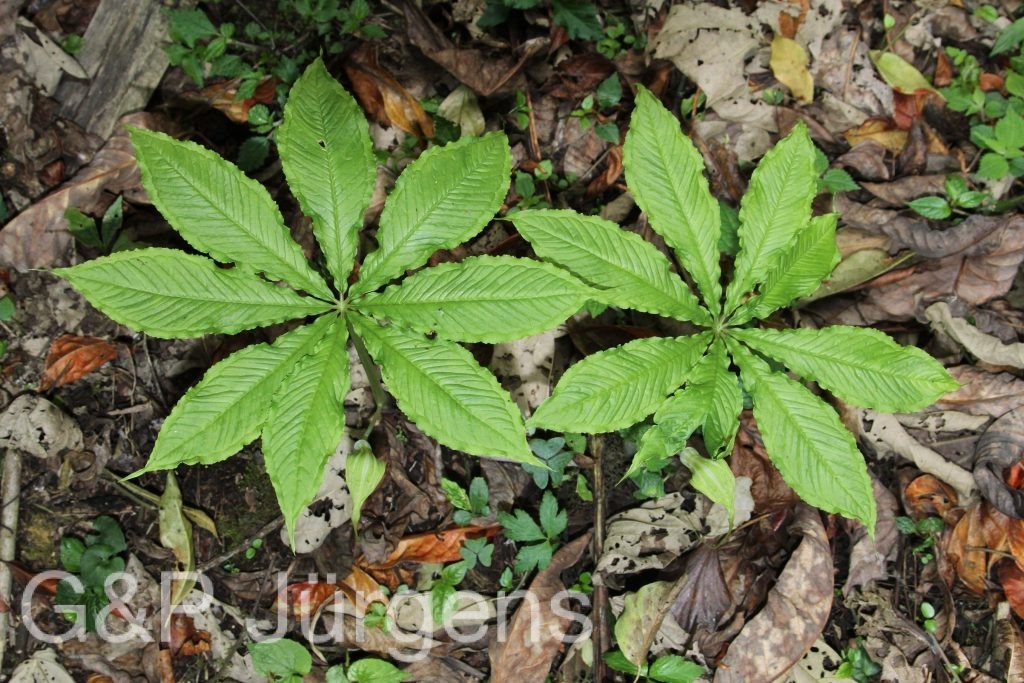
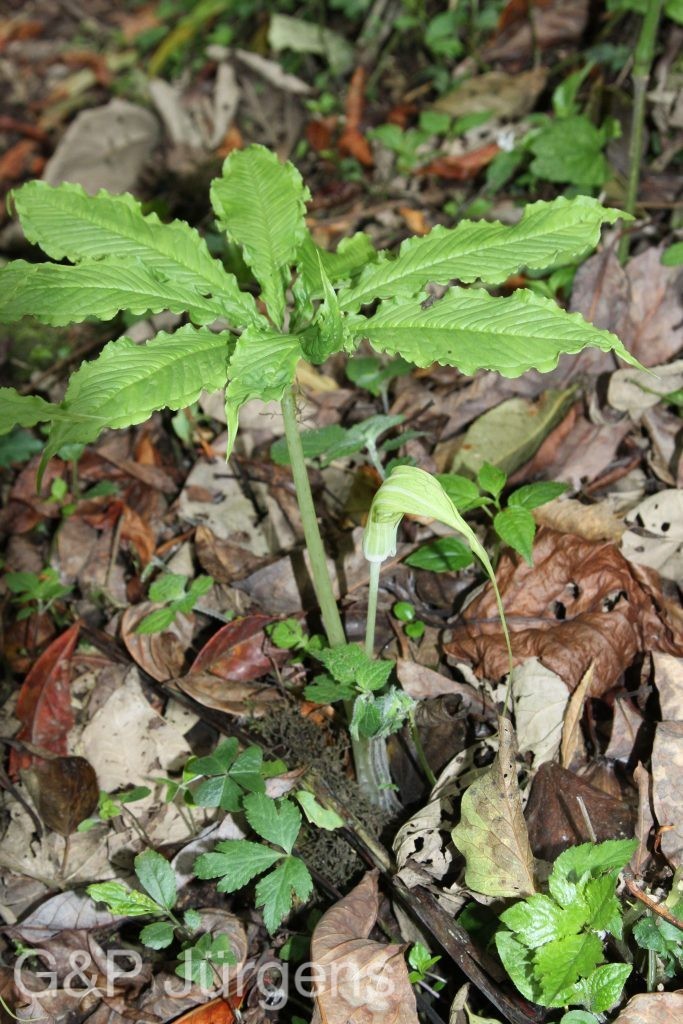
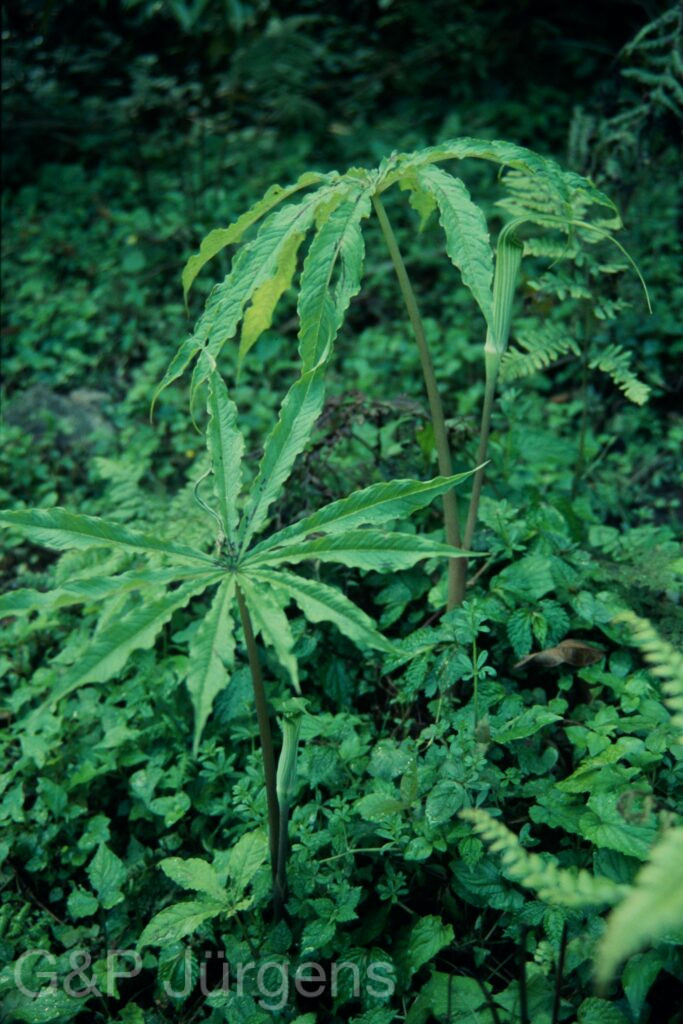
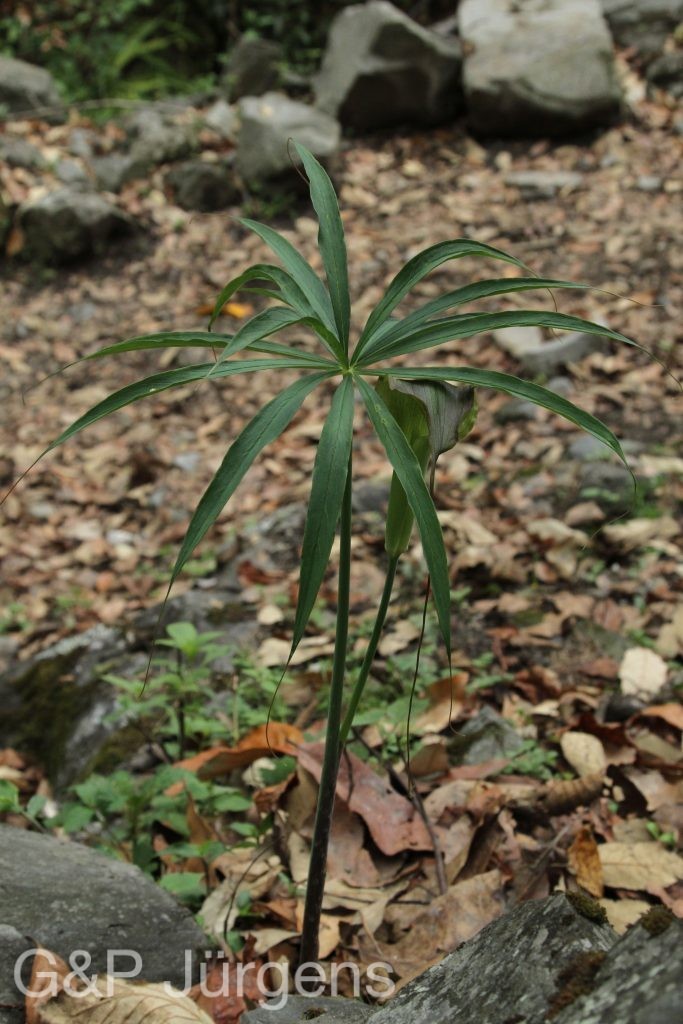
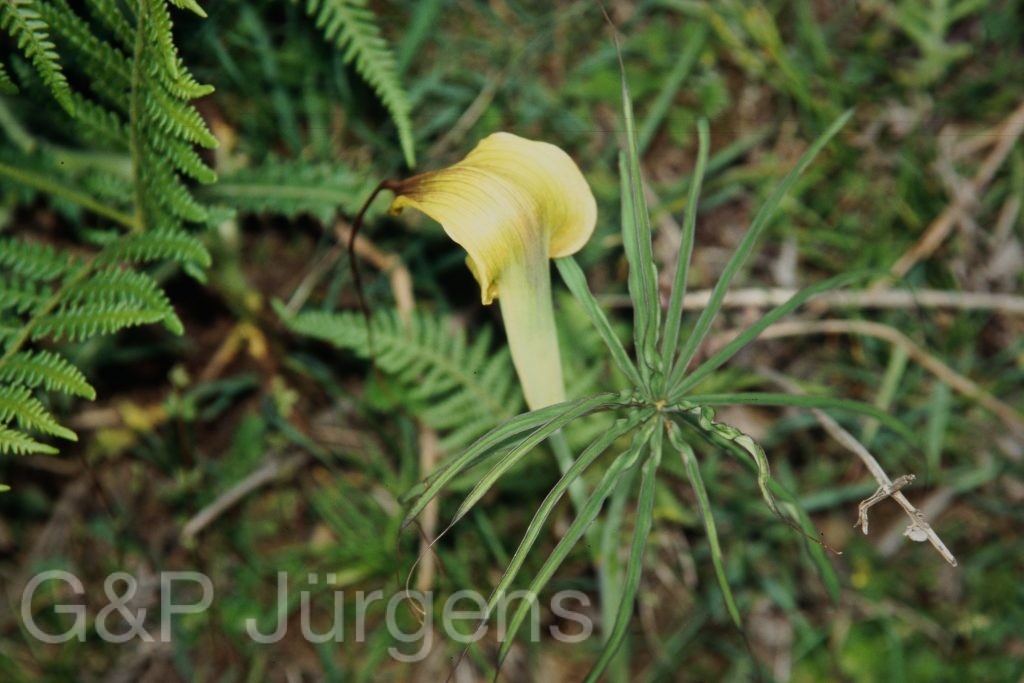
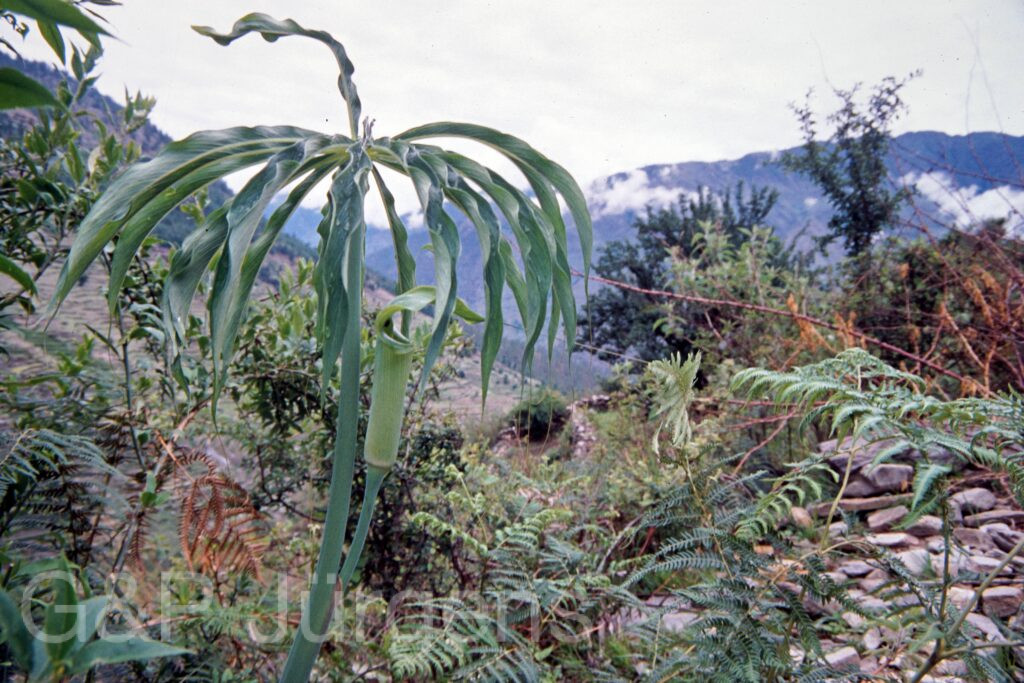
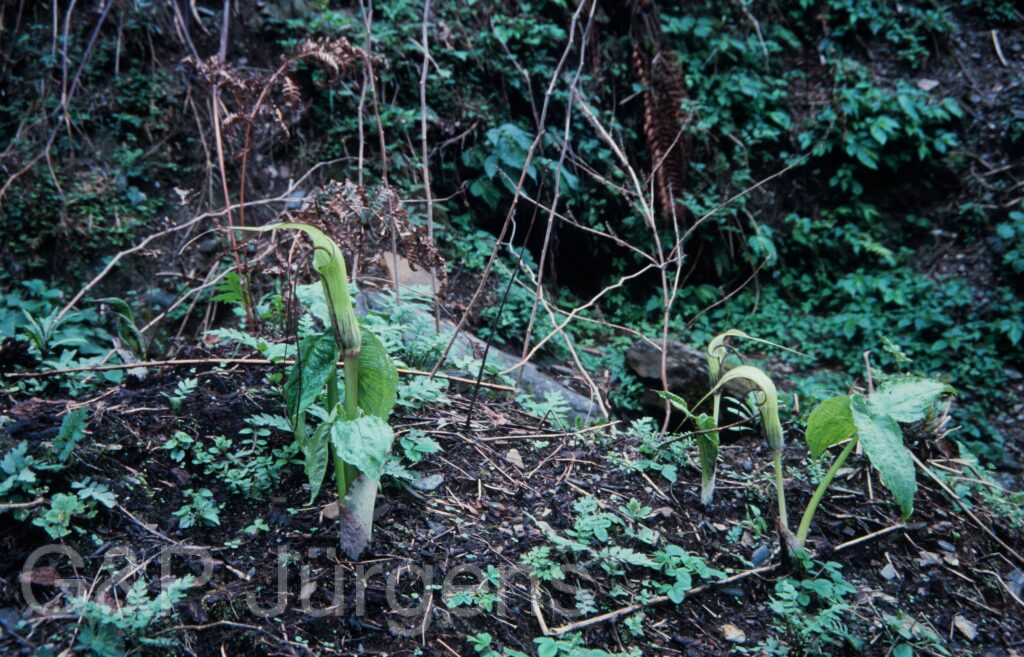
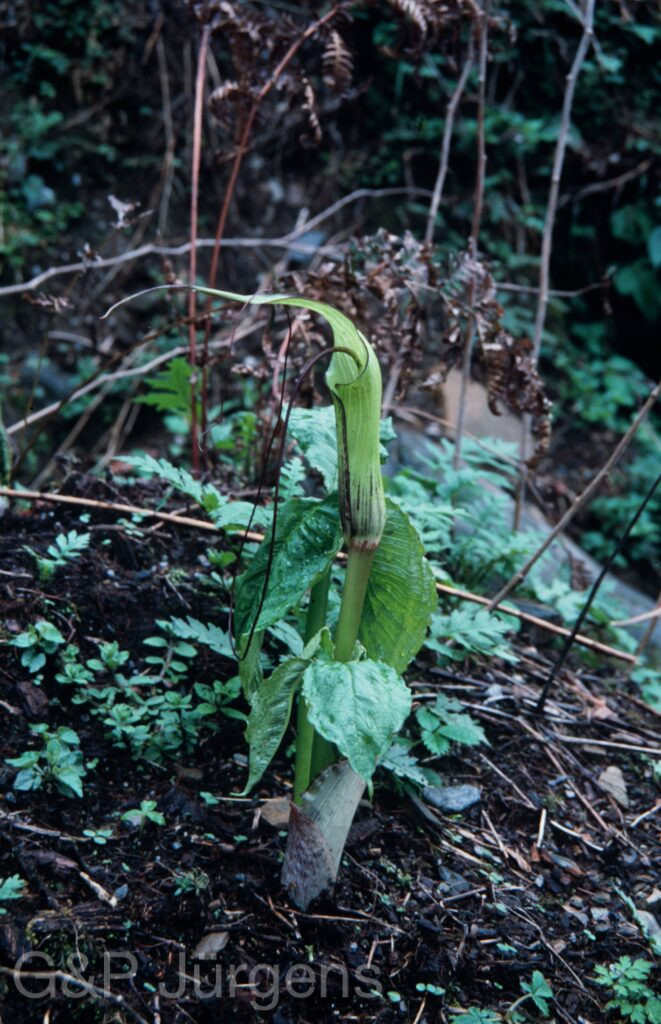
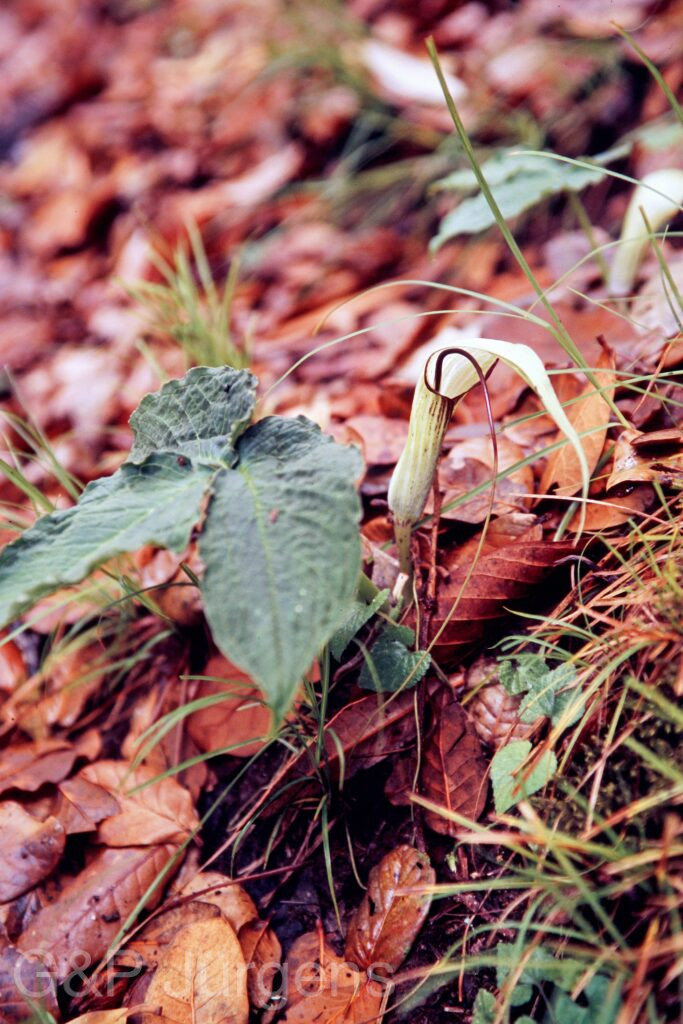
Arisaema concinnum

by GP Jürgens

Schott

Bhutan2014 461
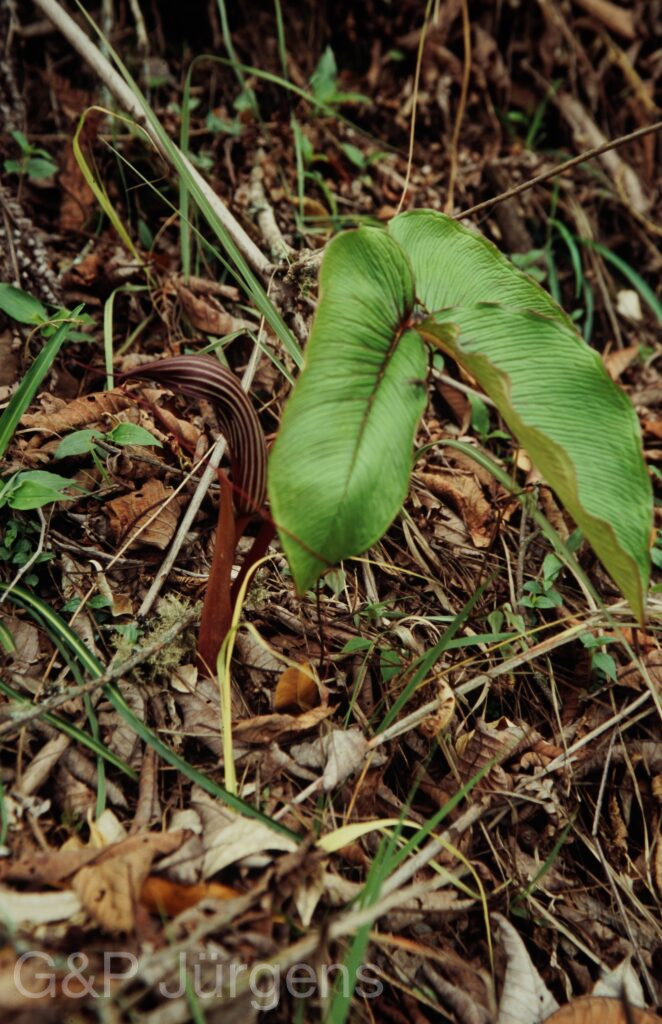
Bhutan Tongsa 2000m, May
Bhutan2014 462
Bhutan Tongsa 2000m, May
Sikkim2004 118 P202
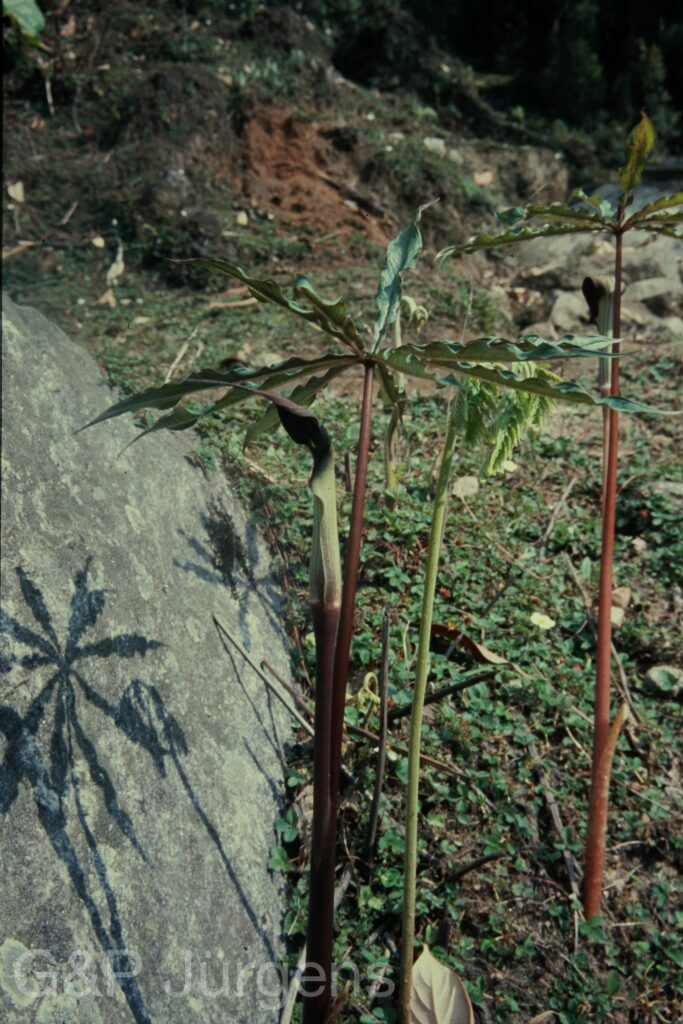
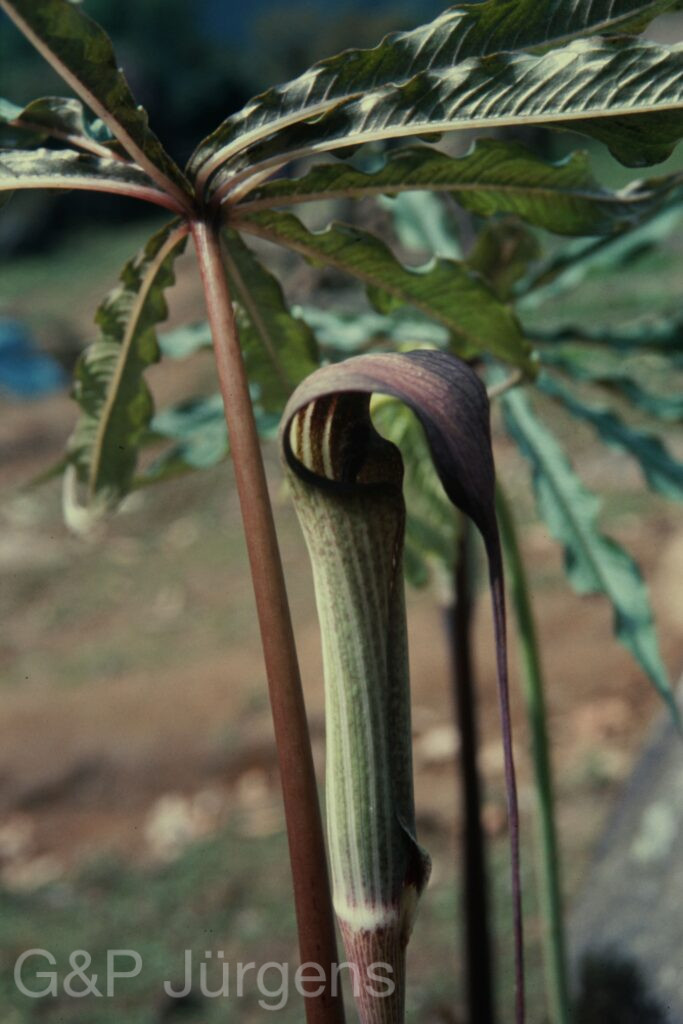
India West-Bengal, Utaray 2200m April

Description

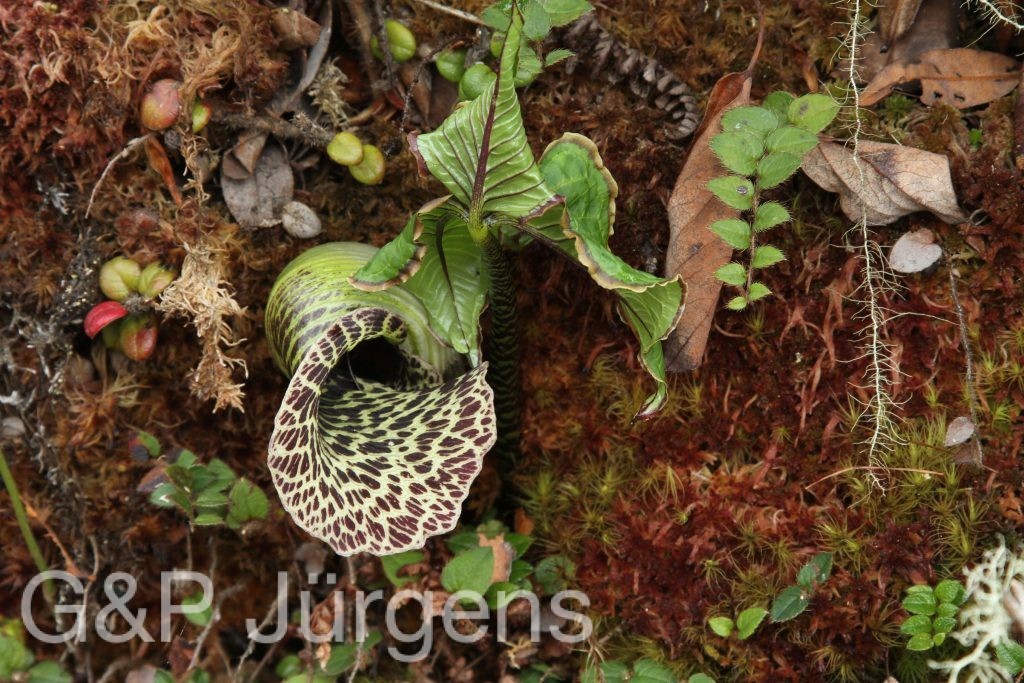
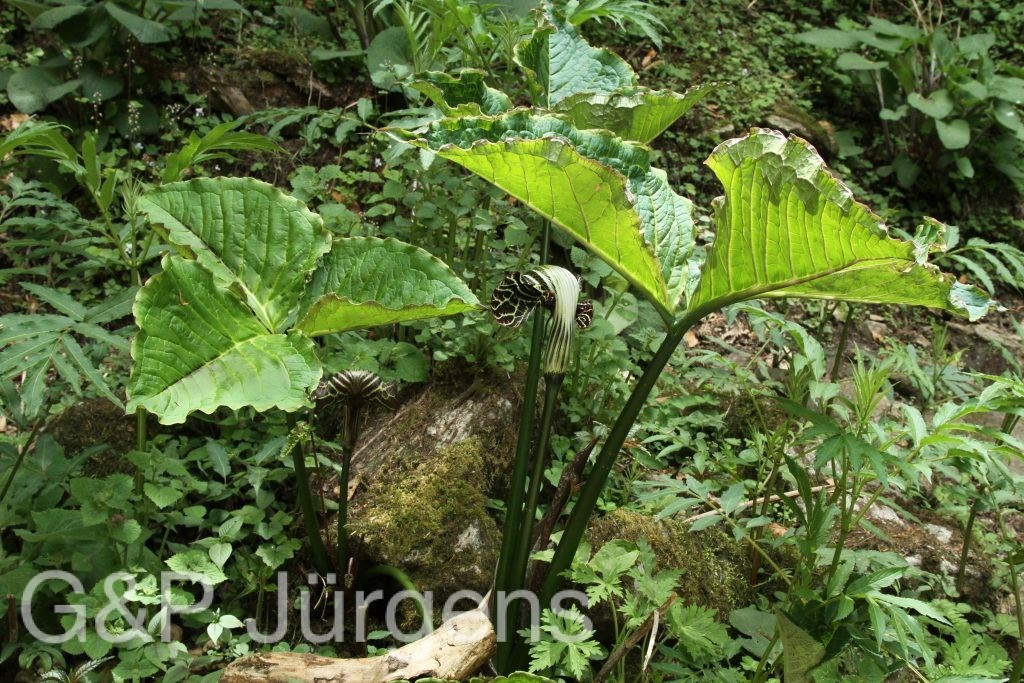
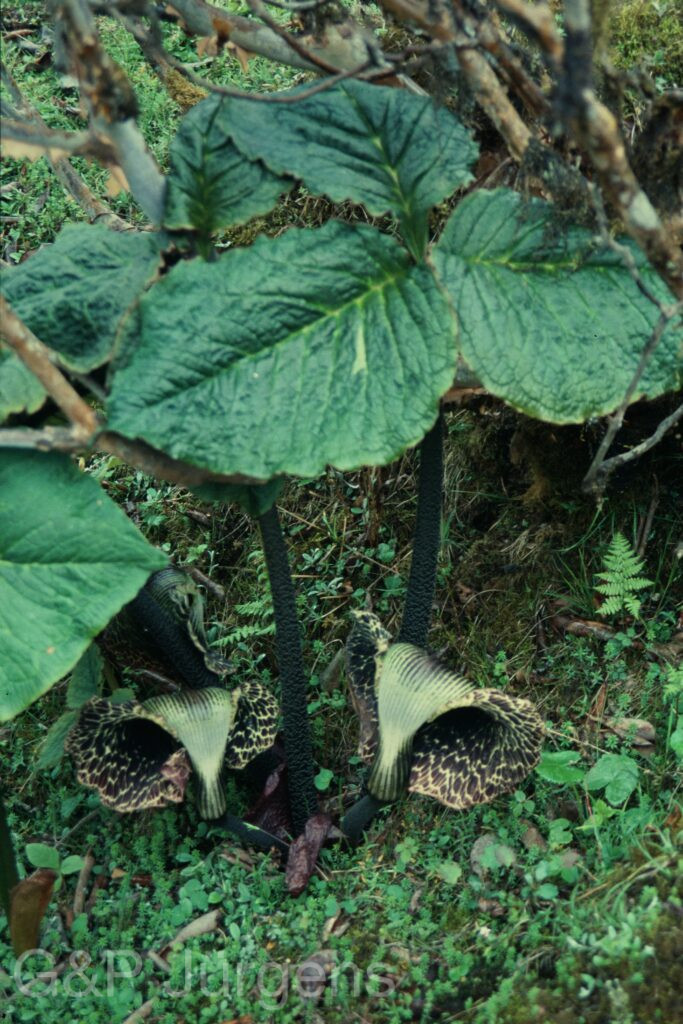
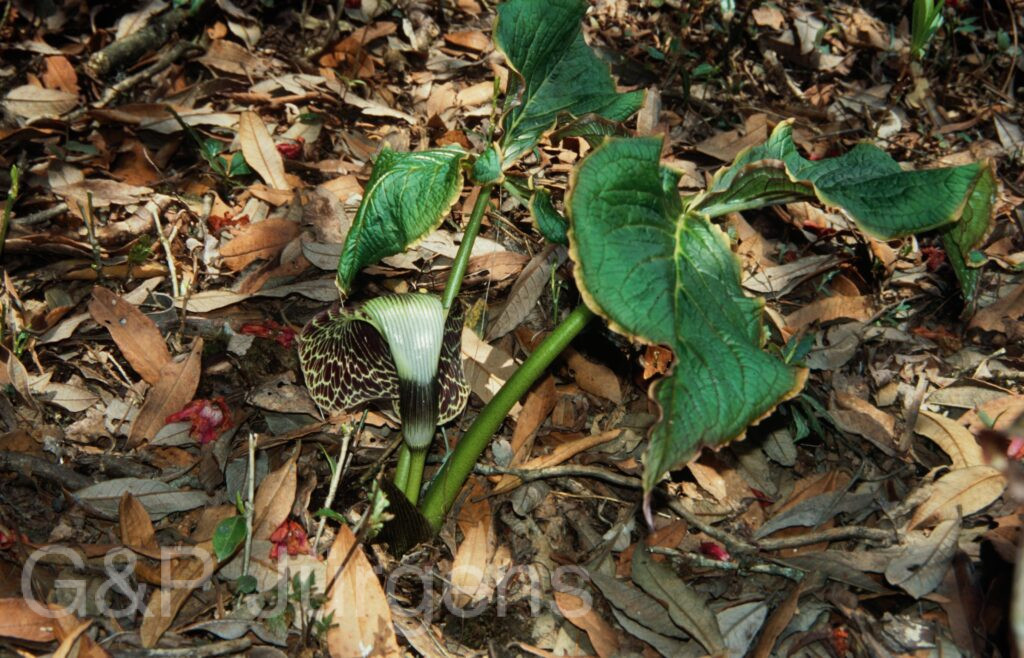
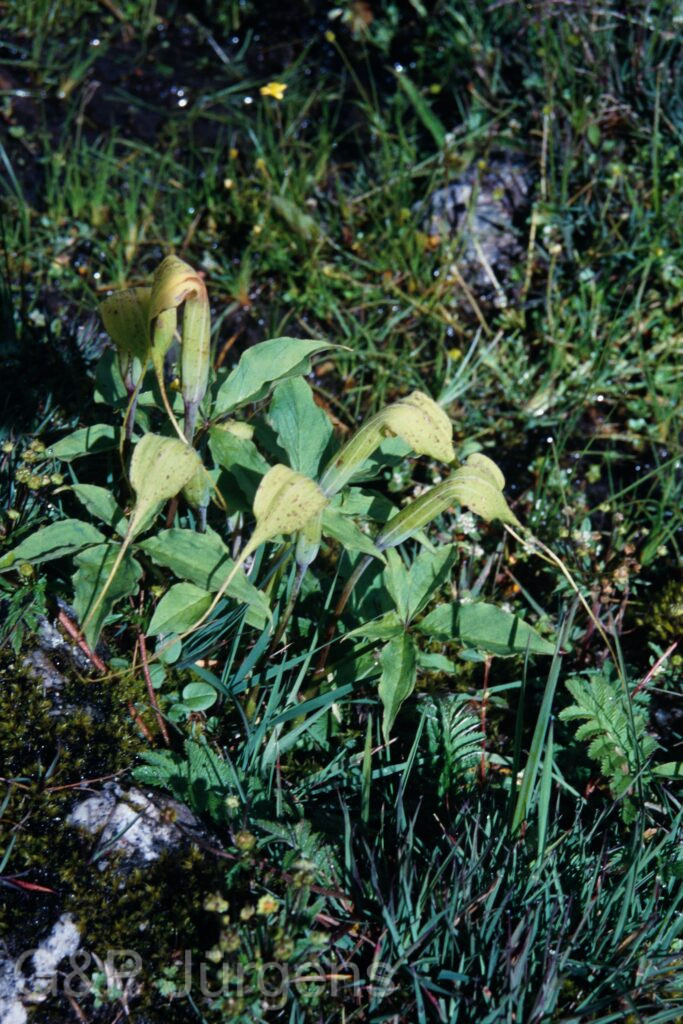
Arisaema concinnum Schott is a tuberous aroid of the temperate Himalaya, ranging through India, Nepal, China, Bhutan, Myanmar and Pakistan. It is recorded from Bhutan at Tongsa near 2000 m, flowering in May, and from Utaray in West Bengal at about 2200 m in April, within the warm to cool temperate forest belt. The species grows in moist, shaded broadleaved and mixed forest, on humus-rich slopes, in ravines and along streamsides, typically between 1800 and 3000 m, where deep leaf litter and consistent monsoonal moisture favour its growth. Its roughly 216 GBIF records reflect a fairly wide but localised montane distribution.

The plant arises from a depressed globose tuber, producing usually a single large radiate leaf divided into numerous (commonly 7–15) lanceolate, acuminate leaflets arranged in a spreading pedate fan. The inflorescence is the characteristic aroid spadix enclosed in a spathe; in this species the spathe tube is greenish and the limb is striped green and white and drawn out into a long, slender, tail-like apex, while the appendix of the spadix is slender and exserted. As in most Arisaema the plants are paradioecious, shifting sex with size and vigour. Pollinated female inflorescences develop a dense club of red berries, each containing few seeds.

Arisaema concinnum belongs to a large, taxonomically intricate genus centred on the Sino-Himalaya, where rapid diversification and sex-lability have produced many closely allied species. Pollination is effected by fungus gnats lured into the spathe, a system in which the female trap can be lethal to the visiting insect. Widespread across its range, the species is not considered threatened, though forest clearance and tuber collection may locally reduce populations.

Author: Schott · Sources: POWO (Kew), GBIF, Flora of China, Flora of Bhutan, Flora of Nepal, The Genus Arisaema (Gusman & Gusman)

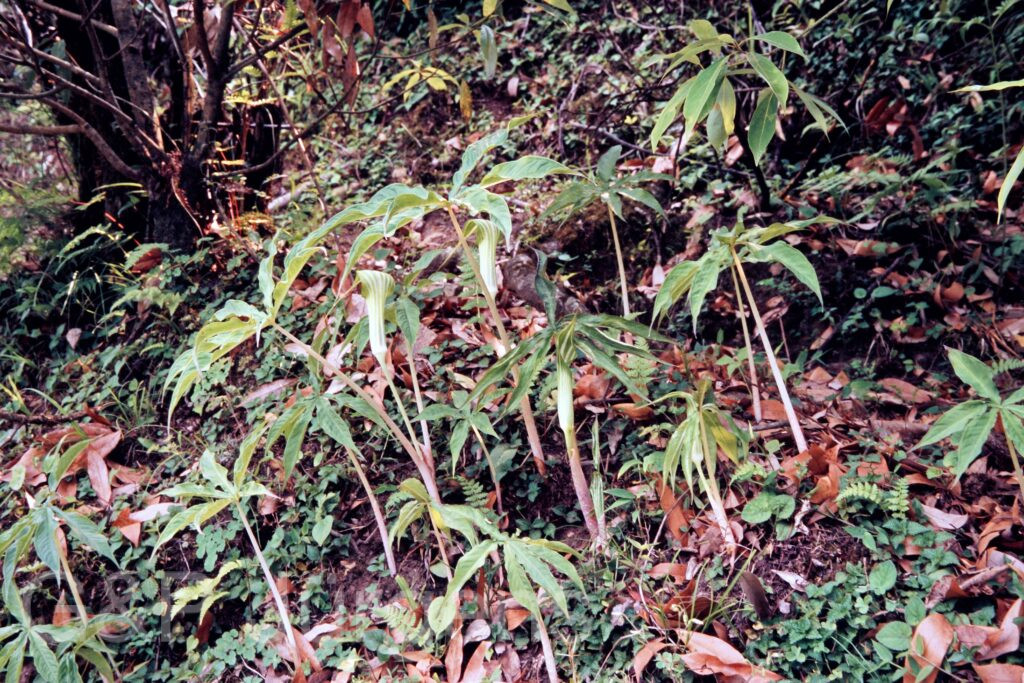
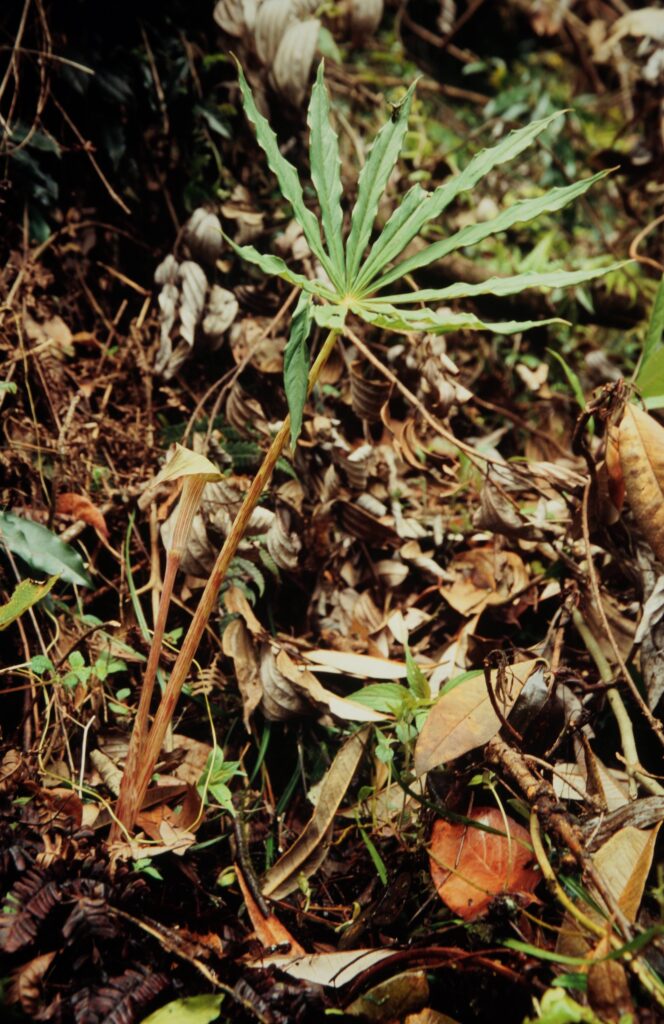
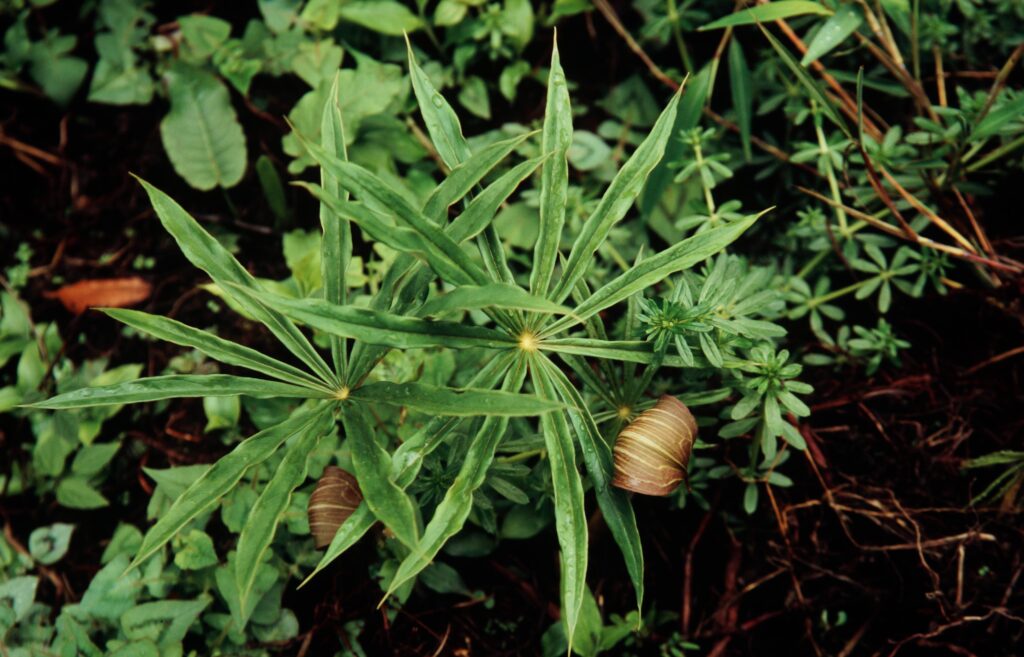
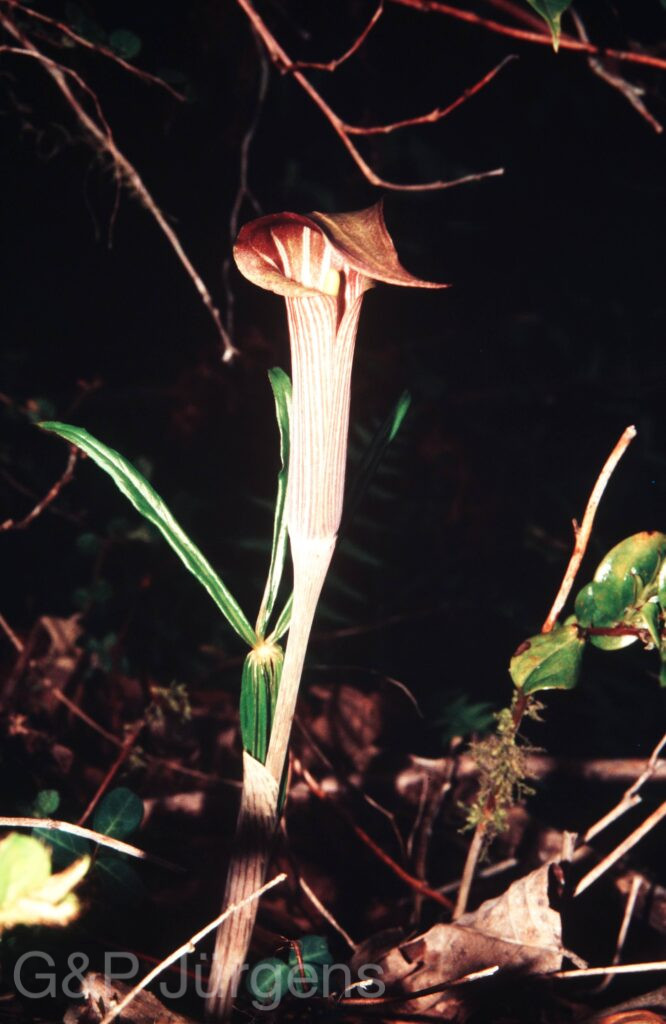
Schott

Bhutan2014 114
Bhutan Kadi 1600m, May
Bh09 254 P423
Bhutan Phobjika, 2900m June
Nepal 99 234 ergebnis
West-Nepal Gattalekh 2800m, June

Description

Arisaema consanguineum Schott is a widespread tuberous aroid of the Sino-Himalayan region, recorded from China, Taiwan, Thailand, Nepal, Bhutan, India, Myanmar, Vietnam, the Philippines, Laos and Japan, with cultivated records reaching Europe and North America; GBIF documents over 2000 occurrences. It grows in shaded forest, forest margins, bamboo thickets, scrub and grassy slopes, generally between about 1500 and 3300 m. The illustrated plants were recorded at Kadi (1600 m, May) and Phobjika (2900 m, June) in Bhutan and at Gattalekh in West Nepal (2800 m, June), spanning the warm-temperate to cool-temperate montane zone where this jack-in-the-pulpit emerges with the early monsoon.

The plant arises from a depressed-globose tuber, producing a stout pseudostem sheathed by the mottled petiole bases. There is usually a single radiate (pedately compound) leaf bearing numerous narrow, lanceolate leaflets that frequently terminate in long, threadlike drip-tips and are sometimes silvery-banded. The inflorescence is a spadix enclosed by a green to purplish, white-striped spathe whose limb arches forward; the spadix appendage is slender and elongate. Plants are typically dioecious, sex expression varying with tuber size. The fruit is a dense cylindrical infructescence of red berries borne on the persistent spadix.

A member of the species-rich genus Arisaema, this taxon belongs to the radiate-leaved Sino-Himalayan group and is prized in horticulture for its striking foliage. Sex change linked to plant vigour is an ecological hallmark of the genus, and the showy berries are bird-dispersed. The species is common and adaptable, not of conservation concern, though wild tubers are locally harvested for traditional medicine.

Author: Schott · Sources: POWO (Kew), GBIF, Flora of China, Flora of Bhutan, Annotated Checklist of the Flowering Plants of Nepal, Gusman & Gusman The Genus Arisaema

Arisaema costatum

by GP Jürgens

Mart.

Nepal 97 313 P617
Nepal Honngaon 2300m May
Nepal 1994 192 ergebnis
Ost-Nepal Mewa-Khola
2100m April
Nepal 2009 98 ergebnis
Nepal Helambu Samathang 2410, May

Description

Arisaema costatum is a tuberous aroid of the central and eastern Himalaya, recorded by GBIF from Nepal, China, India and Bhutan across about 99 occurrences. It is a herb of moist, shaded broadleaved and mixed forest, forest margins, ravines and damp humus-rich slopes at mid montane elevations. The photographed plants come from Nepal at Honngaon (2300 m, May), eastern Nepal in the Mewa-Khola (2100 m, April) and the Helambu at Samathang (2410 m, May), a consistent band of cool, humid forest understorey where this cobra-lily emerges with the spring rains.

The plant arises from a depressed globose tuber and typically produces a single large pedate leaf divided into numerous lanceolate, acuminate leaflets, the central one largest, the lamina conspicuously ribbed, the costae giving rise to the epithet costatum. The inflorescence is a spadix enveloped by a spathe whose tube is greenish and the limb dark purple to maroon, strongly striped with white, and drawn out into a long, slender, pendent filiform tail. Arisaema species are commonly paradioecious, individuals shifting sex with size and vigour: smaller plants bear staminate flowers, larger ones pistillate. Pollinated by fungus-gnats lured into the spathe, fertile plants ripen a dense club of bright red berries.

GBIF accepts the name. The genus Arisaema is a centre of Himalayan diversity, with A. costatum among its most striking species for the boldly white-striped, long-tailed spathe. The size-dependent sex change is an adaptive reproductive strategy linked to tuber resources. Widespread within suitable forest, the species is not regarded as threatened, though forest clearance locally reduces its habitat.

Author: Mart. · Sources: POWO (Kew), GBIF, Flora of Nepal, Flora of China, Gusman monograph of Arisaema

Arisaema echinatum

by GP Jürgens

(Wall.) Schott

Sikkim2004 326 P587
Sikkim/India Kokchurong 3400m May
Sikkim2004 327 P588
Sikkim/India Kokchurong 3400m May
Garh 07 86 ergebnis
India Garhwal Trijugi Narayan 2450m, June

Description

Arisaema echinatum is a tuberous aroid of the Himalaya, distributed through China, Nepal, India and Bhutan, with about 44 georeferenced records spread along the temperate to subalpine Himalayan belt. It grows in moist, shaded forest, among rhododendron and conifer scrub and on humus-rich banks, generally between 2400 and 3500 m. The cited collections from Kokchurong in Sikkim (3400 m, May) and from Trijugi Narayan in Garhwal (2450 m, June) bracket its altitudinal range and show its emergence and flowering through the late spring and early monsoon as the soil warms.

The plant arises from a depressed-globose tuber and usually bears one or two pedately compound leaves, each divided into several oblong-elliptic, acuminate leaflets borne on a long sheathing petiole. The inflorescence comprises a spathe with a cylindrical tube and an incurved, acuminate limb, enclosing the spadix; the diagnostic feature is the sterile appendix of the spadix, which is roughened or echinate with projecting papillae or processes, giving the species its name. As in most Arisaema the plants are sequentially hermaphrodite, shifting sex with size. The infructescence is a dense head of crowded scarlet berries.

Arisaema echinatum, transferred to the genus by Schott from Wallich's basionym, belongs to the taxonomically intricate Himalayan section of the genus, where appendix morphology is a key diagnostic. Pollination is by small flies and fungus gnats lured into and temporarily trapped by the spathe, and the bright berries are bird-dispersed. With a restricted montane range and few records, it is potentially sensitive to forest loss, though it has not been formally assessed for conservation.

Author: (Wall.) Schott · Sources: POWO (Kew), GBIF, Flora of China, Flora of Bhutan, Annotated Checklist of the Flowering Plants of Nepal, Gusman & Gusman The Genus Arisaema

Schott

Nepal 2009 91 ergebnis
Nepal 2009 102 ergebnis

Both: Nepal Bolgoan, 1980m, May

Description

Arisaema erubescens is a widespread tuberous aroid distributed from the Himalaya across much of eastern and southeastern Asia. Its extensive range spans Nepal, northern India (from Uttarakhand to Arunachal Pradesh), Bhutan, Myanmar, Thailand, Vietnam, Taiwan, and much of China, with naturalised populations reported from several other countries. GBIF records over 1,350 occurrences, reflecting its broad distribution. The species inhabits the understorey of subtropical and warm temperate broadleaved forests, forest margins, and shaded ravines at elevations of 900–3,000 m. The photograph from Bolgoan in Nepal at 1,980 m, taken in May, shows the species during its characteristic spring emergence.
The plant arises from a depressed-globose tuber, 2–5 cm in diameter. The pseudostem is 15–40 cm tall, sheathed by cataphylls. Leaves are usually solitary, pedate with 7–15 leaflets; leaflets are elliptic to lanceolate, acuminate, the central one largest, 8–18 cm long, with entire or slightly undulate margins. The spathe is 8–15 cm long, with a tubular lower portion that is green striped with white or pale purple, and an arching, ovate-lanceolate limb that is typically purple-brown to dark maroon — the blushing colour referenced in the epithet erubescens. The spadix appendage is elongate, cylindrical, projecting well beyond the spathe tube, often sigmoid or pendulous. Plants are dioecious or sequentially monoecious. The infructescence is a dense cluster of bright red, globose berries.
Arisaema erubescens is taxonomically variable across its vast range, and several varieties have been described, including var. erubescens and var. onoticum. The species complex has been the subject of considerable systematic revision, as morphological boundaries with related taxa such as A. consanguineum can be subtle. It is one of the most commonly encountered Arisaema species in Himalayan forests and is not considered threatened. The tubers contain calcium oxalate crystals and are toxic if ingested raw, though they have been used in traditional medicine in several cultures.

Author: Schott · Sources: POWO (Kew), GBIF, Li & Hay: Araceae in Flora of China Vol. 23, Pradhan: Himalayan Cobra-Lilies (1997)

Hara

Nepal 2009 20 ergebnis
Nepal Helambu Koktrok 2500m, May

Description

Arisaema exappendiculatum is a Himalayan tuberous aroid of restricted distribution. GBIF holds only some 43 occurrences, chiefly from Nepal and adjacent China, with a handful of herbarium-derived European records (Belgium). It is a plant of moist temperate broadleaved and mixed forest, shaded ravines and shrubby slopes, growing in humus-rich soils. The illustrated plant was photographed in the Helambu region of central Nepal near Koktrok at about 2,500 m in May, a typical station within its montane band of roughly 2,000–3,000 m, where it emerges and flowers with the onset of the pre-monsoon rains.

The plant arises from a depressed-globose tuber producing usually a single leaf with a long sheathing petiole. The leaf is pedately divided into several oblong-lanceolate, acuminate leaflets. The inflorescence is a spathe with a convolute tube and an arching, acuminate limb, greenish to purplish and often pale-striped. As the epithet indicates, the spadix appendix is reduced or absent (exappendiculate), the spadix tapering abruptly above the fertile zone. The plants are dioecious, sex expression depending on tuber size; the fruiting spadix bears a cluster of red berries.

The absence of a developed spadix appendage distinguishes A. exappendiculatum within the predominantly Asian genus Arisaema and aligns it with related Himalayan species. Owing to its narrow range and modest population sizes it warrants monitoring, though no formal IUCN assessment is established. Note that the input wp_link references A. erubescens, with which this taxon should not be confused.

Author: Hara · Sources: POWO (Kew), Flora of Nepal, Flora of China Vol. 23, GBIF, Gusman & Gusman: The Genus Arisaema (2006)

Arisaema griffithii

by GP Jürgens

Schott

Bhutan2014 360
Bhutan Tumching-La 3100m, May
Bhutan2014 830
Bhutan Thimphu 2450m, May
Sikkim2004 399 P681
Sikkim/India Lachung 3200m
Nepal 2001 104 ergebnis ergebnis
East-Nepal Gupka Pokhari 3050m, April

Description

Arisaema griffithii is an eastern Himalayan tuberous geophyte distributed through Nepal, Sikkim and Darjeeling in India, Bhutan, and into adjacent southern China (Xizang, Yunnan) and northern Myanmar, with georeferenced records also from Bangladesh. It is a plant of the cool temperate zone, growing in shaded moist forest, shrubberies, forest clearings and grassy slopes broadly between 2400 and 3600 m. The images document its altitudinal span, from Bhutan's Tumching-La at 3100 m and Thimphu at 2450 m flowering in May, to Lachung in Sikkim at 3200 m and Gupka Pokhari in east Nepal at 3050 m in April.

The plant arises from a depressed tuber and typically bears two trifoliolate leaves with broadly ovate to rhombic, acuminate leaflets, the lateral pair often oblique. The species is celebrated for its remarkable inflorescence: the spathe is large and deeply purple, conspicuously net-veined with pale reticulation, with the tube broadly funnel-shaped and the lamina arched and downturned, its margins recurved. The spadix appendix is exserted and elongated into a long, pendent whip-like flagellum. The plants are dioecious, with small unisexual flowers crowded at the base of the spadix, and the female inflorescence develops a cluster of red berries at maturity.

Within Araceae, A. griffithii belongs to section Sinarisaema and is one of the most distinctive members of the genus, named for William Griffith. Its drooping, intricately veined spathe lures fungus-gnat and small fly visitors into the inflorescence. Prized among specialist gardeners, it remains locally frequent and is not considered globally threatened, though vulnerable to habitat loss and tuber collection.

Author: Schott · Sources: POWO (Kew), GBIF, Flora of Bhutan, Flora of China, Gusman & Gusman 'The Genus Arisaema: A Monograph for Botanists and Nature Lovers'

Blume

Nepal 2001 241 ergebnis ergebnis
Nepal (Gorkha) Niuli Kharka 2600m, May
Nepal 2001 242 ergebnis ergebnis
Nepal (Gorkha) Niuli Kharka 2600m, May
Garh 07 264 ergebnis
India Garhwal Belag Khal 2800m, June

Description

Arisaema intermedium is a Himalayan tuberous aroid distributed along the temperate forest belt of the central and eastern Himalaya, recorded by GBIF from India, Nepal, China, Bhutan and Pakistan across some 118 georeferenced collections. It is a plant of moist, humus-rich woodland floors, shady banks, forest clearings and the margins of rhododendron, oak and conifer forest, where it emerges with the onset of the pre-monsoon and monsoon seasons. Its typical elevational band lies between roughly 2,400 and 3,200 m, consistent with the documented occurrences from Niuli Kharka in the Nepalese district of Gorkha at about 2,600 m in May and from Belag Khal in Garhwal, India, at around 2,800 m in June. The flowering coincides with the early growing season before the leaf is fully expanded.

The species grows from a subglobose underground tuber and produces a solitary leaf divided into three leaflets, the central leaflet broadly ovate to rhombic and the laterals obliquely ovate, the blade often somewhat undulate and acuminate. The inflorescence is a typical aroid spathe-and-spadix structure, the pseudostem and peduncle arising together; the spathe tube is greenish and the limb arched, frequently striped purplish and white with a long-acuminate apex. The diagnostic feature of the genus is the spadix appendage, which in this species is elongate and gradually tapering, projecting forward beyond the spathe mouth. As in other Arisaema the plants are paradioecious, smaller individuals bearing male flowers and larger ones female; pollinated female spadices develop into a dense club of fleshy red berries at maturity.

Arisaema intermedium belongs to a notoriously variable complex within section Sinarisaema, and its delimitation against allied taxa such as A. propinquum has long occupied aroid systematists. The genus exemplifies size-dependent sex change (sequential hermaphroditism keyed to tuber reserves), a reproductive strategy of considerable interest to evolutionary ecologists, with pollination effected by fungus-gnats and small flies trapped within the spathe. Though not formally assessed as threatened and locally frequent within its range, the species shares the general vulnerability of forest-floor Himalayan herbs to habitat degradation and the harvesting pressures that affect tuberous aroids.

Author: Blume · Sources: POWO (Kew), GBIF, Flora of China Vol. 23, Flora of Bhutan Vol. 3, Flora of Nepal, Flora of Pakistan, Gusman & Gusman: The Genus Arisaema, A Monograph for Botanists and Nature Lovers

Blume

Sikkim2003 240 P330
Sikkim Dzongri 3920m, August
Sikkim2003 387 P547
Sikkim Dzongri 3920m, August

Description

Arisaema jacquemontii is a slender alpine cobra-lily widely distributed across the Himalaya, ranging from Afghanistan and Pakistan eastward through northern India, Nepal and Bhutan into south-western China. GBIF records some 568 occurrences, the core lying in India, Nepal, China, Pakistan and Bhutan, with additional cultivated or vouchered material reported from Britain, Belgium and Canada. The species inhabits subalpine and alpine meadows, open forest margins, shrubberies and moist grassy slopes, generally between about 2400 and 4500 m. The plant shown was photographed in Sikkim near Dzongri at 3920 m in August, a high pasture setting typical of its summer flowering on the eastern Himalayan ridges.

The plant grows from a depressed, subglobose tuber and produces usually a single pedately divided leaf with five to eleven elliptic-lanceolate, acuminate leaflets borne on a green, sometimes faintly mottled petiole sheathed at the base. The inflorescence is a spathe with a green tube and an erect to slightly arched, narrowly acuminate limb striped green and white. The spadix bears a slender, cylindrical, greenish appendix shorter than the spathe; the species is dioecious, with sterile or fertile zones of minute unisexual flowers concealed within the tube. The fruit is a dense club-shaped infructescence of orange-red berries each containing few seeds.

Arisaema, the largest genus of the Araceae in temperate Asia, exhibits remarkable sexual lability, individual tubers shifting between male and female expression with size and resource status. A. jacquemontii belongs to the section characterised by green, unmottled spathes and is among the most widespread and hardy Himalayan species, frequently grown by alpine gardeners. It is not considered threatened, though high-altitude collection and grazing locally affect populations.

Author: Blume · Sources: POWO (Kew), GBIF, Flora of China, Flora of Bhutan, The Genus Arisaema: A Monograph for Botanists and Nature Lovers, Aroids: Plants of the Arum Family