Tag:

Nepal

Flowers of Nepal — 1313 wild plant species documented from the Nepalese Himalaya, from subtropical foothills to high alpine meadows above 4,000 m. Nepal’s dramatic elevation gradient makes it one of the richest botanical regions on Earth, home to rhododendrons, primulas, gentians and the famed blue poppies (Meconopsis). Every entry gives a botanical description, native distribution, habitat and flowering season, alongside the original field photograph and the location where it was taken.

Mart.

Bhutan2014 32
Bhutan, Trashigang 1300m, May
Nepal 97 432 G839
Nepal Tashigaon 3100m May
Nepal 1994 269 ergebnis
Ost-Nepal Milka-Danda 3200m May 
Nepal1992 184 P270 ergebnis
Nepal Banyang 1900m March 

Description

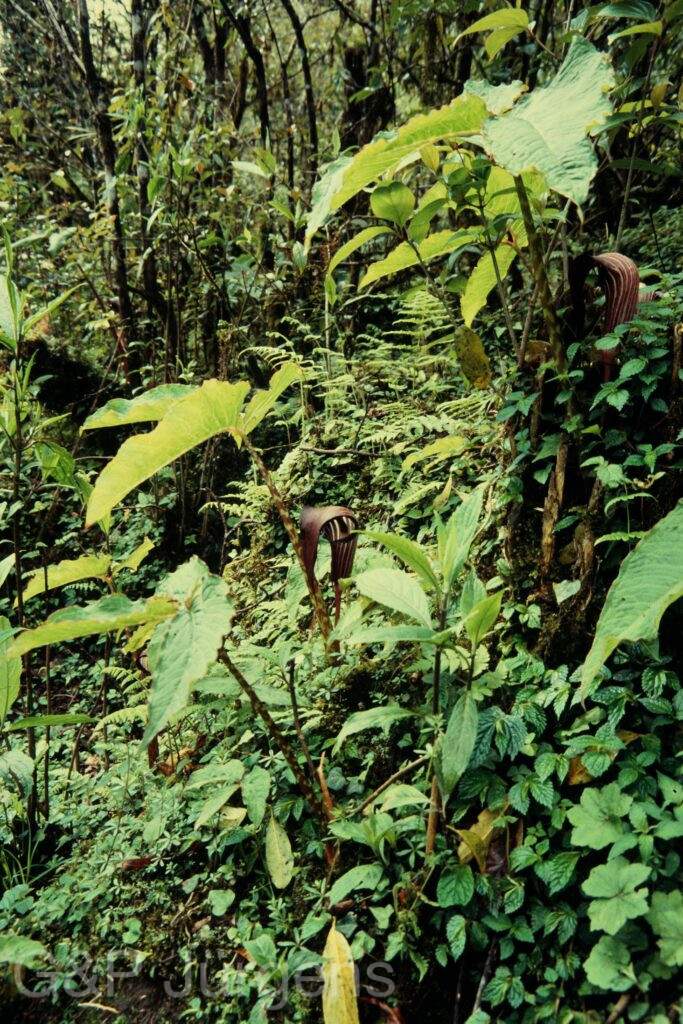
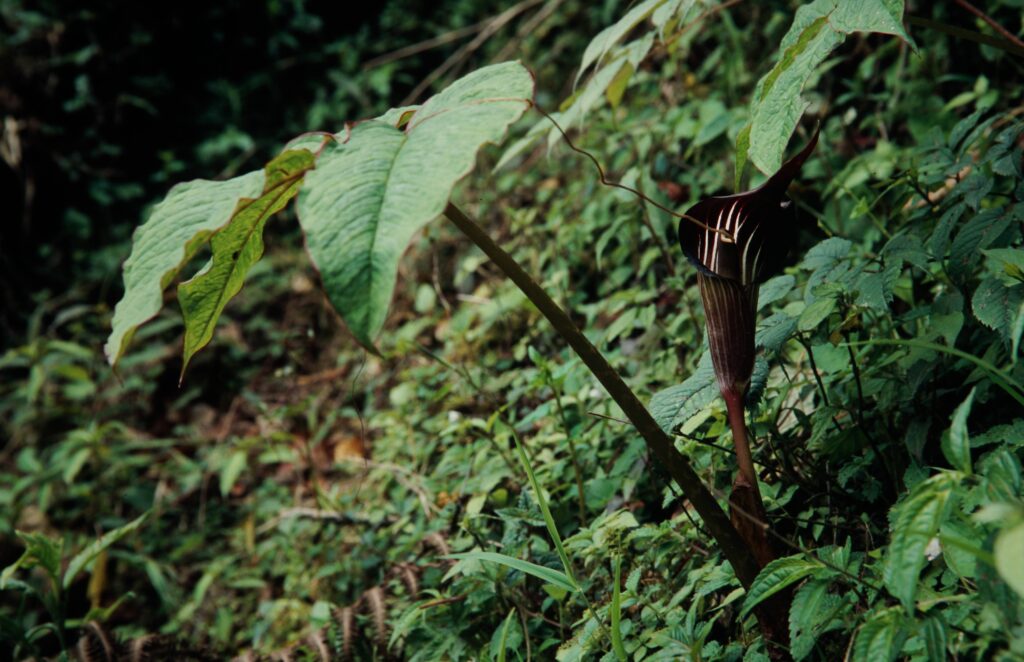
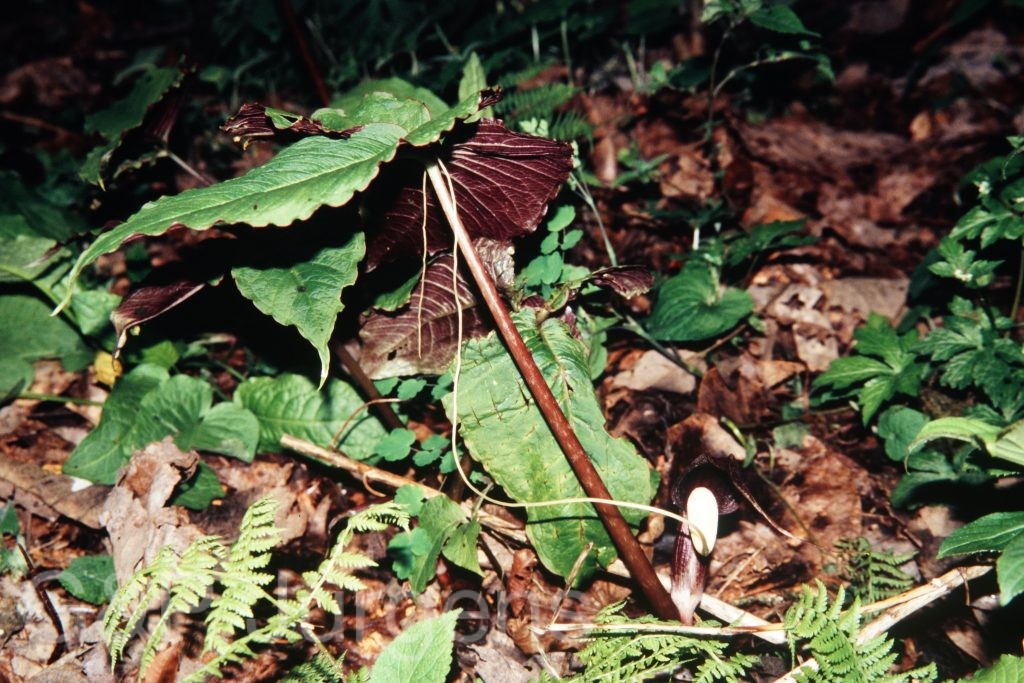
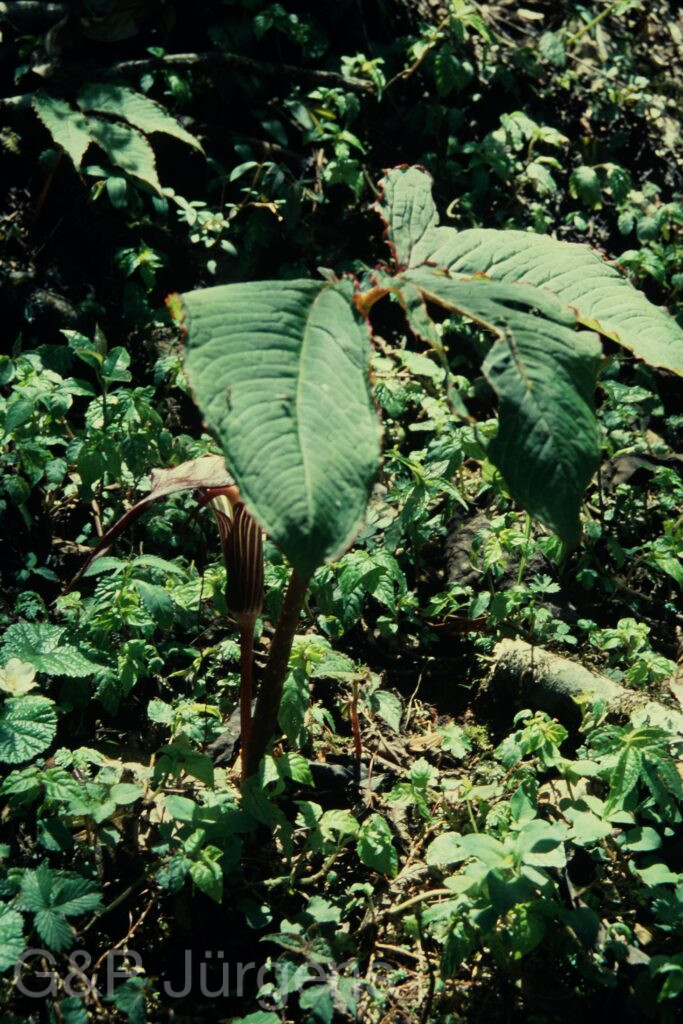
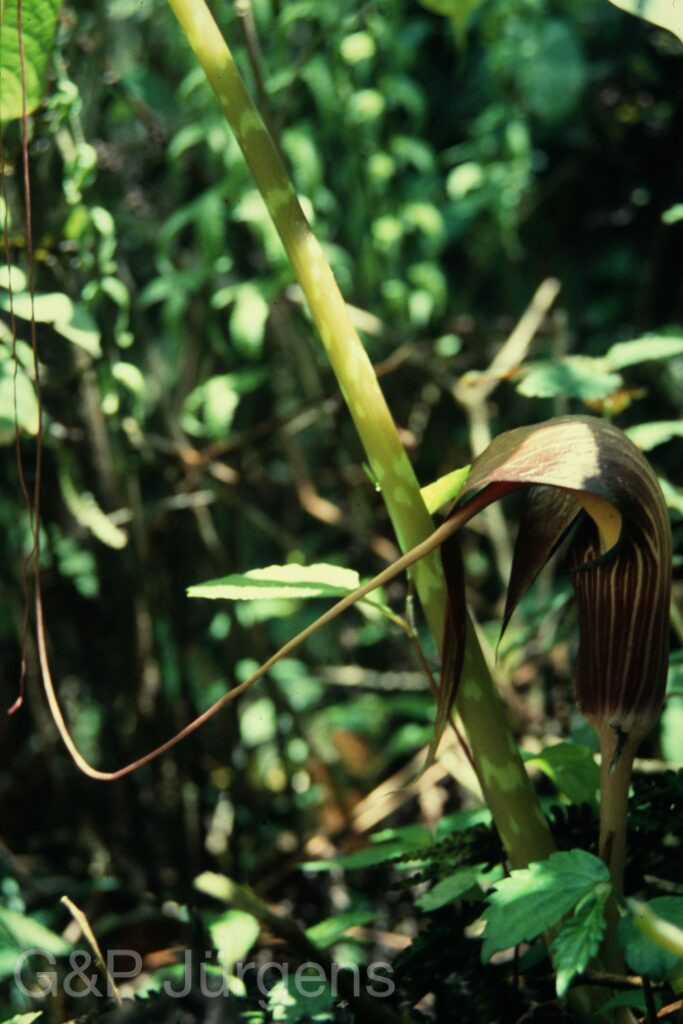
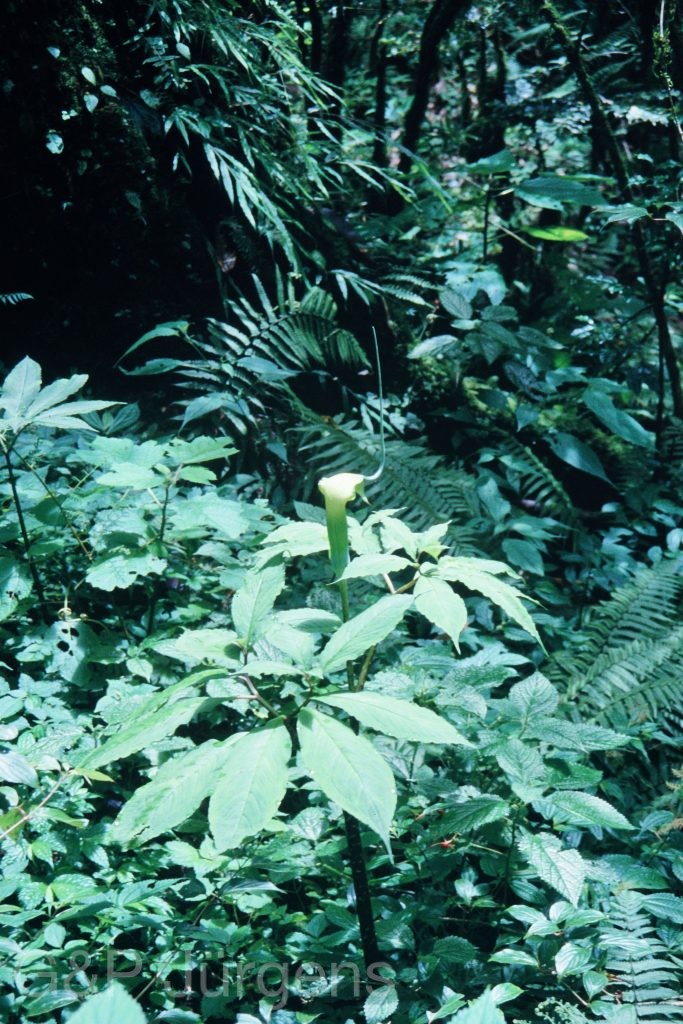
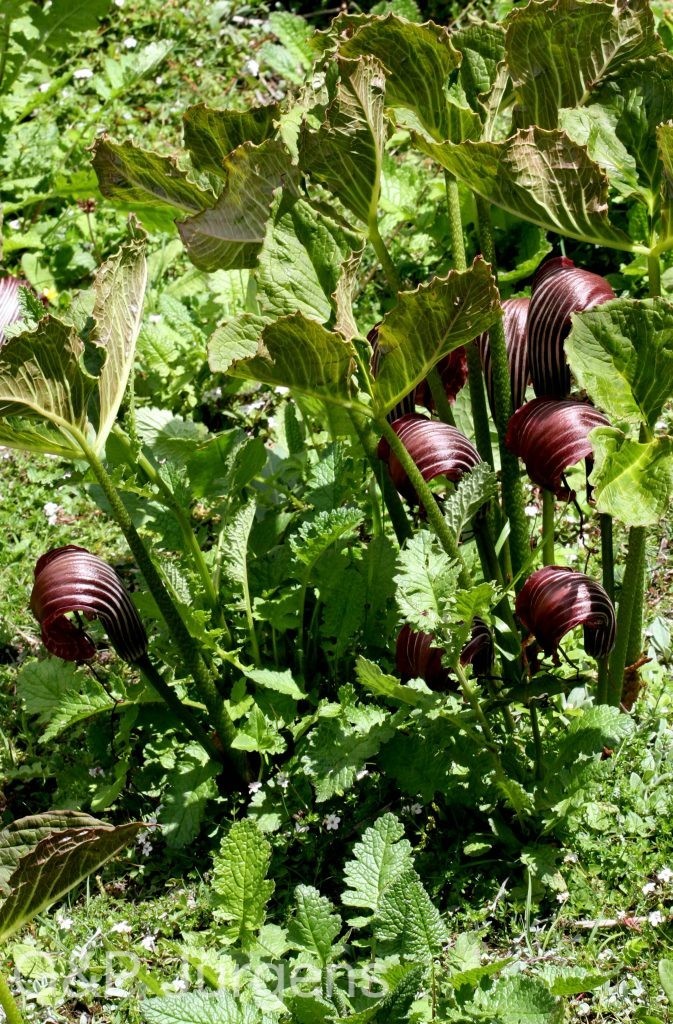
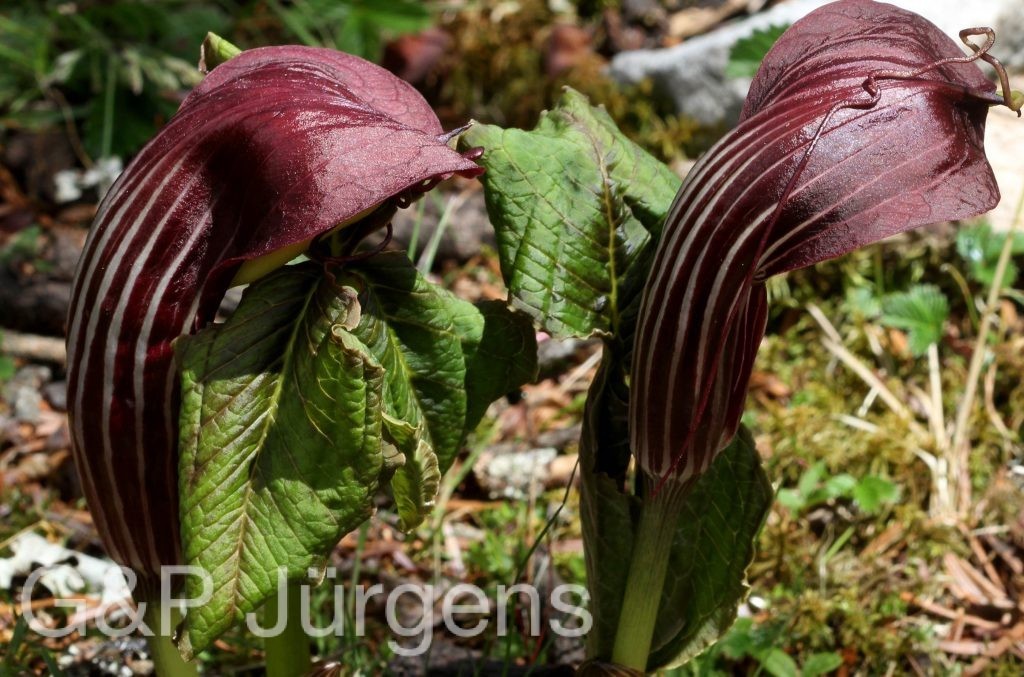
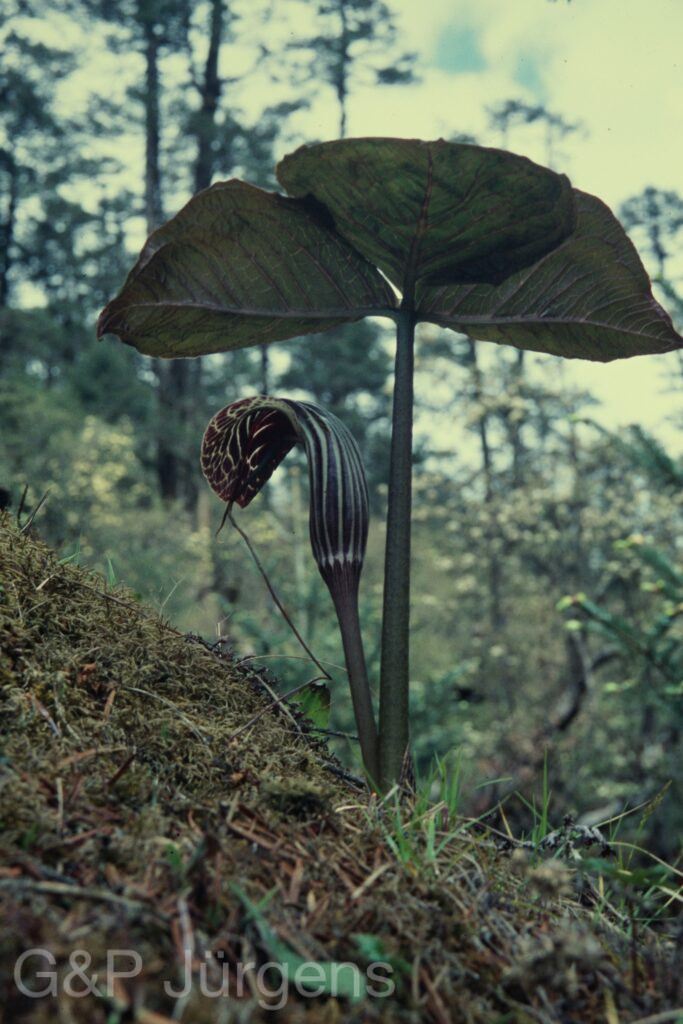
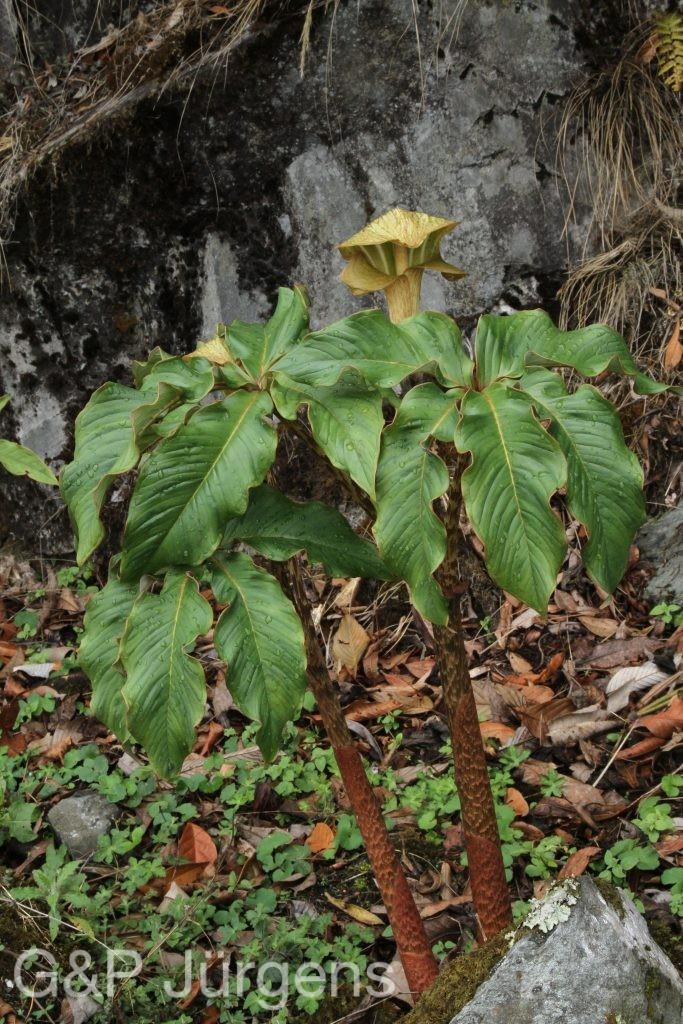
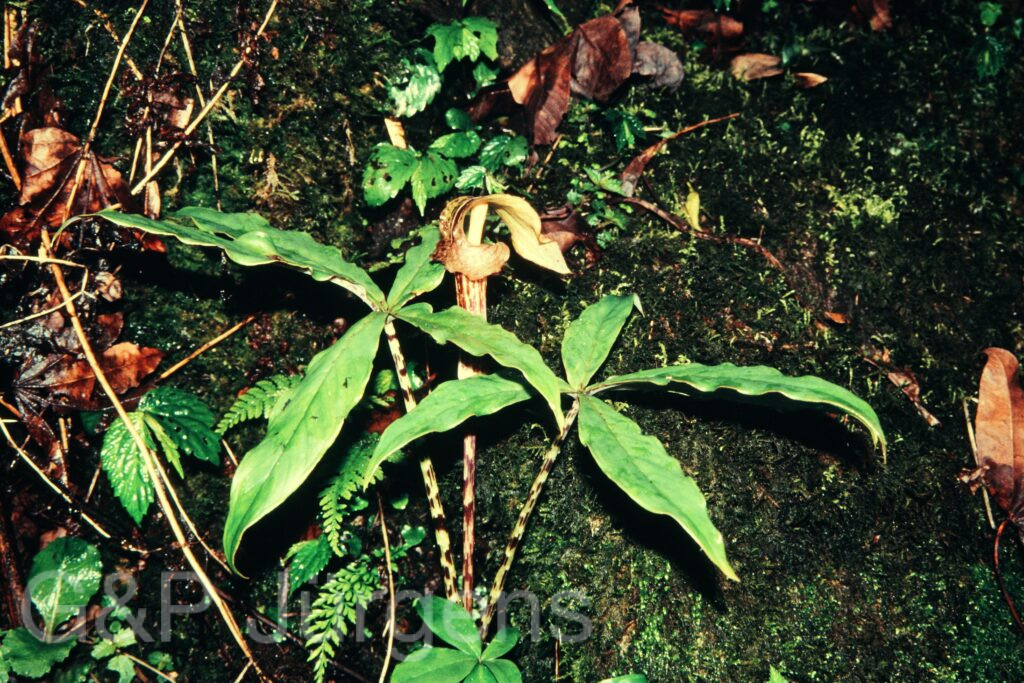
Arisaema nepenthoides is a Himalayan cobra lily distributed from Nepal eastward through Sikkim, Bhutan and north-east India to Myanmar and south-western China, with about 322 GBIF occurrences reflecting its montane range. It is a herb of cool temperate to subalpine forest, growing in moist broad-leaved and conifer-Rhododendron forest, shady banks and forest margins, broadly from 1,900 to 3,600 m. The localities recorded for the photographed plants span this range, from Trashigang in eastern Bhutan at 1,300 m and Banyang in Nepal at 1,900 m to Tashigaon at 3,100 m and Milka Danda at 3,200 m, flowering between March and May as the snows recede.

It is a tuberous perennial arising from a depressed corm, producing a stout, conspicuously mottled pseudostem patterned with brownish-purple and pale markings reminiscent of a snake's skin. Usually two leaves are produced, each pedately divided into several elliptic to oblanceolate leaflets. The inflorescence is a spadix enclosed in a spathe whose tube is greenish and prominently striped, opening into a hooded, incurved limb that recalls the pitcher of a Nepenthes, hence the epithet nepenthoides. The species is dioecious, with the sexes distinguished by the spadix appendage; pollinated female plants develop a dense head of orange-red berries, each with few seeds.

Arisaema is a large genus centred on the Sino-Himalayan region, and A. nepenthoides belongs to a group recognised by its mottled pseudostem and distinctive hooded spathe. Like many relatives it shows sequential gender change, individuals functioning as male when small and as female once the tuber attains sufficient size, an adaptation to resource availability. Pollination is effected by fungus gnats and small flies attracted into the spathe chamber. The conspicuous spathe makes it a sought-after ornamental, but it remains widespread and locally common across the eastern Himalaya and is not considered threatened.

Author: Mart. · Sources: POWO (Kew), GBIF, Flora of China, Flora of Bhutan, The Genus Arisaema (Gusman & Gusman), Araceae of the Himalaya
Arisaema propinquum

by GP Jürgens

Schott

Nepal 2001 310 ergebnis ergebnis
Nepal (Gorkha) Kharka 3100m, May
Nepal 2009 24 ergebnis
Nepal Helambu Koktrok 2600m, May

Description

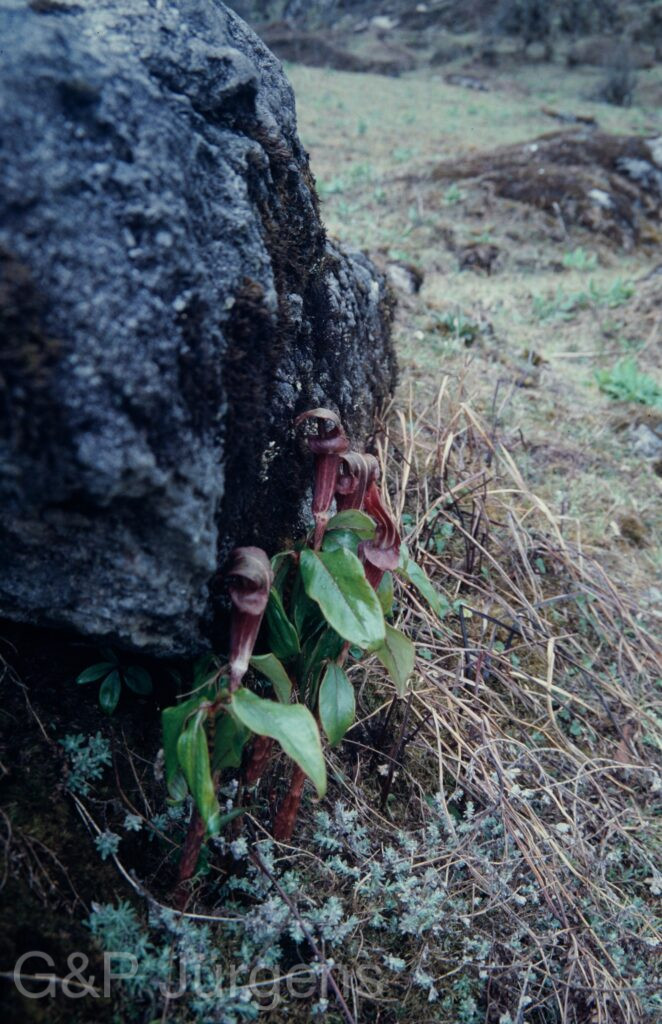
Arisaema propinquum is a Himalayan tuberous aroid distributed from Pakistan and northern India through Nepal, Sikkim and Bhutan into south-western China and Myanmar, with 257 GBIF occurrences across the central and western Himalaya. It grows in moist temperate forest, shrubberies, alpine meadow margins and open slopes, typically between about 2400 and 3700 m. The cited Nepalese collections – from Kharka in the Gorkha district at 3100 m and from Koktrok in Helambu at 2600 m, both in May – place its flowering in the late-spring period as the cobra-lilies emerge with the first monsoon moisture.

It arises from a depressed globose corm and usually produces a single (or paired) leaf divided into three broadly ovate to elliptic leaflets, the lateral ones obliquely based and the whole sometimes flushed purple beneath. The inflorescence is a typical aroid spadix enclosed in a spathe; in A. propinquum the spathe is dark purple with bold whitish or greenish longitudinal stripes, the tube cylindrical and the broad limb arching forward into a long, often filiform tail. The spadix appendage is slender and curved, exserted from the spathe mouth. The fruiting head is a dense ovoid cluster of bright red berries.

Arisaema is a large genus celebrated for paradioecy, in which individuals change sex between female and male states according to size and resources, and for its specialised fly- and fungus-gnat pollination within the trap-like spathe. A. propinquum belongs to the Himalayan striped-spathe assemblage and, while ornamentally prized, remains widespread and is not of conservation concern.

Author: Schott · Sources: POWO (Kew), GBIF, Flora of China, Flora of Bhutan, Annotated Checklist of the Flowering Plants of Nepal, Gusman & Gusman monograph of Arisaema

Arisaema speciosum

by GP Jürgens

(Wall.) Mart.

Nepal 97 439 P855
Nepal Tashigaon 3100m May
Sikkim 2006 6 ergebnis
India West-Bengal Maneybhajang 2000m, May

Description

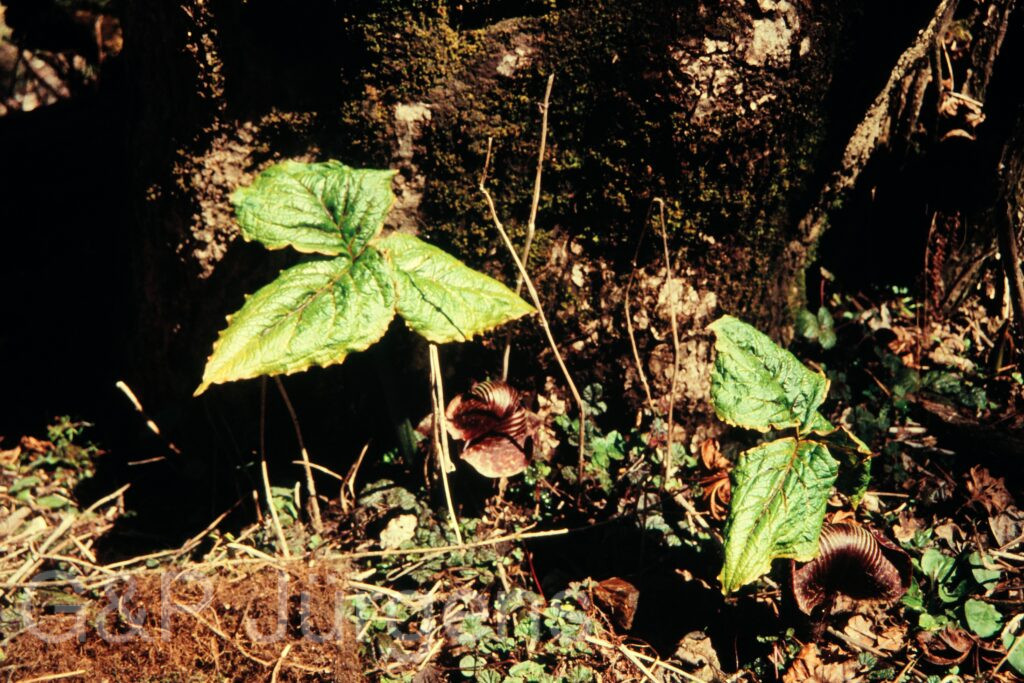
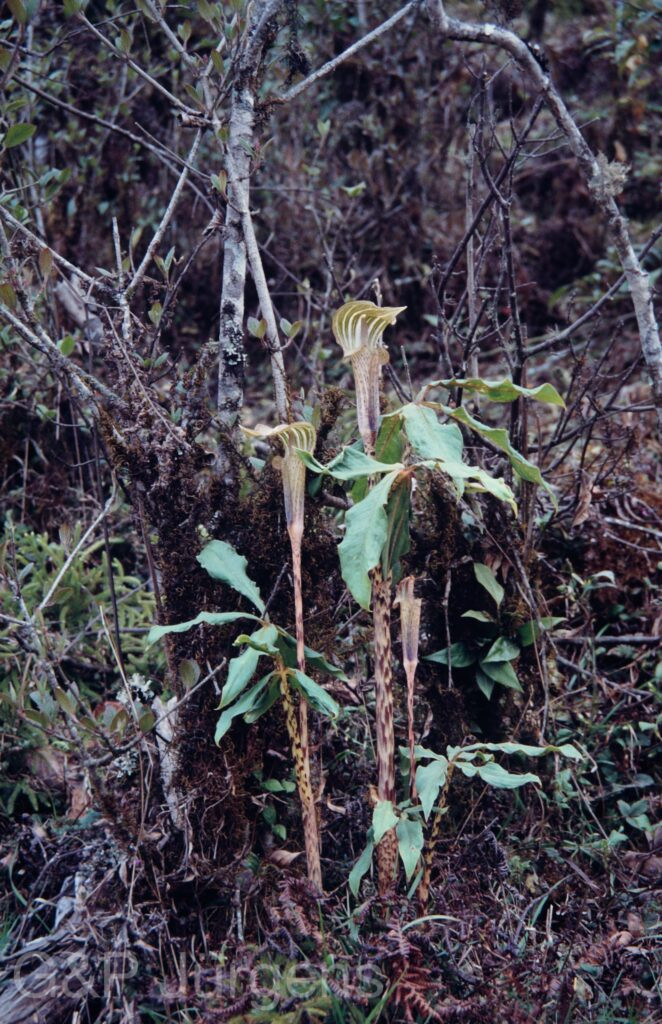
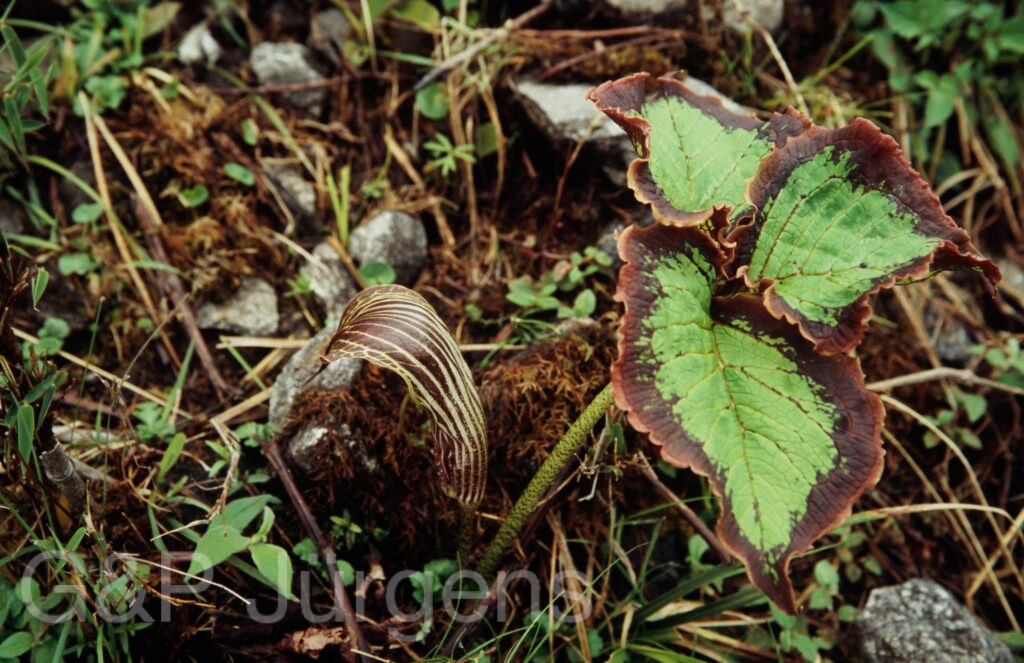
Arisaema speciosum is an eastern Himalayan cobra lily distributed from Nepal through Sikkim and West Bengal in India, Bhutan and into south-central China, with peripheral records in Myanmar and Thailand; GBIF holds nearly 200 occurrences. It grows in cool, humid temperate forest, in the shade of broadleaved and mixed conifer woodland, on rich, moist, humus-laden soils along stream banks, ravines and shaded slopes. The collections illustrated, from Tashigaon in eastern Nepal at about 3100 m and from Maneybhajang in West Bengal at around 2000 m, both in May, reflect its montane belt of roughly 2000-3300 m, where it emerges and flowers as the pre-monsoon rains advance.

The plant arises from a depressed, tuberous corm and produces a single trifoliolate leaf on a stout, mottled petiole; the three leaflets are broadly ovate, acuminate and often suffused dark purplish-red along the margins and central rib. The inflorescence is a spathe with a deep maroon, white-striped tube and an arching, dark purple-brown limb. Most striking is the spadix, whose appendage is prolonged into a very long, pendent, whip-like filiform tail hanging well below the spathe. The plant is typically dioecious, sex expression varying with tuber size, and female spadices ripen into a dense club of bright red berries.

The epithet speciosum, meaning showy, refers to the dramatic spathe and trailing appendage. Within the large Asian genus Arisaema it belongs to a group with trifoliolate leaves and long-tailed spadices. Like its congeners it is protogynous and paradioecious, with pollination effected by fungus gnats lured into the spathe chamber. The species is grown by specialist cultivators, and habitat disturbance and over-collection are potential local conservation concerns.

Author: (Wall.) Mart. · Sources: POWO (Kew), GBIF, Flora of China, Flora of Bhutan, Gusman The Genus Arisaema, Murata monograph of Arisaema

(Schott) Engl.

Bh09 208 G349
Bhutan
Sikkim2004 96 P166
India West-Bengal, Bersay 2600m April
Sikkim2004 98 P168
India West-Bengal, Bersay 2600m April

Description

Arisaema speciosum var. mirabile is a striking tuberous aroid of the eastern Himalaya. GBIF holds only some 20 occurrences, from India, China, Nepal and Bhutan, reflecting its restricted range and the limited collection of this montane taxon. It inhabits moist temperate broadleaved and mixed forest, shaded banks and humus-rich slopes, generally between about 2,000 and 3,000 m. The illustrated plant was photographed at Bersay in West Bengal (Darjeeling–Sikkim Himalaya), and in Bhutan, at around 2,600 m in April, emerging and flowering with the pre-monsoon rains. (Despite the input family "Aceraceae", this is an aroid of the Araceae.)

The plant arises from a depressed tuber and bears characteristically a single trifoliolate leaf with three large, broadly ovate to rhombic leaflets, the central one stalked, often with a reddish margin. The inflorescence is a spathe with a dark purple, white-striped tube and a long-acuminate limb; the spadix is prolonged into a very long, thread-like, pendent appendix that hangs well beyond the spathe, the diagnostic feature of this group. The plants are dioecious; female plants produce a dense head of red berries in fruit.

Var. mirabile is distinguished from typical A. speciosum by features of the spathe and the proportions of the leaflets and appendix, though some authors treat the variation as continuous. The exceptionally long flagelliform spadix appendix is thought to function in pollinator attraction (fungus-gnat trapping). Given its narrow distribution and small documented populations, the taxon merits conservation monitoring, and it is much sought after by specialist aroid growers.

Author: (Schott) Engl. · Sources: POWO (Kew), Flora of Bhutan Vol. 3, Flora of China Vol. 23, GBIF, Gusman & Gusman: The Genus Arisaema (2006)

Arisaema tortuosum

by GP Jürgens

(Wall.) Schott

Sikkim2003 53 P72
Sikkim above Yoksam 2500m, August

Description

Arisaema tortuosum, the whipcord cobra lily, is a wide-ranging Himalayan and peninsular Indian aroid recorded from India, Nepal, China, Bhutan, Sri Lanka, Myanmar, Malaysia and Indonesia, with some 780 georeferenced occurrences and a number of records from cultivation in Europe and North America. It grows in moist forest, scrub, grassy clearings and shaded banks across a wide elevational span. The population photographed above Yoksam in western Sikkim at about 2500 m in August illustrates its montane forest habitat, in leaf and inflorescence during the monsoon on humus-rich soils.

The plant arises from a depressed, tuberous corm and produces one or two large, long-petiolate leaves divided into numerous radiating or pedately arranged leaflets. The inflorescence is a spathe enclosing a spadix, the latter prolonged into a remarkably long, erect or sinuous flagelliform appendage that gives the species its name and tortuosum epithet. Flowers are unisexual and borne at the spadix base, the species being protogynous and capable of size-dependent sex change between female, monoecious and male states. Pollinated fungus-gnats are trapped within the chamber. The fruit is a dense cluster of red berries borne on the swelling infructescence.

Arisaema is a large genus of considerable horticultural interest, and A. tortuosum is one of its most widespread and variable members, with several recognised varieties differing in leaflet number and spadix coloration. Its sequential hermaphroditism, in which individuals switch sex according to accumulated resources, is a celebrated example of size-dependent gender lability. Common across its extensive range, it is of least conservation concern.

Author: (Wall.) Schott · Sources: POWO (Kew), GBIF, Flora of Bhutan, Flora of Nepal, Flora of China, Gusman & Gusman's The Genus Arisaema

Arisaema utile

by GP Jürgens

Hook.f. ex Engl.

Sikkim2011 221
Sikkim, Yungthang 3350m, June
Sikkim2011 222
Sikkim, Yungthang 3350m, June
Sikkim2004 430 P746
Sikkim/India Lachung 3200m

Description

Arisaema utile is a tuberous geophyte of the Himalaya and adjacent ranges, recorded by GBIF in some 84 occurrences from China (Tibet), India, Pakistan, Nepal, Bhutan and Myanmar. It is a plant of the subalpine to lower alpine zone, occupying shrubberies, Rhododendron and conifer forest margins, moist meadows and stony slopes broadly between 3000 and 4300 m. The illustrated plants were found in Sikkim at Yungthang (3350 m, June) and Lachung (3200 m), where the species emerges and flowers shortly after snowmelt on cool, humus-rich ground at the upper limit of woody vegetation.

The plant arises from a depressed-globose tuber and typically bears a single trifoliolate leaf, the three leaflets broadly elliptic and often glaucous beneath, the whole sometimes purple-flushed. The inflorescence is a spadix subtended by a spathe whose tube is striped green and dark purple and whose limb is hooded and acuminate, frequently produced into a long filiform tip. The spadix appendix is slender and tail-like, exserted from the spathe mouth. As in the genus, the plant is paradioecious, individual tubers bearing male or female flowers according to size and vigour; pollinated female spadices ripen into a cylindrical infructescence of bright red berries.

Arisaema (Araceae, tribe Areae) is a large genus centred on the Sino-Himalayan region, and A. utile belongs to a Himalayan group characterised by a long-tailed spathe and trifoliolate leaf. GBIF treats the name as accepted. Sex expression shifts with resource status, an adaptation to harsh montane conditions; although collected for traditional use, the species remains locally frequent within its altitudinal band.

Author: Hook.f. ex Engl. · Sources: POWO (Kew), GBIF, Flora of China, Flora of Bhutan, Gusman monograph The Genus Arisaema

Hara & H.Ohashi

Nepal 97 249 P520
Nepal below Thudam 3450m, May

Description

Arisaema vexillatum is a narrowly distributed tuberous aroid of the eastern Himalaya and adjacent China, known from only China and Nepal with a sparse total of about 11 georeferenced records, reflecting both genuine rarity and limited collecting. It grows in cool-temperate to subalpine forest and shrubberies, in moist, humus-rich soils sheltered by rhododendron and conifer cover. The type material and the photographed plant come from the upper Arun drainage of eastern Nepal below Thudam at around 3450 m, flowering in May as the snow recedes, indicating a strongly montane ecology dependent on persistent soil moisture.

The plant arises from a depressed, subglobose tuber and produces typically a single leaf with a long sheathing petiole. The leaf blade is pedately divided into several oblong-lanceolate, acuminate leaflets arranged in a radiate fashion. The inflorescence is a spathe enclosing the spadix, the spathe tube cylindrical and the limb arching forward; the spadix appendix is slender and the plant is generally monoecious-dioecious depending on tuber size, a sex-lability typical of the genus. The fruiting spadix develops into a dense, club-shaped syncarp of bright red, few-seeded berries.

Arisaema vexillatum belongs to a difficult complex of eastern Himalayan species and was described by Hara and H. Ohashi from Nepalese collections. Like most Arisaema it depends on fungus-gnat and small-fly visitors trapped within the spathe for pollination. Its limited known range and montane habitat suggest vulnerability to habitat disturbance, though its conservation status remains formally unassessed and additional fieldwork would likely clarify its true distribution.

Author: Hara & H.Ohashi · Sources: POWO (Kew), GBIF, Flora of China, Annotated Checklist of the Flowering Plants of Nepal, Gusman & Gusman The Genus Arisaema

Hook.f. & Thomson ex Duch.

Bhutan2014 454
Bhutan Tongsa 2000m, May
Bhutan2014 456
Bhutan Tongsa 2000m, May
Sikkim 2006 340 ergebnis
India West-Bengal, Tolung 2450m, May

Description

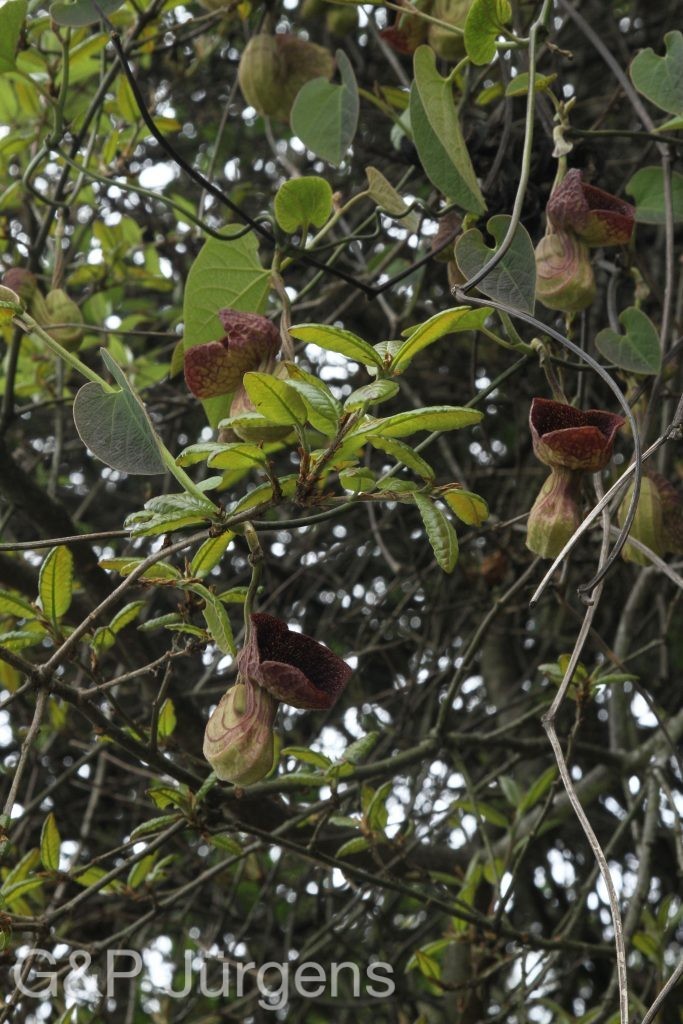
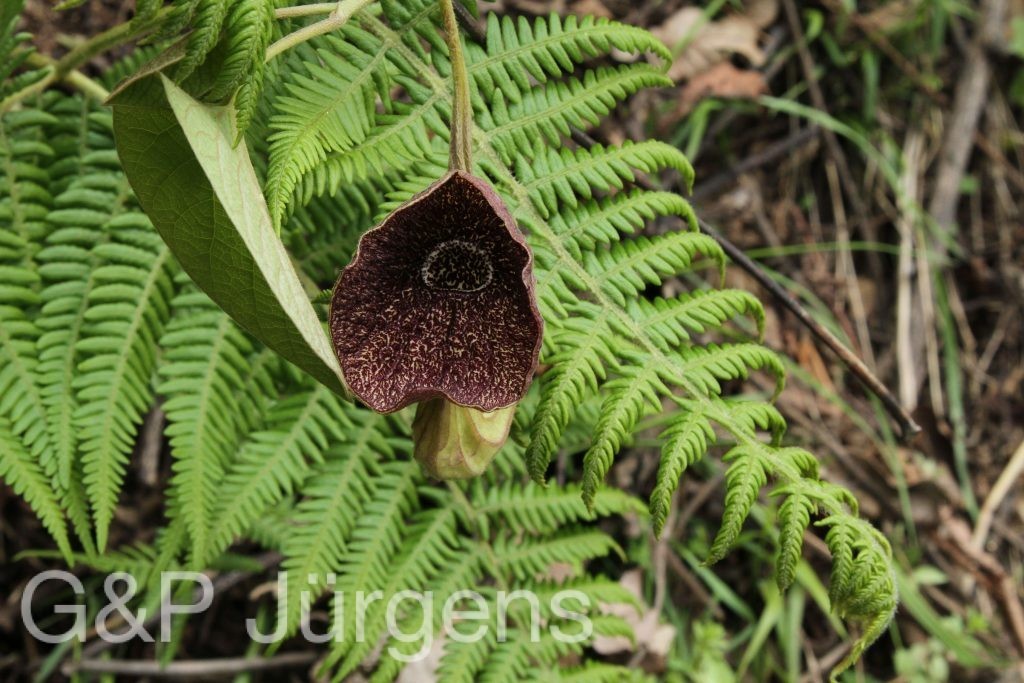
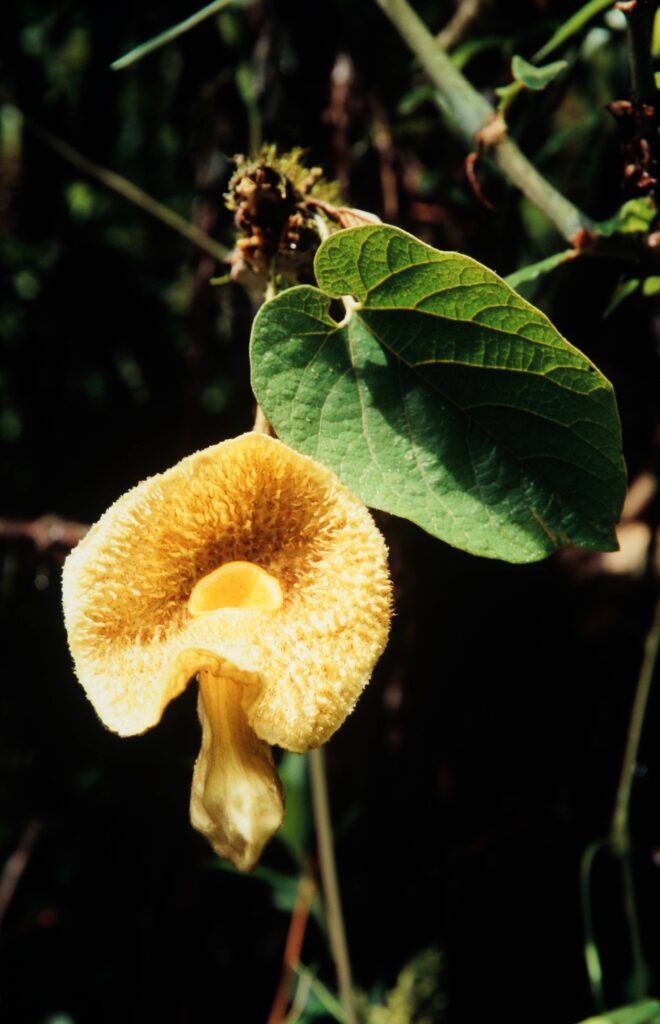
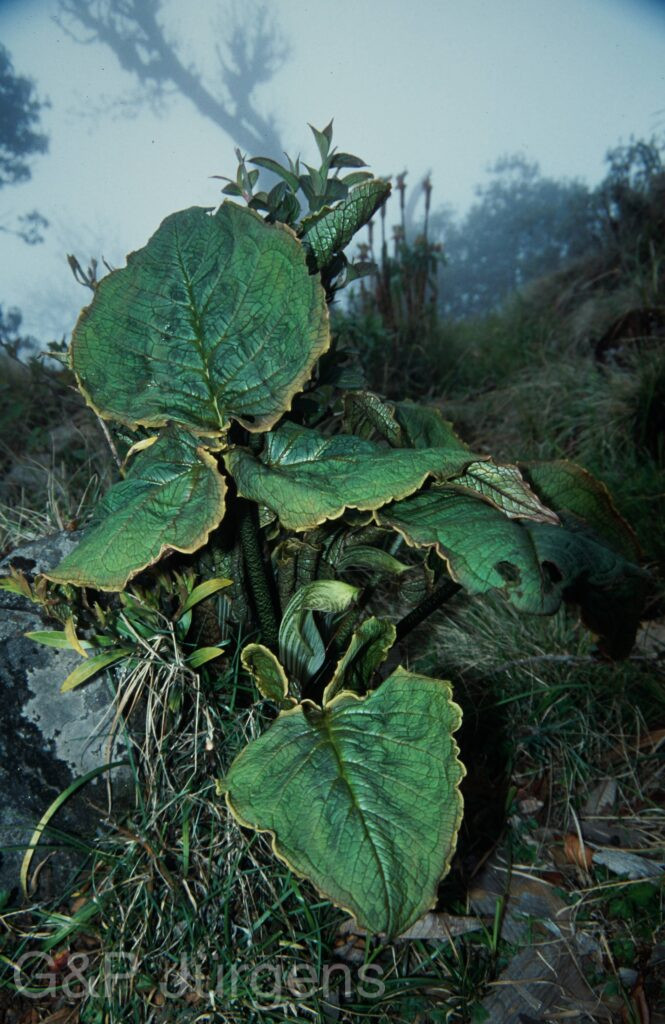
Aristolochia griffithii is an eastern Himalayan woody climber distributed through Nepal, Bhutan, north-east India and south-western China (Xizang, Yunnan), with scattered records extending into northern Myanmar and Thailand. In current taxonomic treatments the name returned as a synonym is referred to the accepted Aristolochia griffithii, under which the species is here treated. It grows in moist temperate broadleaved forest, climbing through trees and shrubs along forest margins and stream gorges, generally between about 1,800 and 3,000 m. The photographs from Tongsa in Bhutan at 2,000 m and from Tolung in West Bengal, India, at 2,450 m, both taken in May, document its late-spring flowering in this mid-montane forest belt.

It is a robust perennial liana with woody, twining stems and large, alternate, ovate-cordate leaves with deeply auriculate bases and entire margins. The flowers are solitary and exceptionally large and showy: the perianth is a strongly inflated, S-curved or globose tube expanding into a broad, spreading, conspicuously netted-veined limb mottled dark purple-brown and yellowish, terminating in a long tail-like appendage. The structure functions as a temporary insect trap, with inwardly directed hairs detaining pollinators (chiefly flies) until the anthers dehisce. The fruit is a pendulous, six-valved, septicidal capsule splitting basipetally into a parachute-like structure releasing flat winged seeds.

Aristolochia (Aristolochiaceae) is notable for its specialised kettle-trap pollination and for the aristolochic acids that render the tissues toxic; the genus includes important larval hosts for swallowtail butterflies. A. griffithii, among the largest-flowered Himalayan species, is prized horticulturally and is locally uncommon, its dependence on intact montane forest making it sensitive to habitat loss.

Author: Hook.f. & Thomson ex Duch. · Sources: POWO (Kew), Flora of China Vol. 5, Flora of Bhutan Vol. 1, GBIF, Hwang, Kelly & Gilbert: Aristolochiaceae in Flora of China

(Wall. ex G.Don) I.M.Johnst.

Nepal 99 91 ergebnis
West-Nepal Bhulbhule 3500m, June
Nepal 99 92 ergebnis
West-Nepal Bhulbhule 3500m, June

Description

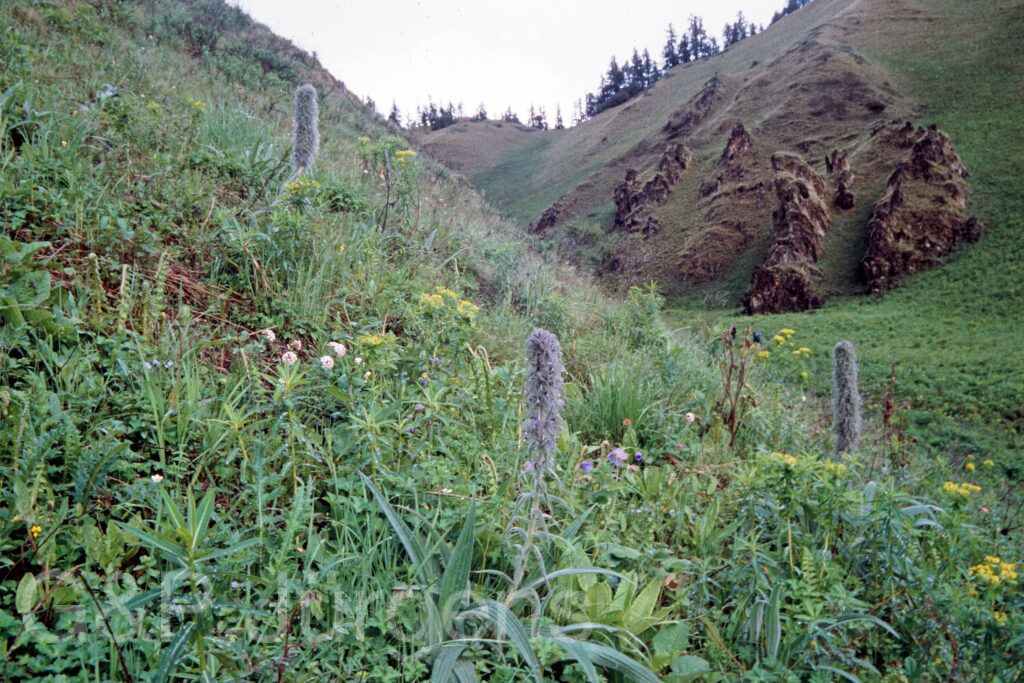
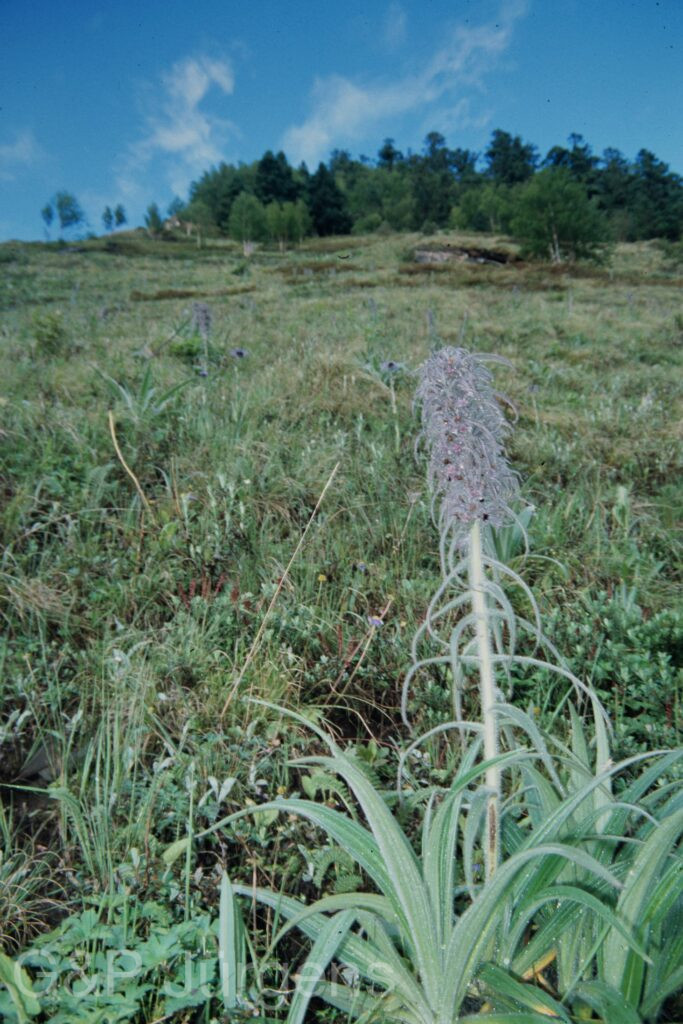
Arnebia benthamii is a stout alpine herb of the western and central Himalaya, distributed through India, Pakistan and Nepal, with GBIF recording roughly 167 occurrences. It inhabits open alpine meadows, grassy and rocky slopes, and stabilised scree in the subalpine and alpine zones, typically from 3000 to 4200 m. The photographed plant grew in West Nepal near Bhulbhule at 3500 m in June, when the species comes into flower as the snow recedes, forming conspicuous erect spikes among the early-summer alpine sward.

The plant is a robust, densely hispid perennial arising from a thick woody rootstock that yields a purple dye. The stems are erect, unbranched and bristly, clothed with sessile, oblong to lanceolate, rough-hairy leaves. The inflorescence is a dense, elongate, cylindrical thyrse of crowded scorpioid cymes subtended by leafy bracts. The flowers are tubular-funnelform, the corolla bluish-purple to violet (drying darker), five-lobed with a hairy throat; the calyx is deeply five-parted and bristly. There are five included stamens and a deeply four-lobed ovary, the gynobasic style producing four hard nutlets at maturity.

The species is referable to genus Arnebia (subfamily Boraginoideae). It is of considerable ethnobotanical importance: the dye-yielding roots, known regionally as "Kahzaban" or "gaozaban," are widely used in Unani and folk medicine, driving substantial wild harvesting. This pressure, combined with grazing and a slow-maturing perennial habit, has caused local declines, and the species is regarded as conservation-sensitive in parts of the western Himalaya, prompting calls for sustainable collection and cultivation.

Author: (Wall. ex G.Don) I.M.Johnst. · Sources: POWO (Kew), GBIF, Flora of Pakistan, Flora of Nepal, Flowers of the Himalaya (Polunin & Stainton)

Lam.

Nepal 97 561 P1094
Nepal Sabha-Khola 550m May
Nepal 97 563 P1096
Nepal Sabha-Khola 550m May
Nepal 97 562 P1095
Nepal Sabha-Khola 550m, May
Nepal 1994 44 ergebnis
Ost-Nepal Simbhuwa Kola 
1250m, April

Description

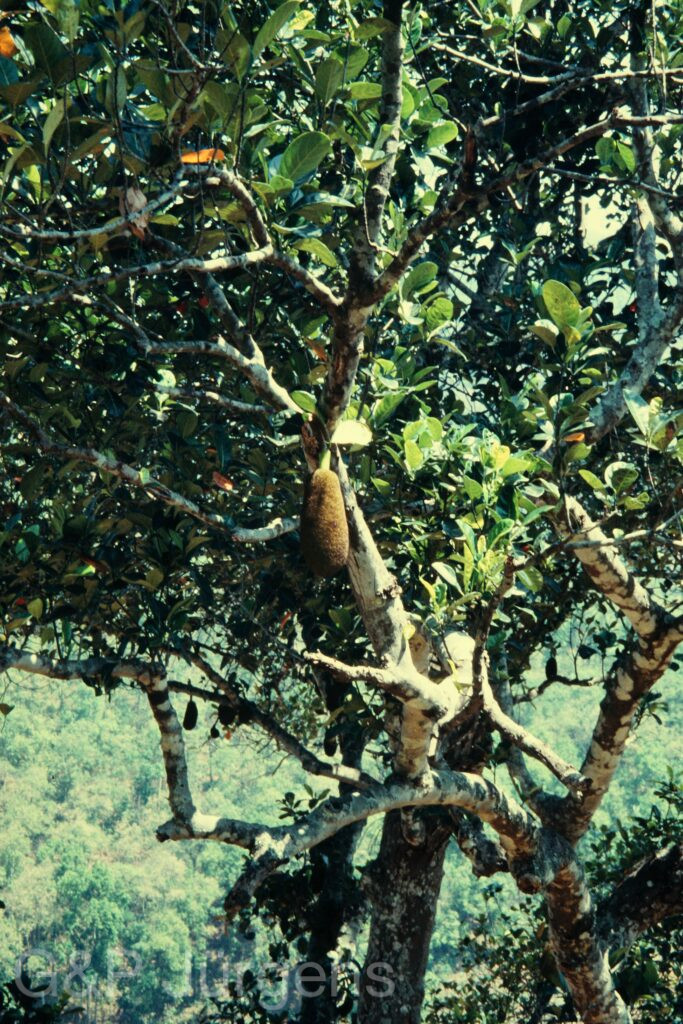
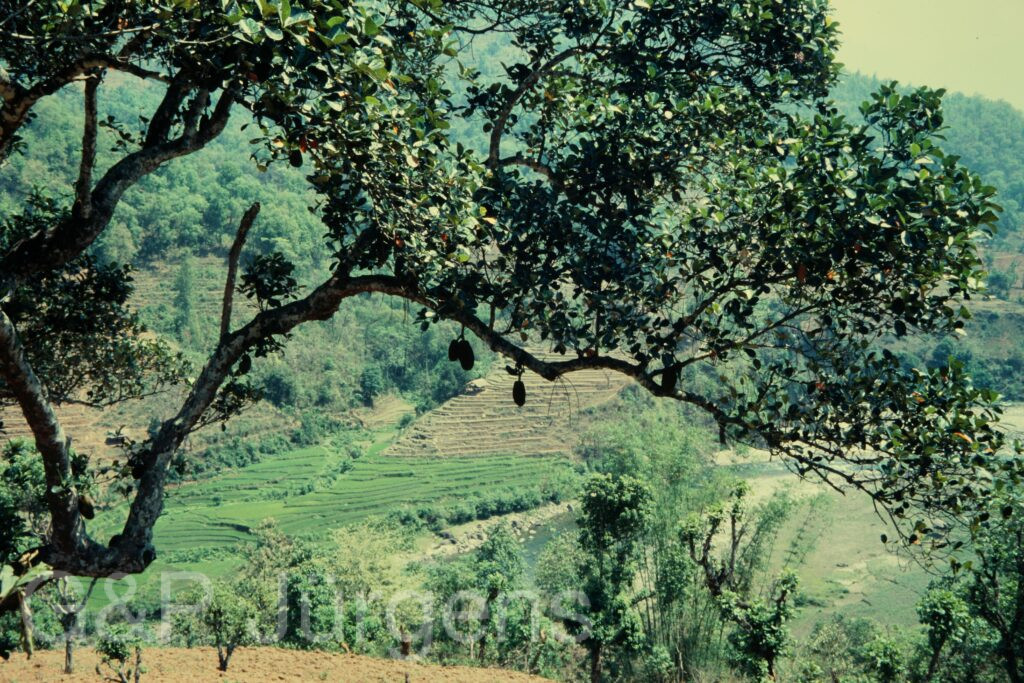
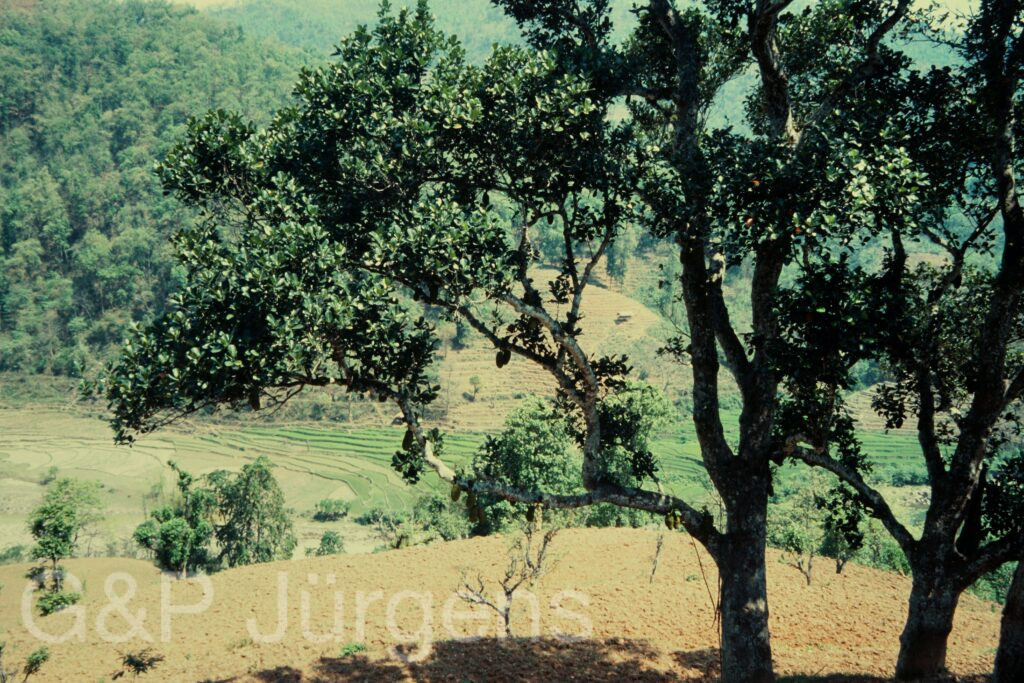
Artocarpus heterophyllus Lam., the jackfruit, is a large evergreen tree believed to be native to the Western Ghats and rainforests of the Indian subcontinent, now cultivated and naturalised throughout the tropics. The extensive GBIF record spans India, Sri Lanka, Bangladesh, China, much of Southeast Asia and Malesia, as well as tropical Africa, the Mascarenes, Brazil and the Pacific, reflecting its pantropical cultivation. In the Himalayan foothills it is grown in warm, humid lowland and lower hill country; the records from the Sabha Khola in Nepal at 550 m in May and the Simbhuwa Khola in east Nepal at 1,250 m in April document its cultivation in subtropical river valleys near the upper limit of its tolerance.

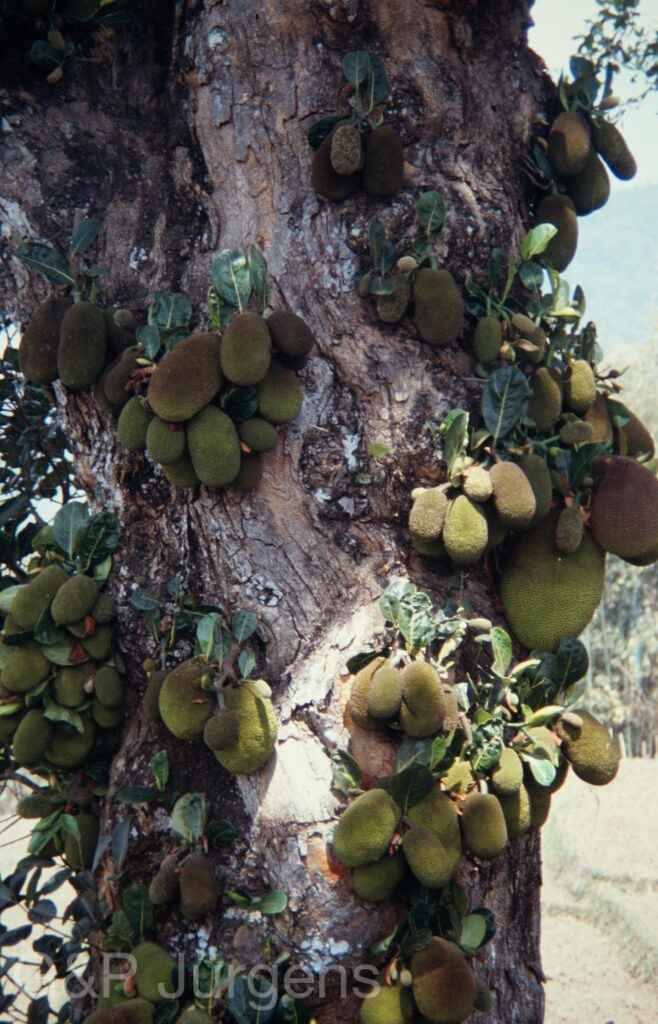
The tree reaches 10–25 m, with a dense, spreading crown and copious white latex in all parts. The alternate, leathery, glossy leaves are obovate to elliptic and entire in adult foliage, although juvenile and coppice leaves may be lobed, accounting for the epithet heterophyllus. The species is monoecious, with minute flowers densely aggregated on separate male and female inflorescences. After pollination the female heads develop into the immense, syncarpous compound fruit, the largest borne by any tree, which may exceed 30 kg; it is oblong, green, covered in conical, hexagonal protuberances, and contains numerous seeds embedded in sweet, aromatic, edible perianth flesh and surrounded by fibrous tissue, the whole borne cauliflorously on the trunk and main branches.

A member of Moraceae, the breadfruit and fig family, jackfruit is among the most important food trees of the humid tropics, the fruit eaten ripe or as a vegetable and the seeds cooked, while the durable, yellow timber and a dye from the heartwood are also valued. As an ancient cultigen of long human domestication it has no conservation concern, but its biogeography illustrates the role of human dispersal in shaping pantropical crop distributions.

Author: Lam. · Sources: POWO (Kew), GBIF, Flora of China Vol. 5, Flora of Nepal, Jarrett: Studies in Artocarpus and Allied Genera (Journal of the Arnold Arboretum)