Tag:

Nepal

Flowers of Nepal — 1313 wild plant species documented from the Nepalese Himalaya, from subtropical foothills to high alpine meadows above 4,000 m. Nepal’s dramatic elevation gradient makes it one of the richest botanical regions on Earth, home to rhododendrons, primulas, gentians and the famed blue poppies (Meconopsis). Every entry gives a botanical description, native distribution, habitat and flowering season, alongside the original field photograph and the location where it was taken.

J.J.Sm.

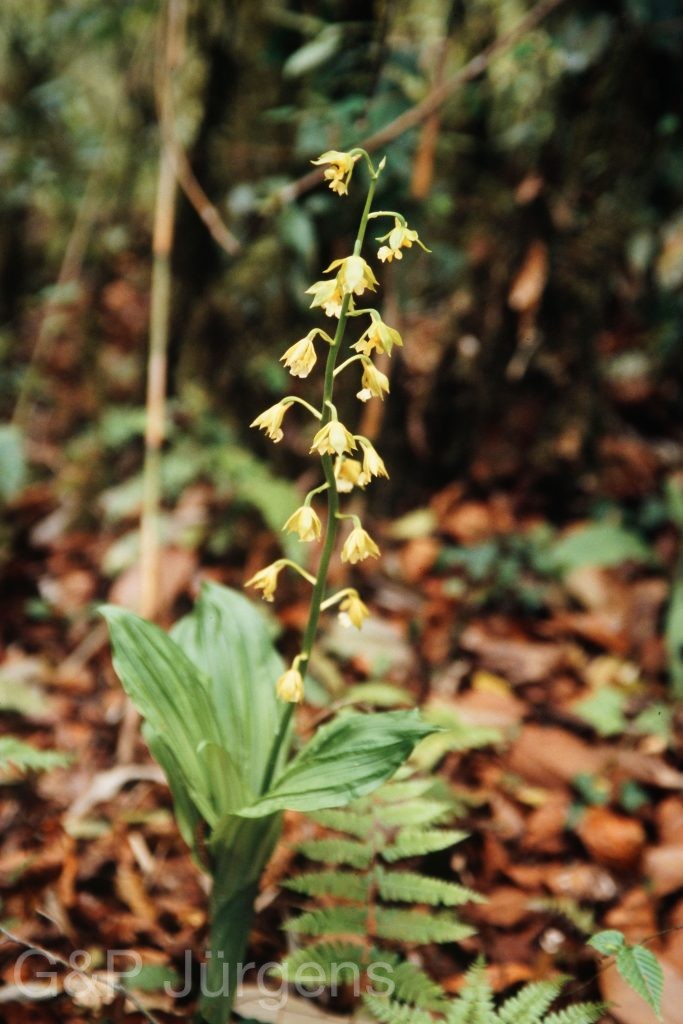
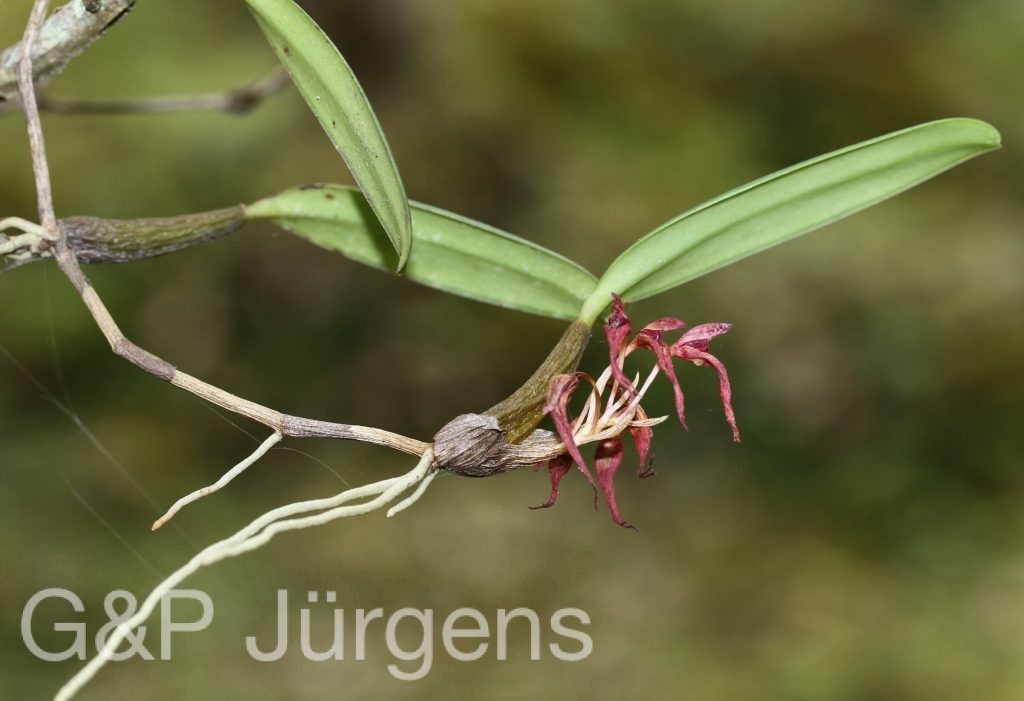
Bhutan2012 1178
Bhutan Tashiyangtse 2000m, October
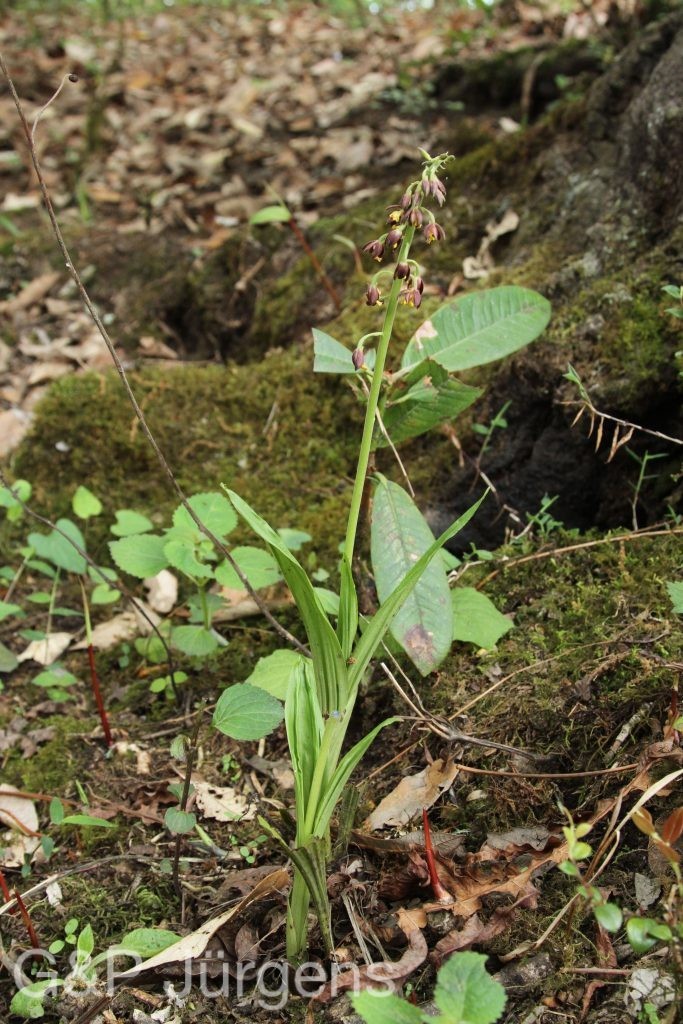
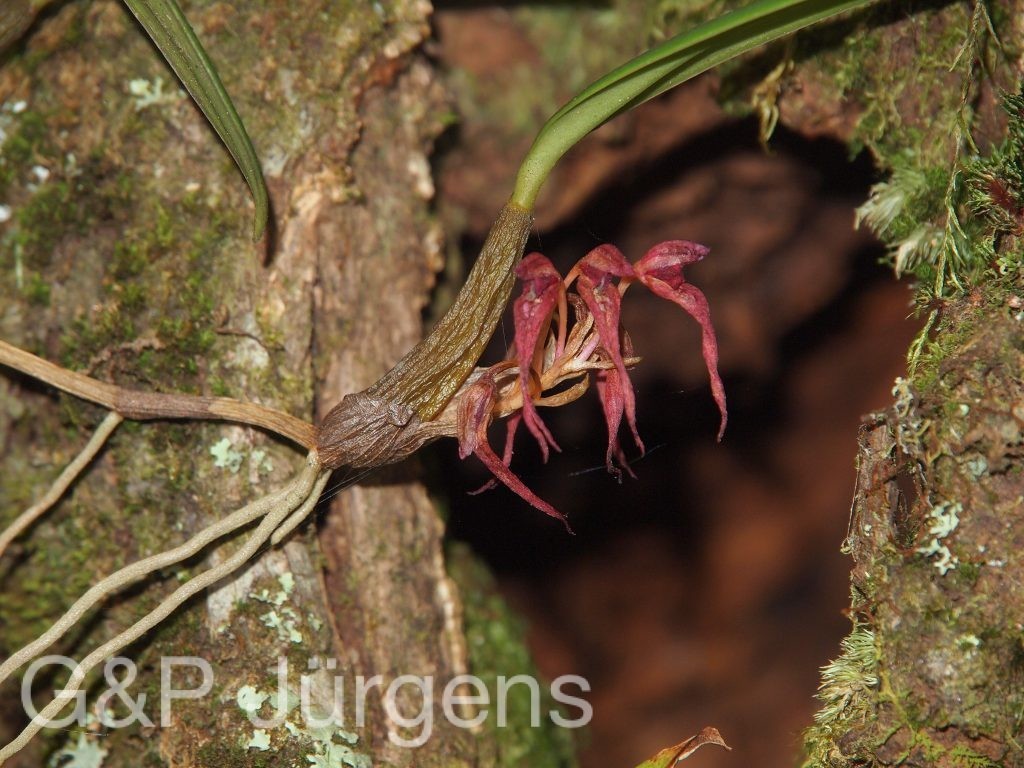
Bhutan2012 1180
Bhutan Tashiyangtse 2000m, October
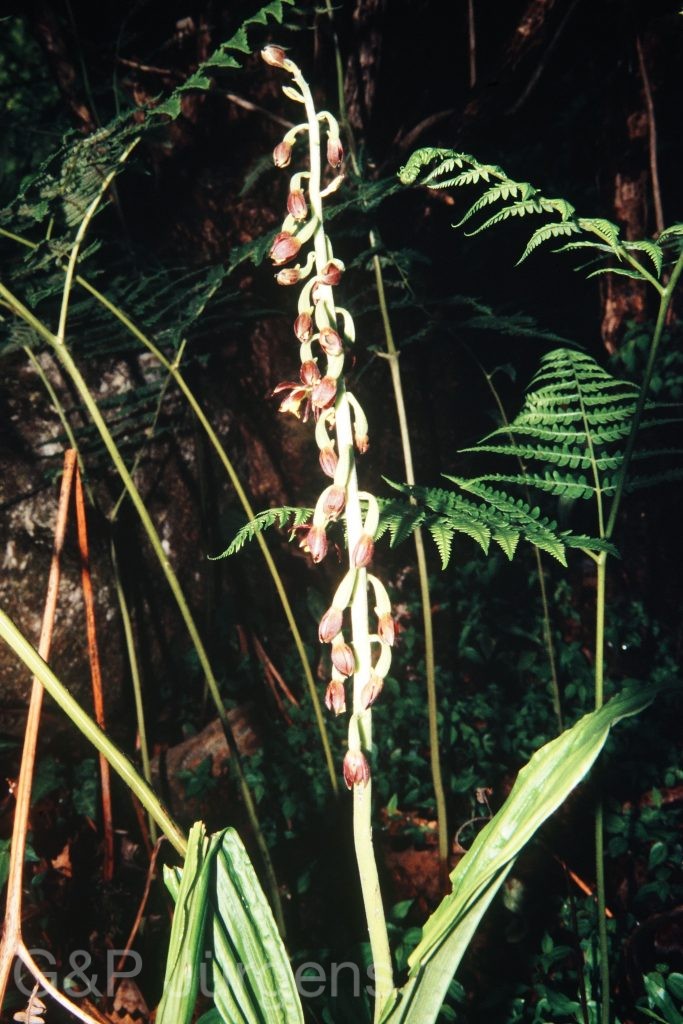
Bhutan2012 1181
Bhutan Tashiyangtse 2000m, October

Description

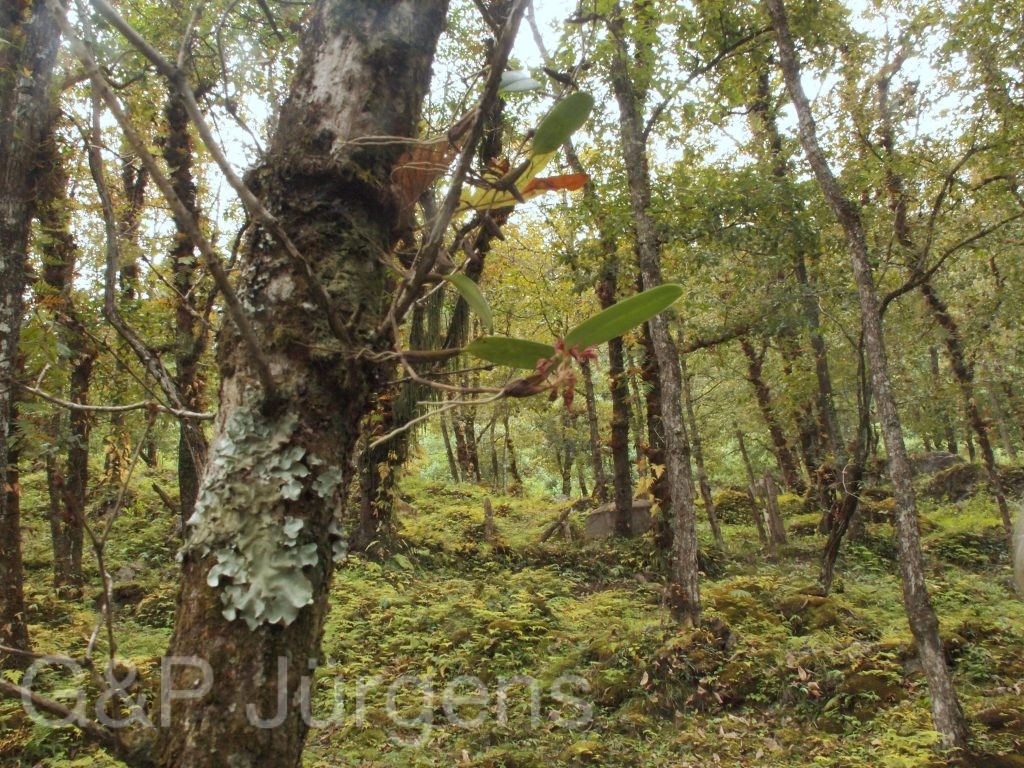
Bulbophyllum yoksunense is a rare epiphytic orchid with a restricted distribution in the eastern Himalayas. The species is named after Yuksom (also spelled Yoksum or Yoksun) in western Sikkim, India, where the type specimen was collected. Its known range includes Sikkim, Bhutan, eastern Nepal, and northern Myanmar. With only 17 documented occurrences in GBIF, it is among the less frequently recorded Bulbophyllum species in the region. It grows on mossy tree trunks in temperate broadleaved forests at 1,500–2,500 m elevation.

The pseudobulbs are ovoid, 1–2 cm tall, closely set on a creeping rhizome. Each bears a single, elliptic, coriaceous leaf 5–10 cm long. The inflorescence is a short, few-flowered raceme. Flowers are small, about 8–12 mm across, with distinctive coloration: the sepals are pale greenish-yellow with fine purple veining, and the lip is dark purple, fleshy, and slightly recurved. The lateral sepals are slightly longer than the dorsal sepal. Flowering in Bhutan occurs in October.

B. yoksunense is poorly known in cultivation and in the wild. Its apparent rarity may partly reflect under-collection in the remote eastern Himalayan forests of Bhutan and Sikkim. Further field survey is needed to clarify its true distribution and conservation status.

Author: J.J.Sm. · Sources: POWO (Kew), GBIF, Pearce & Cribb: The Orchids of Bhutan (2002), J.J. Smith: Orchidaceae Novae (1910)
Butea buteiformis

by GP Jürgens

(Voigt) Grierson

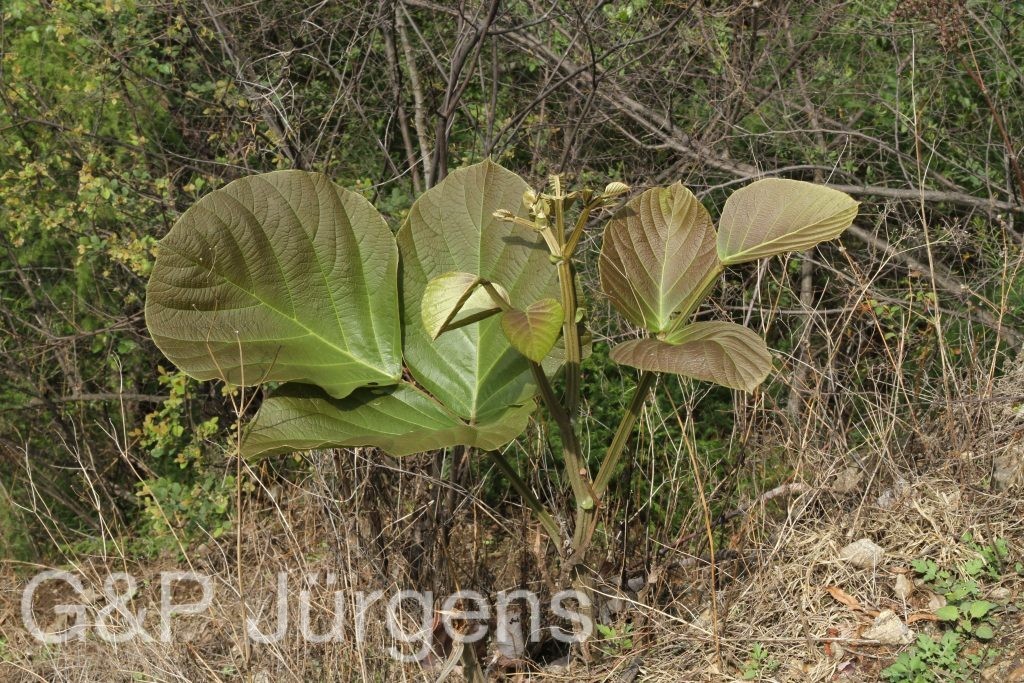
Bhutan2014 146
Bhutan Trashigang 1900m, May
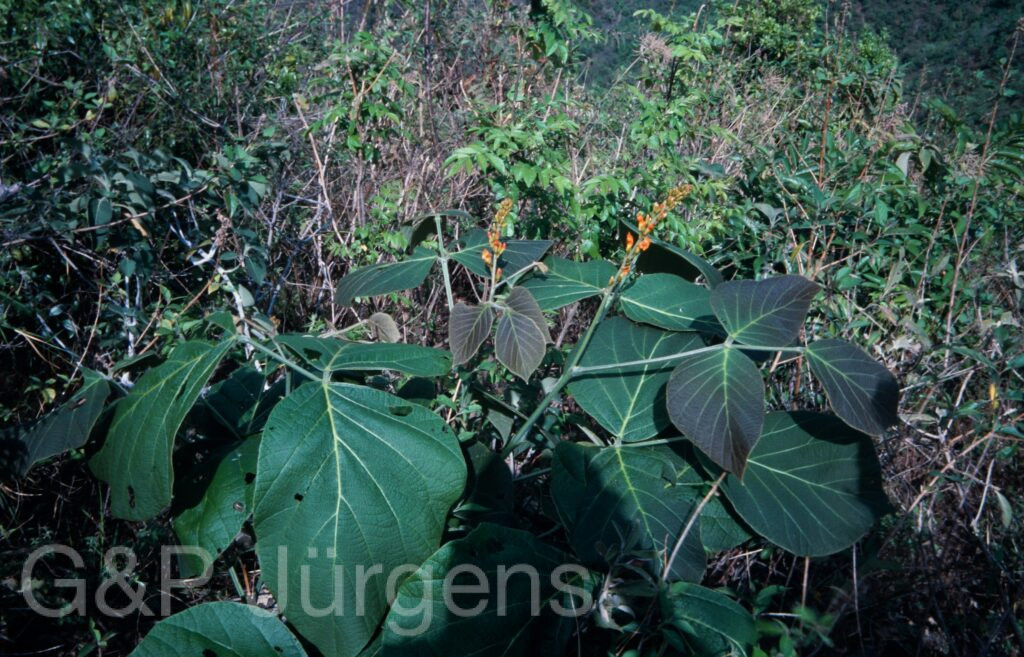
Nepal 2001 229 ergebnis ergebnis
Nepal (Gorkha) Tullikot 1750m, May

Description

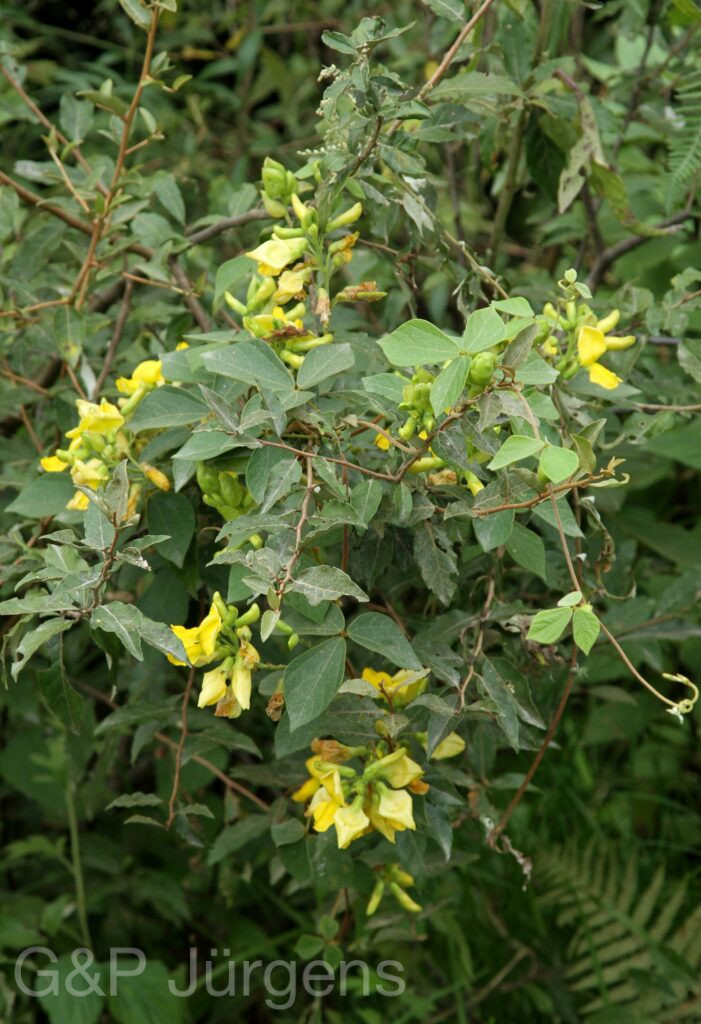
Butea buteiformis is a small tree or scandent shrub of the subtropical and warm-temperate broad-leaved forests of the eastern and central Himalaya, ranging through Nepal, India, Bhutan, Bangladesh and Myanmar, with some 220 georeferenced collections documenting a continuous arc along the southern Himalayan front. It occupies forest margins, ravines and secondary thickets, typically between about 1000 and 2200 m. The photographed plants were recorded at Trashigang in eastern Bhutan at 1900 m and at Tullikot in the Gorkha district of central Nepal at 1750 m, both flowering in May, a season coinciding with the pre-monsoon flush in these mid-montane belts.

The species is a deciduous, often climbing legume with twining or trailing branches and stout, lenticellate stems. The leaves are pinnately trifoliolate, the leaflets broadly ovate to rhombic, coriaceous, with the lateral pair distinctly oblique and a prominent reticulate venation; young growth is silky-pubescent. The inflorescences are dense axillary or terminal racemes bearing showy papilionaceous flowers; the calyx is campanulate and silky-tomentose, and the corolla is bright orange to scarlet, the standard recurved and the keel strongly curved, as is characteristic of bird-pollinated Butea. The fruit is a flattened, indehiscent, samaroid pod, thickened and seed-bearing toward the apex.

Butea is a small palaeotropical genus allied to Spatholobus and Meizotropis within the tribe Phaseoleae; B. buteiformis is distinguished from the lowland B. monosperma by its montane habit, smaller stature and more slender, often climbing form. The vivid ornithophilous flowers are visited by sunbirds and other nectarivores. Though not assessed as threatened and locally frequent, populations face forest clearance along accessible mid-elevation slopes.

Author: (Voigt) Grierson · Sources: POWO (Kew), GBIF, Flora of Bhutan, Flora of Nepal, Legumes of the World (Lewis et al.)

Hatus.

Nepal 99 771 ergebnis
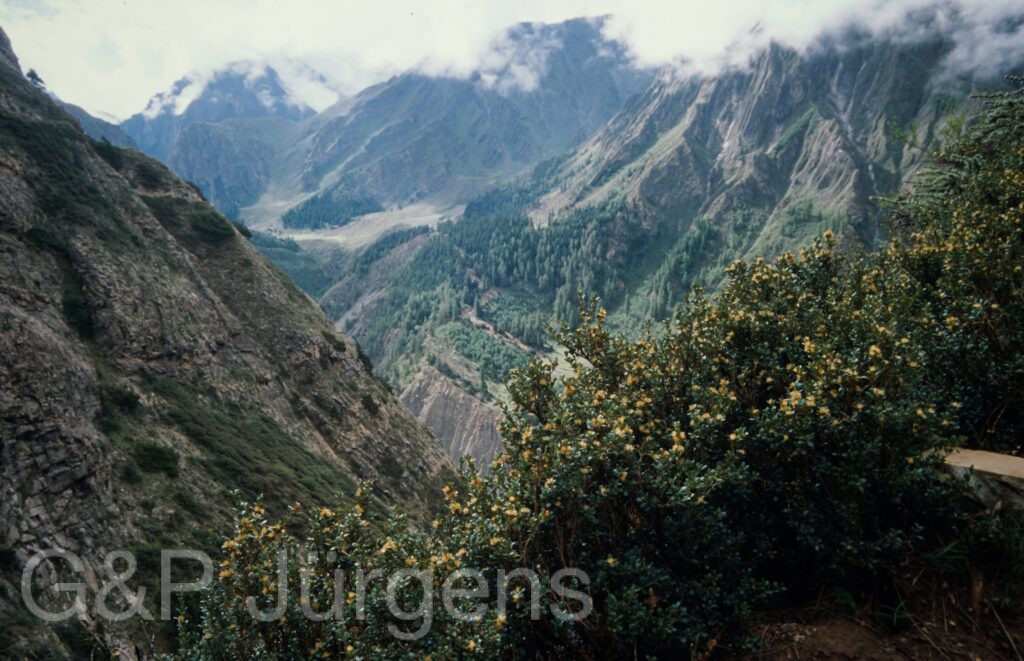
West-Nepal, Baga-La-Phedi 3750m, July
Nepal 99 772 ergebnis
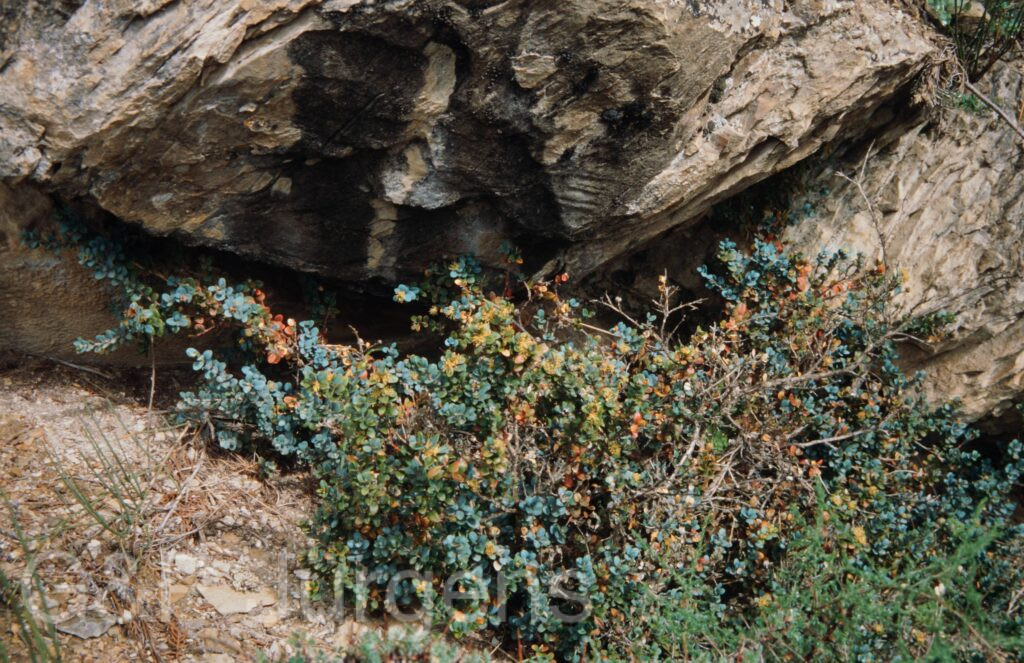
West-Nepal, Baga-La-Phedi 3750m, July

Description

Buxus rugulosa is an evergreen shrub of the high Himalaya and the mountains of western China. GBIF (some 313 occurrences) records it from China, Nepal and Pakistan, with a few outlying records from Turkey likely reflecting cultivation. It grows on open rocky slopes, in alpine scrub, among boulders and at the upper forest margin, ascending to high elevations. The illustrated plant is from western Nepal at Baga-La-Phedi at about 3,750 m, flowering in July, a characteristically high station near or above treeline, where it forms low, hardy thickets exposed to intense radiation and cold.

The plant is a low, much-branched evergreen shrub, often dwarf and cushion-forming in exposed sites, with quadrangular young shoots. The leaves are opposite, small, leathery, obovate to elliptic and rounded or notched at the apex, with a characteristically rugulose (finely wrinkled) upper surface, glossy dark green. The flowers are small, unisexual and apetalous, borne in axillary clusters with a single terminal female flower surrounded by several males; the perianth consists of inconspicuous tepals. The fruit is a three-horned woody capsule that dehisces explosively, ejecting the shiny black seeds.

Buxus (box) is a genus of slow-growing evergreens placed in the basal eudicot family Buxaceae; the wood is dense and finely grained. Buxus rugulosa is distinguished within the Himalayan-Chinese box species by its small rugulose leaves and dwarf alpine habit. It is not currently regarded as threatened, though high-altitude Himalayan populations are restricted to specialised rocky habitats and merit monitoring, particularly given upslope pressures from a warming climate.

Author: Hatus. · Sources: POWO (Kew), Flora of China Vol. 11, Flora of Pakistan, GBIF, Köhler: Buxaceae (Species Plantarum: Flora of the World)

Cajanus mollis

by GP Jürgens

(Benth.) Maesen

Bhutan2012 406
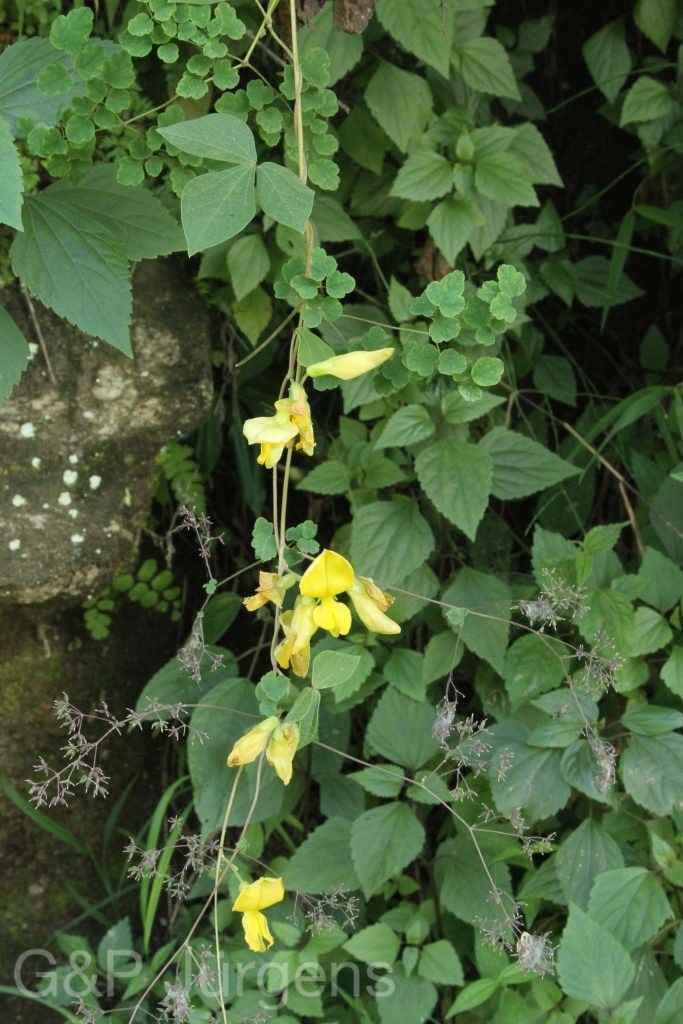
Bhutan Wangdi 2700m, September

Description

Cajanus mollis (Benth.) Maesen is a trailing or twining legume distributed through the Himalaya and southern and southeastern Asia; GBIF records (about 161 occurrences) span India, Nepal, Bhutan, southern China, Thailand, Indonesia, the Philippines and Pakistan. It grows in open scrub, grassland, forest margins, hedgerows and disturbed slopes at lower and middle elevations, scrambling over surrounding vegetation. The plant photographed near Wangdi in Bhutan at 2700 m in September, flowering and fruiting late in the warm season, sits at the upper part of its altitudinal range in the warm-temperate hill belt, where open, sunny, well-drained slopes suit its sprawling habit.

It is a perennial herb or subshrub with slender, prostrate to climbing stems clothed in soft spreading hairs. The leaves are pinnately trifoliolate, the leaflets obovate to elliptic and densely softly pubescent, gland-dotted beneath, and subtended by small stipules. The flowers are papilionaceous, borne in short axillary racemes; the corolla is yellow, the standard often reddish- or purplish-veined on the outer face, with the keel enclosing the diadelphous stamens. The calyx is campanulate and hairy. The fruit is a flattened, oblong, pubescent pod constricted between the seeds and bearing oblique depressions on the valves, dehiscing to release several small seeds.

The taxon, formerly placed in the segregate genus Atylosia, was transferred to Cajanus by Van der Maesen, who united Atylosia with Cajanus on morphological grounds; it is one of the wild relatives of the cultivated pigeonpea, Cajanus cajan, and is therefore of interest as a genetic resource for crop improvement and disease resistance. As a nitrogen-fixing legume it enriches soil on disturbed ground. Widespread and adaptable, it is of least conservation concern across its broad Asian range.

Author: (Benth.) Maesen · Sources: POWO (Kew), GBIF, Flora of China, Flora of Bhutan, Van der Maesen revision of Cajanus, Annotated Checklist of the Flowering Plants of Nepal

(L.) Graham ex Wall.

Bhutan2012 821
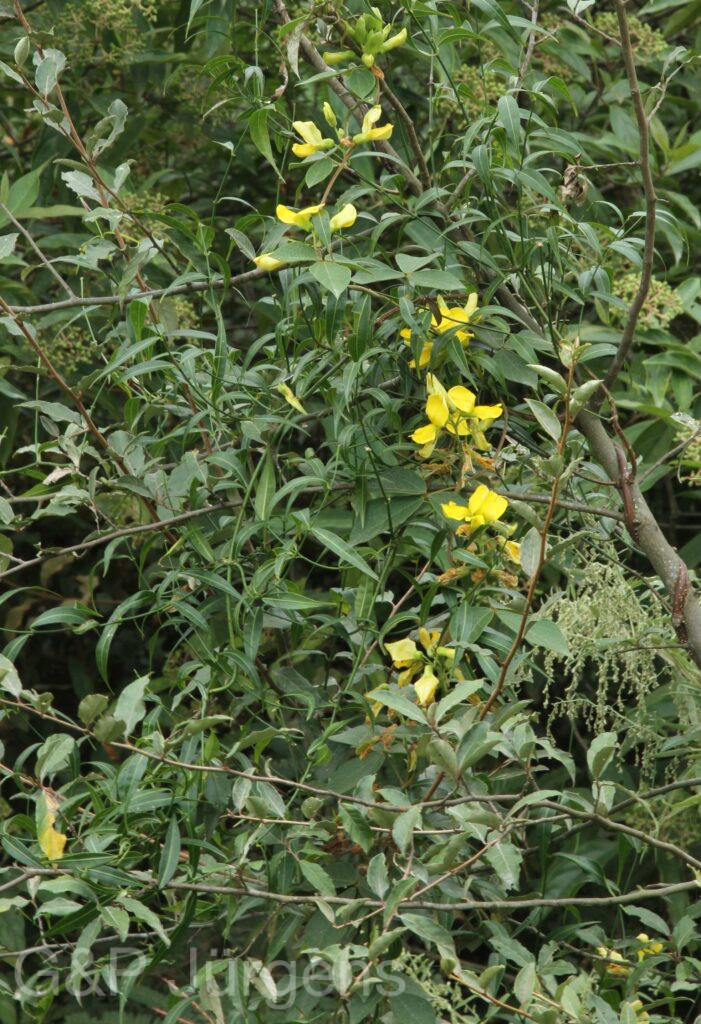
Bhutan Trongsa 2050m, October
Bhutan2012 822
Bhutan Trongsa 2050m, October

Description

Cajanus scarabaeoides is a widely distributed twining legume of the Old World tropics and subtropics, recorded by GBIF from more than two dozen territories spanning the Indian subcontinent, China, Taiwan, mainland and insular Southeast Asia (Thailand, Vietnam, the Philippines, Indonesia, Papua New Guinea), Japan, Australia, the western Indian Ocean islands (Madagascar, Réunion, Mayotte) and parts of West Africa, with over 4,200 georeferenced occurrences attesting to its commonness as a weedy scrambler. In the Himalayan portion of its range it ascends well into the hills, as the photographed plant from Trongsa in central Bhutan at about 2,050 m elevation in October illustrates. It typically grows in open grasslands, scrub, forest margins, fallow fields, roadsides and other disturbed sunny situations, flowering and fruiting through the post-monsoon dry season; as a nitrogen-fixing pioneer it colonises poor soils readily and is often a component of degraded secondary vegetation.

The species is a slender, trailing or twining perennial herb to subshrub with prostrate to climbing stems clothed in spreading silky or brownish hairs. The leaves are pinnately trifoliolate, the leaflets oblong-elliptic to obovate, the terminal one largest, gland-dotted beneath and silky-pubescent on both surfaces, with small stipels and persistent stipules. The flowers are borne in short axillary racemes; the corolla is papilionaceous and yellow, the standard frequently marked with reddish or purplish veining on the back, and the calyx is campanulate with narrow lobes. The fruit is a flattened, oblong, brownish-pubescent pod constricted between the seeds and conspicuously transversely depressed, dehiscing to release several small dark seeds.

Cajanus scarabaeoides belongs to the tribe Phaseoleae (subtribe Cajaninae) and is taxonomically significant as one of the closest wild relatives of the cultivated pigeon pea, Cajanus cajan, sharing the characteristic resinous glandular dots that distinguish the genus. As a hardy, drought-tolerant wild crop relative it is valued in plant breeding as a source of genes for pest resistance and stress tolerance, and it serves locally as fodder and a green-manure cover crop. Its enormous natural range, ecological adaptability and frequency leave it of least conservation concern, though wild germplasm is increasingly recognised for its importance to food-security research.

Author: (L.) Graham ex Wall. · Sources: POWO (Kew), GBIF, Flora of China Vol. 10, Flora of Bhutan Vol. 1, Flora of Nepal, Flora of Pakistan, van der Maesen monograph on Cajanus and Atylosia (Wageningen Agricultural University Papers)

Lindl.

Bhutan2012 689
Bhutan Galephu 850m, September

Description

Calanthe biloba is a terrestrial orchid native to the eastern Himalayas and adjacent regions, occurring in northeast India (Sikkim, Assam, Meghalaya), Bhutan, Nepal, southwest China (Yunnan), and northern Vietnam. It grows in the understory of warm, humid broadleaved forests and along shaded stream banks at 500–1,500 m elevation, in well-drained, humus-rich soils.

The plant produces prominent, conical pseudobulbs partially enclosed by the persistent leaf bases. The leaves are large, 30–50 cm long, broadly elliptic to obovate, plicate (folded lengthwise), and deciduous in the dry season. The inflorescence is an erect, pubescent raceme 30–60 cm tall, bearing 10–20 flowers. Flowers are 2.5–3.5 cm across, white to pale yellow. The lip is conspicuously bilobed (as the specific epithet indicates), with two diverging apical lobes, and bears a yellow callus of raised lamellae. The spur is slender, 1.5–2 cm long. Flowering occurs from August to October.

Calanthe biloba belongs to the deciduous group of Calanthe (subgenus Preptanthe), which shed their leaves before or during flowering. The relatively low elevation of the collecting locality at Galephu (850 m) reflects southern Bhutan's subtropical climate, where several thermophilic orchid species reach their northern distributional limit.

Author: Lindl. · Sources: POWO (Kew), Flora of Bhutan Vol. 3, GBIF, Pearce & Cribb: The Orchids of Bhutan (2002)

Lindl.

Description

Calanthe brevicornu is a terrestrial orchid distributed across the Himalayas and East Asia, from Nepal and northeast India through Bhutan and Myanmar to China and Japan. GBIF records over 320 occurrences, with the majority from China. The species inhabits montane and subalpine forests, growing in deep leaf litter and humus-rich soil in the understory of Rhododendron, Quercus, and mixed broadleaved-coniferous forests at 1,300–3,600 m elevation.

This is an evergreen Calanthe of compact habit. The pseudobulbs are reduced, largely concealed by leaf sheaths. Leaves are 2–4, elliptic-lanceolate, 15–30 cm long, plicate, persisting through the winter. The inflorescence is an erect raceme 15–35 cm tall, bearing 5–15 flowers that open sequentially. The specific epithet 'brevicornu' (short horn) refers to the characteristically short, stout spur, only 3–6 mm long — distinguishing it from many congeners with elongate spurs. Flowers are 2–3 cm across, white to pale pink, the lip trilobed with a yellowish callus. Flowering occurs from April to June.

The record from Helambu at 3,550 m represents the upper elevational limit for this species. At such altitudes, flowering coincides with the pre-monsoon spring, when Calanthe brevicornu blooms alongside Rhododendron species in the subalpine zone of central Nepal.

Author: Lindl. · Sources: POWO (Kew), Flora of Nepal Checklist, GBIF, Flora of China Vol. 25, Pearce & Cribb: The Orchids of Bhutan (2002)

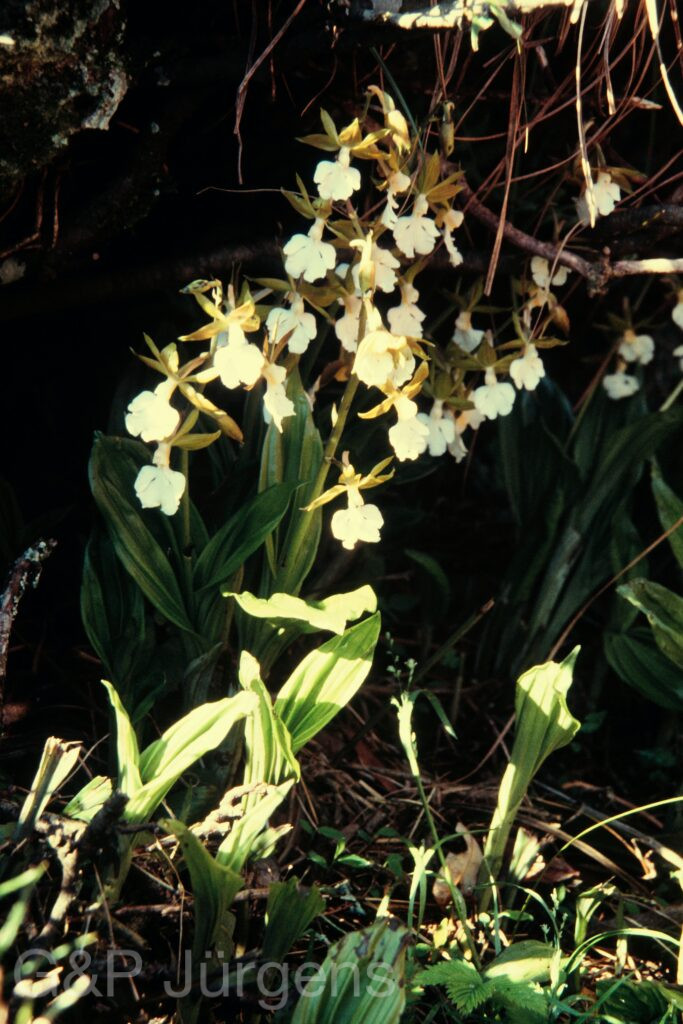
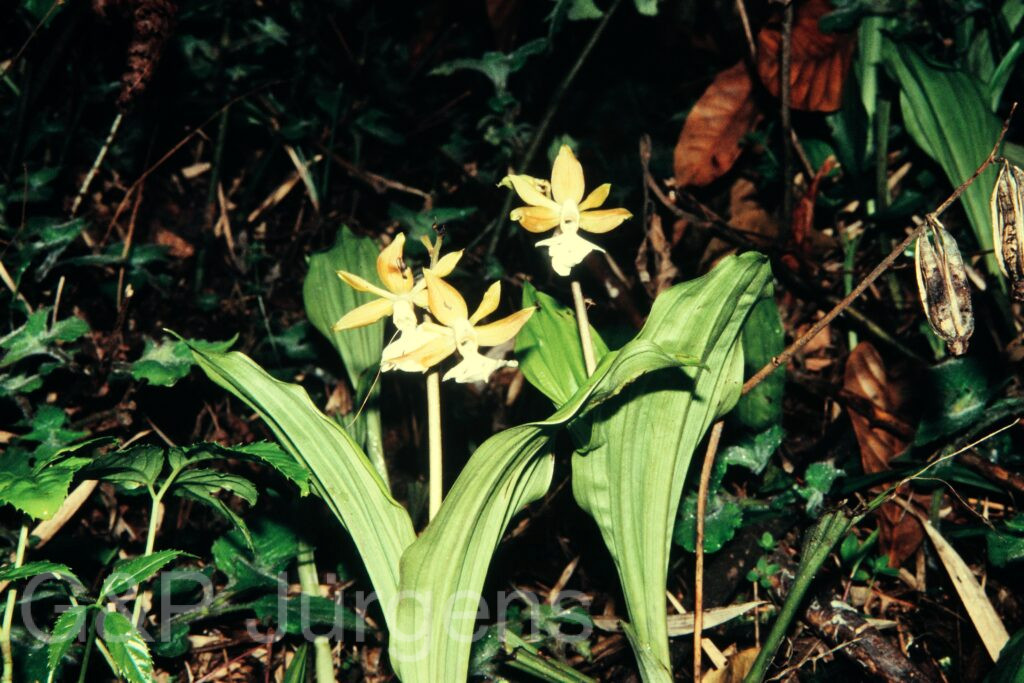
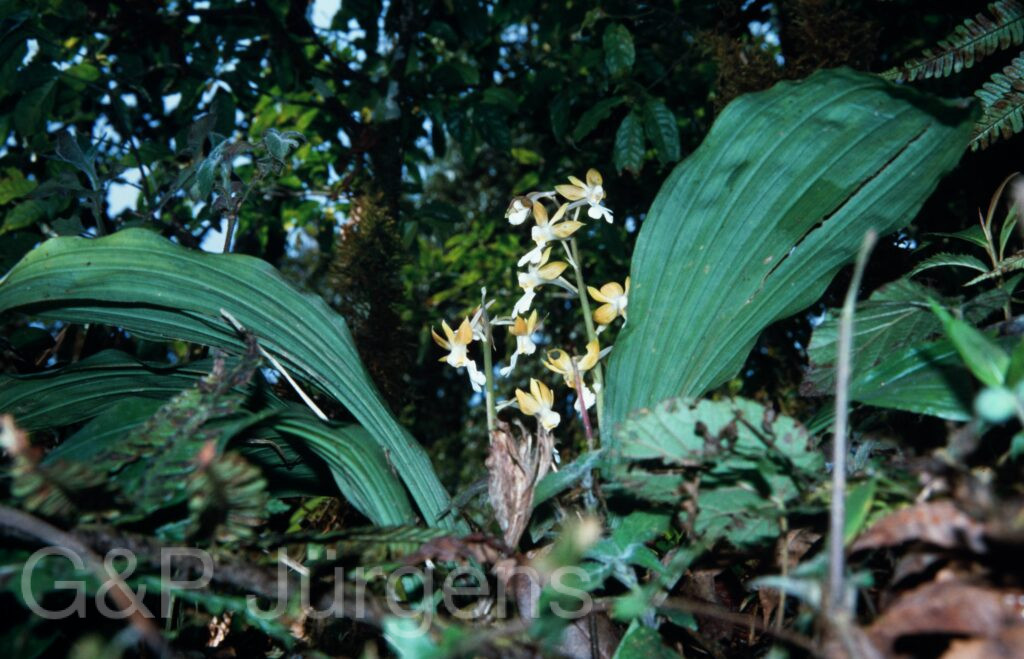
Lindl.

Nepal 97 299 P600
Nepal new Clepua 2370m May
Nepal 97 301 G602
Nepal new Clepua 2370m May
Nepal 2001 147 ergebnis ergebnis
East-Nepal Bhalukhop 2520m, April

Description

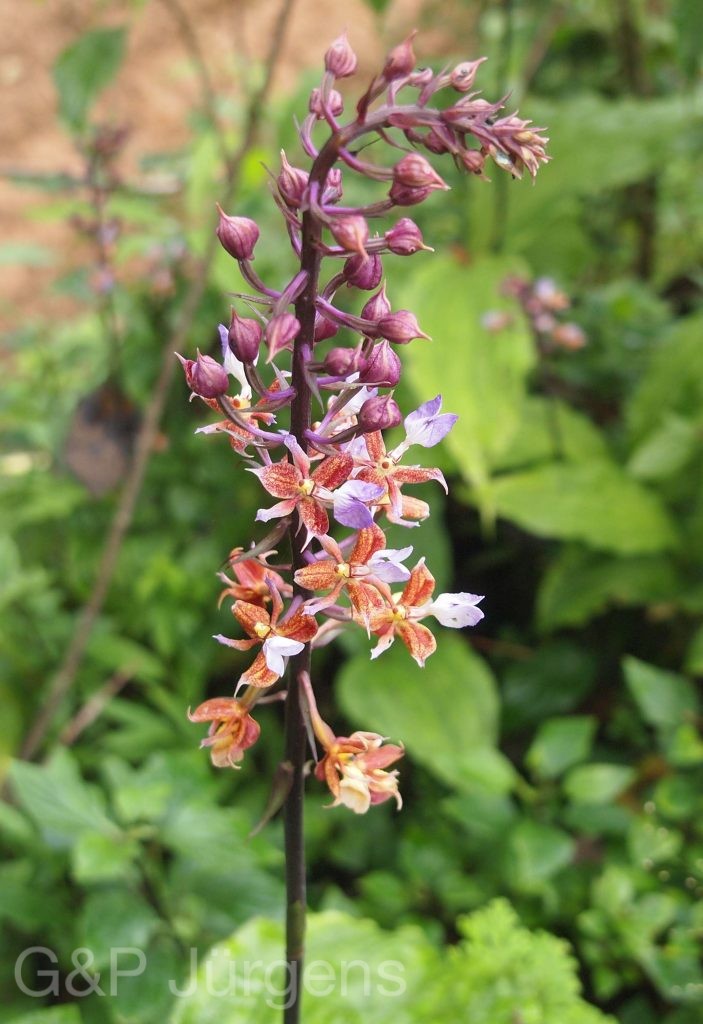
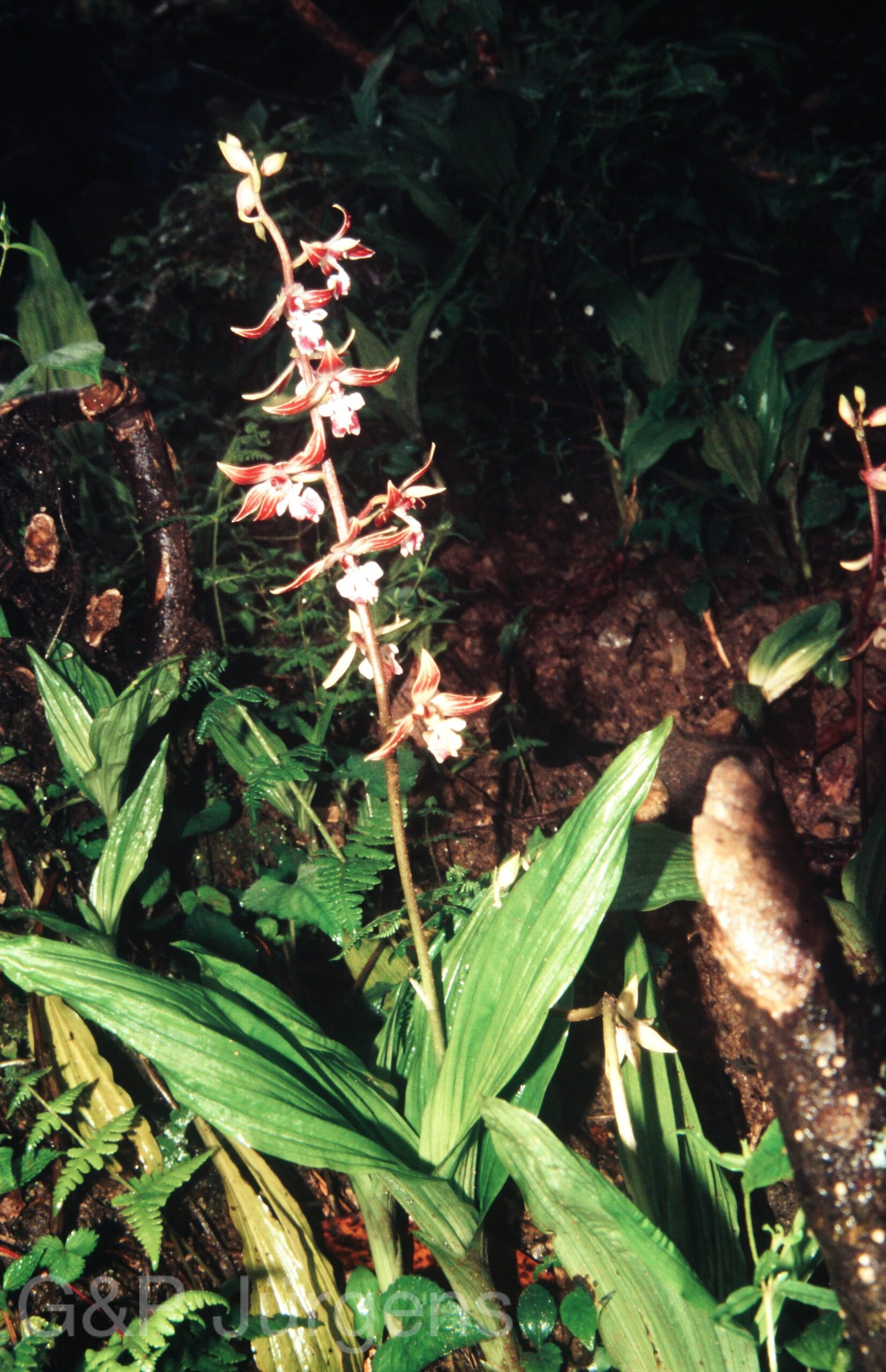
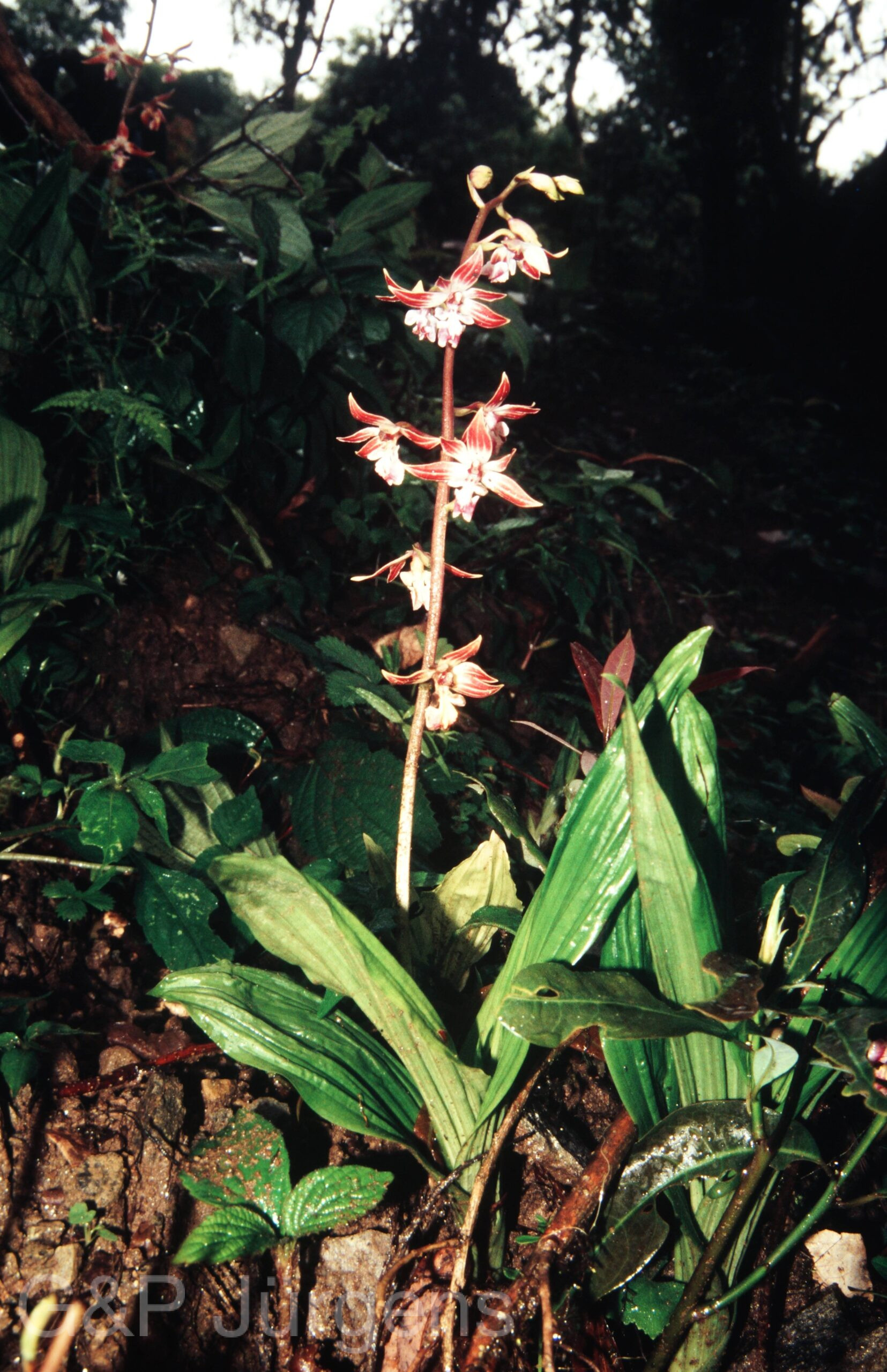
Calanthe chloroleuca is a terrestrial orchid of restricted distribution in the eastern Himalayas, known from Nepal, northeast India (Sikkim), Bhutan, and southwest China (Yunnan). With fewer than 20 documented occurrences in GBIF, it is one of the rarer Calanthe species in the region. The species grows in moist, shaded forest understory, on humus-rich soils among leaf litter, at elevations of 2,000–3,000 m.

The plant is an evergreen species with reduced pseudobulbs hidden by leaf bases. It produces 3–5 elliptic, plicate leaves 15–25 cm long. The inflorescence is an erect raceme 20–40 cm tall, carrying 8–15 flowers. The name 'chloroleuca' derives from Greek chloros (green) and leukos (white), accurately describing the flower coloration: sepals and petals are greenish-white, and the lip is white with a greenish or yellowish tinge, trilobed, with low, parallel keels on the disc. The spur is slender, 1–1.5 cm long, slightly curved. Flowering occurs from April to May.

Calanthe chloroleuca is easily confused with the similarly coloured C. brevicornu, from which it differs in its longer spur, narrower lip lobes, and more elongated floral bracts. Its rarity in herbarium collections may partly reflect the difficulty of distinguishing it from congeners in the field.

Author: Lindl. · Sources: POWO (Kew), Flora of Nepal Checklist, GBIF, Flora of Bhutan Vol. 3

Paxton & Lindl.

Bh2008 443 G693
Bhutan Gogona, 3400m April
Bh2008 513 P788
Bhutan Gogona, 3400m April

Description

Calanthe griffithii is a terrestrial orchid of the eastern Himalayas, named in honour of William Griffith, whose botanical collections from Bhutan and Assam in the 1830s–40s remain foundational for Himalayan botany. The species is distributed from Pakistan through Nepal, northeast India, and Bhutan to southwest China. It inhabits cool, moist montane forests and Rhododendron scrub at 1,600–3,500 m elevation, typically growing in deep humus under dense canopy shade.

This is an evergreen Calanthe with short, inconspicuous pseudobulbs. The leaves are 3–5, broadly elliptic, 15–30 cm long, plicate, and persist through winter. The inflorescence is an erect, pubescent raceme 15–30 cm tall, emerging before or with the new leaves. The flowers are 2–3 cm across, typically pale yellow to greenish-yellow, sometimes with a pinkish tinge. The lip is trilobed, the mid-lobe bifid, with raised yellow lamellae on the disc. The spur is slender, 1–1.5 cm long. Flowering in Bhutan occurs from March to May.

The collection locality at Gogona (3,400 m) in Bhutan represents the high-altitude forests of the inner valleys where C. griffithii flowers early in the spring before canopy closure. The species' relatively wide altitudinal range (1,600–3,500 m) reflects its adaptability to various forest types from warm temperate to subalpine.

Author: Paxton & Lindl. · Sources: POWO (Kew), Flora of Bhutan Vol. 3, GBIF, Pearce & Cribb: The Orchids of Bhutan (2002)

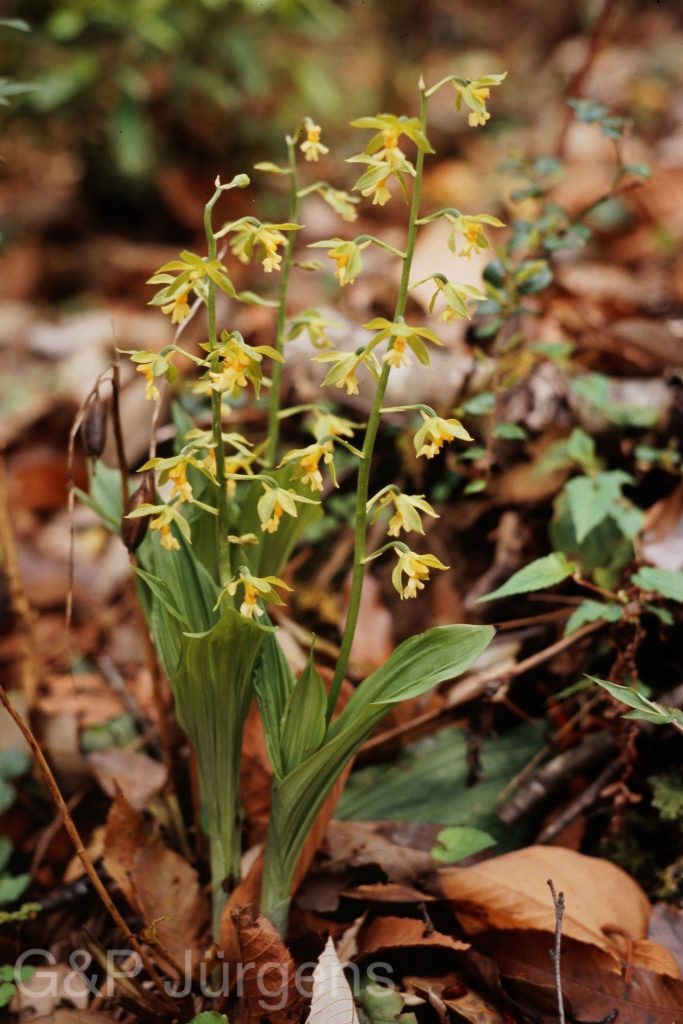
Hook.f.

Bhutan2014 804
Bhutan Mo-Chu 1600m, May
Bh2008 463 G724
Bhutan, Samtengang 1950m, May

Description

Calanthe mannii is a terrestrial orchid distributed across the eastern Himalayas and East Asia, from Nepal and northeast India through Bhutan, Myanmar, southern China (Yunnan, Guizhou, Guangxi), to Japan (Ryukyu Islands). GBIF records nearly 100 occurrences across this range. The species grows in warm to temperate broadleaved forests, often along streams and in ravines with rich humus soil, at elevations of 1,000–2,500 m.

The plant is an evergreen Calanthe producing narrow, conical pseudobulbs partially enclosed by leaf sheaths. Leaves are 3–5, elliptic-lanceolate, 20–40 cm long, plicate, with prominent veins. The inflorescence is an erect, densely many-flowered raceme 30–50 cm tall, bearing 15–30 flowers. Flowers are 2–2.5 cm across, with a distinctive colour combination: the sepals and petals are yellowish-brown to olive-green, while the lip is pale, trilobed, with the mid-lobe deeply bilobed and a prominent yellow callus. The spur is curved, 8–12 mm long. Flowering occurs from April to June.

Calanthe mannii is named after Gustav Mann (1836–1916), the German-born botanical collector who worked in northeast India. The species is distinguished from the similar C. puberula by its more densely flowered raceme and different lip morphology. Its presence in both subtropical (Mo-Chu valley, 1,600 m) and temperate zones in Bhutan indicates broad ecological tolerance.

Author: Hook.f. · Sources: POWO (Kew), Flora of Bhutan Vol. 3, GBIF, Flora of China Vol. 25, Pearce & Cribb: The Orchids of Bhutan (2002)