Tag:

Nepal

Flowers of Nepal — 1313 wild plant species documented from the Nepalese Himalaya, from subtropical foothills to high alpine meadows above 4,000 m. Nepal’s dramatic elevation gradient makes it one of the richest botanical regions on Earth, home to rhododendrons, primulas, gentians and the famed blue poppies (Meconopsis). Every entry gives a botanical description, native distribution, habitat and flowering season, alongside the original field photograph and the location where it was taken.

(D.Don) Soó

Nepal 99 109 ergebnis
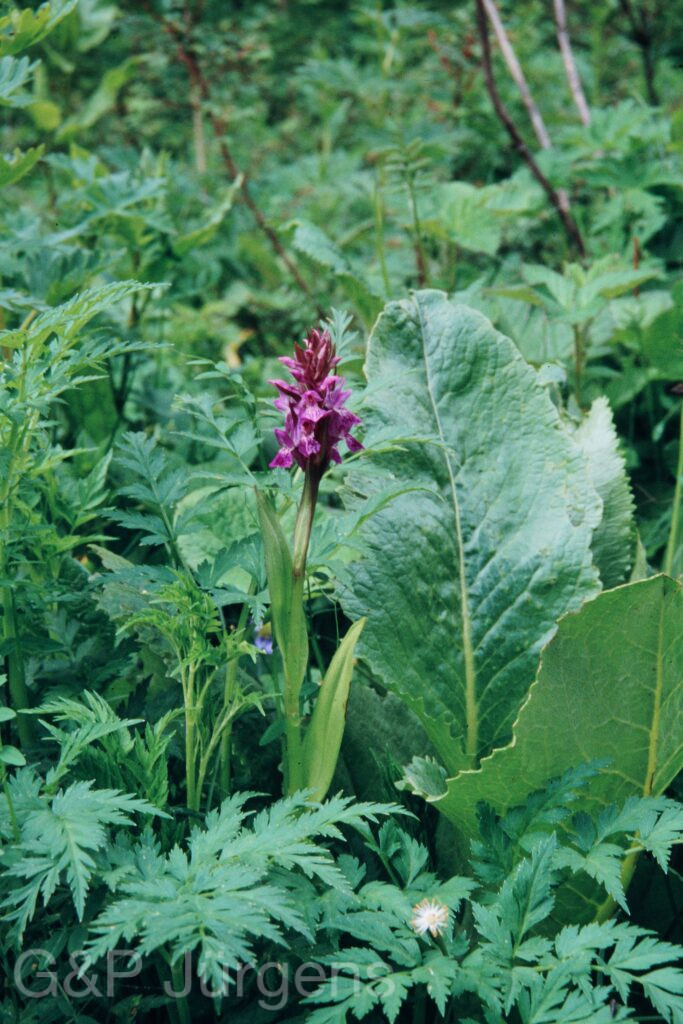
West-Nepal South of Rara-Lake 3600m, June
Garh 07 43 ergebnis
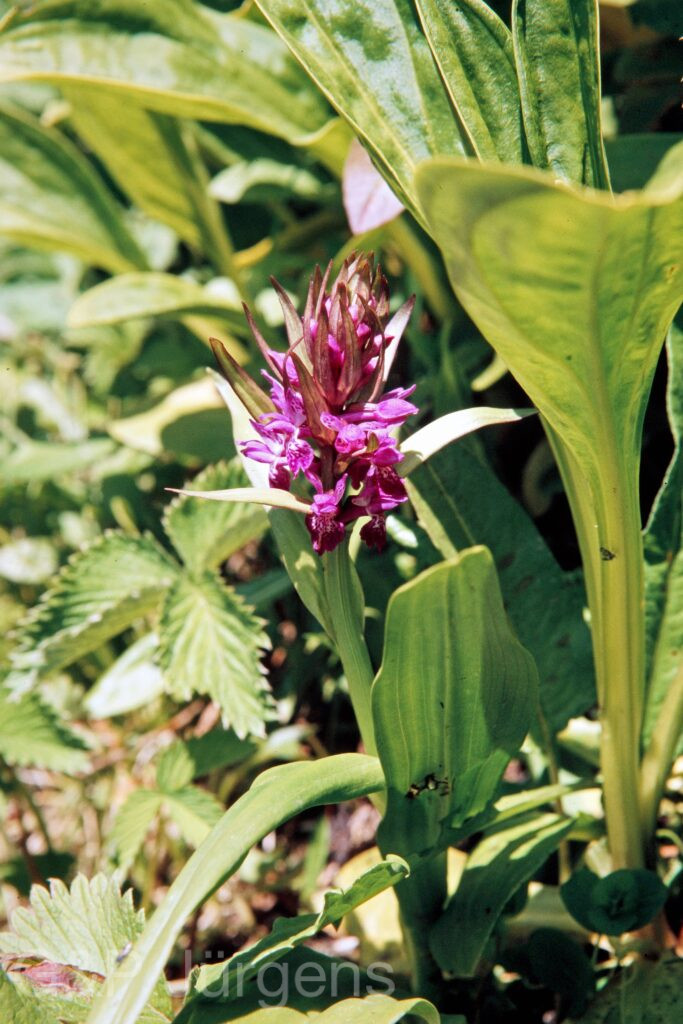
India Garhwal Nanu at Mandakini 2400m, June

Description

Dactylorhiza hatagirea (D.Don) Soó is a terrestrial marsh orchid of the Himalaya and Central Asia, recorded from Afghanistan, Pakistan, India, Nepal, Bhutan, China, Mongolia and Russia; the GBIF dataset of 311 occurrences reflects a wide but increasingly fragmented high-altitude range. It grows in moist alpine and subalpine meadows, marshy grassland, streamsides and damp slopes, broadly between 2500 and 4000 m. The photographed plants from south of Rara Lake in West Nepal at about 3600 m and from Nanu at the Mandakini in Garhwal, India, at about 2400 m, both flowering in June, exemplify its early-summer anthesis in cool, wet, open meadows across the western and central Himalaya.

The species is an erect, glabrous, tuberous perennial herb arising from palmately lobed, hand-shaped root-tubers — the digitate tubers giving both the generic name and the local trade name "Hatajari" or "Salampanja." The stem is stout and hollow, bearing several oblong-lanceolate, sheathing, usually unspotted leaves grading into bracts above. The inflorescence is a dense, many-flowered terminal spike of pink to purple-violet flowers; each has spreading sepals, a hooded arrangement of the upper segments, and a broad, three-lobed, darkly spotted labellum with a stout, descending spur. The column bears two pollinia, and the fruit is a ribbed, dehiscent capsule releasing minute, dust-like seeds.

Dactylorhiza (Orchidaceae, subtribe Orchidinae) is a north-temperate genus of tuberous marsh orchids defined by palmately divided tubers and spurred, lobed labella; D. hatagirea is its principal Himalayan representative. The dried tubers are intensively harvested for the salep trade and traditional medicine, and this over-collection, compounded by grazing and habitat loss, has driven steep population declines. It is consequently listed on CITES Appendix II and regarded as threatened and legally protected across much of its range, making it a priority for conservation and sustainable management.

Author: (D.Don) Soó · Sources: POWO (Kew), GBIF, Flora of China, Flora of Bhutan, Annotated Checklist of the Flowering Plants of Nepal, Pridgeon et al. — Genera Orchidacearum
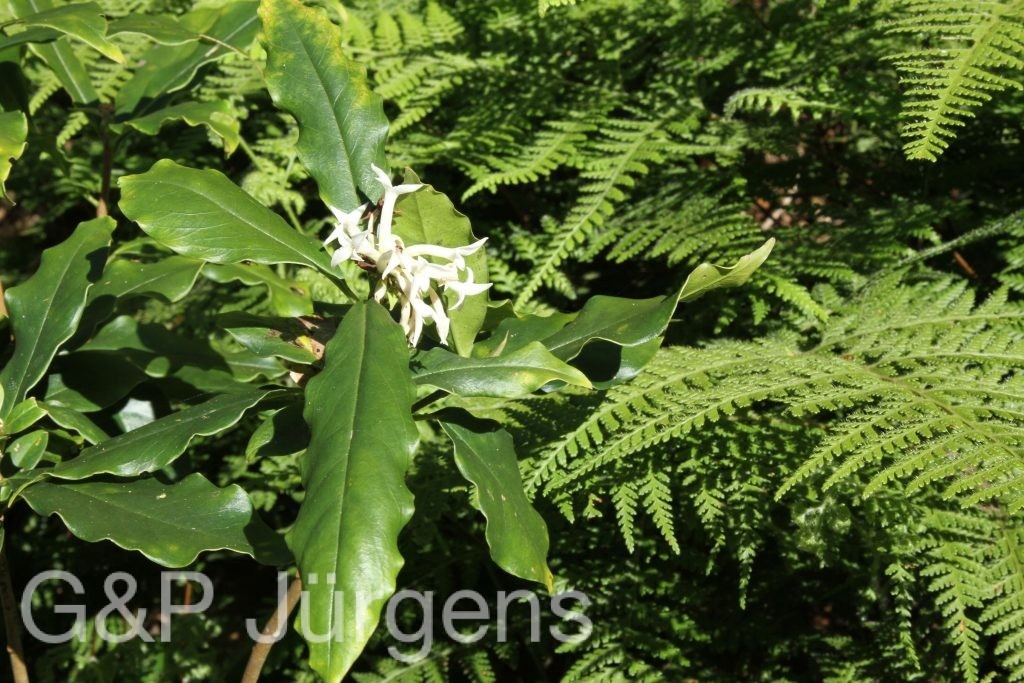
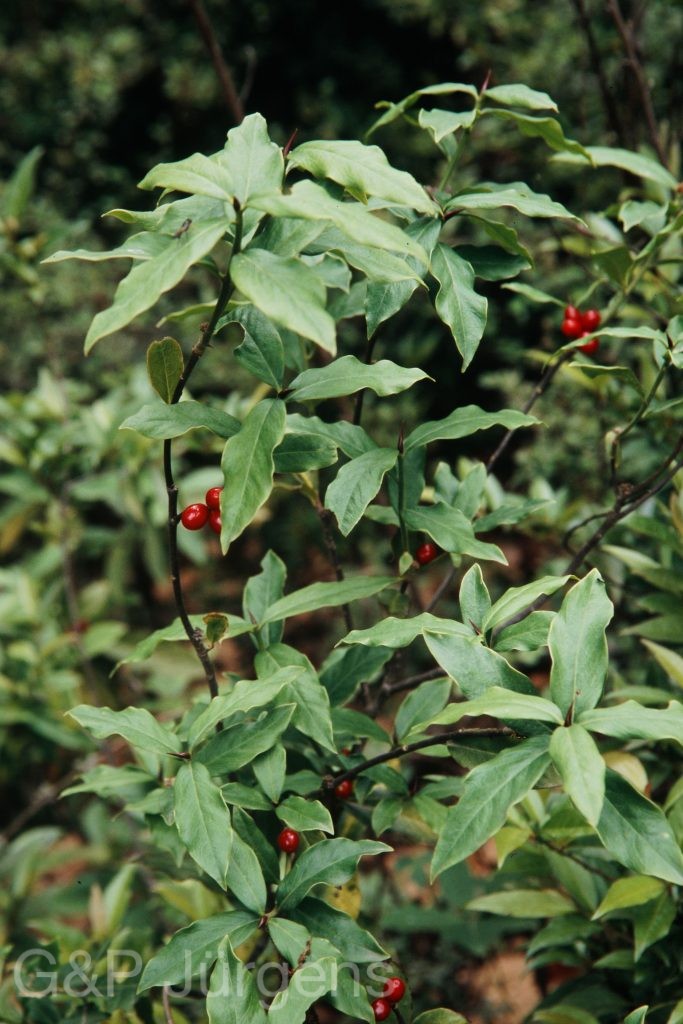
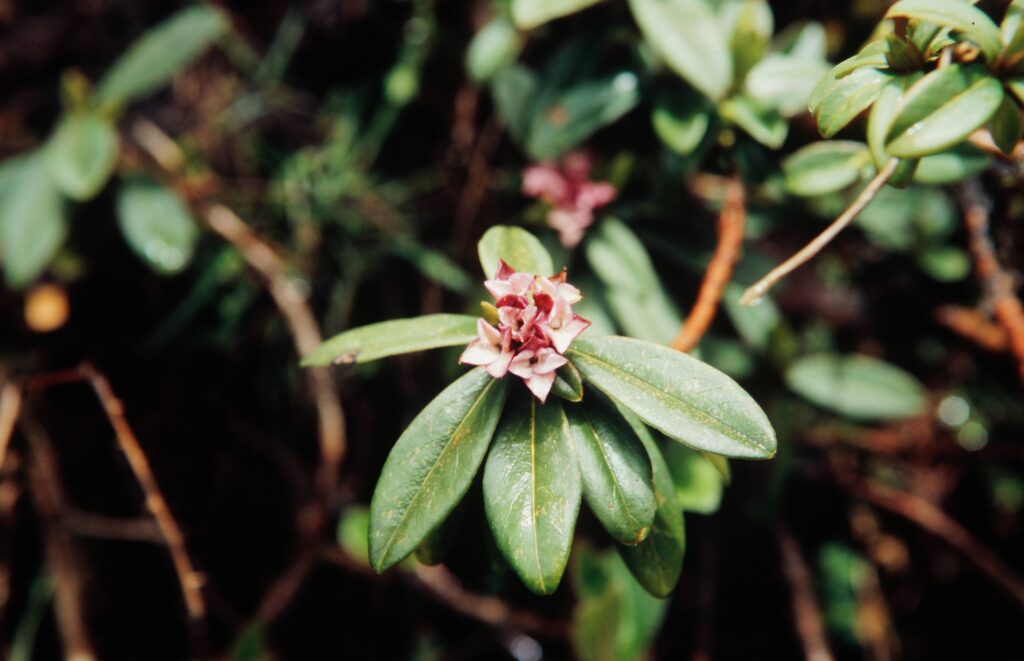
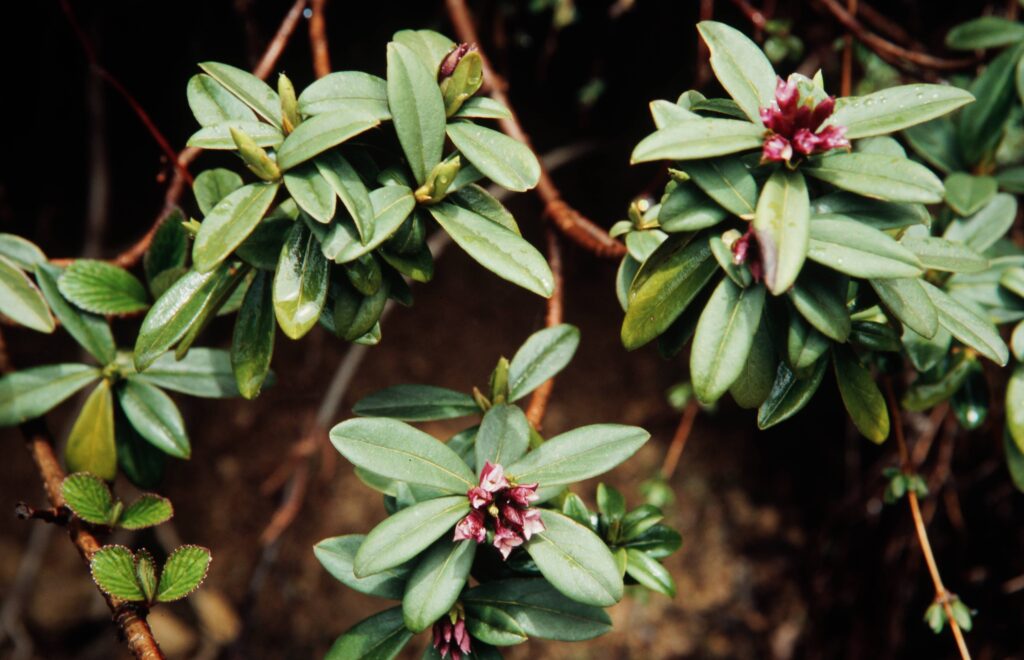
Daphne bholua

by GP Jürgens

Buch.-Ham. ex D.Don

Sikkim2011 45
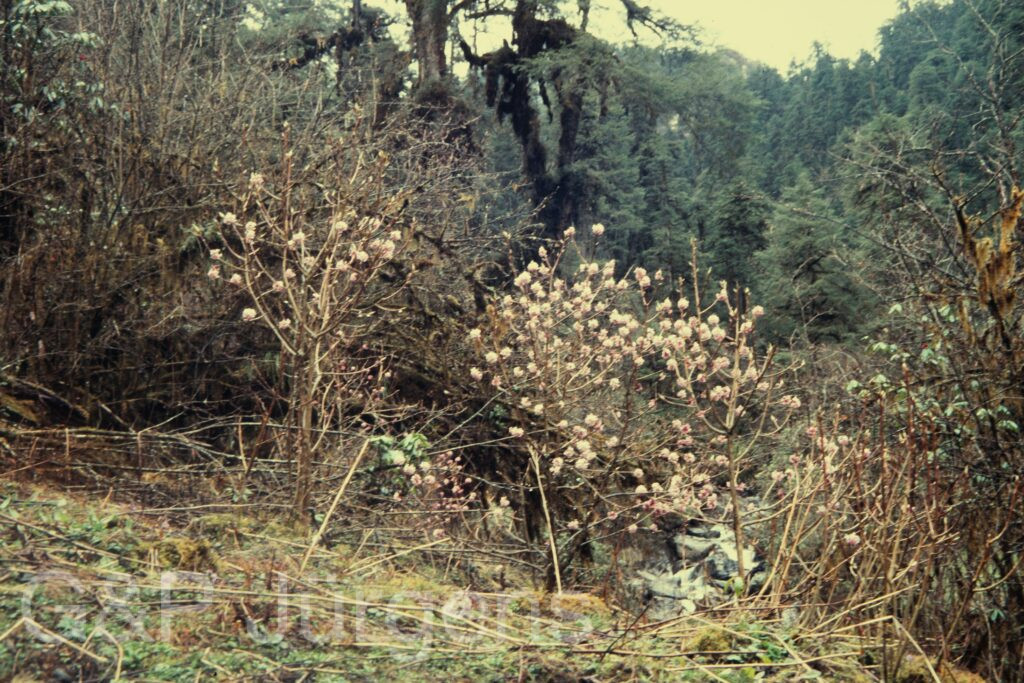
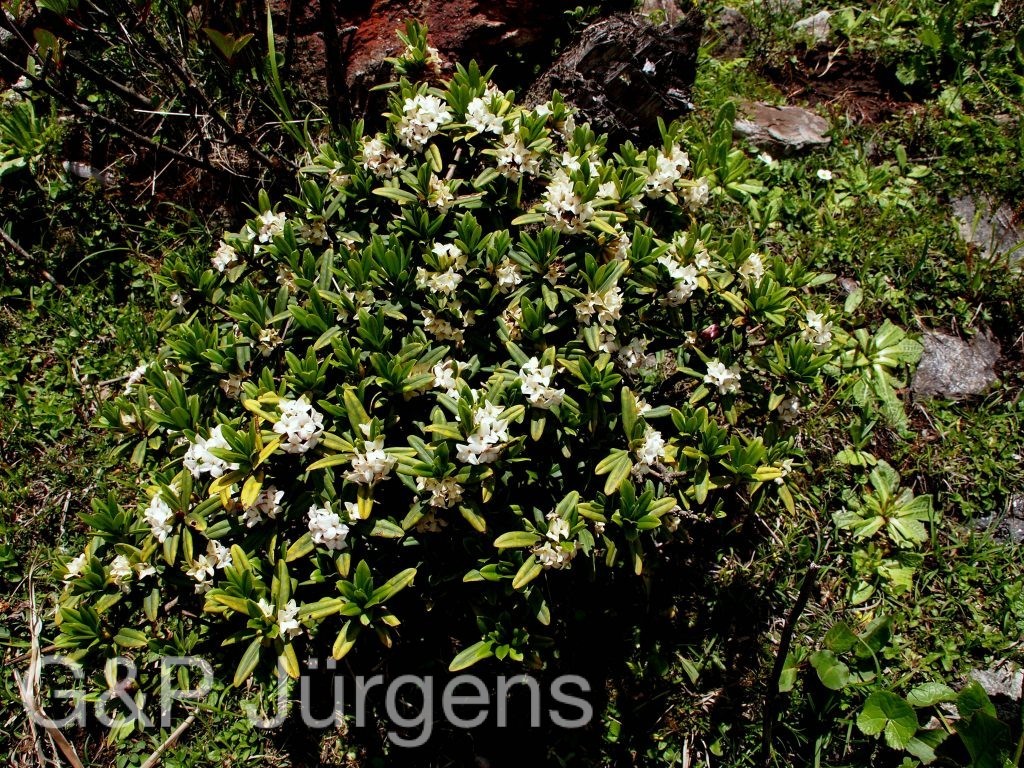
Sikkim Vista-valley 3750m, June
Sikkim2011 49
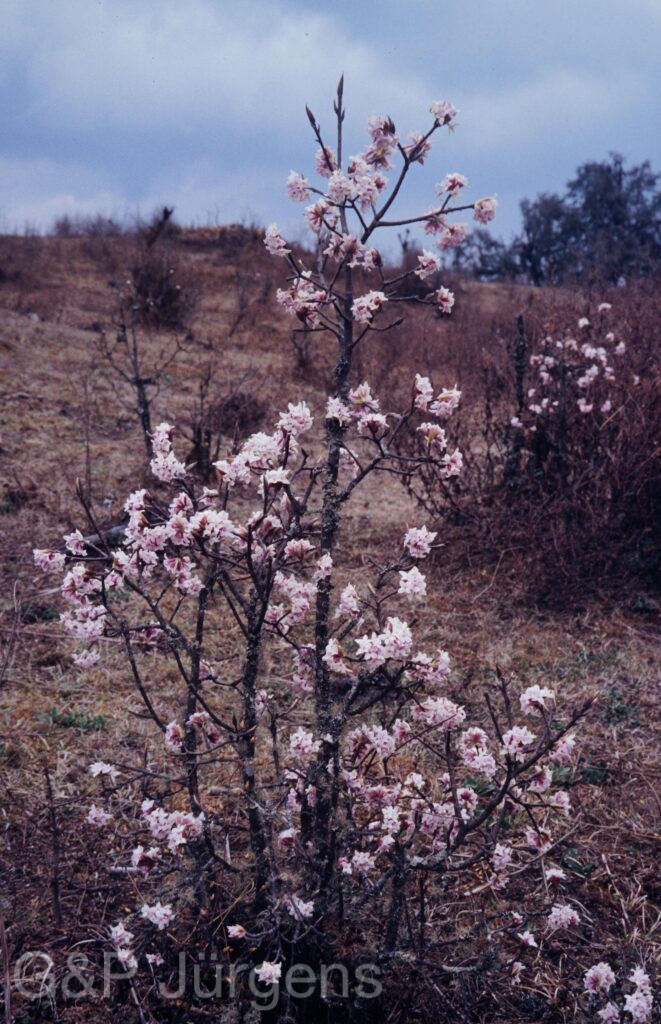
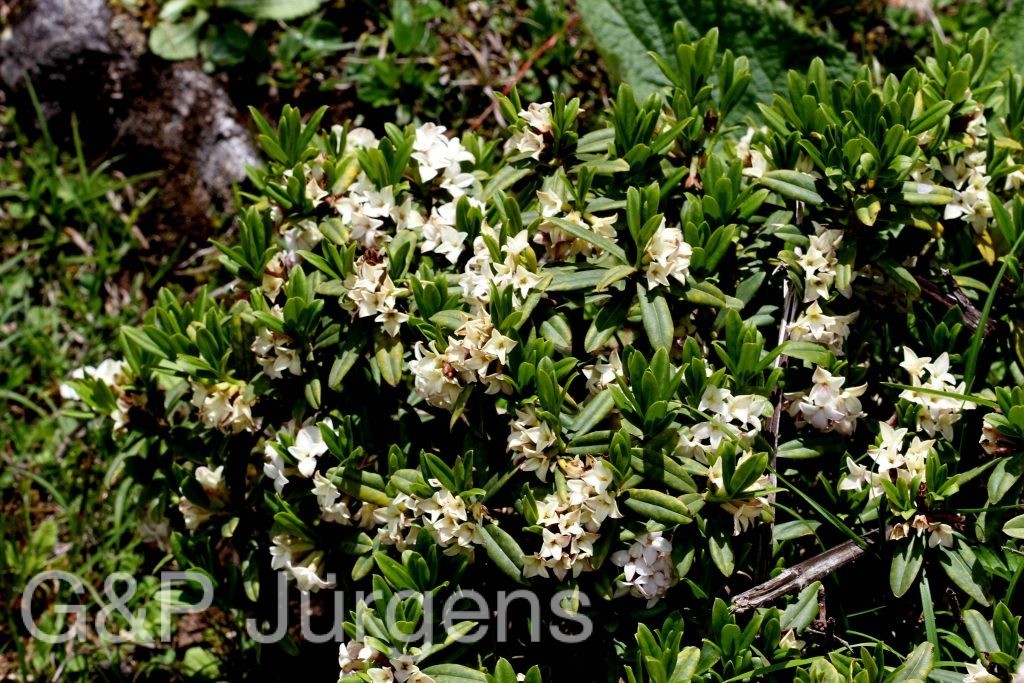
Sikkim Vista-valley 3750m, June

Description

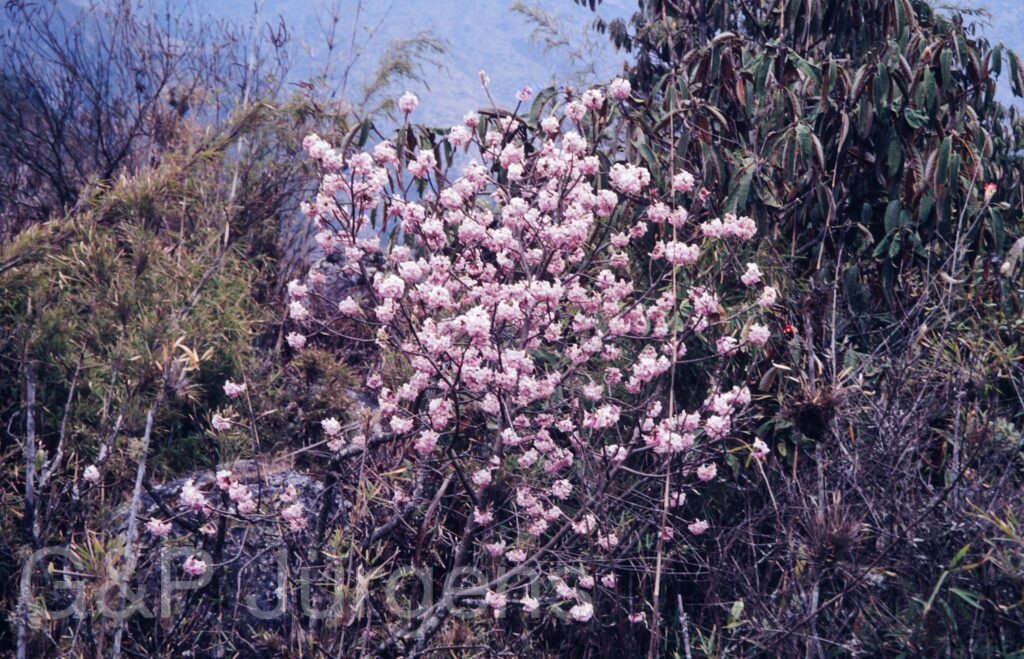
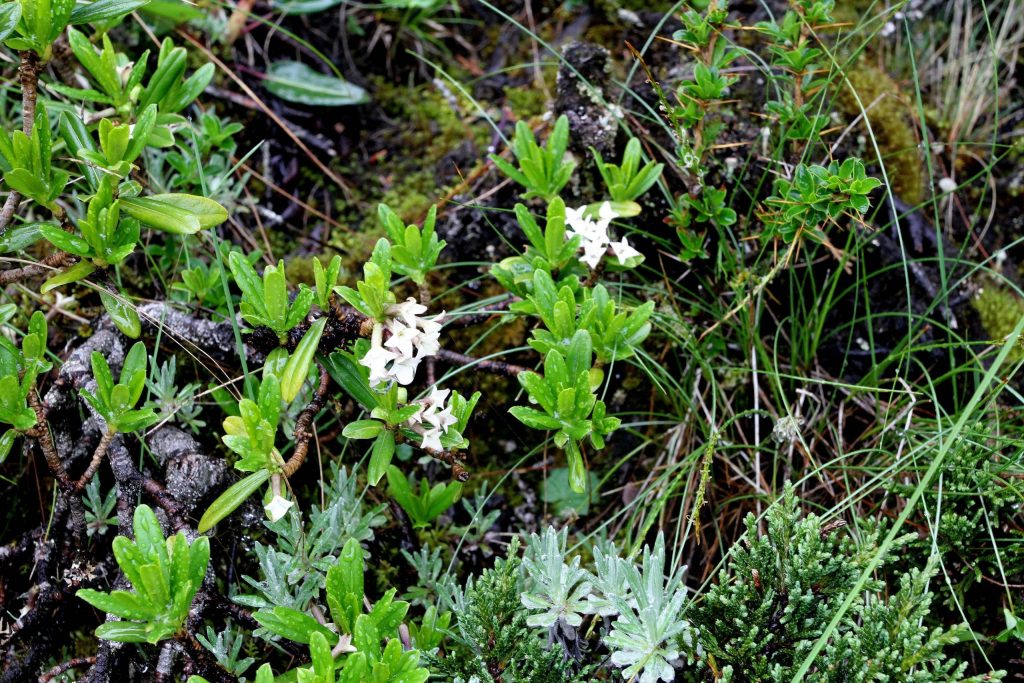
Daphne bholua is an evergreen to semi-deciduous shrub of the central and eastern Himalaya, distributed through Nepal, China, Bhutan and India, with around 758 georeferenced records; its appearance in numerous temperate countries reflects its extensive horticultural cultivation. In the wild it occupies temperate and subalpine forest, scrub and clearings, often in oak, rhododendron and conifer woodland and on open hillsides. The plant photographed in Sikkim's Vista valley at 3750 m, flowering in June, exemplifies its upper-elevation range, where it forms thickets on moist, well-drained slopes.

It grows as an erect shrub to about 2.5 m with tough, fibrous bark and densely leafy branches. The leaves are alternate, clustered toward the branch tips, oblong-lanceolate, leathery, glossy dark green above and entire-margined. The fragrant flowers are borne in dense terminal and subterminal clusters; each has no petals but a petaloid, salverform perianth tube, white within and flushed rose-purple outside, the four spreading lobes strongly scented. The fruit is a fleshy ovoid berry-like drupe, blackening when ripe.

Daphne bholua, described by Buchanan-Hamilton ex D. Don, is celebrated in horticulture for its intensely fragrant winter-to-spring flowers and has given rise to many cultivars. In its homeland the strong bast fibres of the bark are a principal source of traditional Nepali handmade paper (lokta). Like other Thymelaeaceae it contains acrid, toxic compounds. Although widespread and not formally threatened, intensive bark harvesting for paper-making places localised pressure on wild populations.

Author: Buch.-Ham. ex D.Don · Sources: POWO (Kew), GBIF, Flora of Bhutan, Annotated Checklist of the Flowering Plants of Nepal, Halda The Genus Daphne

(W.W.Sm. & Cave) B.L.Burtt

Nepal 97 130 P229
Nepal Mewa-Khola 2600m April
Nepal1992 238 W349 ergebnis
Nepal Kyapra 2800m March 
Nepal1992 108 W148 ergebnis
Nepal Kyapra 2800m March 

Description

Daphne bholua var. glacialis is a Himalayan variant of the paper daphne, distributed across the China-Nepal-India sector of the range, with about 79 GBIF occurrences. It grows in cool temperate forest and forest-edge scrub, in clearings, on shrubby slopes and along ridges, on moist but well-drained humus-rich soils, frequently with rhododendron, oak and conifers. The collections illustrated from the Mewa Khola at 2600 m in April and from Kyapra at 2800 m in March, both in eastern Nepal, are characteristic of its range of roughly 2400-3500 m, where it flowers in late winter and early spring; the epithet glacialis alludes to this hardy, high-cold habitat where the smaller-leaved form prevails.

This variety is a much-branched erect shrub typically 1-2.5 m tall, with tough, fibrous, pliant bark. The leaves are alternate, leathery, elliptic to oblanceolate, entire and glossy above, clustered toward the branch tips and more readily deciduous than in the typical variety. The fragrant flowers are borne in dense terminal and subterminal clusters; lacking petals, the showy perianth consists of a slender hypanthial tube expanding into four spreading lobes that are pinkish-purple outside and paler within, intensely scented. Eight stamens are inserted in two whorls within the tube, and the superior ovary ripens into a small ovoid drupe that turns black.

The taxon is treated by POWO as variety glacialis of Daphne bholua, distinguished from the typical form chiefly by its more deciduous, smaller leaves and tolerance of higher, colder sites. Like other Himalayan daphnes its bark yields strong fibre used in handmade lokta paper, and the whole plant contains acrid, irritant compounds. It is prized in horticulture for its winter fragrance; wild populations can be affected by bark harvesting and habitat clearance.

Author: (W.W.Sm. & Cave) B.L.Burtt · Sources: POWO (Kew), GBIF, Flora of China, Flora of Nepal, Halda The Genus Daphne, Brickell & Mathew Daphne monograph

Daphne sureil

by GP Jürgens

W.W.Sm. & Cave

Bhutan2012 638
Bhutan Tserang, 1600m September
Bhutan2015 218
Bhutan Zhemgang 1000m, October
Bh2008 515 P790
Bhutan Chongsakha, 1800m April

Description

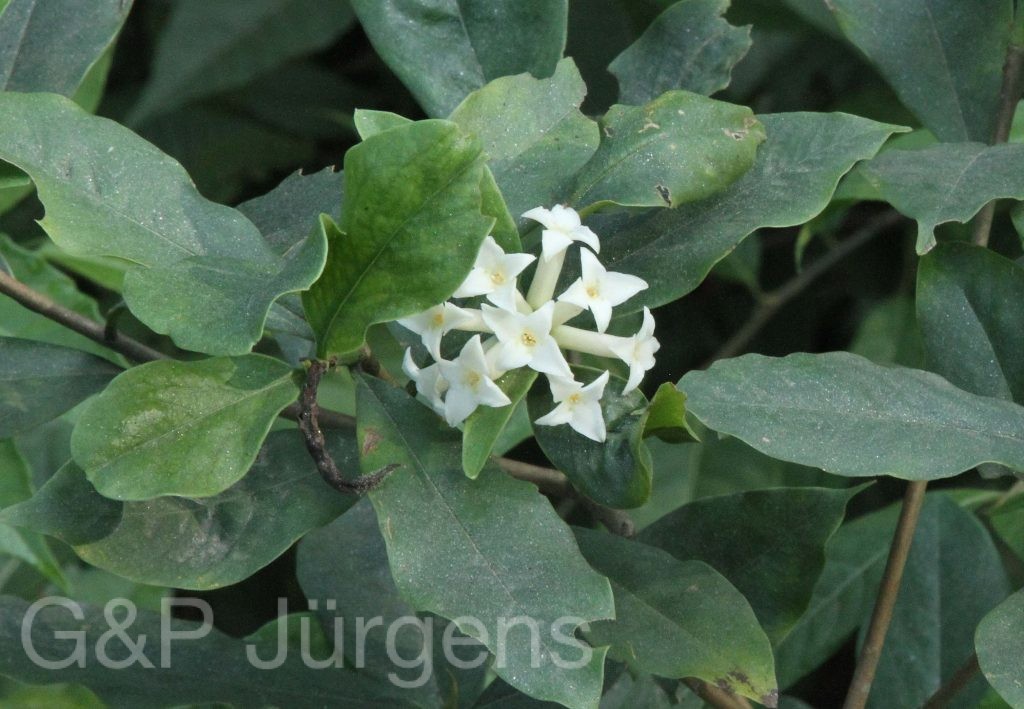
Daphne sureil is a shrub of the eastern Himalaya and adjacent Southeast Asia, recorded from India, Thailand, Nepal, Bhutan, Myanmar, Bangladesh and Vietnam, with about 124 documented occurrences. It is a plant of warm-temperate and subtropical broad-leaved forest, growing in the understorey and along forest margins, ravines and stream banks on moist, well-drained slopes. In Bhutan it occupies the lower to middle montane belt across a broad elevational span, as shown by collections from Tserang at about 1600 m in September, Zhemgang at 1000 m in October and Chongsakha at 1800 m in April, the spring date corresponding to its flowering period.

The species is an evergreen shrub with slender, glabrous branches bearing alternate, shortly petiolate leaves that are elliptic to oblanceolate, entire, acuminate or acute at the apex and tapering at the base, leathery and glossy above with a paler lower surface. The flowers are borne in small terminal clusters and lack petals, the floral display formed instead by a tubular, fragrant white to creamy perianth of four spreading lobes, the tube silky-pubescent without and enclosing eight stamens in two whorls. The fruit is a fleshy ovoid drupe, ripening red, containing a single seed.

Daphne sureil was described by W. W. Smith and Cave from the eastern Himalaya and belongs to the predominantly evergreen Asian assemblage of the genus. As in other Daphne species, the bark contains tough phloem fibres and the tissues bear the diterpenoid daphnane compounds responsible for their acridity and toxicity. The bird-dispersed drupes and strongly scented, presumably moth-pollinated flowers reflect typical thymelaeaceous biology. The species is locally frequent in suitable forest but, being tied to lower-montane broad-leaved woodland, is potentially vulnerable to habitat clearance at its lower elevational limits.

Author: W.W.Sm. & Cave · Sources: POWO (Kew), GBIF, Flora of Bhutan Vol. 1, Flora of China Vol. 13, Flora of Nepal, Halda monograph The Genus Daphne

Maxim.

BhutanPG2011 486 scaled
Bhutan Ludlow-Sherriff-Trail Warrtlang-La, 4350m June

Description

Daphne tangutica is distributed across a broad elevational and geographical range from the eastern Himalayas to central and western China, with the core of its distribution in Sichuan, Gansu, and Qinghai provinces. GBIF records over 1,150 occurrences, predominantly from China, with additional records from Bhutan, India, Nepal, and Pakistan. The species inhabits Rhododendron scrub, alpine meadows, rocky slopes, and open coniferous forest margins at 2,500–4,500 m elevation. Collections from Tamrong in West Bengal at 3,200 m and from the Warrtlang-La along the Ludlow–Sherriff Trail in Bhutan at 4,350 m demonstrate its remarkable altitudinal amplitude within the eastern Himalayan region.
Daphne tangutica is an evergreen shrub, typically 0.5–1.5 m tall, compact and densely branched. Leaves are alternate, clustered towards the branch tips, oblanceolate to elliptic, 3–8 cm long, coriaceous, dark glossy green above and paler beneath, with entire revolute margins. Flowers are borne in dense terminal clusters of 3–8, each flower with a tubular hypanthium 10–14 mm long, the four spreading lobes white internally and purplish-rose externally. The flowers are intensely fragrant. Stamens are eight, in two whorls, inserted on the hypanthium tube. The fruit is an ovoid drupe, 6–8 mm long, red at maturity, containing a single seed.
Daphne tangutica was described by Maximowicz in 1882 from material collected in Gansu. It is closely related to D. retusa, and the two species have been confused in herbaria; D. tangutica is generally distinguished by its longer, more lanceolate leaves and more elongate hypanthium tube. The occurrence at 4,350 m on the Warrtlang-La approaches the upper limit for any Daphne species in the Himalayas and attests to the species' tolerance of extreme alpine conditions. It has been widely introduced into horticulture in Europe and North America, prized for its fragrant spring flowers and compact evergreen habit.

Author: Maxim. · Sources: POWO (Kew), GBIF, Flora of China Vol. 13, Flora of Bhutan Vol. 2, Brickell & Mathew: Daphne — The Genus in the Wild and in Cultivation (1976)

K.Rosenth.

Bhutan2012 636
Bhutan Tserang 1660m, June

Description

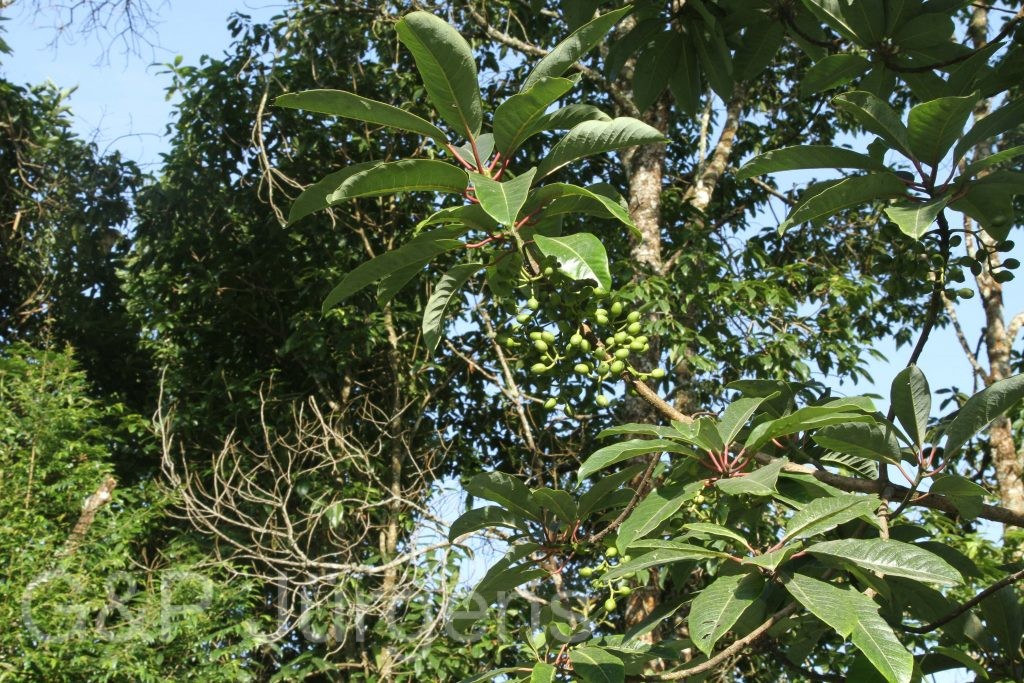
Daphniphyllum chartaceum is an evergreen tree or large shrub of the eastern Himalaya and Indo-Burmese uplands, recorded by GBIF, with around 140 occurrences, from China, Nepal, India, Bhutan, Vietnam and Myanmar. It is a component of moist, broad-leaved evergreen and warm-temperate forest, growing on humid slopes, in ravines and along forest margins, typically between about 1500 and 2500 m. The photographed plant from Tserang in Bhutan, at roughly 1660 m and recorded in June, is representative of its mid-elevation, subtropical-to-warm-temperate forest habitat, where it occupies the understorey to mid-canopy of dense, evergreen Himalayan woodland under a humid, monsoon-influenced climate.

The species is a dioecious tree with smooth bark and stout twigs bearing leaves crowded toward the branch tips. The leaves are simple, alternate but often appearing pseudo-whorled, elliptic to oblong-lanceolate, leathery to chartaceous (papery, as the epithet indicates), entire-margined, with the lower surface usually glaucous and conspicuously papillose, and frequently reddish petioles. Being dioecious, male and female flowers are borne on separate trees in axillary racemes; the flowers are small and apetalous, the males with numerous stamens and the females with a unilocular to bilocular ovary, lacking showy perianth. The fruit is a small, ellipsoid, one-seeded drupe, bluish-black and often glaucous at maturity, borne in short axillary clusters.

Daphniphyllum is the sole genus of Daphniphyllaceae, an isolated family of eastern and southern Asia of considerable phylogenetic interest, placed near Saxifragales and noted for its distinctive Daphniphyllum alkaloids. D. chartaceum is distinguished within the genus by its papery, glaucous-papillose leaves and has been associated with the variable D. himalense complex, with which it shares its montane Himalayan range. The fleshy drupes are dispersed by birds, and the dioecious breeding system enforces outcrossing. The species is reasonably widespread across the eastern Himalaya and Indo-Burma and is not regarded as threatened, though, like many evergreen forest trees of the region, local populations are sensitive to deforestation and land-use change.

Author: K.Rosenth. · Sources: POWO (Kew), GBIF, Flora of China Vol. 11, Flora of Bhutan Vol. 1, Flora of Nepal, Flora of Pakistan, Huang's monograph of Daphniphyllum

Hook.f. & Thomson

Sikkim 2006 329 ergebnis
India West-Bengal, Chaana 1700m, May

Description

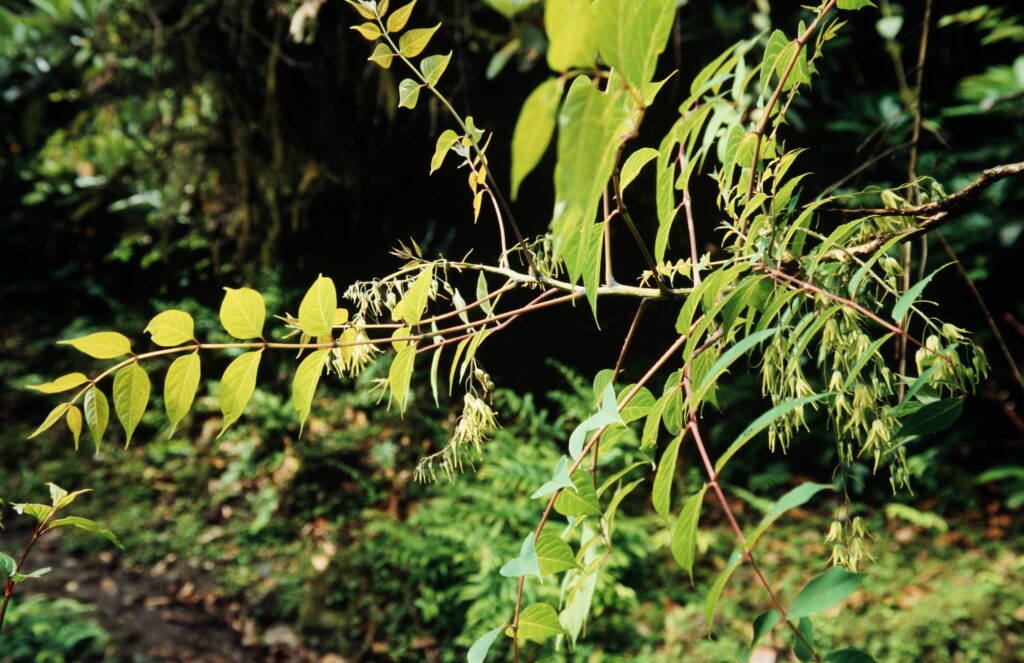
Decaisnea insignis is a deciduous shrub of the Himalaya and southwest China, native to China, India, Bhutan, Nepal and Myanmar, and now widely grown as an ornamental, accounting for numerous records in Europe, North America and elsewhere. It occupies moist temperate forest, forest margins, ravines and shrubby slopes, typically between about 1500 and 3500 m. The photographed plant from Chaana in West Bengal, India, at roughly 1700 m and flowering in May, is characteristic of cool, humid mid-montane forest where it favours sheltered, well-watered situations with rich, humus-laden soils.

The plant is an erect, sparsely branched shrub with stout, pithy stems. The leaves are large, alternate, imparipinnate, with numerous ovate to ovate-lanceolate, entire, acuminate, glaucous-backed leaflets. The flowers are borne in pendulous terminal panicles and are functionally unisexual, with six narrow, greenish-yellow, petaloid sepals and no true petals. The most distinctive feature is the fruit: pendent, cylindrical, sausage-shaped follicles that ripen a striking metallic blue, the fleshy interior containing a translucent, sweetish pulp embedding numerous flattened black seeds, giving rise to the common name dead man's fingers.

The genus commemorates the French botanist Joseph Decaisne, and insignis alludes to its remarkable blue fruit. Some authors treat the blue-fruited Himalayan plants as D. insignis distinct from the yellow-fruited Chinese D. fargesii, though the two are frequently united. The Lardizabalaceae is a small, mainly East Asian family of climbers and shrubs; D. insignis is anomalous as an erect, non-twining member. The conspicuous fleshy fruits suggest vertebrate dispersal, and the species is widely cultivated and not threatened.

Author: Hook.f. & Thomson · Sources: POWO (Kew), GBIF, Flora of China Vol. 7, Flora of Bhutan Vol. 1, Flora of Nepal, A Revision of the Lardizabalaceae

Delonix regia

by GP Jürgens

(Bojer ex. Hook.) Raf.

Nepal 97 595 P1150
Nepal Sabha-Khola 1200m,May
Nepal 97 596 G1151
Nepal Sabha-Khola 1200m,May
Nepal 1994 335 2 ergebnis
Ost-Nepal Chainpur 400m May 

Description

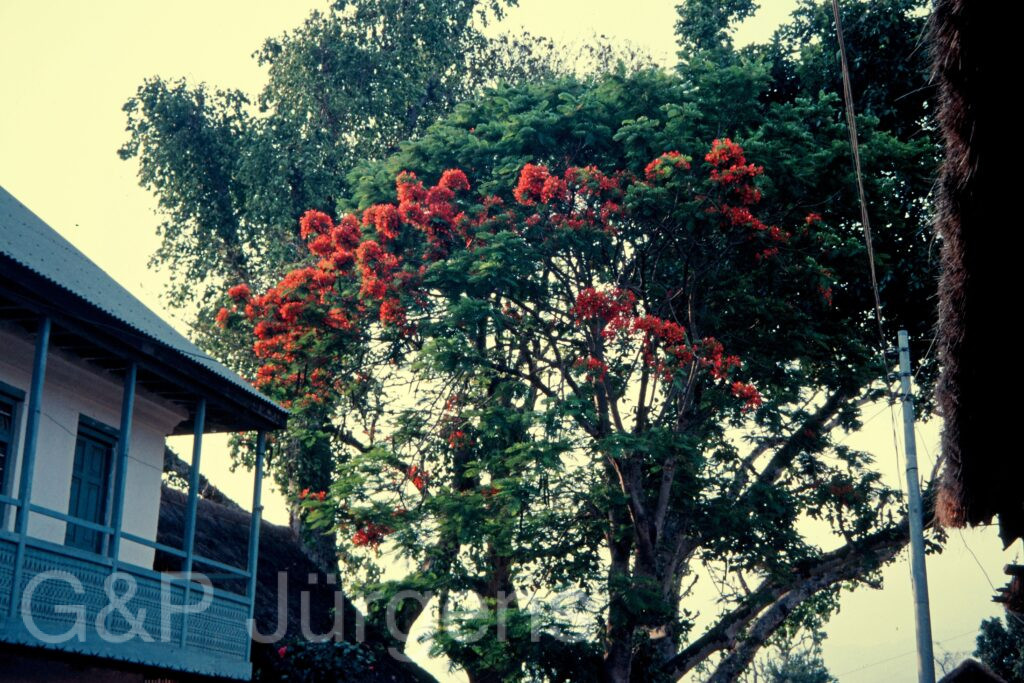
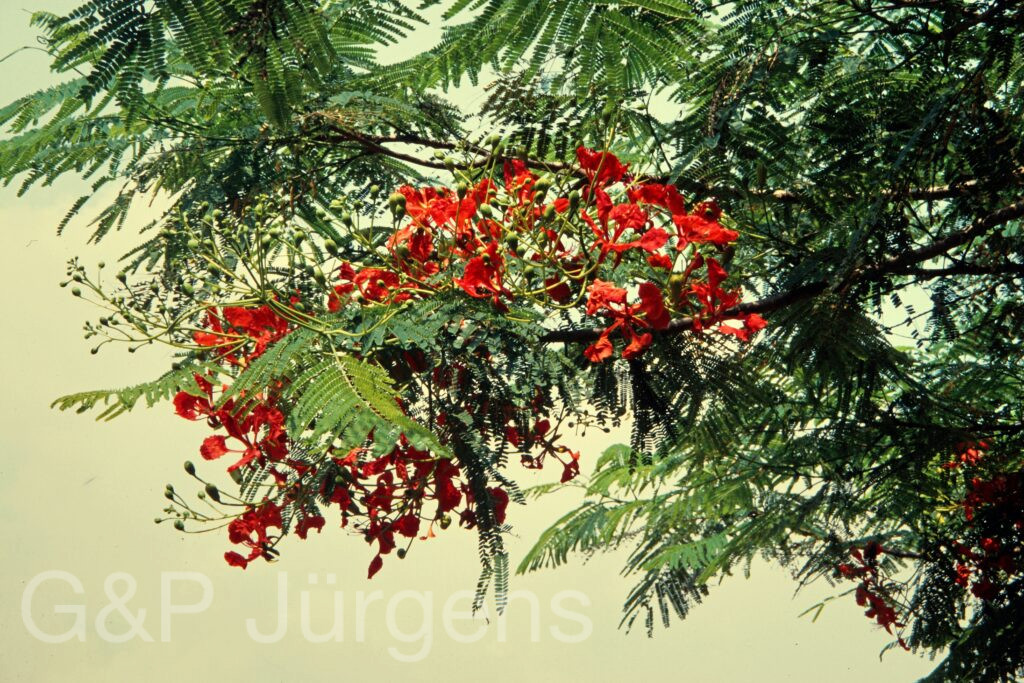
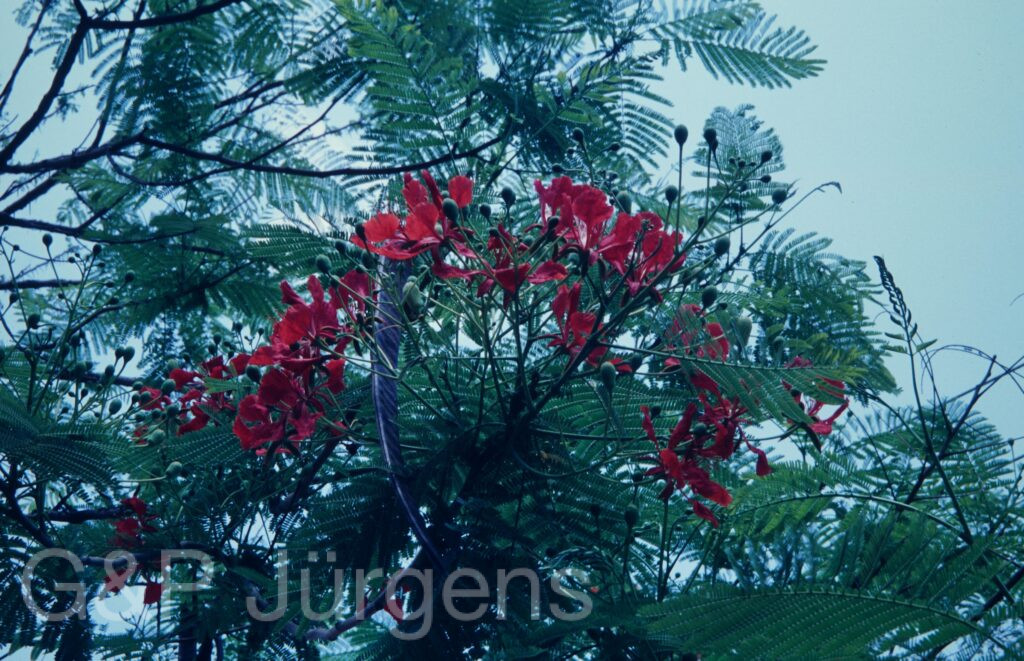
Delonix regia is one of the most widely cultivated ornamental trees of the tropics, native to the deciduous and dry forests of western Madagascar but now naturalised and planted across the warm regions of every continent. GBIF records reflect this pantropical spread, with occurrences across India, Australia, Brazil, Mexico, the United States, Tanzania, Madagascar, Thailand, China, Kenya, South Africa and the Dominican Republic, drawn from more than 27,000 documented collections. In the eastern Himalaya it occurs only as an introduced shade and avenue tree of the warm lowlands and foothills; the photographed material from the Sabha-Khola valley at 1200 m and from Chainpur in East Nepal at around 400 m, flowering in May, lies near the upper altitudinal limit at which the species thrives, requiring frost-free, seasonally dry, sun-exposed sites.

It forms a spreading, umbrella-crowned deciduous tree to 10–15 m, the trunk often buttressed and the bark smooth and grey. The leaves are large, bipinnate and fern-like, with 10–25 pairs of pinnae each bearing numerous small oblong leaflets. The flowers, borne in showy corymbose racemes, are large and zygomorphic with five clawed, spreading petals, four scarlet to orange-red and one larger, whitish or yellow petal streaked with red; the ten stamens are long and exserted with red filaments. The fruit is a large, woody, flattened legume to 60 cm long, persistent and dark brown when ripe, containing numerous hard, mottled seeds.

A member of the Caesalpinioid clade of the Fabaceae, Delonix is a small genus centred on Madagascar and East Africa. Though abundant in cultivation, the species is assessed as of conservation concern in its native range owing to deforestation and a highly restricted wild distribution. Its conspicuous flowering, drought tolerance and nitrogen-fixing capacity have made it a favoured street and amenity tree throughout the tropics, where it is valued equally for shade and ornament.

Author: (Bojer ex. Hook.) Raf. · Sources: POWO (Kew), GBIF, Flora of Nepal, Flora of Madagascar (Flore de Madagascar et des Comores), Legumes of the World (Lewis et al.)

Royle

Nepal 99 666 ergebnis
West-Nepal Kagmara-La 5500m, July

Description

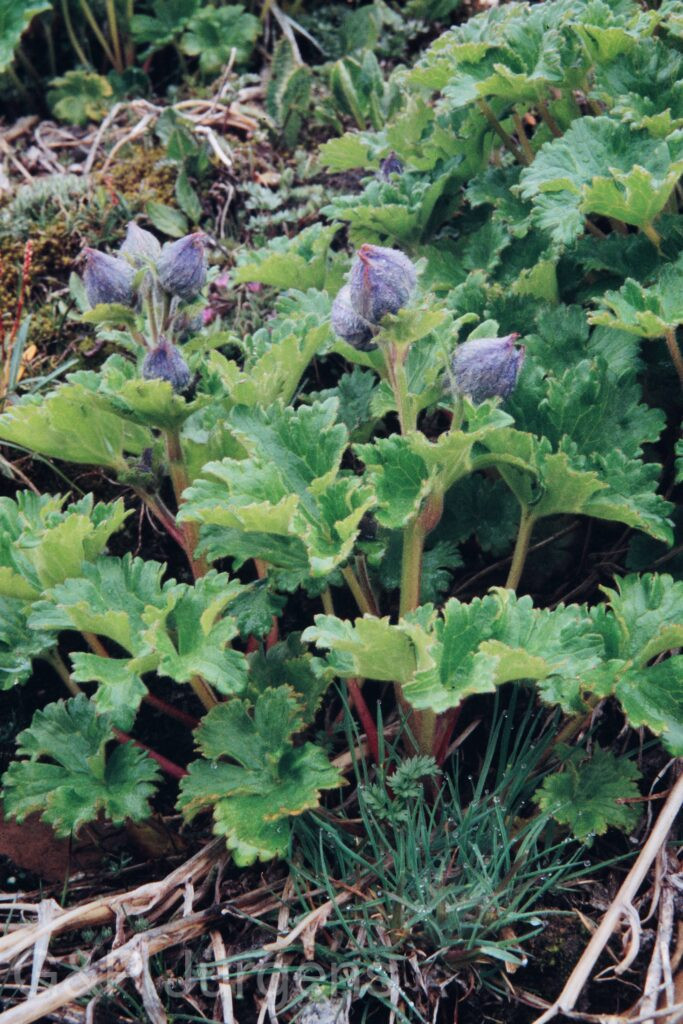
Delphinium brunonianum is a high-alpine perennial of the inner Himalaya and adjacent Central Asian ranges, recorded from Afghanistan, Pakistan, Tajikistan, Uzbekistan and Iraq eastward through northern India, Nepal and Bhutan into south-western China (Tibetan plateau), with some 698 georeferenced GBIF occurrences across this circum-Tibetan arc. It inhabits open stony slopes, screes, moraines and short alpine turf at extreme elevations, typically between about 4000 and 5500 m. The photographed plant from the Kagmara La in West Nepal at 5500 m in July represents the upper range of the species, where it flowers briefly during the short post-monsoon window on wind-exposed, gravelly ground.

It forms a low, tufted herb 8-20 cm tall arising from a stout rootstock, the whole plant glandular-pubescent and emitting a strong musky odour. The leaves are mostly basal, reniform to orbicular in outline and palmately three- to five-lobed with crenate segments. The few-flowered inflorescence bears unusually large, nodding, inflated flowers; the five petaloid sepals are pale to deep blue-purple, broadly ovate, the upper one prolonged into a short blunt spur, and the dark, hairy petals form a contrasting central boss. The fruit is a cluster of three erect, glandular follicles releasing winged seeds.

The species belongs to Delphinium sect. Brunoniana, a small group of musk-scented, large-flowered high-altitude larkspurs. Its strong scent and inflated corolla are associated with bumblebee pollination in a cold, insect-poor environment. Widely used in Tibetan and Himalayan folk medicine, it remains locally common across a vast remote range and is not considered threatened, though it is restricted to fragile alpine habitats sensitive to climate warming and grazing pressure.

Author: Royle · Sources: POWO (Kew), GBIF, Flora of China, Flora of Pakistan, Annotated Checklist of the Flowering Plants of Nepal, Munz monograph of Delphinium

Jacquem. ex Cambess.

Bhutan2015 676
Bhutan Chele-La 3960m, October

Description

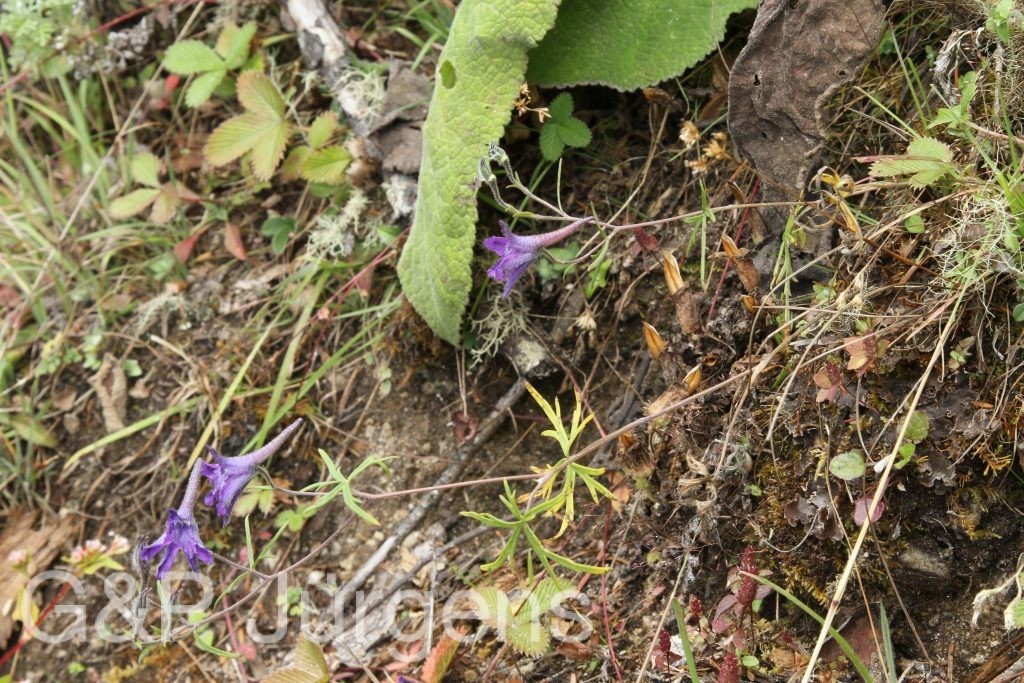
Delphinium caeruleum is an alpine larkspur of the high Himalaya and the Qinghai-Tibetan plateau, distributed across south-western China, northern India, Nepal and Bhutan, well represented in GBIF with 646 occurrences. It inhabits dry alpine meadows, open grassy slopes, sandy and gravelly turf and rocky pastures, typically between 3000 and 5000 m, often on relatively arid, well-drained ground. The photographed plant was found at Chele-La in Bhutan at 3960 m in October, a notably late flowering for this short, cushion-like high-elevation species at the close of the growing season on an exposed pass.

It is a low perennial herb, often only 5-30 cm tall, arising from a slender taproot, with erect or ascending stems and finely dissected leaves divided into narrow linear segments, the lower leaves long-petiolate. The flowers are few in a lax raceme or sometimes solitary, and are an intense deep blue to violet-blue. Each flower has five showy petaloid sepals, the upper one prolonged backward into a slender spur, enclosing the smaller true petals, of which the upper pair forms the nectariferous spur and the lower pair is often bearded. The fruit is a cluster of three erect, glabrous to pubescent follicles releasing winged or scaly seeds.

The spurred flower with its concealed nectar reservoir is adapted to pollination by long-tongued bumblebees, abundant in Himalayan alpine grassland. Within Delphinium it belongs to a group of dwarf, blue-flowered, plateau and high-alpine larkspurs. Like other members of the genus it contains diterpenoid alkaloids and is toxic to livestock, which contributes to its persistence in grazed pasture. Wide-ranging and locally common across the Tibetan and Himalayan highlands, it is of least concern, and several Sino-Himalayan Delphinium species, this among them, feature in traditional Tibetan medicine.

Author: Jacquem. ex Cambess. · Sources: POWO (Kew), GBIF, Flora of China, Flora of Bhutan, Munz: A Revision of Delphinium