Tag:

Nepal

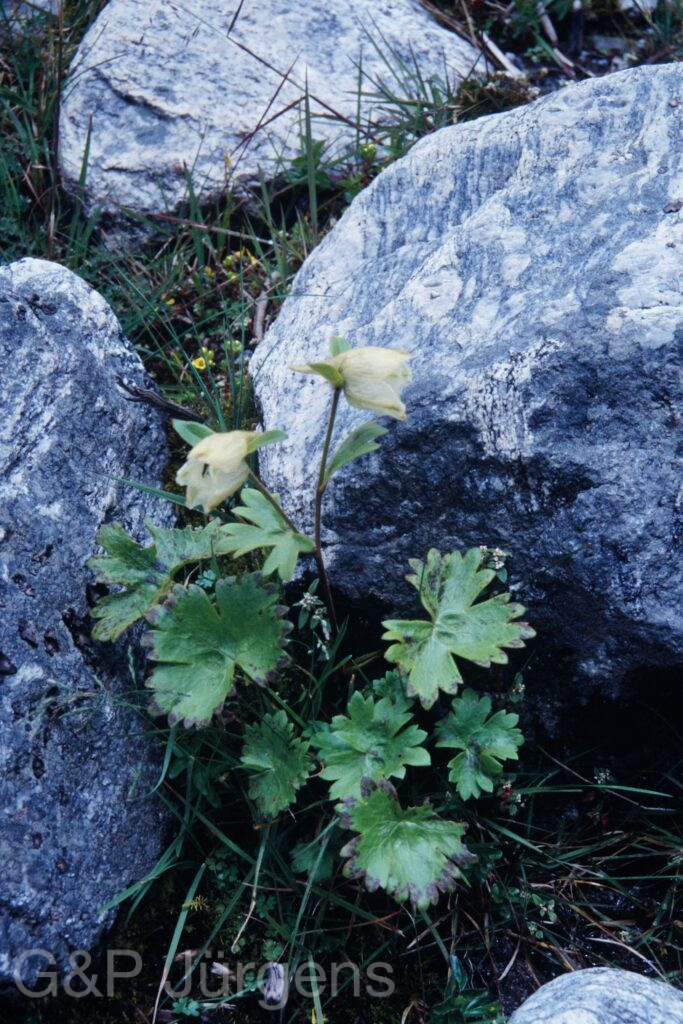
Flowers of Nepal — 1313 wild plant species documented from the Nepalese Himalaya, from subtropical foothills to high alpine meadows above 4,000 m. Nepal’s dramatic elevation gradient makes it one of the richest botanical regions on Earth, home to rhododendrons, primulas, gentians and the famed blue poppies (Meconopsis). Every entry gives a botanical description, native distribution, habitat and flowering season, alongside the original field photograph and the location where it was taken.

Munz

Bhutan2012 184
Bhutan Haar-Valley, 3200m September
Bhutan2012 185
Bhutan Haar-Valley, 3200m September

Description

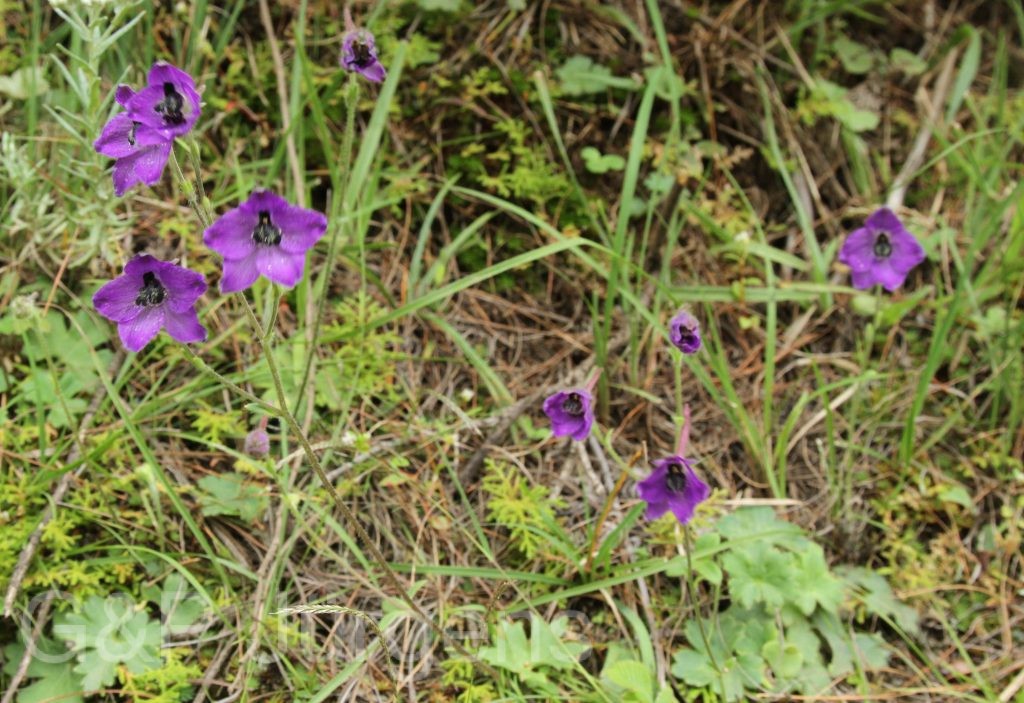
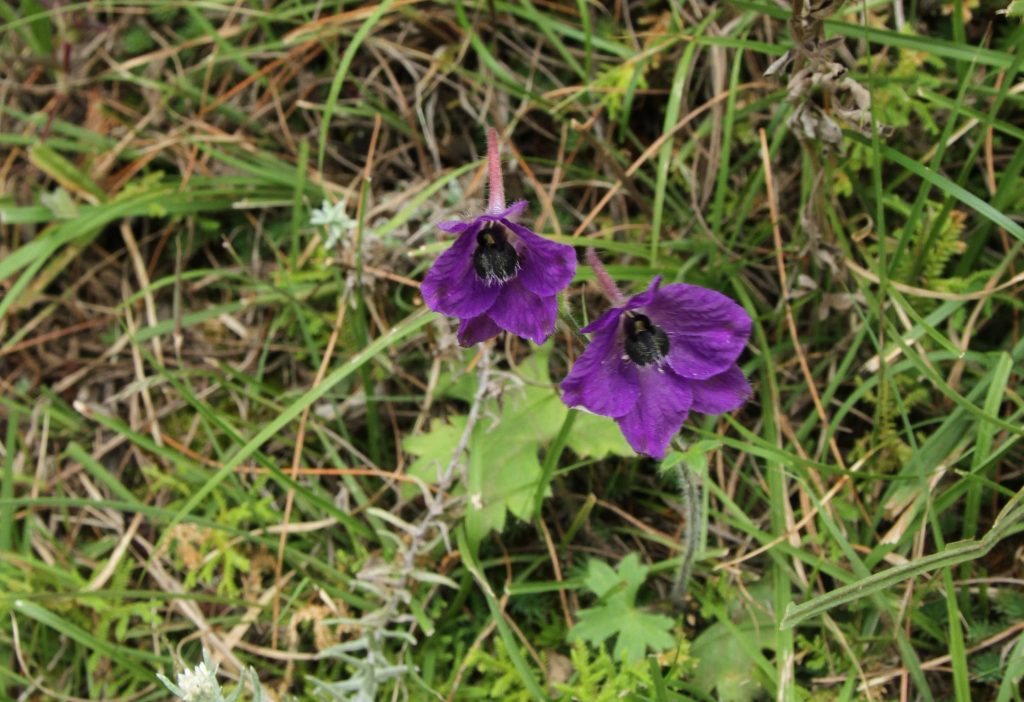
Delphinium cooperi is a Himalayan larkspur of restricted range, recorded principally from Bhutan and Nepal, with only about 42 GBIF occurrences reflecting its narrow distribution. It grows on open alpine and subalpine slopes, meadow margins and among scrub in cool, moist montane settings. The photographed plant in the Haa (Haar) valley of western Bhutan at 3200 m, flowering in September, captures its late-season anthesis in the high inner valleys, where it occupies humus-rich, well-drained ground in a cool, monsoon-influenced climate. Its limited recorded range marks it as a regional endemic of the eastern Himalaya.

The species is an erect perennial herb arising from a fibrous or somewhat thickened rootstock. The leaves are palmately divided into several cuneate, toothed or further-lobed segments, larger and longer-petiolate toward the base and reduced upward. The inflorescence is a terminal raceme of zygomorphic flowers in shades of blue to violet; as in all Delphinium the upper sepal is prolonged backward into a conspicuous spur that encloses the nectariferous petal spurs. Stamens are numerous and the gynoecium of free carpels matures into a cluster of erect, many-seeded follicles that split along the inner suture to shed angular seeds.

Delphinium belongs to the buttercup family Ranunculaceae, within the tribe Delphinieae characterised by spurred, bilaterally symmetrical flowers. The long-spurred corolla of D. cooperi is adapted to pollination by long-tongued bumblebees that probe the nectar spurs. As with many members of the genus, the plant contains toxic diterpenoid alkaloids that deter grazing. Given its apparently narrow eastern-Himalayan range and modest population records, the species warrants attention as a potentially vulnerable regional endemic dependent on intact subalpine habitat.

Author: Munz · Sources: POWO (Kew), GBIF, Flora of Bhutan, Annotated Checklist of the Flowering Plants of Nepal, Munz Delphinium monograph
Duthie ex Huth

Description

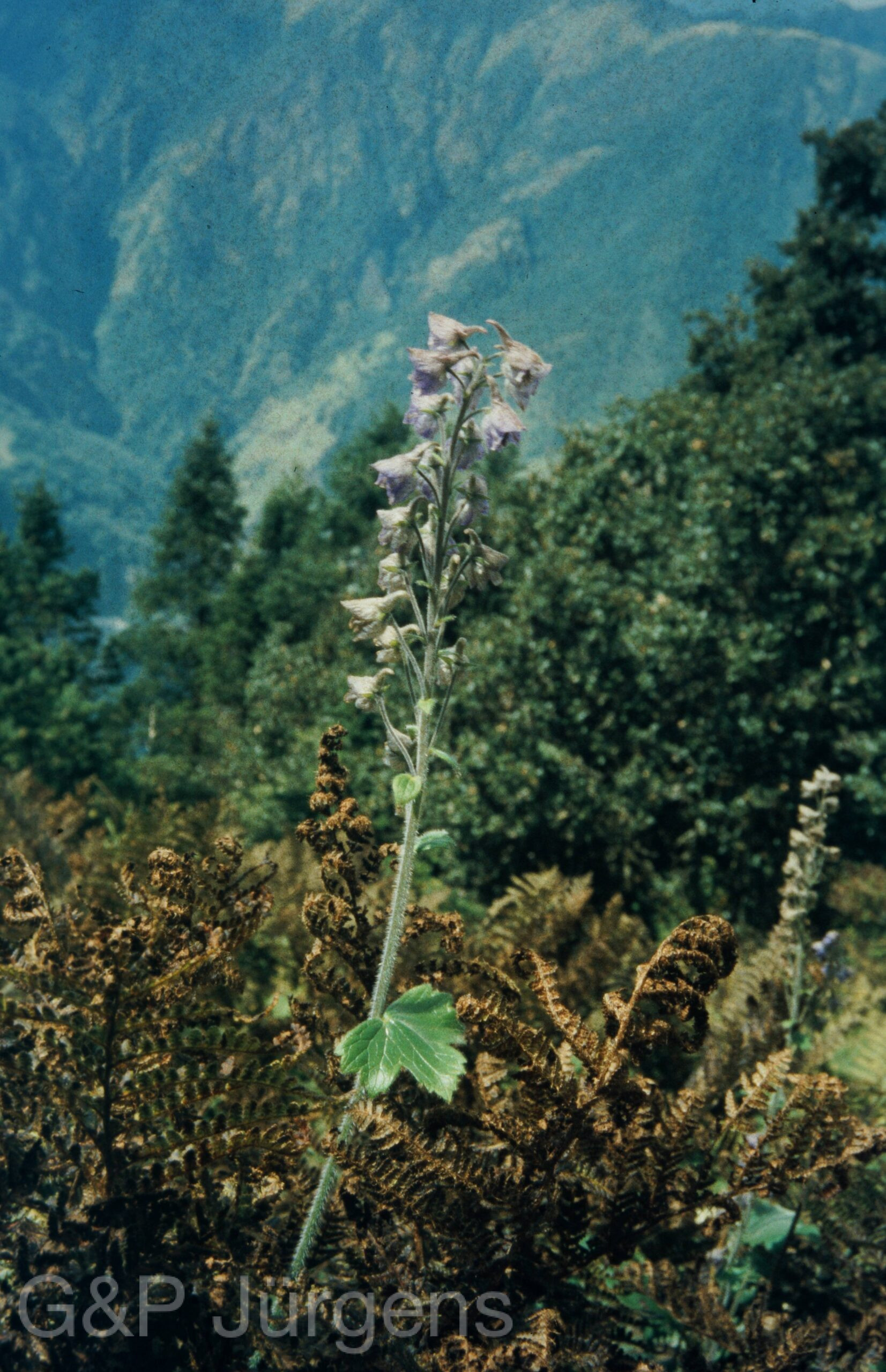
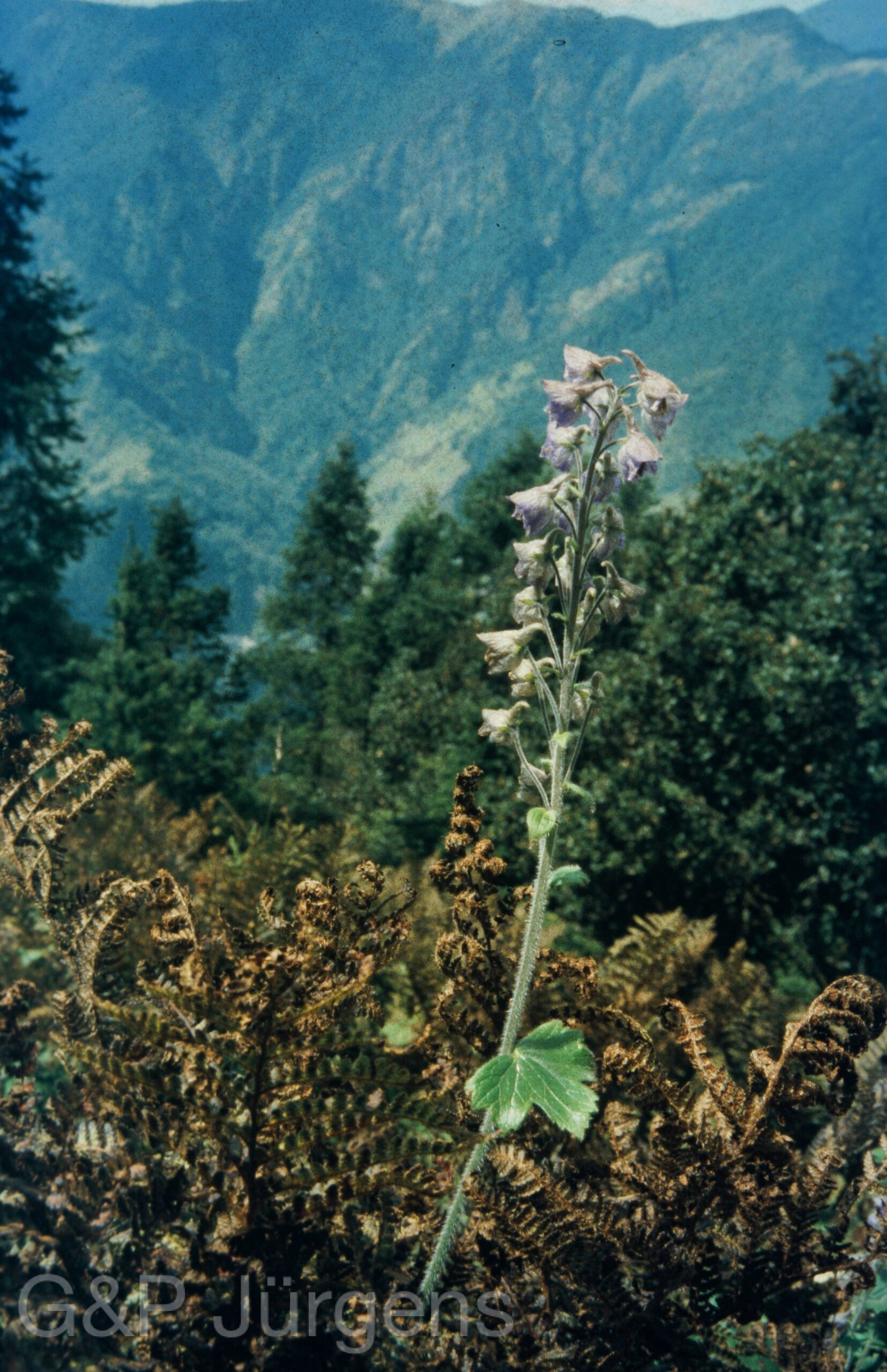
Delphinium densiflorum is a herbaceous perennial of the western and central Himalaya, recorded from India, Nepal and adjacent China (Xizang), with some 70 georeferenced occurrences documented in GBIF. It inhabits subalpine and alpine meadows, open slopes, forest margins and rocky grassland, where it flowers in the late monsoon. The plant illustrated was photographed in the Indian Garhwal Himalaya near Ali at about 3140 m in September, a typical elevation; across its range it generally occupies the belt from roughly 2800 to 4000 m, favouring moist, well-drained soils with abundant summer rainfall.

The species forms an erect, simple or branched stem arising from a fibrous to slightly tuberous rootstock, clothed below with petiolate, palmately divided leaves whose laminae are deeply cut into narrow, toothed lobes. As the specific epithet implies, the inflorescence is a dense, many-flowered raceme of strongly zygomorphic flowers. Each flower has five petaloid sepals, the uppermost prolonged into a conspicuous backward-pointing spur, and small petals modified into nectaries concealed within. The flowers are typically deep blue to violet; the fruit is a cluster of several erect, beaked follicles releasing numerous angular, scaly seeds.

Delphinium densiflorum belongs to the large genus Delphinium (Ranunculaceae), of which the Himalaya is a notable centre of diversity. Like other larkspurs it contains diterpenoid alkaloids and is poisonous to grazing livestock, a trait that influences its persistence in heavily pastured alpine meadows. The spurred flowers are adapted to pollination by long-tongued bumblebees. No major conservation concern is recognised, though localised pressure from grazing and habitat disturbance affects subalpine populations across the region.

Author: Duthie ex Huth · Sources: POWO (Kew), GBIF, Flora of China, Flora of Bhutan, Annotated Checklist of the Flowering Plants of Nepal, Munz Monograph of the Genus Delphinium

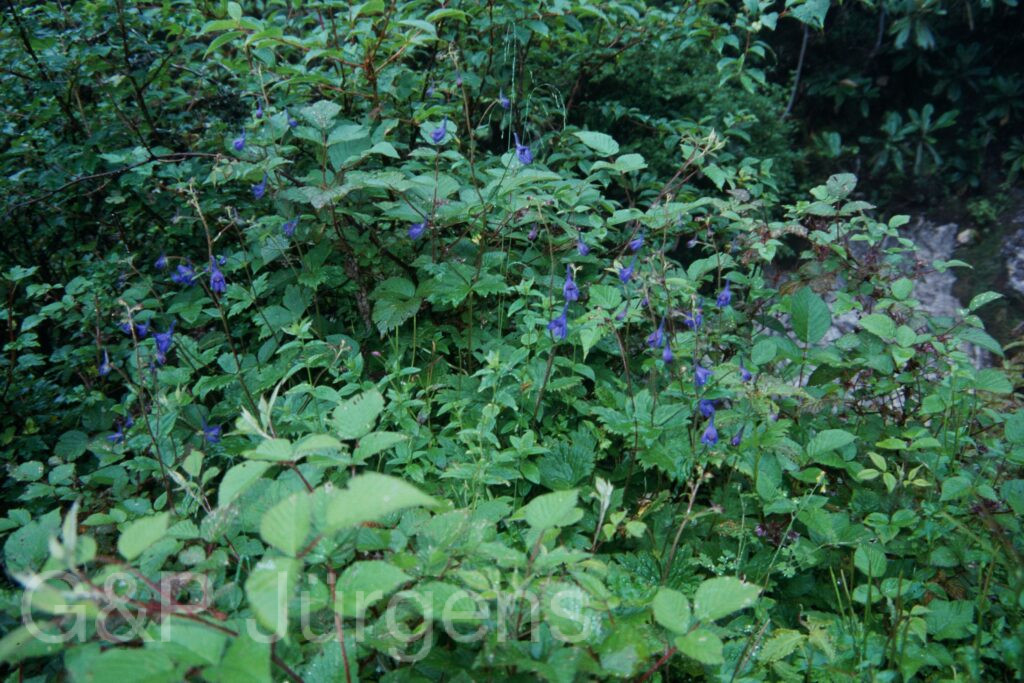
Wall.

Garh 07 298 ergebnis
India Garhwal Sangam 1400m, June

Description

Delphinium denudatum is a perennial larkspur of the western and central Himalaya, documented by GBIF (58 occurrences) from India, Pakistan, Nepal and adjacent China. It occupies shaded, moist temperate forest, forest margins, shrubberies and grassy slopes, generally between about 1200 and 3000 m, lower than many alpine delphiniums. The cited record from Sangam in Garhwal at 1400 m in June reflects this warm-temperate forest habitat, where the plant flowers in early summer in cool, humid, partly shaded ground beneath broadleaved and mixed woodland of the western Himalayan ranges.

The species is an erect perennial herb arising from a tuberous to fibrous rootstock, with slender, sparingly branched stems. The leaves are palmately divided into several broad, toothed or lobed segments, the lower long-petiolate and the upper reduced. The inflorescence is a lax, few- to many-flowered raceme of zygomorphic flowers; the showy blue to violet perianth comprises five petaloid sepals, the uppermost prolonged backward into a conspicuous spur that encloses the nectar-bearing spurs of the two upper petals, while the smaller lower petals are often bearded. The fruit is a group of several erect, many-seeded follicles dehiscing along the ventral suture.

Delphinium belongs to the tribe Delphinieae of the Ranunculaceae, distinguished from Aconitum by its spurred rather than hooded flowers, and its alkaloid-rich tissues underlie a long history of medicinal use of the roots of this species in regional traditional systems. The spurred flowers are adapted for pollination by long-tongued bees. Though comparatively few collections are recorded, the species is fairly widespread in suitable habitat; localised harvesting for medicine warrants attention.

Author: Wall. · Sources: POWO (Kew), GBIF, Flora of Pakistan, Flora of Nepal, Flora of China Vol. 6, Munz A Synopsis of the Asian Species of Delphinium

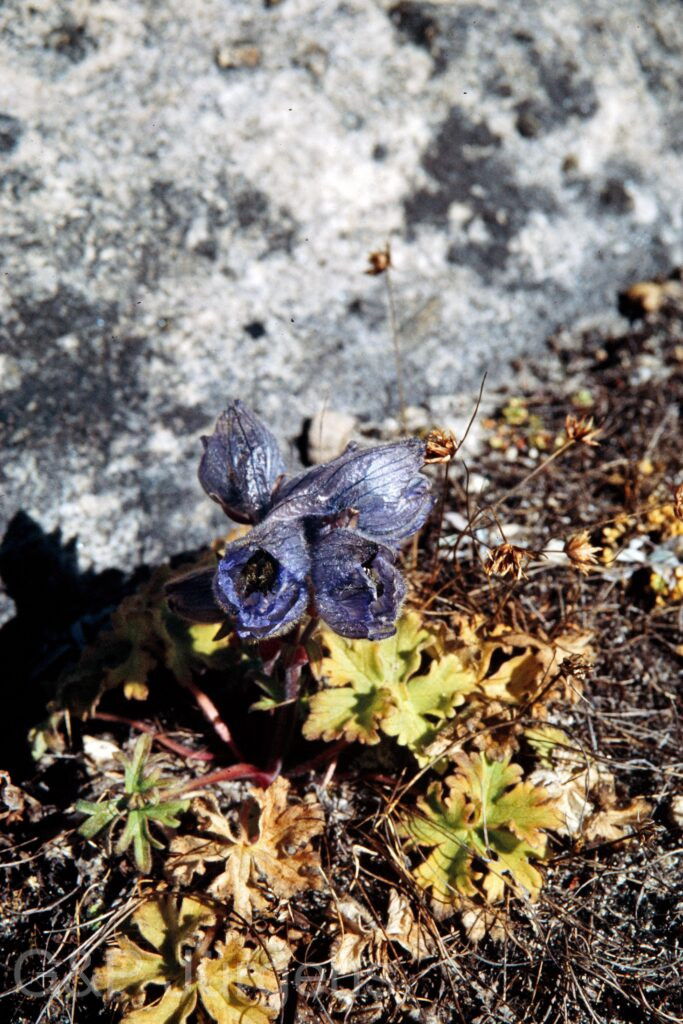
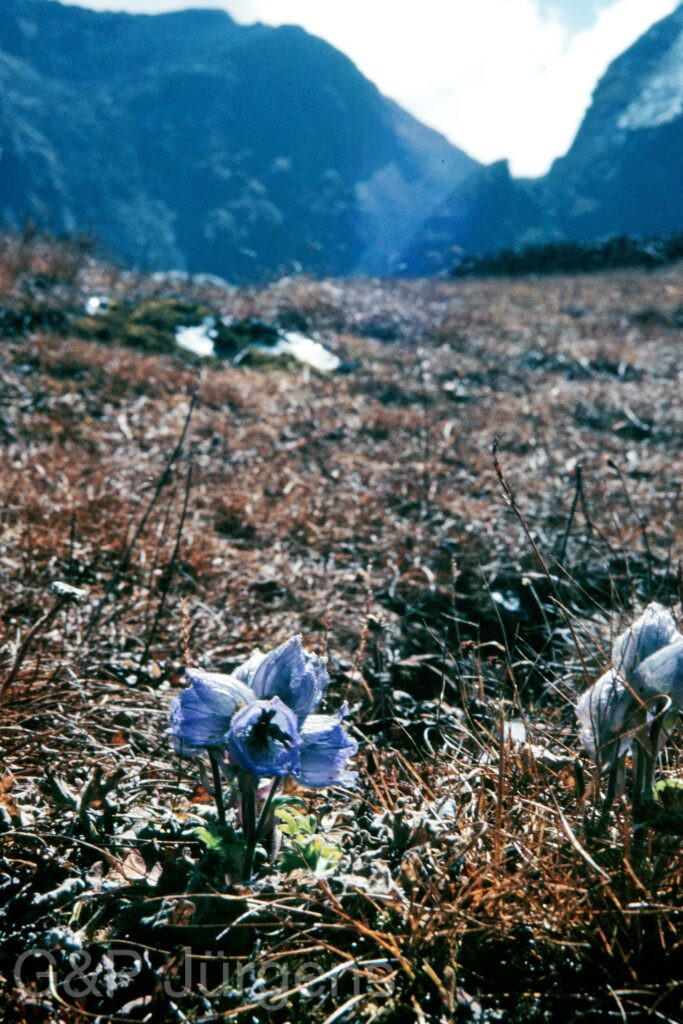
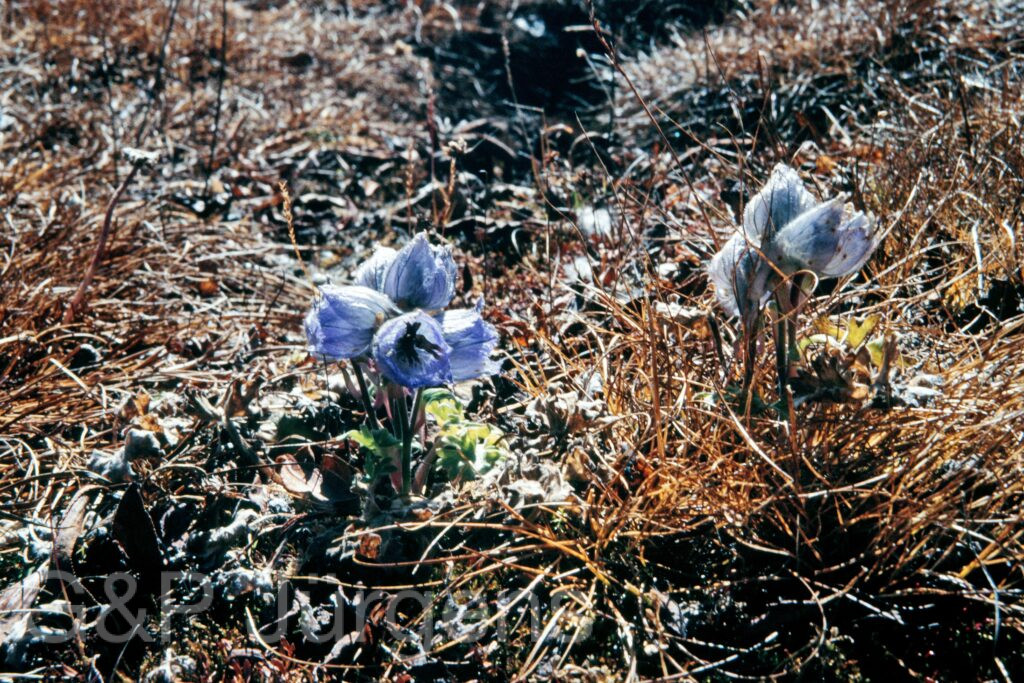
Hook.f. & Thomson

Nepal 95 415 G723 ergebnis
Nepal Jaisuli Kund 4200m October

Description

Delphinium glaciale is a high-alpine larkspur distributed across the central and eastern Himalaya, with documented occurrences in Nepal, India, Bhutan and southern Tibet (China); GBIF records some 85 collections from this range. It is a plant of the upper alpine and subnival zones, typically encountered between roughly 4000 and 5000 m on open screes, moraines, glacial forelands and stony alpine turf, as reflected by the population photographed near Jaisuli Kund in Nepal at about 4200 m in October. It tolerates a short growing season, intense insolation and prolonged snow cover.

The species is a dwarf, cushion-forming or compactly tufted perennial herb arising from a stout woody rootstock. Stems are short, ascending and densely covered, like the foliage, in spreading whitish to yellowish hairs that lend the plant a shaggy appearance. The leaves are palmately divided into narrow segments, mostly basal or crowded toward the stem base. The inflorescence is few-flowered and condensed; the zygomorphic flowers are deep blue to violet-blue, the posterior sepal prolonged into a stout spur enclosing two nectariferous petals, the whole densely pubescent externally. The fruit is a cluster of erect, hairy follicles releasing small angular seeds.

Within Delphinium the species belongs to the assemblage of dwarf, glandular- or villous-haired Sino-Himalayan high-alpine larkspurs adapted to glacial habitats, a feature echoed in the epithet glaciale. Its compact habit and dense indumentum are classic adaptations to wind exposure and cold. Like most members of the genus it contains diterpenoid alkaloids and is toxic to livestock. No specific conservation assessment has been published; its restriction to remote subnival terrain confers natural protection, though high-altitude warming and habitat shifts may threaten such narrowly zoned alpine specialists.

Author: Hook.f. & Thomson · Sources: POWO (Kew), GBIF, Flora of Nepal, Flora of Bhutan, Flora of China, Annotated Checklist of the Flowering Plants of Nepal, Munz Monograph of Delphinium

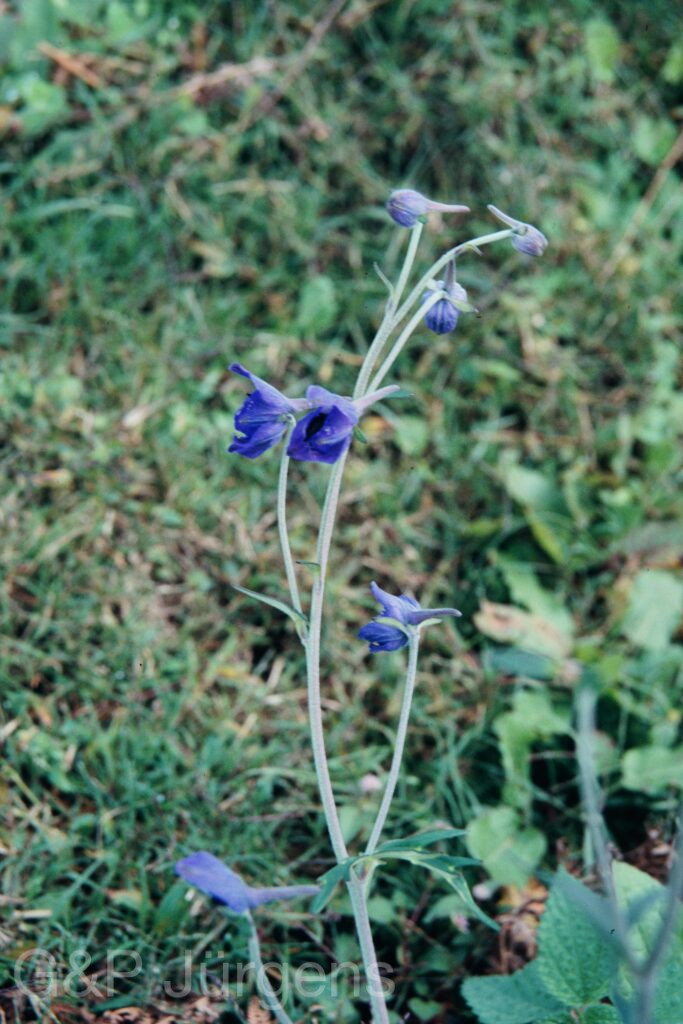
Huth

Nepal 95 120 P208 ergebnis
Nepal south of Rupien La 3450m October

Description

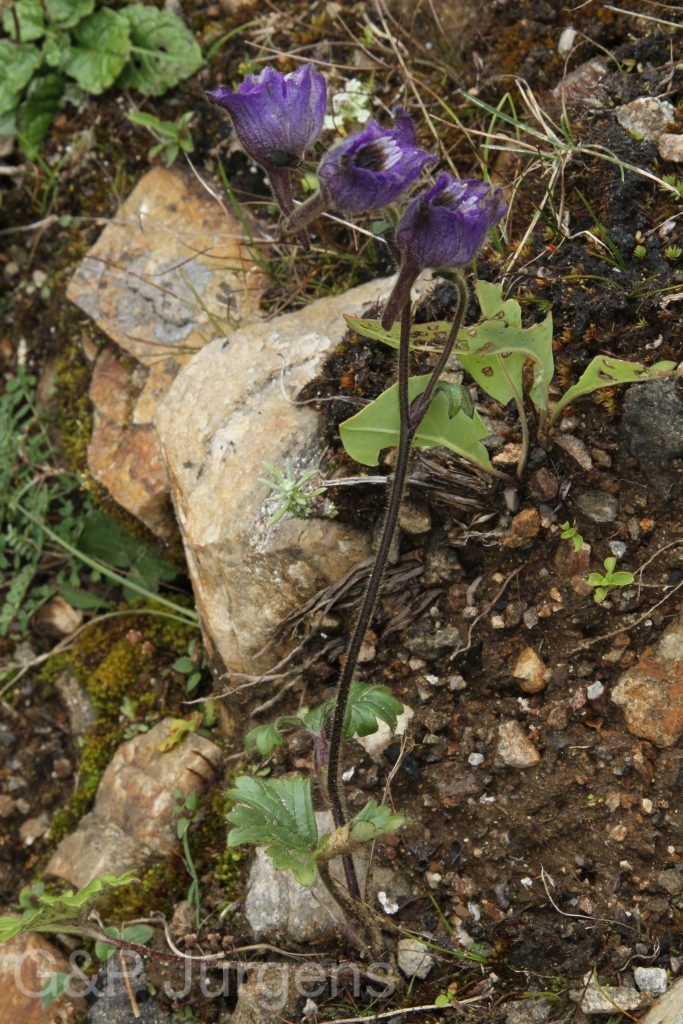
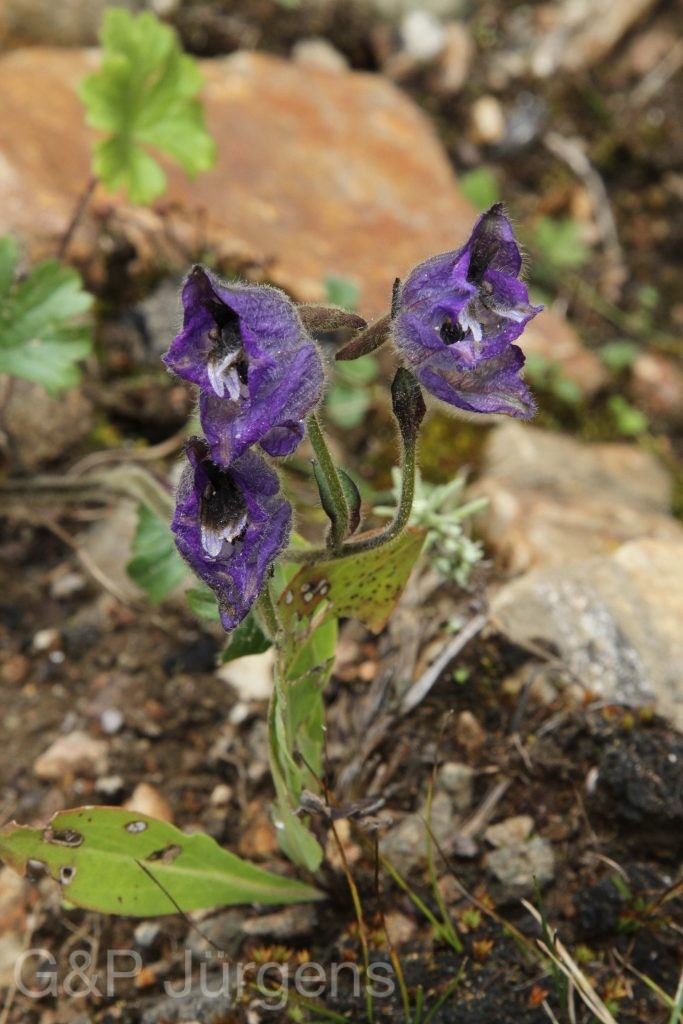
Delphinium kamaonense is a Himalayan and Sino-Himalayan larkspur recorded by GBIF (839 occurrences) from China, Nepal, India and Bhutan. It is a plant of open subalpine and alpine habitats, growing on grassy slopes, among low scrub, on stony pastures and along rocky margins, generally between about 3000 and 4500 m. The individual photographed south of the Rupien La in Nepal at 3450 m in October exemplifies its late, post-monsoon flowering, when many high-altitude perennials complete their reproductive cycle before the onset of winter.

The species is a perennial herb arising from a fibrous or somewhat woody rootstock, with erect, slender stems that are often finely pubescent above. The leaves are alternate, long-petiolate below, with a palmately divided to deeply lobed blade whose segments are further cut into narrow ultimate lobes. The flowers are borne in a lax raceme or panicle and are strongly zygomorphic; the five petaloid sepals are deep blue to violet, the uppermost prolonged backwards into a conspicuous slender spur that encloses the nectariferous spurs of the two upper petals. The dark inner petals form a contrasting central eye. The fruit consists of several erect, many-seeded follicles.

Delphinium is a large northern-temperate genus well represented in the Himalaya, and D. kamaonense belongs to the assemblage of blue-flowered alpine larkspurs centred on the western and central ranges. The spurred flowers are adapted for pollination by long-tongued bumblebees capable of reaching the concealed nectar. Like most members of the genus the plant contains toxic diterpenoid alkaloids that deter grazing. The species is widespread within its high-elevation niche and is not currently considered to be at conservation risk.

Author: Huth · Sources: POWO (Kew), GBIF, Flora of China, Flora of Bhutan, Annotated Checklist of the Flowering Plants of Nepal, Monograph of the Genus Delphinium (Munz)

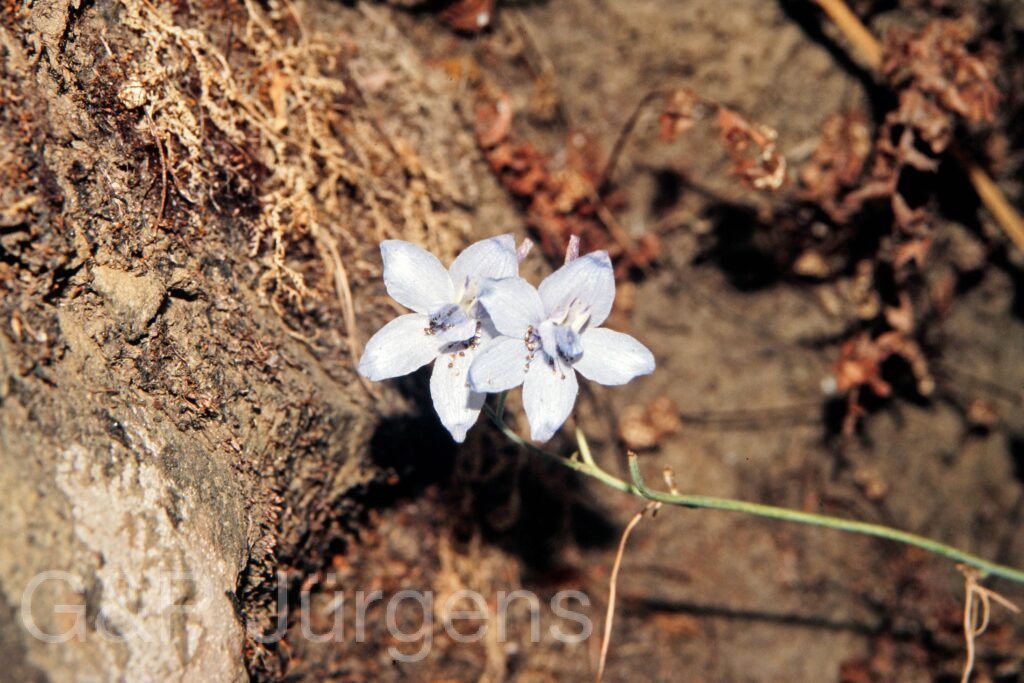
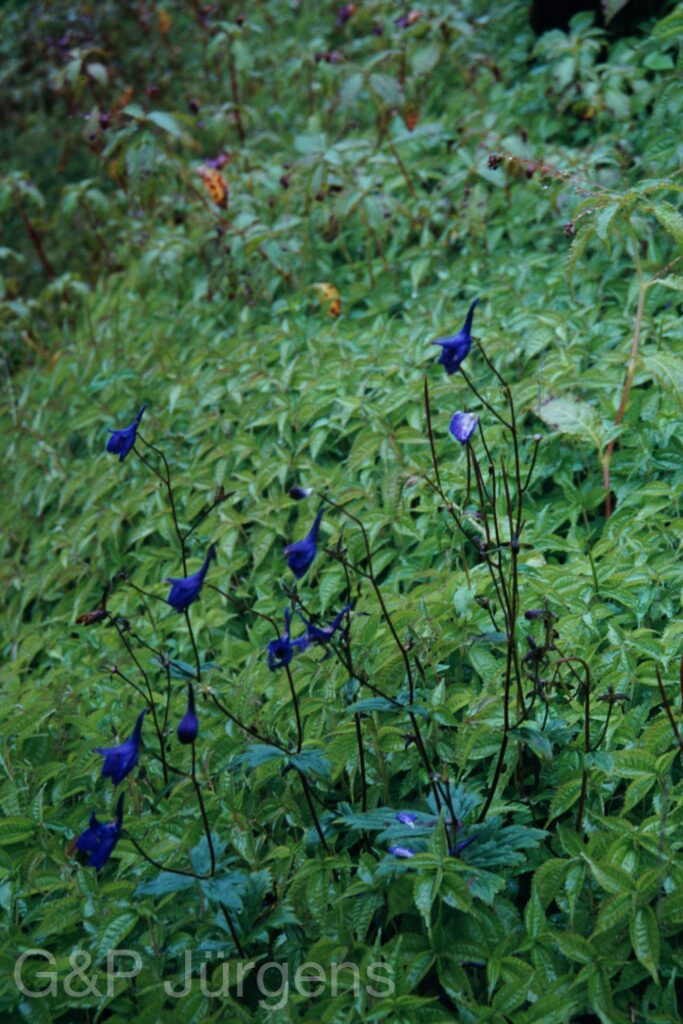
Munz

Sikkim2003 341 G480
Sikkim Choka 3200m August
Sikkim2003 342 P481
Sikkim Choka 3200m August

Description

Delphinium ludlowii Munz is a narrowly distributed alpine larkspur of the eastern Himalaya, known only from Bhutan and adjacent Nepal and Sikkim, where the very small number of records reflects both its restricted range and its remote, high-elevation habitat. It grows on open alpine and subalpine slopes, among rocks, in moist meadows and along the margins of scrub at the upper limits of vegetation. The photographed plant from Choka in Sikkim at 3200 m, flowering in August at the height of the monsoon growing season, illustrates its association with cool, humid, well-watered high-mountain sites where the snowmelt and summer rains sustain a brief but vigorous flowering period.

The plant is an erect perennial herb arising from a fibrous or somewhat tuberous rootstock, bearing palmately divided leaves whose segments are further cut into narrow lobes. The inflorescence is a terminal raceme of characteristically spurred, zygomorphic flowers; the showy, petaloid sepals are blue to violet-blue, the uppermost prolonged backward into a conspicuous nectar spur, within which the smaller true petals are concealed. The fruit consists of several erect, many-seeded follicles typical of the genus, splitting along the inner suture to release the angular seeds.

Within the taxonomically intricate genus Delphinium, D. ludlowii belongs to the Sino-Himalayan alpine larkspurs and commemorates the collector Frank Ludlow, whose Bhutan expeditions yielded much of the type material. Like related montane species it is bumblebee-pollinated, the long spur matching its visitors, and all parts are toxic owing to diterpene alkaloids. Its very limited known range and few documented occurrences make it of conservation interest, dependent on intact alpine habitats in the eastern Himalaya.

Author: Munz · Sources: POWO (Kew), GBIF, Flora of Bhutan, Flora of China (Ranunculaceae), Ludlow & Sherriff Himalayan collections, A Monograph of the Genus Delphinium (Munz)

Kitam. & Tamura

Nepal 95 413 P722 ergebnis
Nepal Jaisuli Kund 4450m October
Nepal 95 414 P724 ergebnis
Nepal Jaisuli Kund 4450m October

Description

Delphinium nepalense is a high-alpine larkspur of the Central and Western Himalaya, recorded from Nepal, Bhutan and Pakistan; GBIF holds about 51 occurrences, reflecting a limited but genuine montane distribution. It is a plant of the upper alpine zone, growing on open grassy slopes, stony meadows, screes and the margins of glacial tarns, as documented at Jaisuli Kund in Nepal at 4450 m. At such elevations it experiences a brief, cool growing season and flowers comparatively late, persisting into October as shown in the field record, when many co-occurring alpines have already set seed.

It is a perennial herb arising from a fibrous to somewhat tuberous rootstock, with erect or ascending stems. The leaves are palmately divided into narrow lobes or segments, the lower ones long-petiolate and the upper progressively reduced and sessile. The inflorescence is a few-flowered raceme of strongly zygomorphic flowers; the five petaloid sepals are blue to violet-purple, the uppermost prolonged backward into a prominent spur that encloses the nectar-bearing spurs of the two upper petals, while the smaller petals form a contrasting honey-guide at the throat. The fruit is a cluster of erect follicles splitting along the ventral suture to release flattened, scaly or winged seeds.

The species was described by Kitamura & Tamura, authorities on the Himalayan Ranunculaceae. Within Delphinium it belongs to the perennial Himalayan element, allied to species such as D. brunonianum and D. kamaonense. As in much of the genus, the flowers are pollinated chiefly by bumblebees adapted to probing the long spur, and the foliage contains diterpenoid alkaloids that render the plant toxic and unpalatable to grazing livestock. Although not formally assessed for conservation, its restricted high-altitude range makes it sensitive to grazing intensity and to the upslope compression of alpine habitat under a warming climate.

Author: Kitam. & Tamura · Sources: POWO (Kew), GBIF, Flora of Nepal, Flora of Pakistan, Munz's monograph of the genus Delphinium

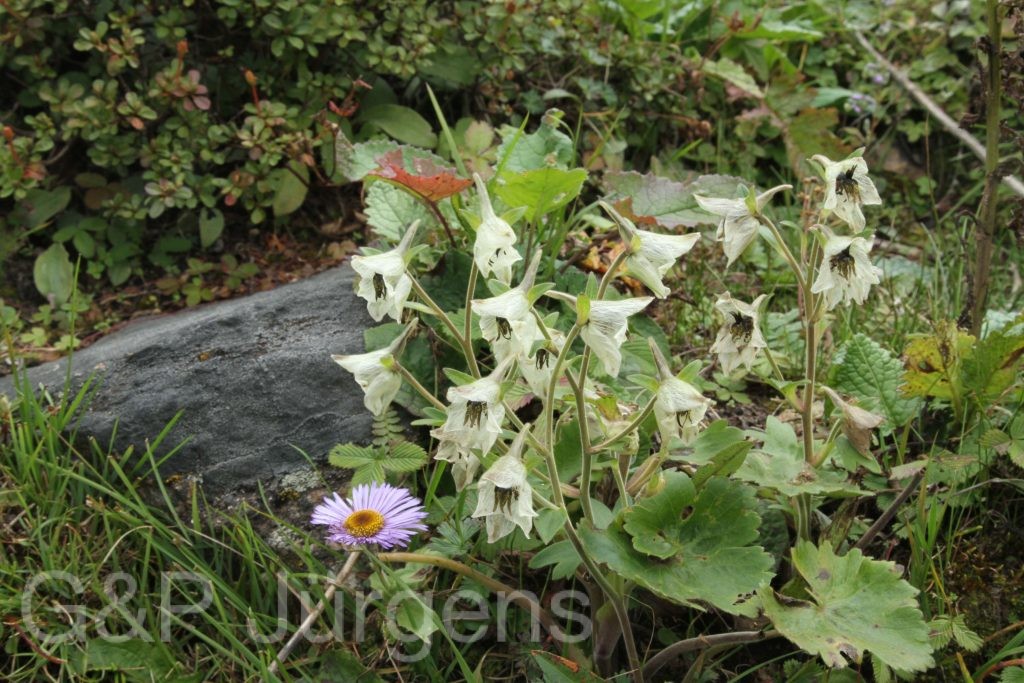
Hook.f. & Thomson

Bhutan2012 283
Bhutan Shele-La, 3900m September
Sikkim2003 283 P389
Sikkim Saniti-Lake 4300m August

Description

Delphinium viscosum is an alpine perennial of the Himalaya, recorded from India, Nepal, Bhutan and China, with 105 occurrences in GBIF reflecting its restricted high-altitude range. It inhabits open alpine slopes, stony meadows, scree margins and rocky pastures, generally between 3500 and 4500 m, where it flowers in late summer and early autumn. The collections figured, from Bhutan's Shele-La at 3900 m in September and Sikkim's Saniti-Lake at 4300 m in August, illustrate its occupancy of cold, exposed alpine terrain at the upper limit of herbaceous vegetation, on well-drained gravelly soils among low alpine swards.

The plant arises from a thickened, somewhat woody rootstock, producing erect stems usually 15-40 cm tall that are conspicuously glandular-viscid and hairy, the sticky pubescence giving the species its epithet. The leaves are alternate, orbicular to reniform in outline and palmately divided into several broad, toothed or further-lobed segments. The inflorescence is a few-flowered terminal raceme of showy zygomorphic flowers; the five petaloid sepals are deep blue to violet, the uppermost prolonged backward into a prominent spur enclosing the nectariferous true petals. The fruit is a cluster of usually three erect, glandular follicles releasing winged or scaly seeds.

Delphinium (Ranunculaceae) is a large genus of the northern temperate zone with a notable Sino-Himalayan radiation of alpine species; D. viscosum belongs to the glandular, spur-flowered montane group adapted to short alpine seasons. Like all larkspurs it contains toxic diterpenoid alkaloids. Its spurred flowers favour pollination by long-tongued bumblebees. With a limited high-alpine distribution, it is potentially sensitive to grazing and climatic change, though its remote habitats afford some natural protection.

Author: Hook.f. & Thomson · Sources: POWO (Kew), GBIF, Flora of China, Flora of Bhutan, A Taxonomic Revision of Himalayan Delphinium (Ranunculaceae)

C.Marquand & Airy Shaw

Bhutan2012 270
Bhutan Shele-La, 4000m September
Bhutan2012 271
Bhutan Shele-La, 4000m September

Description

Delphinium wardii C.Marquand & Airy Shaw is a high-alpine larkspur of very limited distribution; GBIF holds only about 10 occurrences, from Bhutan, neighbouring China (southern Tibet) and northeastern India. It is a plant of open alpine habitats, growing on stony slopes, rocky meadows, scree and grassy turf above the treeline, generally between about 3800 and 4500 m. The individual photographed at Shele-La in Bhutan at 4000 m in September, flowering in the late-season alpine zone, exemplifies its occupation of cold, well-drained, exposed high-altitude sites near the upper limit of vascular plant growth in the eastern Himalaya.

It is a perennial herb arising from a fibrous to somewhat woody rootstock, with erect stems of modest height, often pubescent in the upper parts. The leaves are palmately divided into narrow lobes or segments, the basal leaves long-petiolate and the cauline ones smaller and shorter-stalked. The flowers are borne in a few-flowered terminal raceme; each is zygomorphic with five petaloid sepals, the uppermost prolonged backward into a conspicuous spur, the whole flower deep blue to violet-blue. Within the sepals sit the smaller petals, the upper pair extended into nectar-bearing spurs enclosed in the sepaline spur. The fruit is a cluster of several erect follicles releasing angular, scaly seeds.

The genus Delphinium is well represented in the Sino-Himalayan alpine flora, where its spurred, bee-pollinated flowers are adapted to long-tongued bumblebees that probe the nectar spurs. Like its congeners the plant contains diterpenoid alkaloids and is poisonous to livestock. With an extremely small known range, very few documented collections and confinement to a narrow, climatically vulnerable high-alpine band, Delphinium wardii is a regionally restricted endemic of the eastern Himalaya whose limited occurrence record warrants particular attention to its conservation.

Author: C.Marquand & Airy Shaw · Sources: POWO (Kew), GBIF, Flora of Bhutan, Flora of China, Annotated Checklist of the Flowering Plants of Nepal, Wang & Warnock revision of Delphinium

Wall. ex Lindl.

Nepal 2009 114 ergebnis
Nepal Helambu Indrawati-Valley 1500, May

Description

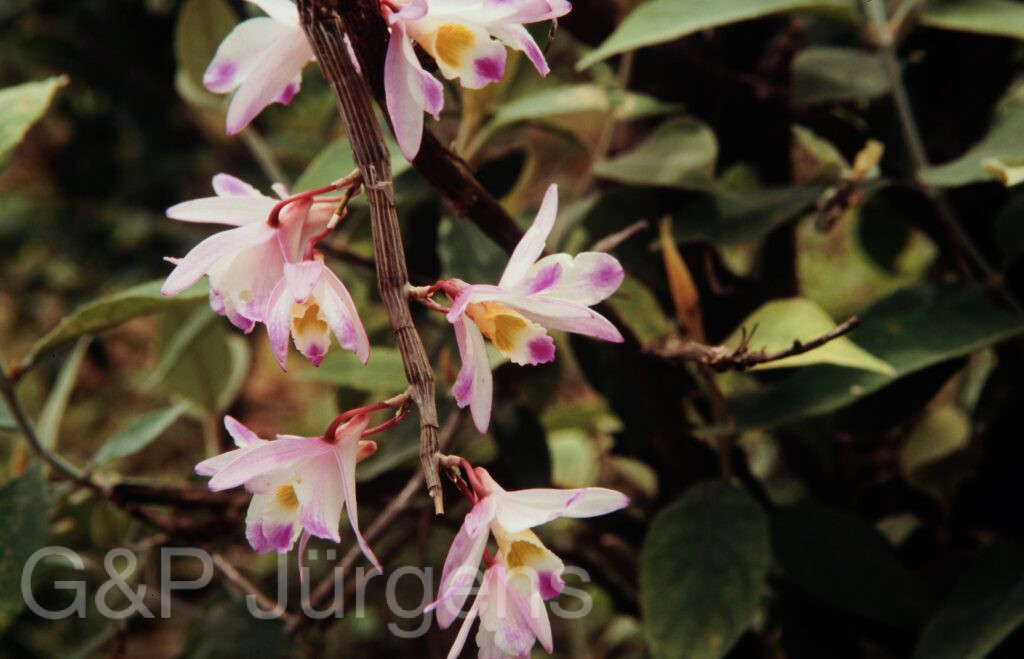
Dendrobium amoenum Wall. ex Lindl. is an epiphytic orchid distributed across the central and eastern Himalaya and adjacent ranges, with records (GBIF: c. 147 occurrences) from India, Nepal, Bhutan and Myanmar, extending into the Malesian region (Indonesia). It is a characteristic element of humid temperate and subtropical broad-leaved forests, growing on mossy trunks and branches at roughly 1,000–2,000 m. The photographed material from Nepal's Helambu region in the Indrawati Valley, at about 1,500 m and flowering in May, falls squarely within its preferred mid-montane belt, where seasonal monsoon humidity and cloud-forest conditions favour epiphytic growth.

The species forms slender, pendulous, terete stems up to 30–60 cm long, often becoming leafless before flowering and bearing thin internodes. The leaves are distichous, lanceolate and deciduous, leaving conspicuous nodal sheaths. Flowers are borne singly or in small clusters from the nodes of older canes, are fragrant, and measure roughly 3–4 cm across. The sepals and petals are white, frequently tinged or tipped with pale rose-purple, while the rounded, pubescent lip is white with a yellow to greenish central disc and a fine purple apical margin. The column is short, bearing four pollinia within an operculate anther cap.

Dendrobium amoenum belongs to the large, taxonomically complex genus Dendrobium (section Dendrobium), members of which display the characteristic deciduous habit and nodal flowering. Like many Himalayan epiphytic orchids it is sensitive to deforestation and to collection pressure, and the genus is listed under CITES Appendix II. The input family "Orchideaceae" is an orthographic variant of the accepted Orchidaceae.

Author: Wall. ex Lindl. · Sources: POWO (Kew), Flora of Bhutan Vol. 3, Flora of Nepal, GBIF, Pearce & Cribb: The Orchids of Bhutan (2002)