Tag:

Nepal

Flowers of Nepal — 1313 wild plant species documented from the Nepalese Himalaya, from subtropical foothills to high alpine meadows above 4,000 m. Nepal’s dramatic elevation gradient makes it one of the richest botanical regions on Earth, home to rhododendrons, primulas, gentians and the famed blue poppies (Meconopsis). Every entry gives a botanical description, native distribution, habitat and flowering season, alongside the original field photograph and the location where it was taken.

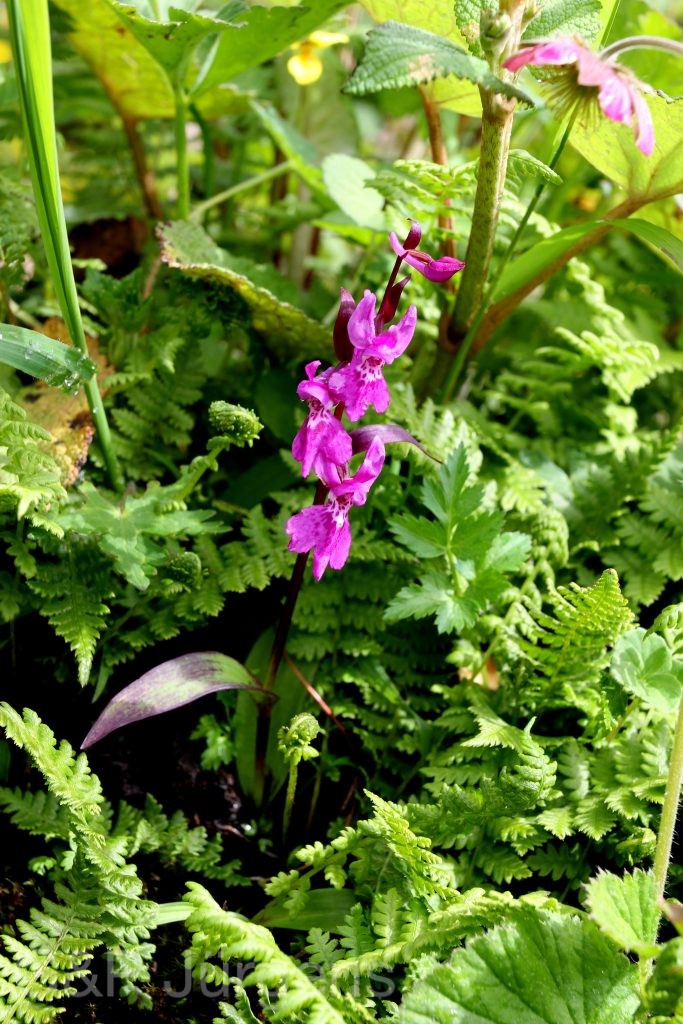
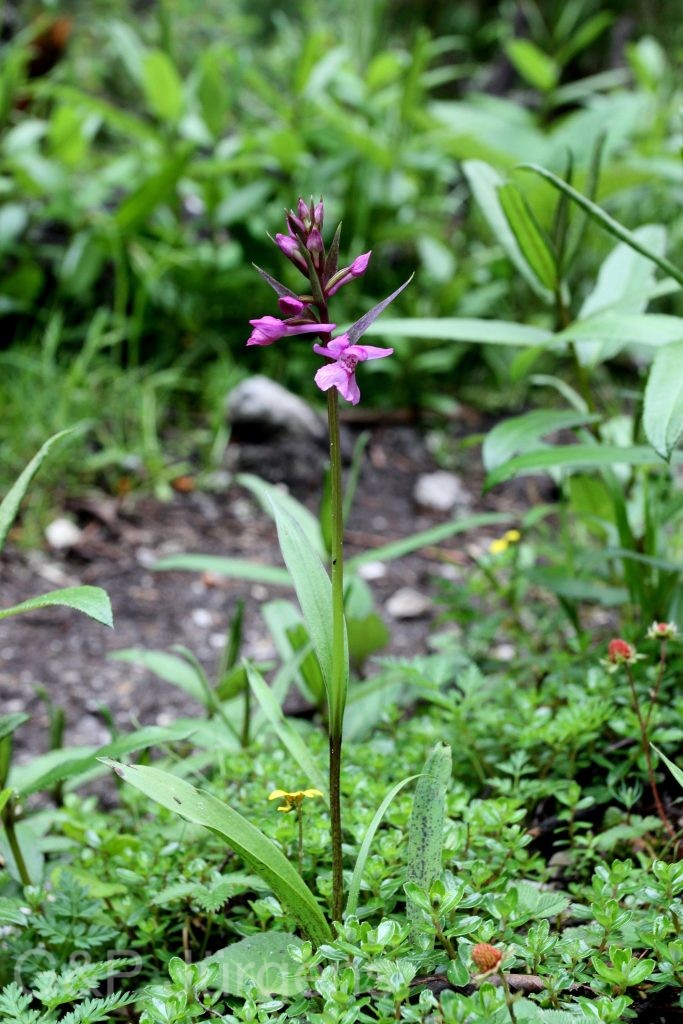
(D.Don) Y.Tang & H.Peng
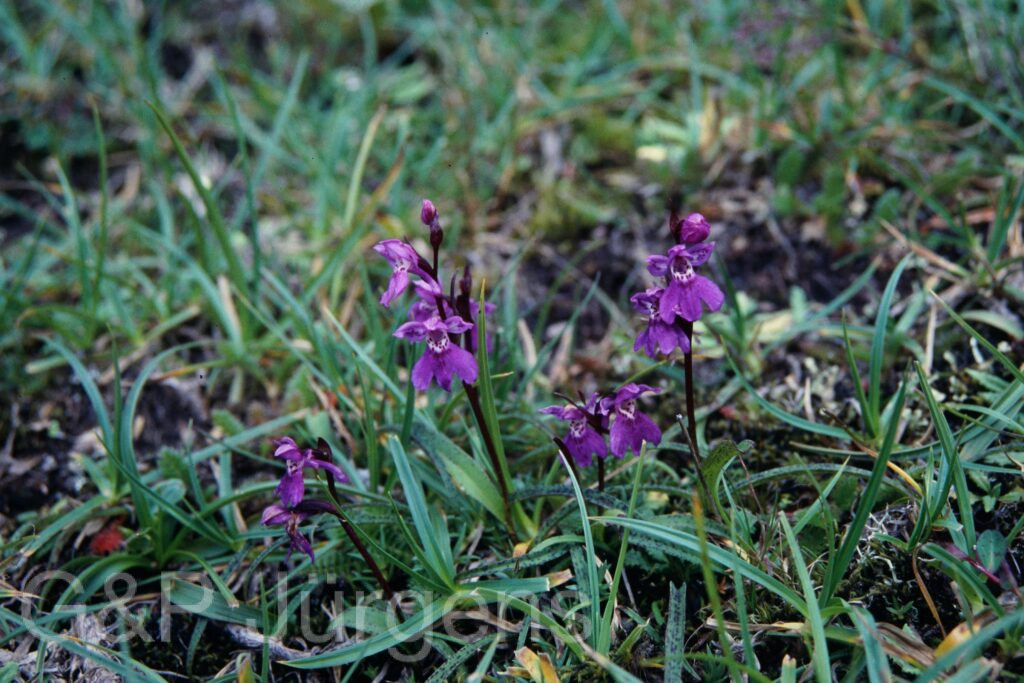
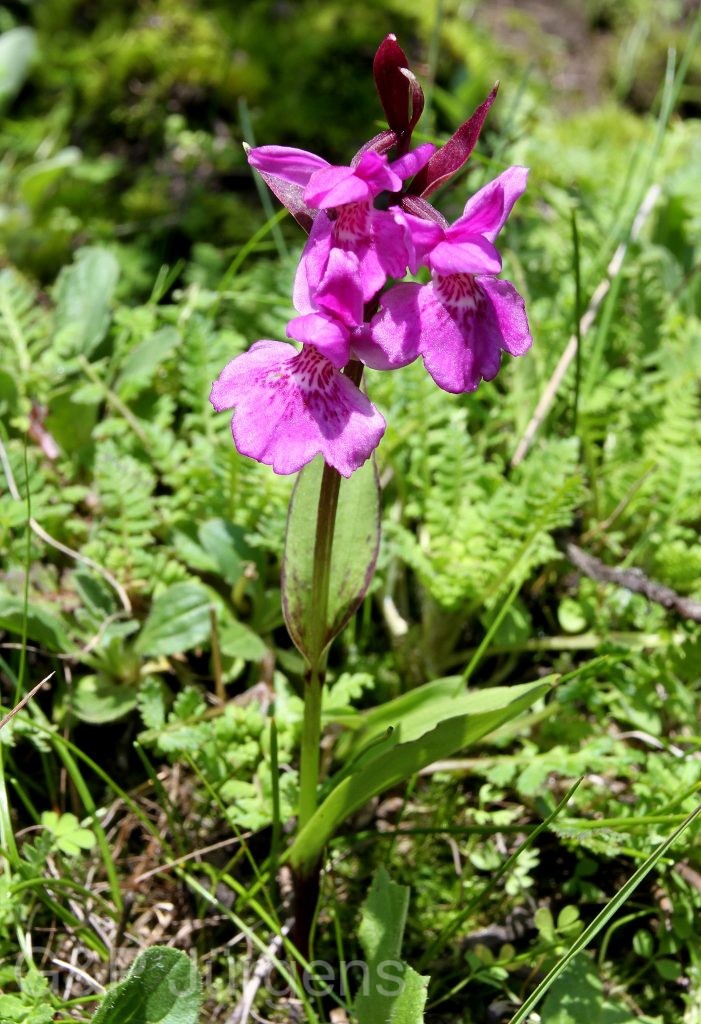
Sikkim2003 150 P201
Sikkim Dzongri, 4100m August
BhutanPG2011 792
Bhutan Ludlow-Sherriff-Trail Kem-La, 4300m July

Description

Hemipilia chusua is a terrestrial orchid widely distributed across temperate and alpine Asia, recorded from China, Nepal, India, Bhutan, Myanmar, Russia, Japan and Korea, with over 1700 GBIF occurrences making it one of the best-documented orchids of the region. It grows in alpine and subalpine meadow, open turf, grassy slopes and the margins of dwarf-shrub heath, typically between about 2500 and 4500 m. The illustrated plants from Dzongri in Sikkim at 4100 m, flowering in August, and from Kem-La on the Ludlow-Sherriff Trail in Bhutan at 4300 m in July, exemplify its high-altitude grassland habitat.

It is a slender terrestrial herb arising from small ovoid to ellipsoid tubers, with an erect, glabrous stem bearing one or few leaves. The leaves are lanceolate to oblong-lanceolate, sheathing at the base and somewhat clasping the stem. The inflorescence is a lax, few-flowered terminal raceme of showy rosy-purple to magenta flowers; the lip (labellum) is broad, three-lobed and bears a slender, downward-pointing spur longer than the ovary, while the lateral sepals spread and the dorsal sepal and petals form a loose hood. The fruit is an erect, ribbed dehiscent capsule releasing dust-like seeds.

Long familiar as Orchis or Ponerorchis chusua, the species was transferred to Hemipilia by Tang and Peng following molecular reappraisal of the orchidine alliance. Though wide-ranging and locally abundant, like all wild orchids it is listed under CITES Appendix II, and its alpine populations are vulnerable to collection, grazing pressure and the upslope shift of montane vegetation under climate change.

Author: (D.Don) Y.Tang & H.Peng · Sources: POWO (Kew), GBIF, Flora of Bhutan, Flora of China, Pearce & Cribb The Orchids of Bhutan
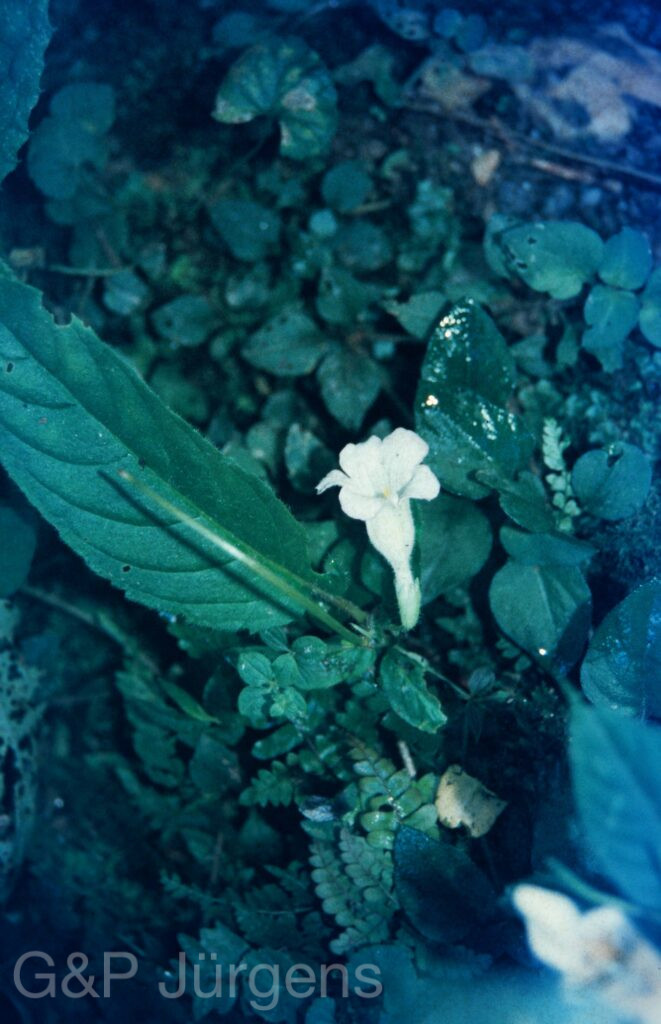
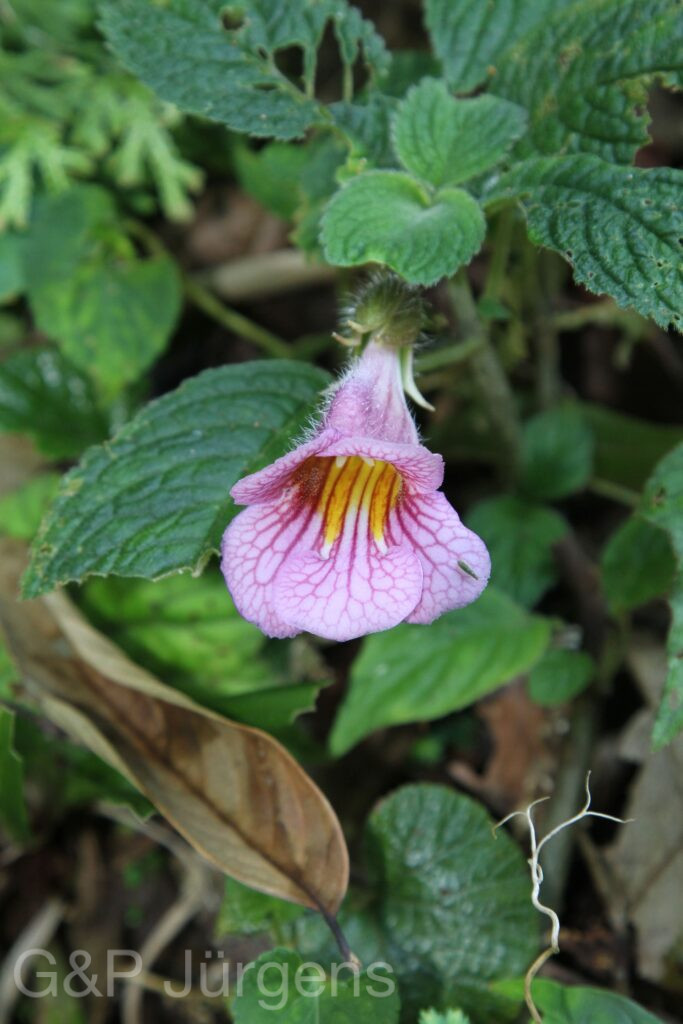
(D.Don) A.Dietr.

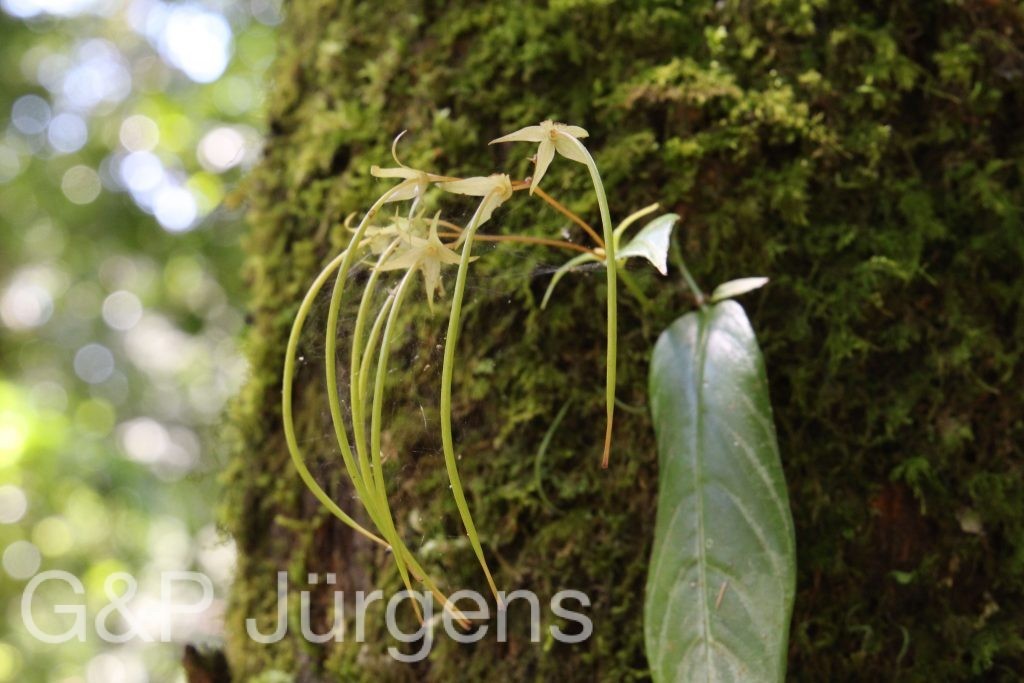
Bhutan2015 203
Bhutan Zhemgang 1000m, October

Description

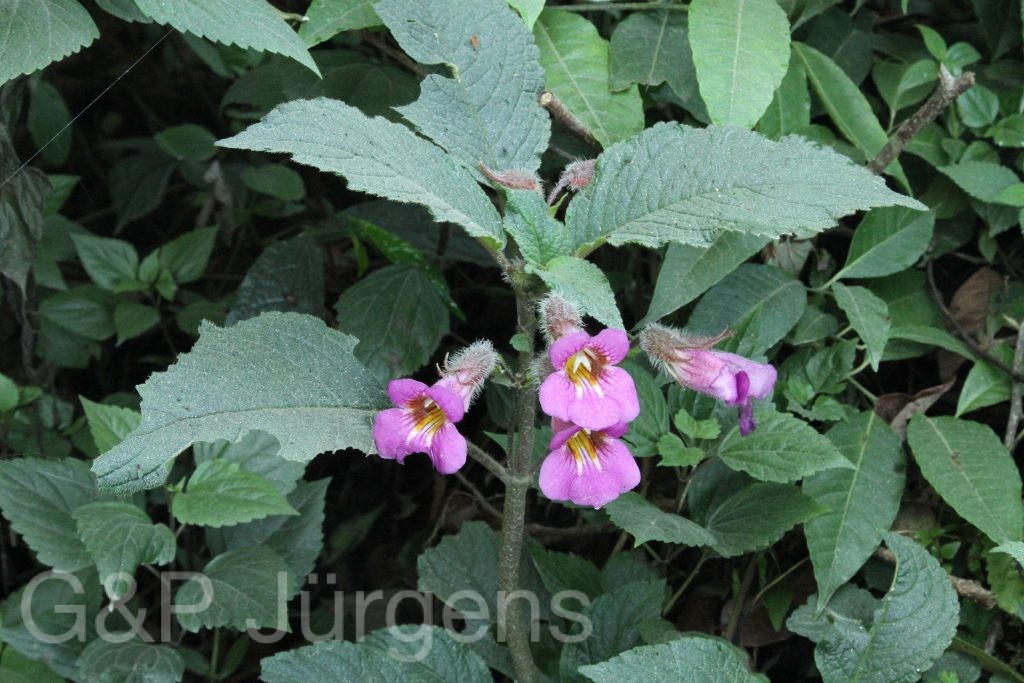
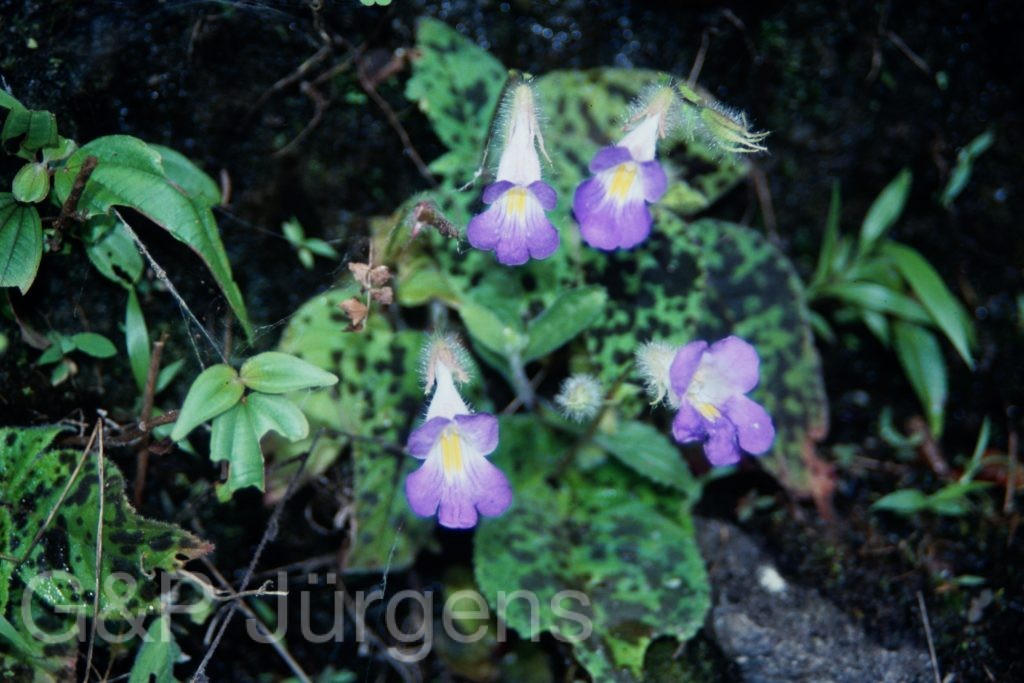
Henckelia bifolia is a Himalayan gesneriad recorded from India, Nepal, Bhutan and Sri Lanka, with about 124 georeferenced occurrences indicating a distribution along the humid southern Himalayan and northeast Indian foothills. It is a plant of warm, shaded, moist habitats: it grows on dripping rock faces, shaded banks, ravines and the floor and margins of subtropical broadleaved forest, generally at lower montane elevations, broadly from about 800 to 1800 m. The illustrated material was gathered at Zhemgang in Bhutan at 1000 m in October, a low, humid forested setting typical of the species, which flowers toward the close of the monsoon season.

It is a small perennial herb, often nearly stemless, with the leaves few and basal; as the epithet bifolia implies, the plant frequently develops a pair of opposite, sometimes markedly unequal leaves that are ovate, soft-textured, crenate to toothed and pubescent. The flowers are borne on slender axillary peduncles in few-flowered cymes; the corolla is zygomorphic, tubular and bilabiate, pale violet to bluish-lilac, with a short erect upper lip and a larger spreading three-lobed lower lip. Two stamens are fertile, and the superior ovary matures into the straight, narrowly cylindrical capsule diagnostic of Henckelia.

Henckelia (Gesneriaceae) was recircumscribed in the molecular reclassification of the didymocarpoid gesneriads, absorbing many species previously placed in Didymocarpus and Chirita; the name listed here as the family, Didymocarpinae, is in fact the subtribe to which Henckelia belongs, and the species properly sits in Gesneriaceae. The genus is characterised by its straight undivided capsules and bilabiate flowers. As a humid-forest understorey herb of restricted, fragmented habitats, H. bifolia depends on intact low-montane forest, and although not formally assessed it is potentially vulnerable to deforestation.

Author: (D.Don) A.Dietr. · Sources: POWO (Kew), GBIF, Flora of Bhutan, A Revised Handbook to the Flora of Ceylon, Weber & Möller revision of Henckelia (Gesneriaceae)

D.Don A.Dietr.

Sikkim2003 23 G27
Sikkim Rathong-Chu 1200m, August
Garw 2005 214 ergebnis ergebnis
India Garhwal Simkarok 2680m, September
Bhutan2015 89
Bhutan Galephug 600m, October

Description

Henckelia pumila is a small gesneriad of the eastern and central Himalaya and adjacent Indo-Burma, recorded from China, India, Nepal, Myanmar, Bhutan, Thailand and Vietnam, with close to 600 occurrences in GBIF. It is a plant of shaded, humid habitats, growing on moist rock faces, mossy boulders, stream banks and shaded earth cuttings within evergreen broad-leaved and subtropical hill forest. Its wide altitudinal amplitude is reflected in the collection localities given for the illustrated material, ranging from the Rathong Chu in Sikkim at 1200 m in August and Galephug in Bhutan at only 600 m in October up to Simkarok in Indian Garhwal at 2680 m in September, indicating tolerance of both warm subtropical and cool temperate forest understorey.

The plant is a small perennial or facultatively annual herb with a short, often weak stem and crowded, opposite or subopposite leaves that are ovate to elliptic, crenate-serrate and softly hairy, frequently somewhat fleshy and unequal in a pair. The flowers are borne singly or in few-flowered cymes on slender peduncles from the leaf axils. The corolla is tubular and weakly two-lipped, white to pale lilac or bluish, often with a yellow throat or coloured markings, with the lower lip the more spreading. There are two fertile stamens with coherent anthers, and the ovary is superior, developing into the slender, elongate, twisted or straight loculicidal capsule typical of the genus.

The family is given as Didymocarpinae on the source page, the subtribal name within the Gesneriaceae to which Henckelia belongs; the species is correctly a member of the Gesneriaceae. The genus Henckelia has been substantially recircumscribed following molecular study, with numerous Asiatic didymocarpoid species transferred into and out of it, and H. pumila sits within this Sino-Himalayan radiation of rock-dwelling gesneriads. Its capacity to colonise moist shaded rock and its broad elevational range make it locally frequent, and it is not regarded as threatened.

Author: D.Don A.Dietr. · Sources: POWO (Kew), GBIF, Flora of China Vol. 18, Flora of Bhutan Vol. 2, Flora of Nepal, A Revision of the Genus Henckelia (Gesneriaceae)

(Buch.-Ham. ex D.Don) A.Dietr

Bhutan2012 646
Bhutan Tserang 1600m, September
Sikkim2003 348 W489
Sikkim above Yoksam 1880m August

Description

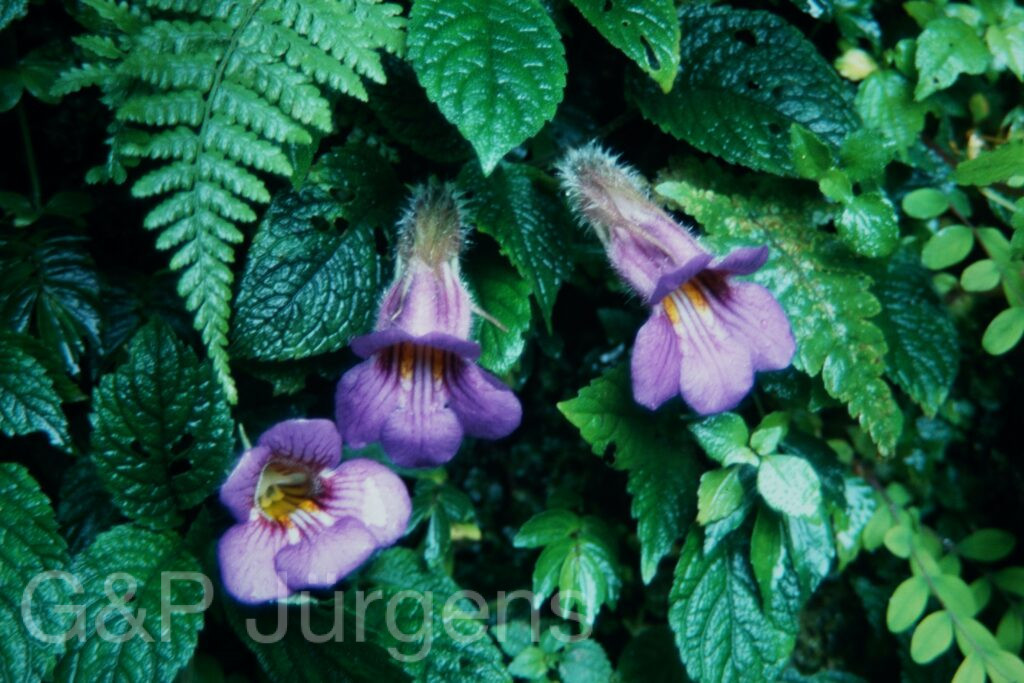
Henckelia urticifolia is a Himalayan gesneriad ranging through Nepal, China, India, Bhutan and Myanmar, the c. 212 georeferenced records concentrated along the humid southern Himalayan front. It is a plant of shaded, moist understorey habitats: it grows on damp banks, mossy rock faces, ravines and the margins of broadleaved and subtropical forest, generally between about 1200 and 2200 m. The illustrated material was gathered at Tserang in Bhutan at 1600 m in September and above Yoksam in Sikkim at 1880 m in August, locations typical of its preference for cool, dripping, sheltered sites that retain monsoon moisture.

It is a perennial herb with an erect to ascending, often softly hairy stem. As the epithet suggests, the leaves are nettle-like (urticifolia): opposite, ovate, coarsely toothed, thin-textured and pubescent, with prominent venation. The flowers are borne in axillary cymes; the calyx is five-parted and the corolla zygomorphic, tubular and bilabiate with a short two-lobed upper lip and a larger spreading three-lobed lower lip, pale violet to bluish-mauve, often with darker guidelines and a paler throat. There are two fertile stamens with cohering anthers, and the ovary is superior. The fruit is the characteristic elongate, narrowly cylindrical capsule of the genus.

Henckelia (Gesneriaceae) was recircumscribed in the molecular reclassification of the Old World didymocarpoid gesneriads, with many Asiatic species formerly placed in Didymocarpus and Chirita transferred to it; the supra-generic placement in subtribe Didymocarpinae reflects that scheme, so the family name given here, though listed as the subtribal name, properly resolves to Gesneriaceae. The genus is defined by its straight, undivided capsules and bilabiate corolla. Forest-dwelling and locally common, the species is not presently considered threatened, but it depends on intact humid forest cover.

Author: (Buch.-Ham. ex D.Don) A.Dietr · Sources: POWO (Kew), GBIF, Flora of China, Flora of Bhutan, Weber & Möller revision of Henckelia (Gesneriaceae)

(G.Don ex Loudon) Lowry & G.M.Plunkett

Bhutan2014 71
Bhutan Trashigang 1350m, May

Description

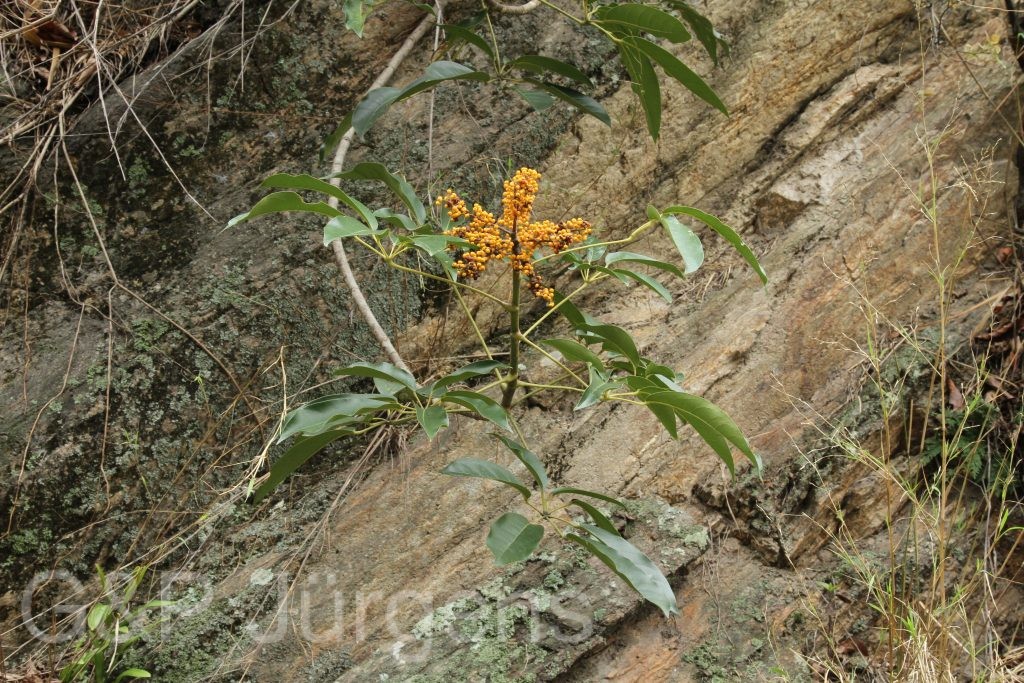
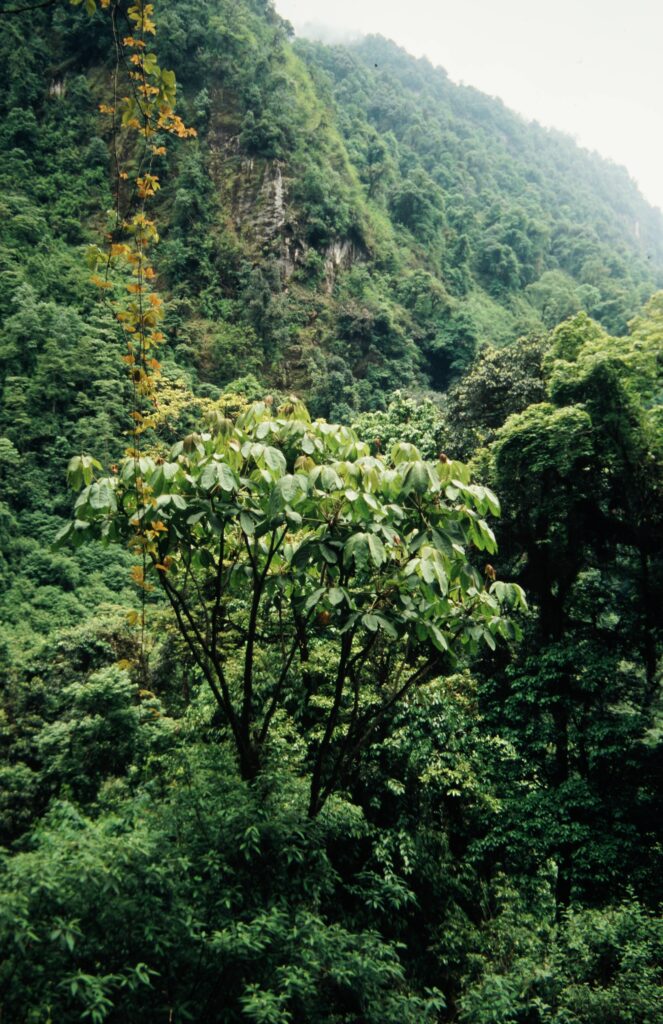
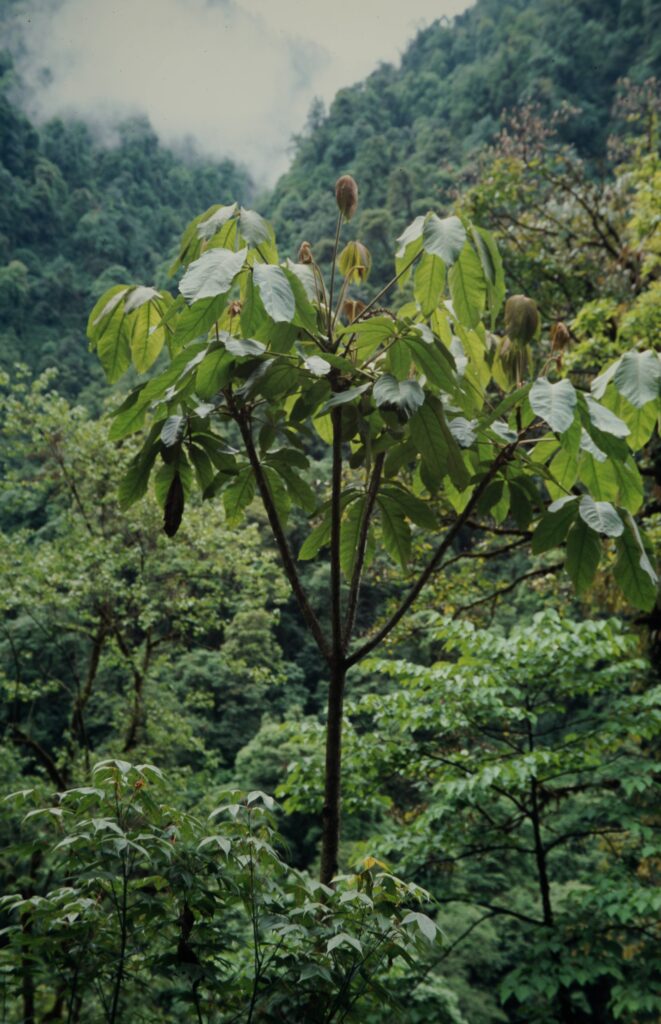
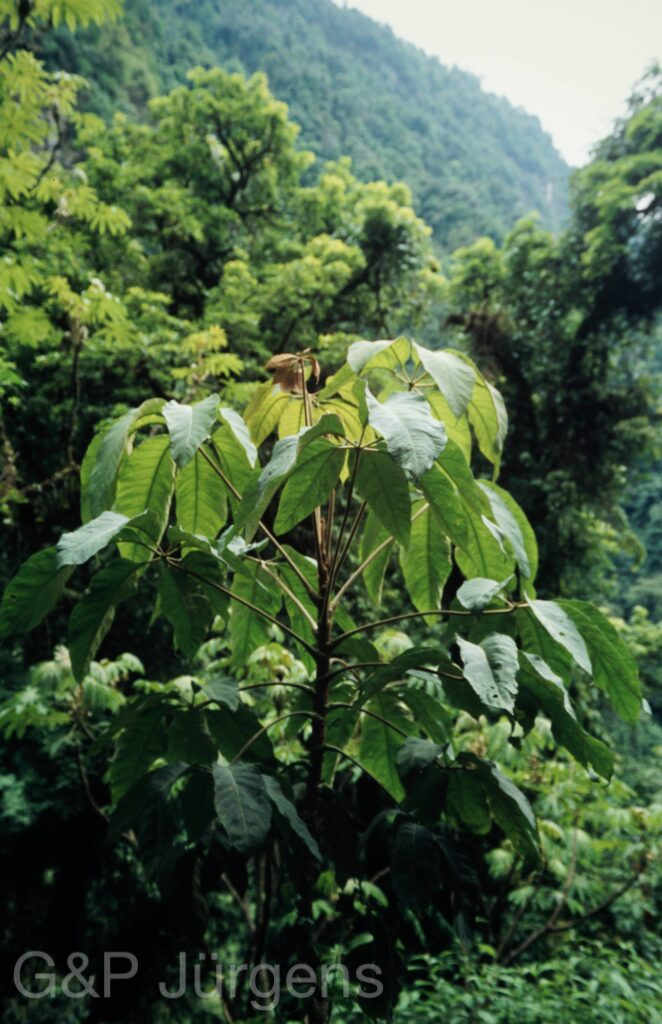
Heptapleurum digitatum is an Indo-Himalayan and Indo-Malesian tree distributed from the eastern Himalaya through northeastern India, Bangladesh, Myanmar and Thailand into the Malesian region, with GBIF recording around 116 occurrences across India, Bhutan, Nepal, Bangladesh, Myanmar, Thailand, Indonesia and Malaysia. It is a plant of warm subtropical to lower montane broadleaf forest, occurring in the foothill belt; the illustrated material comes from Trashigang in eastern Bhutan at 1350 m, flowering in May. It favours humid, evergreen and semi-evergreen forest, ravine slopes and stream banks, where it grows as an understorey to canopy tree, sometimes epiphytic or hemi-epiphytic when young.

The species is a small to medium-sized evergreen tree with stout, often sparsely branched stems bearing conspicuous leaf scars. The leaves are large, alternate, long-petiolate and digitately (palmately) compound, with several to many oblong-elliptic, entire, glabrous, coriaceous leaflets radiating from the petiole apex, the whole giving the characteristic umbrella-plant silhouette of the genus. The numerous small flowers are five-merous, with minute petals and an inferior ovary, arranged in umbellules grouped into large, much-branched terminal panicles. The fruit is a small, subglobose, slightly ribbed drupe with several pyrenes, attractive to birds.

The combination (G.Don ex Loudon) Lowry & G.M.Plunkett reflects the segregation of the Asian "Schefflera" lineages, this species having long been treated under Schefflera. Heptapleurum sensu stricto is now recognised as a large palaeotropical genus within Araliaceae. Widespread and frequent in suitable forest, the species is not considered threatened, and its bird-dispersed drupes and accessible nectar make it an important resource in subtropical forest food webs.

Author: (G.Don ex Loudon) Lowry & G.M.Plunkett · Sources: POWO (Kew), GBIF, Flora of Bhutan, Flora of China, Flora of British India (Hooker), Lowry & Plunkett revision of Schefflera/Heptapleurum (Araliaceae), Frodin & Govaerts World Checklist of Araliaceae

(Seem.) ined.

Sikkim 2006 310 ergebnis
India West-Bengal, Chaana 1750m, May

Description

Heptapleurum griffithii is an eastern Himalayan araliad documented from Bhutan and adjacent south-western China, the GBIF record being sparse with only about three georeferenced occurrences, reflecting both its restricted range and limited collection. It grows in moist, broad-leaved evergreen and mixed montane forest, often as an epiphyte or hemiepiphyte on tree trunks and mossy rocks, or as a free-standing shrub, in the warm-temperate zone. The plant photographed at Chaana in West Bengal at 1750 m in May occupied this humid mid-elevation forest belt, where high atmospheric moisture and shade favour its establishment.

It is a glabrous shrub or small tree, sometimes epiphytic, with stout greyish branchlets. The leaves are alternate and palmately compound, the long petiole bearing a whorl of several leaflets; the leaflets are elliptic to oblong-lanceolate, leathery, entire, acuminate at the apex and cuneate at the base, with prominent lateral venation and a sheathing petiole base. The inflorescence is a large terminal panicle of umbels; the small flowers are greenish to creamy, with five petals, five stamens and an inferior ovary crowned by a low stylar disc. The fruit is a small subglobose drupe, ribbed when dry and containing several pyrenes.

GBIF lists the name as a synonym while retaining Heptapleurum griffithii as accepted; the species was long placed in Schefflera, and the recircumscription of that polyphyletic genus has returned many Asian species to Heptapleurum. As a forest-canopy and epiphytic component it contributes to structural diversity, its fleshy drupes dispersed by birds. Given its narrow documented range, intact mid-montane forest is important to its persistence.

Author: (Seem.) ined. · Sources: POWO (Kew), GBIF, Flora of China Vol. 13, Flora of Bhutan Vol. 2, Flora of Nepal, A Generic Revision of Araliaceae (Schefflera and allies)

(Griff.) G.M.Plunkett & Lowry

Sikkim 2006 482 ergebnis
India Sikkim, Ringi Chu 1900m, May
Sikkim 2006 310 ergebnis
India Sikkim, Ringi Chu 1900m, May

Description

Heptapleurum rhododendrifolium is an epiphytic to semi-epiphytic shrub distributed across the eastern Himalayas and into Southeast Asia, with records from Nepal, Sikkim, Bhutan, northeast India, Myanmar, southern China, and extending to Fiji, Papua New Guinea, and Indonesia. GBIF documents 136 occurrences across this broad range. The species inhabits subtropical and warm-temperate evergreen forests at elevations of 1,200–2,500 m, where it typically grows as an epiphyte on mossy tree trunks and branches, or occasionally as a terrestrial shrub on steep, humus-rich banks in areas of persistent cloud immersion and high rainfall.
Heptapleurum rhododendrifolium is an evergreen shrub, 1–4 m tall, with stout, sparsely branched stems. The leaves are digitately compound, clustered near the branch tips, with 5–9 coriaceous leaflets. Leaflets are oblong-elliptic to oblanceolate, 8–20 cm long, glossy dark green above and often pale or ferruginous-tomentose beneath, with entire margins and a prominent midrib — the overall appearance recalling Rhododendron foliage, hence the epithet. Petioles are stout, 10–20 cm long. The inflorescence is a terminal, compound umbel of numerous small, greenish-white flowers, each 3–4 mm across, with 5–7 petals and an equal number of stamens. The ovary is inferior, 5–7-locular. The fruit is a subglobose drupe, 4–6 mm in diameter, ripening to dark purple or black, with persistent style remnants.
This species was long placed in Schefflera sensu lato, but recent molecular phylogenetic studies by Plunkett and Lowry have led to its transfer to the reinstated genus Heptapleurum, which accommodates the Asian and Pacific clade formerly within Schefflera. The photographed specimen from Ringi Chu in Sikkim at 1,900 m represents a typical mid-elevation epiphytic occurrence in one of the wettest valleys of the eastern Himalayas. The species plays an ecological role as a provider of fruit resources for montane bird communities. Its broad distribution from the Himalayas to the Pacific islands reflects an ancient tropical Asian lineage with considerable dispersal capacity.

Author: (Griff.) G.M.Plunkett & Lowry · Sources: POWO (Kew), GBIF, Flora of China Vol. 13, Flora of Bhutan Vol. 2, Plunkett & Lowry (2018) — Phylogenetics of Araliaceae

(Wall. ex DC.) F.T.Pu & M.F.Watson

BhutanPG2011 769 01 01
Bhutan Chele-La, 3900m July

Description

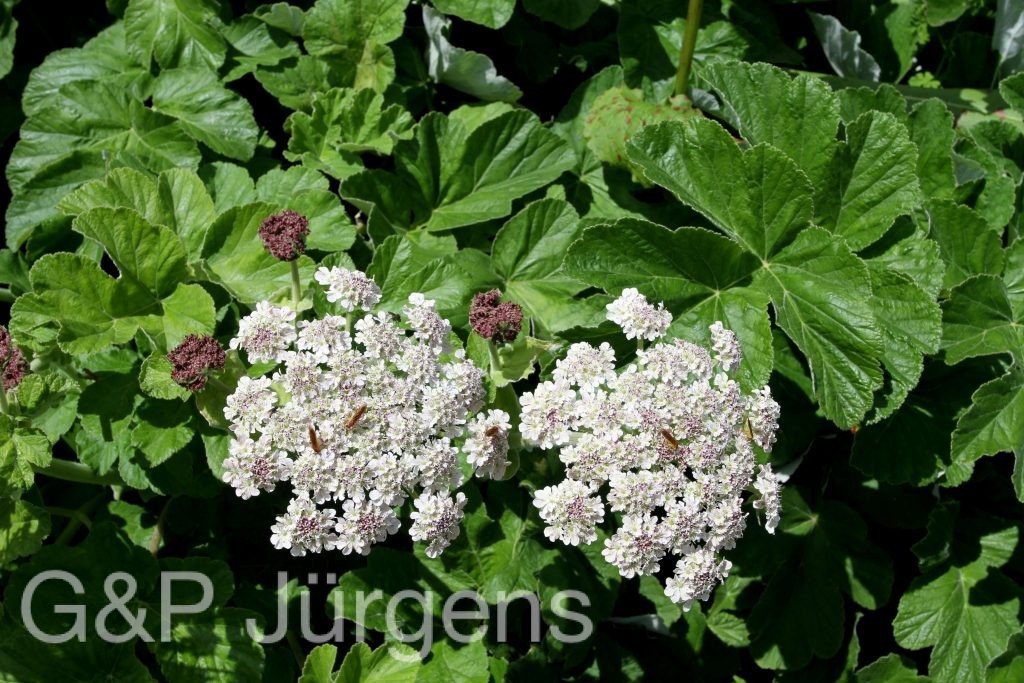
Heracleum candidans var. obtusifolium (Wall. ex DC.) F.T.Pu & M.F.Watson is treated by GBIF as a synonym, with the accepted name being Heracleum candicans obtusifolium. It is a Himalayan umbellifer recorded from China and Nepal, GBIF documenting 44 occurrences, and is a plant of the upper subalpine and alpine zones. It occupies open slopes, meadow flushes, shrubberies and forest clearings, typically between about 3000 and 4200 m. The photographed plant at the Chele-La in western Bhutan, at roughly 3900 m in July, illustrates its association with the moist, high-elevation grasslands of the eastern Himalaya during the summer flowering season.

The plant is a robust, tomentose perennial with a stout rootstock and erect, ridged, hollow stems. The leaves are large and pinnately divided, with broad, lobed segments that are densely white-woolly beneath, the obtuse leaf segments giving the variety its epithet. The inflorescence is a large compound umbel with numerous rays subtended by deciduous bracts; the small flowers are white, with the marginal flowers often radiant and the outer petals enlarged and bilobed. The fruit is a dorsally compressed, broadly winged schizocarp bearing conspicuous oil ducts (vittae), the typical mericarp of the genus.

Heracleum is a taxonomically difficult genus in the Himalaya, with a continuum of closely allied entities; this taxon has been variously ranked as a species, subspecies or variety, and its placement under H. candicans reflects ongoing molecular and morphological reassessment of the group. As with other species of the genus, the foliage and sap contain furanocoumarins that may cause phototoxic dermatitis. The taxon is not regarded as threatened, though it occupies the narrow, climate-sensitive alpine belt of the central and eastern Himalaya.

Author: (Wall. ex DC.) F.T.Pu & M.F.Watson · Sources: POWO (Kew), GBIF, Flora of China, Flora of Bhutan, Flora of Nepal, Pimenov & Leonov genera of Umbelliferae

C.B.Clarke

Nepal 99 285 ergebnis
West-Nepal Kalmura 4000m, June

Description

Heracleum pinnatum, here treated under its accepted name in current databases (it is variously circumscribed and has at times been placed in the segregate genus Tetrataenium, as reflected in the source page), is a robust umbellifer of the western and central Himalaya. GBIF holds about 193 occurrences from India, Pakistan, China and Nepal, indicating a montane-to-alpine distribution along the northwestern arc of the range. It favours open grassy slopes, herb-rich alpine meadows, forest clearings and moist hollows, generally between 3000 and 4300 m. The plant figured from Kalmura in West Nepal at roughly 4000 m in June occupies the upper part of this band, flowering in early summer amid the lush tall-herb communities that develop on deep, moisture-retentive alpine soils.

It is a stout, erect perennial herb arising from a thick taproot, the hollow furrowed stem reaching one to two metres and clothed, as is typical of the genus, in rough or hispid hairs. The leaves are large and pinnately compound with broad, coarsely toothed and often deeply lobed segments. The inflorescence is a large flat-topped compound umbel with numerous rays; the outer flowers frequently have enlarged, radiating, deeply notched petals that give the umbel a showy margin, a trait promoting insect attraction. Flowers are white. The fruit is a dorsally compressed schizocarp (a mericarp pair) with broad lateral wings and conspicuous dark longitudinal oil canals (vittae) on the commissural and dorsal faces, the diagnostic feature underpinning the Tetrataenium concept.

The taxonomy of Himalayan Heracleum is notoriously complex, with the broad-fruited, club-shaped-vitta species often segregated as Tetrataenium by some authors while others retain them within an enlarged Heracleum; molecular work has tended to support a reintegration, hence the accepted placement adopted here. Like its congeners the plant contains furanocoumarins that can cause phytophotodermatitis, and it offers abundant nectar to a wide guild of generalist pollinators. As a wide-ranging montane herb of accessible meadow habitat it is not regarded as threatened.

Author: C.B.Clarke · Sources: POWO (Kew), GBIF, Flora of China Vol. 14, Flora of Pakistan, Flora of Nepal, Mukherjee & Constance Umbelliferae of India

(Lindl.) X.H.Jin, Schuit., Raskoti & Lu Q.Huang

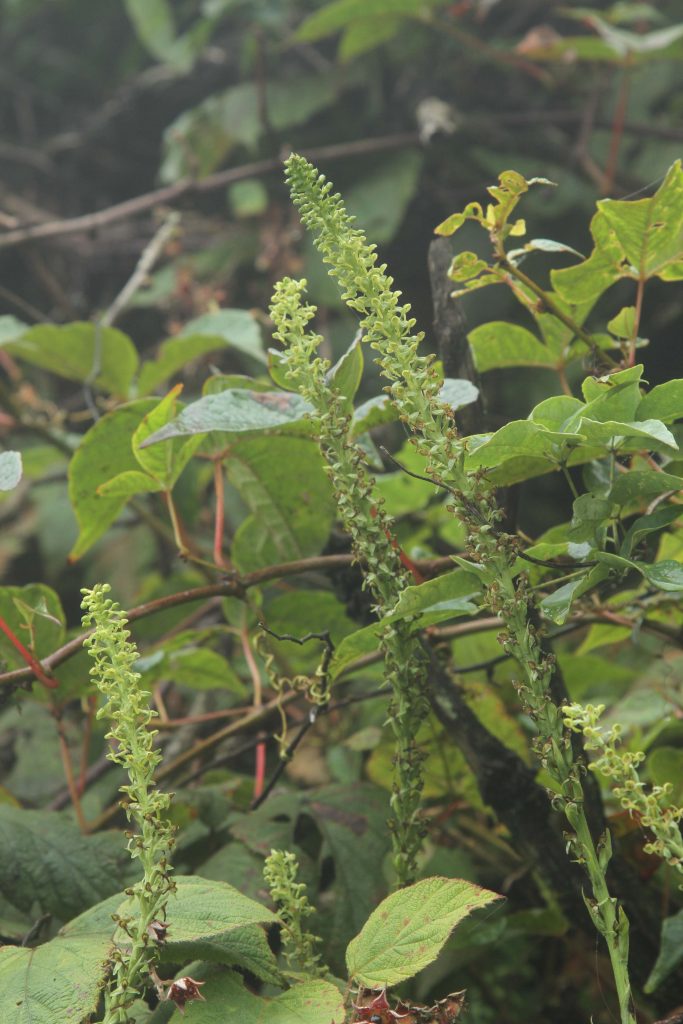
Bhutan2012 839
Bhutan Trontsa 2850m, October

Description

Herminium clavigerum is an alpine terrestrial orchid distributed across the eastern and central Himalaya and adjacent ranges, with documented occurrences in Nepal, China, India, Bhutan and Russia (GBIF logs roughly 220 records). It favours open grassy slopes, moist alpine meadows and the margins of shrubberies, typically between about 2800 and 4000 m. The photographed plant near Trongsa (Trontsa) in central Bhutan at 2850 m, flowering in October, reflects its late-season autumnal anthesis at the lower end of its altitudinal range, where it grows among damp turf in cool, humid montane conditions.

The species is a slender, glabrous geophyte arising from small ovoid or globose tubers. The erect stem bears a few cauline leaves that are narrowly oblong to lanceolate, sheathing at the base and gradually reduced upward into bracts. The inflorescence is a lax to fairly dense terminal raceme of small, greenish to yellowish-green flowers. The lateral sepals are oblong and spreading, the petals narrower; the labellum is the diagnostic organ, deeply three-lobed with elongate, often clavate (club-thickened) lateral lobes, and the spur is short and saccate. The column is short, bearing distinctive clavate caudicles, and the fruit is a small ellipsoid capsule releasing dust-fine seed.

Long placed in the genus Herminium, the species was recombined as Platanthera clavigera by Jin, Schuit., Raskoti & Lu Q.Huang following molecular studies that redefined generic limits within subtribe Orchidinae. Like many Orchidaceae it depends on mycorrhizal associations for germination and is pollinated by small insects. Though not assessed as threatened, its restriction to fragile alpine grassland renders it sensitive to grazing and habitat disturbance.

Author: (Lindl.) X.H.Jin, Schuit., Raskoti & Lu Q.Huang · Sources: POWO (Kew), GBIF, Flora of Bhutan, Flora of China (Orchidaceae), Pridgeon et al. Genera Orchidacearum