
(Seem.) ined.

Description
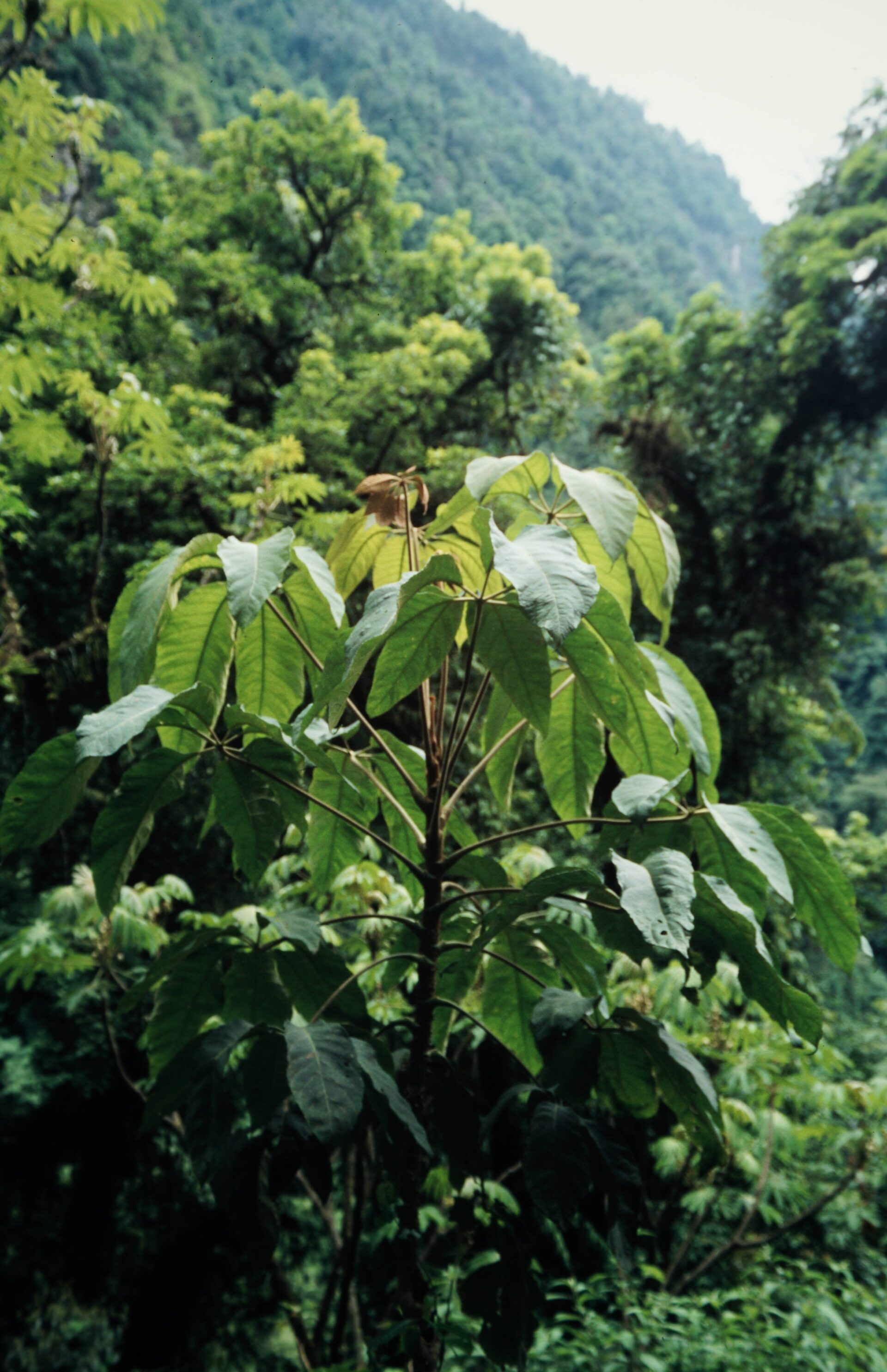
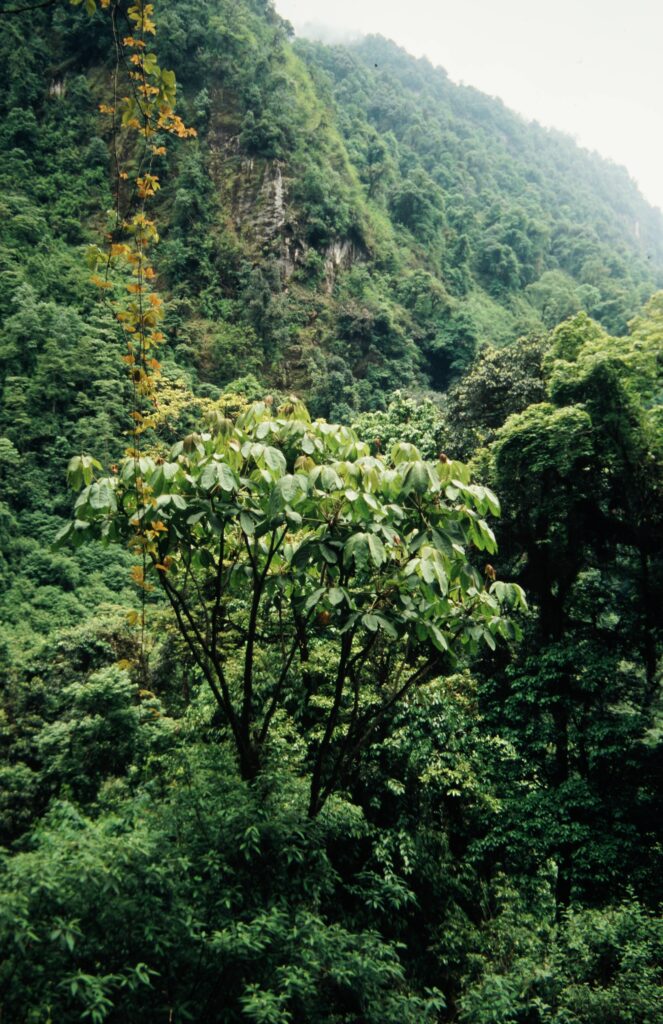
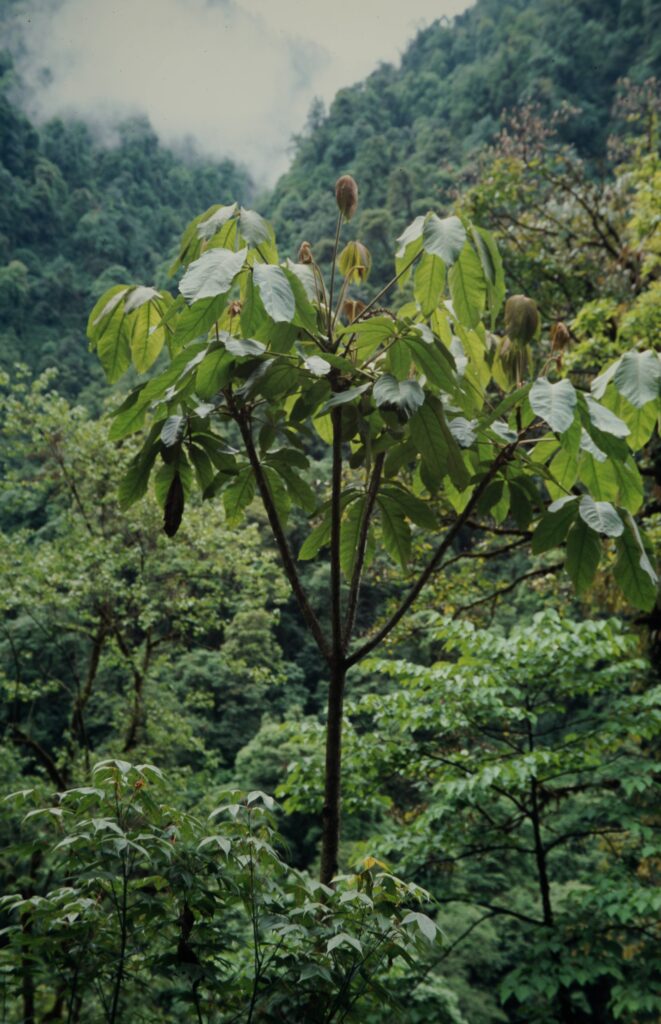
Heptapleurum griffithii is an eastern Himalayan araliad documented from Bhutan and adjacent south-western China, the GBIF record being sparse with only about three georeferenced occurrences, reflecting both its restricted range and limited collection. It grows in moist, broad-leaved evergreen and mixed montane forest, often as an epiphyte or hemiepiphyte on tree trunks and mossy rocks, or as a free-standing shrub, in the warm-temperate zone. The plant photographed at Chaana in West Bengal at 1750 m in May occupied this humid mid-elevation forest belt, where high atmospheric moisture and shade favour its establishment.
It is a glabrous shrub or small tree, sometimes epiphytic, with stout greyish branchlets. The leaves are alternate and palmately compound, the long petiole bearing a whorl of several leaflets; the leaflets are elliptic to oblong-lanceolate, leathery, entire, acuminate at the apex and cuneate at the base, with prominent lateral venation and a sheathing petiole base. The inflorescence is a large terminal panicle of umbels; the small flowers are greenish to creamy, with five petals, five stamens and an inferior ovary crowned by a low stylar disc. The fruit is a small subglobose drupe, ribbed when dry and containing several pyrenes.
GBIF lists the name as a synonym while retaining Heptapleurum griffithii as accepted; the species was long placed in Schefflera, and the recircumscription of that polyphyletic genus has returned many Asian species to Heptapleurum. As a forest-canopy and epiphytic component it contributes to structural diversity, its fleshy drupes dispersed by birds. Given its narrow documented range, intact mid-montane forest is important to its persistence.
Author: (Seem.) ined. · Sources: POWO (Kew), GBIF, Flora of China Vol. 13, Flora of Bhutan Vol. 2, Flora of Nepal, A Generic Revision of Araliaceae (Schefflera and allies)