
(Roxb. ex Lindl.) Vis.
Description
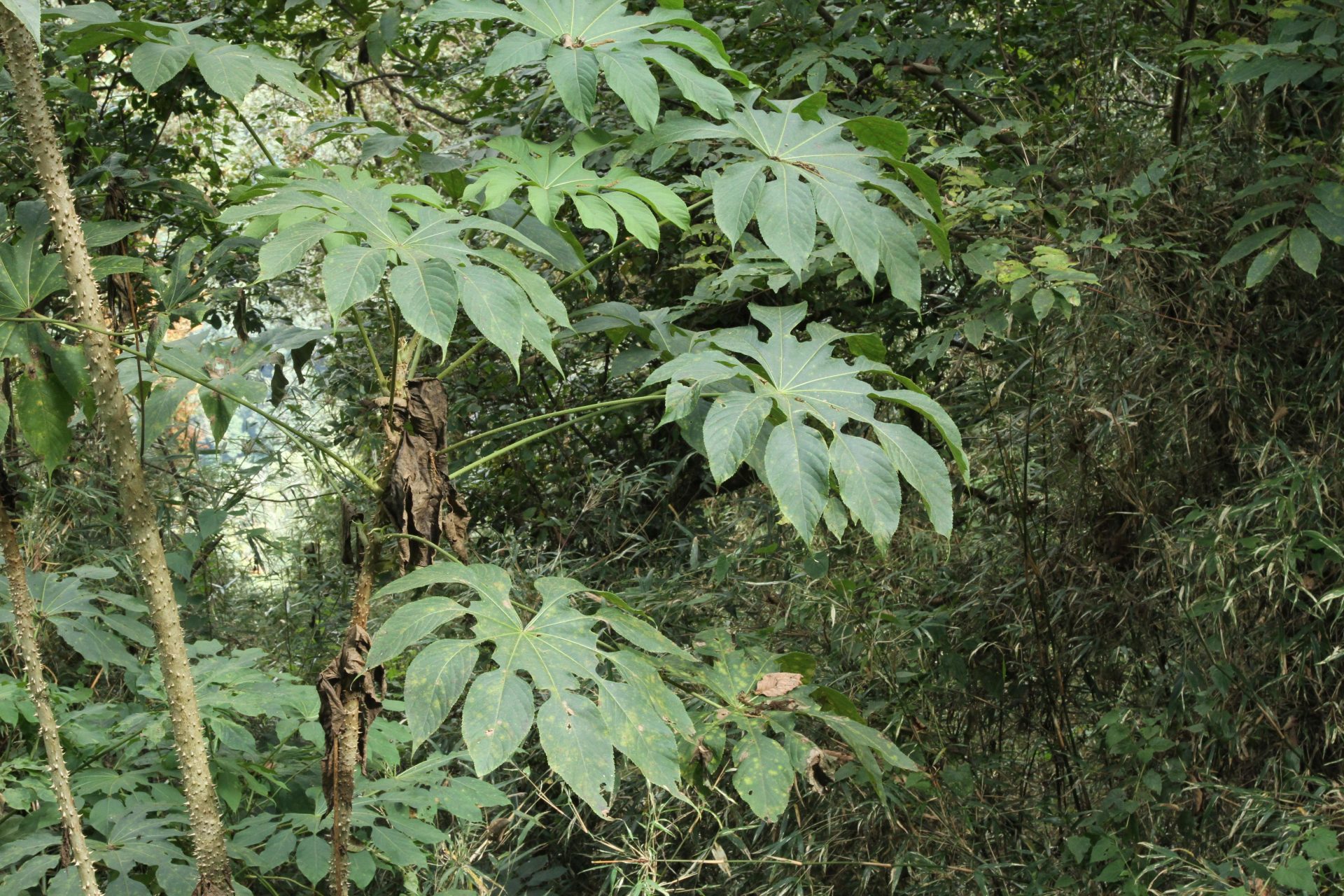
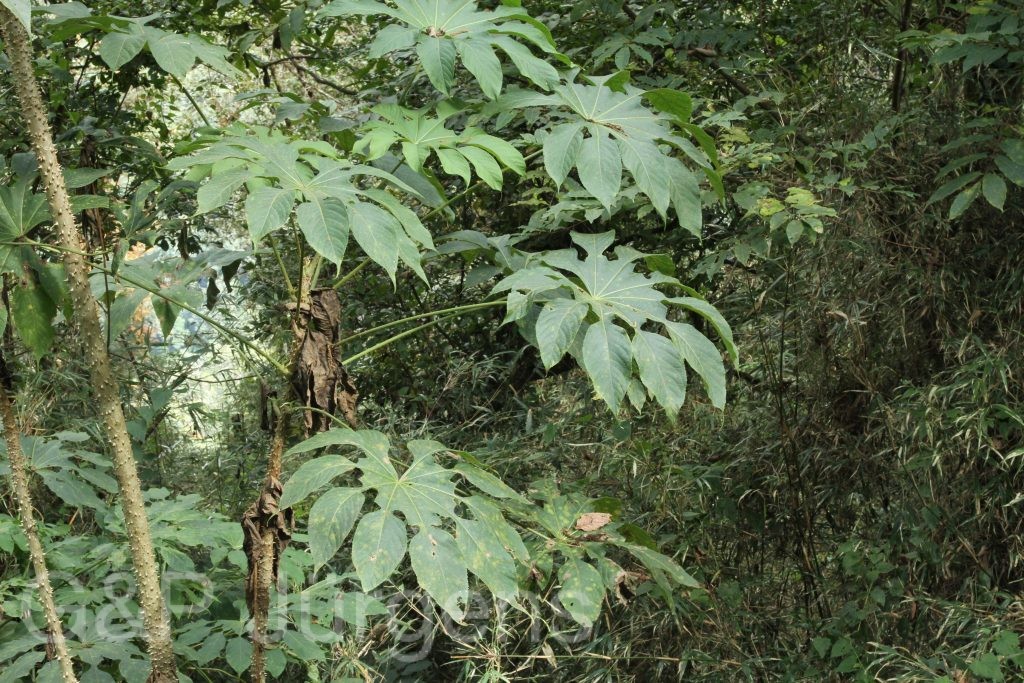
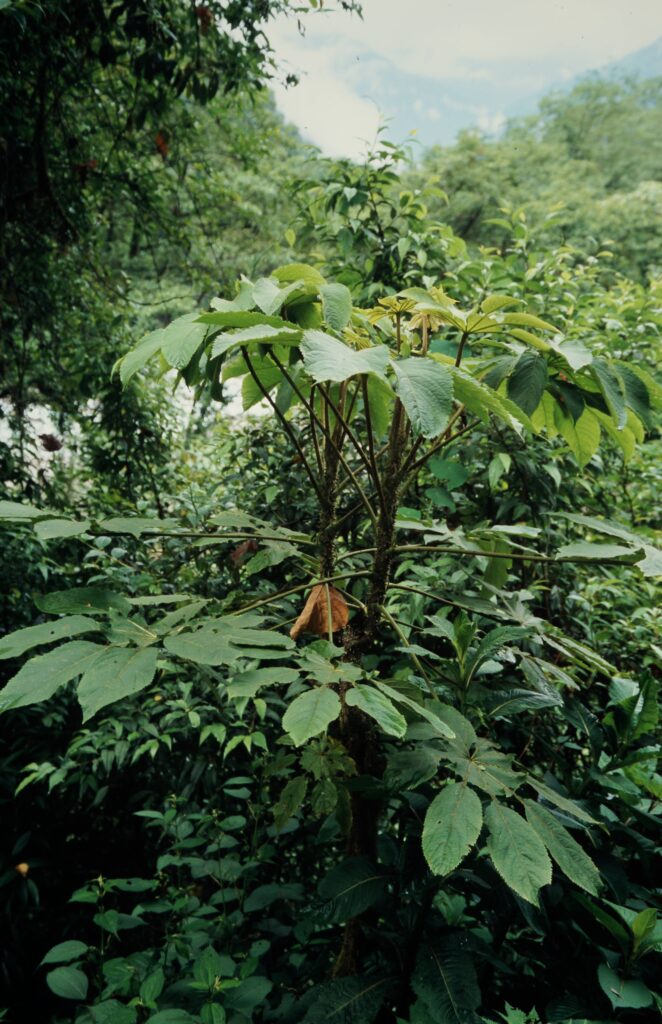
Trevesia palmata, the snowflake tree, is a tropical and subtropical Asian aralioid ranging from the Himalaya of Nepal, India and Bhutan through Bangladesh, Myanmar, Thailand, Laos, Cambodia, Vietnam, southern China and into Malaysia, with more than 700 GBIF occurrences including many from cultivation in botanic gardens worldwide. It grows in warm, humid broadleaved forest, in ravines, along streams, on shaded slopes and in clearings on moist, fertile soils. The localities illustrated, the Mo Chu valley in Bhutan at about 1900 m in October and Chaana in West Bengal at 1750 m in May, are typical of its lower-montane belt of roughly 500-2000 m in the eastern Himalaya.
It is a small, sparsely branched evergreen tree or treelet, often prickly on the trunk and petioles, with a stout pithy stem. The very large leaves are palmately lobed and again deeply incised, so that each is divided almost to the centre into spreading, toothed segments arranged like a snowflake, borne on long prickly petioles and clustered toward the stem apex. The numerous small flowers are creamy to greenish-white and grouped in dense globose umbels arranged along a large, branched terminal panicle. Each flower has a fleshy disc and an inferior ovary of several carpels, and the fruit is a small, somewhat ribbed, fleshy drupe containing several seeds.
Trevesia is a small genus of the ivy family centred on tropical Asia, and T. palmata is its most familiar and widespread species. The dramatically dissected juvenile foliage makes it a popular ornamental and conservatory plant, which explains the many cultivated records far outside its native range. In its forest habitat it is an understorey to mid-canopy element pollinated by insects, and its fruits are dispersed by birds and other animals.
Author: (Roxb. ex Lindl.) Vis. · Sources: POWO (Kew), GBIF, Flora of China, Flora of Bhutan, Frodin & Govaerts World Checklist of Araliaceae, Hooker Flora of British India